Global HER2 Inhibiteurs de la kinase de la tyrosine Segmentation du marché des médicaments, par type (Lapatinib, Neratinib, Tucatinib, Pyrottinib, Afatinib, etc.), Indication (cancer du sein, cancer gastrique, cancer de la jonction gastro-oesophagien, etc.) - Tendances de l'industrie et prévisions jusqu'en 2033
Qu'est-ce que l'inhibiteur HER2 de la kinase
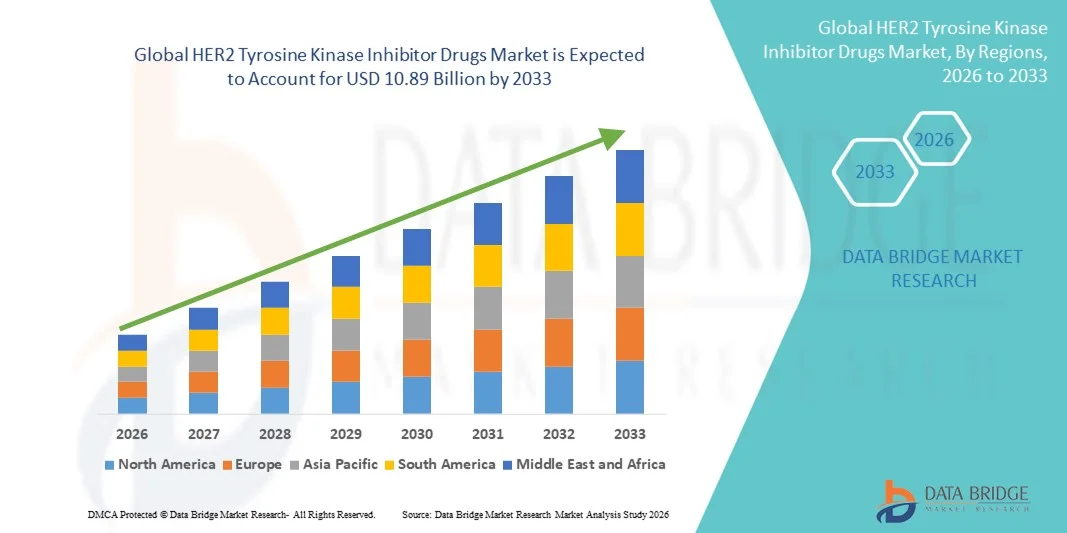
- D'après l'analyse de marché de Data Bridge, la taille du marché mondial des médicaments inhibiteurs de la tyrosine kinase HER2 a été évaluée à4,37 milliards de dollars en 2025et devrait atteindre10,89 milliards de dollars en 2033, à unTCAC de 12,10 %pendant la période de prévision
- La croissance du marché est largement alimentée par l'augmentation de la prévalence des cancers HER2 positifs, l'adoption croissante de thérapies ciblées et les progrès continus dans le développement de médicaments en oncologie
- En outre, la sensibilisation croissante au traitement personnalisé du cancer, l'expansion de l'infrastructure de soins de santé et le nombre croissant d'essais cliniques pour les thérapies ciblées par HER2 accélèrent l'adoption de solutions HER2 pour les inhibiteurs de la kinase, ce qui stimule considérablement la croissance de l'industrie
Taille du marché et prévisions
- Valeur marchande mondiale (2025):4,37 milliards de dollars
- Valeur marchande prévue (2033) :10,89 milliards USD
- Prévisions CAGR (2026-2033):12.10%
Quels sont les principaux avantages du marché des médicaments inhibiteurs de la tyrosine HER2 Kinase
- HER2 Inhibiteurs de la kinase de la Tyrosine Les médicaments, qui offrent un traitement ciblé contre les cancers HER2 positifs, sont des composantes de plus en plus vitales des traitements d'oncologie modernes en raison de leur efficacité accrue, de leurs effets secondaires réduits et de leur capacité à améliorer les taux de survie des patients.
- La demande croissante de médicaments inhibiteurs de la HER2-Kinase est principalement alimentée par la prévalence croissante des cancers positifs de HER2, l'adoption accrue de thérapies oncologiques de précision et la sensibilisation aux options de diagnostic et de traitement précoces
- L'Amérique du Nord a dominé le marché des médicaments inhibiteurs de la HER2-Tyrosine-Kinase avec la plus grande part de revenus de 40,8 % en 2025, caractérisée par une infrastructure en oncologie avancée, une forte adoption de thérapies ciblées et la présence de grandes sociétés pharmaceutiques, les États-Unis ayant connu une forte croissance grâce à une forte sensibilisation des patients, des essais cliniques robustes et une innovation continue dans les thérapies ciblées par HER2.
- L'Asie-Pacifique devrait être la région qui connaîtra la croissance la plus rapide sur le marché des médicaments inhibiteurs de la tyrosine HER2 au cours de la période de prévision, enregistrant un TCAC de 11,2 %, en raison de l'augmentation des investissements dans la médecine de précision, des politiques de soutien en matière de soins de santé et de l'adoption croissante de traitements contre le cancer ciblés dans les pays.
- Le cancer du sein a dominé le marché, atteignant la plus grande part des revenus d'environ 61,2 % en 2025, en raison de la forte prévalence du cancer du sein HER2 positif dans le monde, de directives de traitement bien établies recommandant un traitement ciblé HER2 et de l'adoption clinique généralisée d'ICT de première génération et de prochaine génération.
Portée du rapport et segmentation du marché des inhibiteurs de la HER2
|
Attributs |
HER2 Médicaments inhibiteurs de la kinase de la Tyrosine |
|
Segments couverts |
|
|
Pays couverts |
Amérique du Nord
Europe
Asie-Pacifique
Moyen-Orient et Afrique
Amérique du Sud
|
|
Principaux acteurs du marché |
|
|
Possibilités de marché |
|
|
Infos sur la valeur ajoutée |
En plus des renseignements sur les scénarios de marché comme la valeur marchande, le taux de croissance, la segmentation, la couverture géographique et les principaux intervenants, les rapports de marché établis par Data Bridge Market Research comprennent également une analyse approfondie des experts, l'épidémiologie des patients, l'analyse des pipelines, l'analyse des prix et le cadre réglementaire. |
Quelle est la tendance clé du marché des médicaments inhibiteurs de la HER2-Kinase
L'adoption croissante de thérapies contre le cancer ciblées
- Une tendance significative et accélérée sur le marché mondial des médicaments inhibiteurs de la HER2 est la préférence croissante pour des thérapies ciblées pour les cancers positifs de HER2, y compris les cancers du sein, du gastrique et du poumon
- Cette tendance est alimentée par la reconnaissance croissante de la médecine personnalisée et les avantages des thérapies qui ciblent sélectivement les cellules tumorales surexpressées HER2 tout en minimisant les dommages aux tissus sains
- Les fournisseurs de soins de santé intègrent de plus en plus HER2 TKI dans les protocoles de traitement standard, soit en monothérapie, soit en association avec d'autres agents ciblés par HER2, pour améliorer les résultats des patients et réduire les taux de récidive.
- Par exemple, en mai 2023, Seagen Inc. a reçu l'approbation de la FDA pour le tucatinib en association pour le cancer du sein métastatique HER2-positif, mettant en évidence la poussée vers l'oncologie de précision et l'expansion des options cliniques pour les patients
- En outre, la sensibilisation accrue des patients aux ITK oraux et aux avantages des traitements ambulatoires contribue à l'adoption de thérapies ciblées par HER2, ce qui stimule la demande sur les marchés développés et émergents.
HER2 Dynamique du marché des inhibiteurs de la kinase de la Tyrosine
Chauffeur
Développement de la recherche clinique et de l'infrastructure de soins de santé
- La prévalence croissante des cancers HER2 positifs dans le monde, associée à l'augmentation des dépenses de soins de santé, est l'un des principaux moteurs de la croissance du marché des TKI HER2
- Les hôpitaux et les centres d'oncologie élargissent les capacités de tests moléculaires pour identifier la surexpression de HER2, facilitant ainsi une intervention précoce avec des thérapies ciblées
- Par exemple, en février 2024, Novartis a lancé un essai clinique mondial de phase III pour le neratinib dans le cancer du sein HER2-positif au stade précoce, soulignant que le marché met l'accent sur la recherche et l'innovation pour améliorer les résultats cliniques
- La présence d'infrastructures de soins de santé bien établies, de capacités diagnostiques avancées et de cadres de remboursement solides dans des pays comme les États-Unis, l'Allemagne et le Japon favorise l'adoption plus large de ces thérapies.
- En outre, l'intensification de la collaboration entre les entreprises pharmaceutiques et les établissements de recherche universitaires favorise le développement d'ICT de prochaine génération avec de meilleurs profils de sécurité et efficacité, ce qui favorise la croissance du marché.
Restriction/Défi
Coûts de traitement élevés et effets néfastes
- Malgré l'adoption croissante des ICT HER2, les coûts de traitement élevés demeurent un obstacle important, en particulier dans les régions en développement où le financement des soins de santé est limité. Le coût des inhibiteurs de la marque HER2, souvent couplés à des exigences de thérapie combinée, peut limiter l'accès des patients et entraver la pénétration du marché.
- Par exemple, en juillet 2022, des rapports ont souligné que les patients des pays à faible revenu et à revenu intermédiaire avaient un accès limité à la trastuzumab-emtansine (T-DM1) en raison de prix élevés et de politiques de remboursement inadéquates.
- De plus, les effets indésirables associés à HER2 TKI, y compris la cardiotoxicité, la diarrhée et l'hépatotoxicité, posent des difficultés à l'adhésion au traitement et à la rétention du patient dans les traitements. Ces effets indésirables peuvent nécessiter des ajustements posologiques ou un arrêt du traitement, une incidence sur l'efficacité globale et la croissance du marché.
- Relever ces défis au moyen de programmes de soutien aux patients, de formulations améliorées avec une toxicité réduite et d'initiatives d'accès accrue sera crucial pour maintenir l'expansion du marché et assurer une adoption plus large des patients
Comment le marché des médicaments inhibiteurs de la HER2-Kinase est-il segmenté
Le marché est segmenté en fonction du type et de l'indication.
- Par type
Sur la base du type, le marché des médicaments inhibiteurs de la tyrosine HER2 est segmenté en Lapatinib, Neratinib, Tucatinib, Pyrotinib, Afatinib et autres. Le Lapatinib a dominé le marché avec la plus grande part des revenus d'environ 38,5 % en 2025, principalement en raison de son efficacité clinique établie dans le cancer du sein HER2 positif, de sa présence de longue date dans les protocoles de traitement et de sa grande disponibilité sur les marchés développés et émergents. Son association avec la capécitabine et la grande familiarité du médecin renforcent encore son adoption. Le solide soutien aux brevets, la couverture de remboursement dans des marchés clés comme les États-Unis et l'Europe, et les preuves cliniques solides soutenant la survie sans progression (PFS) et la survie globale (OS) chez les patients HER2-positifs avancés font de Lapatinib une pierre angulaire du segment.
On s'attend à ce que le segment de Tucatinib soit témoin du TCAC le plus rapide de 20,8 % entre 2026 et 2033, en raison de sa grande sélectivité pour les récepteurs HER2, d'une toxicité non ciblée plus faible et d'un profil de sécurité favorable par rapport aux inhibiteurs de première génération. L'approbation de Tucatinib en association avec le trastuzumab et la capécitabine pour le cancer du sein métastatique avancé a alimenté l'adoption, tandis que les essais cliniques en cours étendant ses indications aux cancers de jonction gastrique et gastro-oesophagienne HER2 positifs devraient accélérer la croissance du marché. La sensibilisation accrue aux thérapies personnalisées ciblées par HER2, à la croissance des populations de patients et à l'élargissement de l'accessibilité dans les marchés émergents sont des facteurs supplémentaires qui contribuent à l'adoption rapide de Tucatinib.
- Par indication
Sur la base de l'indication, le marché des médicaments inhibiteurs de la HER2-Kinase est segmenté en cancer du sein, cancer gastrique, cancer gastrique et autres. Le cancer du sein a dominé le marché, atteignant la plus grande part des revenus d'environ 61,2 % en 2025, en raison de la prévalence élevée du cancer du sein HER2 positif dans le monde, de directives de traitement bien établies recommandant un traitement ciblé HER2 et de l'adoption clinique généralisée d'ICT de première génération et de prochaine génération. Une forte sensibilisation des patients, des tests HER2 de routine et la disponibilité de thérapies combinées soutiennent davantage la domination dans ce segment. Les marchés développés comme les États-Unis et l'Europe sont à l'origine de la majorité des ventes, tandis que les marchés émergents sont de plus en plus pris en compte en raison de l'expansion des infrastructures de soins de santé et de l'amélioration des politiques de remboursement.
Le segment du cancer gastrique devrait connaître le TCAC le plus rapide de 19,5 % entre 2026 et 2033, alimenté par l'augmentation de l'incidence des cancers des jonctions gastriques et gastro-oesophagiennes HER2, l'approbation des ICT comme Tucatinib et Pyrotinib pour ces indications et l'accent croissant mis sur des approches de traitement personnalisées. L'urbanisation rapide, l'amélioration du diagnostic du cancer et l'adoption croissante de thérapies ciblées en Asie-Pacifique, en particulier en Chine et au Japon, sont des facteurs de croissance majeurs. Les essais cliniques démontrant l'efficacité en association avec la chimiothérapie et les anticorps monoclonaux encouragent également les fournisseurs de soins de santé à étendre l'utilisation des ICT HER2 dans les tumeurs malignes non cérébrales.
Quelle région détient la plus grande part du marché des médicaments inhibiteurs de la HER2-Kinase
- Amérique du Norda dominé le marché des médicaments inhibiteurs de la HER2-Kinase avec la plus grande part des revenus d'environ 40,8 % en 2025
- Caractérisée par une infrastructure d'oncologie avancée, une forte adoption de thérapies ciblées et la présence de grandes entreprises pharmaceutiques
- Le solide écosystème de soins de santé, les réseaux bien établis d'essais cliniques et la sensibilisation accrue des patients aux cancers HER2 positifs ont contribué de façon significative à la croissance du marché dans la région.
US HER2 Inhibiteur de la tyrosine Kinase Médicaments Aperçu du marché
Le marché américain des médicaments inhibiteurs de la tyrosine HER2 a attiré la majorité des recettes de l'Amérique du Nord en 2025, grâce à une forte sensibilisation des patients, des essais cliniques robustes et une innovation continue dans les thérapies ciblées par HER2. Une vaste recherche en oncologie, des approbations réglementaires précoces et l'accès à des diagnostics avancés ont accéléré l'adoption. La présence de grandes sociétés pharmaceutiques, ainsi que des initiatives gouvernementales appuyant les cadres de traitement et de remboursement du cancer, renforce encore la position du marché.
Canada HER2 Inhibiteurs de la tyrosine Kinase Médicaments Aperçu du marché
Canada HER2 Inhibiteur de la kinase de la tyrosine Le marché des médicaments connaît une croissance constante, soutenue par une sensibilisation accrue aux traitements ciblés contre le cancer, l'expansion de l'infrastructure en oncologie et un solide soutien gouvernemental à la médecine de précision. Les collaborations entre les entreprises pharmaceutiques, les hôpitaux et les établissements de recherche favorisent l'innovation et accroissent l'accès aux thérapies ciblées par HER2 partout au pays.
Europe HER2 Inhibiteur de la kinase de la Tyrosine
Le marché des médicaments inhibiteurs de la tyrosine HER2 devrait s'étendre à un important TCAC, alimenté par des systèmes de santé avancés, des investissements croissants dans la recherche en oncologie et l'adoption croissante de médicaments personnalisés. Des politiques gouvernementales rigoureuses pour la détection précoce des maladies et la prévalence croissante des cas de cancer propulsent davantage la demande du marché.
U.K. HER2 Inhibiteur de la tyrosine Kinase Médicaments Aperçu du marché
Le marché des médicaments inhibiteurs de la tyrosine-kinase du Royaume-Uni HER2 a dominé l'Europe avec la plus grande part des revenus d'environ 39,4 % en 2025, soutenu par des entreprises pharmaceutiques de premier plan, l'adoption de technologies de diagnostic et de traitement de prochaine génération et des programmes gouvernementaux favorisant la détection précoce du cancer. Le réseau de recherche clinique bien établi et la sensibilisation croissante des patients aux cancers HER2 positifs ont accru la pénétration du marché dans les zones urbaines et rurales.
Allemagne HER2 Inhibiteurs de la kinase de la Tyrosine
Allemagne HER2 Inhibiteur de la kinase de la Tyrosine Le marché des médicaments devrait être le pays en croissance la plus rapide d'Europe, enregistrant un TCAC d'environ 13,5% au cours de la période de prévision. La croissance du marché s'explique par l'augmentation des investissements dans le diagnostic des soins de santé, l'expansion des laboratoires et des hôpitaux, la sensibilisation accrue à la médecine de précision et les cadres réglementaires favorables aux thérapies ciblées par HER2. L'Allemagne met l'accent sur l'innovation, associée à sa solide infrastructure de soins de santé, facilite l'adoption de traitements d'oncologie avancés.
Asie-Pacifique HER2 Inhibiteur de la tyrosine Kinase Médicaments Aperçu du marché
Le marché des médicaments inhibiteurs de la HER2 de la HER2 de la HER2 de la HER2 de la HER2 de la kinase est sur le point de croître au rythme le plus rapide du TCAC de 11,2% au cours de la période de prévision, en raison de l'augmentation des investissements dans la médecine de précision, des politiques de soutien en matière de soins de santé et de l'adoption croissante de traitements contre le cancer ciblés. Les initiatives gouvernementales croissantes, l'expansion des réseaux hospitaliers et l'amélioration des infrastructures de soins de santé dans toute la région créent un environnement favorable à la croissance du marché.
Chine HER2 Inhibiteurs de la kinase de la Tyrosine
Chine HER2 Inhibiteur de la kinase de la tyrosine Le marché des médicaments a représenté la plus grande part des revenus de l'APAC en 2025, alimentée par l'expansion de l'infrastructure oncologique, l'augmentation des activités de recherche clinique et la collaboration entre les entreprises pharmaceutiques nationales et internationales. L'urbanisation rapide, la prise de conscience croissante des cancers HER2 positifs et l'appui solide du gouvernement aux thérapies anticancéreuses avancées sont des facteurs clés de la croissance.
Japon HER2 Inhibiteurs de la kinase de la Tyrosine
Japon HER2 Inhibiteur de la kinase de la Tyrosine Le marché des médicaments connaît une forte dynamique du marché en raison de la forte sensibilisation des patients, de l'adoption rapide de thérapies de prochaine génération ciblées sur HER2 et de systèmes de santé bien établis. Le pays met l'accent sur l'oncologie de précision, le vieillissement de la population et les capacités de diagnostic avancées stimulent encore la demande pour ces thérapies.
Quelles sont les meilleures entreprises du marché des médicaments inhibiteurs de la tyrosine HER2
L'industrie des médicaments inhibiteurs de la HER2-Kinase est principalement dirigée par des entreprises bien établies, notamment :
- Roche (Suisse)
- Novartis (Suisse)
- Pfizer (États-Unis)
- AstraZeneca (Royaume-Uni)
- Daiichi Sankyo (Japon)
- Boehringer Ingelheim (Allemagne)
- Amgen (États-Unis)
- Eli Lilly and Company (États-Unis)
- Samsung Bioepis (Corée du Sud)
- Zai Lab (Chine)
- AbbVie (États-Unis)
- Takeda Pharmaceutical (Japon)
- Solutions Bio-Thera (Chine)
- Shanghai Henlius Biotech (Chine)
- BeiGene (Chine)
- Biocon Biologics (Inde)
- Innovent Biologics (Chine)
- Hanmi Pharmaceutical (Corée du Sud)
- Épizyme (États-Unis)
Quelles sont les dernières évolutions du marché des médicaments inhibiteurs de la tyrosine HER2
- En mars 2025, la Food and Drug Administration (FDA) des États-Unis a accordé à Nerlynx (neratinib) la désignation d'orphelins pour le traitement des patients atteints de métastases cérébrales atteints d'un cancer du sein HER2-positif, mettant en évidence l'importance clinique accrue accordée aux besoins non satisfaits dans des situations de maladie avancée. Le Neratinib est déjà approuvé pour un traitement adjuvant prolongé au début du cancer du sein HER2-positif et est évalué en association pour améliorer encore les résultats chez les patients atteints d'une maladie métastatique, reflétant son rôle clinique en évolution dans l'inhibition ciblée de HER2
- En août 2025, la FDA a accordé une approbation accélérée au zongertinib (commercialisé sous le nom d'Hernexeos), le premier inhibiteur de la tyrosine kinase sélectif HER2 administré par voie orale chez les adultes atteints de cancer du poumon non squameux non résécable ou métastatique à petites cellules (CNCSN) contenant des mutations HER2 TKD activant. Cette approbation, fondée sur les données de l'essai de Beamion LUNG‐1 démontrant de forts taux de réponse objective et des réponses durables, marque une expansion significative de l'utilisation de HER2 TKI au-delà du cancer du sein en sous-types de cancer du poumon difficiles à traiter
- En octobre 2025, Pfizer a annoncé des résultats topline positifs de l'essai de phase 3 HER2CLIMB‐05 de TUKYSA (tucatinib) dans le cadre du traitement d'entretien de première ligne dans le cancer du sein métastatique HER2 positif, montrant une amélioration statistiquement significative de la survie sans progression lorsqu'on l'ajoute aux régimes d'entretien standard. Ces résultats soulignent l'amélioration clinique continue des thérapies HER2 TKI et leur intégration dans des lignes de traitement antérieures pour étendre le contrôle de la maladie aux patients
SKU-
Accédez en ligne au rapport sur le premier cloud mondial de veille économique
- Tableau de bord d'analyse de données interactif
- Tableau de bord d'analyse d'entreprise pour les opportunités à fort potentiel de croissance
- Accès d'analyste de recherche pour la personnalisation et les requêtes
- Analyse de la concurrence avec tableau de bord interactif
- Dernières actualités, mises à jour et analyse des tendances
- Exploitez la puissance de l'analyse comparative pour un suivi complet de la concurrence
Méthodologie de recherche
La collecte de données et l'analyse de l'année de base sont effectuées à l'aide de modules de collecte de données avec des échantillons de grande taille. L'étape consiste à obtenir des informations sur le marché ou des données connexes via diverses sources et stratégies. Elle comprend l'examen et la planification à l'avance de toutes les données acquises dans le passé. Elle englobe également l'examen des incohérences d'informations observées dans différentes sources d'informations. Les données de marché sont analysées et estimées à l'aide de modèles statistiques et cohérents de marché. De plus, l'analyse des parts de marché et l'analyse des tendances clés sont les principaux facteurs de succès du rapport de marché. Pour en savoir plus, veuillez demander un appel d'analyste ou déposer votre demande.
La méthodologie de recherche clé utilisée par l'équipe de recherche DBMR est la triangulation des données qui implique l'exploration de données, l'analyse de l'impact des variables de données sur le marché et la validation primaire (expert du secteur). Les modèles de données incluent la grille de positionnement des fournisseurs, l'analyse de la chronologie du marché, l'aperçu et le guide du marché, la grille de positionnement des entreprises, l'analyse des brevets, l'analyse des prix, l'analyse des parts de marché des entreprises, les normes de mesure, l'analyse globale par rapport à l'analyse régionale et des parts des fournisseurs. Pour en savoir plus sur la méthodologie de recherche, envoyez une demande pour parler à nos experts du secteur.
Personnalisation disponible
Data Bridge Market Research est un leader de la recherche formative avancée. Nous sommes fiers de fournir à nos clients existants et nouveaux des données et des analyses qui correspondent à leurs objectifs. Le rapport peut être personnalisé pour inclure une analyse des tendances des prix des marques cibles, une compréhension du marché pour d'autres pays (demandez la liste des pays), des données sur les résultats des essais cliniques, une revue de la littérature, une analyse du marché des produits remis à neuf et de la base de produits. L'analyse du marché des concurrents cibles peut être analysée à partir d'une analyse basée sur la technologie jusqu'à des stratégies de portefeuille de marché. Nous pouvons ajouter autant de concurrents que vous le souhaitez, dans le format et le style de données que vous recherchez. Notre équipe d'analystes peut également vous fournir des données sous forme de fichiers Excel bruts, de tableaux croisés dynamiques (Fact book) ou peut vous aider à créer des présentations à partir des ensembles de données disponibles dans le rapport.