



Global Herbal Products Market Segmentation, By Product (Moringa, Echinacea, Flaxseeds, Turmeric, Ginger and Ginseng), Formulation (Tablets, Capsules, Liquid, Powder and Granules, Soft Gels and Others), Consumer (Pregnant Women, Adult, Paediatric and Geriatric), Source (Leaves, Fruits and Vegetable, Barks, Roots and Others), Function (Medicinal, Aroma and Others), Application (Pharmaceutical, Personal Care, Food and Beverages and Others), Distribution Channel (Offline Stores and Online Stores)- Industry Trends and Forecast to 2033
Quelle est la taille du marché des produits à base de plantes et le taux de croissance
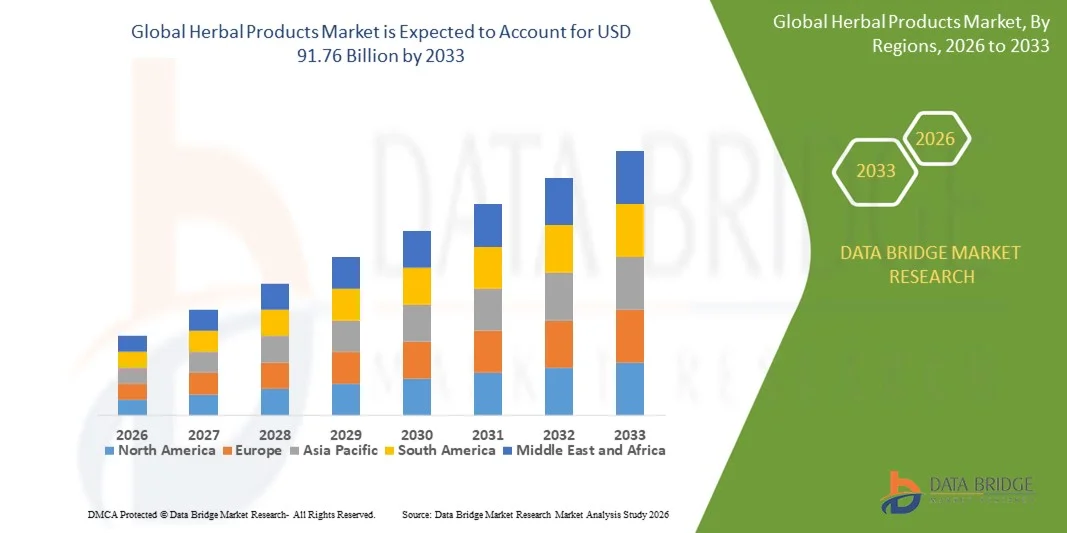
- Selon l'analyse de marché de Data Bridge, la taille du marché mondial des produits à base de plantes a été évaluée à54,01 milliards de dollars en 2025et devrait atteindre91,76 milliards de dollars en 2033, à unTCAC de 6,85%pendant la période de prévision
- La croissance du marché est largement alimentée par la préférence croissante des consommateurs pour les remèdes naturels et à base de plantes, une prise de conscience accrue de la santé et une prise de conscience croissante des avantages des suppléments à base de plantes et des cosmétiques
- L'expansion des produits de soins personnels à base de plantes, des nutraceutiques et des médicaments traditionnels stimule encore la demande du marché
Taille du marché et prévisions
- Valeur marchande mondiale (2025):54,01 milliards de dollars
- Valeur marchande prévue (2033) :91,76 milliards de dollars
- Prévisions CAGR (2026-2033):6.85%
Quels sont les principaux débouchés du marché des produits à base de plantes
- Les consommateurs recherchent de plus en plus des solutions de rechange naturelles et sûres aux drogues synthétiques et aux produits de soins personnels à base de produits chimiques, favorisant l'adoption de produits à base de plantes
- Les innovations continues des produits, la recherche dans les formulations à base de plantes et les cadres réglementaires de soutien encouragent la croissance du marché des produits à base de plantes
- L'Amérique du Nord a dominé le marché mondial des produits à base de plantes en 2025 avec la plus grande part des revenus, soutenue par un fort intérêt des consommateurs pour le bien-être végétal et les suppléments naturels, ainsi que par des circuits de vente au détail et de commerce électronique bien établis qui ont favorisé l'adoption généralisée de formulations et de remèdes à base de plantes.
- La région Asie-Pacifique devrait connaître le taux de croissance le plus élevé du monde.Produits à base de plantesmarché, alimenté par l'augmentation des revenus disponibles, l'accroissement de la population urbaine, la sensibilisation croissante aux soins de santé préventifs et la forte demande de produits naturels et à base de plantes dans des pays comme la Chine et l'Inde
- En 2025, le segment des Turmériques détenait la plus grande part des revenus du marché, en raison de son utilisation intensive dans la médecine traditionnelle, les suppléments alimentaires et les aliments fonctionnels. Le composé bioactif curcumin est très recherché pour ses propriétés antioxydantes et anti-inflammatoires, ce qui en fait un choix populaire parmi les consommateurs soucieux de la santé. La préférence croissante des consommateurs pour les remèdes naturels et les solutions de soins de santé préventifs renforce encore sa position dominante. De plus, les produits à base de curcuma sont de plus en plus intégrés dans les boissons, les collations et les soins de la peau.
Portée du rapport et segmentation du marché des produits à base de plantes
|
Attributs |
Produits à base de plantes Principales perspectives du marché |
|
Segments couverts |
|
|
Pays couverts |
Amérique du Nord
Europe
Asie-Pacifique
Moyen-Orient et Afrique
Amérique du Sud
|
|
Principaux acteurs du marché |
|
|
Possibilités de marché |
|
|
Infos sur la valeur ajoutée |
En plus des renseignements sur les scénarios du marché tels que la valeur du marché, le taux de croissance, la segmentation, la couverture géographique et les principaux intervenants, les rapports de marché établis par Data Bridge Market Research comprennent également une analyse approfondie des experts, une analyse des prix, une analyse des parts de marque, une enquête auprès des consommateurs, une analyse démographique, une analyse de la chaîne d'approvisionnement, une analyse de la chaîne de valeur, une vue d'ensemble des matières premières et des consommables, des critères de sélection des fournisseurs, une analyse PESTLE, une analyse Porter et un cadre réglementaire. |
Quelle est la tendance clé sur le marché des produits à base de plantes
Augmentation de la demande de remèdes naturels et végétaux
- L'accent de plus en plus mis sur les produits naturels, d'origine végétale et peu transformés façonne de façon significative le marché des produits à base de plantes, car les consommateurs préfèrent de plus en plus les remèdes et les solutions de soins personnels qui sont sûrs, sans produits chimiques et écologiques. Les produits à base de plantes gagnent en traction en raison de leur perception des avantages pour la santé, en soutenant l'immunité, le bien-être et les soins holistiques, en renforçant l'adoption dans les segments des nutraceutiques, des soins personnels et de la médecine traditionnelle.
- Une sensibilisation accrue à la santé, au bien-être et aux soins préventifs a accéléré la demande de produits à base de plantes dans les suppléments alimentaires, les boissons fonctionnelles, les soins de la peau et les soins capillaires. Les consommateurs soucieux de la santé et les populations respectueuses de l'environnement recherchent activement des produits formulés avec des ingrédients naturels, ce qui incite les fabricants à mettre l'accent sur la durabilité et la transparence dans l'approvisionnement et la production.
- Les tendances en matière d'étiquetage propre, de sécurité et de durabilité influent sur les décisions d'achat, les fabricants mettant l'accent sur les certifications, l'étiquetage biologique et les pratiques écologiques. Ces facteurs aident les marques à différencier les produits sur un marché concurrentiel et à renforcer la confiance des consommateurs, tout en favorisant l'adoption de certifications naturelles. Les campagnes de marketing renforcent de plus en plus ces avantages pour renforcer le positionnement de la marque et attirer les consommateurs conscients
- Par exemple, en 2024, Himalaya en Inde et Weleda en Allemagne ont élargi leur portefeuille de produits en lançant de nouveaux suppléments à base de plantes et produits de soins personnels. Ces introductions ont répondu à la préférence croissante des consommateurs pour les remèdes naturels et les formulations d'étiquettes propres, avec une distribution par le détail, la spécialité et les canaux en ligne. Les produits ont été commercialisés en tant que produits respectueux de la santé et respectueux de l'environnement, améliorant la fidélité de la marque et les achats répétés
- Bien que la demande de produits à base de plantes augmente, l'expansion soutenue du marché dépend de la recherche-développement continue, de la normalisation et du maintien de l'efficacité comparable aux produits conventionnels. Les fabricants mettent également l'accent sur l'amélioration de l'évolutivité, de la fiabilité de la chaîne d'approvisionnement et sur la mise au point de solutions novatrices qui permettent d'équilibrer les coûts, la qualité et la durabilité pour une adoption plus large.
Dynamique du marché des produits à base de plantes
Chauffeur
Préférence croissante pour les remèdes naturels à base végétale
- L'augmentation de la demande des consommateurs pour des solutions naturelles d'origine végétale est un moteur majeur du marché des produits à base de plantes. Les fabricants remplacent activement les ingrédients synthétiques ou chimiques par des substituts à base de plantes pour répondre à des exigences propres et axées sur le bien-être, améliorer l'attrait des produits et se conformer aux normes réglementaires. Cette tendance pousse également la recherche vers de nouvelles formulations végétales, soutenant la diversification des produits
- L'expansion des applications dans les suppléments alimentaires, les soins personnels, les aliments fonctionnels et la médecine traditionnelle influe sur la croissance du marché. Les produits à base de plantes contribuent à améliorer la santé, le bien-être et la satisfaction globale des consommateurs, ce qui permet aux fabricants de répondre aux attentes en matière d'offre naturelle de haute qualité. L'adoption croissante de soins de santé préventifs et de modes de vie holistiques dans le monde renforce encore cette tendance
- Les fabricants de produits à base de plantes promeuvent activement les formulations à base de plantes par l'innovation de produits, les campagnes de marketing et les certifications. Ces efforts sont appuyés par la préférence croissante des consommateurs pour des produits naturels, sûrs et durables, et ils encouragent la collaboration entre les fournisseurs d'ingrédients et les marques pour améliorer l'efficacité des produits et réduire l'impact environnemental
- Par exemple, en 2023, Dabur en Inde et la Nature de Bounty aux États-Unis ont signalé l'incorporation accrue d'ingrédients à base de plantes dans les suppléments alimentaires et les produits de soins personnels. Cette expansion a fait suite à l'augmentation de la demande des consommateurs pour les produits naturels, végétaux et non OGM, ce qui a entraîné des achats répétés et une différenciation des produits. Les deux entreprises ont mis l'accent sur la durabilité, la traçabilité et l'efficacité dans les campagnes de marketing visant à renforcer la confiance des consommateurs et la loyauté des marques
- Bien que l'augmentation des tendances naturelles et axées sur le bien-être favorise la croissance, l'adoption plus large dépend de l'optimisation des coûts, de la qualité des ingrédients et des processus de production évolutives. L'investissement dans l'efficacité de la chaîne d'approvisionnement, l'approvisionnement durable et la technologie de formulation avancée seront essentiels pour répondre à la demande mondiale et maintenir l'avantage concurrentiel
Restriction/Défi
Coût élevé et sensibilisation limitée par rapport aux produits conventionnels
- Le coût relativement plus élevé des produits à base de plantes par rapport aux produits chimiques classiques demeure un défi majeur, limitant l'adoption chez les consommateurs sensibles aux prix. Les coûts plus élevés des matières premières, les méthodes complexes d'extraction ou de transformation et la disponibilité saisonnière contribuent à l'augmentation des prix
- La sensibilisation des consommateurs et des fabricants demeure inégale, en particulier sur les marchés en développement où la demande de produits naturels ou à base de plantes est toujours en train de se développer. Une compréhension limitée des avantages fonctionnels limite l'adoption dans certaines catégories de produits, et l'adoption de l'innovation est plus lente dans les régions où les initiatives éducatives sur les produits à base de plantes sont minimes.
- Les défis liés à la chaîne d'approvisionnement et à la distribution ont également une incidence sur la croissance du marché, car les produits à base de plantes nécessitent des fournisseurs certifiés et le respect de normes de qualité rigoureuses. La complexité logistique, les limites de durée de conservation et les exigences d'entreposage appropriées augmentent les coûts opérationnels
- Par exemple, en 2024, les distributeurs d'Asie du Sud-Est fournissant des suppléments alimentaires à base de plantes et des marques de soins personnels comme Himalaya et Swisse ont signalé une absorption plus lente en raison de prix plus élevés et d'une connaissance limitée des avantages fonctionnels par rapport aux produits conventionnels. Les exigences de stockage et la conformité à la certification constituaient des obstacles supplémentaires, ce qui a incité certains détaillants à limiter l'espace disponible pour les produits à base de plantes de première qualité.
- Pour surmonter ces défis, il faudra une production rentable, des réseaux de distribution élargis et des initiatives éducatives ciblées pour les fabricants et les consommateurs. La collaboration avec les détaillants, les opérateurs de soins de santé et les organismes de certification peut contribuer à libérer le potentiel de croissance à long terme du marché mondial des produits à base de plantes. L'élaboration de formulations compétitives sur le plan des coûts et le renforcement des stratégies de commercialisation en matière d'efficacité, d'avantages naturels et de durabilité seront essentiels pour une large adoption.
Comment le marché des produits à base de plantes est-il segmenté
Le marché est segmenté en fonction du produit, de la formulation, du consommateur, de la source, de la fonction, de l'application et du canal de distribution.
- Par produit
Sur la base du produit, le marché des produits à base de plantes est segmenté en Moringa, Echinacea, Linseeds, Turmeric, Ginger et Ginseng. En 2025, le segment des Turmériques détenait la plus grande part des revenus du marché, en raison de son utilisation intensive dans la médecine traditionnelle, les suppléments alimentaires et les aliments fonctionnels. Le composé bioactif curcumin est très recherché pour ses propriétés antioxydantes et anti-inflammatoires, ce qui en fait un choix populaire parmi les consommateurs soucieux de la santé. La préférence croissante des consommateurs pour les remèdes naturels et les solutions de soins de santé préventifs renforce encore sa position dominante. De plus, les produits à base de curcuma sont de plus en plus intégrés dans les boissons, les collations et les soins de la peau.
Le segment de Moringa devrait connaître le taux de croissance le plus rapide de 2026 à 2033, en raison de son riche profil nutritionnel, de sa polyvalence dans les applications des aliments et des boissons et de la sensibilisation accrue à ses avantages pour la santé. Les feuilles et la poudre de Moringa sont reconnues pour leur teneur élevée en protéines, vitamines et minéraux, ce qui favorise l'adoption par les consommateurs. La hausse de la demande de suppléments nutritionnels à base de plantes et de poudres de superaliments devrait favoriser la croissance du marché. Les fabricants introduisent des produits Moringa innovants dans des smoothies, des thés et des compléments alimentaires destinés à un public plus large.
- Par formulation
Sur la base de la formulation, le marché est segmenté en comprimés, capsules, liquides, poudres et granules, gels doux, etc. Le segment des capsules détenait la plus grande part de revenus du marché en 2025 en raison de la commodité de la consommation et de l'uniformité de la livraison des doses, attirant un large éventail de consommateurs. Les capsules sont préférées pour leur facilité d'utilisation, la portabilité, et la capacité de masquer des saveurs de plantes fortes. Les consommateurs soucieux de la santé optent de plus en plus pour les capsules dans le cadre des routines quotidiennes de bien-être. De plus, les progrès de la technologie d'encapsulation améliorent la biodisponibilité des extraits de plantes sous cette forme.
Le segment des poudres et des granules devrait croître au rythme le plus rapide en 2026-2033, en raison de l'adoption croissante de boissons, de smoothies et d'ingrédients de cuisson. Les poudres offrent une souplesse de dosage et sont faciles à incorporer dans les aliments et boissons fonctionnels. La sensibilisation croissante des consommateurs aux ingrédients naturels dans la nutrition quotidienne soutient la demande de poudres à base de plantes. Les fabricants innovent en mélangeant plusieurs poudres à base de plantes pour créer des suppléments riches en nutriments. Les plateformes de commerce électronique facilitent également l'achat et la livraison de poudres à base de plantes.
- Par consommateur
Sur la base du consommateur, le marché est segmenté en femmes enceintes, adultes, pédiatriques et gériatriques. Le segment des adultes détenait la plus grande part de marché en 2025, grâce à une sensibilisation accrue aux soins de santé préventifs et à l'adoption croissante de suppléments à base de plantes pour le bien-être et l'immunité. Les adultes sont plus susceptibles d'intégrer les produits à base de plantes dans les routines quotidiennes de gestion du stress, de stimulation énergétique et de prévention des maladies chroniques. Les campagnes de marketing mettant l'accent sur les ingrédients naturels et les bienfaits pour la santé ont encore stimulé l'adoption. Le segment continue de bénéficier de la tendance à la hausse des aliments fonctionnels et des boissons à base de plantes.
Le segment gériatrique devrait croître au rythme le plus rapide en 2026-2033, alimenté par la population vieillissante qui cherche des remèdes naturels pour les maladies chroniques et les maladies liées à l'âge. Les produits à base de plantes tels que Ginseng et Turmeric sont préférés pour la santé articulaire, le soutien cardiovasculaire et le bien-être cognitif. L'augmentation du revenu disponible chez les personnes âgées permet d'investir dans des suppléments à base de plantes de haute qualité. Les professionnels de la santé recommandent également des interventions à base de plantes pour le bien-être lié à l'âge. La croissance des gammes de produits axés sur la gériatrie par les fabricants favorise l'expansion du marché.
- Par source
Selon la source, le marché est segmenté en feuilles, fruits et légumes, barques, racines et autres. Le segment des feuilles a dominé en 2025 en raison de leur forte concentration de composés bioactifs et de la facilité de traitement pour diverses formulations de produits. Les feuilles comme Moringa, Eucalyptus et Menthe sont largement utilisées dans les thés, les capsules et les extraits. La facilité de la culture et de la récolte durable fait des feuilles une source rentable. La hausse de la demande de régimes à base de plantes et de remèdes à base de plantes renforce encore la part de marché. Les feuilles offrent également une polyvalence pour les applications cosmétiques et de soins personnels.
Le segment des racines devrait croître le plus rapidement de 2026 à 2033, en raison de la demande croissante de remèdes traditionnels à base de plantes et d'extraits aux propriétés médicinales. Les racines comme le gingembre, le ginseng et le curcuma sont appréciées pour leurs effets thérapeutiques puissants. La préférence croissante pour la médecine ayurvédique et traditionnelle dans le monde soutient cette croissance. Des extraits et des mélanges de racines innovants sont lancés dans des aliments fonctionnels, des boissons et des suppléments. L'éducation des consommateurs sur les avantages fondés sur la racine augmente l'adoption dans toutes les régions.
- Par fonction
Sur la base de la fonction, le marché est segmenté en médicaments, Aroma, et autres. En 2025, le segment Médicament détenait la plus grande part du marché en raison de l'utilisation intensive de produits à base de plantes dans les traitements thérapeutiques, les rappels d'immunité et les soins de santé préventifs. Les herbes médicinales sont incorporées dans les suppléments alimentaires, les tisanes et les formulations pharmaceutiques. L'augmentation de la conscience de la santé et la prévalence des maladies liées au mode de vie sont à l'origine de la demande. La recherche et la validation clinique des bienfaits des plantes médicinales renforcent la confiance des consommateurs. Les fabricants positionnent de plus en plus les herbes médicinales comme des substituts aux drogues synthétiques.
Le segment Aroma devrait croître au rythme le plus rapide en 2026-2033, soutenu par la popularité croissante des huiles essentielles, de l'aromathérapie et des produits de soins personnels incorporant des parfums naturels. Les consommateurs recherchent des solutions de bien-être à base de plantes pour la relaxation, le soulagement du stress et le bien-être mental. L'utilisation croissante des bougies, des diffuseurs et des produits de soins de la peau augmente les débouchés commerciaux. Le développement des autosoins à domicile stimule l'adoption. Les entreprises innovent avec des mélanges d'herbes aromatiques pour créer des produits multifonctionnels.
- Par demande
Sur la base de la demande, le marché est segmenté en produits pharmaceutiques, soins personnels, aliments et boissons, et autres. Le segment des aliments et boissons détenait la plus grande part en 2025, grâce à l'incorporation d'ingrédients à base de plantes dans les aliments fonctionnels, les boissons et les suppléments alimentaires. Les thés à base de plantes, les jus et les collations aux propriétés favorisant la santé sont de plus en plus populaires. Les consommateurs préfèrent les ingrédients naturels dans leur alimentation pour la santé préventive. L'innovation de produits avec des mélanges d'herbes multiples améliore les profils nutritionnels. L'importance croissante accordée aux aliments de bien-être à l'échelle mondiale favorise la croissance continue.
Le secteur des soins personnels devrait connaître le taux de croissance le plus rapide de 2026 à 2033, alimenté par la demande croissante de soins naturels, de soins capillaires et de produits cosmétiques exempts de produits chimiques synthétiques. Des extraits à base de plantes comme Aloe Vera, Turmeric et Ginseng sont largement utilisés pour le bien-être de la peau et des cheveux. La préférence croissante des consommateurs pour des produits de soins personnels propres et durables est à l'origine de la croissance. Les entreprises tirent parti des propriétés à base de plantes pour contrer l'âge, l'hydratation et les bienfaits thérapeutiques. Les campagnes de marketing et d'influence en ligne sensibilisent les consommateurs.
- Par canal de distribution
Sur la base du canal de distribution, le marché est segmenté en magasins hors ligne et en ligne. Le segment des magasins hors ligne détenait la plus grande part de marché en 2025 en raison des réseaux de détail établis, de la confiance des consommateurs et de l'accessibilité directe des produits. Les pharmacies, les magasins de santé et les supermarchés servent de points d'achat clés pour les produits à base de plantes. La fidélité de la marque et les essais de produits dans les magasins physiques continuent de soutenir les ventes. En outre, la présence hors ligne permet aux consommateurs d'accéder à des informations détaillées sur les produits et à des conseils d'experts.
Le segment des Boutiques en ligne devrait croître au rythme le plus rapide en 2026-2033, grâce à l'adoption croissante de plateformes de commerce électronique, à la commodité de la livraison à domicile et à une sensibilisation accrue à la disponibilité des produits à base de plantes par les canaux numériques. Les plateformes en ligne offrent un accès à une grande variété de produits et des prix compétitifs. La pénétration croissante des smartphones et la littératie numérique facilitent les achats en ligne. Les produits à base de plantes basés sur l'abonnement et les promotions ciblées entraînent des ventes répétées. Le marketing sur les médias sociaux favorise l'adoption en ligne.
Quelle région détient la plus grande part du marché des produits à base de plantes
- L'Amérique du Nord a dominé le marché mondial des produits à base de plantes en 2025 avec la plus grande part des revenus, soutenue par un fort intérêt des consommateurs pour le bien-être végétal et les suppléments naturels, ainsi que par des circuits de vente au détail et de commerce électronique bien établis qui ont favorisé l'adoption généralisée de formulations et de remèdes à base de plantes.
- Les consommateurs de la région apprécient les avantages pour la santé, les racines traditionnelles et la sécurité perçue des produits à base de plantes, et cette préférence est renforcée par les revenus disponibles élevés, la croissance des dépenses de santé préventives et les cadres réglementaires qui appuient les solutions de rechange pour la santé naturelle.
- Cette large adoption est encore renforcée par une attention croissante à la médecine intégrative, une sensibilisation accrue aux conditions de santé liées au mode de vie et une innovation stratégique de la part des fabricants clés, rendant les produits à base de plantes de plus en plus courantes dans les soins personnels et les applications alimentaires.
Aperçu du marché américain des produits à base de plantes
Le marché américain des produits à base de plantes a représenté une part importante de la part nord-américaine en 2025, en raison de l'acceptation croissante des suppléments botaniques, des remèdes naturels et des ingrédients cosmétiques dérivés des plantes. Les consommateurs choisissent de plus en plus d'options à base de plantes pour la condition physique, le renforcement de l'immunité et le bien-être général, avec des plateformes de commerce électronique qui élargissent l'accès et la commodité. L'intégration des produits à base de plantes dans les routines de santé et de beauté, combinée à une commercialisation robuste et à l'innovation de produits, continue de favoriser l'expansion du marché.
Perspectives du marché européen des produits à base de plantes
Le marché européen des produits à base de plantes devrait enregistrer une croissance constante de 2026 à 2033, motivée par des environnements réglementaires favorables pour les médicaments traditionnels à base de plantes, et une forte préférence culturelle pour les solutions de santé naturelle. Les populations urbaines de tous les pays européens accordent de plus en plus d'importance à l'étiquetage propre et aux produits à base de plantes. Le vieillissement de la population de la région et l'expansion du tourisme de bien-être renforcent encore la dynamique du marché.
Aperçu du marché des produits à base de plantes au Royaume-Uni
Le marché des produits à base de plantes du Royaume-Uni est en passe d'accélérer sa croissance de 2026 à 2033, stimulé par l'intérêt accru des consommateurs pour le bien-être botanique et les solutions de santé préventive. La pénétration accrue des ventes en ligne et la forte présence au détail de suppléments à base de plantes médicinales, combinée à une sensibilisation croissante aux alternatives naturelles, encouragent les achats individuels et familiaux. La vaste infrastructure de vente au détail et la culture du bien-être du pays devraient soutenir une forte croissance du marché.
Allemagne Herbal Products Market Insight
Le marché allemand des produits à base de plantes devrait connaître une croissance importante de 2026 à 2033, grâce à des traditions à base de plantes bien établies, à la vigueur des secteurs pharmaceutiques et de la santé naturelle et au vif intérêt des consommateurs pour les produits botaniques validés scientifiquement. En Allemagne, les consommateurs tendent à privilégier les formulations de santé et de beauté naturelles, et l'intégration des ingrédients à base de plantes dans les routines quotidiennes devient de plus en plus courante, ce qui favorise une expansion constante du marché.
Aperçu du marché des produits à base de plantes d'Asie-Pacifique
Le marché des produits à base de plantes d'Asie-Pacifique devrait connaître le taux de croissance le plus rapide de 2026 à 2033, en raison de l'urbanisation croissante, de l'augmentation des revenus disponibles et des traditions culturelles durables de la médecine à base de plantes dans des pays comme la Chine, l'Inde et le Japon. Des pratiques profondément enracinées comme la médecine traditionnelle chinoise et l'Ayurveda contribuent à une adoption généralisée, tandis que de solides capacités de fabrication nationales et la croissance des exportations renforcent la compétitivité mondiale. Les consommateurs de la région adoptent des produits à base de plantes dans toutes les catégories de soins de santé, de beauté et de bien-être, renforçant ainsi le leadership de la région sur le marché mondial.
Marché japonais des produits à base de plantes
Le marché japonais des produits à base de plantes devrait se développer rapidement de 2026 à 2033, avec le soutien de la culture de bien-être avancée du pays et de la demande de produits naturels de haute qualité. Les formulations à base de plantes qui s'intègrent à des routines de santé holistiques, particulièrement parmi les populations soucieuses de la santé et vieillissantes, gagnent en importance. Le mélange de pratiques traditionnelles à base de plantes avec l'innovation moderne des produits et un pouvoir de consommation élevé maintient une forte dynamique du marché.
China Herbal Products Market Insight
En 2025, le marché chinois des produits à base d'herbes a occupé une place prépondérante en Asie-Pacifique, alimenté par la longue histoire de la médecine traditionnelle à base d'herbes, une production nationale robuste et une classe moyenne en croissance avec une sensibilisation accrue à la santé. L'utilisation intensive de produits à base de plantes dans les soins de santé préventifs, une forte activité d'exportation et des initiatives stratégiques de soutien pour les systèmes de médecine traditionnelle sont des facteurs clés du marché. La Chine demeure un centre central pour les matières premières à base de plantes et les produits finis, contribuant ainsi de manière significative à la croissance du marché mondial des plantes.
Quelles sont les principales entreprises du marché des produits à base de plantes
L'industrie des produits à base de plantes est principalement dirigée par des entreprises bien établies, notamment :
- Formules Jarrow, Inc.(États-Unis)
- Gaia Herbs (États-Unis)
- Nourriture(États-Unis)
- Bio Botanica, Inc. (États-Unis)
- Nature Bounty (États-Unis)
- Solgar Inc. (États-Unis)
- Ancient Greenfields PVT LTD (Inde)
- Bactolac Pharmaceutical, Inc. (États-Unis)
- Bionova (États-Unis)
- Sunfood (États-Unis)
- Partenaire de fabrication de suppléments (États-Unis)
- Cedar Bear Naturales (États-Unis)
- Technologies de la vie biologique (États-Unis)
- Produits d'ABH nature (États-Unis)
- Produits essentiels de l'Atlantique, INC. (États-Unis)
- TVS Biotech (Inde)
SKU-
Accédez en ligne au rapport sur le premier cloud mondial de veille économique

- Tableau de bord d'analyse de données interactif
- Tableau de bord d'analyse d'entreprise pour les opportunités à fort potentiel de croissance
- Accès d'analyste de recherche pour la personnalisation et les requêtes
- Analyse de la concurrence avec tableau de bord interactif
- Dernières actualités, mises à jour et analyse des tendances
- Exploitez la puissance de l'analyse comparative pour un suivi complet de la concurrence
Méthodologie de recherche
La collecte de données et l'analyse de l'année de base sont effectuées à l'aide de modules de collecte de données avec des échantillons de grande taille. L'étape consiste à obtenir des informations sur le marché ou des données connexes via diverses sources et stratégies. Elle comprend l'examen et la planification à l'avance de toutes les données acquises dans le passé. Elle englobe également l'examen des incohérences d'informations observées dans différentes sources d'informations. Les données de marché sont analysées et estimées à l'aide de modèles statistiques et cohérents de marché. De plus, l'analyse des parts de marché et l'analyse des tendances clés sont les principaux facteurs de succès du rapport de marché. Pour en savoir plus, veuillez demander un appel d'analyste ou déposer votre demande.
La méthodologie de recherche clé utilisée par l'équipe de recherche DBMR est la triangulation des données qui implique l'exploration de données, l'analyse de l'impact des variables de données sur le marché et la validation primaire (expert du secteur). Les modèles de données incluent la grille de positionnement des fournisseurs, l'analyse de la chronologie du marché, l'aperçu et le guide du marché, la grille de positionnement des entreprises, l'analyse des brevets, l'analyse des prix, l'analyse des parts de marché des entreprises, les normes de mesure, l'analyse globale par rapport à l'analyse régionale et des parts des fournisseurs. Pour en savoir plus sur la méthodologie de recherche, envoyez une demande pour parler à nos experts du secteur.
Personnalisation disponible
Data Bridge Market Research est un leader de la recherche formative avancée. Nous sommes fiers de fournir à nos clients existants et nouveaux des données et des analyses qui correspondent à leurs objectifs. Le rapport peut être personnalisé pour inclure une analyse des tendances des prix des marques cibles, une compréhension du marché pour d'autres pays (demandez la liste des pays), des données sur les résultats des essais cliniques, une revue de la littérature, une analyse du marché des produits remis à neuf et de la base de produits. L'analyse du marché des concurrents cibles peut être analysée à partir d'une analyse basée sur la technologie jusqu'à des stratégies de portefeuille de marché. Nous pouvons ajouter autant de concurrents que vous le souhaitez, dans le format et le style de données que vous recherchez. Notre équipe d'analystes peut également vous fournir des données sous forme de fichiers Excel bruts, de tableaux croisés dynamiques (Fact book) ou peut vous aider à créer des présentations à partir des ensembles de données disponibles dans le rapport.











