Global High-Potency Oncology API (HPAPI) segmentation du marché, par type de produit (IPHP synthétique et IPHP biotech), classe de médicaments (médicaments cytotoxiques, médicaments de thérapie ciblée, et médicaments de thérapie hormonale), par niveau de puissance (=100 μg/g, 100–1000 μg/g, et 1000 μg/g), application (chimie, traitement contre le cancer ciblé, conjugué anti-drogue (SAD) et autres) - Tendances et prévisions de l'industrie jusqu'en 2033
Quelle est la taille du marché et le taux de croissance de l'API à haut potentiel
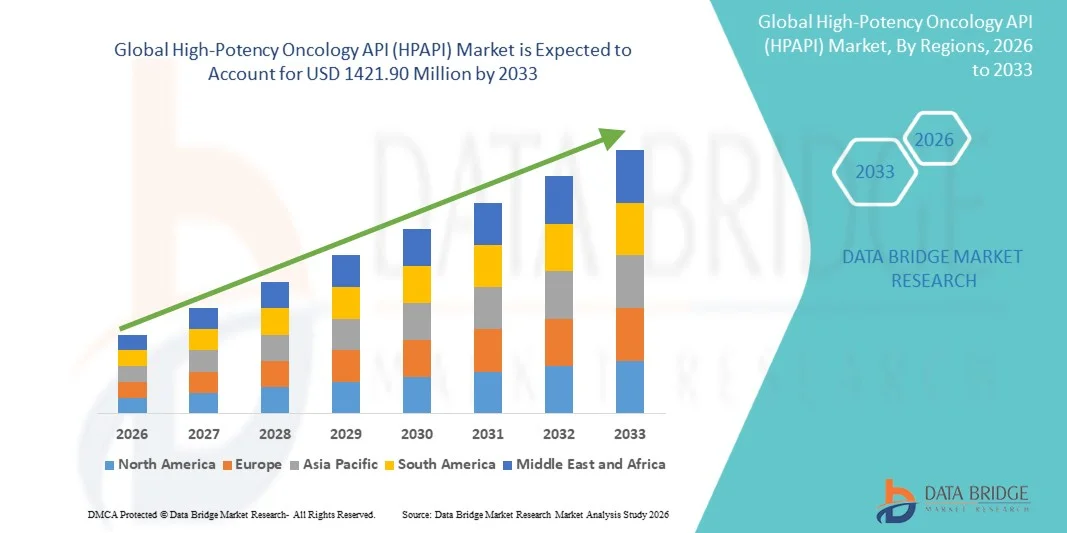
- Selon l'analyse de marché de Data Bridge, la taille du marché mondial de l'API à haut potentiel en oncologie (IPAP) a été évaluée à693 millions de dollars en 2025et devrait atteindre1421,90 millions de dollars en 2033, à unTCAC de 9,40%pendant la période de prévision
- La croissance du marché est largement alimentée par l'augmentation du fardeau mondial du cancer et la demande croissante de traitements oncologiques hautement efficaces et ciblés, ce qui conduit à une plus grande adoption de traitements actifsingrédients pharmaceutiques(HPAPI) dans le développement et la fabrication de médicaments contre le cancer dans les segments innovateurs et pharmaceutiques génériques
- De plus, les investissements croissants dans la R-D en oncologie, l'expansion des pipelines de thérapies ciblées et de conjugués anticorps-médicaments (SAD) et le besoin de composés à faible dose et à haute efficacité établissent les IHPAP comme composants essentiels des thérapies anticancéreuses modernes. Ces facteurs convergents accélèrent l'adoption de solutions d'API à haut potentiel en oncologie (HPAPI), ce qui stimule considérablement la croissance globale du marché
Taille du marché et prévisions
- Valeur marchande mondiale (2025):693 millions de dollars
- Valeur marchande prévue (2033) :1421,90 millions de dollars
- Prévisions CAGR (2026-2033):9.40%
Quels sont les principaux débouchés du marché de l'API à haut potentiel en oncologie (HPAPI)
- API en oncologie à haut potentiel (IPPA), qui sont des ingrédients pharmaceutiques hautement actifs utilisés dans des produits ciblésthérapies contre le cancer, deviennent de plus en plus critiques dans le développement moderne des médicaments en oncologie en raison de leur grande efficacité à de faibles doses, de l'amélioration des résultats thérapeutiques et de l'utilisation croissante dans les formulations avancées telles que les conjugués anticorps-médicaments (ADC) et les thérapies ciblées dans les milieux cliniques et commerciaux
- L'augmentation de la demande d'IPHP est principalement alimentée par l'augmentation du fardeau mondial du cancer, l'expansion rapide des pipelines de médicaments oncologiques, l'accent accru mis sur la médecine ciblée et personnalisée, et l'externalisation croissante de la fabrication de haute puissance à des CDMO spécialisés dotés de capacités de confinement avancées
- L'Amérique du Nord a dominé le marché de l'API en oncologie à fort potentiel (IPAP) avec la plus grande part de revenus d'environ 41,5 % en 2025, appuyée par un écosystème biopharmaceutique solide, des dépenses élevées en R-D en oncologie, l'adoption rapide de traitements anticancéreux avancés et la présence de grandes sociétés pharmaceutiques et de fabricants spécialisés de PAP, les États-Unis représentant la majorité de la demande régionale tirée par une solide activité d'essais cliniques et le développement de l'IDC.
- On s'attend à ce que l'Asie-Pacifique soit la région qui connaît la croissance la plus rapide sur le marché de l'API en oncologie à haut potentiel (IPAP) au cours de la période de prévision, enregistrant un TCAC fort en raison de l'augmentation de la prévalence du cancer, de l'augmentation de la capacité de fabrication de produits pharmaceutiques, de l'augmentation des investissements dans la recherche en oncologie et de l'adoption croissante de la production externalisée d'IPAP dans des pays comme la Chine et l'Inde.
- En 2025, le segment des HPAPI synthétiques a dominé la plus grande part des revenus du marché, soit 62,8 %, en raison de leur large utilisation dans la fabrication conventionnelle et ciblée de médicaments en oncologie. Les HPAPI synthétiques sont largement utilisés en raison de leur rentabilité, de leur évolutivité et de leurs voies de synthèse chimique bien établies.
Étendue du rapport et segmentation du marché de l'API en oncologie à fort potentiel
|
Attributs |
API d'oncologie à haut potentiel (IPAP) Principales perspectives du marché |
|
Segments couverts |
|
|
Pays couverts |
Amérique du Nord
Europe
Asie-Pacifique
Moyen-Orient et Afrique
Amérique du Sud
|
|
Principaux acteurs du marché |
|
|
Possibilités de marché |
|
|
Infos sur la valeur ajoutée |
|
Quelle est la tendance clé sur le marché de l'API à haut potentiel en oncologie (HPAPI)
(en milliers de dollars)Développement de technologies de fabrication et de confinement spécialisées(en milliers de dollars)
- Une tendance importante et accélérée sur le marché mondial de l'API en oncologie à fort potentiel est l'attention croissante accordée aux installations de fabrication spécialisées et aux technologies de confinement de pointe. En raison de l'extrême puissance et de la toxicité de ces composés, les fabricants investissent massivement dans des environnements hautement contrôlés pour assurer la sécurité de l'exploitant, la conformité réglementaire et l'intégrité du produit.
- Par exemple, plusieurs organisations mondiales de développement de contrats et de fabrication (ODCM) ont élargi les lignes de production dédiées HPAPI équipées d'isolants et de systèmes de confinement pour soutenir le pipeline croissant de médicaments en oncologie
- Cela reflète l'évolution de l'industrie vers des capacités de fabrication HPAPI plus sûres et plus évolutives
- Cette tendance est encore renforcée par l'adoption croissante de traitements contre le cancer ciblés, tels que les conjugués anticorps-médicaments (ADC) et les petites molécules cytotoxiques, qui dépendent fortement des API à haut potentiel.
- De plus, les progrès de l'automatisation des processus et de la manipulation des systèmes fermés améliorent l'efficacité de fabrication tout en minimisant les risques de contamination croisée dans la production de HPAPI
- Cette évolution continue vers une infrastructure de fabrication hautement spécialisée, conforme et évolutive remodele la dynamique concurrentielle sur le marché mondial de l'IPAP
Dynamique du marché de l'API à haut potentiel en oncologie
Chauffeur
L'augmentation du fardeau mondial du cancer et la demande croissante de thérapies ciblées
- La prévalence mondiale croissante du cancer et des troubles liés à l'oncologie est l'un des principaux moteurs du marché des API en oncologie à haut potentiel.
- Les entreprises pharmaceutiques intensifient leurs efforts pour mettre au point des traitements anticancéreux hautement efficaces et ciblés qui nécessitent souvent des ingrédients actifs puissants.
- Par exemple, la croissance continue du développement de conjugués anticorps-médicaments et d'agents de chimiothérapie cytotoxiques a augmenté de façon significative la demande d'IPHP utilisés dans les médicaments d'oncologie au stade clinique et commercial.
- L'expansion des pipelines d'oncologie, soutenue par des investissements accrus dans la recherche sur le cancer et le développement de médicaments, accélère la nécessité de chaînes d'approvisionnement HPAPI fiables et évolutives
- En outre, l'augmentation de la médecine personnalisée et de l'oncologie de précision stimule la demande d'API hautement puissantes qui permettent de cibler sélectivement les cellules cancéreuses tout en minimisant la toxicité systémique
- Le rôle croissant des CDMO dans l'externalisation de la production de HPAPI contribue également à la croissance du marché, car les entreprises pharmaceutiques recherchent des compétences spécialisées et des capacités de fabrication conformes
Restriction/Défi
(en milliers de dollars)Coûts de fabrication élevés et exigences réglementaires rigoureuses(en milliers de dollars)
- La production d'IPA de haute capacité en oncologie implique d'importants investissements en capital, car les fabricants doivent respecter des normes strictes en matière de sécurité au travail, d'environnement et de réglementation. Ces exigences augmentent les coûts de production globaux et limitent l'entrée des petits acteurs
- Par exemple, la nécessité de systèmes de confinement spécialisés, d'unités de traitement de l'air perfectionnées et d'une formation étendue des exploitants augmente considérablement le coût de la mise en place et de l'entretien des installations de fabrication de HPAPI
- L'examen réglementaire effectué par des autorités telles que la FDA et l'EMA accroît la complexité, car les fabricants doivent démontrer des processus robustes d'atténuation des risques, de validation et de contrôle de la qualité.
- En outre, une disponibilité limitée de professionnels qualifiés ayant une expérience dans la manipulation de composés très puissants peut limiter la capacité de fabrication et l'évolutivité
- Surmonter ces défis grâce à l'optimisation des processus, à l'externalisation stratégique, à l'innovation technologique et à l'harmonisation réglementaire sera essentiel pour assurer une croissance soutenue et une plus grande accessibilité des IPA en oncologie à haut potentiel à l'échelle mondiale
Comment le marché de l'API à haut potentiel en oncologie (IPAP) est-il segmenté
Le marché est segmenté en fonction du type de produit, de la classe de médicaments, du niveau de puissance et de l'application.
• Par type de produit
Sur la base du type de produit, le marché de l'API à haut potentiel en oncologie (HPAPI) est segmenté en HPAPI synthétiques et HPAPI biotechnologiques. En 2025, le segment des HPAPI synthétiques a dominé la plus grande part des revenus du marché, soit 62,8 %, en raison de leur large utilisation dans la fabrication conventionnelle et ciblée de médicaments en oncologie. Les HPAPI synthétiques sont largement utilisés en raison de leur rentabilité, de leur évolutivité et de leurs voies de synthèse chimique bien établies. Ces IPA sont couramment appliqués dans les chimiothérapies cytotoxiques et les thérapies ciblées à petites molécules. Les sociétés pharmaceutiques préfèrent les IPAP synthétiques pour la production commerciale à grande échelle en raison de la qualité constante et de la familiarité réglementaire. Les infrastructures manufacturières matures soutiennent l'adoption. Accroître l'approbation des médicaments en oncologie contenant des IHP synthétiques. Une forte présence d'OCM spécialisés dans la synthèse chimique renforce l'offre. La longue durée de conservation et la stabilité favorisent également ce segment. L'optimisation continue du processus améliore le rendement. Ces facteurs positionnent collectivement les IPHP synthétiques comme le type de produit dominant.
On s'attend à ce que le segment des IHP de la biotechnologie soit témoin du TCAC le plus rapide de 11,9 % entre 2026 et 2033, en raison de l'adoption croissante de produits biologiques et de conjugués anticorps-médicaments (CAD). Les HPAPI biotech sont de plus en plus utilisés dans les traitements d'oncologie et d'immunothérapie de précision. Les investissements croissants dans la fabrication de produits biologiques stimulent la croissance du marché. L'expansion des pipelines d'anticorps monoclonaux accélère la demande. Les HPAPI biotech offrent une plus grande spécificité cible et une toxicité systémique réduite. Les progrès de la technologie recombinante soutiennent l'évolutivité. L'augmentation des approbations réglementaires pour les produits biologiques accroît la croissance des carburants. Les entreprises pharmaceutiques se tournent vers les IPAP biologiques. Les ORMC développent leurs capacités biologiques. Ces facteurs établissent que les IPAPB de biotechnologie constituent le segment de produits qui connaît la croissance la plus rapide.
• Par classe de drogue
Sur la base de la classe de médicaments, le marché de l'IPA à haute capacité en oncologie (IPAP) est segmenté en médicaments cytotoxiques, en médicaments thérapeutiques ciblés et en médicaments hormonaux. Le segment des médicaments cytotoxiques a dominé la plus grande part du marché de 45,6 % en 2025, en raison de leur utilisation de longue date dans le traitement du cancer à travers de multiples indications. Les IHP cytotoxiques sont largement utilisés dans les régimes de chimiothérapie pour les tumeurs solides et les tumeurs malignes hématologiques. Une puissance élevée est nécessaire pour obtenir une efficacité thérapeutique à de faibles doses. Les protocoles cliniques établis soutiennent la demande continue. Les médicaments génériques de chimiothérapie renforcent encore la présence sur le marché. Une large disponibilité sur les marchés mondiaux est à l'origine de la consommation en volume. De solides capacités de fabrication soutiennent l'évolutivité. Les IHP cytotoxiques demeurent essentiels dans les thérapies combinées. La rentabilité par rapport aux produits biologiques soutient l'adoption. Des volumes élevés de patients contribuent à la domination. Ces facteurs positionnent les médicaments cytotoxiques comme la première classe de médicaments.
Le segment des médicaments thérapeutiques ciblés devrait enregistrer le TCAC le plus rapide de 13,4 %, de 2026 à 2033, en raison du passage à l'oncologie de précision. Les HPAPI ciblés offrent une action sélective contre les cellules cancéreuses, réduisant ainsi les effets indésirables. L'augmentation de la prévalence des biomarqueurs accélère la croissance. L'augmentation des approbations des inhibiteurs de la kinase et des médicaments spécifiques à la voie stimule la demande. De solides investissements en R-D appuient l'expansion des pipelines. L'amélioration des résultats cliniques stimule la préférence des médecins. Les entreprises pharmaceutiques privilégient les thérapies ciblées pour la différenciation. Les diagnostics complémentaires favorisent l'adoption. La hausse des prix favorise la croissance des revenus. Ces facteurs établissent que les médicaments thérapeutiques ciblés constituent la classe de médicaments dont la croissance est la plus rapide.
• Par niveau de puissance
Sur la base du niveau de puissance, le marché de l'API à haut potentiel en oncologie (IPAP) est segmenté en ≤100 μg/g, 100–1000 μg/g et >1000 μg/g. En 2025, le segment de 100 à 1000 μg/g représentait la plus grande part des revenus du marché, soit 48,3 %, en raison de sa puissance équilibrée et de ses exigences de manutention gérable. Cette gamme de puissance est largement utilisée dans les médicaments cytotoxiques et oncologiques ciblés. Il permet un dosage efficace tout en minimisant l'extrême complexité du confinement. Les fabricants de produits pharmaceutiques préfèrent cette gamme pour la production évolutive. La conformité à la réglementation est plus facile que les API ultra-hautes puissance. L'utilisation croissante de formes orales solides soutient la demande. La compatibilité avec les installations standard à haut confinement stimule l'adoption. Un important pipeline de médicaments en oncologie à moyenne capacité soutient la croissance. Le rapport coût-efficacité appuie également la domination. Ces facteurs positionnent le segment de 100 à 1000 μg/g comme la principale catégorie de puissance.
Le segment >1000 μg/g devrait connaître le TCAC le plus rapide de 14,2 % entre 2026 et 2033, en raison du développement croissant de thérapies ciblées et de charges utiles ADC. Les HPAPI ultra-potents permettent une dose plus faible avec une efficacité accrue. L'augmentation des approbations ADC stimule considérablement la demande. Les technologies de confinement et de manutention avancées soutiennent la fabrication. Une attention croissante à la médecine personnalisée accélère la croissance. Les entreprises pharmaceutiques investissent dans des installations spécialisées pour des API à puissance élevée. Une valeur thérapeutique élevée favorise le prix élevé. Les CDMO élargissent leurs capacités pour répondre à la demande. Les approbations réglementaires encouragent la commercialisation. Ces facteurs établissent que plus de 1000 μg/g constituent le segment de puissance qui connaît la croissance la plus rapide.
• Par demande
Sur la base de l'application, le marché de l'API à haut potentiel en oncologie (IPAP) est segmenté en chimiothérapie, en traitement ciblé contre le cancer, en conjugués anticorps-médicaments (CAD) et autres. Le segment de la chimiothérapie a dominé la plus grande part du marché de 41,9 % en 2025, en raison de son rôle continu en tant que pierre angulaire du traitement du cancer. Les médicaments chimiothérapie dépendent fortement des HPAPI pour la suppression efficace des tumeurs. Des volumes élevés de patients au niveau mondial soutiennent une demande soutenue. Les médicaments génériques de chimiothérapie contribuent de façon significative aux revenus du marché. Les régimes combinés conservent leur pertinence dans les protocoles de traitement. La rentabilité par rapport aux nouvelles thérapies favorise l'adoption. Une base de fabrication solide assure un approvisionnement régulier. La chimiothérapie demeure essentielle dans les régions à faible revenu et à revenu intermédiaire. La familiarité clinique maintient la confiance du médecin. Ces facteurs positionnent la chimiothérapie comme le segment dominant de l'application.
On s'attend à ce que le segment des conjugués anticorps-médicaments (CMA) soit témoin du TCAC le plus rapide de 15,1 % entre 2026 et 2033, grâce à l'innovation rapide dans les traitements anticancéreux ciblés. Les ADC nécessitent des HPAPI ultra-potents comme charges utiles cytotoxiques. Accroître les approbations des médicaments d'oncologie basés sur l'ADC. Une forte efficacité clinique avec une toxicité systémique réduite accélère l' adoption. Les sociétés pharmaceutiques investissent massivement dans les pipelines d'ADC. Les progrès dans les technologies de liaison et de conjugaison soutiennent l'expansion. La hausse de la demande en oncologie de précision stimule la croissance. Une valeur commerciale élevée stimule la contribution des revenus. Les CDMO élargissent les services de fabrication d'ADC. Ces facteurs établissent les CAD comme le segment d'application qui connaît la croissance la plus rapide.
Quelle est la région qui détient la plus grande part du marché de l'API en oncologie à haut potentiel (IPAP)
- L'Amérique du Nord a dominé le marché de l'API en oncologie (HPAPI), qui représentait environ 41,5 % de la part des revenus mondiaux en 2025.
- Le leadership de la région est soutenu par un écosystème biopharmaceutique solide, des dépenses élevées en recherche et développement en oncologie, l'adoption rapide de traitements anticancéreux avancés et la présence de grandes entreprises pharmaceutiques et de fabricants spécialisés de HPAPI
- Une activité d'essai clinique robuste, en particulier pour les thérapies ciblées et les conjugués anticorps-médicaments (SAD), continue de stimuler une demande soutenue dans toute la région
U.S. High-Potency Oncology API (HPAPI) Aperçu du marché
Le marché américain de l'API en oncologie à fort potentiel (HPAPI) a représenté la majorité des revenus du marché nord-américain de l'IPAP en 2025, sous l'impulsion de vastes pipelines de mise au point de médicaments en oncologie, d'importants investissements dans la recherche clinique et la forte présence de grandes sociétés pharmaceutiques et de biotechnologie. De plus en plus l'accent est mis sur la précision de l'oncologie, le développement de l'ADC et l'externalisation généralisée de la fabrication de HPAPI.
Aperçu du marché de l'API sur l'oncologie à haut potentiel en Europe
Le marché européen de l'API en oncologie à fort potentiel devrait s'étendre à un important TCAC au cours de la période de prévision, grâce à l'augmentation de l'incidence du cancer, à l'augmentation des investissements dans la recherche en oncologie et à l'adoption croissante de thérapies ciblées. De solides cadres réglementaires et l'expansion des capacités de fabrication de produits pharmaceutiques dans la région continuent d'appuyer l'expansion du marché.
U.K. High-Potency Oncology API (HPAPI) Aperçu du marché
On s'attend à ce que le marché de l'API en oncologie à fort potentiel au Royaume-Uni augmente à un TCAC remarquable au cours de la période de prévision, en raison de l'augmentation des activités de R-D en oncologie, de solides collaborations entre les universités et l'industrie et de l'augmentation des volumes d'essais cliniques. La présence d'entreprises pharmaceutiques établies et d'organismes de développement et de fabrication de contrats (ODMC) appuie également la demande d'IPHP.
Allemagne Aperçu du marché de l'API d'oncologie à haut potentiel
On s'attend à ce que le marché de l'API en oncologie (IPAP) à fort potentiel s'étende à un TCAC considérable, alimenté par une base de fabrication pharmaceutique bien développée, l'accent étant mis sur l'innovation et l'adoption croissante de traitements anticancéreux de pointe. Les investissements croissants dans la mise au point de médicaments en oncologie et les produits biologiques contribuent davantage à la croissance du marché.
Asia-Pacific High-Potency Oncology API (HPAPI) Aperçu du marché
On s'attend à ce que la région de marché de l'API d'oncologie à haut potentiel en Asie et dans le Pacifique (IPAPH) soit le marché qui connaît la croissance la plus rapide pour les IPAPP au cours de la période de prévision, enregistrant un TCAC fort. La croissance est attribuable à l'augmentation de la prévalence du cancer, à l'augmentation de la capacité de fabrication de produits pharmaceutiques, à l'augmentation des investissements dans la recherche en oncologie et à l'adoption croissante de la production externalisée de HPAPI. Des pays comme la Chine et l'Inde deviennent des pôles clés en raison des avantages en termes de coûts et de l'amélioration du respect de la réglementation.
Aperçu du marché de l'API d'oncologie à haut potentiel au Japon
Le marché japonais de l'API en oncologie à haut potentiel (IPAP) prend de l'ampleur en raison de l'augmentation des activités de développement des médicaments en oncologie, d'un solide soutien réglementaire aux thérapies innovantes contre le cancer et d'une attention croissante accordée à la médecine de précision. L'infrastructure de santé avancée du pays et l'activité croissante de recherche clinique soutiennent la demande constante d'IPHP.
China High-Potency Oncology API (HPAPI) Aperçu du marché
En 2025, le marché chinois de l'API en oncologie à fort potentiel a représenté une part importante des revenus dans la région de l'Asie-Pacifique, en raison de l'expansion rapide de la fabrication pharmaceutique, de l'augmentation des investissements en R-D en oncologie et de l'adoption croissante de la production externalisée de l'IPAP. L'aide gouvernementale au développement des médicaments au pays et la demande croissante de traitements anticancéreux avancés continuent de favoriser la croissance du marché.
Quelles sont les entreprises les plus performantes du marché de l'API en oncologie (HPAPI)
L'industrie de l'API à haut potentiel en oncologie (IPAP) est principalement dirigée par des entreprises bien établies, notamment :
- Groupe Lonza AG (Suisse)
- WuXi AppTec (Chine)
- Piramal Pharma Solutions (Inde)
- Cambrex Corporation (États-Unis)
- Jubilant Sciences de la vie (Inde)
- Boehringer Ingelheim (Allemagne)
- Thermo Fisher Scientific (États-Unis)
- Syngene International Ltd. (Inde)
- Samsung Biologics (Corée du Sud)
- Recipharm AB (Suède)
Quels sont les derniers développements sur le marché de l'API à haut potentiel en oncologie (HPAPI)
- En février 2023, Lonza a annoncé l'achèvement de son expansion de l'installation de conjugaison HPAPI à Viège, en Suisse, ajoutant deux nouvelles suites de fabrication et une infrastructure de soutien. Cette extension a amélioré la capacité de Lonza d'appuyer la production de bioconjugués et de charge utile-lien HPAPI pour l'oncologie et d'autres thérapies à haut potentiel aux échelles préclinique, clinique et commerciale
- En mars 2023, Lonza a terminé une nouvelle gamme de médicaments cliniques et commerciaux sur son site Viège, en Suisse, qui a augmenté les capacités des molécules hautement puissantes, permettant un approvisionnement plus large en GMPc pour les projets d'oncologie HPAPI et soutenant les flux de travail de bout en bout de substances médicamenteuses et de produits pharmaceutiques
- En mai 2025, AGC Pharma Chemicals a annoncé une expansion importante de ses capacités d'API à haut potentiel (HPAPI) à Barcelone, en Espagne, permettant une progression sans heurts de la production de grammes à la production de tonnes au sein d'une seule installation intégrée. Cette expansion soutient directement la demande mondiale croissante d'ICHP axés sur l'oncologie et de thérapies ciblées avancées
SKU-
Accédez en ligne au rapport sur le premier cloud mondial de veille économique
- Tableau de bord d'analyse de données interactif
- Tableau de bord d'analyse d'entreprise pour les opportunités à fort potentiel de croissance
- Accès d'analyste de recherche pour la personnalisation et les requêtes
- Analyse de la concurrence avec tableau de bord interactif
- Dernières actualités, mises à jour et analyse des tendances
- Exploitez la puissance de l'analyse comparative pour un suivi complet de la concurrence
Méthodologie de recherche
La collecte de données et l'analyse de l'année de base sont effectuées à l'aide de modules de collecte de données avec des échantillons de grande taille. L'étape consiste à obtenir des informations sur le marché ou des données connexes via diverses sources et stratégies. Elle comprend l'examen et la planification à l'avance de toutes les données acquises dans le passé. Elle englobe également l'examen des incohérences d'informations observées dans différentes sources d'informations. Les données de marché sont analysées et estimées à l'aide de modèles statistiques et cohérents de marché. De plus, l'analyse des parts de marché et l'analyse des tendances clés sont les principaux facteurs de succès du rapport de marché. Pour en savoir plus, veuillez demander un appel d'analyste ou déposer votre demande.
La méthodologie de recherche clé utilisée par l'équipe de recherche DBMR est la triangulation des données qui implique l'exploration de données, l'analyse de l'impact des variables de données sur le marché et la validation primaire (expert du secteur). Les modèles de données incluent la grille de positionnement des fournisseurs, l'analyse de la chronologie du marché, l'aperçu et le guide du marché, la grille de positionnement des entreprises, l'analyse des brevets, l'analyse des prix, l'analyse des parts de marché des entreprises, les normes de mesure, l'analyse globale par rapport à l'analyse régionale et des parts des fournisseurs. Pour en savoir plus sur la méthodologie de recherche, envoyez une demande pour parler à nos experts du secteur.
Personnalisation disponible
Data Bridge Market Research est un leader de la recherche formative avancée. Nous sommes fiers de fournir à nos clients existants et nouveaux des données et des analyses qui correspondent à leurs objectifs. Le rapport peut être personnalisé pour inclure une analyse des tendances des prix des marques cibles, une compréhension du marché pour d'autres pays (demandez la liste des pays), des données sur les résultats des essais cliniques, une revue de la littérature, une analyse du marché des produits remis à neuf et de la base de produits. L'analyse du marché des concurrents cibles peut être analysée à partir d'une analyse basée sur la technologie jusqu'à des stratégies de portefeuille de marché. Nous pouvons ajouter autant de concurrents que vous le souhaitez, dans le format et le style de données que vous recherchez. Notre équipe d'analystes peut également vous fournir des données sous forme de fichiers Excel bruts, de tableaux croisés dynamiques (Fact book) ou peut vous aider à créer des présentations à partir des ensembles de données disponibles dans le rapport.