



Global Hospice Care Market Segmentation, By Type (Nursing Services, Medical Supply Services, Physician Services, and Other Type of Services), Application (Home Settings, Hospitals, Specialty Nursing Homes, and Hospice Care Centres) - Industry Trends and Forecast to 2032
Hospice Care Market Size
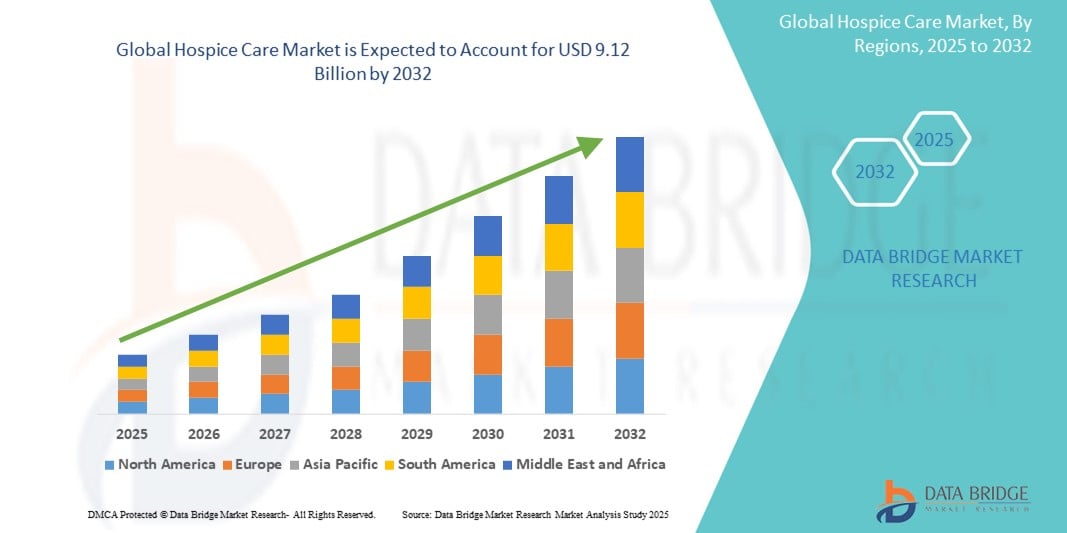
- The global hospice care market size was valued at USD 4.66 billion in 2024 and is expected to reach USD 9.12 billion by 2032, at a CAGR of 8.75% during the forecast period
- The market growth is largely fuelled by the growing adoption and advancement of palliative care services, along with increasing awareness of end-of-life care, leading to a surge in demand for comprehensive, compassionate, and home-based healthcare solutions for terminally ill patients
- Furthermore, rising consumer demand for comfort-focused, patient-centered care and the growing geriatric population worldwide is establishing hospice care as a preferred solution for managing chronic and life-limiting illnesses. These converging factors are accelerating the uptake of hospice care services across both developed and developing regions, thereby significantly boosting the industry's growth
Hospice Care Market Analysis
- Hospice care services are increasingly essential, offering compassionate, palliative care to patients with terminal illnesses in both home and institutional settings. These services focus on enhancing quality of life, managing symptoms, and providing emotional support to patients and their families
- The escalating demand for hospice care is propelled by the rising prevalence of chronic illnesses, aging populations, and a growing emphasis on dignified, patient-centered end-of-life support. In addition, rising healthcare costs and a preference for home-based care models reinforce this trend
- North America dominated the hospice care market with the largest revenue share of 45.8% in 2024, driven by factors such as a high chronic disease burden, sophisticated healthcare infrastructure, comprehensive reimbursement systems, and strong public awareness
- Asia‑Pacific is expected to be the fastest-growing region in the hospice care market, with a CAGR of 9.2% expected from 2025 to 2032, fuelled by increasing health expenditures, expanding geriatric populations, and government-led efforts to strengthen palliative care services in countries such as China, India, and Japan
- Home Settings segment dominated the market, representing a 52.7% share in 2024, as families favour receiving personalized hospice care in familiar surroundings, supported by professional caregivers and telehealth solutions
Report Scope and Hospice Care Market Segmentation
|
Attributes |
Hospice Care Key Market Insights |
|
Segments Covered |
|
|
Countries Covered |
North America
Europe
Asia-Pacific
Middle East and Africa
South America
|
|
Key Market Players |
|
|
Market Opportunities |
|
|
Value Added Data Infosets |
In addition to the insights on market scenarios such as market value, growth rate, segmentation, geographical coverage, and major players, the market reports curated by the Data Bridge Market Research also include in-depth expert analysis, pricing analysis, brand share analysis, consumer survey, demography analysis, supply chain analysis, value chain analysis, raw material/consumables overview, vendor selection criteria, PESTLE Analysis, Porter Analysis, and regulatory framework. |
Hospice Care Market Trends
“Expanding Access and Personalized End-of-Life Care”
- A significant and accelerating trend in the global hospice care market is the expansion of community-based palliative services and home-based hospice care, aimed at improving patient comfort and accessibility. As healthcare systems increasingly shift towards value-based care, hospice services are being integrated earlier and more holistically into treatment plans for patients with terminal illnesses
- For instance, several healthcare providers are expanding in-home hospice care programs, enabling patients to receive medical, emotional, and spiritual support in familiar environments. This approach enhances quality of life, reduces hospital admissions, and allows for greater involvement of family members in caregiving
- The rising geriatric population, particularly in North America, Europe, and parts of Asia, is creating a surge in demand for hospice services. Patients with chronic illnesses such as cancer, heart failure, and neurodegenerative conditions are increasingly opting for hospice care to receive compassionate support during advanced stages of illness
- Moreover, healthcare providers are focusing on interdisciplinary care models that include nurses, social workers, chaplains, and bereavement counselors to address physical, emotional, and spiritual needs. This patient-centered approach fosters dignity and comfort, which are the cornerstones of hospice care
- The integration of telehealth and mobile medical units is further enabling hospice providers to reach patients in remote or underserved areas, minimizing barriers to access. These developments are crucial in regions with dispersed rural populations or limited in-hospital hospice capacity
- Organizations such as VITAS Healthcare, Kindred Healthcare, and Amedisys are spearheading innovations in hospice delivery, expanding specialized services such as pediatric hospice, palliative rehabilitation, and culturally tailored programs to meet diverse community needs
- This growing emphasis on personalized, compassionate, and community-oriented end-of-life care is redefining the hospice care landscape. As awareness increases and preferences shift toward comfort-focused care, the market is expected to witness sustained growth across all regions
Hospice Care Market Dynamics
Driver
“Growing Need Due to Rising Chronic Illnesses and Aging Population”
- The global hospice care market is experiencing significant growth driven by the increasing prevalence of chronic illnesses such as cancer, cardiovascular diseases, and neurodegenerative disorders, alongside a rapidly aging global population. As life expectancy increases, the demand for compassionate end-of-life care is rising steadily across developed and developing countries alike
- For instance, according to the World Health Organization (WHO), the number of people aged 60 years and older is expected to double by 2050, creating an urgent need for scalable and accessible palliative and hospice care services. This demographic trend directly translates to growing pressure on healthcare systems to offer high-quality, patient-centric end-of-life care options
- Moreover, the shift towards value-based care models across the healthcare industry emphasizes the importance of quality of life, comfort, and dignity for patients nearing the end of life. Hospice care plays a vital role in this context by delivering multidisciplinary support—including medical, psychological, and spiritual care—tailored to the unique needs of terminally ill patients and their families
- The growing awareness among patients and caregivers about the benefits of hospice care, such as pain management, emotional support, and reduced hospitalizations, is also propelling its adoption, especially in home-based and community-based care settings
- In addition, public and private healthcare initiatives, such as Medicare and Medicaid hospice benefits in the U.S., and similar reimbursement frameworks in other countries, are improving access and affordability of hospice services, thereby driving market growth
Restraint/Challenge
“Limited Reimbursement Policies and Shortage of Skilled Workforce”
- One of the significant challenges in the hospice care market is the variation and limitations in reimbursement policies across regions, particularly in low- and middle-income countries. In some regions, lack of government funding and unclear insurance coverage often restrict patient access to hospice care, leading to underutilization of these essential services
- In addition, the shortage of trained hospice and palliative care professionals—including physicians, nurses, social workers, and spiritual counselors—limits the scalability and quality of hospice programs. This workforce gap is especially pronounced in rural areas and under-resourced healthcare systems
- According to various global health agencies, the demand for palliative care is expected to far outpace the supply of skilled professionals in the coming years. Training and retaining staff in emotionally and physically demanding hospice roles remains a persistent hurdle.
- Cultural and societal stigmas surrounding end-of-life care in certain regions can also act as a barrier to hospice utilization. In some cultures, discussing death or choosing hospice over aggressive treatment is still taboo, which prevents timely referrals and reduces patient outcomes
- Overcoming these challenges will require government policy reform, international collaboration, and expanded educational initiatives to grow a qualified hospice workforce and ensure equitable access to services across all demographics
Hospice Care Market Scope
The market is segmented on the basis of type and application.
• By Type
On the basis of type, the hospice care market is segmented into nursing services, medical supply services, physician services, and other types of services. The nursing services segment dominated the largest market revenue share of 47.8% in 2024, driven by the central role nurses play in delivering round-the-clock patient care, symptom management, emotional support, and patient education. The increasing demand for skilled nursing professionals and the critical nature of their services in ensuring quality palliative care contribute significantly to this segment's dominance. Moreover, growing preference for home-based hospice care has led to rising demand for mobile nursing units and in-home care programs.
The medical supply services segment is anticipated to witness the fastest growth rate of 20.6% from 2025 to 2032, fueled by the rising demand for essential medical equipment and supplies such as oxygen concentrators, hospital beds, mobility aids, and pain relief devices. As more patients opt for hospice care in home and community-based settings, the need for a reliable and accessible medical supply infrastructure continues to grow. Technological advancements in portable equipment and increased insurance coverage for durable medical goods are also supporting segment growth.
• By Application
On the basis of application, the hospice care market is segmented into home settings, hospitals, specialty nursing homes, and hospice care centres. The home settings segment accounted for the largest market revenue share of 52.7% in 2024, driven by the growing preference among patients and families for receiving end-of-life care in a familiar, comfortable environment. The expansion of home healthcare infrastructure, coupled with reimbursement support from Medicare, Medicaid, and private insurers, has bolstered the popularity of hospice care at home. In addition, home settings offer personalized care while reducing hospital readmissions and associated costs.
The hospice care centres segment is expected to witness the fastest CAGR of 19.8% from 2025 to 2032, as these dedicated facilities provide specialized, holistic care tailored to terminally ill patients. The increasing number of nonprofit and private hospice centres, alongside rising public awareness about the benefits of hospice services, is driving demand. These centres offer comprehensive care through a multidisciplinary team approach, ensuring medical, emotional, and spiritual support under one roof.
Hospice Care Market Regional Analysis
- North America dominated the hospice care market with the largest revenue share of 45.8% in 2024, driven by the increasing prevalence of chronic illnesses, a rapidly aging population, and the strong presence of well-established hospice and palliative care providers across the U.S. and Canada
- The region’s healthcare infrastructure is highly developed, enabling better access to specialized end-of-life care services, including in-home hospice programs and institutional care settings
- Favorable reimbursement policies, such as Medicare and Medicaid support for hospice care in the U.S., along with strong advocacy by organizations such as the National Hospice and Palliative Care Organization (NHPCO), are further contributing to widespread adoption. Moreover, growing public awareness and acceptance of hospice as a compassionate alternative to aggressive treatment have also led to increased utilization across the region
U.S. Hospice Care Market Insight
The U.S. hospice care market captured the largest revenue share of 78.4% in 2024 within North America, driven by its robust hospice infrastructure, Medicare reimbursement policies, and increasing prevalence of chronic and terminal illnesses. Rising patient preference for home-based end-of-life care, along with technological integration in service delivery (telehospice), is further propelling market expansion. The presence of major providers such as VITAS Healthcare and Amedisys strengthens regional dominance.
Europe Hospice Care Market Insight
The Europe hospice care market is projected to grow at a CAGR of 8.9% from 2025 to 2032, fueled by a rising aging population, government mandates supporting palliative care access, and heightened awareness about quality end-of-life care. The region also benefits from nonprofit and community-led hospice service models, especially in the U.K., Germany, and France, which are seeing increasing demand across both urban and rural settings.
U.K. Hospice Care Market Insight
The U.K. hospice care market is anticipated to grow at a CAGR of 8.1% during the forecast period, backed by strong public sector investment and widespread operation of charitable hospices under the NHS framework. The growing prevalence of cancer and neurodegenerative diseases and government prioritization of patient dignity in palliative care settings are central to market growth.
Germany Hospice Care Market Insight
The Germany hospice care market is expected to expand at a CAGR of 8.7% from 2025 to 2032, driven by government-supported outpatient palliative care laws, increased patient-centric care initiatives, and an aging population. The expansion of hospice beds and mobile hospice services across federal states reflects the country’s structured and policy-driven approach to hospice development.
Asia-Pacific Hospice Care Market Insight
The Asia-Pacific hospice care market is poised to grow at the fastest CAGR of 9.2% during the forecast period (2025–2032), led by expanding healthcare reforms, increasing chronic disease prevalence, and a rapidly aging demographic in countries such as China, Japan, and India. Public-private partnerships and awareness campaigns are also helping to destigmatize hospice care and drive market growth across both urban and rural settings.
Japan Hospice Care Market Insight
The Japan hospice care market is projected to grow at a CAGR of 10.8% from 2025 to 2032, attributed to the country’s super-aged society, growing government investments in community-based care, and adoption of hybrid hospice models combining home-based and institutional care. Technology integration in care management and emphasis on culturally sensitive hospice care models further support expansion.
China Hospice Care Market Insight
The China hospice care market accounted for 39.6% of the Asia-Pacific revenue share in 2024, driven by growing urbanization, a rapidly aging population, and expanding government-backed hospice pilot programs. The presence of a large middle-income demographic and expanding healthcare access in Tier 2 and Tier 3 cities is contributing to the growing demand for end-of-life care services. Strategic investments by both domestic and international providers are also fueling growth.
Hospice Care Market Share
The hospice care industry is primarily led by well-established companies, including:
- Covenant Care (U.S.)
- Knight Health Holdings, LLC (U.S.)
- PruittHealth (U.S.)
- Dierksen Hospice (U.S.)
- Samaritan Health Services (U.S.)
- Oklahoma Palliative & Hospice Care (U.S.)
- Alzheimer's Association (U.S.)
- VITAS Healthcare (U.S.)
- LHC Group, Inc. (U.S.)
- Amedisys (U.S.)
- Brookdale Senior Living Inc. (U.S.)
- EXTENDICARE (Canada)
- My Living Choice (U.S.)
- Ensign Group, Inc. (U.S.)
- Living Assistance Services (Canada)
SKU-
Accédez en ligne au rapport sur le premier cloud mondial de veille économique

- Tableau de bord d'analyse de données interactif
- Tableau de bord d'analyse d'entreprise pour les opportunités à fort potentiel de croissance
- Accès d'analyste de recherche pour la personnalisation et les requêtes
- Analyse de la concurrence avec tableau de bord interactif
- Dernières actualités, mises à jour et analyse des tendances
- Exploitez la puissance de l'analyse comparative pour un suivi complet de la concurrence
Méthodologie de recherche
La collecte de données et l'analyse de l'année de base sont effectuées à l'aide de modules de collecte de données avec des échantillons de grande taille. L'étape consiste à obtenir des informations sur le marché ou des données connexes via diverses sources et stratégies. Elle comprend l'examen et la planification à l'avance de toutes les données acquises dans le passé. Elle englobe également l'examen des incohérences d'informations observées dans différentes sources d'informations. Les données de marché sont analysées et estimées à l'aide de modèles statistiques et cohérents de marché. De plus, l'analyse des parts de marché et l'analyse des tendances clés sont les principaux facteurs de succès du rapport de marché. Pour en savoir plus, veuillez demander un appel d'analyste ou déposer votre demande.
La méthodologie de recherche clé utilisée par l'équipe de recherche DBMR est la triangulation des données qui implique l'exploration de données, l'analyse de l'impact des variables de données sur le marché et la validation primaire (expert du secteur). Les modèles de données incluent la grille de positionnement des fournisseurs, l'analyse de la chronologie du marché, l'aperçu et le guide du marché, la grille de positionnement des entreprises, l'analyse des brevets, l'analyse des prix, l'analyse des parts de marché des entreprises, les normes de mesure, l'analyse globale par rapport à l'analyse régionale et des parts des fournisseurs. Pour en savoir plus sur la méthodologie de recherche, envoyez une demande pour parler à nos experts du secteur.
Personnalisation disponible
Data Bridge Market Research est un leader de la recherche formative avancée. Nous sommes fiers de fournir à nos clients existants et nouveaux des données et des analyses qui correspondent à leurs objectifs. Le rapport peut être personnalisé pour inclure une analyse des tendances des prix des marques cibles, une compréhension du marché pour d'autres pays (demandez la liste des pays), des données sur les résultats des essais cliniques, une revue de la littérature, une analyse du marché des produits remis à neuf et de la base de produits. L'analyse du marché des concurrents cibles peut être analysée à partir d'une analyse basée sur la technologie jusqu'à des stratégies de portefeuille de marché. Nous pouvons ajouter autant de concurrents que vous le souhaitez, dans le format et le style de données que vous recherchez. Notre équipe d'analystes peut également vous fournir des données sous forme de fichiers Excel bruts, de tableaux croisés dynamiques (Fact book) ou peut vous aider à créer des présentations à partir des ensembles de données disponibles dans le rapport.











