



Rapport d'analyse du marché mondial des cloueuses industrielles : taille, part de marché et tendances
Taille du marché en milliards USD
TCAC :
% 
 USD
759.43 Million
USD
1,334.41 Million
2025
2033
USD
759.43 Million
USD
1,334.41 Million
2025
2033
 Période de prévision Période de prévision |
2026 –2033 |
 Taille du marché (année de référence) Taille du marché (année de référence) |
USD 759.43 Million |
 Taille du marché (année de prévision) Taille du marché (année de prévision) |
USD 1,334.41 Million |
 TCAC TCAC |
% |
| Principaux acteurs du marché |
|
Segmentation du marché mondial des cloueuses industrielles, par type de produit (cloueuses à pointes, cloueuses à bobine, cloueuses pour toitures et bardages, cloueuses à ossature bois et cloueuses pour sols), par mode de fonctionnement (cloueuses pneumatiques et électriques) et par utilisateurs finaux (emballage, fabrication, construction, travail du bois, travail des métaux et autres) - Tendances et prévisions du secteur jusqu'en 2033
Taille du marché des cloueuses industrielles
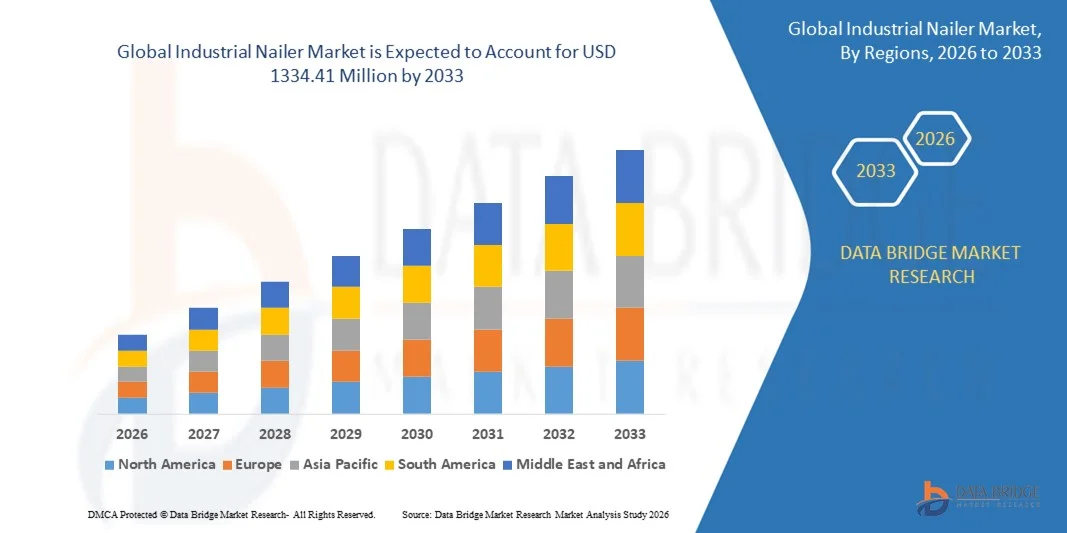
- Le marché mondial des cloueuses industrielles était évalué à 759,43 millions de dollars en 2025 et devrait atteindre 1 334,41 millions de dollars d’ici 2033 , avec un TCAC de 7,30 % au cours de la période de prévision.
- La croissance du marché est largement alimentée par la demande croissante d'outils de fixation performants et efficaces dans les secteurs de la construction, du travail du bois et de la fabrication, ce qui favorise l'adoption des cloueuses industrielles pour leur rapidité, leur précision et leur productivité.
- De plus, la demande croissante de cloueuses robustes, ergonomiques et polyvalentes, tant du côté professionnel que commercial, fait des cloueuses industrielles des outils indispensables pour les entrepreneurs et les fabricants. Cette convergence de facteurs accélère l'adoption des cloueuses pneumatiques, électriques et à batterie, stimulant ainsi considérablement la croissance du secteur.
Analyse du marché des cloueuses industrielles
- Les cloueuses industrielles, notamment les cloueuses à bobine, à pointes, à charpente, à toiture et de finition, sont des éléments de plus en plus essentiels dans la construction moderne, la menuiserie et les opérations industrielles en raison de leur capacité à améliorer l'efficacité du flux de travail, à réduire les coûts de main-d'œuvre et à fournir des solutions de fixation précises.
- La demande croissante de cloueuses industrielles est principalement alimentée par l'urbanisation rapide, l'expansion des infrastructures et des projets de construction, l'adoption croissante d'outils mécanisés et sans fil, et une importance grandissante accordée à la productivité et à la sécurité au travail.
- L'Amérique du Nord dominait le marché des cloueuses industrielles avec une part de plus de 40 % en 2025, grâce à une industrialisation rapide, à la croissance du secteur de la construction et à l'adoption d'outils de pointe pour la fabrication et le travail du bois.
- La région Asie-Pacifique devrait connaître la croissance la plus rapide sur le marché des cloueuses industrielles au cours de la période de prévision, en raison de l'urbanisation rapide, de l'expansion industrielle et de l'essor des activités de construction dans des pays comme la Chine, le Japon et l'Inde.
- Le segment des cloueuses pneumatiques industrielles a dominé le marché avec une part de 58,8 % en 2025, grâce à sa puissance constante, sa vitesse de frappe élevée et son adéquation aux applications de construction et de fabrication intensives. Les cloueuses pneumatiques sont privilégiées dans les opérations à grande échelle en raison de leur durabilité et de leur capacité à supporter de longues périodes d'utilisation continue sans surchauffe.
Portée du rapport et segmentation du marché des cloueuses industrielles
|
Attributs |
Cloueuses industrielles : principales informations sur le marché |
|
Segments couverts |
|
|
Pays couverts |
Amérique du Nord
Europe
Asie-Pacifique
Moyen-Orient et Afrique
Amérique du Sud
|
|
Acteurs clés du marché |
|
|
Opportunités de marché |
|
|
Ensembles d'informations de données à valeur ajoutée |
En plus des informations sur le marché telles que la valeur du marché, le taux de croissance, les segments de marché, la couverture géographique, les acteurs du marché et le scénario du marché, le rapport de marché élaboré par l'équipe de Data Bridge Market Research comprend une analyse approfondie d'experts, une analyse des importations/exportations, une analyse des prix, une analyse de la consommation de production et une analyse PESTEL. |
Tendances du marché des cloueuses industrielles
Adoption croissante des cloueuses industrielles sans fil
- L'adoption croissante des cloueuses sans fil constitue une tendance majeure sur le marché des cloueuses industrielles. Ce phénomène est motivé par le besoin de mobilité, de facilité d'utilisation et d'efficacité opérationnelle accrue dans les secteurs de la construction et du travail du bois. Les modèles sans fil réduisent la dépendance aux compresseurs d'air ou aux câbles d'alimentation, permettant ainsi aux opérateurs d'effectuer des travaux de fixation dans des espaces restreints ou isolés, sans interruption.
- Par exemple, DEWALT et BOSTITCH proposent des cloueuses industrielles sans fil haute performance, largement utilisées dans les projets de construction et de menuiserie professionnels. Ces outils offrent une autonomie prolongée, une conception ergonomique et une cadence de tir rapide, améliorant ainsi la productivité et réduisant les temps d'arrêt.
- Les fabricants s'attachent à intégrer la technologie des moteurs sans balais aux cloueuses sans fil, ce qui permet une meilleure efficacité énergétique, une maintenance réduite et une durée de vie accrue de l'outil. Cette tendance améliore la fiabilité des outils et favorise leur adoption par les utilisateurs professionnels.
- The shift toward modular construction and prefabricated structures is increasing the use of cordless nailers as they allow for faster assembly and on-site flexibility. These tools are critical for projects that demand precision, speed, and portability
- Industries are leveraging cordless nailers for applications in roofing, flooring, and furniture manufacturing, where manual nailing is labor-intensive and time-consuming. This growing reliance on battery-powered tools is reshaping standard construction workflows
- The market is witnessing rising interest in multi-functional cordless nailers capable of handling various nail types and sizes. This trend is positioning cordless solutions as essential tools for modern industrial fastening tasks
Industrial Nailer Market Dynamics
Driver
Rising Demand for Efficient Fastening Tools
- The demand for efficient and high-performing fastening tools is driving the industrial nailer market, as businesses seek to improve operational speed, precision, and safety. Efficient nailers reduce manual labor, minimize errors, and optimize project timelines
- For instance, companies such as Makita provide industrial nailers designed for rapid firing and consistent depth control, widely adopted in construction and woodworking sectors. These tools improve workforce productivity and enable faster project completion
- The increasing scale of construction projects is creating a need for tools that combine speed with reliability, supporting higher throughput without compromising quality. Industrial nailers are becoming critical for meeting tight project deadlines
- Rising adoption of automated and semi-automated nailing systems in manufacturing and assembly lines is encouraging the use of industrial nailers that integrate with robotic and powered systems. This is expanding the market for tools that enhance industrial efficiency
- Growing emphasis on worker ergonomics and reduced fatigue is influencing the design and adoption of industrial nailers that are lightweight, easy to handle, and reduce vibration. These factors are shaping purchasing decisions across professional sectors
Restraint/Challenge
High Cost and Maintenance of Advanced Nailers
- The industrial nailer market faces challenges due to the high cost of advanced tools that incorporate cordless technology, brushless motors, and multi-functional capabilities. These tools require significant upfront investment and can strain budgets for small to mid-sized businesses
- For instance, companies such as Paslode offer premium industrial nailers with advanced features, which come at higher prices and require regular maintenance. This can limit adoption among cost-sensitive users and smaller contractors
- Maintenance complexity for cordless and pneumatic nailers, including battery management, motor servicing, and nail jam resolution, adds to operational overhead. Proper maintenance is essential to maintain performance and longevity, increasing total ownership cost
- Dependence on proprietary batteries, chargers, and replacement parts can constrain flexibility and drive additional expenditure for tool users. Supply chain limitations may also affect availability and cost stability
- The market continues to encounter barriers in balancing performance, affordability, and serviceability, making cost and maintenance considerations critical factors in purchase decisions. These challenges collectively influence market growth and adoption patterns
Industrial Nailer Market Scope
The market is segmented on the basis of product type, operation, and end-users.
- By Product Type
On the basis of product type, the industrial nailer market is segmented into industrial brad nailers, industrial coil nailers, industrial roofing and siding nailers, industrial stick framing nailers, and industrial flooring nailers. The industrial coil nailers segment dominated the market with the largest market revenue share in 2025, driven by their high-capacity magazine and rapid-fire capability suitable for large-scale construction and manufacturing projects. Contractors often prioritize coil nailers for their efficiency in repetitive nailing tasks and reduced downtime due to fewer reloads. The strong demand for industrial coil nailers is also fueled by their compatibility with a wide range of nail sizes and lengths, providing versatility across multiple applications in construction, woodworking, and packaging sectors.
The industrial brad nailers segment is anticipated to witness the fastest growth rate from 2026 to 2033, fueled by increasing adoption in fine woodworking and furniture manufacturing. Brad nailers offer precision and minimal surface damage, making them ideal for delicate projects and finishing work. Their integration with lightweight, portable designs enhances operator convenience, and their affordability relative to other nailer types contributes to rapid adoption in small- and medium-scale workshops. The rising preference for efficient and ergonomic tools in the industrial sector also supports the accelerated growth of brad nailers.
- By Operation
On the basis of operation, the industrial nailer market is segmented into pneumatic industrial nailers and electric industrial nailers. The pneumatic segment held the largest market revenue share of 58.8% in 2025, driven by its consistent power output, high driving speed, and suitability for heavy-duty construction and manufacturing applications. Pneumatic nailers are preferred in large-scale operations due to their durability and ability to handle extended periods of continuous use without overheating. Their compatibility with standard air compressors and availability in a variety of industrial formats further strengthen their position as the dominant segment.
The electric segment is expected to witness the fastest CAGR from 2026 to 2033, fueled by increasing demand for portable, battery-operated solutions in construction and woodworking. Electric nailers provide freedom from hoses and compressors, enabling flexible and mobile operations on job sites. Their growing adoption is supported by advancements in battery technology, reduced maintenance requirements, and quieter operation, making them attractive for indoor and residential applications. Manufacturers are continuously innovating electric models to improve efficiency and ergonomics, which further drives market growth.
- By End-Users
On the basis of end-users, the industrial nailer market is segmented into packaging, manufacturing, construction, woodworking, metalworking, and others. The construction segment dominated the market with the largest market revenue share in 2025, driven by the widespread use of industrial nailers for framing, roofing, flooring, and siding applications. Construction companies prioritize nailers for their speed, reliability, and ability to handle large-scale projects efficiently, reducing labor costs and time. The segment benefits from increasing infrastructure development and housing projects, which fuel demand for high-performance nailing tools across residential and commercial sites.
The woodworking segment is anticipated to witness the fastest growth rate from 2026 to 2033, fueled by the rising demand for custom furniture, cabinetry, and interior design projects. Woodworking professionals prefer precision nailers, such as brad and finish nailers, for delicate applications requiring minimal surface damage. The segment is further supported by the adoption of ergonomic and lightweight industrial nailers that improve operator efficiency and reduce fatigue. In addition, small-scale workshops and artisan businesses increasingly adopt advanced nailers to enhance productivity and product quality, driving rapid growth in this end-user segment.
Industrial Nailer Market Regional Analysis
- North America dominated the industrial nailer market with the largest revenue share of over 40% in 2025, driven by rapid industrialization, growing construction activities, and adoption of advanced tools for manufacturing and woodworking
- Contractors and manufacturers in the region highly value pneumatic and electric nailers for their efficiency, precision, and durability across large-scale projects
- This widespread adoption is further supported by high labor productivity, advanced infrastructure, and increasing demand for automated fastening solutions, establishing industrial nailers as essential tools in construction and industrial applications
U.S. Industrial Nailer Market Insight
The U.S. industrial nailer market captured the largest revenue share in 2025 within North America, fueled by widespread use in construction, woodworking, and packaging industries. Manufacturers are increasingly prioritizing productivity-enhancing tools, and pneumatic nailers are preferred for heavy-duty applications. The growing trend of prefabricated construction and modular buildings is further driving demand. In addition, the adoption of electric and battery-operated nailers for mobility and ease of use in indoor applications contributes significantly to market growth.
Europe Industrial Nailer Market Insight
The Europe industrial nailer market is projected to expand at a substantial CAGR during the forecast period, driven by increasing construction activities, renovation projects, and industrial automation. The region’s focus on high-quality construction and sustainable practices encourages the adoption of precision nailers, particularly in woodworking and manufacturing. Contractors and industrial users are drawn to nailers that improve operational efficiency and reduce labor costs. In addition, rising urbanization and regulatory emphasis on workplace safety are fostering the adoption of advanced industrial fastening tools across commercial and residential projects.
U.K. Industrial Nailer Market Insight
The U.K. industrial nailer market is anticipated to grow at a noteworthy CAGR during the forecast period, fueled by infrastructure development, residential construction, and the expansion of commercial projects. Industrial nailers are increasingly preferred for their speed, accuracy, and ergonomic designs that enhance productivity. The growing trend of modular construction and home renovation projects is encouraging adoption. Moreover, manufacturers are investing in electric and cordless nailers to provide portable solutions for small- and medium-scale construction and woodworking applications.
Germany Industrial Nailer Market Insight
The Germany industrial nailer market is expected to expand at a considerable CAGR during the forecast period, driven by the country’s focus on precision manufacturing, woodworking, and industrial automation. Industrial nailers, particularly pneumatic and coil nailers, are widely adopted for high-volume construction and manufacturing projects. Germany’s well-developed industrial infrastructure, coupled with emphasis on technological innovation and worker safety, promotes the use of efficient and reliable nailers. In addition, integration of ergonomic designs and battery-operated systems supports adoption across residential and commercial sectors.
Asia-Pacific Industrial Nailer Market Insight
The Asia-Pacific industrial nailer market is poised to grow at the fastest CAGR during the forecast period of 2026 to 2033, driven by rapid urbanization, industrial expansion, and rising construction activities in countries such as China, Japan, and India. Increasing demand for efficient and high-performance fastening solutions in construction, manufacturing, and woodworking is driving market adoption. The growing focus on smart and automated tools, coupled with rising disposable incomes and a large labor workforce, is accelerating growth. Furthermore, APAC’s emergence as a manufacturing hub for industrial nailers ensures affordability and accessibility, supporting widespread adoption across various sectors.
Japan Industrial Nailer Market Insight
The Japan industrial nailer market is gaining momentum due to the country’s focus on high-precision woodworking, construction, and industrial automation. Japanese manufacturers and contractors favor compact, ergonomic, and battery-operated nailers for ease of use in confined spaces. The growing trend of prefabricated buildings and smart factory setups is boosting demand. In addition, the emphasis on safety and productivity in industrial environments is encouraging the adoption of advanced pneumatic and electric nailers.
China Industrial Nailer Market Insight
The China industrial nailer market accounted for the largest market revenue share in Asia-Pacific in 2025, attributed to rapid urbanization, rising construction and manufacturing activities, and strong industrial growth. Industrial nailers are increasingly deployed in large-scale residential, commercial, and industrial projects. The push for mechanized construction, availability of affordable nailer models, and growing domestic production of fastening tools are key factors propelling the market. In addition, the expanding middle-class workforce and government-supported infrastructure initiatives further stimulate demand across multiple end-user segments.
Industrial Nailer Market Share
The industrial nailer industry is primarily led by well-established companies, including:
- APACH INDUSTRIAL CO., LTD (Taiwan)
- Grex Power Tools (U.S.)
- JAACO CORP (U.S.)
- Meite USA (U.S.)
- Raimund Beck KG (Austria)
- METRO Industries (U.S.)
- Stanley Black & Decker (U.S.)
- Illinois Tool Works (ITW) (U.S.)
- Robert Bosch Power Tools (Germany)
- Makita Corporation (Japan)
- Aerosmith Fastening Systems (U.S.)
- Everwin Pneumatic Corp (Taiwan)
- Techtronic Industries (Hong Kong)
- Bostitch / Stanley Bostitch (U.S.)
Latest Developments in Global Industrial Nailer Market
- In February 2025, HiKOKI Power Tools launched a new series of cordless nailers powered by an advanced dual‑battery system, providing pneumatic-grade performance without compressors or gas cartridges. This innovation significantly enhances portability and reduces operational costs for professionals, driving the adoption of battery-powered solutions in construction and woodworking. The introduction of these tools allows contractors to operate efficiently in locations where traditional pneumatic systems are impractical, strengthening HiKOKI’s market position and encouraging a shift toward more versatile, energy-efficient fastening solutions
- In February 2025, Makita introduced new framing nailers for its LXT platform with enhanced power, dual firing modes, and adjustable depth settings. This expansion enables professionals to achieve greater precision and versatility on the job site, particularly in framing, cabinetry, and finish work. The development reinforces Makita’s leadership in high-performance industrial nailers, boosts user productivity, and drives demand for advanced cordless nailers capable of replacing traditional pneumatic tools in small- and medium-scale construction projects
- In October 2024, Dewalt unveiled the Trak‑It C6 Gas Concrete Nailer, improving compatibility with Cordless Concrete Nailer (CCN) fasteners and offering more robust performance for heavy-duty applications. This launch strengthens Dewalt’s presence in the concrete construction segment and encourages adoption among professional contractors who require reliable, high-speed fastening tools. By reducing dependence on traditional gas-powered or pneumatic systems, this innovation enhances workflow efficiency and supports growth in the heavy-duty industrial nailer market
- In October 2024, Bosch Power Tools expanded its 18V cordless platform with more than 30 new tools, including angled finish nailers and brad nailers featuring ergonomic depth adjustment and improved jobsite efficiency. This development enhances Bosch’s competitive edge in the battery-powered nailer segment, promotes adoption in residential and commercial construction, and allows operators to complete tasks with reduced fatigue. The addition of ergonomic and efficient nailers contributes to the growing trend of replacing pneumatic nailers with cordless alternatives across Europe and North America
- In April 2024, DeWalt introduced its 20V MAX XR Brushless Cordless Framing Nailers with a flywheel mechanism for faster shooting and extended battery runtime. This product reduces setup complexity, improves jobsite efficiency, and appeals to professional contractors seeking high-performance cordless solutions. The launch strengthens DeWalt’s leadership in brushless technology, drives the transition from traditional pneumatic nailers, and increases overall market adoption of cordless industrial nailers in both residential and commercial construction applications
SKU-
Accédez en ligne au rapport sur le premier cloud mondial de veille économique

- Tableau de bord d'analyse de données interactif
- Tableau de bord d'analyse d'entreprise pour les opportunités à fort potentiel de croissance
- Accès d'analyste de recherche pour la personnalisation et les requêtes
- Analyse de la concurrence avec tableau de bord interactif
- Dernières actualités, mises à jour et analyse des tendances
- Exploitez la puissance de l'analyse comparative pour un suivi complet de la concurrence
Méthodologie de recherche
La collecte de données et l'analyse de l'année de base sont effectuées à l'aide de modules de collecte de données avec des échantillons de grande taille. L'étape consiste à obtenir des informations sur le marché ou des données connexes via diverses sources et stratégies. Elle comprend l'examen et la planification à l'avance de toutes les données acquises dans le passé. Elle englobe également l'examen des incohérences d'informations observées dans différentes sources d'informations. Les données de marché sont analysées et estimées à l'aide de modèles statistiques et cohérents de marché. De plus, l'analyse des parts de marché et l'analyse des tendances clés sont les principaux facteurs de succès du rapport de marché. Pour en savoir plus, veuillez demander un appel d'analyste ou déposer votre demande.
La méthodologie de recherche clé utilisée par l'équipe de recherche DBMR est la triangulation des données qui implique l'exploration de données, l'analyse de l'impact des variables de données sur le marché et la validation primaire (expert du secteur). Les modèles de données incluent la grille de positionnement des fournisseurs, l'analyse de la chronologie du marché, l'aperçu et le guide du marché, la grille de positionnement des entreprises, l'analyse des brevets, l'analyse des prix, l'analyse des parts de marché des entreprises, les normes de mesure, l'analyse globale par rapport à l'analyse régionale et des parts des fournisseurs. Pour en savoir plus sur la méthodologie de recherche, envoyez une demande pour parler à nos experts du secteur.
Personnalisation disponible
Data Bridge Market Research est un leader de la recherche formative avancée. Nous sommes fiers de fournir à nos clients existants et nouveaux des données et des analyses qui correspondent à leurs objectifs. Le rapport peut être personnalisé pour inclure une analyse des tendances des prix des marques cibles, une compréhension du marché pour d'autres pays (demandez la liste des pays), des données sur les résultats des essais cliniques, une revue de la littérature, une analyse du marché des produits remis à neuf et de la base de produits. L'analyse du marché des concurrents cibles peut être analysée à partir d'une analyse basée sur la technologie jusqu'à des stratégies de portefeuille de marché. Nous pouvons ajouter autant de concurrents que vous le souhaitez, dans le format et le style de données que vous recherchez. Notre équipe d'analystes peut également vous fournir des données sous forme de fichiers Excel bruts, de tableaux croisés dynamiques (Fact book) ou peut vous aider à créer des présentations à partir des ensembles de données disponibles dans le rapport.











