



Global Iodine Deficiency Drug Market, By Drug Class (Iodine Supplements, Potassium Iodide, Others), Route of Administration (Oral, Intravenous, Others), End-Users (Clinics, Hospitals, Others), Distribution Channel (Hospital Pharmacy, Retail Pharmacy, Online Pharmacy) - Industry Trends and Forecast to 2032
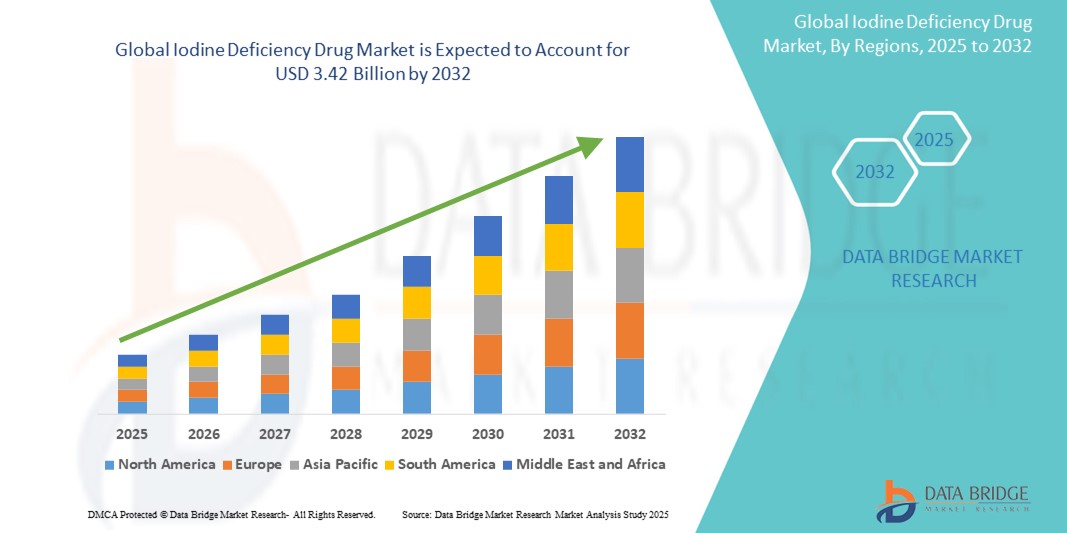
Iodine Deficiency Drug Market Size
- The global Iodine Deficiency Drug Market was valued at USD 1.95 billion in 2024 and is expected to reach USD 3.42 billion by 2032.
- During the forecast period of 2025 to 2032, the market is likely to grow at a CAGR of 7.1%, primarily driven by the growing awareness of thyroid-related disorders and rising demand for iodine supplementation in developing regions.
- This growth is driven by factors such as the increasing prevalence of iodine deficiency disorders (IDD), expansion of nutritional programs, and innovations in supplement formulations tailored to diverse demographic needs.
Iodine Deficiency Drug Market Analysis
- The global Iodine Deficiency Drug Market is expected to gain market growth in the forecast period of 2025 to 2032. Data Bridge Market Research analyzes the market to account for growth at a CAGR of 7.1% in the above-mentioned forecast period.
- Iodine deficiency is a major public health issue globally, leading to conditions such as goiter, hypothyroidism, and developmental delays, particularly in pregnant women and young children. It is primarily caused by insufficient dietary iodine intake.
- The rise in health education campaigns, increased consumption of processed food lacking iodine, initiatives by global health organizations for universal salt iodization, and enhanced access to healthcare services are key factors driving the growth of the global Iodine Deficiency Drug Market
Report Scope and Iodine Deficiency Drug Market Segmentation
|
Attributes |
Iodine Deficiency Drug Market Key Market Insights |
|
Segments Covered |
• By Drug Type : (Iodine Supplements, Potassium Iodide, Others) |
|
Countries Covered |
North America
Europe
Asia-Pacific
Middle East and Africa
South America
|
|
Key Market Players |
|
|
Market Opportunities |
|
|
Value Added Data Infosets |
In addition to the insights on market scenarios such as market value, growth rate, segmentation, geographical coverage, and major players, the market reports curated by the Data Bridge Market Research also include import export analysis, production capacity overview, production consumption analysis, price trend analysis, climate change scenario, supply chain analysis, value chain analysis, raw material/consumables overview, vendor selection criteria, PESTLE Analysis, Porter Analysis, and regulatory framework. |
Global Iodine Deficiency Drug Market Trends
“Emphasis on Preventive Healthcare and Iodine-Enriched Formulations”
• A prominent trend in the iodine deficiency drug market is the growing focus on preventive healthcare approaches, including iodine supplementation through oral formulations and fortified food products.
• The market is witnessing increased adoption of iodine tablets, multivitamin supplements, and potassium iodide-based treatments to address both mild and severe deficiencies, particularly in high-risk populations such as pregnant women and children.
• For example, global health authorities have updated dietary guidelines to include higher iodine intake recommendations in iodine-deficient regions to prevent conditions like goiter, cognitive impairment, and cretinism.
• Additionally, innovations in slow-release and bioavailable iodine formulations are improving patient compliance and treatment outcomes.
• Rising health literacy, school-based supplementation programs, and public-private partnerships are collectively boosting awareness and early intervention for iodine deficiency disorders.
Global Iodine Deficiency Drug Market Dynamics
Driver
“Rising Prevalence of Iodine Deficiency and Associated Disorders”
Iodine deficiency remains one of the leading causes of preventable intellectual disabilities and thyroid dysfunction globally.
For instance:
• According to the World Health Organization, nearly 2 billion people worldwide have insufficient iodine intake, with substantial impact in parts of Africa, Southeast Asia, and Eastern Europe.
• The resulting health issues such as goiter, hypothyroidism, and developmental delays are driving the need for increased iodine supplementation and fortified drug products.
“Government Endorsement of Iodine Supplementation Initiatives”
Policies that support salt iodization, regular monitoring of iodine status in vulnerable groups, and mass media awareness campaigns are driving market growth.
For instance:
• In 2023, several nations implemented mandatory iodization laws and increased funding for iodine monitoring and health education, contributing to better disease prevention outcomes and expanded access to iodine supplements.
Opportunity
“Increased Fortification Programs and Awareness Campaigns”
The iodine deficiency drug market is experiencing growth opportunities from expanded food fortification initiatives and rising health consciousness.
For instance:
• Novel delivery systems such as iodine-fortified beverages, cereals, and prenatal supplements are gaining popularity.
• Organizations like UNICEF and WHO are collaborating with governments to strengthen supply chains and promote iodine-rich diets in underserved regions.
• Growing demand for over-the-counter iodine supplements in developed nations is also contributing to market expansion, particularly among health-conscious consumers and aging populations.
Restraint/Challenge
“Limited Access and Awareness in Low-Income Regions”
• Despite public health efforts, the market is constrained by low awareness levels and limited healthcare access in certain parts of the world, especially rural areas with poor distribution networks.
• Additionally, misconceptions about iodine supplementation, lack of proper diagnostic infrastructure, and insufficient healthcare funding continue to challenge implementation.
For example:
• While iodized salt and supplements are effective preventive tools, their distribution remains uneven, and sustainability of supplementation programs is often threatened by funding shortages and political instability in low-resource settings
Global Iodine Deficiency Drug Market Scope
The market is segmented on the basis of drug type, Route of Administration, end-users, and distribution channel.
|
Segmentation |
Sub-Segmentation |
|
Drug type |
|
|
Route of Administration |
|
|
End-Users |
|
|
Distribution Channel |
|
Global Iodine Deficiency Drug Market Regional Analysis
“North America is the Dominant Region in the Global Iodine Deficiency Drug Market”
- North America leads the global Iodine Deficiency Drug market due to strong public health infrastructure, proactive nutritional monitoring programs, and widespread use of iodine supplements.
- The United States holds the largest market share, driven by rising awareness regarding thyroid disorders, government-supported iodine fortification initiatives, and broad access to over-the-counter iodine supplements.
- Advanced diagnostic capabilities and the presence of major pharmaceutical and nutraceutical companies contribute to sustained innovation and availability of iodine therapies.
- Reimbursement support for thyroid disorder treatment and preventive supplementation further boosts product adoption across healthcare settings.
“Asia-Pacific is Projected to Register the Highest Growth Rate”
- The Asia-Pacific region is expected to witness the fastest growth in the Iodine Deficiency Drug market due to higher rates of iodine deficiency and increasing efforts to improve nutritional health.
- Countries such as India, China, Indonesia, and the Philippines are driving demand through government-led iodized salt programs and increased access to thyroid disorder treatment.
- National campaigns and public-private partnerships for maternal and child health are significantly enhancing market penetration.
- Japan and South Korea, with their well-developed healthcare systems, have robust demand for iodine supplements in managing thyroid conditions.
- Multinational companies expanding their regional footprint and increasing online supplement sales are accelerating market expansion in Asia-Pacific.
Iodine Deficiency Drug Market Share
The competitive landscape of the market provides detailed insights into key players. This includes company profiles, financial data, R&D investment, product portfolios, global footprint, manufacturing capabilities, strategic initiatives, and competitive positioning in the context of iodine therapy development and distribution.
The Major Market Leaders Operating in the Market Include:
- Abbott Laboratories
- GlaxoSmithKline plc
- Merck KGaA
- Pfizer Inc.
- Bayer AG
- Sanofi S.A.
- Nutraceutical Corporation
- Life Extension
- NOW Foods
- Biotics Research Corporation
- A.Vogel
- Pure Encapsulations, LLC
- RLC Labs
- Thorne Research, Inc.
- Himalaya Wellness
- Amway Corporation
- DSM Nutritional Products
- Jarrow Formulas, Inc.
- Nature’s Way Products, LLC
- Archer Daniels Midland Company
Latest Developments in Global Iodine Deficiency Drug Market
- In November 2022, the World Health Organization (WHO) emphasized the growing need to address iodine deficiency disorders, especially among pregnant women and children in developing countries. Global disparities in iodine intake prompted calls for renewed commitment to fortification programs and universal salt iodization.
- Furthermore, industry players are increasingly focusing on bioavailable formulations and precision supplementation technologies, while integrating iodine with other essential micronutrients to enhance efficacy in managing thyroid-related conditions.
SKU-
Accédez en ligne au rapport sur le premier cloud mondial de veille économique

- Tableau de bord d'analyse de données interactif
- Tableau de bord d'analyse d'entreprise pour les opportunités à fort potentiel de croissance
- Accès d'analyste de recherche pour la personnalisation et les requêtes
- Analyse de la concurrence avec tableau de bord interactif
- Dernières actualités, mises à jour et analyse des tendances
- Exploitez la puissance de l'analyse comparative pour un suivi complet de la concurrence
Méthodologie de recherche
La collecte de données et l'analyse de l'année de base sont effectuées à l'aide de modules de collecte de données avec des échantillons de grande taille. L'étape consiste à obtenir des informations sur le marché ou des données connexes via diverses sources et stratégies. Elle comprend l'examen et la planification à l'avance de toutes les données acquises dans le passé. Elle englobe également l'examen des incohérences d'informations observées dans différentes sources d'informations. Les données de marché sont analysées et estimées à l'aide de modèles statistiques et cohérents de marché. De plus, l'analyse des parts de marché et l'analyse des tendances clés sont les principaux facteurs de succès du rapport de marché. Pour en savoir plus, veuillez demander un appel d'analyste ou déposer votre demande.
La méthodologie de recherche clé utilisée par l'équipe de recherche DBMR est la triangulation des données qui implique l'exploration de données, l'analyse de l'impact des variables de données sur le marché et la validation primaire (expert du secteur). Les modèles de données incluent la grille de positionnement des fournisseurs, l'analyse de la chronologie du marché, l'aperçu et le guide du marché, la grille de positionnement des entreprises, l'analyse des brevets, l'analyse des prix, l'analyse des parts de marché des entreprises, les normes de mesure, l'analyse globale par rapport à l'analyse régionale et des parts des fournisseurs. Pour en savoir plus sur la méthodologie de recherche, envoyez une demande pour parler à nos experts du secteur.
Personnalisation disponible
Data Bridge Market Research est un leader de la recherche formative avancée. Nous sommes fiers de fournir à nos clients existants et nouveaux des données et des analyses qui correspondent à leurs objectifs. Le rapport peut être personnalisé pour inclure une analyse des tendances des prix des marques cibles, une compréhension du marché pour d'autres pays (demandez la liste des pays), des données sur les résultats des essais cliniques, une revue de la littérature, une analyse du marché des produits remis à neuf et de la base de produits. L'analyse du marché des concurrents cibles peut être analysée à partir d'une analyse basée sur la technologie jusqu'à des stratégies de portefeuille de marché. Nous pouvons ajouter autant de concurrents que vous le souhaitez, dans le format et le style de données que vous recherchez. Notre équipe d'analystes peut également vous fournir des données sous forme de fichiers Excel bruts, de tableaux croisés dynamiques (Fact book) ou peut vous aider à créer des présentations à partir des ensembles de données disponibles dans le rapport.











