


Segmentation du marché mondial des circuits intégrés logiques, par type (circuits intégrés logiques à usage général et circuits intégrés logiques spécifiques à une application), technologie (bipolaire, CMOS et BiCMOS), application (électronique grand public, automobile, informatique et télécommunications, informatique et autres) - Tendances du secteur et prévisions jusqu'en 2033
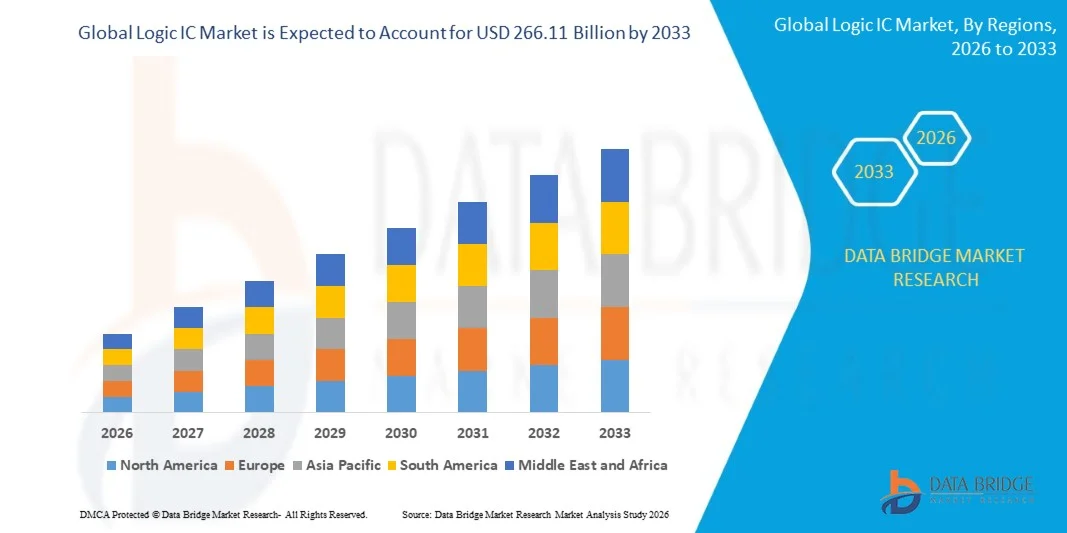
Taille du marché des circuits intégrés logiques
- Le marché mondial des circuits intégrés logiques était évalué à 170,15 milliards de dollars en 2025 et devrait atteindre 266,11 milliards de dollars d'ici 2033 , avec un TCAC de 5,75 % au cours de la période de prévision.
- La croissance du marché est largement alimentée par la demande croissante en matière de calcul haute performance, d'applications basées sur l'IA et d'électronique grand public avancée.
- L'adoption rapide du cloud computing, des centres de données et des infrastructures réseau alimente le besoin de solutions de circuits intégrés logiques efficaces et évolutives.
Analyse du marché des circuits intégrés logiques
- Le marché connaît des avancées technologiques significatives, notamment une faible consommation d'énergie, la miniaturisation et une vitesse de traitement accrue, permettant des applications plus larges dans de nombreux secteurs.
- L'augmentation des investissements dans la R&D des semi-conducteurs, ainsi que les initiatives gouvernementales visant à stimuler la production locale de semi-conducteurs, renforcent l'écosystème mondial des circuits intégrés logiques.
- La région Asie-Pacifique a dominé le marché des circuits intégrés logiques en 2025, avec la plus grande part de revenus, grâce à la croissance rapide de l'électronique grand public, de l'électronique automobile, des infrastructures informatiques et de l'automatisation industrielle dans des pays comme la Chine, le Japon, la Corée du Sud et l'Inde.
- L'Amérique du Nord devrait connaître le taux de croissance le plus élevé sur le marché mondial des circuits intégrés logiques , sous l'effet de la demande croissante en matière de cloud computing, de centres de données, d'appareils dotés d'intelligence artificielle et de systèmes automobiles avancés.
- Le segment des circuits intégrés logiques à usage général a représenté la plus grande part de revenus du marché en 2025, grâce à leur polyvalence pour de multiples applications, leur facilité d'intégration dans les appareils électroniques standard et leur rentabilité pour la production de masse. Ces circuits intégrés sont largement utilisés dans l'électronique grand public, les systèmes informatiques et les équipements de réseau, ce qui en fait un choix privilégié pour les fabricants.
Portée du rapport et segmentation du marché des circuits intégrés logiques
|
Attributs |
Aperçu du marché des circuits intégrés logiques |
|
Segments couverts |
|
|
Pays couverts |
Amérique du Nord
Europe
Asie-Pacifique
Moyen-Orient et Afrique
Amérique du Sud
|
|
Acteurs clés du marché |
|
|
Opportunités de marché |
|
|
Ensembles d'informations de données à valeur ajoutée |
En plus des informations sur les scénarios de marché tels que la valeur du marché, le taux de croissance, la segmentation, la couverture géographique et les principaux acteurs, les rapports de marché élaborés par Data Bridge Market Research comprennent également une analyse approfondie d'experts, la production et la capacité par entreprise représentées géographiquement, les schémas de réseau des distributeurs et des partenaires, une analyse détaillée et mise à jour des tendances des prix et une analyse des déficits de la chaîne d'approvisionnement et de la demande. |
Tendances du marché des circuits intégrés logiques
« L’essor des circuits intégrés logiques hautes performances et basse consommation »
L’essor des circuits intégrés logiques hautes performances et basse consommation transforme le paysage des semi-conducteurs en permettant un traitement plus rapide et un fonctionnement écoénergétique dans l’électronique grand public, les centres de données et les applications d’IA. Ces avancées améliorent les performances des systèmes tout en réduisant la consommation d’énergie, contribuant ainsi aux objectifs de développement durable et au respect des normes énergétiques réglementaires strictes. Par ailleurs, la demande croissante de dispositifs miniaturisés et d’électronique portable stimule l’innovation dans la conception de circuits basse consommation.
La demande croissante de circuits intégrés logiques dans le cloud computing, les équipements réseau et le calcul haute performance (HPC) accélère le développement d'architectures avancées et de puces optimisées. Les entreprises adoptent des architectures multicœurs et hétérogènes pour gérer efficacement des charges de travail complexes, tout en assurant une gestion thermique et une optimisation énergétique. Cette tendance est renforcée par l'augmentation du trafic de données et le besoin de solutions évolutives et fiables dans les centres de données à grande échelle.
L'intégration de circuits intégrés logiques dans l'électronique automobile, l'automatisation industrielle et les objets connectés (IoT) favorise l'adoption du marché. Les fabricants bénéficient de systèmes plus efficaces et de capacités de calcul accrues, permettant ainsi la création d'appareils plus intelligents et connectés. Le déploiement croissant de véhicules autonomes, d'usines intelligentes et d'applications IoT basées sur l'IA stimule la demande en solutions de circuits intégrés logiques robustes, à faible latence et à haute fiabilité.
Par exemple, en 2023, plusieurs entreprises de semi-conducteurs ont lancé des circuits intégrés logiques basse consommation de nouvelle génération, optimisés pour les accélérateurs d'IA et les dispositifs de calcul en périphérie. Ces circuits intégrés améliorent les performances, réduisent la consommation d'énergie et optimisent l'efficacité globale des dispositifs. Ces lancements visaient également à réduire l'encombrement sur silicium, à améliorer l'efficacité thermique et à permettre des fréquences d'horloge plus élevées pour les applications en temps réel. L'adoption précoce par les fournisseurs de services cloud et les constructeurs automobiles confirme le potentiel du marché.
Si les progrès réalisés dans le domaine des circuits intégrés logiques favorisent la différenciation des produits et permettent le développement d'applications de nouvelle génération, une croissance durable repose sur l'innovation continue, l'évolutivité de la production et l'optimisation des coûts. Garantir la compatibilité avec les plateformes existantes, raccourcir les cycles de conception et répondre aux enjeux de cybersécurité sont également des facteurs clés qui influencent l'adoption à long terme et l'expansion du marché.
Dynamique du marché des circuits intégrés logiques
Conducteur
« Adoption croissante des circuits intégrés logiques dans l’électronique grand public, les centres de données et les applications automobiles »
L'intégration croissante de circuits intégrés logiques dans les smartphones, les ordinateurs portables, les serveurs et les périphériques réseau alimente la demande en puces rapides et économes en énergie. Ces circuits intégrés permettent un traitement plus rapide, une latence réduite et des performances améliorées, répondant ainsi aux besoins des applications numériques modernes. Par ailleurs, les attentes croissantes des consommateurs en matière de jeux vidéo avancés, de réalité augmentée/réalité virtuelle et d'intelligence artificielle stimulent les mises à niveau et l'adoption continues de ces technologies.
L’essor des investissements dans l’IA, l’apprentissage automatique et le cloud computing favorise l’adoption des circuits intégrés logiques dans les centres de données et les systèmes de calcul haute performance. Les entreprises privilégient les puces offrant des performances optimales tout en minimisant la consommation d’énergie. Le déploiement d’accélérateurs d’inférence IA et de nœuds de calcul en périphérie accroît encore la demande de circuits intégrés logiques spécialisés, adaptés aux exigences spécifiques des charges de travail.
L’expansion du marché de l’électronique automobile, notamment les systèmes avancés d’aide à la conduite (ADAS), les systèmes d’infodivertissement et les véhicules électriques, génère une demande accrue de circuits intégrés logiques prenant en charge des fonctions de traitement et de connectivité avancées. Ces circuits intégrés logiques sont également essentiels à la communication véhicule-infrastructure (V2X), aux systèmes de gestion des batteries et au contrôle de la chaîne de traction électrique, contribuant ainsi à améliorer l’intelligence et la sécurité globales du véhicule.
Par exemple, en 2024, les principaux fabricants de semi-conducteurs ont augmenté leur production de circuits intégrés logiques haute vitesse et basse consommation pour les accélérateurs d'IA et les applications automobiles, favorisant ainsi une adoption plus large et stimulant la croissance du marché. Ces augmentations ont porté sur l'accroissement de la production de plaquettes, l'amélioration des taux de rendement et l'intégration de solutions d'encapsulation avancées pour de meilleures performances et une fiabilité accrue dans les applications finales.
• Si les progrès technologiques stimulent l'adoption, la fiabilité de la chaîne d'approvisionnement, la maîtrise des coûts et la flexibilité de conception demeurent essentielles à une expansion durable. Garantir un approvisionnement fiable en matières premières, réduire la dépendance à un fournisseur unique et optimiser les délais de fabrication sont indispensables pour atténuer les risques et assurer une croissance régulière du marché.
Retenue/Défi
« Coût élevé des circuits intégrés logiques avancés et processus de fabrication complexes »
Le coût élevé des circuits intégrés logiques avancés, dû à des procédés de fabrication de pointe et à des conceptions sophistiquées, limite leur accessibilité aux petits fabricants et aux marchés émergents. Ceci freine leur adoption à grande échelle dans tous les secteurs d'utilisation finale. De plus, les dépenses de R&D, les licences de propriété intellectuelle et les exigences de test augmentent encore les coûts globaux pour les acteurs du marché.
Les exigences complexes de fabrication, notamment la lithographie avancée et la manipulation de précision des plaquettes, augmentent les coûts de production et les difficultés opérationnelles des entreprises de semi-conducteurs. La gestion du rendement, la réduction des défauts et l'intégration de nouveaux matériaux complexifient encore la production, nécessitant des investissements importants et une main-d'œuvre qualifiée.
Les perturbations de la chaîne d'approvisionnement, les fluctuations du coût des matières premières et les contraintes de capacité de production peuvent affecter la disponibilité et le prix des produits, limitant ainsi la pénétration du marché. Les facteurs géopolitiques, les catastrophes naturelles et les problèmes logistiques peuvent aggraver ces risques, entraînant des retards de livraison et des pertes de revenus.
Par exemple, en 2023, les pénuries mondiales de puces ont entraîné des retards dans le lancement de produits et une hausse des prix des circuits intégrés logiques hautes performances, affectant de nombreux secteurs technologiques. Les entreprises ont été contraintes de privilégier leurs clients clés, ce qui a impacté les acteurs de plus petite taille et ralenti l'adoption sur les marchés émergents.
Si l'innovation continue d'améliorer les performances des circuits intégrés logiques, la maîtrise des coûts, la robustesse de la chaîne d'approvisionnement et la capacité de production à grande échelle demeurent essentielles à la croissance du marché à long terme. Les fabricants investissent de plus en plus dans les technologies de pointe, l'automatisation et les sites de production locaux afin de réduire leur dépendance aux chaînes d'approvisionnement mondiales instables et de garantir une croissance durable.
Étendue du marché des circuits intégrés logiques
Le marché des circuits intégrés logiques est segmenté en fonction du type, de la technologie et de l'application.
• Par type
Le marché est segmenté, selon le type de circuit intégré, en circuits intégrés logiques à usage général et circuits intégrés logiques dédiés. En 2025, le segment des circuits intégrés logiques à usage général détenait la plus grande part de revenus, grâce à leur polyvalence, leur facilité d'intégration dans les appareils électroniques standard et leur rentabilité pour la production de masse. Largement utilisés dans l'électronique grand public, les systèmes informatiques et les équipements de réseau, ces circuits intégrés sont privilégiés par les fabricants.
Le segment des circuits intégrés logiques dédiés devrait connaître la croissance la plus rapide entre 2026 et 2033, portée par la demande croissante de solutions personnalisées pour les accélérateurs d'IA, l'électronique automobile et l'automatisation industrielle. Ces circuits intégrés offrent des performances optimisées, une consommation d'énergie réduite et une fiabilité accrue pour les tâches spécialisées, favorisant ainsi leur adoption dans les applications émergentes et à hautes performances.
• Par la technologie
En fonction de la technologie utilisée, le marché se divise en trois segments : bipolaire, CMOS et BiCMOS. Le segment CMOS détenait la plus grande part de marché en 2025, grâce à sa faible consommation d’énergie, sa haute densité d’intégration et son adéquation aux appareils portables et alimentés par batterie. La technologie CMOS est largement utilisée dans les smartphones, les ordinateurs portables et les objets connectés, contribuant ainsi à la conception de systèmes économes en énergie.
Le segment BiCMOS devrait connaître la croissance la plus rapide entre 2026 et 2033, grâce à sa capacité à combiner la vitesse de fonctionnement des transistors bipolaires et la faible consommation d'énergie des transistors CMOS. Cette technologie est de plus en plus utilisée dans les applications à haute fréquence et à forte intensité analogique, telles que les systèmes de communication, les capteurs automobiles et les accélérateurs matériels d'intelligence artificielle.
• Sur demande
En fonction de l'application, le marché est segmenté en électronique grand public, automobile, informatique et télécommunications, informatique et autres. Le segment de l'électronique grand public a généré la plus grande part de revenus en 2025, grâce à la forte demande de smartphones, d'ordinateurs portables, de tablettes et d'objets connectés, pour lesquels les circuits intégrés logiques constituent un élément essentiel à la performance et à l'efficacité énergétique.
Le secteur automobile devrait connaître la croissance la plus rapide entre 2026 et 2033, portée par l'intégration croissante des circuits intégrés logiques dans les véhicules électriques, les systèmes avancés d'aide à la conduite (ADAS), les systèmes d'infodivertissement et les modules de communication V2X. Les circuits intégrés logiques permettent de concevoir des véhicules plus intelligents, plus sûrs et plus connectés, favorisant ainsi leur adoption rapide dans l'industrie automobile.
Analyse régionale du marché des circuits intégrés logiques
• La région Asie-Pacifique a dominé le marché des circuits intégrés logiques en 2025, avec la plus grande part de revenus, grâce à la croissance rapide de l'électronique grand public, de l'électronique automobile, des infrastructures informatiques et de l'automatisation industrielle dans des pays comme la Chine, le Japon, la Corée du Sud et l'Inde.
• Les entreprises de la région se concentrent de plus en plus sur les circuits intégrés logiques hautes performances et basse consommation pour répondre à la demande croissante d'accélérateurs d'IA, de cloud computing, de systèmes ADAS automobiles et d'appareils intelligents.
Cette adoption généralisée est également soutenue par des initiatives gouvernementales favorisant la fabrication de semi-conducteurs, des chaînes d'approvisionnement électroniques robustes et des investissements importants en R&D, faisant de l'Asie-Pacifique le pôle mondial de la production et de l'innovation en circuits intégrés logiques.
Analyse du marché des circuits intégrés logiques en Chine
Le marché chinois des circuits intégrés logiques a généré la plus grande part de revenus en Asie-Pacifique en 2025, grâce à une forte activité de production électronique nationale, à l'adoption rapide de l'IA, de l'IoT et de l'électronique automobile, ainsi qu'à des politiques gouvernementales favorables à la production locale de semi-conducteurs. Les fabricants chinois augmentent leurs capacités de production et investissent dans des technologies de fabrication avancées afin de répondre à la demande locale et mondiale.
Analyse du marché japonais des circuits intégrés logiques
Le marché japonais des circuits intégrés logiques devrait connaître une croissance significative entre 2026 et 2033, portée par leur adoption croissante dans l'électronique grand public, la robotique, l'électronique automobile et les applications d'intelligence artificielle. L'écosystème mature des semi-conducteurs au Japon, l'accent mis sur les puces à haute performance et à faible consommation d'énergie, ainsi que l'importance accordée à la R&D, favorisent l'innovation et une meilleure pénétration du marché.
Analyse du marché européen des circuits intégrés logiques
Le marché européen des circuits intégrés logiques devrait connaître une forte croissance entre 2026 et 2033, principalement tirée par la demande croissante en électronique automobile, en automatisation industrielle et en appareils grand public à faible consommation d'énergie. Les investissements dans la fabrication de semi-conducteurs de pointe et les circuits intégrés logiques intégrant l'intelligence artificielle soutiennent l'expansion de ce marché.
Analyse du marché américain des circuits intégrés logiques
Le marché américain des circuits intégrés logiques devrait connaître une croissance soutenue entre 2026 et 2033, portée par leur adoption dans les centres de données, le cloud computing, les accélérateurs d'IA, l'électronique automobile et les appareils grand public. Des investissements importants en R&D, une infrastructure de fabrication de semi-conducteurs de pointe et la demande croissante de circuits intégrés logiques basse consommation et hautes performances sont les principaux moteurs de cette croissance aux États-Unis.
Analyse du marché allemand des circuits intégrés logiques
Le marché allemand des circuits intégrés logiques devrait connaître une croissance notable entre 2026 et 2033, portée par l'automatisation industrielle, l'électronique automobile et la demande en calcul haute performance. L'accent mis par l'Allemagne sur l'innovation, l'efficacité énergétique et l'intégration des circuits intégrés logiques dans les applications d'IA, automobiles et IoT favorise cette expansion.
Analyse du marché des circuits intégrés logiques en Amérique du Nord
L'Amérique du Nord devrait connaître une croissance notable entre 2026 et 2033, portée par l'adoption massive de l'électronique grand public, des centres de données et des applications automobiles, ainsi que par l'augmentation des investissements dans l'IA, le cloud computing et les systèmes de calcul haute performance. Les entreprises de la région se concentrent de plus en plus sur les circuits intégrés logiques haute performance et économes en énergie afin de répondre à la demande croissante de traitement plus rapide, de latence réduite et de performances accrues des appareils dans de nombreux secteurs d'utilisation finale.
Analyse du marché américain des circuits intégrés logiques
Le marché américain des circuits intégrés logiques devrait connaître une croissance notable entre 2026 et 2033, portée par une forte demande en smartphones, ordinateurs portables, serveurs et systèmes électroniques automobiles. Les entreprises privilégient la production de circuits intégrés logiques basse consommation et haute vitesse pour les accélérateurs d'IA, les systèmes ADAS automobiles et l'infrastructure de cloud computing. Par ailleurs, les investissements publics et privés dans la recherche et la fabrication de semi-conducteurs contribuent significativement à l'expansion de ce marché.
Part de marché des circuits intégrés logiques
L'industrie des circuits intégrés logiques est principalement dominée par des entreprises bien établies, notamment :
- Analog Devices, Inc. (États-Unis)
- Diodes Incorporated (États-Unis)
- Infineon Technologies AG (Allemagne)
- Intel Corporation (États-Unis)
- NXP Semiconductors (Pays-Bas)
- Renesas Electronics Corporation (Japon)
- Industries de composants semi-conducteurs, LLC (États-Unis)
- STMicroelectronics (Suisse)
- Texas Instruments Incorporated (États-Unis)
- TOSHIBA ELECTRONIC DEVICES & STORAGE CORPORATION (Japon)
Dernières évolutions du marché mondial des circuits intégrés logiques
- En février 2025, SMIC a annoncé la deuxième phase d'expansion de son usine de fabrication de plaquettes à Pékin, avec pour objectif d'y établir la plus grande fonderie de circuits intégrés logiques de la ville. Ce projet représente un investissement total d'environ 6,86 milliards de dollars (50 milliards de yuans) et sa construction devrait débuter début 2025. Ce développement vise à accroître la capacité de production de semi-conducteurs de SMIC, à soutenir la production de circuits intégrés logiques avancés et à renforcer la chaîne d'approvisionnement chinoise en puces, ce qui aura un impact positif sur le marché régional des semi-conducteurs.
- En décembre 2024, Nexperia a lancé une série de circuits intégrés logiques miniaturisés en boîtier MicroPak XSON5 sans broches, conforme aux exigences automobiles. Ces circuits intégrés sont conçus pour réduire la surface occupée sur les circuits imprimés jusqu'à 75 % tout en améliorant la fiabilité de fabrication pour des applications automobiles telles que la surveillance des batteries, les systèmes de sécurité du châssis, l'infodivertissement et les systèmes avancés d'aide à la conduite (ADAS). Le boîtier plastique à dissipation thermique optimisée et à flancs mouillables permet une inspection optique automatisée des joints de soudure, ce qui réduit les coûts de production et garantit des normes de qualité plus élevées, favorisant ainsi son adoption dans les systèmes électroniques automobiles où l'espace est limité.
SKU-
Accédez en ligne au rapport sur le premier cloud mondial de veille économique

- Tableau de bord d'analyse de données interactif
- Tableau de bord d'analyse d'entreprise pour les opportunités à fort potentiel de croissance
- Accès d'analyste de recherche pour la personnalisation et les requêtes
- Analyse de la concurrence avec tableau de bord interactif
- Dernières actualités, mises à jour et analyse des tendances
- Exploitez la puissance de l'analyse comparative pour un suivi complet de la concurrence
Méthodologie de recherche
La collecte de données et l'analyse de l'année de base sont effectuées à l'aide de modules de collecte de données avec des échantillons de grande taille. L'étape consiste à obtenir des informations sur le marché ou des données connexes via diverses sources et stratégies. Elle comprend l'examen et la planification à l'avance de toutes les données acquises dans le passé. Elle englobe également l'examen des incohérences d'informations observées dans différentes sources d'informations. Les données de marché sont analysées et estimées à l'aide de modèles statistiques et cohérents de marché. De plus, l'analyse des parts de marché et l'analyse des tendances clés sont les principaux facteurs de succès du rapport de marché. Pour en savoir plus, veuillez demander un appel d'analyste ou déposer votre demande.
La méthodologie de recherche clé utilisée par l'équipe de recherche DBMR est la triangulation des données qui implique l'exploration de données, l'analyse de l'impact des variables de données sur le marché et la validation primaire (expert du secteur). Les modèles de données incluent la grille de positionnement des fournisseurs, l'analyse de la chronologie du marché, l'aperçu et le guide du marché, la grille de positionnement des entreprises, l'analyse des brevets, l'analyse des prix, l'analyse des parts de marché des entreprises, les normes de mesure, l'analyse globale par rapport à l'analyse régionale et des parts des fournisseurs. Pour en savoir plus sur la méthodologie de recherche, envoyez une demande pour parler à nos experts du secteur.
Personnalisation disponible
Data Bridge Market Research est un leader de la recherche formative avancée. Nous sommes fiers de fournir à nos clients existants et nouveaux des données et des analyses qui correspondent à leurs objectifs. Le rapport peut être personnalisé pour inclure une analyse des tendances des prix des marques cibles, une compréhension du marché pour d'autres pays (demandez la liste des pays), des données sur les résultats des essais cliniques, une revue de la littérature, une analyse du marché des produits remis à neuf et de la base de produits. L'analyse du marché des concurrents cibles peut être analysée à partir d'une analyse basée sur la technologie jusqu'à des stratégies de portefeuille de marché. Nous pouvons ajouter autant de concurrents que vous le souhaitez, dans le format et le style de données que vous recherchez. Notre équipe d'analystes peut également vous fournir des données sous forme de fichiers Excel bruts, de tableaux croisés dynamiques (Fact book) ou peut vous aider à créer des présentations à partir des ensembles de données disponibles dans le rapport.











