



Global Magnetic Resonance Imaging (MRI) systems market Segmentation, By Application (Neurology, Cardiology, Breast Imaging, Vascular Imaging, Extremity Imaging, Pediatric Imaging, and Others), Field Strength (Very-high—field, High-field, and Low-to-mid-field), Architecture (Closed MRI systems, Standard bore MRI, Wide bore MRI, and Open MRI systems) - Industry Trends and Forecast to 2032
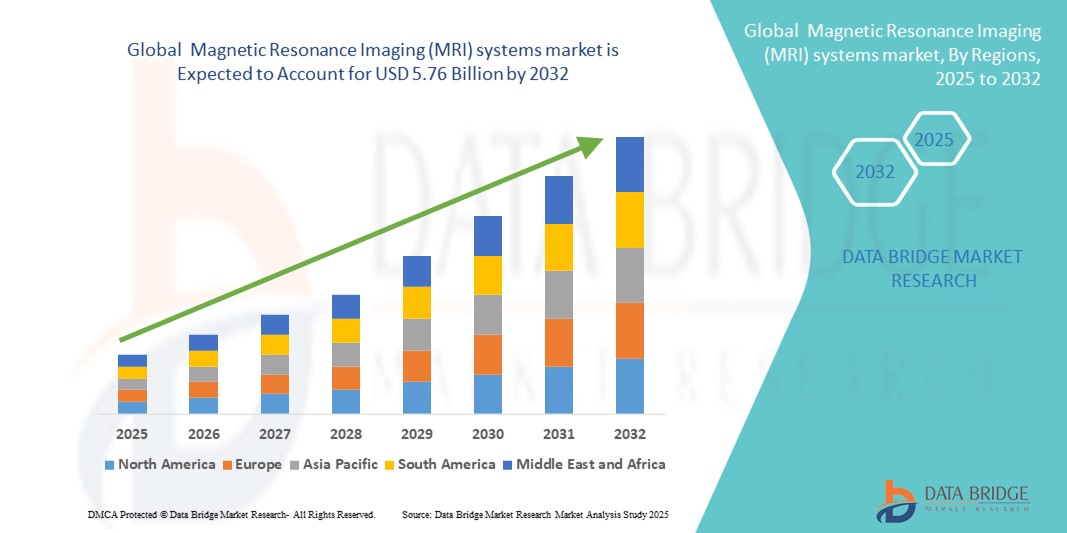
Magnetic Resonance Imaging (MRI) systems market Size
- The global Magnetic Resonance Imaging (MRI) systems market size was valued at USD 4.13 billion in 2024 and is expected to reach USD 5.76 billion by 2032, at a CAGR of 4.25% during the forecast period
- This growth is driven by factors such as the increasing prevalence of chronic diseases, advancements in MRI technology, rising demand for early diagnosis, and expanding healthcare infrastructure worldwide
Magnetic Resonance Imaging (MRI) systems market Analysis
- Magnetic resonance imaging (MRI) is an imaging technology which is used to diagnose the diseases or health concerns in the body
- Magnetic resonance imaging scanners uses electromagnetic radiation to develop images of the body. Its applications are widespread in terms of diagnosis, aftermath of diseases, identification of phase of disease
- North America is expected to dominate the Global Magnetic Resonance Imaging (MRI)s market due to advanced healthcare infrastructure and with a high number of MRI systems per capita
- Asia-Pacific is expected to be the fastest growing region in the magnetic resonance imaging (MRI) systems market during the forecast period due to Increasing geriatric population leading to higher demand for diagnostic imaging
- Closed MRI systems segment is expected to dominate the market with a market share of 76.10% due to its high prevalence and demand for precision. As the leading procedure for vision restoration, advancements in surgical techniques and microscope technologies enhance outcomes
Report Scope and Magnetic Resonance Imaging (MRI) systems market Segmentation
|
Attributes |
Magnetic Resonance Imaging (MRI) systems Key Market Insights |
|
Segments Covered |
|
|
Countries Covered |
North America
Europe
Asia-Pacific
Middle East and Africa
South America
|
|
Key Market Players |
|
|
Market Opportunities |
|
|
Value Added Data Infosets |
In addition to the insights on market scenarios such as market value, growth rate, segmentation, geographical coverage, and major players, the market reports curated by the Data Bridge Market Research also include in-depth expert analysis, patient epidemiology, pipeline analysis, pricing analysis, and regulatory framework. |
Magnetic Resonance Imaging (MRI) systems market Trends
“Integration of Artificial Intelligence (AI) in MRI Systems”
- AI algorithms assist in analyzing complex MRI images, leading to more accurate and timely diagnoses
- For instance, AI-driven tools can detect subtle abnormalities that may be overlooked by human radiologists
- AI integration streamlines the image acquisition and interpretation processes, reducing scan times and increasing throughput in clinical settings
- By analyzing vast datasets, AI can help in tailoring individualized treatment strategies based on MRI findings
- AI models can predict disease progression by analyzing changes in MRI scans over time, aiding in proactive patient management
- The incorporation of AI is expected to drive the MRI systems market, with projections indicating significant growth in the coming years
Magnetic Resonance Imaging (MRI) systems market Dynamics
Driver
“Increasing Prevalence of Chronic Diseases”
- Chronic conditions such as cancer, cardiovascular diseases, and neurological disorders are becoming more prevalent globally, increasing the demand for diagnostic imaging
- The global aging demographic contributes to a higher incidence of age-related chronic diseases, further driving the need for MRI diagnostics
- The growing number of patients with chronic diseases places additional pressure on healthcare systems, highlighting the necessity for advanced diagnostic tools such as MRI.
- Early diagnosis through MRI can lead to better treatment outcomes and reduced healthcare costs in the long term
- The increasing burden of chronic diseases is a significant factor propelling the growth of the MRI systems market
Opportunity
“Expansion in Emerging Markets”
- Emerging economies are investing in healthcare infrastructure, creating opportunities for MRI system adoption
- For Instance, increased spending on healthcare in developing countries facilitates the procurement of advanced diagnostic equipment such as MRI systems
- Improved awareness and accessibility to healthcare services in emerging markets drive the demand for diagnostic imaging
- Supportive government policies and initiatives aimed at enhancing healthcare services contribute to the growth of the MRI market in these regions
- The expansion of healthcare services in emerging markets presents significant growth opportunities for the MRI systems market
Restraint/Challenge
“High Cost and Limited Accessibility”
- The high cost of MRI systems makes them unaffordable for many healthcare facilities, particularly in low-resource settings
- Maintenance, operational expenses, and the need for specialized personnel add to the overall cost of MRI services
- For Instance, in many regions, especially rural and underserved areas, access to MRI facilities is limited, affecting timely diagnosis and treatment
- Inadequate insurance coverage and reimbursement policies can deter healthcare providers from investing in MRI technology
- These challenges hinder the widespread adoption of MRI systems, particularly in developing countries, affecting market growth
Magnetic Resonance Imaging (MRI) systems market Scope
The market is segmented on the basis of application, field strength, and architecture.
|
Segmentation |
Sub-Segmentation |
|
By Application |
|
|
By Field Strength |
|
|
By Architecture |
|
In 2025, the cataract surgery is projected to dominate the market with a largest share in architecture segment
The closed MRI system segment is expected to dominate the magnetic resonance imaging (MRI) systems market with the largest share of 76.10% in 2025 due to its high prevalence and demand for precision. As the leading procedure for vision restoration, advancements in surgical techniques and microscope technologies enhance outcomes.
The neurology is expected to account for the largest share during the forecast period in application market
In 2025, the neurology segment is expected to dominate the market with the largest market share due to its rising prevalence of neurological disorders such as Alzheimer's, Parkinson's, and multiple sclerosis. The ability of MRI to provide detailed, non-invasive imaging of the brain and spinal cord makes it an essential tool for diagnosing and monitoring these conditions.
Magnetic Resonance Imaging (MRI) systems market Regional Analysis
“North America Holds the Largest Share in the Magnetic Resonance Imaging (MRI) systems market”
- North America magnetic resonance imaging market dominated the market with the largest revenue share of 37.1%
- U.S. Is expected to dominate the global magnetic resonance imaging (MRI) systems market, particularly in the North America region. This dominance is attributed to its presence of leading MRI system manufacturers and research institutions
- High prevalence of chronic diseases such as breast cancer, cardiovascular disorders, and neurological conditions. Advanced healthcare infrastructure with a high number of MRI systems per capita.
- Significant healthcare expenditure and favorable reimbursement policies. Presence of leading MRI system manufacturers and research institutions.
- Integration of artificial intelligence (AI) and big data analytics in MRI systems.
- Development of high-field MRI systems offering superior image quality. Introduction of portable and open MRI systems catering to diverse patient needs.
- Continued dominance expected due to ongoing investments in healthcare infrastructure and technological innovations.
“Asia-Pacific is Projected to Register the Highest CAGR in the Magnetic Resonance Imaging (MRI) systems market”
- Increasing geriatric population leading to higher demand for diagnostic imaging. Rising prevalence of chronic diseases such as cancer and cardiovascular disorders.
- Government initiatives to enhance healthcare infrastructure and accessibility. Expansion of medical tourism, particularly in countries such as India and Thailand.
- Adoption of advanced MRI technologies, including high-field and open MRI systems. Implementation of AI-driven diagnostic tools to improve imaging accuracy.
- Growth in private healthcare facilities equipped with state-of-the-art MRI systems Rapid expansion anticipated due to favorable demographic trends and increasing healthcare investments.
Magnetic Resonance Imaging (MRI) systems market Share
The market competitive landscape provides details by competitor. Details included are company overview, company financials, revenue generated, market potential, investment in research and development, new market initiatives, global presence, production sites and facilities, production capacities, company strengths and weaknesses, product launch, product width and breadth, application dominance. The above data points provided are only related to the companies' focus related to market.
The Major Market Leaders Operating in the Market Are:
- Siemens Healthcare Private Limited(Germany)
- GENERAL ELECTRIC(U.S.)
- Koninklijke Philips N.V.(Netherlands)
- Hitachi Ltd. (Japan)
- CANON MEDICAL SYSTEMS CORPORATION(Japan)
- Aspect Imaging (U.S.)
- Bruker (U.S.)
- Aurora Health Care (U.S.)
- Esaote SpA (Italy)
- FONAR (U.S.)
- Neusoft Corporation (China)
- Shenzhen Mindray Bio-Medical Electronics Co. Ltd. (China)
- Shimadzu Corporation (Japan)
- Carestream Health (U.S.)
- Hologic Inc. (U.S.)
- Barco (Belgium)
- Nordion Inc (Canada)
Latest Developments in Global Magnetic Resonance Imaging (MRI) systems Market
- In March 2025, Polarean Imaging plc expanded its Xenon MRI imaging platform to support pharma-sponsored research. This expansion, in partnership with VIDA Diagnostics, included the introduction of a new service model to enable the use of the device in enhanced research applications
- In November 2023, GE Healthcare collaborated with The University of Wisconsin School of Medicine and Public Health at UW–Madison to expand the existing scope beyond medical imaging to the introduction of new digital technologies and disease-focused solutions
- In October 2023, Siemens Healthineers and Cardiff University formed a strategic partnership to advance medical technologies, building on their decade-long collaboration in diagnostics. The partnership focuses on imaging research and precision diagnostics, with Cardiff’s Brain Research Imaging Centre (CUBRIC) driving innovation in MR technology and brain mapping
- In June 2023, Imagion Biosystems Limited expanded its collaboration with Siemens Healthineers, extending its existing agreement with Siemens Healthcare Pty Ltd in Australia for 2 more years. The partnership now includes collaboration in the U.S. through Siemens Medical Solutions USA
- In April 2023, Siemens Healthineers expanded its manufacturing presence in India by launching an MRI facility in Bengaluru, supported by the Government of India’s PLI scheme. The company has also introduced a new production line at the Bengaluru facility for manufacturing MRI machines
- In November 2022, Siemens Healthineers (Germany) launched a new MRI system for mobile use. The Magnetom Viato.Mobile system is equipped with latest advancements and can be used anywhere.
SKU-
Accédez en ligne au rapport sur le premier cloud mondial de veille économique

- Tableau de bord d'analyse de données interactif
- Tableau de bord d'analyse d'entreprise pour les opportunités à fort potentiel de croissance
- Accès d'analyste de recherche pour la personnalisation et les requêtes
- Analyse de la concurrence avec tableau de bord interactif
- Dernières actualités, mises à jour et analyse des tendances
- Exploitez la puissance de l'analyse comparative pour un suivi complet de la concurrence
Méthodologie de recherche
La collecte de données et l'analyse de l'année de base sont effectuées à l'aide de modules de collecte de données avec des échantillons de grande taille. L'étape consiste à obtenir des informations sur le marché ou des données connexes via diverses sources et stratégies. Elle comprend l'examen et la planification à l'avance de toutes les données acquises dans le passé. Elle englobe également l'examen des incohérences d'informations observées dans différentes sources d'informations. Les données de marché sont analysées et estimées à l'aide de modèles statistiques et cohérents de marché. De plus, l'analyse des parts de marché et l'analyse des tendances clés sont les principaux facteurs de succès du rapport de marché. Pour en savoir plus, veuillez demander un appel d'analyste ou déposer votre demande.
La méthodologie de recherche clé utilisée par l'équipe de recherche DBMR est la triangulation des données qui implique l'exploration de données, l'analyse de l'impact des variables de données sur le marché et la validation primaire (expert du secteur). Les modèles de données incluent la grille de positionnement des fournisseurs, l'analyse de la chronologie du marché, l'aperçu et le guide du marché, la grille de positionnement des entreprises, l'analyse des brevets, l'analyse des prix, l'analyse des parts de marché des entreprises, les normes de mesure, l'analyse globale par rapport à l'analyse régionale et des parts des fournisseurs. Pour en savoir plus sur la méthodologie de recherche, envoyez une demande pour parler à nos experts du secteur.
Personnalisation disponible
Data Bridge Market Research est un leader de la recherche formative avancée. Nous sommes fiers de fournir à nos clients existants et nouveaux des données et des analyses qui correspondent à leurs objectifs. Le rapport peut être personnalisé pour inclure une analyse des tendances des prix des marques cibles, une compréhension du marché pour d'autres pays (demandez la liste des pays), des données sur les résultats des essais cliniques, une revue de la littérature, une analyse du marché des produits remis à neuf et de la base de produits. L'analyse du marché des concurrents cibles peut être analysée à partir d'une analyse basée sur la technologie jusqu'à des stratégies de portefeuille de marché. Nous pouvons ajouter autant de concurrents que vous le souhaitez, dans le format et le style de données que vous recherchez. Notre équipe d'analystes peut également vous fournir des données sous forme de fichiers Excel bruts, de tableaux croisés dynamiques (Fact book) ou peut vous aider à créer des présentations à partir des ensembles de données disponibles dans le rapport.











