


Global Piezoelectric Materials Market Segmentation, par produit (ceramiques, polymères, composites, etc.), Application (activateurs, capteurs, moteurs, dispositifs acoustiques, générateurs, SONAR, transducteurs, etc.), Utilisation finale (automobile, santé, information et télécommunications, biens de consommation, aérospatiale et défense, etc.) - Tendances et prévisions de l'industrie jusqu'en 2033
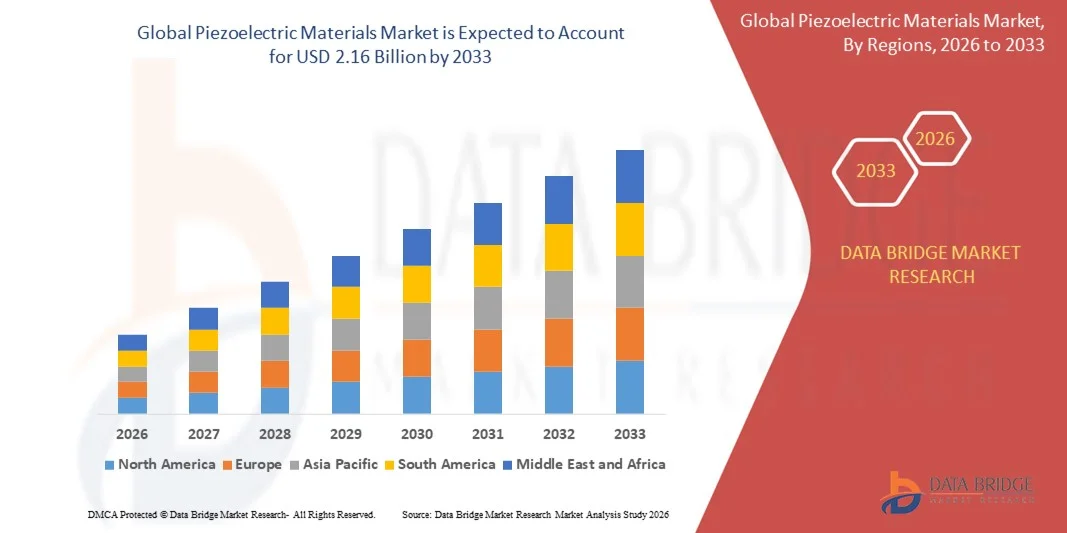
Quelle est la taille et le taux de croissance du marché mondial des matériaux piézoélectriques?
- La taille du marché mondial des matériaux piézoélectriques a été évaluée à1,47 milliard de dollars en 2025et devrait atteindre2,16 milliards de dollars en 2033, à unTCAC de6,88%pendant la période de prévision
- L'augmentation de la demande de composants électroniques économes en énergie et performants, l'adoption croissante de matériaux piézoélectriques dans les capteurs automobiles, les actuateurs, les dispositifs d'imagerie médicale, l'automatisation industrielle et l'électronique grand public, l'utilisation croissante des dispositifs compatibles avec l'IoT et les progrès continus dans les matériaux intelligents et les systèmes électroniques miniaturisés sont parmi les facteurs clés de la croissance du marché
Quels sont les principaux débouchés du marché des matériaux piézoélectriques?
- La demande croissante de véhicules électriques, de dispositifs de soins de santé de pointe, de capteurs de précision et d'électronique de consommation intelligente, ainsi que les activités croissantes de recherche et de développement dans le domaine de la science des matériaux, créent des possibilités de croissance importantes pour le marché des matériaux piézoélectriques
- Toutefois, les coûts élevés des matériaux, les processus de fabrication complexes, les préoccupations environnementales liées aux céramiques au plomb et la disponibilité limitée de compétences spécialisées pour l'intégration des matériaux avancés sont des défis clés qui peuvent freiner la croissance du marché au cours de la période de prévision.
- L'Asie-Pacifique a dominé le marché des matériaux piézoélectriques avec la plus grande part des revenus de 35,53 % en 2025, sous l'impulsion de solides bases de fabrication d'électronique, d'industrialisation rapide et de forte demande des secteurs de l'automobile, de l'électronique grand public, des télécommunications et de l'automatisation industrielle en Chine, au Japon, en Corée du Sud et en Inde.
- L'Amérique du Nord devrait enregistrer le TCAC le plus rapide de 9,36 % de 2026 à 2033, appuyé par une forte activité de R-D, l'adoption rapide de technologies médicales de pointe, l'innovation en aérospatiale et en défense et l'utilisation croissante de matériaux piézoélectriques dans les véhicules électriques, les systèmes d'énergie renouvelable et l'automatisation industrielle.
- Le segment de la céramique a dominé le marché avec une part d'environ 48 % en 2025, en raison de ses coefficients piézoélectriques supérieurs, de sa haute résistance mécanique, de sa stabilité thermique et de sa grande applicabilité à l'ensemble des capteurs, des actionneurs, des transducteurs et des appareils d'échographie médicale.
Portée du rapport et segmentation du marché des matériaux piézoélectriques
| Attributs | Matériaux piézoélectriques Principales perspectives du marché |
| Segments couverts |
|
| Pays couverts | Amérique du Nord
Europe
Asie-Pacifique
Moyen-Orient et Afrique
Amérique du Sud
|
| Principaux acteurs du marché |
|
| Possibilités de marché |
|
| Infos sur la valeur ajoutée | En plus des renseignements sur les scénarios du marché tels que la valeur du marché, le taux de croissance, la segmentation, la couverture géographique et les principaux intervenants, les rapports de marché établis par Data Bridge Market Research comprennent également une analyse approfondie des experts, une analyse des prix, une analyse des parts de marque, une enquête auprès des consommateurs, une analyse démographique, une analyse de la chaîne d'approvisionnement, une analyse de la chaîne de valeur, une vue d'ensemble des matières premières et des consommables, des critères de sélection des fournisseurs, une analyse PESTLE, une analyse Porter et un cadre réglementaire. |
Quelle est la tendance clé du marché des matériaux piézoélectriques?
Vers des matériaux piézoélectriques spécifiques, miniaturisés, à haut rendement et à application
- Le marché des matériaux piézoélectriques est témoin de l'adoption croissante de matériaux compacts, légers et à haute sensibilité conçus pour les capteurs avancés, les actionneurs, les dispositifs médicaux et l'électronique de précision
- Les fabricants se concentrent de plus en plus sur les céramiques sans plomb, les cristaux simples et les matériaux piézoélectriques à base de polymères pour répondre aux exigences de durabilité et de performance
- La demande croissante de composants électroniques miniaturisés, de dispositifs MEMS et de technologies portables stimule l'innovation dans les matériaux piézoélectriques souples et minces
- Par exemple, des entreprises telles que TDK, CeramTec, PI Ceramics, Solvay et Arkema développent des portefeuilles avec des céramiques piézoélectriques et des polymères à haut rendement, optimisés par l'application
- L'utilisation croissante de matériaux piézoélectriques pour la récolte d'énergie, l'imagerie par échographie, le contrôle des mouvements de précision et la détection acoustique accélère l'adoption du marché
- À mesure que les systèmes électroniques deviennent plus petits, plus intelligents et plus économes en énergie, les matériaux piézoélectriques demeurent critiques pour le contrôle de précision, la précision de détection et l'intégration des appareils multifonctionnels
Quels sont les principaux moteurs du marché des matériaux piézoélectriques?
- Augmentation de la demande de capteurs, actionneurs et transducteurs haute performance dans les secteurs de l'automobile, des soins de santé, de l'automatisation industrielle et de l'électronique grand public
- Par exemple, entre 2024 et 2025, plusieurs fabricants ont amélioré les formulations de matériaux piézoélectriques pour soutenir les systèmes d'EV, les systèmes avancés d'assistance au conducteur (ADAS) et les équipements d'imagerie médicale
- L'adoption croissante d'appareils IoT, de robotique, de systèmes de fabrication intelligents et d'instruments de précision stimule la demande mondiale de composants piézoélectriques fiables
- Les progrès de la science des matériaux, des techniques de croissance des cristaux et des composites de polymères ont amélioré la sensibilité, la durabilité et la stabilité de la température.
- Le déploiement croissant de diagnostics à base d'ultrasons, de dispositifs médicaux peu invasifs et de systèmes de détection aérospatiale est à l'origine de la demande en volume
- Soutenu par de solides investissements dans la R-D en électronique, la technologie des soins de santé et la fabrication avancée, le marché des matériaux piézoélectriques devrait connaître une croissance soutenue à long terme
Quel est le facteur qui conteste la croissance du marché des matériaux piézoélectriques?
- Les coûts élevés associés aux céramiques piézoélectriques avancées, aux matériaux monocristaux et aux procédés de fabrication de précision limitent l'adoption dans les applications sensibles aux coûts
- Ainsi, entre 2024 et 2025, les fluctuations des prix des matières premières et des coûts énergétiques ont eu des répercussions sur les dépenses de production de plusieurs fournisseurs mondiaux de matières piézoélectriques.
- La complexité de la conception et les défis d'intégration des matériaux dans les applications à haute fréquence, à haute température et miniaturisées nécessitent une expertise spécialisée
- Les préoccupations environnementales et les restrictions réglementaires imposées aux matériaux piézoélectriques au plomb augmentent les coûts de conformité et le fardeau de la R-D
- La concurrence des technologies de détection alternatives, telles que les capteurs optiques et électromagnétiques, crée une pression tarifaire dans certaines applications
- Pour surmonter ces difficultés, les entreprises investissent dans des matériaux sans plomb, la fabrication évolutive et la personnalisation spécifique à l'application, favorisant l'adoption plus large du marché des matériaux piézoélectriques
Comment le marché des matériaux piézoélectriques est-il segmenté?
Le marché est segmenté sur la base detype de produit, application et utilisation finale.
- Par produit
Sur la base du produit, le marché des matériaux piézoélectriques est segmenté en céramique, polymères, composites et autres. Le segment de la céramique a dominé le marché avec une part d'environ 48% en 2025, en raison de ses coefficients piézoélectriques supérieurs, haute résistance mécanique, stabilité thermique, et une large applicabilité entre capteurs, actionneurs, transducteurs et appareils d'échographie médicale. Les céramiques piézoélectriques telles que PZT sont largement utilisées dans les systèmes automobiles, l'automatisation industrielle, les composants aérospatiaux et l'électronique grand public en raison de leur fiabilité et de leur rentabilité dans la production en grand volume.
Le segment des polymères devrait enregistrer le TCAC le plus rapide de 2026 à 2033, en raison de la demande croissante d'électronique légère, flexible et portable. L'adoption croissante de matériaux piézoélectriques à base de polymères dans les dispositifs médicaux, les systèmes de récolte d'énergie, les capteurs flexibles et les applications IoT accélère la croissance. Les progrès réalisés dans le domaine de l'ingénierie des matériaux et la préférence croissante pour des solutions de remplacement sans plomb favorisent davantage l'expansion à long terme.
- Par demande
Sur la base de l'application, le marché est segmenté en actuateurs, capteurs, moteurs, appareils acoustiques, générateurs, SONAR, transducteurs, etc. Le segment Sensors détenait la plus grande part de marché d'environ 38 à 40 % en 2025, soutenue par une large utilisation dans les systèmes de sécurité automobile, la surveillance industrielle, le diagnostic des soins de santé et l'électronique grand public. Les capteurs piézoélectriques offrent une haute sensibilité, une réponse rapide et une durabilité, ce qui les rend idéales pour les applications de pression, de vibration, d'accélération et de détection acoustique.
On s'attend à ce que le segment des actuateurs augmente au rythme le plus rapide entre 2026 et 2033, en raison de la demande croissante de contrôle des mouvements de précision dans les domaines de la robotique, de la fabrication de semi-conducteurs, des systèmes aérospatiaux et de l'équipement médical. L'adoption croissante de systèmes de micropositionnement, d'optique adaptative et de technologies de nanoposition stimule considérablement l'utilisation de servomoteurs piézoélectriques dans les applications techniques avancées.
- Par utilisation finale
Sur la base de l'utilisation finale, le marché des matériaux piézoélectriques est segmenté en Automobile, Santé, Information et Télécom, Biens de consommation, Aéronautique et Défense, et autres. Le segment de l'automobile a dominé le marché avec une part d'environ 34 à 36 % en 2025, grâce à l'intégration croissante de matériaux piézoélectriques dans les systèmes d'injection de carburant, la gestion des moteurs, l'ADAS, la détection de vibrations et les composants du groupe motopropulseur EV. L'élargissement de l'électrification des véhicules et des normes de sécurité strictes continuent de renforcer l'adoption.
Le segment des soins de santé devrait connaître la croissance la plus rapide de 2026 à 2033, grâce à l'utilisation accrue de matériaux piézoélectriques dans l'imagerie par échographie, les capteurs médicaux, les systèmes de distribution de médicaments et les dispositifs peu invasifs. Les investissements croissants dans les soins de santé, le vieillissement de la population et les progrès technologiques accélèrent encore la croissance du marché dans ce segment.
Quelle région détient la plus grande part du marché des matériaux piézoélectriques?
- L'Asie-Pacifique a dominé le marché des matériaux piézoélectriques avec la plus grande part des revenus de 35,53 % en 2025, sous l'impulsion de solides bases de fabrication d'électronique, d'industrialisation rapide et de forte demande des secteurs de l'automobile, de l'électronique grand public, des télécommunications et de l'automatisation industrielle en Chine, au Japon, en Corée du Sud et en Inde. La région bénéficie de la production à grande échelle de capteurs, actionneurs, transducteurs et composants acoustiques qui utilisent largement la céramique piézoélectrique et les polymères
- Les investissements croissants dans la fabrication de semi-conducteurs, la fabrication d'EV, la robotique et les appareils intelligents, ainsi que l'expansion de l'infrastructure 5G et le déploiement de l'IoT, continuent d'alimenter la demande de matériaux piézoélectriques dans les applications de masse et de haute performance.
- Une fabrication rentable, une main-d'oeuvre qualifiée et un solide soutien gouvernemental pour l'électronique et les matériaux avancés renforcent encore le leadership de l'Asie-Pacifique sur le marché mondial
China Piezoelectric Materials Market Insight
La Chine est le principal contributeur de l'Asie et du Pacifique, soutenue par son écosystème dominant de fabrication d'électroniques, son importante base de production automobile et ses investissements énergiques dans les technologies de fabrication intelligente et les énergies renouvelables. L'utilisation croissante de matériaux piézoélectriques dans les capteurs, les appareils à ultrasons, les systèmes de récolte d'énergie et l'automatisation industrielle stimule une croissance soutenue du marché.
Marché japonais des matériaux piézoélectriques
Le Japon affiche une croissance constante en raison de sa forte concentration sur l'électronique de haute précision, l'innovation automobile, la robotique et les appareils médicaux. La R-D continue dans les céramiques de pointe et les matériaux piézoélectriques sans plomb soutient l'adoption à long terme dans toutes les applications premium.
India Piezoelectric Materials Market Insight
L'Inde émerge comme un marché à forte croissance, alimenté par l'expansion de la fabrication électronique, l'adoption croissante d'EV, la production d'appareils de soins de santé et des initiatives soutenues par le gouvernement. La demande croissante de capteurs, d'actionneurs et d'appareils d'échographie médicale accélère la pénétration du marché.
Amérique du Nord Marché des matériaux piézoélectriques
L'Amérique du Nord devrait enregistrer le TCAC le plus rapide de 9,36 % entre 2026 et 2033, appuyé par une forte activité de R-D, l'adoption rapide de technologies médicales de pointe, l'innovation en aérospatiale et en défense et l'utilisation croissante de matériaux piézoélectriques dans les véhicules électriques, les systèmes d'énergie renouvelable et l'automatisation industrielle.
U.S. Piezoelectric Materials Market Insight
Les États-Unis dirigent la croissance régionale en raison de la forte recherche sur les semi-conducteurs, de l'innovation dans les dispositifs médicaux et des applications aérospatiales. La hausse de la demande de capteurs de précision, d'actionneurs et de technologies à ultrasons stimule considérablement l'expansion du marché.
Aperçu du marché canadien des matériaux piézoélectriques
Le Canada contribue de façon constante, en raison de l'adoption croissante de matériaux piézoélectriques dans les domaines du diagnostic des soins de santé, de la détection industrielle, des applications d'énergie propre et de la recherche universitaire, appuyée par des programmes d'innovation financés par le gouvernement et des compétences en génie.
Quelles sont les meilleures entreprises du marché des matériaux piézoélectriques?
L'industrie des matériaux piézoélectriques est principalement dirigée par des entreprises bien établies, notamment :
- PI Ceramics GmbH (Allemagne)
- APC International, Ltd. (États-Unis)
- L3Harris Technologies, Inc. (États-Unis)
- CeramTec (Allemagne)
- Arkema (France)
- Solvay (Belgique)
- Céramiques mousseuses (Inde)
- Piezomechanik GmbH (Allemagne)
- TDK Corporation (Japon)
- Hong Kong Piezo Co. Ltd. (Chine)
- Mide Technology (États-Unis)
- Megitt PLC (Royaume-Uni)
- HOERBIGER Motion Control GmbH (Allemagne)
- Piezo Kinetics Inc. (États-Unis)
- TRS Technologies, Inc. (États-Unis)
Quelles sont les évolutions récentes du marché mondial des matériaux piézoélectriques?
- En février 2025, CeramTec a développé un nouveau titanate de sodium de bismuth – titanate de barium (BNT-BT) à base de piézoceramic sans plomb avec un fort potentiel pour les applications médicales, renforçant l'entreprise se concentrant sur des matériaux durables et de haute performance pour les technologies de santé de prochaine génération
- En décembre 2024, PI Ceramic a mis en place une ligne de production entièrement automatisée pour la technologie multicouches et investi environ 1,08 million de dollars pour accélérer la production de petites séries et le développement de prototypes, ce qui a permis d'accélérer le redressement des échantillons et une plus grande flexibilité de fabrication pour répondre à la demande croissante des clients.
- En octobre 2022, PI Ceramic a investi environ 16,24 millions de dollars pour la construction d'une nouvelle installation à Lederhose, en Allemagne, augmentant de près de 50 % sa capacité de production de composants piézo de haute qualité, ce qui renforce les capacités d'approvisionnement à long terme dans un contexte de croissance de la demande mondiale.
- En avril 2020, CTS Corporation a élargi son portefeuille de produits en lançant quatre nouvelles familles de cristaux conçues pour les applications de résonateurs à cristaux de qualité automobile, améliorant ainsi sa position sur le marché de l'électronique automobile grâce à des solutions de performance et de fiabilité améliorées
SKU-
Accédez en ligne au rapport sur le premier cloud mondial de veille économique

- Tableau de bord d'analyse de données interactif
- Tableau de bord d'analyse d'entreprise pour les opportunités à fort potentiel de croissance
- Accès d'analyste de recherche pour la personnalisation et les requêtes
- Analyse de la concurrence avec tableau de bord interactif
- Dernières actualités, mises à jour et analyse des tendances
- Exploitez la puissance de l'analyse comparative pour un suivi complet de la concurrence
Méthodologie de recherche
La collecte de données et l'analyse de l'année de base sont effectuées à l'aide de modules de collecte de données avec des échantillons de grande taille. L'étape consiste à obtenir des informations sur le marché ou des données connexes via diverses sources et stratégies. Elle comprend l'examen et la planification à l'avance de toutes les données acquises dans le passé. Elle englobe également l'examen des incohérences d'informations observées dans différentes sources d'informations. Les données de marché sont analysées et estimées à l'aide de modèles statistiques et cohérents de marché. De plus, l'analyse des parts de marché et l'analyse des tendances clés sont les principaux facteurs de succès du rapport de marché. Pour en savoir plus, veuillez demander un appel d'analyste ou déposer votre demande.
La méthodologie de recherche clé utilisée par l'équipe de recherche DBMR est la triangulation des données qui implique l'exploration de données, l'analyse de l'impact des variables de données sur le marché et la validation primaire (expert du secteur). Les modèles de données incluent la grille de positionnement des fournisseurs, l'analyse de la chronologie du marché, l'aperçu et le guide du marché, la grille de positionnement des entreprises, l'analyse des brevets, l'analyse des prix, l'analyse des parts de marché des entreprises, les normes de mesure, l'analyse globale par rapport à l'analyse régionale et des parts des fournisseurs. Pour en savoir plus sur la méthodologie de recherche, envoyez une demande pour parler à nos experts du secteur.
Personnalisation disponible
Data Bridge Market Research est un leader de la recherche formative avancée. Nous sommes fiers de fournir à nos clients existants et nouveaux des données et des analyses qui correspondent à leurs objectifs. Le rapport peut être personnalisé pour inclure une analyse des tendances des prix des marques cibles, une compréhension du marché pour d'autres pays (demandez la liste des pays), des données sur les résultats des essais cliniques, une revue de la littérature, une analyse du marché des produits remis à neuf et de la base de produits. L'analyse du marché des concurrents cibles peut être analysée à partir d'une analyse basée sur la technologie jusqu'à des stratégies de portefeuille de marché. Nous pouvons ajouter autant de concurrents que vous le souhaitez, dans le format et le style de données que vous recherchez. Notre équipe d'analystes peut également vous fournir des données sous forme de fichiers Excel bruts, de tableaux croisés dynamiques (Fact book) ou peut vous aider à créer des présentations à partir des ensembles de données disponibles dans le rapport.











