


Global Polycaprolactone (PCL) Market Segmentation, By Form (Pellets, Nanosphere, and Microsphere), Production Method (Ring Opening Polymerization and Polycondensation of Carboxylic Acid), Application (Thermoplastic Polyurethane and Healthcare) - Industry Trends and Forecast to 2032
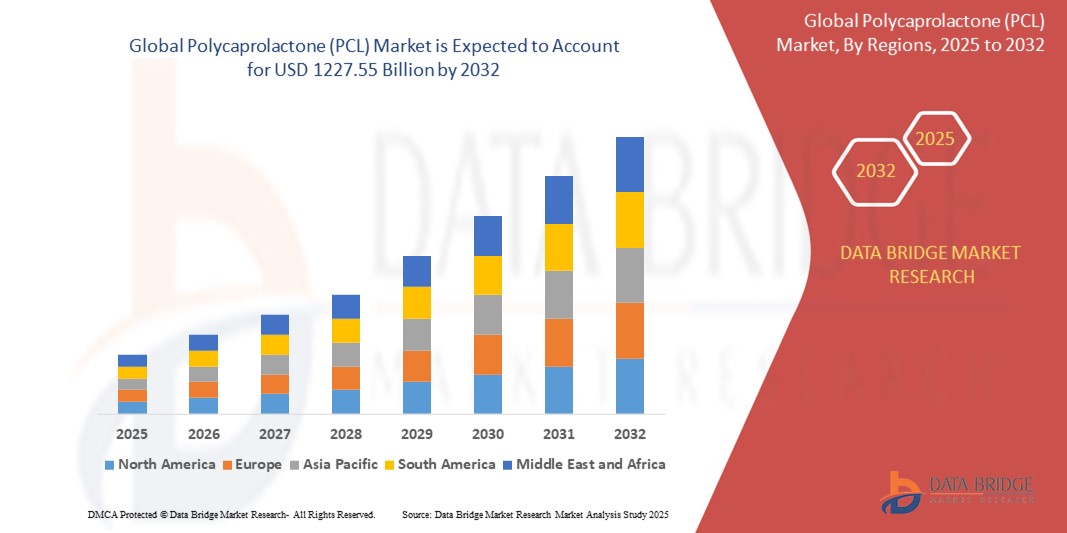
Polycaprolactone (PCL) Market Size
- The global polycaprolactone (PCL) market size was valued at USD 552.25 billion in 2024 and is expected to reach USD 1227.55 billion by 2032, at a CAGR of 10.50% during the forecast period
- The market growth is largely fuelled by the increasing demand for biodegradable polymers in medical, packaging, and agricultural applications, as well as the growing emphasis on sustainable materials across multiple industries
- Rising research and development activities focused on bioresorbable materials for use in tissue engineering and drug delivery systems are further driving market expansion
Polycaprolactone (PCL) Market Analysis
- The PCL market is gaining momentum due to its excellent biodegradability, biocompatibility, and low melting point, which make it highly suitable for 3D printing, wound healing, orthopedic implants, and controlled drug release applications
- Surge in demand from the medical and healthcare sectors, particularly in the development of scaffolds and drug encapsulation, is significantly contributing to market growth
- North America dominated the polycaprolactone (PCL) market with the largest revenue share in 2024, driven by strong demand for biodegradable materials in medical and packaging industries, along with increasing investment in bioplastics research
- Asia-Pacific region is expected to witness the highest growth rate in the global polycaprolactone (PCL) market, driven by increasing demand for biodegradable materials, rising healthcare expenditure, and expanding applications of PCL in medical devices and packaging across countries such as China, Japan, and India
- The pellets segment accounted for the largest market revenue share in 2024, driven by its extensive use in manufacturing thermoplastic polyurethane (TPU), specialty compounds, and biodegradable plastics. Pellets are favored by manufacturers due to their ease of handling, consistent quality, and compatibility with standard polymer processing techniques such as extrusion and injection molding. The demand for PCL pellets is particularly high in the medical sector for producing long-term implantable devices
Report Scope and Polycaprolactone (PCL) Market Segmentation
|
Attributes |
Polycaprolactone (PCL) Key Market Insights |
|
Segments Covered |
|
|
Countries Covered |
North America
Europe
Asia-Pacific
Middle East and Africa
South America
|
|
Key Market Players |
|
|
Market Opportunities |
• Rising Demand for Bioresorbable Polymers in Tissue Engineering and Drug Delivery Applications • Expansion of Sustainable Packaging Solutions using Biodegradable Polymer Blends Containing PCL |
|
Value Added Data Infosets |
In addition to the insights on market scenarios such as market value, growth rate, segmentation, geographical coverage, and major players, the market reports curated by the Data Bridge Market Research also include import export analysis, production capacity overview, production consumption analysis, price trend analysis, climate change scenario, supply chain analysis, value chain analysis, raw material/consumables overview, vendor selection criteria, PESTLE Analysis, Porter Analysis, and regulatory framework. |
Polycaprolactone (PCL) Market Trends
“Increasing Integration of PCL in 3D Printing for Biomedical Applications”
• PCL is increasingly used in 3D printing for its low melting point, biocompatibility, and ease of shaping into complex medical structures
• Its slow degradation rate supports long-term applications such as tissue scaffolds and bone implants
• Research institutions and biotech firms are actively exploring PCL-based bio-inks for regenerative medicine and personalized healthcare
• PCL is compatible with various cells and bioactive molecules, making it ideal for printing layered tissue constructs
• For instance, Aspect Biosystems uses PCL scaffolds to develop customized tissue models for research and therapeutic purposes
Polycaprolactone (PCL) Market Dynamics
Driver
“Growing Demand for Biodegradable Polymers in Healthcare and Packaging Industries”
- Heightened environmental regulations are pushing industries toward eco-friendly alternatives such as PCL
- PCL’s biocompatibility and biodegradability make it ideal for medical devices such as sutures, implants, and wound dressings
- In drug delivery, PCL enables controlled release formulations, reducing dosage frequency and enhancing efficacy
- Packaging companies are blending PCL with other bioplastics to create compostable films and containers
- For instance, Evonik Industries offers Resomer-grade PCL for bioresorbable medical applications, highlighting growing demand in healthcare
Restraint/Challenge
“High Production Costs and Limited Raw Material Availability”
- PCL production involves energy-intensive ring-opening polymerization, increasing manufacturing costs
- The use of specialized catalysts and petrochemical-based monomers further inflates raw material expenses
- Cost constraints limit its use in mass-market applications, especially when compared to cheaper alternatives such as PLA
- Small manufacturers and price-sensitive sectors often avoid PCL due to economic unviability despite its superior performance
- For instance, some packaging firms prefer low-cost starch-based films over PCL to meet sustainability goals within budget
Polycaprolactone (PCL) Market Scope
The polycaprolactone (PCL) market is segmented into three notable segments based on form, production method, and application.
• By Form
On the basis of form, the PCL market is segmented into pellets, nanosphere, and microsphere. The pellets segment accounted for the largest market revenue share in 2024, driven by its extensive use in manufacturing thermoplastic polyurethane (TPU), specialty compounds, and biodegradable plastics. Pellets are favored by manufacturers due to their ease of handling, consistent quality, and compatibility with standard polymer processing techniques such as extrusion and injection molding. The demand for PCL pellets is particularly high in the medical sector for producing long-term implantable devices.
The nanosphere segment is expected to witness the fastest growth rate from 2025 to 2032, attributed to its growing application in targeted drug delivery and advanced wound healing. Nanospheres offer controlled release properties and enhanced bioavailability, making them highly suitable for pharmaceutical and cosmetic formulations. The increasing focus on precision medicine and non-invasive treatment delivery systems is further accelerating the adoption of PCL nanospheres.
• By Production Method
On the basis of production method, the market is segmented into ring opening polymerization and polycondensation of carboxylic acid. The ring opening polymerization method held the largest share in 2024, owing to its ability to produce high molecular weight PCL with superior mechanical properties and controlled degradation rates. This method is widely used in industrial production due to its scalability, efficiency, and suitability for medical-grade applications.
The polycondensation of carboxylic acid segment is expected to witness the fastest growth rate from 2025 to 2032, due to its potential in developing low-molecular-weight PCL for specific niche applications. Though less common, this method is being explored for its cost-effectiveness and flexibility in tuning polymer properties for customized use cases.
• By Application
On the basis of application, the PCL market is segmented into thermoplastic polyurethane and healthcare. The thermoplastic polyurethane segment dominated the market in 2024 due to growing demand from footwear, automotive, and electronics industries for durable and biodegradable polymer blends. PCL’s ability to enhance the flexibility and biodegradability of TPU materials has contributed to its widespread industrial usage.
The healthcare segment is expected to witness the fastest growth rate from 2025 to 2032, driven by increasing applications in drug delivery systems, tissue engineering, and medical implants. PCL’s excellent biocompatibility and slow degradation rate make it highly suitable for use in resorbable sutures, scaffolds, and controlled release formulations in pharmaceutical and biomedical applications.
Polycaprolactone (PCL) Market Regional Analysis
• North America dominated the polycaprolactone (PCL) market with the largest revenue share in 2024, driven by strong demand for biodegradable materials in medical and packaging industries, along with increasing investment in bioplastics research
• The region benefits from well-established healthcare infrastructure and the presence of key market players focused on developing PCL-based implants, drug delivery systems, and specialty polymers
• Adoption is further boosted by favorable regulatory frameworks, rising sustainability awareness, and the integration of bioresorbable materials into high-value medical applications, making PCL a preferred choice across industrial and healthcare sectors
U.S. Polycaprolactone (PCL) Market Insight
The U.S. PCL market held the largest revenue share within North America in 2024, driven by continuous innovation in biomedical applications and the growing popularity of sustainable polymers. The country has witnessed significant adoption of PCL in orthopedic devices, drug encapsulation, and tissue engineering. Companies and research institutions are actively collaborating to enhance the functionality of PCL in 3D printing, regenerative medicine, and custom medical devices. Moreover, the growing emphasis on biodegradable packaging solutions is further expanding the material's commercial potential across multiple end-use sectors.
Europe Polycaprolactone (PCL) Market Insight
The Europe PCL market is expected to witness the fastest growth rate from 2025 to 2032, primarily due to strict environmental regulations, growing demand for green alternatives, and advancements in biomedical R&D. The region is witnessing increasing adoption of polycaprolactone in bioresorbable surgical implants and eco-friendly packaging. Consumers and manufacturers are shifting toward compostable and biocompatible materials, accelerating the uptake of PCL in both industrial and pharmaceutical domains. Europe also benefits from government-backed initiatives supporting circular economy principles and bio-based innovation.
U.K. Polycaprolactone (PCL) Market Insight
The U.K. PCL market is expected to witness the fastest growth rate from 2025 to 2032, supported by the rise in demand for sustainable materials in healthcare and consumer goods. The country is fostering innovation in advanced drug delivery systems and 3D-printed medical devices using PCL. Academic institutions and biotech firms are collaborating to develop novel formulations and biodegradable polymeric materials. In addition, the emphasis on reducing plastic waste and increasing adoption of compostable materials in packaging is supporting PCL market expansion.
Germany Polycaprolactone (PCL) Market Insight
The Germany PCL market is expected to witness the fastest growth rate from 2025 to 2032, driven by a strong medical device manufacturing base and increasing R&D investments in bioresorbable materials. PCL’s use in tissue engineering and orthopedic applications is expanding due to its excellent performance and compatibility with other biomaterials. Germany’s leadership in innovation, along with government support for sustainable materials and clean technologies, positions the country as a prominent contributor to the European PCL landscape.
Asia-Pacific Polycaprolactone (PCL) Market Insight
The Asia-Pacific PCL market is expected to witness the fastest growth rate from 2025 to 2032, driven by growing industrialization, expanding healthcare infrastructure, and a rising focus on eco-friendly materials. Countries such as China, Japan, and India are witnessing increasing demand for PCL in medical devices, biodegradable packaging, and 3D printing applications. The availability of cost-effective manufacturing, supportive government policies, and expanding pharmaceutical industries are major factors contributing to market growth across the region.
Japan Polycaprolactone (PCL) Market Insight
The Japan PCL market is expected to witness the fastest growth rate from 2025 to 2032, owing to its advanced healthcare systems and the country’s commitment to sustainable innovation. PCL is being utilized in a variety of biomedical applications, including resorbable sutures and drug delivery platforms. Japan’s strong emphasis on R&D, coupled with its leadership in polymer technology, is accelerating the development and commercialization of high-performance biodegradable polymers such as PCL.
China Polycaprolactone (PCL) Market Insight
The China PCL market held the largest revenue share in Asia Pacific in 2024, supported by rapid industrial growth, increasing consumer awareness of sustainable products, and rising demand from the pharmaceutical sector. China is also a major manufacturing base for biodegradable polymers, which has enabled cost-effective production and innovation in PCL applications. The government's push toward reducing plastic waste and promoting bio-based materials in packaging and healthcare is expected to further stimulate market growth in the country.
Polycaprolactone (PCL) Market Share
The Polycaprolactone (PCL) industry is primarily led by well-established companies, including:
- BASF SE (Germany)
- SABIC (Saudi Arabia)
- 3M (U.S.)
- Asahi Kasei Corporation (Japan)
- Solvay (Belgium), Sumitomo Chemical Co., Ltd (Japan)
- LyondellBasell Industries Holdings BV (Netherlands)
- Momentive (U.S.)
- Huntsman International L.L.C. (U.S.)
- LANXESS (Germany)
- Dow (U.S.)
- Perstorp (Sweden)
- Daicel Corporation (Japan)
- Shenzhen Esun Industrial Co. Ltd (China)
- Corbion (Netherlands)
- Merck KGaA (Germany)
- Polysciences Inc. (U.S.)
- Haihang Group (China)
- Durect Corporation (U.S.)
Latest Developments in Global Polycaprolactone (PCL) Market
- In November 2023, Sulzer unveiled CAPSUL, a pioneering technology set to transform the production of polycaprolactone (PCL). PCL, a biodegradable polyester, finds extensive use across various sectors such as packaging, textiles, agriculture, and horticulture. This cutting-edge CAPSUL technology enhances process efficiency, allowing for the production of high-quality PCL grades at competitive rates. It complements Sulzer's lineup of renewable and circular plastics technologies, which includes polylactic acid (PLA) process technology
SKU-
Accédez en ligne au rapport sur le premier cloud mondial de veille économique

- Tableau de bord d'analyse de données interactif
- Tableau de bord d'analyse d'entreprise pour les opportunités à fort potentiel de croissance
- Accès d'analyste de recherche pour la personnalisation et les requêtes
- Analyse de la concurrence avec tableau de bord interactif
- Dernières actualités, mises à jour et analyse des tendances
- Exploitez la puissance de l'analyse comparative pour un suivi complet de la concurrence
Table des matières
1 INTRODUCTION
1.1 OBJECTIVES OF THE STUDY
1.2 MARKET DEFINITION
1.3 OVERVIEW OF GLOBAL POLYCAPROLACTONE (PCL) MARKET
1.4 CURRENCY AND PRICING
1.5 LIMITATION
1.6 MARKETS COVERED
2 MARKET SEGMENTATION
2.1 KEY TAKEAWAYS
2.2 ARRIVING AT THE GLOBAL POLYCAPROLACTONE (PCL) MARKET SIZE
2.3 VENDOR POSITIONING GRID
2.4 TECHNOLOGY LIFE LINE CURVE
2.5 MARKET GUIDE
2.6 COMPANY POSITIONING GRID
2.6.1 KEY PLAYERS
2.6.2 DISRUPTORS
2.6.3 NICHE PLAYERS
2.6.4 PROSPECT LEADERS
2.7 COMPANY MARKET SHARE ANALYSIS
2.8 MULTIVARIATE MODELLING
2.9 DEMAND AND SUPPLY-SIDE VARIABLES
2.1 TOP TO BOTTOM ANALYSIS
2.11 STANDARDS OF MEASUREMENT
2.12 VENDOR SHARE ANALYSIS
2.13 DATA POINTS FROM KEY PRIMARY INTERVIEWS
2.14 DATA POINTS FROM KEY SECONDARY DATABASES
2.15 GLOBAL POLYCAPROLACTONE (PCL) MARKET : RESEARCH SNAPSHOT
2.16 ASSUMPTIONS
3 MARKET OVERVIEW
3.1 DRIVERS
3.2 RESTRAINTS
3.3 OPPORTUNITIES
3.4 CHALLENGES
4 EXECUTIVE SUMMARY
5 PREMIUM INSIGHTS
5.1 RAW MATERIAL COVERAGE
5.2 PRODUCTION CONSUMPTION ANALYSIS
5.3 IMPORT EXPORT SCENARIO
5.4 TECHNOLOGICAL ADVANCEMENT BY MANUFACTURERS
5.5 PORTER’S FIVE FORCES
5.6 VENDOR SELECTION CRITERIA
5.7 PESTEL ANALYSIS
5.8 REGULATION COVERAGE
5.8.1 PRODUCT CODES
5.8.2 CERTIFIED STANDARDS
5.8.3 SAFETY STANDARDS
5.8.3.1. MATERIAL HANDLING & STORAGE
5.8.3.2. TRANSPORT & PRECAUTIONS
5.8.3.3. HARAD IDENTIFICATION
6 PRICING ANALYSIS
7 SUPPLY CHAIN ANALYSIS
7.1 OVERVIEW
7.2 LOGISTIC COST SCENARIO
7.3 IMPORTANCE OF LOGISTICS SERVICE PROVIDERS
8 CLIMATE CHANGE SCENARIO
8.1 ENVIRONMENTAL CONCERNS
8.2 INDUSTRY RESPONSE
8.3 GOVERNMENT’S ROLE
8.4 ANALYST RECOMMENDATIONS
9 GLOBAL POLYCAPROLACTONE (PCL) MARKET, BY FORM, 2022-2031, (USD MILLION) (KILO TONS)
9.1 OVERVIEW
9.2 PELLETS
9.3 NANOSPHERE
9.4 MICROSPHERE
9.5 OTHERS (IF ANY)
10 GLOBAL POLYCAPROLACTONE (PCL) MARKET, BY PRODUCTION METHOD, 2022-2031, (USD MILLION)
10.1 OVERVIEW
10.2 RING OPENING POLYMERIZATION
10.3 POLYCONDENSATION OF CARBOXYLIC ACID
11 GLOBAL POLYCAPROLACTONE (PCL) MARKET, BY APPLICATION, 2022-2031, (USD MILLION)
11.1 OVERVIEW
11.2 THERMOPLASTIC POLYURETHANE
11.2.1 THERMOPLASTIC POLYURETHANE, BY CATEGORY
11.2.1.1. HIGH-SPEED ROLLERS AND WHEELS
11.2.1.2. O-RINGS AND SEALS
11.2.1.3. SHOCK ABSORBERS
11.2.1.4. VIBRATION DAMPENING EQUIPMENT
11.2.1.5. OTHERS
11.3 MEDICAL
11.3.1 MEDICAL, BY CATEGORY
11.3.1.1. DRUG DELIVERY
11.3.1.2. SUTURES
11.3.1.3. WOUND DRESSINGS
11.3.1.4. TISSUE ENGINEERING
11.3.1.5. ORTHOPEDICS
11.3.1.6. DENTAL IMPLANTS
11.3.1.7. OTHERS
11.4 OTHERS
12 GLOBAL POLYCAPROLACTONE (PCL) MARKET, BY GEOGRAPHY, 2022-2031, (USD MILLION) (KILO TONS)
OVERVIEW (ALL SEGMENTATION PROVIDED ABOVE IS REPRESNTED IN THIS CHAPTER BY COUNTRY)
12.1 NORTH AMERICA
12.1.1 U.S.
12.1.2 CANADA
12.1.3 MEXICO
12.2 EUROPE
12.2.1 GERMANY
12.2.2 U.K.
12.2.3 ITALY
12.2.4 FRANCE
12.2.5 SPAIN
12.2.6 RUSSIA
12.2.7 SWITZERLAND
12.2.8 TURKEY
12.2.9 BELGIUM
12.2.10 NETHERLANDS
12.2.11 REST OF EUROPE
12.3 ASIA-PACIFIC
12.3.1 JAPAN
12.3.2 CHINA
12.3.3 SOUTH KOREA
12.3.4 INDIA
12.3.5 SINGAPORE
12.3.6 THAILAND
12.3.7 INDONESIA
12.3.8 MALAYSIA
12.3.9 AUSTRALIA
12.3.10 NEW ZEALAND
12.3.11 REST OF ASIA-PACIFIC
12.4 SOUTH AMERICA
12.4.1 BRAZIL
12.4.2 ARGENTINA
12.4.3 REST OF SOUTH AMERICA
12.5 MIDDLE EAST AND AFRICA
12.5.1 SOUTH AFRICA
12.5.2 EGYPT
12.5.3 UNITED ARAB EMIRATES
12.5.4 SAUDI ARABIA
12.5.5 REST OF MEA
13 GLOBAL POLYCAPROLACTONE (PCL) MARKET , COMPANY LANDSCAPE, 2022-2031, (USD MILLION)
13.1 COMPANY SHARE ANALYSIS: GLOBAL
13.2 COMPANY SHARE ANALYSIS: NORTH AMERICA
13.3 COMPANY SHARE ANALYSIS: EUROPE
13.4 COMPANY SHARE ANALYSIS: ASIA-PACIFIC
13.5 MERGERS & ACQUISITIONS
13.6 NEW PRODUCT DEVELOPMENT & APPROVALS
13.7 EXPANSIONS & PARTNERSHIP
13.8 REGULATORY CHANGES
14 GLOBAL POLYCAPROLACTONE (PCL) MARKET , SWOT & DBMR ANALYSIS
15 GLOBAL POLYCAPROLACTONE (PCL) MARKET , COMPANY PROFILE
15.1 CORBION
15.1.1 COMPANY SNAPSHOT
15.1.2 PRODUCT PORTFOLIO
15.1.3 PRODUCTION CAPACITY OVERVIEW
15.1.4 SWOT ANALYSIS
15.1.5 REVENUE ANALYSIS
15.1.6 RECENT UPDATES
15.2 BASF SE
15.2.1 COMPANY SNAPSHOT
15.2.2 PRODUCT PORTFOLIO
15.2.3 PRODUCTION CAPACITY OVERVIEW
15.2.4 SWOT ANALYSIS
15.2.5 REVENUE ANALYSIS
15.2.6 RECENT UPDATES
15.3 OTTO CHEMIE PVT. LTD
15.3.1 COMPANY SNAPSHOT
15.3.2 PRODUCT PORTFOLIO
15.3.3 PRODUCTION CAPACITY OVERVIEW
15.3.4 SWOT ANALYSIS
15.3.5 REVENUE ANALYSIS
15.3.6 RECENT UPDATES
15.4 SHENZHEN ESUN INDUSTRIAL CO., LTD.
15.4.1 COMPANY SNAPSHOT
15.4.2 PRODUCT PORTFOLIO
15.4.3 PRODUCTION CAPACITY OVERVIEW
15.4.4 SWOT ANALYSIS
15.4.5 REVENUE ANALYSIS
15.4.6 RECENT UPDATES
15.5 HAIHANG GROUP
15.5.1 COMPANY SNAPSHOT
15.5.2 PRODUCT PORTFOLIO
15.5.3 PRODUCTION CAPACITY OVERVIEW
15.5.4 SWOT ANALYSIS
15.5.5 REVENUE ANALYSIS
15.5.6 RECENT UPDATES
15.6 PERSTORP
15.6.1 COMPANY SNAPSHOT
15.6.2 PRODUCT PORTFOLIO
15.6.3 PRODUCTION CAPACITY OVERVIEW
15.6.4 SWOT ANALYSIS
15.6.5 REVENUE ANALYSIS
15.6.6 RECENT UPDATES
15.7 SHENZHEN POLYMTEK BIOMATERIAL CO., LTD.
15.7.1 COMPANY SNAPSHOT
15.7.2 PRODUCT PORTFOLIO
15.7.3 PRODUCTION CAPACITY OVERVIEW
15.7.4 SWOT ANALYSIS
15.7.5 REVENUE ANALYSIS
15.7.6 RECENT UPDATES
15.8 DAICEL CHEMTECH INC
15.8.1 COMPANY SNAPSHOT
15.8.2 PRODUCT PORTFOLIO
15.8.3 PRODUCTION CAPACITY OVERVIEW
15.8.4 SWOT ANALYSIS
15.8.5 REVENUE ANALYSIS
15.8.6 RECENT UPDATES
15.9 POLYSCIENCES INC. (AN OTT SCIENTIFIC COMPANY)
15.9.1 COMPANY SNAPSHOT
15.9.2 PRODUCT PORTFOLIO
15.9.3 PRODUCTION CAPACITY OVERVIEW
15.9.4 SWOT ANALYSIS
15.9.5 REVENUE ANALYSIS
15.9.6 RECENT UPDATES
15.1 BIOSYNTH
15.10.1 COMPANY SNAPSHOT
15.10.2 PRODUCT PORTFOLIO
15.10.3 PRODUCTION CAPACITY OVERVIEW
15.10.4 SWOT ANALYSIS
15.10.5 REVENUE ANALYSIS
15.10.6 RECENT UPDATES
15.11 ZHISHANG GROUP
15.11.1 COMPANY SNAPSHOT
15.11.2 PRODUCT PORTFOLIO
15.11.3 PRODUCTION CAPACITY OVERVIEW
15.11.4 SWOT ANALYSIS
15.11.5 REVENUE ANALYSIS
15.11.6 RECENT UPDATES
15.12 XINGLU CHEMICAL
15.12.1 COMPANY SNAPSHOT
15.12.2 PRODUCT PORTFOLIO
15.12.3 PRODUCTION CAPACITY OVERVIEW
15.12.4 SWOT ANALYSIS
15.12.5 REVENUE ANALYSIS
15.12.6 RECENT UPDATES
15.13 MUSCAT CHEMICAL
15.13.1 COMPANY SNAPSHOT
15.13.2 PRODUCT PORTFOLIO
15.13.3 PRODUCTION CAPACITY OVERVIEW
15.13.4 SWOT ANALYSIS
15.13.5 REVENUE ANALYSIS
15.13.6 RECENT UPDATES
NOTE: THE LIST OF COMPANIES IS A TENTATIVE AND THIS CAN BE MODIFIED ACCORDING TO THE CLIENT’S REQUEST AND SUGGESTION.
16 RELATED REPORTS
17 QUESTIONNAIRE
18 ABOUT DATA BRIDGE MARKET RESEARCH

Méthodologie de recherche
La collecte de données et l'analyse de l'année de base sont effectuées à l'aide de modules de collecte de données avec des échantillons de grande taille. L'étape consiste à obtenir des informations sur le marché ou des données connexes via diverses sources et stratégies. Elle comprend l'examen et la planification à l'avance de toutes les données acquises dans le passé. Elle englobe également l'examen des incohérences d'informations observées dans différentes sources d'informations. Les données de marché sont analysées et estimées à l'aide de modèles statistiques et cohérents de marché. De plus, l'analyse des parts de marché et l'analyse des tendances clés sont les principaux facteurs de succès du rapport de marché. Pour en savoir plus, veuillez demander un appel d'analyste ou déposer votre demande.
La méthodologie de recherche clé utilisée par l'équipe de recherche DBMR est la triangulation des données qui implique l'exploration de données, l'analyse de l'impact des variables de données sur le marché et la validation primaire (expert du secteur). Les modèles de données incluent la grille de positionnement des fournisseurs, l'analyse de la chronologie du marché, l'aperçu et le guide du marché, la grille de positionnement des entreprises, l'analyse des brevets, l'analyse des prix, l'analyse des parts de marché des entreprises, les normes de mesure, l'analyse globale par rapport à l'analyse régionale et des parts des fournisseurs. Pour en savoir plus sur la méthodologie de recherche, envoyez une demande pour parler à nos experts du secteur.
Personnalisation disponible
Data Bridge Market Research est un leader de la recherche formative avancée. Nous sommes fiers de fournir à nos clients existants et nouveaux des données et des analyses qui correspondent à leurs objectifs. Le rapport peut être personnalisé pour inclure une analyse des tendances des prix des marques cibles, une compréhension du marché pour d'autres pays (demandez la liste des pays), des données sur les résultats des essais cliniques, une revue de la littérature, une analyse du marché des produits remis à neuf et de la base de produits. L'analyse du marché des concurrents cibles peut être analysée à partir d'une analyse basée sur la technologie jusqu'à des stratégies de portefeuille de marché. Nous pouvons ajouter autant de concurrents que vous le souhaitez, dans le format et le style de données que vous recherchez. Notre équipe d'analystes peut également vous fournir des données sous forme de fichiers Excel bruts, de tableaux croisés dynamiques (Fact book) ou peut vous aider à créer des présentations à partir des ensembles de données disponibles dans le rapport.











