


Global Power Generator for Military Market Segmentation, By Capacity (Upto 60 KW, 61 to 250 KW, 251 to 500 KW, 501 to 1000 KW, and Above 1000 KW), Output Type (AC and DC), Fuel Type (Diesel and Natural Gas), Installation Type (Stationery, Mobile, and Portable), Application (Communication System, Air Defense System, Field Hospitals, Field Camps/Accommodation, Lighting, Military Vehicles, and Others) - Industry Trends and Forecast to 2033
Quel est le générateur de puissance mondial pour la taille du marché militaire et le taux de croissance
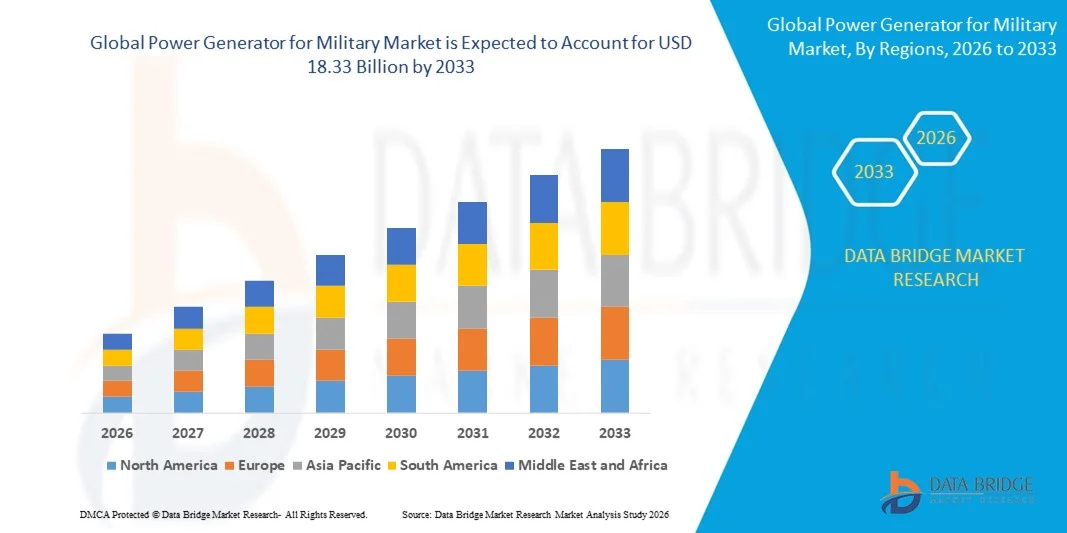
- Selon l'analyse de Data Bridge Market Research, le générateur d'énergie mondial pour la taille du marché militaire a été évalué à14,25 milliards de dollars en 2025et devrait atteindre18,33 milliards de dollars en 2033, à unTCAC de 3,20 %pendant la période de prévision
- La croissance du marché est en grande partie alimentée par l'augmentation des programmes de modernisation de la défense et des dépenses militaires, qui stimulent la demande de solutions d'énergie fiables, performantes et portables capables de soutenir des opérations critiques sur divers terrains.
- De plus, l'importance croissante accordée aux capacités expéditionnaires, à l'efficacité énergétique et à la résilience opérationnelle encourage les forces armées à adopter des technologies de pointe en matière de générateurs. Ces facteurs convergents accélèrent le déploiement de systèmes électriques tactiques et stationnaires, ce qui stimule considérablement l'expansion du marché.
Taille du marché et prévisions
- Valeur de marché (2025):14,25 milliards de dollars
- Valeur marchande prévue (2033) :18,33 milliards de dollars
- Prévisions TCAC:3.20%
Quelles sont les principales sources d'énergie pour le marché militaire
- Les générateurs d'énergie destinés à des applications militaires, fournissant des solutions d'énergie mobiles, fixes ou hybrides, sont de plus en plus essentiels pour soutenir les opérations sur le terrain, les centres de commandement et les déploiements tactiques. Leur capacité à fournir une puissance ininterrompue, robuste et sûre les rend indispensables aux forces armées modernes
- La demande croissante de générateurs militaires est principalement motivée par des initiatives de modernisation de la défense, la nécessité de solutions économes en énergie et à faible signalisation, et les besoins croissants en matière d'alimentation électrique fiable dans des environnements éloignés et hostiles. L'intégration aux systèmes d'énergie hybrides, aux sources renouvelables et aux technologies de contrôle avancées renforce encore leur valeur opérationnelle
- L'Amérique du Nord a dominé le générateur d'énergie pour le marché militaire avec une part de42,5 % en 2025, en raison de dépenses de défense élevées, d'infrastructures militaires avancées et d'un déploiement accru d'opérations tactiques sur le terrain nécessitant des solutions d'énergie fiables
- On s'attend à ce que l'Asie-Pacifique soit la région qui connaît la croissance la plus rapide du marché de l'électricité pour le marché militaire au cours de la période de prévision en raison de la hausse des budgets de défense, des tensions géopolitiques régionales et des initiatives de modernisation dans des pays comme l'Inde, le Japon et l'Australie.
- Le segment de 61 à 250 KW a dominé le marché avec une part de marché de 39% en 2025, en raison de son équilibre optimal entre portabilité et puissance, le rendant adapté pour diverses opérations tactiques. Les unités militaires préfèrent souvent cette capacité pour les déploiements sur le terrain, car elle appuie les communications critiques, l'éclairage et le petit matériel sans trop de charge logistique
Portée du rapport et générateur de puissance pour la segmentation du marché militaire
|
Attributs |
Générateur d'énergie pour les principales perspectives du marché militaire |
|
Segments couverts |
|
|
Pays couverts |
Amérique du Nord
Europe
Asie-Pacifique
Moyen-Orient et Afrique
Amérique du Sud
|
|
Principaux acteurs du marché |
|
|
Possibilités de marché |
|
|
Infos sur la valeur ajoutée |
Outre les informations sur les scénarios du marché, tels que la valeur du marché, le taux de croissance, la segmentation, la couverture géographique et les principaux acteurs, les rapports de marché établis par Data Bridge Market Research comprennent également une analyse approfondie des experts, une production et une capacité géographiquement représentées par l'entreprise, des schémas de réseau des distributeurs et des partenaires, une analyse détaillée et actualisée des tendances des prix et une analyse du déficit de la chaîne d'approvisionnement et de la demande. |
Quelle est la tendance clé dans le générateur de puissance pour le marché militaire
Adoption croissante de groupes électrogènes militaires hybrides et économes en carburant
- Une tendance significative dans le générateur d'énergie pour le marché militaire est l'adoption croissante de générateurs hybrides et économes en carburant capables d'opérer dans des terrains difficiles et des conditions extrêmes. Ces systèmes sont de plus en plus privilégiés pour les bases d'opérations avancées, les unités de commandement mobiles et les missions expéditionnaires en raison de leur capacité à réduire la logistique des carburants et à améliorer la disponibilité opérationnelle
- Par exemple, l'INTRACOM DEFENSE a déployé son système d'alimentation tactique hybride TVH25K pendant les exercices de l'OTAN, démontrant une efficacité énergétique accrue, une signature acoustique réduite et une évolutivité modulaire pour les opérations militaires. Ces déploiements influent sur les forces armées à l ' échelle mondiale pour donner la priorité aux solutions hybrides répondant aux besoins en matière de puissance tactique et stationnaire
- L'intégration de générateurs hybrides avec des sources d'énergie renouvelables telles que l'énergie solaire ou le stockage de batteries gagne en traction, offrant une endurance opérationnelle prolongée aux installations militaires éloignées. Cela place les systèmes hybrides comme des moteurs essentiels de la sécurité énergétique critique de la mission
- Les forces militaires valorisent de plus en plus les groupes électrogènes qui offrent un faible entretien et une exploitation fiable dans des conditions environnementales variables, de la chaleur du désert au froid arctique. Cette préférence pousse l'approvisionnement vers des plates-formes de générateurs hybrides à haute performance
- Des entreprises comme Cummins Inc. et Caterpillar Inc. innovent des générateurs hybrides diesel-électriques qui combinent les moteurs diesel traditionnels et le stockage de batteries, qui soutiennent les opérations de veille silencieuses et réduisent la consommation de carburant. Ces développements accélèrent la transition vers des solutions de puissance militaire économes en énergie
- L'accent croissant mis sur les capacités expéditionnaires, combiné à des innovations technologiques qui améliorent l'efficacité et la fiabilité, continue de renforcer l'adoption de générateurs hybrides et économes en carburant, assurant ainsi une croissance soutenue du marché entre les régions
Générateur d'énergie pour la dynamique du marché militaire
Chauffeur
Accroître les programmes de modernisation de la Défense et les dépenses militaires
- La croissance des programmes de modernisation de la défense et l'augmentation des budgets militaires dans toutes les régions stimulent la demande de solutions de puissance avancées, portables et résistantes. Les forces armées modernisent les groupes électrogènes déployés sur le terrain pour appuyer le matériel perfectionné, la sécurité des communications et les opérations à forte intensité énergétique
- Par exemple, Cummins Inc. a obtenu un contrat de 500 millions de dollars de l'armée américaine pour la fourniture de générateurs mobiles de 500 kW pour la Pologne, soulignant la demande de solutions d'alimentation robustes et de grande capacité. Ces contrats soulignent le rôle des groupes électrogènes militaires dans le renforcement de la disponibilité opérationnelle et de l ' efficacité logistique
- La modernisation des forces navales, aériennes et terrestres nécessite l'intégration de groupes électrogènes capables de soutenir les systèmes à forte charge tout en assurant la mobilité et le déploiement rapide. Ces exigences stimulent directement l'adoption de technologies de production d'électricité de pointe
- Les gouvernements se concentrent de plus en plus sur la sécurité énergétique et l'autonomie opérationnelle, en créant des programmes d'approvisionnement à long terme pour les générateurs hybrides, économes en carburant et silencieux. Ces initiatives renforcent la croissance soutenue du secteur des groupes électrogènes militaires
- L'accent mis sur les solutions énergétiques stratégiques qui réduisent la dépendance à l'égard des carburants et améliorent la flexibilité opérationnelle continue de stimuler les investissements dans les technologies génératrices. À mesure que les opérations militaires deviennent plus exigeantes en technologie, la demande de sources d'énergie fiables et polyvalentes devrait augmenter régulièrement.
Restriction/Défi
Coût élevé et entretien des générateurs tactiques avancés
- Le marché est confronté à des défis en raison des coûts d'acquisition élevés et des besoins d'entretien des groupes électrogènes militaires sophistiqués. Des caractéristiques avancées telles que l'intégration hybride, la conception modulaire et l'exploitation à faible bruit augmentent la complexité de la fabrication et augmentent les dépenses d'approvisionnement
- Par exemple, les générateurs à haute performance Rolls-Royce Power Systems ont besoin d'une maintenance spécialisée et d'un personnel formé pour fonctionner efficacement sur le terrain, ce qui limite l'accessibilité pour des budgets de défense plus petits. Ces facteurs entravent l'adoption rapide sur les marchés émergents
- La charge logistique liée au transport de carburant, de pièces de rechange et de matériel d'entretien pour les groupes électrogènes tactiques augmente les coûts opérationnels, en particulier dans les régions éloignées ou sujettes à des conflits.
- Le strict respect des normes militaires en matière de sécurité, de fiabilité et de réglementation environnementale augmente encore les coûts de production et de cycle de vie. Le maintien de l ' efficacité dans diverses conditions environnementales exige un suivi et un entretien préventif fréquents
- La combinaison de l'investissement initial, des dépenses opérationnelles permanentes et de la complexité technique limite la pénétration du marché dans certaines régions, mettant l'accent sur la nécessité de concevoir des générateurs robustes et optimisés par rapport aux coûts.
Comment le générateur de puissance pour le marché militaire est-il segmenté
Le marché est segmenté en fonction de la capacité, du type de sortie, du type de carburant, du type d'installation et de l'application.
- Par capacité
Sur la base de la capacité, le générateur d'énergie pour le marché militaire est segmenté en jusqu'à 60 KW, 61 à 250 KW, 251 à 500 KW, 501 à 1000 KW et plus de 1000 KW. Le segment de 61 à 250 KW a dominé le marché avec la plus grande part des revenus de 39 % en 2025, grâce à son équilibre optimal entre portabilité et puissance, ce qui le rend adapté à diverses opérations tactiques. Les unités militaires préfèrent souvent cette capacité pour les déploiements sur le terrain, car elle soutient les communications critiques, l'éclairage et le petit matériel sans trop de charge logistique. Le segment bénéficie également de la disponibilité de modèles diesel et hybrides de pointe, améliorant ainsi le rendement énergétique et la fiabilité opérationnelle dans diverses conditions environnementales.
Le segment ci-dessus de 1000 KW devrait connaître la croissance la plus rapide de 2026 à 2033, alimentée par la demande croissante de solutions de puissance à haute capacité dans les grandes bases militaires, les systèmes de défense aérienne et les camps d'exploitation avancés. Ces groupes électrogènes fournissent une puissance ininterrompue pour le matériel lourd et les centres de commandement, assurant ainsi la disponibilité opérationnelle pendant les missions prolongées. Les améliorations technologiques telles que la conception modulaire, les systèmes de refroidissement améliorés et les capacités de surveillance à distance favorisent l'adoption de groupes électrogènes de grande capacité dans les déploiements stratégiques.
- Par type de sortie
Sur la base du type de sortie, le marché est segmenté en générateurs de courant alternatif et de courant continu. Le segment AC détenait la plus grande part du marché en 2025, en raison de son utilisation généralisée dans l'équipement militaire, les hôpitaux de campagne et les systèmes de communication qui nécessitent un courant alternatif pour une alimentation électrique stable et évolutive. Les générateurs à courant alternatif sont préférés en raison de leur compatibilité avec les appareils électriques standard et de leur capacité à fournir efficacement de l'énergie sur de longues distances avec une perte d'énergie minimale.
On s'attend à ce que le segment de DC enregistre la croissance la plus rapide de 2026 à 2033, en raison de l'intégration croissante des systèmes à piles, des unités de commandement mobiles et des sources d'énergie renouvelables dans les opérations militaires. Les générateurs DC offrent un contrôle précis de la tension, des temps de réponse rapides et une intégration plus facile avec l'électronique sensible, ce qui les rend idéales pour les applications mobiles et mobiles sur le terrain. Les unités avancées de courant continu soutiennent également les configurations de puissance hybrides, permettant aux forces militaires de maintenir la continuité opérationnelle même dans des conditions difficiles.
- Par type de carburant
Sur la base du type de carburant, le marché est segmenté en groupes électrogènes diesel et gaz naturel. Le segment du diesel a dominé le marché avec la plus grande part des revenus en 2025, grâce à sa fiabilité, sa grande disponibilité et sa forte densité énergétique, qui assure des opérations ininterrompues dans des environnements éloignés et hostiles. Les générateurs diesel sont souvent le choix privilégié pour les déploiements sur le terrain et les unités mobiles, car ils peuvent supporter de longues heures de fonctionnement avec un minimum d'entretien.
On s'attend à ce que les générateurs de gaz naturel connaissent la croissance la plus rapide de 2026 à 2033, alimentée par les forces armées qui se concentrent de plus en plus sur des solutions plus propres et plus silencieuses. Par exemple, les forces en Europe et en Amérique du Nord adoptent des générateurs de gaz naturel dans les bases d'exploitation et les camps d'entraînement avancés pour réduire les émissions de carbone et améliorer la furtivité opérationnelle. Ces générateurs bénéficient également des progrès de la technologie bicarburant, permettant un passage flexible entre le diesel et le gaz naturel pour une efficacité et une résilience stratégiques.
- Par type d'installation
Sur la base du type d'installation, le marché est segmenté en papeterie, mobile et générateurs portables. Le segment mobile détenait la plus grande part du marché en 2025, en raison de la nécessité d'un déploiement flexible sur divers terrains et scénarios opérationnels. Les groupes électrogènes mobiles sont souvent montés sur des remorques ou des véhicules, ce qui permet d'accéder rapidement aux hôpitaux de campagne, aux centres de communication et aux installations militaires temporaires. Le segment bénéficie également de la conception modulaire et des fonctionnalités de démarrage rapide, qui réduisent le temps de configuration et augmentent la mobilité tactique.
Les groupes électrogènes portatifs devraient connaître la croissance la plus rapide entre 2026 et 2033, alimentée par la demande croissante de solutions légères et facilement déployables pour les petites unités, les missions de reconnaissance et les camps temporaires. Les unités mobiles offrent des avantages tels que la taille compacte, la facilité de transport et le faible niveau de bruit, ce qui les rend aptes aux opérations secrètes et aux déploiements rapides. Des améliorations technologiques telles que l'amélioration de l'efficacité énergétique et la surveillance à distance favorisent l'adoption de générateurs portables dans les applications militaires modernes.
- Par demande
Sur la base de l'application, le marché est segmenté en systèmes de communication, systèmes de défense aérienne, hôpitaux de campagne, camps de campagne/hébergement, éclairage, véhicules militaires, etc. Le segment des systèmes de communication a dominé le marché avec la plus grande part des revenus en 2025, en raison de l'exigence essentielle d'une puissance ininterrompue pour maintenir des liaisons de communication sécurisées, des systèmes satellites et des réseaux tactiques. Les forces militaires privilégient les groupes électrogènes pour les systèmes de communication afin d ' assurer la coordination critique de la mission et la transmission de données en temps réel dans toutes les conditions opérationnelles.
Les hôpitaux de campagne devraient connaître la croissance la plus rapide entre 2026 et 2033, alimentée par des investissements accrus dans des unités médicales de déploiement rapide pour les zones de conflit et les opérations de secours en cas de catastrophe. Par exemple, les unités militaires de l'OTAN et des États-Unis ont adopté des générateurs fiables et de grande capacité pour soutenir les installations médicales mobiles avec une puissance continue pour le matériel de sauvetage. Les progrès réalisés en matière de réduction du bruit, d'efficacité énergétique et de portabilité appuient davantage le déploiement de groupes électrogènes dans les applications médicales, améliorant ainsi l'efficacité opérationnelle et la sécurité du personnel.
Quelle région détient la plus grande part du générateur de puissance pour le marché militaire
- L'Amérique du Nord a dominé le générateur d'électricité pour le marché militaire avec la plus grande part des revenus de 42,5 % en 2025, sous l'impulsion de dépenses de défense élevées, d'infrastructures militaires avancées et d'un déploiement accru d'opérations tactiques sur le terrain nécessitant des solutions d'énergie fiables
- Les forces militaires de la région accordent la priorité aux groupes électrogènes performants qui soutiennent des systèmes essentiels tels que les réseaux de communication, les hôpitaux de campagne et les bases d ' opérations avancées, assurant des opérations ininterrompues dans des conditions diverses
- Cette large adoption est encore soutenue par les progrès technologiques, la fabrication de défense bien établie et les initiatives gouvernementales de modernisation, en établissant des générateurs d'électricité comme équipement essentiel pour les déploiements fixes et mobiles
Générateur d'énergie américain pour une vision du marché militaire
Le marché américain a remporté la plus grande part des revenus en Amérique du Nord en 2025, alimentée par la modernisation rapide du matériel militaire et l'augmentation des budgets de défense. Par exemple, des sociétés telles que Generac Defense Solutions fournissent des générateurs portables avancés qui soutiennent les opérations sur le terrain et les unités de commandement mobiles. La demande croissante de solutions énergétiques efficaces, silencieuses et tactiques favorise la croissance du marché. L'intégration avec les sources d'énergie renouvelables et les systèmes hybrides gagne en traction, renforçant ainsi la flexibilité opérationnelle. De plus, les initiatives stratégiques visant à renforcer les capacités de défense et à maintenir l'état de préparation sur divers terrains contribuent à accroître la demande de groupes électrogènes de grade militaire.
Générateur d'énergie européen pour une vision du marché militaire
Le marché européen devrait croître à un TCAC important au cours de la période de prévision, en raison de l'augmentation des dépenses de défense et de la modernisation des forces armées dans des pays comme la France et l'Italie. Par exemple, Caterpillar Defense Power Systems fournit des générateurs militaires conçus pour un déploiement rapide et des environnements difficiles. Le besoin croissant de solutions compactes, économes en carburant et de réduction du bruit favorise l'adoption dans les opérations sur le terrain et les infrastructures de base. L'accent mis sur l'efficacité opérationnelle, l'intégration des énergies renouvelables et le respect de normes environnementales rigoureuses favorise la croissance. En outre, la collaboration entre entrepreneurs européens de défense accélère le développement de systèmes de générateurs avancés pour les applications militaires.
U.K. Générateur d'énergie pour une vision du marché militaire
On s'attend à ce que le marché britannique augmente à un TCAC notable au cours de la période de prévision, en raison des programmes de modernisation des Forces armées britanniques et de la dépendance croissante à l'égard des capacités expéditionnaires. Par exemple, Rolls-Royce Power Systems fournit des générateurs mobiles et fixes capables de soutenir les déploiements à l'étranger. La demande de sources d'énergie fiables, portables et à faible entretien augmente en raison de l'augmentation des exercices d'entraînement et des missions de défense à l'étranger. L'intégration aux technologies des énergies hybrides et renouvelables gagne en importance, assurant la sécurité énergétique et la résilience opérationnelle. L'infrastructure de défense robuste du Royaume-Uni et l'investissement continu dans les systèmes militaires intelligents continuent de stimuler l'expansion du marché.
Allemagne Générateur d'énergie pour une vision du marché militaire
On s'attend à ce que le marché allemand s'étende à un TCAC solide pendant la période de prévision, alimenté par les progrès technologiques dans les équipements de défense et l'accent croissant mis sur les solutions écoénergétiques. Par exemple, MAN Energy Solutions produit des générateurs militaires de haute performance optimisés pour la mobilité et la fiabilité. La base industrielle bien établie de l'Allemagne et son engagement en faveur de pratiques énergétiques durables favorisent l'adoption dans le cadre des opérations nationales et de l'OTAN. Une prise de conscience accrue de la sécurité énergétique critique de la mission et du maintien de la disponibilité opérationnelle stimule la demande. L'intégration de systèmes numériques de surveillance et de contrôle améliore l'efficacité des générateurs et s'harmonise avec les normes militaires modernes.
Générateur d'énergie Asie-Pacifique pour une vision du marché militaire
Le marché Asie-Pacifique est sur le point de croître au rythme le plus rapide du TCAC pendant la période de prévision de 2026 à 2033, en raison de l'augmentation des budgets de défense, des tensions géopolitiques régionales et des initiatives de modernisation dans des pays comme l'Inde, le Japon et l'Australie. Par exemple, Mitsubishi Heavy Industries fournit des générateurs militaires optimisés pour des conditions opérationnelles difficiles. La région se concentre de plus en plus sur les générateurs mobiles, silencieux et économes en carburant. L'augmentation des capacités de production, l'aide gouvernementale à la fabrication de défense intérieure et les partenariats technologiques accélèrent encore l'adoption. En outre, l'accent stratégique mis sur la modernisation des forces armées assure une demande soutenue de solutions de puissance fiables.
Générateur d'énergie du Japon pour une vision du marché militaire
Le marché japonais prend de l'ampleur en raison de l'augmentation des programmes de modernisation de la défense, des progrès technologiques et de la préparation aux catastrophes naturelles et aux menaces pour la sécurité. Par exemple, Fuji Electric fournit des générateurs compacts et portables conçus pour une utilisation tactique et d'urgence. Le pays met fortement l'accent sur l'efficacité opérationnelle, les opérations silencieuses et le faible impact sur l'environnement, ce qui favorise l'adoption dans les applications militaires terrestres et maritimes. L'intégration aux systèmes avancés de gestion de l'énergie est de plus en plus courante. Les politiques de défense stratégique et l'expertise technologique du Japon continuent à alimenter la demande de générateurs militaires polyvalents.
Générateur d'énergie de la Chine pour une vision du marché militaire
En 2025, le marché chinois a représenté la plus grande part des revenus en Asie-Pacifique, attribuable à l'augmentation des dépenses de défense, à la modernisation rapide des forces armées et au besoin de solutions énergétiques fiables sur divers terrains. Par exemple, Sinomach Defense Power Systems fabrique des générateurs tactiques pour les opérations sur le terrain et les unités mobiles. L'adoption de groupes électrogènes compacts, écoénergétiques et de grande capacité se développe dans toutes les bases militaires et les unités d'opérations avancées. Les initiatives gouvernementales visant à développer les technologies de défense intérieure et l'autonomie du matériel militaire accélèrent encore la croissance. Des capacités de fabrication solides et l'intégration avec une infrastructure militaire intelligente sont des facteurs clés de l'expansion du marché chinois.
Quelles sont les principales entreprises de production d'électricité pour le marché militaire
Le générateur d'énergie pour l'industrie militaire est principalement dirigé par des entreprises bien établies, notamment :
- Caterpillar Inc.(États-Unis)
- Cummins Inc. (États-Unis)
- Exploitations de rouleaux en rouleaux plc(Royaume-Uni)
- Harrington Generators International (Royaume-Uni)
- HIMOINSA(Espagne)
- Teknel SRL (Italie)
- (Slovaquie)
- GRUPEL SA (Pologne)
- HITZINGER GmbH(Autriche)
- Ascot Industrial Srl(Italie)
- Fischer Panda GmbH (Allemagne)
- SYSTEMES DE PUISSANCE GREEN Srl (Italie)
- Kirloskar Oil Engines Ltd. (Inde)
- Kohler Co. (États-Unis)
- Ausonia Srl (Italie)
Quelles sont les évolutions récentes de la génération d'énergie mondiale pour le marché militaire
- En février 2026, INTRACOM DEFENSE a déployé avec succès son système de puissance tactique hybride de nouvelle génération, le système d'hybridation du générateur TVH25K, lors d'importants exercices de l'OTAN tels que Loyal Dolos 2025 et Steadfast Dart 2026. Cette démonstration, dans des conditions de terrain réalistes, a renforcé l'importance croissante sur le marché des solutions de puissance expéditionnaire hybrides et économes en carburant qui améliorent l'autonomie opérationnelle, réduisent le fardeau du carburant et de la logistique, et améliorent la résilience énergétique des forces alliées, signalant une demande accrue de générateurs de microréseau de pointe dans les théâtres militaires modernes
- En décembre 2025, Cummins Inc. a obtenu de l'armée américaine un contrat de 500 millions de dollars pour la production et la modification de groupes électrogènes électriques mobiles montés à skid de 500 kW pour la Pologne dans le cadre du programme de ventes militaires à l'étranger. Ce contrat souligne le rôle stratégique des systèmes d'électricité transportables à haute capacité dans le soutien des infrastructures alliées et des bases d'exploitation avancées, le renforcement de la position de Cummins dans le segment de la production d'électricité militaire et la forte demande mondiale de plates-formes de production robustes et critiques pour la mission
- En novembre 2025, l'armée américaine, dans le cadre du programme Janus, a avancé le plan de déploiement des centrales à microréacteurs en choisissant plusieurs bases et en engageant des sollicitations de l'industrie, poussant les microréacteurs vers une utilisation opérationnelle pour une puissance résiliente et évolutive. Cette évolution vers les petites technologies de production nucléaire pourrait transformer les futures stratégies énergétiques militaires en réduisant la dépendance à l'égard de la logistique des combustibles fossiles et en permettant une alimentation électrique soutenue dans des environnements austères ou contestés
- En 2025, plusieurs entreprises ont été sélectionnées dans le cadre du programme d'énergie nucléaire avancée pour les installations (ANPI) du Département de la défense des États-Unis pour développer des technologies de microréacteurs capables de fournir une puissance décentralisée aux installations militaires, reflétant une tendance plus large du marché vers des sources d'énergie expéditionnaires de nouvelle génération qui pourraient compléter ou remplacer les systèmes de production traditionnels pour les opérations de longue durée.
- En 2025, Honeywell a remporté un contrat pour le développement d'un système d'alimentation en piles à hydrogène pour les soldats de l'armée américaine. Ce développement met en évidence l'intérêt croissant pour les technologies énergétiques de remplacement afin de réduire la charge des soldats et d'améliorer la fourniture d'électricité sur le marché, en élargissant le marché de l'énergie militaire au-delà des générateurs conventionnels pour y inclure les nouvelles technologies de piles à combustible
SKU-
Accédez en ligne au rapport sur le premier cloud mondial de veille économique

- Tableau de bord d'analyse de données interactif
- Tableau de bord d'analyse d'entreprise pour les opportunités à fort potentiel de croissance
- Accès d'analyste de recherche pour la personnalisation et les requêtes
- Analyse de la concurrence avec tableau de bord interactif
- Dernières actualités, mises à jour et analyse des tendances
- Exploitez la puissance de l'analyse comparative pour un suivi complet de la concurrence
Méthodologie de recherche
La collecte de données et l'analyse de l'année de base sont effectuées à l'aide de modules de collecte de données avec des échantillons de grande taille. L'étape consiste à obtenir des informations sur le marché ou des données connexes via diverses sources et stratégies. Elle comprend l'examen et la planification à l'avance de toutes les données acquises dans le passé. Elle englobe également l'examen des incohérences d'informations observées dans différentes sources d'informations. Les données de marché sont analysées et estimées à l'aide de modèles statistiques et cohérents de marché. De plus, l'analyse des parts de marché et l'analyse des tendances clés sont les principaux facteurs de succès du rapport de marché. Pour en savoir plus, veuillez demander un appel d'analyste ou déposer votre demande.
La méthodologie de recherche clé utilisée par l'équipe de recherche DBMR est la triangulation des données qui implique l'exploration de données, l'analyse de l'impact des variables de données sur le marché et la validation primaire (expert du secteur). Les modèles de données incluent la grille de positionnement des fournisseurs, l'analyse de la chronologie du marché, l'aperçu et le guide du marché, la grille de positionnement des entreprises, l'analyse des brevets, l'analyse des prix, l'analyse des parts de marché des entreprises, les normes de mesure, l'analyse globale par rapport à l'analyse régionale et des parts des fournisseurs. Pour en savoir plus sur la méthodologie de recherche, envoyez une demande pour parler à nos experts du secteur.
Personnalisation disponible
Data Bridge Market Research est un leader de la recherche formative avancée. Nous sommes fiers de fournir à nos clients existants et nouveaux des données et des analyses qui correspondent à leurs objectifs. Le rapport peut être personnalisé pour inclure une analyse des tendances des prix des marques cibles, une compréhension du marché pour d'autres pays (demandez la liste des pays), des données sur les résultats des essais cliniques, une revue de la littérature, une analyse du marché des produits remis à neuf et de la base de produits. L'analyse du marché des concurrents cibles peut être analysée à partir d'une analyse basée sur la technologie jusqu'à des stratégies de portefeuille de marché. Nous pouvons ajouter autant de concurrents que vous le souhaitez, dans le format et le style de données que vous recherchez. Notre équipe d'analystes peut également vous fournir des données sous forme de fichiers Excel bruts, de tableaux croisés dynamiques (Fact book) ou peut vous aider à créer des présentations à partir des ensembles de données disponibles dans le rapport.











