



Global Prebiotic Fruit Powder Market Segmentation, By Flavor (Apple, Peach, Blueberry, Cranberry, and Others), Distribution Channel (Business to Business and Business to Consumer), Application (Food and Beverages, Pharmaceutical, Nutraceutical, and Others)- Industry Trends and Forecast to 2033
Quelle est la taille et l'aperçu du marché de la poudre de fruits prébiotique
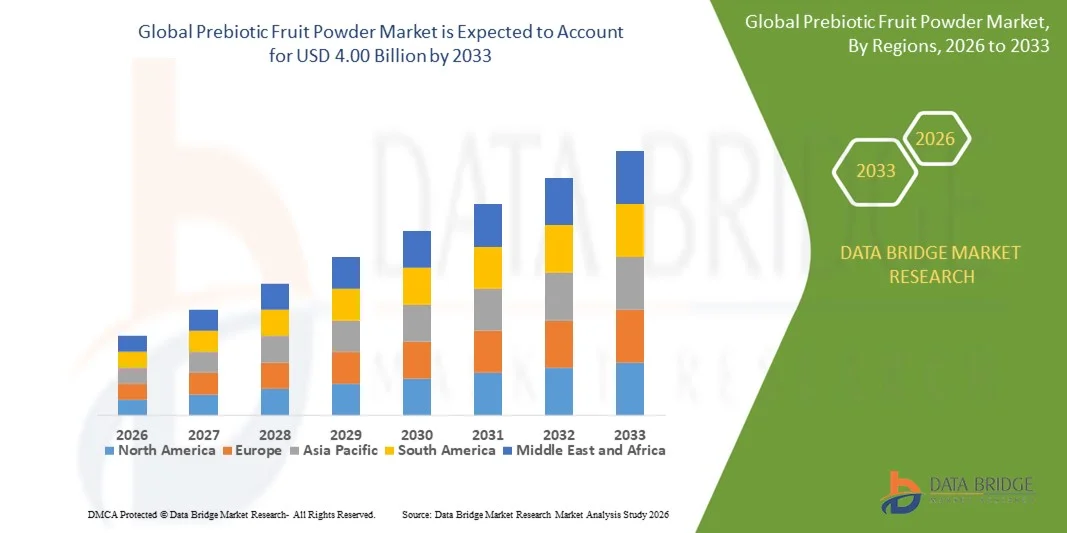
- La taille du marché mondial de la poudre de fruits prébiotiques a été évaluée à2,10 milliards de dollars en 2025et devrait atteindre4,00 milliards de dollars en 2033, à unTCAC de 8,50%pendant la période de prévision
- La croissance du marché est largement alimentée par la sensibilisation accrue des consommateurs à la santé intestinale et au bien-être digestif, ce qui stimule la demande d'ingrédients alimentaires fonctionnels comme les poudres de fruits prébiotiques
- L'adoption croissante d'ingrédients propres, à base de plantes et naturels dans les aliments et les boissons, ainsi que l'expansion des applications dans les compléments alimentaires et les nutraceutiques, accélère encore l'expansion du marché
Taille du marché et prévisions
- Valeur marchande mondiale (2025):2,10 milliards de dollars
- Valeur marchande prévue (2033) :4,00 milliards de dollars
- Prévisions CAGR (2026-2033):8.50%
Analyse du marché des poudres de fruits prébiotiques
- Le marché connaît une croissance régulière en raison de l'évolution de la préférence des consommateurs pour les soins de santé préventifs et la nutrition fonctionnelle, encourageant les fabricants à incorporer des poudres de fruits prébiotiques dans diverses formulations
- De plus, l'expansion de l'industrie des aliments et boissons fonctionnels, combinée à l'innovation dans les technologies de transformation des fruits et à la demande croissante de formats nutritionnels pratiques, favorise la croissance à long terme du marché.
- L'Amérique du Nord a dominé le marché des poudres de fruits prébiotiques avec la plus grande part des revenus de 38,64 % en 2025, sous l'impulsion d'une forte sensibilisation des consommateurs à la santé digestive et à la nutrition fonctionnelle, ainsi que de la disponibilité généralisée de produits alimentaires enrichis et de suppléments.
- La région Asie-Pacifique devrait connaître le taux de croissance le plus élevé du monde.poudre de fruits prébiotiquesle marché, en raison de l'augmentation des revenus disponibles, de l'expansion des industries des aliments fonctionnels et des suppléments, et de l'importance croissante accordée par les consommateurs à la santé et au bien-être digestifs
- Le segment Apple détenait la plus grande part du marché en 2025, sous l'effet de son acceptation généralisée par les consommateurs, de son goût doux et de sa forte teneur en fibres naturelles, adaptée aux applications de la santé digestive. Les poudres prébiotiques à base de pommes sont couramment utilisées dansles aliments fonctionnels,boissons et compléments alimentaires en raison de leur polyvalence, de leur valeur nutritive et de leur compatibilité avec diverses formulations
Portée du rapport et segmentation du marché des poudres de fruits prébiotiques
|
Attributs |
Poudre de fruits prébiotiques Principales perspectives du marché |
|
Segments couverts |
|
|
Pays couverts |
Amérique du Nord
Europe
Asie-Pacifique
Moyen-Orient et Afrique
Amérique du Sud
|
|
Principaux acteurs du marché |
|
|
Possibilités de marché |
|
|
Infos sur la valeur ajoutée |
|
Quelle est la tendance clé du marché des poudres de fruits prébiotiques
Demande croissante d'ingrédients de santé et de nutrition fonctionnelle
- L'accent croissant mis sur le bien-être digestif et la santé du microbiome façonne de façon significative le marché mondial des poudres de fruits prébiotiques, car les consommateurs préfèrent de plus en plus les ingrédients naturels qui soutiennent la santé globale. Les poudres de fruits prébiotiques gagnent en traction en raison de leur capacité à promouvoir les bactéries intestinales bénéfiques tout en offrant une valeur nutritive et une souplesse de formulation. Cette tendance renforce leur adoption dans les aliments fonctionnels, les boissons etcompléments alimentaires, encourageant les fabricants à développer des formulations innovantes et axées sur la santé
- Une sensibilisation accrue aux soins de santé préventifs, à l'immunité et au bien-être holistique a accéléré la demande de poudres de fruits prébiotiques dans les smoothies, les barres de nutrition, les substituts laitiers et les mélanges de suppléments. Les consommateurs soucieux de la santé et les populations axées sur la condition physique cherchent activement des solutions nutritionnelles pratiques et végétales, ce qui incite les marques à incorporer des ingrédients prébiotiques à base de fruits. Cela a également mené à des collaborations entre les fournisseurs d'ingrédients et les fabricants de produits pour améliorer la fonctionnalité, le goût et la performance nutritionnelle.
- L'étiquetage propre et les tendances basées sur les végétaux influencent les décisions d'achat, les fabricants mettant l'accent sur l'approvisionnement naturel, le traitement minimal et l'étiquetage transparent. Ces facteurs aident les marques à différencier leurs offres sur un marché concurrentiel des ingrédients fonctionnels et à renforcer la confiance des consommateurs. Les entreprises promeuvent de plus en plus le contenu prébiotique dérivé des fruits et les avantages pour la santé digestive dans les campagnes de marketing pour renforcer le positionnement de la marque et élargir leur base de consommateurs
- Par exemple, en 2024, Danone en France et Nestlé en Suisse ont élargi leurs portefeuilles de yaourts fonctionnels et de produits nutritionnels en incorporant des poudres de fruits prébiotiques. Ces lancements ont été introduits en réponse à l'augmentation de la préférence des consommateurs pour les ingrédients à base de plantes et de soutien à la santé des intestins, avec une disponibilité sur les réseaux de vente au détail et en ligne. Les produits ont également été placés comme solutions de bien-être digestif naturel, augmentant l'engagement des consommateurs et les achats répétés
- Bien que la demande de poudres de fruits prébiotiques augmente, l'expansion soutenue du marché dépend de l'innovation continue des produits, d'un traitement rentable et du maintien de la stabilité et de la compatibilité des goûts dans diverses applications. Les fabricants mettent également l'accent sur l'amélioration de la normalisation des ingrédients, de l'évolutivité et de l'efficacité de la chaîne d'approvisionnement pour favoriser une adoption commerciale plus large.
Dynamique du marché des poudres de fruits prébiotiques
Chauffeur
Préférence croissante pour la santé digestive et les ingrédients fonctionnels naturels
- La hausse de la demande des consommateurs en matière de nutrition intestinale et végétale est un facteur important du marché des poudres de fruits prébiotiques. Les fabricants intègrent de plus en plus les prébiotiques à base de fruits dans les aliments, les boissons et les suppléments afin d'accroître la valeur fonctionnelle et de s'aligner sur les attentes en matière d'étiquetage propre. Cette tendance encourage également la recherche sur les nouvelles sources de fruits et les technologies avancées de séchage pour préserver la qualité nutritionnelle et les avantages fonctionnels
- L'expansion des applications dans les boissons fonctionnelles, les barres de nutrition, les produits laitiers, la nutrition infantile et les suppléments alimentaires influe sur la croissance du marché. Les poudres de fruits prébiotiques contribuent à améliorer le positionnement de la santé digestive tout en maintenant les allégations d'ingrédients naturels, ce qui permet aux fabricants de répondre aux attentes changeantes des consommateurs. La popularité croissante des soins de santé préventifs et de la nutrition personnalisée soutient davantage l'expansion du marché
- Les fabricants d'aliments et de suppléments promeuvent activement les préparations à base de poudre de fruits prébiotiques par l'innovation des produits, les allégations santé et les initiatives de marketing ciblées. Ces efforts sont soutenus par une sensibilisation croissante des consommateurs à la santé du microbiome et à l'importance des fibres alimentaires. Les partenariats entre les producteurs d'ingrédients et les marques de consommateurs contribuent également à améliorer l'efficacité des produits et la portée du marché.
- Par exemple, en 2023, General Mills, aux États-Unis, et Kellogg Company ont augmenté l'utilisation de poudres prébiotiques à base de fruits dans les céréales et les produits de collation. Cette expansion a fait suite à l'augmentation de la demande des consommateurs pour la santé digestive et les produits alimentaires fonctionnels, en améliorant la différenciation des produits et en renforçant la valeur de la marque. Les deux entreprises ont également souligné les avantages de l'approvisionnement en ingrédients naturels et du bien-être dans la commercialisation des produits
- Bien que l'accroissement de la sensibilisation à la santé favorise la croissance, l'adoption plus large dépend du maintien d'une qualité cohérente, de l'amélioration de l'efficacité de la transformation et d'une production à grande échelle rentable. Les investissements dans la technologie, l'approvisionnement et le développement de la formulation seront essentiels pour soutenir la croissance à long terme du marché.
Restriction/Défi
Coûts de production élevés et défis de stabilité dans les applications alimentaires
- Le coût de production relativement plus élevé des poudres de fruits prébiotiques par rapport aux ingrédients de fibres classiques demeure un défi clé, limitant l'adoption chez les fabricants sensibles aux coûts. Les techniques de séchage avancées telles que le séchage au gel et le séchage par pulvérisation augmentent les frais de traitement. En outre, les fluctuations de la disponibilité des fruits et de l'offre saisonnière peuvent influer sur la stabilité des coûts et la cohérence de la production.
- La connaissance et l'expertise technique du fabricant en matière de compatibilité de la formulation demeurent également inégales, en particulier sur les marchés émergents. Une compréhension limitée des performances fonctionnelles dans différents formats de produits peut restreindre l'adoption dans certaines applications. Cela ralentit également l'innovation dans les régions où l'intégration fonctionnelle des ingrédients se développe encore.
- Les défis de la chaîne d'approvisionnement et du stockage ont également une incidence sur la croissance du marché, car les poudres de fruits prébiotiques nécessitent un traitement, un emballage et un stockage contrôlés pour maintenir les propriétés fonctionnelles. La sensibilité à l'humidité, à la température et à l'oxydation peut affecter la stabilité du produit et sa durée de conservation. Les entreprises doivent investir dans des technologies de manutention, d'emballage et d'infrastructure logistique appropriées pour garantir l'intégrité des produits
- Par exemple, en 2024, les fabricants et distributeurs d'aliments fonctionnels à Singapour et en Thaïlande ont signalé une adoption plus lente des poudres de fruits prébiotiques dans les produits traditionnels en raison du coût plus élevé des ingrédients et de la complexité de la formulation. La stabilité de l'entreposage et la cohérence de l'offre étaient des préoccupations supplémentaires qui influaient sur les décisions d'achat. Ces facteurs ont également influé sur les stratégies de fixation des prix et sur l'expansion rapide limitée des segments de produits concurrentiels.
- Pour surmonter ces défis, il faudra investir dans des technologies de production rentables, améliorer la gestion de la chaîne d'approvisionnement et renforcer l'appui à la formulation. La collaboration entre les fournisseurs d'ingrédients, les fabricants et les distributeurs contribuera à améliorer les taux d'adoption. En outre, il sera essentiel de mieux faire connaître les bienfaits de la santé digestive et d'améliorer l'accessibilité pour libérer le plein potentiel de croissance du marché mondial des poudres de fruits prébiotiques
Étendue du marché des poudres de fruits prébiotiques
Le marché est segmenté sur la base de la saveur, canal de distribution, et l'application.
- Par Saveur
Sur la base de la saveur, le marché de la poudre de fruits prébiotiques est segmenté en pommes, pêches, bleuets, canneberges et autres. Le segment Apple détenait la plus grande part du marché en 2025, sous l'effet de son acceptation généralisée par les consommateurs, de son goût doux et de sa forte teneur en fibres naturelles, adaptée aux applications de la santé digestive. Les poudres prébiotiques à base de pommes sont couramment utilisées dans les aliments fonctionnels, les boissons et les compléments alimentaires en raison de leur polyvalence, de leur valeur nutritive et de leur compatibilité avec diverses formulations.
Le segment Blueberry devrait connaître le taux de croissance le plus rapide de 2026 à 2033, en raison de sa forte teneur en antioxydants et de la popularité croissante des produits de nutrition fonctionnels. Les poudres prébiotiques de bleuets sont particulièrement appréciées pour leurs bienfaits pour la santé, leur profil de saveur attrayant et leur forte demande en nutraceutiques, en smoothies et en produits alimentaires enrichis, ce qui en fait un choix privilégié pour les consommateurs axés sur la santé.
- Par canal de distribution
Sur la base du canal de distribution, le marché de la poudre de fruits prébiotiques est segmenté en Business to Business and Business to Consumer. En 2025, le segment Business to Business détenait la plus grande part des revenus du marché, en raison de la forte demande des fabricants d'aliments, des entreprises nutraceutiques et des producteurs de suppléments qui incorporent des poudres de fruits prébiotiques dans leurs produits. Les achats en vrac, les accords d'approvisionnement à long terme et l'utilisation croissante de produits fonctionnels appuient la domination de ce segment.
Le segment des affaires au consommateur devrait connaître le taux de croissance le plus rapide de 2026 à 2033, en raison de la popularité croissante des produits de santé directs au consommateur et des plateformes de vente au détail en ligne. Les consommateurs achètent de plus en plus de poudres de fruits prébiotiques pour usage personnel dans les smoothies, les boissons de bien-être et la nutrition à domicile, grâce à une sensibilisation croissante à la santé digestive et à la nutrition préventive.
- Par demande
Sur la base de l'application, le marché des poudres de fruits prébiotiques est segmenté en aliments et boissons, produits pharmaceutiques, nutraceutiques et autres. En 2025, le segment des aliments et des boissons détenait la plus grande part de revenus du marché grâce à une utilisation intensive dans les aliments fonctionnels, les produits laitiers, les produits de boulangerie et les boissons de santé. Les fabricants intègrent des poudres de fruits prébiotiques pour augmenter la valeur nutritive, améliorer l'attrait des produits et soutenir le positionnement du bien-être digestif.
Le segment nutraceutique devrait connaître le taux de croissance le plus rapide de 2026 à 2033, en raison de la préférence croissante des consommateurs pour les suppléments alimentaires et les produits de santé intestinales. Les poudres de fruits prébiotiques sont largement utilisées dans les capsules, les sachets et les mélanges de suppléments en poudre en raison de leurs avantages fonctionnels, commodité et compatibilité avec diverses formulations nutraceutiques.
Marché des poudres de fruits prébiotiques Analyse régionale
- L'Amérique du Nord a dominé le marché des poudres de fruits prébiotiques avec la plus grande part des revenus de 38,64 % en 2025, sous l'impulsion d'une forte sensibilisation des consommateurs à la santé digestive et à la nutrition fonctionnelle, ainsi que de la disponibilité généralisée de produits alimentaires enrichis et de suppléments.
- Les consommateurs de la région attachent une grande importance à l'origine naturelle, aux bienfaits pour la santé et à la souplesse de formulation des poudres de fruits prébiotiques dans des produits tels que les smoothies,barres de nutritionet compléments alimentaires
- Cette adoption généralisée est soutenue par des dépenses de santé élevées, une industrie alimentaire fonctionnelle bien établie et une préférence croissante pour les soins de santé préventifs, établissant les poudres de fruits prébiotiques comme ingrédient privilégié dans les secteurs alimentaire et nutraceutique
Aperçu du marché américain de la poudre de fruits prébiotiques
Le marché américain de la poudre de fruits prébiotiques a remporté la plus grande part de revenus en 2025 en Amérique du Nord, alimentée par l'adoption rapide d'aliments fonctionnels et l'accent croissant des consommateurs sur la santé intestinale. Les consommateurs accordent de plus en plus d'importance aux fibres alimentaires et aux ingrédients qui soutiennent le microbiome dans leur alimentation quotidienne. La popularité croissante des régimes à base de plantes, associée à une forte demande de produits écologiques et biologiques, favorise la croissance du marché. En outre, l'expansion des marques nutraceutiques et la disponibilité de formats de suppléments innovants contribuent de manière significative à l'expansion du marché.
Europe Perspectives du marché des poudres de fruits prébiotiques
Le marché européen des poudres de fruits prébiotiques devrait connaître le taux de croissance le plus rapide entre 2026 et 2033, principalement en raison de l'augmentation de la demande d'ingrédients de santé naturels et de la stricte réglementation en faveur des produits d'étiquetage propre. L'augmentation du nombre de consommateurs soucieux de la santé et l'intérêt croissant pour les soins de santé préventifs encouragent l'adoption de poudres de fruits prébiotiques. Les consommateurs européens sont également attirés par des solutions de nutrition végétale et biologique. La région connaît une forte croissance dans les applications d'aliments fonctionnels, de boissons et de suppléments, avec une incorporation croissante dans les produits nouveaux et reformulés.
Aperçu du marché de la poudre de fruits prébiotique au Royaume-Uni
Le marché des poudres de fruits prébiotiques du Royaume-Uni devrait connaître le taux de croissance le plus rapide de 2026 à 2033, en raison de l'intérêt croissant des consommateurs pour la santé digestive et les produits alimentaires fonctionnels. De plus, la demande croissante d'ingrédients naturels et végétaux encourage les fabricants à incorporer des prébiotiques dérivés des fruits. Les secteurs bien développés du commerce de détail et du commerce électronique, ainsi que la disponibilité croissante de produits de santé et de bien-être, devraient continuer à soutenir la croissance du marché.
Allemagne Perspectives du marché des poudres de fruits prébiotiques
Le marché allemand des poudres de fruits prébiotiques devrait connaître le taux de croissance le plus rapide de 2026 à 2033, alimenté par une sensibilisation accrue à la santé des intestins et une forte demande de produits biologiques et d'étiquettes propres. L'Allemagne soutient l'expansion du marché grâce à l'industrie de transformation des aliments et à l'accent mis sur les ingrédients naturels de haute qualité. L'intégration des poudres de fruits prébiotiques dans les aliments fonctionnels, les boissons et les compléments alimentaires augmente également, soutenue par la préférence des consommateurs pour des solutions nutritionnelles scientifiquement soutenues.
Aperçu du marché de la poudre de fruits prébiotique en Asie-Pacifique
Le marché de la poudre de fruits prébiotiques en Asie-Pacifique devrait connaître le taux de croissance le plus rapide entre 2026 et 2033, en raison de la hausse des revenus disponibles, de la sensibilisation accrue à la santé et de l'expansion des industries alimentaires fonctionnelles dans des pays comme la Chine, le Japon et l'Inde. L'adoption croissante par la région de soins préventifs et de nutrition végétale favorise la croissance du marché. De plus, à mesure que l'Asie-Pacifique devient un important producteur d'ingrédients à base de fruits, la disponibilité et l'accessibilité des poudres de fruits prébiotiques s'étendent à une plus grande clientèle.
Aperçu du marché japonais des poudres de fruits prébiotiques
Le marché japonais de la poudre de fruits prébiotiques devrait connaître le taux de croissance le plus rapide entre 2026 et 2033 en raison de la forte culture alimentaire fonctionnelle du pays et de la forte demande de produits de santé digestifs. Le marché japonais met l'accent sur une nutrition scientifiquement validée, favorisant l'adoption d'ingrédients prébiotiques. L'utilisation croissante de poudres de fruits prébiotiques dans les boissons fonctionnelles, les suppléments et les aliments enrichis alimente la croissance. De plus, la population vieillissante du Japon stimule la demande de solutions de santé digestive, soutenant l'expansion à long terme du marché.
Chine Perspectives du marché des poudres de fruits prébiotiques
En 2025, le marché chinois de la poudre de fruits prébiotiques représentait la plus grande part des revenus du marché en Asie-Pacifique, attribuable à la forte population du pays, à l'augmentation de la classe moyenne et à l'attention croissante accordée à la santé et au bien-être. La Chine représente l'un des marchés les plus dynamiques pour les aliments fonctionnels et les compléments alimentaires, les poudres de fruits prébiotiques gagnant en popularité dans de multiples applications. L'expansion des fabricants nationaux, combinée à une forte demande d'ingrédients naturels et végétaux, est un moteur important du marché chinois.
Quelles sont les principales entreprises du marché des poudres de fruits prébiotiques
L'industrie de la poudre de fruits prébiotiques est principalement dirigée par des entreprises bien établies, notamment :
- Benefibre (États-Unis)
- Baobab Foods (États-Unis)
- Nutrition du bien-être (Inde)
- Soins de santé de qualité (Inde)
- Nutriments activés (Australie)
- Ingrédients du DMH (Danemark)
- BioSchwartz (États-Unis)
- The Green Labs LLC (États-Unis)
- Ingrédients de Van Wankum (Pays-Bas)
- Nu-Lax (Australie)
SKU-
Accédez en ligne au rapport sur le premier cloud mondial de veille économique

- Tableau de bord d'analyse de données interactif
- Tableau de bord d'analyse d'entreprise pour les opportunités à fort potentiel de croissance
- Accès d'analyste de recherche pour la personnalisation et les requêtes
- Analyse de la concurrence avec tableau de bord interactif
- Dernières actualités, mises à jour et analyse des tendances
- Exploitez la puissance de l'analyse comparative pour un suivi complet de la concurrence
Méthodologie de recherche
La collecte de données et l'analyse de l'année de base sont effectuées à l'aide de modules de collecte de données avec des échantillons de grande taille. L'étape consiste à obtenir des informations sur le marché ou des données connexes via diverses sources et stratégies. Elle comprend l'examen et la planification à l'avance de toutes les données acquises dans le passé. Elle englobe également l'examen des incohérences d'informations observées dans différentes sources d'informations. Les données de marché sont analysées et estimées à l'aide de modèles statistiques et cohérents de marché. De plus, l'analyse des parts de marché et l'analyse des tendances clés sont les principaux facteurs de succès du rapport de marché. Pour en savoir plus, veuillez demander un appel d'analyste ou déposer votre demande.
La méthodologie de recherche clé utilisée par l'équipe de recherche DBMR est la triangulation des données qui implique l'exploration de données, l'analyse de l'impact des variables de données sur le marché et la validation primaire (expert du secteur). Les modèles de données incluent la grille de positionnement des fournisseurs, l'analyse de la chronologie du marché, l'aperçu et le guide du marché, la grille de positionnement des entreprises, l'analyse des brevets, l'analyse des prix, l'analyse des parts de marché des entreprises, les normes de mesure, l'analyse globale par rapport à l'analyse régionale et des parts des fournisseurs. Pour en savoir plus sur la méthodologie de recherche, envoyez une demande pour parler à nos experts du secteur.
Personnalisation disponible
Data Bridge Market Research est un leader de la recherche formative avancée. Nous sommes fiers de fournir à nos clients existants et nouveaux des données et des analyses qui correspondent à leurs objectifs. Le rapport peut être personnalisé pour inclure une analyse des tendances des prix des marques cibles, une compréhension du marché pour d'autres pays (demandez la liste des pays), des données sur les résultats des essais cliniques, une revue de la littérature, une analyse du marché des produits remis à neuf et de la base de produits. L'analyse du marché des concurrents cibles peut être analysée à partir d'une analyse basée sur la technologie jusqu'à des stratégies de portefeuille de marché. Nous pouvons ajouter autant de concurrents que vous le souhaitez, dans le format et le style de données que vous recherchez. Notre équipe d'analystes peut également vous fournir des données sous forme de fichiers Excel bruts, de tableaux croisés dynamiques (Fact book) ou peut vous aider à créer des présentations à partir des ensembles de données disponibles dans le rapport.











