



Segmentation du marché mondial de la messagerie premium, par produit (SMS A2P, MMS A2P, SMS P2A et MMS P2A), application (services bancaires, financiers et d'assurance, divertissement et médias, hôtellerie, externalisation, commerce de détail et autres) - Tendances du secteur et prévisions jusqu'en 2033
Quelle est la taille et le taux de croissance du marché mondial de la messagerie Premium
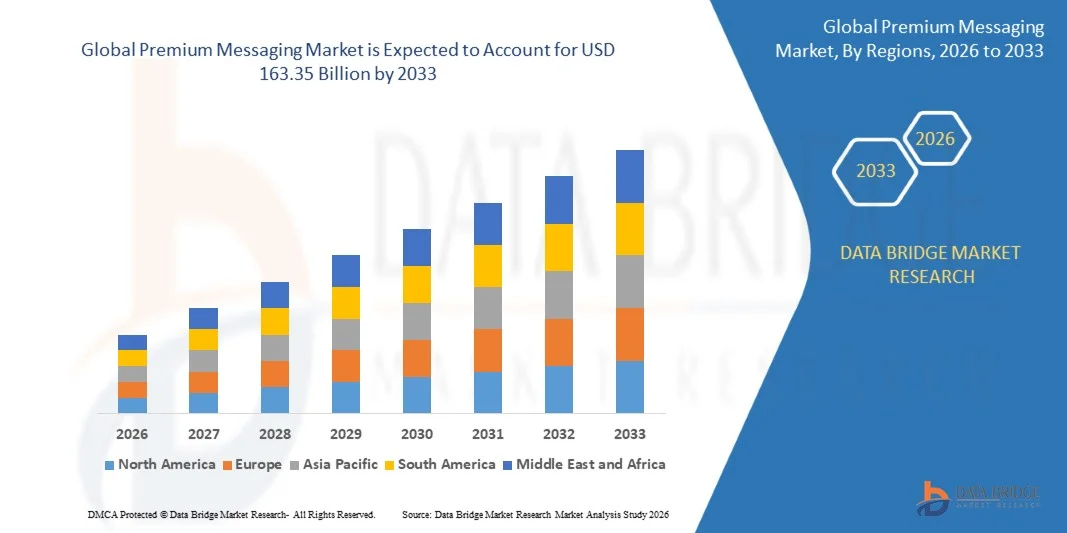
- Selon Data Bridge études de marché Analyse La taille du marché mondial de la messagerie premium a été évaluée à97,15 milliards de dollars en 2025et devrait atteindre163,35 milliards de dollars en 2033, à unTCAC de 6,71 %pendant la période de prévision
- L'adoption croissante d'appareils mobiles, l'utilisation croissante de messages d'application en personne (A2P) pour les services bancaires, les services de détail et les médias, la demande croissante pour l'engagement personnalisé des clients, l'expansion des réseaux 5G, la pénétration croissante de l'internet mobile et la dépendance croissante à l'égard des canaux de communication numérique sont des facteurs clés de la croissance du marché de la messagerie Premium.
Taille du marché et prévisions
- Valeur marchande mondiale (2025): 97,15 milliards de dollars
- Valeur marchande prévue (2033): 163,35 milliards de dollars
- Prévisions CAGR (2026-2033): 6.71%
Quelles sont les principales options du marché de la messagerie Premium
- La pénétration croissante des smartphones, l'expansion des services de messagerie en nuage et l'adoption croissante de solutions de messagerie assistées par l'IA dans les secteurs de la BFSI, du commerce de détail et des médias créent des possibilités de croissance importantes pour le marché de la messagerie Premium
- Les défis réglementaires, les problèmes de filtrage des pourriels et la concurrence croissante des applications de messagerie libre peuvent constituer des restrictions du marché, limitant l'adoption dans certaines régions.
- L'Amérique du Nord a dominé le marché de la messagerie premium avec une part des revenus de 42,65 % en 2025, grâce à l'adoption généralisée de messages A2P et P2A dans les secteurs de la BFSI, du commerce de détail, des télécommunications et des médias aux États-Unis et au Canada.
- L'Asie-Pacifique devrait enregistrer le TCAC le plus rapide de 7,69 % entre 2026 et 2033, en raison de l'adoption croissante de solutions de communications mobiles, de commerce électronique et de technologies financières en Chine, au Japon, en Inde, en Corée du Sud et en Asie du Sud.
- Le segment des SMS A2P a dominé le marché avec une part de 38,6% en 2025, entraînée par une forte adoption dans les secteurs bancaire, des télécommunications, du commerce de détail et du commerce électronique pour la messagerie transactionnelle, alerte et promotionnelle
Portée du rapport et segmentation du marché de la messagerie Premium
|
Attributs |
Messagerie Premium Principales perspectives du marché |
|
Segments couverts |
|
|
Pays couverts |
Amérique du Nord
Europe
Asie-Pacifique
Moyen-Orient et Afrique
Amérique du Sud
|
|
Principaux acteurs du marché |
|
|
Possibilités de marché |
|
|
Infos sur la valeur ajoutée |
En plus des renseignements sur les scénarios du marché tels que la valeur du marché, le taux de croissance, la segmentation, la couverture géographique et les principaux intervenants, les rapports de marché établis par Data Bridge Market Research comprennent également une analyse approfondie des experts, une analyse des prix, une analyse des parts de marque, une enquête auprès des consommateurs, une analyse démographique, une analyse de la chaîne d'approvisionnement, une analyse de la chaîne de valeur, une vue d'ensemble des matières premières et des consommables, des critères de sélection des fournisseurs, une analyse PESTLE, une analyse Porter et un cadre réglementaire. |
Quelle est la tendance clé dans le marché de la messagerie Premium
(en milliers de dollars)Augmentation de l'adoption de solutions de messagerie assistée par l'IA, multicanaux et d'entreprises(en milliers de dollars)
- Le marché de la messagerie haut de gamme connaît une forte adoption de plateformes de messagerie automatisées à l'IA conçues pour améliorer l'engagement des clients, fournir des notifications personnalisées et soutenir la communication omnicanale
- Les fournisseurs introduisent des solutions de messagerie multicanaux intégrant SMS, MMS, RCS, et poussent les notifications pour améliorer la portée, la fiabilité et l'expérience utilisateur
- La demande croissante pour des plateformes de messagerie rentables, évolutives et basées sur le cloud stimule l'adoption dans les secteurs de la BFSI, du commerce de détail, du divertissement et des soins de santé
- Par exemple, des entreprises comme Twilio, Sinch, MessageBird et Infobip ont mis à niveau leurs plateformes grâce à des fonctions de routage, d'analyse et de messagerie personnalisées basées sur l'IA pour améliorer les taux de livraison et l'engagement
- Le besoin croissant de communication instantanée, de programmes de fidélisation de la clientèle et de notifications transactionnelles accélère le passage à des plateformes de messagerie intégrées dans le cloud.
- Au fur et à mesure que les entreprises développent les canaux de communication numérique, la messagerie Premium restera essentielle pour l'engagement en temps réel, la rétention des clients et l'automatisation du marketing
Quels sont les principaux moteurs du marché de messagerie Premium
- Augmentation de la demande de solutions de messagerie automatisées et à haute diffusion pour soutenir des campagnes de communication et de marketing personnalisées entre les entreprises
- Par exemple, en 2025, des entreprises de premier plan comme Twilio, Sinch et Infobip ont amélioré les fonctions de messagerie par l'IA, le support multilingue et l'intégration avec les systèmes CRM
- L'adoption croissante de smartphones, d'internet mobile et de systèmes de paiement numérique stimule la demande de messages transactionnels et promotionnels aux États-Unis, en Europe et en Asie-Pacifique
- Les progrès dans le cloud computing, l'analyse basée sur l'IA et l'orchestration multicanaux ont renforcé l'efficacité, l'évolutivité et la fiabilité des plateformes
- L'utilisation accrue d'appareils compatibles avec l'IoT, d'applications intelligentes et de systèmes de notification automatisés crée une demande pour les plateformes de messagerie premium multicanaux
- Soutenu par la transformation digitale d'entreprise régulière, l'adoption accrue du commerce électronique et l'accent mis sur l'expérience client, le marché de la messagerie Premium devrait connaître une forte croissance à long terme
Quel facteur conteste la croissance du marché de la messagerie Premium
- Des coûts de mise en œuvre et d'abonnement élevés pour les plateformes de messagerie de qualité entreprise peuvent limiter l'adoption parmi les PME et les petites entreprises
- Par exemple, au cours des années 2024-2025, des réglementations strictes en matière de conformité, des restrictions aux messages transfrontaliers et des prix élevés des transporteurs ont augmenté les coûts d'exploitation des fournisseurs mondiaux
- La complexité de l'intégration des plateformes de messagerie avec les systèmes existants, les solutions CRM et les tableaux de bord analytiques nécessite un personnel qualifié et une expertise technique.
- Une connaissance limitée des solutions de messagerie avancée et des avantages sur les marchés émergents ralentit l'adoption
- La concurrence des applications gratuites de messagerie OTT, des plateformes de médias sociaux et des canaux de notification push crée une pression sur les prix et réduit la différenciation
- Pour relever ces défis, les entreprises se concentrent sur des offres de cloud optimisées par les coûts, des API faciles à intégrer, des analyses basées sur l'IA et des modèles d'abonnement flexibles afin d'accroître l'adoption mondiale de messages premium
Comment le marché de messagerie Premium est-il segmenté
Le marché est segmenté sur la base deproduit et application.
• Par produit
Sur la base du produit, le marché de la messagerie premium est segmenté en A2P SMS, A2P MMS, P2A SMS et P2A MMS. Le segment des SMS A2P a dominé le marché avec une part de 38,6% en 2025, sous l'impulsion d'une forte adoption dans les secteurs des services bancaires, des télécommunications, du commerce de détail et du commerce électronique pour la messagerie transactionnelle, alerte et promotionnelle. A2P SMS offre la fiabilité, la compatibilité étendue du réseau mobile et la rentabilité, ce qui en fait le choix préféré pour les entreprises qui communiquent avec de grandes bases d'utilisateurs. Les entreprises comptent de plus en plus sur la messagerie automatisée pour les PAO, les alertes, les rappels et les campagnes de marketing, renforçant ainsi leur position dominante sur le marché.
Le segment des MMS P2A devrait croître au rythme le plus rapide du TCAC de 2026 à 2033, alimenté par l'adoption croissante de communications multimédias, de messages interactifs et de campagnes de marketing améliorées. La pénétration croissante des smartphones, la préférence des consommateurs pour le contenu visuel et les innovations dans les services de communication riches (SCR) accélèrent le passage à des solutions de messagerie Premium basées sur MMS dans plusieurs industries.
• Par demande
Sur la base de l'application, le marché de la messagerie premium est segmenté en BFSI, Entertainment & Media, Hospitality, Outsourcing, Retail, et autres. Le segment BFSI a dominé le marché avec une part de 41,2% en 2025, sous l'effet d'une forte utilisation des alertes transactionnelles, des PAO, des notifications de fraude et des confirmations de paiement. Les institutions financières, les compagnies d'assurance et les sociétés fintech comptent sur des solutions de messagerie sûres et fiables pour maintenir l'engagement et la confiance des clients.
Le segment Entertainment & Media devrait croître au rythme le plus rapide du CAGR de 2026 à 2033, alimenté par une demande croissante de notifications de billets, d'alertes de contenu, de renouvellements d'abonnements et de campagnes interactives. La croissance est soutenue par l'augmentation de la consommation de médias numériques, de plateformes de streaming et de services de jeux en ligne, qui nécessitent des messages en temps réel en grand volume pour améliorer l'engagement et la rétention des clients. L'expansion de la messagerie personnalisée et de l'intégration avec les outils d'automatisation du marketing stimule la croissance dans ce segment d'applications.
Quelle région détient la plus grande part du marché de la messagerie Premium
- L'Amérique du Nord a dominé le marché de la messagerie premium avec une part des revenus de 42,65 % en 2025, en raison de l'adoption généralisée de messages A2P et P2A dans les secteurs de la BFSI, du commerce de détail, des télécommunications et des médias aux États-Unis et au Canada. La forte demande de messages sécurisés, en temps réel et automatisés pour les alertes, les OTP et les campagnes promotionnelles continue de stimuler la croissance du marché. Des plateformes de messagerie avancées, des solutions basées sur le cloud et une infrastructure numérique forte renforcent encore le leadership de la région
- Les principaux acteurs nord-américains mettent en place des API de messagerie évolutives, une intégration multicanaux et des analyses en nuage, améliorant la fiabilité du service et l'adoption des entreprises. Les investissements continus dans les solutions de communication 5G, IoT et de marketing axées sur l'IA devraient soutenir l'expansion du marché.
- Une forte réserve de talents, des réseaux de télécommunications matures et des écosystèmes axés sur l'innovation renforcent la position de l'Amérique du Nord en tant que premier contributeur au marché mondial de la messagerie Premium
US Premium Messaging Market Insight
Les États-Unis sont les principaux contributeurs en Amérique du Nord, appuyés par l'adoption généralisée de solutions de SMS A2P, de messagerie transactionnelle et de marketing automatisé dans les secteurs de la BFSI, du commerce de détail et des télécommunications. Les entreprises tirent parti de la messagerie en nuage, de l'analyse par l'IA et des intégrations d'API pour la communication en temps réel en grand volume. La demande croissante de messages sécurisés et multicanaux et de notifications personnalisées conduit à l'adoption de la messagerie Premium. Les principaux opérateurs de télécommunications, les fintechs et les plateformes de commerce électronique contribuent de manière significative aux recettes régionales.
Aperçu du marché canadien de la messagerie Premium
Le Canada contribue régulièrement au marché nord-américain, en raison de l'utilisation croissante des messages A2P dans les secteurs de la BFSI, des soins de santé et du commerce de détail. Les entreprises de télécommunications comptent sur des messages sûrs et efficaces pour les alertes transactionnelles, les notifications et les campagnes de marketing. Les initiatives gouvernementales soutenant l'infrastructure de communication numérique, l'adoption d'entreprises fortes et l'intégration croissante des messages en nuage renforcent la pénétration du marché. Les start-up et les PME canadiennes adoptent de plus en plus des plateformes de messagerie Premium pour améliorer l'engagement des clients et les communications automatisées.
Marché de la messagerie prime Asie-Pacifique
L'Asie-Pacifique devrait enregistrer le TCAC le plus rapide de 7,69 % entre 2026 et 2033, en raison de l'adoption croissante de solutions de communications mobiles, de commerce électronique et de technologies financières en Chine, au Japon, en Inde, en Corée du Sud et en Asie du Sud-Est. Les exigences élevées en matière de messagerie dans les secteurs de la BFSI, du divertissement, du commerce de détail et des télécommunications exigent des solutions de messagerie Premium fiables, évolutives et automatisées. La pénétration rapide des smartphones, la croissance de l'infrastructure numérique et le déploiement 5G accélèrent l'adoption de messages A2P et P2A dans les entreprises.
China Premium Messaging Market Insight
La Chine est le principal contributeur à l'Asie-Pacifique en raison de la base massive d'abonnés mobiles, de l'adoption généralisée de l'A2P et de l'infrastructure numérique avancée. Les entreprises et les opérateurs de télécommunications font appel à des messages à volume élevé pour les alertes bancaires, les notifications de commerce électronique et les campagnes de marketing. L'appui du gouvernement à la numérisation, aux réseaux de télécommunications de pointe et à la tarification concurrentielle des plateformes de messagerie favorise l'adoption partout au pays.
Japan Premium Messaging Market Insight
Le Japon affiche une croissance régulière avec une forte demande des secteurs de la BFSI, du commerce de détail et des télécommunications. Les entreprises comptent sur une messagerie fiable et sécurisée pour les alertes automatisées, les notifications et le marketing. Réseaux de télécommunications avancés, forte pénétration des smartphones, et intégration avec l'adoption d'un support analytique basé sur l'IA. La croissance est encore renforcée par la demande de messages multicanaux et interactifs entre entreprises.
Inde Premium Messaging Market Insight
L'Inde émerge comme un pôle de croissance majeur pour la messagerie Premium, alimenté par la numérisation rapide, l'adoption de smartphones, et les secteurs de la fintech et du commerce électronique en plein essor. Les entreprises et les startups adoptent de plus en plus les SMS A2P, les MMS P2A et les messages en nuage pour les alertes transactionnelles, le marketing et l'engagement des clients. Les initiatives numériques soutenues par l'État, l'expansion de l'infrastructure des télécommunications et l'adoption croissante de la 5G appuient davantage l'expansion du marché.
Corée du Sud Premium Messaging Market Insight
La Corée du Sud apporte une contribution importante en raison de la forte pénétration des services mobiles, de l'adoption généralisée des entreprises et de la forte demande des secteurs de la BFSI, du commerce de détail et des télécommunications. L'adoption rapide d'API de messagerie avancée, d'intégrations multicanaux et de plateformes de communication basées sur le cloud stimule la croissance. Une infrastructure numérique solide, l'innovation technologique et le soutien gouvernemental aux solutions de communication intelligentes assurent une expansion durable du marché.
Quelles sont les meilleures entreprises du marché de la messagerie Premium
L'industrie de la messagerie haut de gamme est principalement dirigée par des entreprises bien établies, notamment :
- Deutsche Telekom AG (Allemagne)
- Entreprise orange (France)
- NTT DOCOMO (Japon)
- China Telecom Corporation Limited (Chine)
- Twilio Inc. (États-Unis)
- AT&T Propriété intellectuelle (États-Unis)
- Vodafone Limited (Royaume-Uni)
- Sinch (Suède)
- SoftBank Corporation (Japon)
- Chine Unicom (Hong Kong) Limited (Chine)
- Vonage America, LLC (États-Unis)
- KDDI CORPORATION (Japon)
Quelles sont les évolutions récentes du marché mondial de la messagerie Premium
- En février 2025, Vonage a annoncé un partenariat avec la plateforme allemande de commerce social mydealz, permettant à l'entreprise d'utiliser Rich Communication Services (RCS) et d'offrir aux utilisateurs une expérience de messagerie plus avancée, améliorant la communication personnalisée, engageante et interactive. Cette collaboration permet à mydealz d'envoyer des notifications en temps réel sur des offres populaires, de créer des offres adaptées aux préférences de l'utilisateur, et de fournir des expériences d'achat interactives à travers des médias riches tels que des images et des boutons cliquables, améliorant considérablement l'engagement et la rétention des clients
- En septembre 2024, Twilio a annoncé la disponibilité mondiale de messages Rich Communication Services pour ses clients via ses API programmables de messagerie et de vérification, permettant aux entreprises d'envoyer des messages vérifiés et de marque pour renforcer la confiance et la fidélité des clients. Le RCS Twilio est automatiquement mis à niveau les messages SMS vers le RCS sur des appareils compatibles pour des messages allant jusqu'à 160 caractères, y compris les logos d'affaires, les balises et la vérification de l'expéditeur. Les entreprises peuvent configurer leur marque et la vérification à travers la console Twilio sans codage, assurant des communications rapides, fiables et fiables dans le monde entier
SKU-
Accédez en ligne au rapport sur le premier cloud mondial de veille économique

- Tableau de bord d'analyse de données interactif
- Tableau de bord d'analyse d'entreprise pour les opportunités à fort potentiel de croissance
- Accès d'analyste de recherche pour la personnalisation et les requêtes
- Analyse de la concurrence avec tableau de bord interactif
- Dernières actualités, mises à jour et analyse des tendances
- Exploitez la puissance de l'analyse comparative pour un suivi complet de la concurrence
Méthodologie de recherche
La collecte de données et l'analyse de l'année de base sont effectuées à l'aide de modules de collecte de données avec des échantillons de grande taille. L'étape consiste à obtenir des informations sur le marché ou des données connexes via diverses sources et stratégies. Elle comprend l'examen et la planification à l'avance de toutes les données acquises dans le passé. Elle englobe également l'examen des incohérences d'informations observées dans différentes sources d'informations. Les données de marché sont analysées et estimées à l'aide de modèles statistiques et cohérents de marché. De plus, l'analyse des parts de marché et l'analyse des tendances clés sont les principaux facteurs de succès du rapport de marché. Pour en savoir plus, veuillez demander un appel d'analyste ou déposer votre demande.
La méthodologie de recherche clé utilisée par l'équipe de recherche DBMR est la triangulation des données qui implique l'exploration de données, l'analyse de l'impact des variables de données sur le marché et la validation primaire (expert du secteur). Les modèles de données incluent la grille de positionnement des fournisseurs, l'analyse de la chronologie du marché, l'aperçu et le guide du marché, la grille de positionnement des entreprises, l'analyse des brevets, l'analyse des prix, l'analyse des parts de marché des entreprises, les normes de mesure, l'analyse globale par rapport à l'analyse régionale et des parts des fournisseurs. Pour en savoir plus sur la méthodologie de recherche, envoyez une demande pour parler à nos experts du secteur.
Personnalisation disponible
Data Bridge Market Research est un leader de la recherche formative avancée. Nous sommes fiers de fournir à nos clients existants et nouveaux des données et des analyses qui correspondent à leurs objectifs. Le rapport peut être personnalisé pour inclure une analyse des tendances des prix des marques cibles, une compréhension du marché pour d'autres pays (demandez la liste des pays), des données sur les résultats des essais cliniques, une revue de la littérature, une analyse du marché des produits remis à neuf et de la base de produits. L'analyse du marché des concurrents cibles peut être analysée à partir d'une analyse basée sur la technologie jusqu'à des stratégies de portefeuille de marché. Nous pouvons ajouter autant de concurrents que vous le souhaitez, dans le format et le style de données que vous recherchez. Notre équipe d'analystes peut également vous fournir des données sous forme de fichiers Excel bruts, de tableaux croisés dynamiques (Fact book) ou peut vous aider à créer des présentations à partir des ensembles de données disponibles dans le rapport.











