


Global Rotogravure Printing Machine Market Segmentation, By Automation Mode (Automatic Rotogravure Printing Machine, and Manual Rotogravure Printing Machine), Substrate (Plastic, Aluminium Foil, Paper and Paperboard), Ink Type (Water Ink, Solvent Based Ink, and Radiation Ink), Drying Source (Gas, Electrical and Thermal Fluid), Application (Food and Beverage, Pharmaceutical, Consumer Goods, and Others)- Industry Trends and Forecast to 2033
Rotogravure Printing Machine Market Size
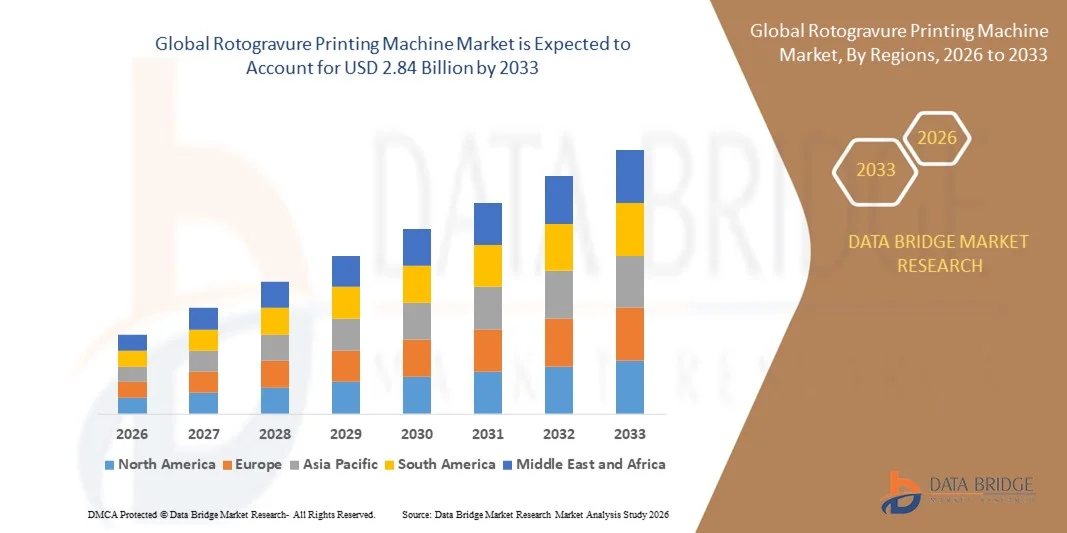
- The global rotogravure printing machine market size was valued at USD 2.14 billion in 2025 and is expected to reach USD 2.84 billion by 2033, at a CAGR of 3.60% during the forecast period
- The market growth is largely fuelled by increasing demand for high-quality printing in packaging, labels, and decorative applications, along with rising adoption of automated and efficient printing solutions
- Growing preference for sustainable and cost-effective printing technologies, coupled with advancements in printing speed and precision, is further driving market expansion
Rotogravure Printing Machine Market Analysis
- The market is witnessing steady growth due to the rising need for high-volume printing in packaging and publishing industries
- Technological advancements, including automated cylinder preparation and integration with digital systems, are enhancing operational efficiency and reducing production costs
- North America dominated the rotogravure printing machine market with the largest revenue share of 37.50% in 2025, driven by high demand for premium packaging, labels, and decorative printing, as well as the presence of well-established printing and packaging industries
- Asia-Pacific region is expected to witness the highest growth rate in the global rotogravure printing machine market, driven by expanding food, beverage, and pharmaceutical industries, increasing industrial automation, and rising demand for high-quality and cost-efficient printing solutions across emerging economies
- The automatic rotogravure printing machine segment held the largest market revenue share in 2025, driven by rising demand for high-speed, high-volume printing and operational efficiency. Automatic machines offer consistent print quality, reduced labor requirements, and seamless integration with digital controls, making them a preferred choice for large-scale converters
Report Scope and Rotogravure Printing Machine Market Segmentation
|
Attributes |
Rotogravure Printing Machine Key Market Insights |
|
Segments Covered |
|
|
Countries Covered |
North America
Europe
Asia-Pacific
Middle East and Africa
South America
|
|
Key Market Players |
|
|
Market Opportunities |
|
|
Value Added Data Infosets |
In addition to the insights on market scenarios such as market value, growth rate, segmentation, geographical coverage, and major players, the market reports curated by the Data Bridge Market Research also include import export analysis, production capacity overview, production consumption analysis, price trend analysis, climate change scenario, supply chain analysis, value chain analysis, raw material/consumables overview, vendor selection criteria, PESTLE Analysis, Porter Analysis, and regulatory framework. |
Rotogravure Printing Machine Market Trends
Increasing Adoption of Automated and High-Speed Printing Solutions
- The growing demand for high-quality and large-volume printing in packaging, labels, and decorative applications is significantly shaping the rotogravure printing machine market, as manufacturers seek equipment that delivers precision, speed, and reliability. Rotogravure machines are gaining traction due to their ability to produce consistent print quality at high production volumes, encouraging adoption across packaging, publishing, and specialty printing industries
- Rising focus on sustainability and cost-efficient printing processes has accelerated demand for energy-efficient and automated rotogravure machines. Companies are actively investing in machinery that reduces ink and material waste, while improving operational efficiency, prompting suppliers to innovate with advanced, eco-friendly solutions
- Digital integration trends are influencing purchasing decisions, with manufacturers emphasizing smart control systems, automated cylinder preparation, and predictive maintenance. These features enhance workflow efficiency, reduce downtime, and improve overall print quality, helping brands differentiate themselves in a competitive market
- For instance, in 2024, Bobst in Switzerland and Mark Andy in the U.S. expanded their product portfolios by introducing high-speed and automated rotogravure printing machines, targeting packaging and label converters. These launches were aimed at improving productivity, reducing operational costs, and meeting the growing demand for premium print finishes in global markets
- While adoption of advanced rotogravure machines is growing, sustained market expansion depends on cost optimization, workforce training, and maintenance efficiency. Manufacturers are also focusing on improving scalability, energy efficiency, and process automation to enable broader adoption and long-term market growth
Rotogravure Printing Machine Market Dynamics
Driver
Growing Demand For High-Quality, Large-Volume Printing
- Rising requirements for premium packaging, labels, and decorative printing are a major driver for the rotogravure printing machine market. Manufacturers are increasingly investing in automated and high-speed machines to achieve consistent print quality and reduce production costs, supporting market growth
- Expanding applications in food and beverage, pharmaceuticals, cosmetics, and specialty packaging are influencing market adoption. Rotogravure printing machines enhance print resolution, color consistency, and production efficiency, enabling companies to meet industry standards and consumer expectations
- Machine suppliers are promoting automated solutions with integrated digital controls, predictive maintenance, and energy-efficient designs. These innovations reduce operational complexity and downtime, driving market preference for technologically advanced machinery
- For instance, in 2023, Comexi in Spain and Uteco in Italy reported increased deployment of automated rotogravure printing machines in packaging and label production, driven by higher demand for premium print quality and operational efficiency. Marketing campaigns highlighted productivity gains and reduced environmental impact, reinforcing brand credibility
- Although rising automation and demand for high-quality printing support market growth, wider adoption depends on cost management, machine availability, and skilled workforce training. Investment in maintenance support, energy-efficient solutions, and digital integration will be critical for meeting global demand
Restraint/Challenge
High Capital Investment And Maintenance Complexity
- The relatively high cost of rotogravure printing machines compared to other printing technologies remains a key challenge, limiting adoption among small and medium-scale converters. High initial investment, maintenance requirements, and skilled operator dependence contribute to slower uptake
- Operational complexity and need for trained personnel impact market growth, as rotogravure machines require precise setup, cylinder preparation, and ongoing quality monitoring. Lack of skilled operators can result in inefficiencies and increased production costs
- Supply chain and spare parts availability also affect adoption, as components must meet stringent precision and quality standards. Delays in maintenance or cylinder replacement can disrupt production schedules, impacting profitability
- For instance, in 2024, packaging converters in Southeast Asia and Latin America reported slower adoption due to high capital expenditure and maintenance requirements, despite demand for high-quality printing. Limited access to technical support and skilled operators further constrained market growth
- Overcoming these challenges will require cost-efficient machine designs, improved training programs, and enhanced after-sales support. Collaboration between manufacturers, suppliers, and training institutes can help optimize machine utilization and unlock the long-term potential of the global rotogravure printing machine market
Rotogravure Printing Machine Market Scope
The market is segmented on the basis of automation mode, substrate, ink type, drying source, and application.
- By Automation Mode
On the basis of automation mode, the rotogravure printing machine market is segmented into automatic rotogravure printing machine and manual rotogravure printing machine. The automatic rotogravure printing machine segment held the largest market revenue share in 2025, driven by rising demand for high-speed, high-volume printing and operational efficiency. Automatic machines offer consistent print quality, reduced labor requirements, and seamless integration with digital controls, making them a preferred choice for large-scale converters. These machines also support advanced features such as automated cylinder changes, real-time quality monitoring, and remote diagnostics, further improving productivity and reducing downtime. Manufacturers are increasingly investing in automatic machines to meet the growing demand for high-quality packaging in food, pharmaceutical, and consumer goods industries.
The manual rotogravure printing machine segment is expected to witness the fastest growth rate from 2026 to 2033, driven by its cost-effectiveness and suitability for small-scale production and specialized printing applications. Manual machines are particularly popular among small converters and niche packaging manufacturers, offering flexibility and lower initial investment. These machines allow operators to customize printing for short-run or specialty jobs, making them ideal for boutique packaging and limited-edition products. Their simplicity and lower maintenance requirements also make them appealing in emerging markets where technical expertise is limited.
- By Substrate
On the basis of substrate, the market is segmented into plastic, aluminium foil, paper, and paperboard. The plastic segment held the largest market share in 2025, owing to its widespread use in flexible packaging for food, beverages, and consumer goods. Plastic substrates enable high-quality print reproduction, durability, and resistance to moisture and chemicals, which are critical for packaged products. The versatility of plastics allows for various shapes, sizes, and finishes, supporting brand differentiation. Increasing demand for visually appealing and protective packaging is further boosting the adoption of plastic substrates in rotogravure printing.
The paper and paperboard segment is expected to register the fastest growth from 2026 to 2033, fueled by increasing demand for sustainable packaging and eco-friendly materials. Paper-based substrates are increasingly preferred for premium packaging, cartons, and labels, appealing to environmentally conscious consumers. Advances in paper coating and treatment technologies allow high-resolution printing comparable to plastic substrates. The growing trend of recyclable and biodegradable packaging solutions is driving manufacturers to adopt paper and paperboard in both food and non-food applications.
- By Ink Type
On the basis of ink type, the market is segmented into water ink, solvent-based ink, and radiation ink. Solvent-based ink held the largest market share in 2025, attributed to its versatility, high adhesion, and suitability for diverse substrates in industrial printing applications. Solvent inks provide vibrant colors, fast drying times, and strong resistance to smudging, making them ideal for high-speed rotogravure operations. The continued preference for solvent-based inks is supported by their ability to handle complex graphics and maintain print quality over long production runs. They are widely used in packaging for food, pharmaceuticals, and consumer goods.
The water ink segment is expected to register the fastest growth from 2026 to 2033, driven by environmental regulations and rising preference for eco-friendly and low-VOC printing solutions. Water-based inks are increasingly adopted in food, beverage, and pharmaceutical packaging to reduce environmental impact while maintaining high-quality print output. These inks offer benefits such as easy cleanup, reduced hazardous emissions, and compatibility with recyclable substrates. With increasing sustainability mandates globally, manufacturers are investing in water-based ink technologies to meet regulatory compliance and consumer demand.
- By Drying Source
On the basis of drying source, the market is segmented into gas, electrical, and thermal fluid. The gas drying segment held the largest market share in 2025, supported by its efficiency in high-speed printing and ability to achieve uniform ink drying across substrates. Gas drying systems are widely preferred in industrial printing due to their reliability, speed, and adaptability to various ink types. They also help minimize production delays by providing rapid drying without compromising print quality. The adoption of gas dryers is particularly high in large-scale food, beverage, and packaging operations.
The thermal fluid drying segment is expected to witness the fastest growth rate from 2026 to 2033, driven by advancements in energy-efficient and precise temperature control technologies, offering improved drying performance and operational cost savings. Thermal fluid systems allow for uniform heat distribution and can handle diverse substrates and ink types, making them suitable for premium packaging applications. They also reduce energy consumption and carbon footprint compared to conventional drying systems, aligning with the growing focus on sustainability. Manufacturers are increasingly incorporating thermal fluid drying to improve efficiency and reduce operational costs.
- By Application
On the basis of application, the market is segmented into food and beverage, pharmaceutical, consumer goods, and others. The food and beverage segment held the largest market revenue share in 2025, owing to high demand for printed packaging in snacks, beverages, and processed foods, requiring vibrant graphics and durable prints. Rotogravure printing ensures precise color reproduction, consistent quality, and durability, which are essential for maintaining brand identity. The growth of packaged food and beverage products in emerging economies is further boosting demand for high-quality printing solutions.
The pharmaceutical segment is expected to witness the fastest growth from 2026 to 2033, driven by stringent packaging regulations, increasing demand for tamper-evident labels, and growth in pharmaceutical production. High-quality, precise printing ensures compliance with safety and regulatory standards, particularly for medication labels, blister packs, and cartons. The rise in global healthcare demand and expanding pharmaceutical manufacturing in Asia-Pacific and North America are accelerating the adoption of rotogravure printing machines. Manufacturers are increasingly investing in advanced machines to ensure accuracy, speed, and compliance in pharmaceutical packaging.
Rotogravure Printing Machine Market Regional Analysis
- North America dominated the rotogravure printing machine market with the largest revenue share of 37.50% in 2025, driven by high demand for premium packaging, labels, and decorative printing, as well as the presence of well-established printing and packaging industries
- Manufacturers in the region highly value advanced features, automation, and energy-efficient printing solutions offered by modern rotogravure machines, enabling high-quality, large-volume production
- This widespread adoption is further supported by strong industrial infrastructure, availability of skilled workforce, and high investment in printing technology, establishing rotogravure machines as the preferred choice for food, beverage, and consumer goods packaging
U.S. Rotogravure Printing Machine Market Insight
The U.S. rotogravure printing machine market captured the largest revenue share in 2025 within North America, fueled by growing demand for high-quality packaging and labels. Manufacturers are increasingly prioritizing automated and high-speed printing solutions to enhance productivity and print consistency. The adoption of digital integration, predictive maintenance, and energy-efficient machinery is further propelling the market. In addition, the rising demand for sustainable packaging and regulatory compliance in food and pharmaceutical segments is contributing to market growth.
Europe Rotogravure Printing Machine Market Insight
The Europe rotogravure printing machine market is expected to witness the fastest growth rate from 2026 to 2033, primarily driven by stringent packaging standards, increasing demand for premium product labeling, and the adoption of automation technologies. Rising urbanization, along with the push for sustainable and eco-friendly printing solutions, is fostering adoption. European manufacturers are also investing in high-speed, energy-efficient machines to meet quality and environmental standards across food, beverage, and consumer goods industries.
U.K. Rotogravure Printing Machine Market Insight
The U.K. rotogravure printing machine market is expected to witness the fastest growth rate from 2026 to 2033, driven by increasing demand for high-quality labels, premium packaging, and decorative printing. Rising awareness regarding regulatory compliance and sustainable production is encouraging manufacturers to adopt advanced rotogravure solutions. The U.K.’s established printing infrastructure and strong e-commerce and packaging industries further support market expansion.
Germany Rotogravure Printing Machine Market Insight
The Germany rotogravure printing machine market is expected to witness the fastest growth rate from 2026 to 2033, fueled by the country’s emphasis on technological innovation, precision engineering, and sustainable production processes. Germany’s mature industrial base, along with growing investments in automated and energy-efficient printing solutions, promotes adoption in food, pharmaceutical, and consumer goods packaging. Integration with digital systems and predictive maintenance is becoming increasingly prevalent, enhancing operational efficiency and print quality.
Asia-Pacific Rotogravure Printing Machine Market Insight
The Asia-Pacific rotogravure printing machine market is expected to witness the fastest growth rate from 2026 to 2033, driven by increasing industrialization, rising demand for high-quality packaging, and expanding food, beverage, and pharmaceutical sectors in countries such as China, Japan, and India. The region’s growing manufacturing capabilities, along with the availability of affordable machinery and skilled operators, is accelerating adoption. Government initiatives promoting industrial automation and technological advancement are also contributing to market growth.
Japan Rotogravure Printing Machine Market Insight
The Japan rotogravure printing machine market is expected to witness the fastest growth rate from 2026 to 2033 due to the country’s focus on precision, automation, and high-quality packaging standards. Japanese manufacturers are increasingly adopting automated and energy-efficient machines to enhance production efficiency and print quality. The integration of digital controls, predictive maintenance, and eco-friendly solutions is driving market expansion in food, beverage, and consumer goods packaging segments.
China Rotogravure Printing Machine Market Insight
The China rotogravure printing machine market accounted for the largest market revenue share in Asia-Pacific in 2025, attributed to the country’s rapid industrialization, growing packaging and printing industries, and increasing demand for high-quality labeling. China is emerging as a hub for manufacturing advanced rotogravure machines, offering affordable solutions to domestic and international converters. Rising investment in automated, high-speed printing technologies and the growth of food, beverage, and consumer goods sectors are key factors driving market expansion.
Rotogravure Printing Machine Market Share
The Rotogravure Printing Machine industry is primarily led by well-established companies, including:
- JM Heaford (U.K.)
- BOBST (Switzerland)
- WINDMOELLER & HOELSCHER CORPORATION (U.S.)
- KKA (Italy)
- Rotatek (India)
- Uteco Converting S.p.A. (Italy)
- Shaanxi Beiren Printing Machinery Co., Ltd. (China)
- Hsing Wei Machine Industry CO., LTD. (Taiwan)
- QUEEN'S MACHINERY CO., LTD. (Taiwan)Pelican Rotoflex Pvt. Ltd. (India)
- HYPLAS MACHINERY CO., LTD. (China)
- FUJI KIKAI KOGYO Co., Ltd. (Japan)
- WEIJIN MACHINERY INDUSTRY CO., LTD. (China)
- ChinaplasOnline (China)
- Comexi Group (Spain)
- DCM-ATN (Italy)
- Italian Trade Agency (Italy)
- Shibaura Machine CO., LTD (Japan)
- Shibaura Machine CO., LTD (Japan)
SKU-
Accédez en ligne au rapport sur le premier cloud mondial de veille économique

- Tableau de bord d'analyse de données interactif
- Tableau de bord d'analyse d'entreprise pour les opportunités à fort potentiel de croissance
- Accès d'analyste de recherche pour la personnalisation et les requêtes
- Analyse de la concurrence avec tableau de bord interactif
- Dernières actualités, mises à jour et analyse des tendances
- Exploitez la puissance de l'analyse comparative pour un suivi complet de la concurrence
Méthodologie de recherche
La collecte de données et l'analyse de l'année de base sont effectuées à l'aide de modules de collecte de données avec des échantillons de grande taille. L'étape consiste à obtenir des informations sur le marché ou des données connexes via diverses sources et stratégies. Elle comprend l'examen et la planification à l'avance de toutes les données acquises dans le passé. Elle englobe également l'examen des incohérences d'informations observées dans différentes sources d'informations. Les données de marché sont analysées et estimées à l'aide de modèles statistiques et cohérents de marché. De plus, l'analyse des parts de marché et l'analyse des tendances clés sont les principaux facteurs de succès du rapport de marché. Pour en savoir plus, veuillez demander un appel d'analyste ou déposer votre demande.
La méthodologie de recherche clé utilisée par l'équipe de recherche DBMR est la triangulation des données qui implique l'exploration de données, l'analyse de l'impact des variables de données sur le marché et la validation primaire (expert du secteur). Les modèles de données incluent la grille de positionnement des fournisseurs, l'analyse de la chronologie du marché, l'aperçu et le guide du marché, la grille de positionnement des entreprises, l'analyse des brevets, l'analyse des prix, l'analyse des parts de marché des entreprises, les normes de mesure, l'analyse globale par rapport à l'analyse régionale et des parts des fournisseurs. Pour en savoir plus sur la méthodologie de recherche, envoyez une demande pour parler à nos experts du secteur.
Personnalisation disponible
Data Bridge Market Research est un leader de la recherche formative avancée. Nous sommes fiers de fournir à nos clients existants et nouveaux des données et des analyses qui correspondent à leurs objectifs. Le rapport peut être personnalisé pour inclure une analyse des tendances des prix des marques cibles, une compréhension du marché pour d'autres pays (demandez la liste des pays), des données sur les résultats des essais cliniques, une revue de la littérature, une analyse du marché des produits remis à neuf et de la base de produits. L'analyse du marché des concurrents cibles peut être analysée à partir d'une analyse basée sur la technologie jusqu'à des stratégies de portefeuille de marché. Nous pouvons ajouter autant de concurrents que vous le souhaitez, dans le format et le style de données que vous recherchez. Notre équipe d'analystes peut également vous fournir des données sous forme de fichiers Excel bruts, de tableaux croisés dynamiques (Fact book) ou peut vous aider à créer des présentations à partir des ensembles de données disponibles dans le rapport.











