



Global Sandboxing Market Segmentation, By Component (Solutions, Services), Delivery Type (Hardware, Virtual Appliance, Cloud-Based), Organization Size (Large Enterprises, Small and Medium Enterprises), Industry Vertical (Government and Defense, BFSI, IT and Telecom, Healthcare, Retail, Education, Others) - Industry Trends and Forecast to 2032
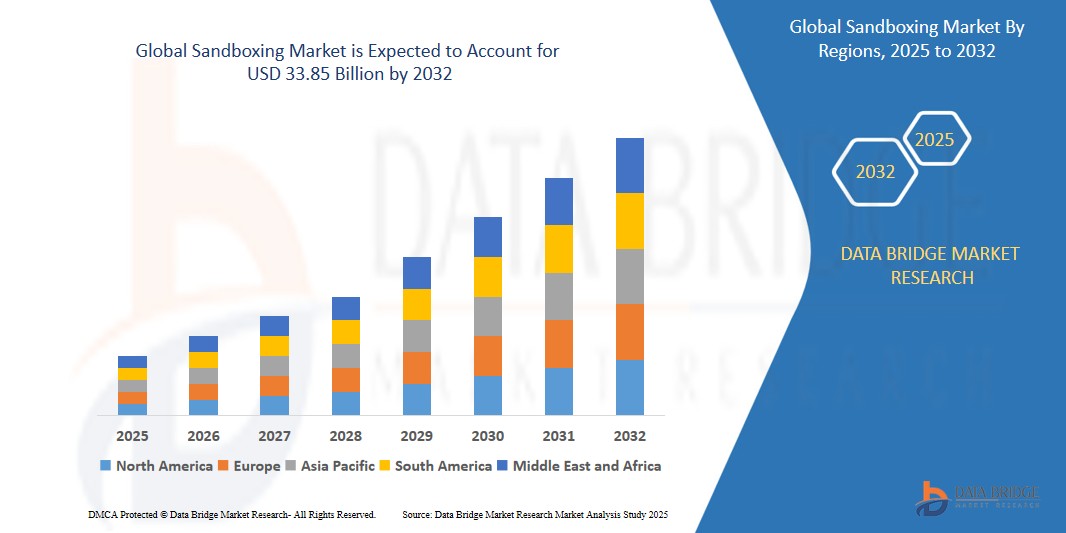
Sandboxing Market Size
- The global Sandboxing market size was valued atUSD 10.88 billion in 2024 and is expected to reachUSD 33.85 billion by 2032, at aCAGR of 17.94%during the forecast period
- This growth is driven by the increasing sophistication of cyber threats, rising adoption of cloud-based sandboxing solutions, and stringent regulatory requirements for data protection across industries
Sandboxing Market Analysis
- The Sandboxing market encompasses cybersecurity solutions and services that isolate and analyze potentially malicious files, applications, or code in a secure, virtual environment to prevent threats from compromising enterprise networks or systems.
- The demand for sandboxing solutions is significantly driven by the surge in advanced cyberattacks, with 60% of organizations reporting malware incidents in 2024, and the growing adoption of cloud-based and IoT technologies, which expand the attack surface by 25% annually.
- North America is expected to dominate the Sandboxing market due to its advanced cybersecurity infrastructure and presence of key vendors like Cisco and Fortinet, holding a 33.6% market share in 2022.
- Asia-Pacific is expected to be the fastest-growing region during the forecast period due to increasing cyber threats, rapid digital transformation, and government initiatives in countries like Japan and India.
- The Solutions segment is expected to dominate the market with a market share of 60.0% in 2025 due to the critical role of standalone and integrated sandboxing software in detecting and mitigating advanced threats.
Report Scope and Sandboxing Market Segmentation
|
Attributes |
Sandboxing Key Market Insights |
|
Segments Covered |
|
|
Countries Covered |
North America
Europe
Asia-Pacific
Middle East and Africa
South America
|
|
Key Market Players |
|
|
Market Opportunities |
|
|
Value Added Data Infosets |
In addition to the insights on market scenarios such as market value, growth rate, segmentation, geographical coverage, and major players, the market reports curated by the Data Bridge Market Research also include import export analysis, production capacity overview, production consumption analysis, price trend analysis, climate change scenario, supply chain analysis, value chain analysis, raw material/consumables overview, vendor selection criteria, PESTLE Analysis, Porter Analysis, and regulatory framework. |
Sandboxing Market Trends
“Rise of AI-Driven and Cloud-Based Sandboxing Solutions”
- A prominent trend in the Sandboxing market is the integration of artificial intelligence (AI) and machine learning (ML) into sandboxing solutions, enabling real-time threat detection and behavioral analysis, with 55% of enterprises adopting AI-driven sandboxing by 2024.
- Cloud-based sandboxing is gaining traction due to its scalability and cost-effectiveness, with the cloud-based segment projected to grow to USD 2.8 billion by 2032, driven by increased demand for data security.
- For instance, In 2024, Fortinet introduced cloud-based sandboxing enhancements to its FortiSandbox platform, improving malware detection for distributed enterprises.
- This trend is driving demand for flexible, AI-enhanced sandboxing solutions that address evolving cyber threats
Sandboxing Market Dynamics
Driver
“Escalating Sophistication of Cyber Threats”
- The increasing frequency and complexity of cyberattacks, with ransomware incidents rising by 30% in 2024, and the limitations of traditional security tools in detecting zero-day attacks are significantly contributing to the Sandboxing market growth.
- Sandboxing solutions provide a secure environment to analyze suspicious files, reducing data breach risks by 25% in enterprises adopting these technologies.
- For instance, in April 2022, a cyberattack on The Works, a U.K. retailer, highlighted the need for sandboxing to protect sensitive data, boosting adoption in the retail sector.
- As organizations prioritize proactive threat detection, the demand for sandboxing solutions continues to rise, ensuring robust cybersecurity frameworks
Opportunity
“Adoption of Cloud-Based Sandboxing in SMEs”
- The growing adoption of cloud-based sandboxing solutions by small and medium enterprises (SMEs), with 40% of SMEs investing in cloud security by 2025, offers significant opportunities for market growth due to their scalability and lower costs compared to hardware-based solutions.
- These solutions enable SMEs to protect against malware and phishing attacks without significant infrastructure investments, with cloud-based deployments projected to grow at a CAGR of 17.2% by 2032.
- For instance, in 2024, Zscaler expanded its cloud sandboxing offerings for SMEs, enhancing threat detection for remote work environments.
- This opportunity drives market expansion by making advanced cybersecurity accessible to smaller organizations.
Restraint/Challenge
“High Deployment Costs and Integration Complexity”
- High deployment and maintenance costs, with 35% of SMEs citing cost as a barrier to sandboxing adoption in 2024, and integration complexity with existing security systems, affecting 45% of enterprises, pose significant barriers to the Sandboxing market.
- These challenges require substantial investments in skilled personnel and system upgrades, limiting adoption among resource-constrained organizations.
- For instance, in 2024, 30% of mid-sized firms reported difficulties in finding qualified personnel to manage sandboxing tools, leading to underutilization.
- These issues can hinder market growth, necessitating cost-effective and interoperable solutions.
Sandboxing Market Scope
The market is segmented on the basis application, product type, technology, magnification type, end user, and distribution channel.
|
Segmentation |
Sub-Segmentation |
|
By Component |
|
|
By Delivery Type |
|
|
By Organization Size |
|
|
By Industry Vertical
|
|
In 2025, the Solution segment is projected to dominate the Global Sandboxing Market with the largest share in the component segment.
The growing need for advanced threat protection tools to detect and mitigate zero-day attacks is driving the adoption of sandboxing solutions over services. These solutions provide automated malware analysis and behavior monitoring, making them essential for securing enterprise networks against evolving cyber threats.
The Government & Defense segment is expected to account for the largest share during the forecast period in the industry vertical segment.
This dominance is fueled by the rising need for national cybersecurity frameworks, increased risks of state-sponsored attacks, and sensitive data protection. Governments worldwide are investing heavily in proactive threat detection technologies like sandboxing to secure critical infrastructure and defense systems.
Sandboxing Market Regional Analysis
“North America Holds the Largest Share in the Sandboxing Market”
- North America dominates the Sandboxing market, driven by its advanced cybersecurity infrastructure, high adoption of cloud-based solutions, and presence of key vendors like Cisco, Fortinet, and Palo Alto Networks, with a 33.6% market share in 2022.
- The U.S. holds a significant share, valued at USD 3.1 billion in 2024, due to innovations in security technologies and regulatory compliance requirements.
- The region’s focus on protecting critical infrastructure, with 65% of enterprises adopting sandboxing for threat detection, further strengthens the market.
- In addition, high demand for sandboxing in BFSI and government sectors, with 70% of U.S. banks using sandboxing solutions, fuels market expansion
“Asia-Pacific is Projected to Register the Highest CAGR in the Sandboxing Market”
- The Asia-Pacific region is expected to experience the highest growth rate in the sandboxing market, driven by increasing cyber threats, rapid digital transformation, and expanding IT infrastructure across industries.
- Countries like China, India, Japan, and South Korea are investing heavily in advanced cybersecurity tools to protect against sophisticated malware and zero-day exploits.
- The region’s growing number of SMEs, increasing cloud adoption, and government-led initiatives for cybersecurity strengthen market demand, while international security vendors expand their presence to tap into the booming market
Sandboxing Market Share
The market competitive landscape provides details by competitor. Details included are company overview, company financials, revenue generated, market potential, investment in research and development, new market initiatives, global presence, production sites and facilities, production capacities, company strengths and weaknesses, product launch, product width and breadth, application dominance. The above data points provided are only related to the companies' focus related to market.
The Major Market Leaders Operating in the Market Are:
- Cisco Systems, Inc. (U.S.)
- Check Point Software Technologies Ltd. (Israel)
- Fortinet, Inc. (U.S.)
- Palo Alto Networks, Inc. (U.S.)
- Zscaler, Inc. (U.S.)
- FireEye (Trellix) (U.S.)
- McAfee, LLC (U.S.)
- Symantec Corporation (NortonLifeLock) (U.S.)
- Juniper Networks, Inc. (U.S.)
- Forcepoint (U.S.)
Latest Developments in Global Sandboxing Market
- In March 2024, Fortinet enhanced its FortiSandbox platform with cloud-based sandboxing capabilities, improving malware detection for distributed enterprises.
- In July 2023, Check Point Software Technologies introduced AI-driven sandboxing features to its Quantum Sandboxing solution, enhancing real-time threat analysis.
- In May 2022, Palo Alto Networks expanded its cloud-delivered sandboxing services through the WildFire platform, targeting SMEs with scalable threat detection.
SKU-
Accédez en ligne au rapport sur le premier cloud mondial de veille économique

- Tableau de bord d'analyse de données interactif
- Tableau de bord d'analyse d'entreprise pour les opportunités à fort potentiel de croissance
- Accès d'analyste de recherche pour la personnalisation et les requêtes
- Analyse de la concurrence avec tableau de bord interactif
- Dernières actualités, mises à jour et analyse des tendances
- Exploitez la puissance de l'analyse comparative pour un suivi complet de la concurrence
Méthodologie de recherche
La collecte de données et l'analyse de l'année de base sont effectuées à l'aide de modules de collecte de données avec des échantillons de grande taille. L'étape consiste à obtenir des informations sur le marché ou des données connexes via diverses sources et stratégies. Elle comprend l'examen et la planification à l'avance de toutes les données acquises dans le passé. Elle englobe également l'examen des incohérences d'informations observées dans différentes sources d'informations. Les données de marché sont analysées et estimées à l'aide de modèles statistiques et cohérents de marché. De plus, l'analyse des parts de marché et l'analyse des tendances clés sont les principaux facteurs de succès du rapport de marché. Pour en savoir plus, veuillez demander un appel d'analyste ou déposer votre demande.
La méthodologie de recherche clé utilisée par l'équipe de recherche DBMR est la triangulation des données qui implique l'exploration de données, l'analyse de l'impact des variables de données sur le marché et la validation primaire (expert du secteur). Les modèles de données incluent la grille de positionnement des fournisseurs, l'analyse de la chronologie du marché, l'aperçu et le guide du marché, la grille de positionnement des entreprises, l'analyse des brevets, l'analyse des prix, l'analyse des parts de marché des entreprises, les normes de mesure, l'analyse globale par rapport à l'analyse régionale et des parts des fournisseurs. Pour en savoir plus sur la méthodologie de recherche, envoyez une demande pour parler à nos experts du secteur.
Personnalisation disponible
Data Bridge Market Research est un leader de la recherche formative avancée. Nous sommes fiers de fournir à nos clients existants et nouveaux des données et des analyses qui correspondent à leurs objectifs. Le rapport peut être personnalisé pour inclure une analyse des tendances des prix des marques cibles, une compréhension du marché pour d'autres pays (demandez la liste des pays), des données sur les résultats des essais cliniques, une revue de la littérature, une analyse du marché des produits remis à neuf et de la base de produits. L'analyse du marché des concurrents cibles peut être analysée à partir d'une analyse basée sur la technologie jusqu'à des stratégies de portefeuille de marché. Nous pouvons ajouter autant de concurrents que vous le souhaitez, dans le format et le style de données que vous recherchez. Notre équipe d'analystes peut également vous fournir des données sous forme de fichiers Excel bruts, de tableaux croisés dynamiques (Fact book) ou peut vous aider à créer des présentations à partir des ensembles de données disponibles dans le rapport.











