


Global Scotch Whisky Market Segmentation, par type de produit (Blasse, Malt simple, Grain unique, Malt mélangé, Grain mélangé, etc.), prix (standard, Premium, et luxe), type d'emballage (Bouteilles de verre, Bouteilles en plastique, etc.), genre (Homme et femme), groupe d'âge (18-30, 31-44 et 45+), utilisateur final (Consommateurs individuels et établissements commerciaux), chaîne de vente (sur le commerce et hors commerce) - Tendances de l'industrie et prévisions à 2033
Quelle est la taille du marché mondial du whisky écossais et le taux de croissance
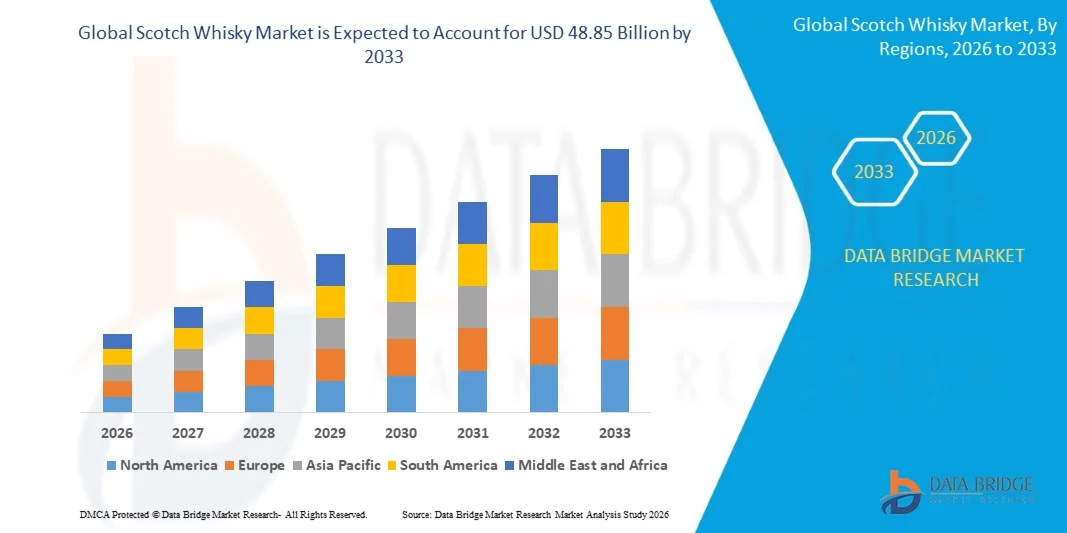
- Selon l'analyse de Data Bridge Market Research, la taille du marché mondial du whisky scotch a été évaluée à36,47 milliards de dollars en 2025et devrait atteindre48,85 milliards de dollars en 2033, à unTCAC de 6,02 %pendant la période de prévision
- La croissance du marché est due à l'augmentation de la demande mondiale de boissons alcoolisées de luxe et de haute qualité, à la préférence croissante pour les whiskies de malt âgés et simples, à la forte demande d'exportation en provenance d'Europe, d'Amérique du Nord et d'Asie-Pacifique, à l'expansion des ventes au détail hors taxes et de voyages et à la consommation croissante chez les jeunes qui recherchent des spiritueux authentiques et riches en patrimoine
Taille du marché et prévisions
- Valeur de marché (2025):36,47 milliards de dollars
- Valeur marchande prévue (2033) :48,85 milliards de dollars
- Prévisions TCAC:6.02%
Quelles sont les principales recettes du marché du whisky écossais
- La croissance du revenu disponible, les tendances à la hausse, l'expansion de la culture des cocktails et la hausse de la demande des marchés émergents comme l'Inde, la Chine et l'Asie du Sud-Est créent des possibilités de croissance importantes pour les fabricants de whisky écossais
- Toutefois, des facteurs tels que des réglementations strictes en matière d'alcool, des droits d'accise élevés, des contraintes de la chaîne d'approvisionnement liées au vieillissement et des fluctuations des coûts des matières premières peuvent être des facteurs de restriction de la croissance globale du marché du whisky écossais.
- L'Europe a dominé le marché du whisky scotch avec une part de 39,6 % en 2025, grâce à la forte présence de pays producteurs traditionnels de whisky, de distilleries bien établies et d'une culture de consommation de whisky profondément enracinée au Royaume-Uni, en France, en Allemagne et en Espagne.
- L'Amérique du Nord devrait enregistrer le TCAC le plus rapide de 8,88% entre 2026 et 2033, sous l'effet d'une prime rapide, d'une hausse des revenus disponibles et d'une augmentation de la préférence des consommateurs pour les spiritueux âgés et de haute qualité aux États-Unis et au Canada.
- Le segment des whiskys écossais mélangés a dominé le marché avec une part d'environ 52,6 % en 2025, en raison de son large acceptation par les consommateurs, de son profil de saveur uniforme et de sa tarification concurrentielle.
Portée du rapport et segmentation du marché du whisky écossais
|
Attributs |
Scotch Whisky Principales perspectives du marché |
|
Segments couverts |
|
|
Pays couverts |
Amérique du Nord
Europe
Asie-Pacifique
Moyen-Orient et Afrique
Amérique du Sud
|
|
Principaux acteurs du marché |
|
|
Possibilités de marché |
|
|
Infos sur la valeur ajoutée |
En plus des renseignements sur les scénarios du marché tels que la valeur du marché, le taux de croissance, la segmentation, la couverture géographique et les principaux intervenants, les rapports de marché établis par Data Bridge Market Research comprennent également une analyse approfondie des experts, une analyse des prix, une analyse des parts de marque, une enquête auprès des consommateurs, une analyse démographique, une analyse de la chaîne d'approvisionnement, une analyse de la chaîne de valeur, une vue d'ensemble des matières premières et des consommables, des critères de sélection des fournisseurs, une analyse PESTLE, une analyse Porter et un cadre réglementaire. |
Quelle est la tendance clé du marché du whisky écossais
(en milliers de dollars)Accroître le changement vers la prime, l'innovation artisanale et le whisky écossais durable(en milliers de dollars)
- Le marché du whisky scotch connaît une forte évolution vers des whiskies haut de gamme, super premium et single malt, animés par l'évolution des préférences des consommateurs en matière d'authenticité, de patrimoine et de profils de goût supérieurs
- Les distillateurs se concentrent de plus en plus sur la production de petits lots, les éditions limitées et les whiskies d'âge, ce qui améliore l'exclusivité de la marque et la perception des valeurs
- L'accent mis de plus en plus sur les pratiques de distillation durable, y compris l'utilisation des énergies renouvelables, l'efficacité de l'eau et les emballages écologiques, façonne les stratégies de développement des produits
- Par exemple, des entreprises comme Diageo, Pernod Ricard, Edrington Group et William Grant & Sons développent leurs portefeuilles de primes et investissent dans des distilleries neutres en carbone et des sources d'approvisionnement durables
- La demande croissante pour la consommation expérientielle, y compris le tourisme de distillerie, les dégustations de whisky et les sorties de collection, renforce l'engagement de la marque à l'échelle mondiale
- Comme les consommateurs associent de plus en plus le whisky de scotch à l'artisanat et au luxe, la valorisation restera une tendance déterminante à la croissance du marché à long terme.
Quels sont les principaux moteurs du marché du whisky écossais
- Augmentation de la consommation mondiale de boissons alcoolisées de qualité supérieure, soutenue par l'augmentation des revenus disponibles et l'amélioration du mode de vie
- Par exemple, en 2024-2025, les principaux producteurs, tels que Diageo et Pernod Ricard, ont élargi la distribution de whiskys écossais haut de gamme et vieillis en Asie-Pacifique et en Amérique du Nord.
- La popularité croissante du single malt et des whiskies de malt mélangés parmi les millenaires et les consommateurs à revenu élevé stimule la demande de catégorie
- L'expansion du commerce de détail en franchise de droits, des plateformes d'alcool du commerce électronique et des circuits commerciaux améliore l'accessibilité des produits
- L'augmentation de la demande d'exportation des marchés émergents, en particulier l'Inde, la Chine et l'Asie du Sud-Est, renforce le volume des ventes mondiales
- Soutenu par la forte marque, le positionnement patrimonial et l'innovation, le marché du whisky écossais devrait connaître une croissance soutenue à long terme
Quel facteur met en cause la croissance du marché du whisky écossais
- Les coûts de production élevés associés aux longs cycles de vieillissement, à l'approvisionnement en fûts de chêne et aux exigences de stockage augmentent l'intensité du capital
- Par exemple, au cours des années 2024-2025, les fluctuations des prix de l'orge, les coûts des emballages en verre et les dépenses logistiques ont fait pression sur les marges bénéficiaires de plusieurs distillateurs.
- Des cadres réglementaires rigoureux, des droits d'accise et des restrictions à la publicité sur l'alcool limitent la pénétration du marché dans certaines régions
- Les déséquilibres de l'offre et de la demande causés par les contraintes liées au vieillissement peuvent limiter l'évolutivité rapide des segments de whisky haut de gamme et vieillis
- La concurrence d'autres spiritueux haut de gamme comme le bourbon, le whisky irlandais et le whisky japonais intensifie les défis en matière de prix et de différenciation des marques
- Pour relever ces défis, les producteurs mettent l'accent sur la diversification du portefeuille, l'efficacité opérationnelle et la gestion durable des coûts afin de renforcer la compétitivité mondiale.
Comment est segmenté le marché du whisky écossais
Le marché est segmenté sur la base detype de produit, prix, type d'emballage, sexe, groupe d'âge, utilisateur final et canal de vente.
- Par type de produit
Sur la base du type de produit, le marché du whisky de scotch est segmenté en mélange, single malt, single grain, mixed malt, mixed grain, etc. Le segment des whiskys écossais mélangés a dominé le marché avec une part d'environ 52,6 % en 2025, en raison de son large acceptation par les consommateurs, de son profil de saveur uniforme et de ses prix concurrentiels. Les whiskies mélangés sont largement préférés dans toutes les catégories de marché de masse et les catégories premium et bénéficient d'une forte pénétration sur les circuits commerciaux et hors commerce à l'échelle mondiale. Leur accessibilité et leur disponibilité en font le type de whisky écossais le plus consommé au monde.
On s'attend à ce que le segment de Single Malt augmente au rythme le plus rapide du TCAC de 2026 à 2033, en raison de la hausse des primes, de l'intérêt croissant pour les spiritueux artisanaux et de la demande croissante des consommateurs et des collectionneurs à revenu élevé. L'expansion du tourisme à la distillerie, les émissions limitées et la forte demande d'exportation en provenance de l'Asie-Pacifique et de l'Amérique du Nord continuent d'appuyer la croissance à long terme des single malts.
- Par prix
Selon les prix, le marché du whisky scotch est segmenté en catégories Standard, Premium et Luxe. Le segment des prix standard détenait la plus grande part de marché d'environ 46,8 % en 2025, soutenue par des volumes de consommation élevés, une forte présence dans les whiskies mélangés et une disponibilité généralisée dans les circuits de vente au détail et d'accueil. Les whiskies écossais à prix standard attirent les consommateurs sensibles aux prix et restent populaires dans les marchés émergents où l'abordabilité entraîne des décisions d'achat.
Le segment du luxe devrait connaître la croissance la plus rapide au cours de la période de prévision, alimentée par l'augmentation des revenus disponibles, la culture croissante du don et la hausse de la demande de whiskies écossais âgés, rares et à composition limitée. Les particuliers et les collectionneurs de grande valeur investissent de plus en plus dans les offres ultra premium, en particulier en Asie-Pacifique, en Europe et dans les chaînes de vente en franchise. L'histoire de marque, le positionnement patrimonial et l'exclusivité renforcent encore les perspectives de croissance dans le secteur du luxe.
- Par type d'emballage
Sur la base du type d'emballage, le marché est segmenté en bouteilles en verre, bouteilles en plastique et autres. Le segment des bouteilles de verre a dominé le marché avec plus de 88% de parts en 2025, car le verre reste le matériau d'emballage préféré en raison de son attrait premium, la préservation de l'intégrité de la saveur, et une forte association avec l'authenticité et le patrimoine. Les whiskies Scotch Premium et de luxe sont presque exclusivement emballés dans des bouteilles en verre, renforçant la valeur de la marque et la confiance des consommateurs.
Le segment Autres, y compris les formats d'emballage innovateurs et durables, devrait croître au plus vite, grâce à une sensibilisation accrue à l'environnement et à l'expérimentation de matériaux écologiques. Toutefois, les bouteilles en plastique restent limitées à choisir des offres peu coûteuses et à la vente au détail, avec une pénétration minimale dans les catégories premium.
- Par sexe
Selon le sexe, le marché du scotch est segmenté en consommateurs masculins et féminins. Le segment masculin domine le marché avec une part d'environ 68,4% en 2025, soutenue par des habitudes de consommation de longue date, une forte association de whisky avec des milieux sociaux et culturels traditionnels orientés vers les hommes et une fréquence de consommation plus élevée.
On s'attend à ce que le segment des femmes augmente au rythme le plus rapide du TCAC de 2026 à 2033, en raison de l'évolution des normes sociales, du marketing ciblé, des profils de saveur plus doux et de la participation accrue des femmes à la consommation d'alcool haut de gamme. Les marques lancent de plus en plus des variantes accessibles et des campagnes axées sur le mode de vie pour attirer les femmes dans le monde entier.
- Par groupe d'âge
Selon le groupe d'âge, le marché est segmenté en 18–30, 31–44 et 45+. La tranche d'âge de 45 ans et plus a représenté la plus grande part de marché d'environ 41,7 % en 2025, sous l'effet d'un pouvoir d'achat plus élevé, de la préférence accordée aux whiskies âgés et haut de gamme et d'une forte fidélité à la marque. Ce groupe valorise le patrimoine, la qualité et l'authenticité, ce qui en fait une base de consommation clé pour les marques de whisky écossais haut de gamme.
Le groupe d'âge des 31 à 44 ans devrait enregistrer la croissance la plus rapide, soutenue par l'augmentation des revenus disponibles, les tendances de la prime et l'intérêt croissant pour la consommation expérientielle, comme les dégustations et les visites de distillerie. Les jeunes consommateurs font de plus en plus du commerce des spiritueux de masse aux offres écossaises de qualité supérieure.
- Par Utilisateur final
Selon l'utilisateur final, le marché du whisky de scotch est segmenté en consommateurs individuels et en établissements commerciaux. Le segment des consommateurs individuels dominait le marché avec une part d'environ 57,3 % en 2025, sous l'effet des fortes ventes hors commerce, des tendances de la consommation domestique, de la culture du don et de la croissance des plateformes d'alcool de commerce électronique.
Le segment des établissements commerciaux devrait croître au rythme le plus rapide du TCAC, grâce à la reprise du secteur de l'accueil, à l'expansion des bars haut de gamme, des hôtels, des salons et à l'augmentation de la demande de whisky écossais dans la culture des cocktails et les environnements de restauration fine.
- Par chaîne de vente
Sur la base de la chaîne de vente, le marché est segmenté en On-Trade et Off-Trade. Le segment hors commerce a dominé le marché avec une part d'environ 62,1% en 2025, sous l'impulsion de supermarchés, de magasins spécialisés, de points de vente hors taxes et de plateformes de vente au détail en ligne d'alcool. La commodité, les promotions de prix et l'élargissement de la disponibilité des produits soutiennent la domination hors commerce.
Le segment On-Trade devrait croître au TCAC le plus rapide de 2026 à 2033, alimenté par la relance des bars et des restaurants, la promotion de l'hospitalité et l'augmentation de la préférence des consommateurs pour la consommation expérientielle de whisky.
Quelle région détient la plus grande part du marché du whisky écossais
- L'Europe a dominé le marché du whisky scotch avec une part de 39,6 % en 2025, grâce à la forte présence de pays producteurs traditionnels de whisky, de distilleries bien établies et d'une culture de consommation de whisky profondément enracinée au Royaume-Uni, en France, en Allemagne et en Espagne. L'Écosse demeure le pôle mondial de production du whisky écossais, soutenu par un patrimoine de distillation séculaire, un statut d'indication géographique protégée (IG) et une solide infrastructure d'exportation. La forte consommation intérieure, la fidélisation de la marque haut de gamme et de fortes ventes axées sur le tourisme renforcent encore le leadership du marché européen
- Les principaux producteurs de whisky écossais en Europe continuent d'investir dans des expressions âgées, des éditions limitées, des pratiques de distillation durables et des emballages haut de gamme pour maintenir la compétitivité mondiale. De solides réseaux de distribution à travers les circuits de vente au détail, d'accueil et hors taxes renforcent la demande dans toute la région
- La sensibilisation des consommateurs matures, des cadres réglementaires solides et la poursuite de l'innovation dans les offres de whisky haut de gamme et de luxe soutiennent davantage la domination de l'Europe sur le marché mondial du whisky écossais
Royaume-Uni Scotch Whisky Aperçu du marché
Le Royaume-Uni est le principal contributeur en Europe, dirigé par les distilleries reconnues mondialement et les capacités de production axées sur l'exportation. Une forte demande de single malt et de whiskies écossais mélangés, un vaste tourisme de distillerie et des investissements continus dans les installations de maturation favorisent la stabilité du marché. Le rôle du Royaume-Uni en tant que producteur et exportateur assure un leadership cohérent en matière d'approvisionnement et de marque.
France Scotch Whisky Aperçu du marché
La France représente l'un des plus grands marchés de consommation de whisky écossais en Europe. Une forte consommation par habitant, une forte présence hors commerce de détail et une préférence croissante pour les whiskies haut de gamme et vieillis entraînent une demande soutenue. Le pays joue également un rôle clé en tant que plaque tournante pour les whiskies écossais haut de gamme dans toute l'Europe continentale.
Amérique du Nord Marché du whisky écossais
On s'attend à ce que l'Amérique du Nord enregistre le TCAC le plus rapide de 8,88% entre 2026 et 2033, en raison de la hausse rapide des primes, des revenus disponibles et de la préférence accrue des consommateurs pour les spiritueux âgés et de haute qualité aux États-Unis et au Canada. L'intérêt croissant pour les single malts, les rejets limités et les whiskies écossais à collectionner accélère la croissance du marché. L'expansion des magasins d'alcool spécialisés, des plateformes d'alcool de commerce électronique et du commerce de détail hors taxes stimule encore les ventes régionales.
Aperçu du marché américain du whisky écossais
Les États-Unis sont le plus important contributeur à l'Amérique du Nord, soutenu par une forte demande de whiskys écossais haut de gamme et de luxe, une culture de cocktails en évolution et des communautés de plus en plus passionnées de whisky. La hausse de la consommation dans les centres urbains, l'accroissement de la culture du don et la forte reprise du commerce entre les bars et les restaurants sont à l'origine d'une croissance soutenue.
Aperçu du marché canadien du whisky écossais
Le Canada contribue de façon constante, en raison de l'intérêt croissant pour les spiritueux haut de gamme, de la vigueur des ventes hors commerce et de l'expansion des canaux d'accueil. L'exposition accrue des consommateurs aux marques mondiales de whisky et la demande croissante de spiritueux importés de haute qualité favorisent l'expansion à long terme du marché.
Quelles sont les meilleures entreprises du marché du whisky écossais
L'industrie du whisky scotch est principalement dirigée par des entreprises bien établies, notamment :
- Diageo plc(Royaume-Uni)
- Pernod Ricard S.A. (France)
- Edrington Group Ltd. (Royaume-Uni)
- Société canadienne des postes(Royaume-Uni)
- La société Glenmorangie Ltd.(Royaume-Uni)
- Société canadienne d'hypothèques et de logement(Hong Kong)
- Ian Macleod Distillers Ltd. (Royaume-Uni)
- La société Douglas Laing & Co. Ltd.(Royaume-Uni)
- Subvention J&G (Distillerie de Glenfarclas) (Royaume-Uni)
- Gordon et MacPhail (Royaume-Uni)
- Bladnoch Distillery Ltd. (Royaume-Uni)
- Arran Distillers Ltd. (Royaume-Uni)
- Wemyss Malts (Wemyss Development Co. Ltd.) (Royaume-Uni)
- Adelphi Distillery Ltd (Royaume-Uni)
- Scotch Whisky Investments B.V. (Pays-Bas)
- InchDairnie Distillery Company Ltd. (Royaume-Uni)
- The Borders Distillery Company Ltd. (Royaume-Uni)
- Kingsbarns Distillery (Wemyss Development) (Royaume-Uni)
- Duncan Taylor Scotch Whisky Ltd. (Royaume-Uni)
- The Glasgow Distillery Company Ltd. (Royaume-Uni)
Quelles sont les évolutions récentes du marché mondial du whisky écossais
- En mars 2025, Johnnie Walker a lancé l'expérience Vault, offrant des services de mélange de whisky Scotch sur mesure à partir de GBP 50,000 et ciblant les personnes ultra-hautes-net-worth à la recherche d'offres de luxe hautement personnalisées, renforçant le positionnement de la marque dans les spiritueux expérientiels et ultra-prémium
- En novembre 2024, Diageo a introduit la technologie FlavorPrintConnect, combinant des kits de dégustation de whisky avec des masterclasses numériques compatibles avec l'IA pour offrir des expériences personnalisées aux consommateurs, renforçant l'engagement direct au consommateur grâce à l'innovation numérique
- En octobre 2024, Johnnie Walker a dévoilé des conceptions de bouteilles alimentées par l'IA en collaboration avec l'artiste Andy Gellenberg, libérant 5 000 bouteilles collectibles uniques exclusivement en Allemagne, démontrant ainsi une personnalisation avancée et une différenciation technologique de la marque.
- En avril 2023, Royal Salute a lancé deux whiskies écossais de luxe, l'édition du jubilé Platinum et la maison de décanteur Quinn, et les a présentés au magasin de départs hors taxes de l'aéroport international Chhatrapati Shivaji Maharaj à Mumbai, renforçant ainsi sa présence et sa visibilité sur le marché indien.
- En septembre 2022, Thirstie a lancé une plate-forme d'alcool de commerce électronique en partenariat avec Benriach single malt Scotch whisky, permettant des achats en ligne à travers les États-Unis grâce à des collaborations de détail intégrées, accélérant l'adoption de ventes numériques et des expériences de consommateurs omnicanaux sans faille
SKU-
Accédez en ligne au rapport sur le premier cloud mondial de veille économique

- Tableau de bord d'analyse de données interactif
- Tableau de bord d'analyse d'entreprise pour les opportunités à fort potentiel de croissance
- Accès d'analyste de recherche pour la personnalisation et les requêtes
- Analyse de la concurrence avec tableau de bord interactif
- Dernières actualités, mises à jour et analyse des tendances
- Exploitez la puissance de l'analyse comparative pour un suivi complet de la concurrence
Méthodologie de recherche
La collecte de données et l'analyse de l'année de base sont effectuées à l'aide de modules de collecte de données avec des échantillons de grande taille. L'étape consiste à obtenir des informations sur le marché ou des données connexes via diverses sources et stratégies. Elle comprend l'examen et la planification à l'avance de toutes les données acquises dans le passé. Elle englobe également l'examen des incohérences d'informations observées dans différentes sources d'informations. Les données de marché sont analysées et estimées à l'aide de modèles statistiques et cohérents de marché. De plus, l'analyse des parts de marché et l'analyse des tendances clés sont les principaux facteurs de succès du rapport de marché. Pour en savoir plus, veuillez demander un appel d'analyste ou déposer votre demande.
La méthodologie de recherche clé utilisée par l'équipe de recherche DBMR est la triangulation des données qui implique l'exploration de données, l'analyse de l'impact des variables de données sur le marché et la validation primaire (expert du secteur). Les modèles de données incluent la grille de positionnement des fournisseurs, l'analyse de la chronologie du marché, l'aperçu et le guide du marché, la grille de positionnement des entreprises, l'analyse des brevets, l'analyse des prix, l'analyse des parts de marché des entreprises, les normes de mesure, l'analyse globale par rapport à l'analyse régionale et des parts des fournisseurs. Pour en savoir plus sur la méthodologie de recherche, envoyez une demande pour parler à nos experts du secteur.
Personnalisation disponible
Data Bridge Market Research est un leader de la recherche formative avancée. Nous sommes fiers de fournir à nos clients existants et nouveaux des données et des analyses qui correspondent à leurs objectifs. Le rapport peut être personnalisé pour inclure une analyse des tendances des prix des marques cibles, une compréhension du marché pour d'autres pays (demandez la liste des pays), des données sur les résultats des essais cliniques, une revue de la littérature, une analyse du marché des produits remis à neuf et de la base de produits. L'analyse du marché des concurrents cibles peut être analysée à partir d'une analyse basée sur la technologie jusqu'à des stratégies de portefeuille de marché. Nous pouvons ajouter autant de concurrents que vous le souhaitez, dans le format et le style de données que vous recherchez. Notre équipe d'analystes peut également vous fournir des données sous forme de fichiers Excel bruts, de tableaux croisés dynamiques (Fact book) ou peut vous aider à créer des présentations à partir des ensembles de données disponibles dans le rapport.











