Modulateur mondial sélectif des récepteurs d'estrogènes (SERM) Segmentation du marché des médicaments, par type (tamoxifène, raloxifène, Torémifène, Bazédoxifène, Ospémifène, etc.), indication (cancer du sein, ostéoporose, symptômes postménopausiques, infertilité, etc.)- Tendances de l'industrie et prévisions jusqu'en 2033
Quelle est la taille et le taux de croissance du marché des médicaments pour le modulateur sélectif des récepteurs d'estrogènes (SERM)
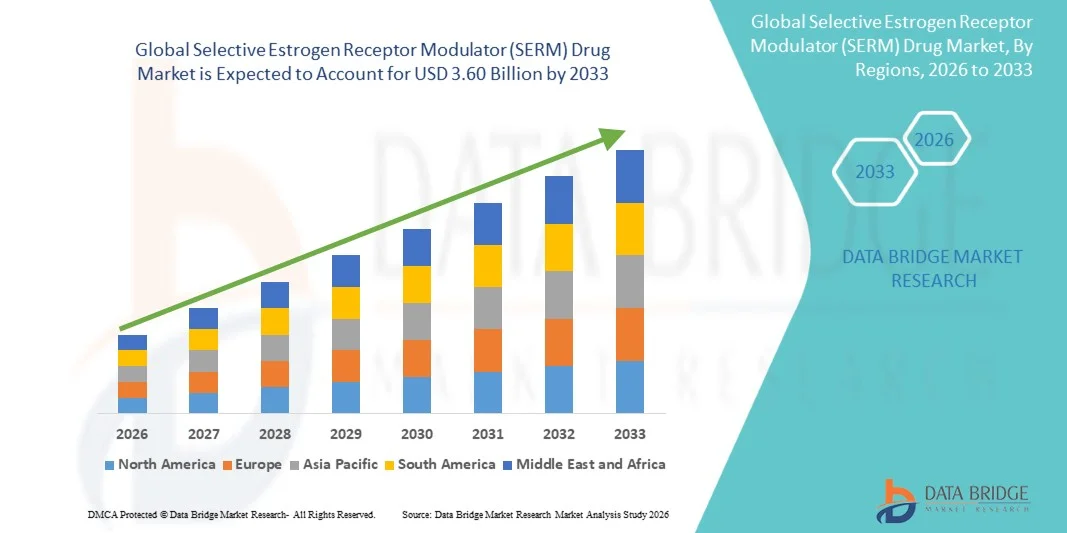
- Selon Data Bridge études de marché Analyse la taille du marché des médicaments a été évaluée à2,23 milliards de dollars en 2025et devrait atteindre3,60 milliards de dollars en 2033, à unTCAC de 6,20%pendant la période de prévision
- La croissance du marché est largement alimentée par la prévalence croissante de maladies hormonales comme le cancer du sein, l'ostéoporose et les symptômes postménopausiques, ainsi que par la demande croissante de traitements ciblés et plus sûrs.
- De plus, les patients et les fournisseurs de soins de santé sont de plus en plus conscients des avantages des MRSE, en plus d'investir de plus en plus dans la R-D pour les nouveaux médicaments MRSE, ce qui fait de ces thérapies un choix privilégié pour la gestion des troubles liés aux œstrogènes. Ces facteurs convergents accélèrent l'adoption de solutions antidrogue pour les récepteurs d'estrogène sélectifs (SERM), ce qui stimule significativement la croissance de l'industrie
Taille du marché et prévisions
- Valeur marchande mondiale (2025):USD 2,23 milliards
- Valeur marchande prévue (2033) :3,60 milliards de dollars
- Prévisions CAGR (2026-2033):6.20%
Modulateur sélectif du récepteur d'estrogène (SERM) Analyse du marché des médicaments
- Les médicaments de modulateur de récepteur d'œstrogène sélectifs (SERM) sont de plus en plus essentiels dans les soins de santé modernes en raison de leur capacité à cibler sélectivement les récepteurs d'œstrogènes, offrant des options de traitement efficaces pour des affections dépendantes des hormones telles que le cancer du sein, l'ostéoporose et les symptômes postménopausiques
- La demande croissante de médicaments SERM est principalement alimentée par la prévalence croissante de troubles hormonaux, la sensibilisation accrue aux thérapies ciblées et l'augmentation des investissements dans la recherche clinique pour les nouvelles formulations SERM
- L'Amérique du Nord a dominé le marché des médicaments modulateurs sélectifs de récepteurs d'oestrogènes (SERM), avec la plus grande part de revenus d'environ 39,5 % en 2025, appuyée par des infrastructures de soins de santé de pointe, des dépenses élevées en soins de santé, une forte présence d'entreprises pharmaceutiques clés et une forte adoption de thérapies innovatrices aux États-Unis.
- On s'attend à ce que l'Asie-Pacifique soit la région qui connaît la croissance la plus rapide du marché des médicaments modulateurs sélectifs des récepteurs d'œstrogènes (SERM) au cours de la période de prévision, en raison de l'augmentation des dépenses de santé, de l'augmentation de la population gériatrique, de l'élargissement de l'accès aux thérapies de pointe et de la sensibilisation à la gestion du cancer du sein et de l'ostéoporose dans les économies émergentes.
- Le segment du cancer du sein a représenté la part de marché la plus importante de 45,7 % en 2025, en raison de la forte prévalence du cancer du sein positif aux récepteurs hormonaux dans le monde
Portée du rapport et segmentation sélective du marché des médicaments
|
Attributs |
Modulateur sélectif de récepteur d'estrogène (SERM) |
|
Segments couverts |
|
|
Pays couverts |
Amérique du Nord
Europe
Asie-Pacifique
Moyen-Orient et Afrique
Amérique du Sud
|
|
Principaux acteurs du marché |
|
|
Possibilités de marché |
|
|
Infos sur la valeur ajoutée |
En plus des renseignements sur les scénarios de marché comme la valeur marchande, le taux de croissance, la segmentation, la couverture géographique et les principaux intervenants, les rapports de marché établis par Data Bridge Market Research comprennent également une analyse approfondie des experts, l'épidémiologie des patients, l'analyse des pipelines, l'analyse des prix et le cadre réglementaire. |
Quelle est la tendance clé du marché des médicaments pour le modulateur de récepteur d'estrogène sélectif (SERM)
(en milliers de dollars)Adoption croissante des MRSES pour la prévention et le traitement du cancer du sein(en milliers de dollars)
- Une tendance significative et accélérée sur le marché mondial des médicaments SERM est l'adoption croissante de SERM pour la prévention et le traitement du cancer du sein, en particulier chez les femmes à haut risque et celles qui ont des tumeurs positives aux récepteurs hormonaux
- Par exemple, les fournisseurs de soins de santé prescrivent de plus en plus le tamoxifène et le raloxifène comme traitements préventifs pour les femmes à haut risque de développer un cancer du sein, fondés sur des données cliniques à long terme et des lignes directrices cliniques actualisées.
- L'accent de plus en plus mis sur la détection précoce et l'oncologie préventive pousse à l'adoption de MRSE sur les marchés développés et émergents.
- De nouveaux essais cliniques et de nouvelles recherches élargissent également les indications relatives aux MRSE dans le traitement du cancer du sein, y compris les traitements combinés avec des agents ciblés
- L'incidence croissante du cancer du sein dans le monde, ainsi que la sensibilisation accrue aux thérapies préventives, renforcent la demande de MRSE
- Cette tendance devrait se poursuivre, les systèmes de santé mettant l'accent sur les soins préventifs et l'amélioration des résultats des patients.
Modulateur sélectif du récepteur d'estrogène (SERM) Dynamique du marché des médicaments
Chauffeur
Besoin de croissance en raison de l'incidence croissante du cancer du sein et de l'ostéoporose
- La prévalence croissante du cancer du sein et de l'ostéoporose, en particulier parmi les populations vieillissantes, est un facteur clé du marché des médicaments SERM
- Par exemple, en novembre 2021, la FDA des États-Unis a approuvé le bazédoxifène/oestrogènes conjugués (Duavee) pour le traitement des symptômes de la ménopause et la prévention de l'ostéoporose post-ménopausique, mettant en évidence l'appui réglementaire aux thérapies à base de SERM
- La sensibilisation aux thérapies préventives et aux programmes de dépistage augmente la demande de MRSE
- L'augmentation de la population gériatrique et l'amélioration de l'accès aux soins de santé dans les économies émergentes contribuent à accroître les taux d'adoption.
- Les initiatives gouvernementales et les programmes de santé publique axés sur la santé des femmes et la prévention des maladies osseuses appuient la croissance du marché
- Étant donné que les systèmes de soins de santé mettent l'accent sur les soins préventifs et la gestion des maladies à long terme, la demande de MRSE devrait augmenter régulièrement
Restriction/Défi
(en milliers de dollars)Effets secondaires et exigences réglementaires strictes(en milliers de dollars)
- Le risque d'effets indésirables comme les événements thromboemboliques, les bouffées de chaleur et le cancer de l'utérus (dans certains SERM) pose un défi majeur à la croissance du marché
- Par exemple, les préoccupations au sujet des effets secondaires et des mises en garde dans les boîtes noires ont limité l'adoption de certaines MRSE dans les populations de patients à risque élevé, ce qui a amené les cliniciens à préférer les thérapies alternatives.
- Des exigences réglementaires strictes et des délais d'approbation longs pour les nouveaux médicaments SERM augmentent les coûts de développement et retardent l'entrée sur le marché
- En outre, la concurrence des thérapies alternatives telles que les inhibiteurs de l'aromatase etTraitement hormonal substitutifpeut limiter la croissance du marché
- La sensibilité aux prix et le remboursement limité dans certaines régions peuvent entraver l'adoption de nouveaux médicaments SERM
- Il sera essentiel de relever ces défis en améliorant les profils d'innocuité des médicaments, en sensibilisant les patients et en fournissant des données cliniques solides pour assurer une croissance soutenue du marché.
Modulateur sélectif de récepteurs d'estrogène (SERM)
Le marché est segmenté en fonction du type et de l'indication.
• Par type
Sur la base du type, le marché des médicaments est segmenté en Tamoxifène, Raloxifène, Torémifène, Bazédoxifène, Ospémifène et autres. Le segment du Tamoxifène a dominé la plus grande part du marché en 2025, soit 39,2 %, en raison de sa position bien établie en tant que norme de soins pour le traitement et la prévention du cancer du sein positif aux récepteurs des œstrogènes. Le tamoxifène est largement prescrit en raison de ses preuves cliniques à long terme, de son efficacité prouvée dans la réduction des taux de récidive et d'un solide soutien au remboursement sur les principaux marchés. Le rapport coût-efficacité du médicament et sa grande connaissance du médecin contribuent également à sa présence dominante sur le marché. De plus, le tamoxifène est fréquemment utilisé dans le traitement adjuvant et chez les femmes préménopausées, ce qui renforce encore son leadership sur le marché.
On s'attend à ce que le segment du raloxifène soit témoin du TCAC le plus rapide de 10,8% entre 2026 et 2033, en raison de l'augmentation de la prévalence de l'ostéoporose et de la demande croissante de substituts hormonaux plus sûrs. La capacité de raloxifène à réduire la perte osseuse sans augmenter le risque de cancer du sein en fait une option privilégiée chez les femmes ménopausées. Une prise de conscience croissante de la gestion de l'ostéoporose et des résultats cliniques favorables soutient son adoption rapide. L'expansion des programmes de sensibilisation des patients et l'amélioration de l'accès aux soins de santé dans les économies émergentes contribuent également à la dynamique de croissance du segment.
• Par indication
Sur la base de l'indication, le marché des médicaments est segmenté en cancer du sein, ostéoporose, symptômes postménopausiques, infertilité et autres. Le segment du cancer du sein a représenté la plus grande part du marché de 45,7 % en 2025, en raison de la forte prévalence du cancer du sein positif aux récepteurs hormonaux dans le monde. Les médicaments SERM sont une pierre angulaire du traitement du cancer du sein, en particulier dans le traitement adjuvant, la prévention des récidives et la réduction des risques chez les patients à haut risque. L'incidence croissante du cancer du sein, conjuguée à l'augmentation des taux de dépistage et au diagnostic précoce, stimule la demande de médicaments SERM. De plus, de solides lignes directrices cliniques appuyant l'utilisation à long terme des MRSE chez les patients atteints de cancer du sein renforcent la domination du segment du marché.
Le segment de l'ostéoporose devrait enregistrer le TCAC le plus rapide de ~11,2% entre 2026 et 2033, appuyé par la population âgée croissante et les cas croissants de perte de densité osseuse postménopausique. Les médicaments SERM tels que le raloxifène sont de plus en plus utilisés pour la prévention de l'ostéoporose en raison de leurs effets de conservation osseuse et de leur risque de cancer plus faible que le traitement hormonal substitutif. La sensibilisation accrue au dépistage de l'ostéoporose et au traitement préventif dans les populations vieillissantes est à l'origine de la croissance du segment. L'expansion de l'infrastructure des soins de santé et l'amélioration de l'accès aux thérapies de santé osseuses dans les économies émergentes stimulent davantage la croissance du marché.
Modulateur sélectif du récepteur d'estrogène (SERM)
- L'Amérique du Nord a dominé le marché des médicaments modulateurs sélectifs des récepteurs d'oestrogènes (SERM) avec la plus grande part des revenusenviron 39,5% en 2025, soutenue par des infrastructures de soins de santé avancées, des dépenses élevées en soins de santé, une forte présence d'entreprises pharmaceutiques clés et une forte adoption de thérapies innovantes aux États-Unis.
- Le marché américain représente la majorité de la demande régionale en raison de l'accès généralisé aux traitements d'oncologie et d'ostéoporose, des taux élevés de dépistage du cancer du sein et d'un solide soutien au remboursement des thérapies SERM. L'incidence croissante du cancer du sein et la prévalence croissante de l'ostéoporose postménopausique sont des facteurs clés qui alimentent la croissance
- La disponibilité de réseaux de distribution bien établis et de solides activités de recherche clinique renforce encore le marché. En outre, les investissements croissants dans le développement de médicaments, les installations de diagnostic avancées et la sensibilisation élevée des patients aux troubles liés aux hormones continuent de stimuler l'adoption du SERM en Amérique du Nord.
É.-U. Modulateur sélectif du récepteur d'estrogène (SERM) Aperçu du marché des médicaments
Le marché américain des médicaments modulateurs sélectifs de récepteurs d'œstrogènes (SERM) a enregistré la plus grande part des revenus en Amérique du Nord en 2025, en raison de l'incidence élevée du cancer du sein, de l'augmentation des cas d'ostéoporose et de l'adoption de thérapies avancées. Le pays dispose d'une solide infrastructure de soins de santé et de vastes programmes de recherche clinique, ce qui a permis l'adoption rapide de nouveaux médicaments SERM et de thérapies combinées. De plus, des dépenses de santé élevées et des politiques de remboursement favorables favorisent l'accès des patients aux médicaments SERM. On s'attend à ce que les essais cliniques en cours, la forte présence de grandes sociétés pharmaceutiques et la sensibilisation croissante des patients au traitement préventif des patients atteints d'un cancer du sein à haut risque soutiennent la croissance du marché. Les États-Unis demeurent le principal moteur de la croissance du marché nord-américain du SERM.
Europe Modulateur de récepteur d'estrogène sélectif (SERM)
Le marché européen des modulateurs de récepteurs d'œstrogènes sélectifs (SERM) devrait s'étendre à un TCAC important tout au long de la période de prévision, en raison de la prévalence croissante du cancer du sein et de l'ostéoporose dans la population vieillissante. L'amélioration de l'accès aux services de soins de santé de pointe, la sensibilisation accrue des patients et les initiatives gouvernementales de soutien en matière de soins de santé encouragent l'adoption de médicaments SERM. L'Europe est témoin d'une augmentation de l'activité de recherche clinique et d'une plus grande concentration sur les thérapies préventives, qui soutiennent le marché. En outre, l'expansion des centres d'oncologie spécialisés et des cliniques de santé osseuse stimule la demande de médicaments SERM dans les principaux pays européens.
U.K. Modulateur sélectif du récepteur d'estrogène (SERM) Aperçu du marché des médicaments
On s'attend à ce que le marché des médicaments modulateurs des récepteurs d'oestrogènes sélectifs (SERM) du Royaume-Uni augmente à un TCAC remarquable au cours de la période de prévision, en raison de l'augmentation des programmes de dépistage du cancer du sein et de l'amélioration de l'accès aux traitements de l'ostéoporose. Le pays dispose d'infrastructures de santé bien développées et met fortement l'accent sur les soins préventifs pour soutenir l'utilisation des thérapies SERM. De plus, la sensibilisation accrue aux substituts hormonaux et à la croissance de la population gériatrique contribuent à la croissance du marché. La présence de grandes sociétés pharmaceutiques et d'institutions de recherche renforce encore le marché britannique SERM.
Allemagne Modulateur sélectif du récepteur d'estrogène (SERM)
On s'attend à ce que le marché allemand des médicaments modulateurs de récepteurs d'œstrogènes sélectifs (SERM) s'étende à un TCAC considérable au cours de la période de prévision, en raison de l'augmentation des dépenses de soins de santé, de l'augmentation de l'incidence du cancer du sein et de l'ostéoporose et de l'adoption croissante de thérapies avancées.
L'Allemagne dispose d'infrastructures de santé solides et l'accent mis sur l'innovation médicale soutient l'introduction de formulations SERM plus récentes.
Le pays devrait être le marché qui connaît la croissance la plus rapide en Europe en raison de l'expansion de l'infrastructure hospitalière, de la sensibilisation accrue des patients et du soutien accru des pouvoirs publics aux soins contre le cancer et aux soins de santé gériatriques.
Modulateur de récepteur d'estrogène sélectif pour l'Asie et le Pacifique
On s'attend à ce que le marché des médicaments modulateurs des récepteurs d'œstrogènes sélectifs (SERM) d'Asie-Pacifique augmente au rythme le plus rapide au cours de la période de prévision, en raison de l'augmentation des dépenses en soins de santé, de l'augmentation de la population gériatrique, de l'élargissement de l'accès aux thérapies de pointe et de la sensibilisation à la prise en charge du cancer du sein et de l'ostéoporose. Les économies en croissance rapide, comme la Chine et l'Inde, connaissent une augmentation des services de diagnostic et un meilleur accès aux soins de santé, ce qui favorise l'adoption de médicaments SERM. Les initiatives gouvernementales en matière de soins contre le cancer et les investissements accrus dans les infrastructures de soins de santé stimulent la croissance du marché. De plus, la sensibilisation accrue des patients et l'amélioration de la couverture d'assurance appuient l'expansion du marché des médicaments SERM dans l'ensemble de l'APAC.
Japon Modulateur sélectif de récepteur d'estrogène (SERM) Aperçu du marché des médicaments
Le marché japonais du modulateur sélectif des récepteurs oestrogènes (SERM) prend de l'ampleur en raison du vieillissement de la population, de l'incidence croissante de l'ostéoporose et des normes élevées en matière de soins de santé. Une infrastructure de soins de santé solide et une sensibilisation accrue à la prévention du cancer du sein contribuent à la croissance du marché. Le pays soutient l'environnement de recherche avancéeessais cliniqueset l'adoption de thérapies SERM innovantes, qui stimulent l'expansion du marché.
Chine Modulateur sélectif de récepteur d'estrogène (SERM)
En 2025, le marché chinois du modulateur sélectif des récepteurs d'œstrogènes (SERM) a représenté la plus grande part des revenus du marché en Asie et dans le Pacifique, en raison de l'augmentation de l'incidence du cancer du sein, de l'augmentation de la population gériatrique et de l'augmentation des dépenses de santé. L'accès accru à l'oncologie et aux traitements de santé osseuse, ainsi que le soutien gouvernemental aux soins contre le cancer, stimulent l'adoption des médicaments SERM. L'élargissement de l'infrastructure de soins de santé et la sensibilisation accrue à la thérapie préventive pour les patients à haut risque sont des facteurs clés de croissance.
Quelles sont les principales entreprises du marché des médicaments pour les récepteurs d'estrogène sélectifs
L'industrie des médicaments est principalement dirigée par des entreprises bien établies, notamment :
- AstraZeneca (Royaume-Uni)
- Pfizer (États-Unis)
- Novartis (Suisse)
- Eli Lilly and Company (États-Unis)
- Daiichi Sankyo (Japon)
- Gedeon Richter (Hongrie)
- Teva Pharmaceuticals (Israël)
- Mylan (États-Unis)
- Glenmark Pharmaceuticals (Inde)
- Cipla (Inde)
- Laboratoires de Reddy (Inde)
- Lupin (Inde)
- Torrent Pharmaceuticals (Inde)
- Hétérodrogues (Inde)
- Zydus Cadila (Inde)
- Merck & Co. (États-Unis)
- Bayer AG (Allemagne)
- Sanofi (France)
- Boehringer Ingelheim (Allemagne)
- Biocon (Inde)
Les derniers développements dans le marché mondial des médicaments pour les récepteurs d'estrogène sélectifs
- En janvier 2023, la Food and Drug Administration (FDA) des États-Unis a approuvé l'élacestrant (marque Orserdu), un dégradateur sélectif du récepteur d'œstrogène par voie orale (hybride SERM/SERD) pour le traitement du cancer du sein avancé ou métastatique muté HER2-négatif ER, offrant une nouvelle option de traitement endocrinien oral pour les patients résistants à des traitements endocriniens antérieurs.
- En juin 2023, le Pfizer. Duavee (œstrogènes conjugués/bazédoxifène), une association de SERM et d'œstrogènes conjugués pour les femmes ménopausées, a été mis en évidence dans les mises à jour commerciales et cliniques comme un traitement pour réduire les bouffées de chaleur modérée à sévère et aider à prévenir l'ostéoporose post ménopausique, en maintenant son rôle dans les portefeuilles de thérapies de santé des femmes.
- En avril 2025, Atossa Therapeutics a annoncé que l'Office américain des brevets et des marques de commerce a délivré un nouveau brevet couvrant les formulations orales entériques de l'endoxifène (Z), un nouveau candidat SERM/SERD en cours de développement pour le cancer du sein positif aux récepteurs des œstrogènes, marquant ainsi un jalon dans la propriété intellectuelle de son programme clinique.
- En avril 2025, Sermonix Pharmaceuticals et le Quantum Leap Healthcare Collaborative ont rapporté des données cliniques encourageantes de phase II d'un essai néoadjuvant de lasofoxifène dans le cancer du sein localement avancé HR+/HER2, démontrant une bonne tolérance et une suppression précoce des marqueurs de prolifération tumorale, favorisant ainsi le développement dans des milieux métastatiques
- En décembre 2025, Atossa Therapeutics a présenté plusieurs mises à jour d'essais cliniques au Symposium de San Antonio sur le cancer du sein concernant la poursuite de la recherche sur l'endoxifène (Z), renforçant son rôle potentiel à différents stades de la gestion du cancer du sein et la production de données appuyant son utilité
SKU-
Accédez en ligne au rapport sur le premier cloud mondial de veille économique
- Tableau de bord d'analyse de données interactif
- Tableau de bord d'analyse d'entreprise pour les opportunités à fort potentiel de croissance
- Accès d'analyste de recherche pour la personnalisation et les requêtes
- Analyse de la concurrence avec tableau de bord interactif
- Dernières actualités, mises à jour et analyse des tendances
- Exploitez la puissance de l'analyse comparative pour un suivi complet de la concurrence
Méthodologie de recherche
La collecte de données et l'analyse de l'année de base sont effectuées à l'aide de modules de collecte de données avec des échantillons de grande taille. L'étape consiste à obtenir des informations sur le marché ou des données connexes via diverses sources et stratégies. Elle comprend l'examen et la planification à l'avance de toutes les données acquises dans le passé. Elle englobe également l'examen des incohérences d'informations observées dans différentes sources d'informations. Les données de marché sont analysées et estimées à l'aide de modèles statistiques et cohérents de marché. De plus, l'analyse des parts de marché et l'analyse des tendances clés sont les principaux facteurs de succès du rapport de marché. Pour en savoir plus, veuillez demander un appel d'analyste ou déposer votre demande.
La méthodologie de recherche clé utilisée par l'équipe de recherche DBMR est la triangulation des données qui implique l'exploration de données, l'analyse de l'impact des variables de données sur le marché et la validation primaire (expert du secteur). Les modèles de données incluent la grille de positionnement des fournisseurs, l'analyse de la chronologie du marché, l'aperçu et le guide du marché, la grille de positionnement des entreprises, l'analyse des brevets, l'analyse des prix, l'analyse des parts de marché des entreprises, les normes de mesure, l'analyse globale par rapport à l'analyse régionale et des parts des fournisseurs. Pour en savoir plus sur la méthodologie de recherche, envoyez une demande pour parler à nos experts du secteur.
Personnalisation disponible
Data Bridge Market Research est un leader de la recherche formative avancée. Nous sommes fiers de fournir à nos clients existants et nouveaux des données et des analyses qui correspondent à leurs objectifs. Le rapport peut être personnalisé pour inclure une analyse des tendances des prix des marques cibles, une compréhension du marché pour d'autres pays (demandez la liste des pays), des données sur les résultats des essais cliniques, une revue de la littérature, une analyse du marché des produits remis à neuf et de la base de produits. L'analyse du marché des concurrents cibles peut être analysée à partir d'une analyse basée sur la technologie jusqu'à des stratégies de portefeuille de marché. Nous pouvons ajouter autant de concurrents que vous le souhaitez, dans le format et le style de données que vous recherchez. Notre équipe d'analystes peut également vous fournir des données sous forme de fichiers Excel bruts, de tableaux croisés dynamiques (Fact book) ou peut vous aider à créer des présentations à partir des ensembles de données disponibles dans le rapport.