


Global Smart Weapons Market Segmentation, By Product (Missiles, Munitions, Guided Projectiles, Guided Rockets, and Precision Guided Firearms), Technology (Laser, Radar, GPS, Infrared, and Others), Platform (Air, Land, and Naval) - Industry Trends and Forecast to 2033
Quelle est la taille et le taux de croissance du marché mondial des armes intelligentes
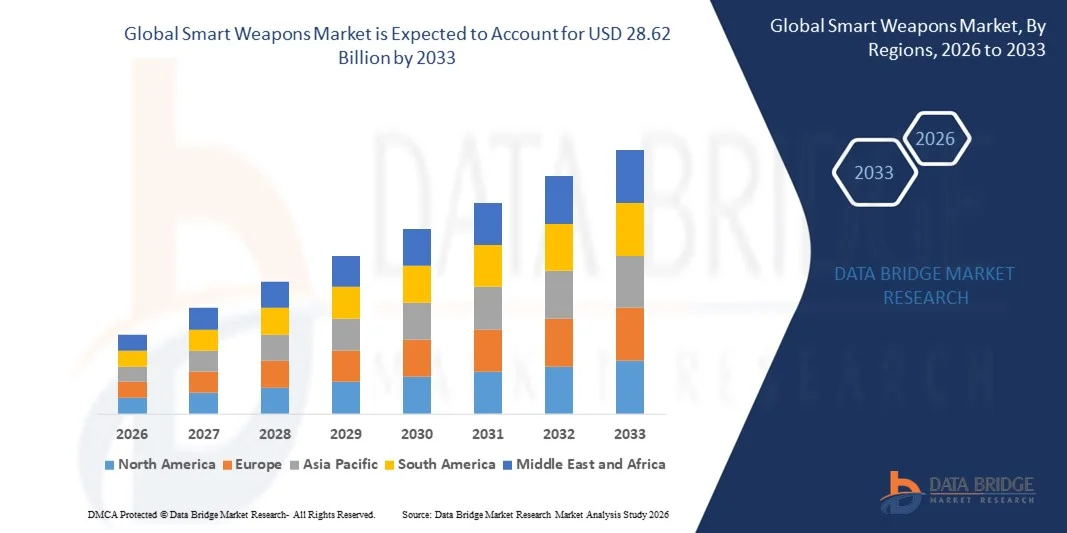
- Selon l'analyse de Data Bridge Market Research, la taille du marché mondial des armes intelligentes a été évaluée à17,82 milliards de dollars en 2025et devrait atteindre28,62 milliards de dollars en 2033, à unTCAC de 6,10 %pendant la période de prévision
- La croissance du marché est largement alimentée par l'augmentation des programmes de modernisation de la défense, l'adoption croissante de systèmes d'armes autonomes et guidés par la précision, et les progrès dans les technologies de l'IA et des capteurs, qui améliorent l'efficacité opérationnelle et la précision sur le champ de bataille
- De plus, les préoccupations croissantes en matière de sécurité mondiale, le besoin de capacités de réaction rapide et l'augmentation des budgets de défense tant dans les économies développées que dans les économies émergentes stimulent les investissements dans les armes intelligentes. Ces facteurs convergents accélèrent le déploiement de systèmes d'armes avancés, ce qui stimule considérablement la croissance de l'industrie
Taille du marché et prévisions
- Valeur de marché (2025):17,82 milliards de dollars
- Valeur marchande prévue (2033) :28,62 milliards de dollars
- Prévisions TCAC:6.10%
Quels sont les principaux débouchés du marché des armes intelligentes
- Les armes intelligentes, y compris les munitions guidées par la précision, les systèmes de combat autonomes et les drones équipés d'IA, sont de plus en plus vitales pour les opérations militaires modernes en raison de leur précision accrue, de la réduction des dommages collatéraux et de la capacité à s'intégrer aux réseaux de commandement et de contrôle avancés.
- La demande croissante d'armes intelligentes est principalement alimentée par les initiatives de modernisation de la défense mondiale, les progrès technologiques dans les systèmes autonomes et guidés, et l'accent stratégique mis sur l'amélioration de la préparation au combat et de l'efficacité opérationnelle
- L'Amérique du Nord a dominé le marché des armes intelligentes avec une part de39,6 % en 2025, en raison des budgets de défense robustes de la région, des progrès technologiques et de la modernisation continue des arsenaux militaires
- L'Asie-Pacifique devrait être la région qui connaît la croissance la plus rapide du marché des armes intelligentes au cours de la période de prévision en raison de la hausse des budgets de défense, des tensions régionales et des initiatives de modernisation dans des pays comme la Chine, l'Inde et le Japon.
- Le segment aérien a dominé le marché avec une part de marché de 47,1 % en 2025, en raison de l'utilisation intensive d'armes intelligentes aéroportées pour les frappes stratégiques, la surveillance et les opérations de déploiement rapide. Les armes lancées par l'air offrent une souplesse opérationnelle, une précision de ciblage accrue et la capacité d'engager des moyens ennemis dans les zones contestées tout en minimisant les risques pour le personnel
Portée du rapport et segmentation du marché des armes intelligentes
|
Attributs |
Les principales perspectives du marché des armes intelligentes |
|
Segments couverts |
|
|
Pays couverts |
Amérique du Nord
Europe
Asie-Pacifique
Moyen-Orient et Afrique
Amérique du Sud
|
|
Principaux acteurs du marché |
|
|
Possibilités de marché |
|
|
Infos sur la valeur ajoutée |
Outre les perspectives du marché telles que la valeur du marché, le taux de croissance, les segments de marché, la couverture géographique, les acteurs du marché et le scénario du marché, le rapport de marché préparé par l'équipe de recherche sur le marché de Data Bridge comprend une analyse approfondie des experts, une analyse des importations et des exportations, une analyse des prix, une analyse de la consommation de production et une analyse des ravageurs. |
Quelle est la tendance clé du marché des armes intelligentes
Adoption d ' armes autonomes et de précision
- Une tendance importante sur le marché des armes intelligentes est l'adoption croissante de systèmes autonomes et de munitions guidées par la précision, en raison de la nécessité d'accroître la précision, de réduire les dommages collatéraux et d'améliorer l'efficacité opérationnelle des opérations militaires modernes. Ces armes deviennent essentielles pour les stratégies nationales de défense et sont de plus en plus intégrées dans les plates-formes de combat avancées, y compris les systèmes aériens, navals et terrestres
- Par exemple, Lockheed Martin et Raytheon Technologies fournissent des missiles guidés par la précision et des munitions de braquage pour renforcer les capacités de frappe des forces armées dans le monde entier. Ces systèmes améliorent les taux de réussite de la mission tout en réduisant les risques pour le personnel, en positionnant les armes intelligentes comme des outils essentiels pour la défense moderne
- L'intégration de l'IA et des capteurs avancés dans les armes intelligentes s'accélère, permettant un ciblage autonome, une évaluation des menaces en temps réel et des opérations multiplateformes coordonnées. Cette tendance façonne le développement de systèmes de combat de nouvelle génération capables de fonctionner efficacement dans des environnements complexes et contestés
- La demande de véhicules aériens de combat sans pilote (UCAV) et de systèmes navals autonomes augmente, car ces plates-formes comptent fortement sur des armes intelligentes pour exécuter des frappes de précision et des missions de reconnaissance. Cette croissance stimule les investissements dans la recherche et le développement de capacités d'engagement pleinement autonomes
- Les forces armées modernes se concentrent sur la mise à niveau des systèmes existants dotés d'armes intelligentes pour conserver un avantage stratégique, ce qui crée des possibilités d'interopérabilité entre les plates-formes existantes et les technologies émergentes. L'intégration de ces systèmes permet d'améliorer l'efficacité du commandement et du contrôle ainsi que la connaissance de la situation.
- Les tensions géopolitiques croissantes et les préoccupations en matière de sécurité régionale propulsent l'adoption d'armes intelligentes, en particulier dans des régions comme l'Amérique du Nord, l'Europe et l'Asie-Pacifique. Les gouvernements accordent la priorité à l ' achat de systèmes technologiquement avancés pour renforcer la capacité de défense et maintenir la supériorité militaire
Dynamique du marché des armes intelligentes
Chauffeur
Amélioration de la modernisation de la défense et des besoins en matière de sécurité
- La modernisation croissante des forces armées et l'importance croissante accordée aux capacités de défense stratégique sont les principaux moteurs du marché des armes intelligentes. Les nations investissent massivement dans les munitions guidées par la précision, les systèmes de combat autonomes et les plates-formes adaptées à l'IA pour améliorer l'efficacité des missions et réduire les risques opérationnels
- Par exemple, le Département de la défense des États-Unis élargit les programmes de munitions anti-IA et de systèmes de missiles avancés pour maintenir la domination technologique dans les opérations de défense. Ces programmes stimulent l'innovation et augmentent la demande d'armes intelligentes dans plusieurs branches de l'armée
- L'instabilité géopolitique croissante et les menaces à la sécurité dans le monde poussent les gouvernements à acquérir des armes de pointe capables de cibler avec précision et de s'engager rapidement. Ce besoin est d'intensifier l'acquisition de systèmes d'armes intelligents sur les marchés développés et émergents
- Les progrès technologiques dans les systèmes de guidage, les capteurs et les logiciels de ciblage autonomes permettent le déploiement d'armes intelligentes avec une plus grande précision et des coûts opérationnels moins élevés. Ces innovations appuient les programmes de modernisation militaire et stimulent la croissance globale du marché
- L'augmentation des budgets militaires et des investissements dans la recherche et le développement favorise l'évolution continue des capacités d'armes intelligentes. La demande de précision supérieure, d'engagement autonome et d'intervention rapide influence les stratégies d'approvisionnement à l'échelle mondiale
Restriction/Défi
Règlement sur les coûts élevés et strict
- Le marché des armes intelligentes est confronté à des défis en raison du coût élevé de la recherche, du développement et de la production de systèmes guidés par la précision et autonomes. Ces coûts comprennent les technologies de détection avancées, les algorithmes d'IA et l'intégration complexe avec les plateformes de défense existantes
- Par exemple, des entreprises comme MBDA et BAE Systems ont des dépenses importantes dans la conception et l'essai de systèmes de missiles de nouvelle génération qui répondent à des normes de sécurité, de précision et d'exploitation rigoureuses. Ces exigences financières et réglementaires limitent la flexibilité dans l'échelle de production et l'introduction de nouvelles innovations
- Le respect des règlements internationaux sur les armes, des contrôles à l'exportation et des normes nationales de défense complique encore la mise au point et la vente d'armes intelligentes. Ces règlements ont une incidence sur les délais, limitent les marchés potentiels et exigent une documentation et des approbations rigoureuses.
- Le recours à des matériaux spécialisés, à l'électronique de pointe et à des procédés de fabrication de précision accroît la vulnérabilité aux perturbations de la chaîne d'approvisionnement et aux fluctuations des coûts. Maintenir les normes de rendement tout en contrôlant les dépenses demeure un défi majeur pour les fabricants
- L'équilibre entre l'avancement technologique et l'abordabilité et la faisabilité opérationnelle est un frein permanent. Les entreprises doivent optimiser la production, investir efficacement dans la R-D et naviguer dans les environnements réglementaires pour soutenir la croissance du marché tout en fournissant des armes intelligentes à haute performance
Comment le marché des armes intelligentes est-il segmenté
Le marché est segmenté en fonction du produit, de la technologie et de la plateforme.
- Par produit
Sur la base du produit, le marché des armes intelligentes est segmenté en missiles, munitions, projectiles guidés, roquettes guidées et armes à feu guidées de précision. Le segment des missiles a dominé le marché avec la plus grande part des revenus du marché en 2025, en raison de leurs capacités à longue portée, de la précision de ciblage avancée et du rôle stratégique dans la guerre moderne. Les forces militaires privilégient de plus en plus les systèmes de missiles en raison de leur capacité d'engager avec précision des cibles de grande valeur tout en minimisant les dommages collatéraux. En outre, l'intégration de systèmes intelligents de guidage et de suivi en temps réel renforce l'efficacité opérationnelle, faisant des missiles une pierre angulaire des arsenaux de défense.
Le segment des armes à feu à guidage de précision devrait connaître la croissance la plus rapide de 2026 à 2033, alimentée par la demande croissante d'engagements ciblés dans des scénarios de guerre asymétrique et de combat urbain. Les armes à feu à guidage de précision offrent une précision accrue, un gaspillage de munitions réduit et une sécurité opérationnelle accrue pour les soldats dans des environnements de combat complexes. Leur adoption est également soutenue par des progrès dans les technologies de microguidance et les systèmes de ciblage intelligents légers, ce qui les rend de plus en plus attrayants pour les forces spéciales et les unités tactiques.
- Par technologie
Sur la base de la technologie, le marché des armes intelligentes est segmenté en laser, radar, GPS, infrarouge, etc. Le segment GPS détenait la plus grande part du marché en 2025, en raison de sa grande applicabilité aux systèmes de navigation, de ciblage et de suivi sur diverses plates-formes d'armes. Les armes intelligentes compatibles avec le GPS offrent une grande précision sur de longues distances, assurant le succès de la mission et minimisant les dommages imprévus. Les organisations militaires continuent de s'appuyer sur les directives du GPS en raison de son interopérabilité avec d'autres systèmes et de sa compatibilité avec les cadres de commandement et de contrôle avancés, ce qui renforce les capacités de déploiement stratégique.
Le segment laser devrait être témoin du TCAC le plus rapide de 2026 à 2033, alimenté par les progrès technologiques dans les systèmes à énergie dirigée et le besoin croissant de capacités de contre-drone et de frappe de précision. Les armes intelligentes à guidage laser offrent un ciblage rapide, des coûts opérationnels peu élevés et un fardeau logistique minime, ce qui les rend de plus en plus attrayantes pour les opérations offensives et défensives. De plus, les améliorations continues du contrôle des faisceaux et de l'efficacité énergétique élargissent leurs applications tactiques sur les plates-formes terrestres, aériennes et navales.
- Par plateforme
Sur la base de la plate-forme, le marché des armes intelligentes est segmenté en air, terre et naval. Le segment des plates-formes aériennes a dominé le marché avec la plus grande part des revenus du marché de 47,1 % en 2025, grâce à l'utilisation intensive d'armes intelligentes aéroportées pour les frappes stratégiques, la surveillance et les opérations de déploiement rapide. Les armes lancées par l'air offrent une souplesse opérationnelle, une précision de ciblage accrue et la capacité d'engager des actifs ennemis dans les zones contestées tout en minimisant les risques pour le personnel. En outre, l'intégration avec les avions de chasse modernes, les UAV et les bombardiers assure une coordination transparente avec les réseaux de commandement, améliorant ainsi l'efficacité globale de la mission.
Le segment de la plate-forme terrestre devrait connaître la croissance la plus rapide de 2026 à 2033, alimentée par l'adoption croissante par les forces terrestres d'artillerie intelligente, de roquettes guidées et de systèmes de combat autonomes. Les armes intelligentes terrestres améliorent la précision, réduisent les dommages collatéraux et permettent des réponses tactiques rapides dans des scénarios de combat dynamiques. L'utilisation croissante de plates-formes robotiques et automatisées accélère encore le déploiement, rendant les systèmes terrestres intelligents critiques pour les stratégies de défense modernes.
Quelle région détient la plus grande part du marché des armes intelligentes
- L'Amérique du Nord a dominé le marché des armes intelligentes avec la plus grande part des revenus de 39,6 % en 2025, sous l'impulsion de la région.
- Les forces armées de la région privilégient la précision, les capacités à longue portée et les systèmes de ciblage avancés, favorisant l'adoption d'armes intelligentes à travers les plates-formes aériennes, terrestres et navales.
- Ce déploiement généralisé est appuyé par des initiatives gouvernementales, des collaborations stratégiques en matière de défense et un accent mis sur le maintien de la supériorité technologique, établissant l'Amérique du Nord comme un marché clé pour les systèmes d'armes intelligents
Aperçu du marché des armes intelligentes aux États-Unis
Le marché américain des armes intelligentes a enregistré la plus grande part de revenus en 2025 en Amérique du Nord, alimentée par de fortes dépenses de défense et le déploiement de technologies de combat de pointe. Les forces armées privilégient de plus en plus les capacités de frappe de précision et réduisent l'exposition humaine dans des environnements hostiles. Par exemple, Raytheon Technologies élargit son portefeuille de munitions guidées de précision et de systèmes autonomes pour répondre aux besoins de modernisation militaire. L'intégration d'armes intelligentes avec des systèmes de ciblage avancés, des drones et des réseaux de commande et de contrôle stimule la croissance du marché. De plus, la R-D en cours dans les systèmes d'armes à IA renforce l'efficacité opérationnelle et l'avantage stratégique.
Perspectives du marché européen des armes intelligentes
Le marché européen des armes intelligentes devrait s'étendre à un TCAC important tout au long de la période de prévision, principalement grâce à la modernisation des forces de défense et à l'adoption de systèmes autonomes avancés. Par exemple, MBDA met au point des systèmes de missiles de nouvelle génération qui améliorent la précision et réduisent les dommages collatéraux. Les nations européennes investissent dans des plates-formes d'armes intelligentes interopérables dans l'ensemble des opérations de l'OTAN, en favorisant le développement collaboratif. L'accent mis sur la préparation à la défense, associé à la demande croissante de solutions de précision rentables, favorise l'adoption du marché. L'augmentation des tensions géopolitiques et la nécessité de capacités d'intervention rapide favorisent l'utilisation d'armes intelligentes dans toute la région.
Aperçu du marché des armes intelligentes au Royaume-Uni
On s'attend à ce que le marché des armes intelligentes du Royaume-Uni augmente au cours de la période de prévision, grâce à des programmes de modernisation et à des investissements dans des systèmes autonomes et guidés par la précision. Par exemple, BAE Systems améliore les capacités de munitions intelligentes pour les opérations terrestres et aériennes. Des préoccupations accrues en matière de sécurité et le besoin de flexibilité opérationnelle encouragent les organismes de défense à adopter des systèmes d'armes de pointe. L'accent mis par le Royaume-Uni sur la R-D nationale, combiné à des projets de collaboration avec des partenaires de l'OTAN, devrait continuer à stimuler l'expansion du marché. L'adoption de plates-formes numériques de commandement et de contrôle favorise l'intégration des armes intelligentes dans les scénarios de combat modernes.
Allemagne Aperçu du marché des armes intelligentes
Le marché allemand des armes intelligentes devrait s'étendre à un TCAC considérable pendant la période de prévision, alimenté par l'accent mis par le pays sur la modernisation de la défense et l'innovation technologique. Par exemple, Rheinmetall fait progresser les systèmes d'artillerie et de missiles guidés par la précision pour renforcer les capacités de défense nationale. L'Allemagne dispose d'infrastructures de défense robustes et met l'accent sur la durabilité dans les opérations militaires pour promouvoir le déploiement d'armes intelligentes. L'intégration aux technologies avancées de surveillance et de ciblage devient de plus en plus courante, répondant aux normes opérationnelles nationales et à celles de l'OTAN. Les investissements stratégiques du pays dans des systèmes d'armes autonomes et télécommandés stimulent la croissance du marché.
Aperçu du marché des armes intelligentes en Asie et dans le Pacifique
Le marché des armes intelligentes en Asie et dans le Pacifique est sur le point de croître au rythme le plus rapide du TCAC pendant la période de prévision de 2026 à 2033, sous l'impulsion de la hausse des budgets de défense, des tensions régionales et des initiatives de modernisation dans des pays comme la Chine, l'Inde et le Japon. Par exemple, la Chine étend rapidement ses programmes de missiles guidés par la précision et de systèmes sans pilote pour améliorer ses capacités stratégiques. L'adoption de programmes de modernisation militaire de plus en plus nombreux, associés à des progrès technologiques dans les armes autonomes et à usage d'IA. De plus, le renforcement des capacités de fabrication nationales et l'appui gouvernemental à l'innovation en matière de défense améliorent l'accessibilité et le déploiement dans toute la région.
Aperçu du marché japonais des armes intelligentes
Le marché japonais des armes intelligentes prend de l'ampleur en raison des efforts croissants de modernisation de la défense, des préoccupations en matière de sécurité régionale et de la sophistication technologique. Par exemple, Mitsubishi Heavy Industries fait avancer les systèmes de missiles intelligents et d'UAV pour renforcer la capacité de défense. Le Japon met l'accent sur les systèmes d'armes autonomes et les réseaux de défense intégrés. Les collaborations stratégiques avec les pays alliés et les investissements dans des solutions de ciblage et de surveillance adaptées à l'IA favorisent la croissance du marché. L'intégration d'armes intelligentes dans les opérations de défense maritime, aérienne et terrestre du Japon devrait continuer à conduire à l'adoption.
Chine Aperçu du marché des armes intelligentes
En 2025, le marché chinois des armes intelligentes a représenté la plus grande part des revenus en Asie-Pacifique, attribuable à l'augmentation des dépenses de défense, au développement technologique rapide et aux initiatives régionales de sécurité. Par exemple, China Aerospace Science and Technology Corporation développe des munitions guidées de précision et des programmes intelligents d'UAV pour améliorer les capacités opérationnelles. Le pays s'attache à moderniser ses forces armées avec des armes autonomes, adaptées à l'IA et à la frappe de précision. Les investissements croissants dans la R-D nationale et la fabrication de défense favorisent un déploiement rentable. La poussée vers des systèmes de combat intelligents intégrés et la préparation à la défense stratégique est un facteur clé de la croissance du marché en Chine.
Quelles sont les meilleures entreprises du marché des armes intelligentes
L'industrie des armes intelligentes est principalement dirigée par des entreprises bien établies, notamment :
- Société Lockheed Martin(États-Unis)
- Raytheon Technologies Corporation(États-Unis)
- MBDA Inc. (France)
- Société de dynamique générale(États-Unis)
- Systèmes BAE(Royaume-Uni)
- Boeing (États-Unis)
- L3Harris Technologies, Inc. (États-Unis)
- Groupe Thales(France)
- Textron Inc. (États-Unis)
- Rheinmetall AG (Allemagne)
- Industrie aérospatiale d'Israël (IAI) (Israël)
- Dynamique du Denel (Afrique du Sud)
- Northrop Grumman (États-Unis)
- Saab AB (Suède)
- Airbus SA (France)
- Aelsan (Turquie)
- Rafael Advanced Defense Systems Ltd. (Israël)
- Diehl Stiftung & Co. KG (Allemagne)
- Leonardo (Italie)
Quelles sont les évolutions récentes du marché mondial des armes intelligentes
- En février 2026, l'entreprise américaine Anduril Industries a lancé des plans visant à réunir jusqu'à 8 milliards de dollars en nouveaux fonds, une initiative qui devrait accélérer considérablement le développement d'armes intelligentes autonomes et pilotées par des capteurs et créer une importante installation de fabrication d'armes pour répondre à la demande mondiale croissante de systèmes de défense avancés. Cet important effort de capital renforcerait la position concurrentielle d'Anduril, dans le secteur des armes autonomes, soutiendrait l'expansion de ses systèmes embarqués sur drones et de ses capteurs avancés, et permettrait une innovation plus rapide sur les futures plates-formes d'armes intelligentes, marquant ainsi une tendance majeure des investissements du secteur privé dans les technologies de défense.
- En septembre 2023, EDGE Group, un entrepreneur de défense basé aux Émirats arabes unis, a acquis une participation de 50 % dans le SIATT brésilien, donnant à l'entreprise les moyens de promouvoir le développement d'armes intelligentes et favorisant la collaboration qui pourrait améliorer les capacités technologiques d'armes intelligentes sur les marchés de la défense des Émirats arabes unis et du Brésil. Cette acquisition stratégique a élargi l'empreinte mondiale d'EDGE et vérifié le rôle croissant des partenariats internationaux dans l'expansion des capacités de R-D et de production d'armes intelligentes
- En juillet 2021, la start-up Biofire Technologies a amassé 17 millions de dollars en capitaux de démarrage pour faire progresser sa technologie de canons intelligents qui se déverrouille via la reconnaissance des empreintes digitales, avec seulement les utilisateurs autorisés capables de tirer l'arme. Cette étape de financement a soutenu les efforts de l'entreprise pour innover les armes intelligentes vérifiées par les utilisateurs, démontrant la confiance des investisseurs dans les systèmes d'armes intelligentes axés sur la sécurité et signalant un intérêt croissant pour les technologies de contrôle biométrique sur les marchés de la défense et de la sécurité
- En février 2022, l'Inde a annoncé son intention de tester des armes de lancement d'avions intelligents dans le cadre de l'initiative « Make in India » (Make in India), en mettant l'accent sur les missiles, les missiles antiradar et les bombes volantes pour renforcer les capacités indigènes. Cette initiative a souligné l'importance stratégique de développer des systèmes d'armes intelligentes propres, d'améliorer l'autonomie de la défense nationale et d'accélérer la croissance du marché dans l'industrie de la défense indienne
SKU-
Accédez en ligne au rapport sur le premier cloud mondial de veille économique

- Tableau de bord d'analyse de données interactif
- Tableau de bord d'analyse d'entreprise pour les opportunités à fort potentiel de croissance
- Accès d'analyste de recherche pour la personnalisation et les requêtes
- Analyse de la concurrence avec tableau de bord interactif
- Dernières actualités, mises à jour et analyse des tendances
- Exploitez la puissance de l'analyse comparative pour un suivi complet de la concurrence
Méthodologie de recherche
La collecte de données et l'analyse de l'année de base sont effectuées à l'aide de modules de collecte de données avec des échantillons de grande taille. L'étape consiste à obtenir des informations sur le marché ou des données connexes via diverses sources et stratégies. Elle comprend l'examen et la planification à l'avance de toutes les données acquises dans le passé. Elle englobe également l'examen des incohérences d'informations observées dans différentes sources d'informations. Les données de marché sont analysées et estimées à l'aide de modèles statistiques et cohérents de marché. De plus, l'analyse des parts de marché et l'analyse des tendances clés sont les principaux facteurs de succès du rapport de marché. Pour en savoir plus, veuillez demander un appel d'analyste ou déposer votre demande.
La méthodologie de recherche clé utilisée par l'équipe de recherche DBMR est la triangulation des données qui implique l'exploration de données, l'analyse de l'impact des variables de données sur le marché et la validation primaire (expert du secteur). Les modèles de données incluent la grille de positionnement des fournisseurs, l'analyse de la chronologie du marché, l'aperçu et le guide du marché, la grille de positionnement des entreprises, l'analyse des brevets, l'analyse des prix, l'analyse des parts de marché des entreprises, les normes de mesure, l'analyse globale par rapport à l'analyse régionale et des parts des fournisseurs. Pour en savoir plus sur la méthodologie de recherche, envoyez une demande pour parler à nos experts du secteur.
Personnalisation disponible
Data Bridge Market Research est un leader de la recherche formative avancée. Nous sommes fiers de fournir à nos clients existants et nouveaux des données et des analyses qui correspondent à leurs objectifs. Le rapport peut être personnalisé pour inclure une analyse des tendances des prix des marques cibles, une compréhension du marché pour d'autres pays (demandez la liste des pays), des données sur les résultats des essais cliniques, une revue de la littérature, une analyse du marché des produits remis à neuf et de la base de produits. L'analyse du marché des concurrents cibles peut être analysée à partir d'une analyse basée sur la technologie jusqu'à des stratégies de portefeuille de marché. Nous pouvons ajouter autant de concurrents que vous le souhaitez, dans le format et le style de données que vous recherchez. Notre équipe d'analystes peut également vous fournir des données sous forme de fichiers Excel bruts, de tableaux croisés dynamiques (Fact book) ou peut vous aider à créer des présentations à partir des ensembles de données disponibles dans le rapport.











