


Global Space Situational Awareness Market Segmentation, By Offering (Services and Software), Object (Mission-Related Debris, Rocket Bodies, Fragmentation Debris, Functional Spacecraft, and Non-Functional Spacecraft), End User (Government and Military and Commercial), Capability (Detect, Track, and Identify (D/T/ID), Threat Warning and Assessment, and Characterization)- Industry Trends and Forecast to 2033
Quelle est la taille du marché et le taux de croissance de la sensibilisation à la situation spatiale mondiale
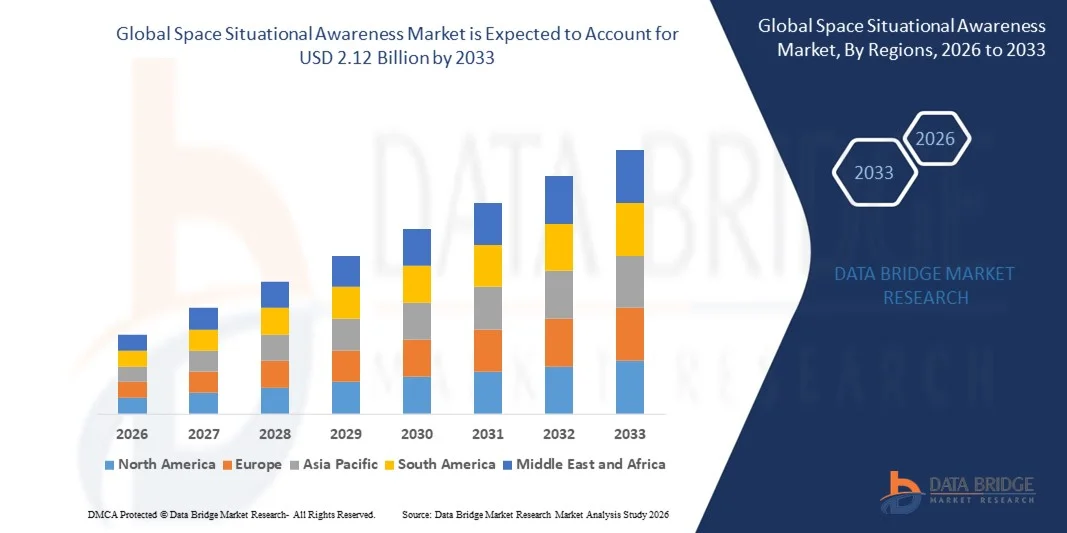
- Selon l'analyse de Data Bridge Market Research, la taille du marché mondial de la sensibilisation à la situation spatiale a été évaluée à1,49 milliard de dollars en 2025et devrait atteindre2,12 milliards de dollars en 2033, à unTCAC de 4,50 %pendant la période de prévision
- La croissance du marché est largement alimentée par le nombre croissant de lancements de satellites, les préoccupations croissantes concernant les débris spatiaux et la nécessité croissante de suivre et de surveiller en temps réel les objets spatiaux.
- L'expansion des activités spatiales commerciales et le déploiement rapide de méga-constellations pour la communication et l'observation de la Terre accélèrent encore la demande de solutions SSA avancées
Taille du marché et prévisions
- Valeur de marché (2025):1,49 milliard de dollars
- Valeur marchande prévue (2033) :2.12 milliards de dollars
- Prévisions TCAC:4.50%
Quels sont les principaux débouchés du marché de la sensibilisation à la situation spatiale
- Le marché connaît une croissance régulière grâce à l'intégration des technologies d'intelligence artificielle, d'analyse de données et de fusion de capteurs dans les systèmes de surveillance spatiale, améliorant ainsi la précision de détection et les capacités prédictives
- Une collaboration croissante entre les agences spatiales gouvernementales et les entreprises spatiales privées, ainsi que des progrès dans les infrastructures radar et de suivi optique, soutient l'innovation et la dynamique concurrentielle sur le marché mondial de la sensibilisation à la situation spatiale
- L'Amérique du Nord a dominé le marché de la sensibilisation à la situation spatiale avec la plus grande part des revenus en 2025, grâce à des investissements substantiels dans les programmes de défense spatiale, l'infrastructure de surveillance avancée et l'augmentation des déploiements par satellite.
- La région Asie-Pacifique devrait connaître le taux de croissance le plus élevé du monde.conscience de la situation spatialele marché, en raison de l'augmentation des budgets de défense, de l'expansion rapide des constellations de satellites et de l'accent accru mis par le gouvernement sur la durabilité et la sécurité spatiales. Des pays comme la Chine, l ' Inde, le Japon et la Corée du Sud investissent activement dans des systèmes de surveillance avancés pour renforcer les capacités régionales de sensibilisation au domaine spatial
- En 2025, le segment des Services détenait la plus grande part de revenus du marché en raison de la demande croissante de services de surveillance en temps réel, de soutien à l'évitement des collisions et de services d'analyse de données fournis aux exploitants de satellites et aux organismes de défense. Les fournisseurs de services offrent un suivi continu, une évaluation des risques et un soutien à la conformité réglementaire, ce qui les rend essentiels pour les missions gouvernementales et commerciales.
Portée du rapport et sensibilisation à la situation spatiale Segmentation du marché
|
Attributs |
Connaissance de la situation spatiale Principales perspectives du marché |
|
Segments couverts |
|
|
Pays couverts |
Amérique du Nord
Europe
Asie-Pacifique
Moyen-Orient et Afrique
Amérique du Sud
|
|
Principaux acteurs du marché |
|
|
Possibilités de marché |
|
|
Infos sur la valeur ajoutée |
Outre les perspectives du marché telles que la valeur du marché, le taux de croissance, les segments de marché, la couverture géographique, les acteurs du marché et le scénario du marché, le rapport de marché préparé par l'équipe de recherche sur le marché de Data Bridge comprend une analyse approfondie des experts, une analyse des importations et des exportations, une analyse des prix, une analyse de la consommation de production et une analyse des ravageurs. |
Quelle est la tendance clé du marché de la sensibilisation à la situation spatiale
Déploiement croissant de satellites et préoccupation croissante au sujet des débris spatiaux
- Le nombre croissant de lancements de satellites pour des applications de communication, de navigation, d'observation de la Terre et de défense façonne de manière significative le marché mondial de la sensibilisation à la situation spatiale. Les gouvernements et les entreprises spatiales privées investissent dans des systèmes avancés de suivi et de surveillance pour assurer la sécurité opérationnelle et éviter les collisions. Les solutions de sensibilisation à la situation spatiale améliorent la détection, le suivi et la caractérisation en temps réel des objets spatiaux, favorisent la continuité des missions et la protection des biens.
- Les préoccupations croissantes concernant les débris spatiaux et la congestion en orbite terrestre basse accélèrent la demande de technologies d'analyse prédictive et d'évitement des collisions. À mesure que les mégaconstellations augmentent, le risque de collisions orbitales augmente, encourageant les autorités réglementaires et les exploitants de satellites à adopter des plates-formes avancées de SSA. Cette tendance renforce les investissements dans le radar, les capteurs optiques et les systèmes d'intégration de données pour améliorer la surveillance orbitale
- Une collaboration accrue entre les agences spatiales gouvernementales et les opérateurs commerciaux influe sur l'innovation et le développement technologique. Les partenariats public-privé facilitent le déploiement de réseaux de surveillance terrestres et spatiales de nouvelle génération. Ces collaborations améliorent le partage des données, améliorent les capacités de sensibilisation à la situation et appuient des cadres normalisés de gestion du trafic spatial
- Par exemple, en 2024, la NASA aux États-Unis et l'Agence spatiale européenne en Europe ont élargi les initiatives de suivi des débris spatiaux et renforcé les partenariats avec les exploitants privés de satellites. Ces initiatives portaient sur l'amélioration des services d'évitement des collisions et l'intégration des analyses fondées sur l'IA dans les plateformes de surveillance. Amélioration de la transparence opérationnelle et de la viabilité à long terme des activités spatiales
- Bien que l'adoption de solutions SSA se développe, la croissance soutenue du marché dépend du progrès technologique continu, de l'exactitude des données et de l'harmonisation réglementaire. Les parties prenantes se concentrent sur une infrastructure évolutive, une précision améliorée des capteurs et des modèles de déploiement rentables pour assurer une couverture complète et une coordination fiable du trafic spatial
Dynamique du marché de la sensibilisation à la situation spatiale
Chauffeur
Accent croissant sur la sécurité spatiale et la protection des biens
- La montée des tensions géopolitiques et l'importance stratégique des actifs spatiaux sont des moteurs majeurs du marché de la sensibilisation à la situation spatiale. Les gouvernements accordent la priorité à la protection des satellites utilisés pour la communication, la surveillance et la navigation de la défense. L ' investissement dans des systèmes avancés d ' assurance de la sécurité renforce les capacités de sécurité nationale et assure la résilience contre les menaces potentielles
- L'expansion des activités spatiales commerciales influence davantage la croissance du marché. La participation du secteur privé au déploiement de satellites et aux missions dans l'espace profond exige une surveillance précise et des solutions d'atténuation des risques. Les plates-formes SSA fournissent des systèmes d'alerte rapide, améliorent la planification des missions et réduisent les incertitudes opérationnelles pour les opérateurs commerciaux
- Les organismes de défense et les organisations spatiales promeuvent activement les réseaux de surveillance avancés au moyen de programmes de recherche et de collaborations internationales. Ces initiatives sont appuyées par des allocations de financement accrues et des cadres stratégiques visant à maintenir des opérations spatiales sûres et durables. L'intégration de l'IA et de l'analyse des mégadonnées améliore également les capacités de modélisation prédictive et de réponse
- Par exemple, en 2023, la U.S. Space Force a élargi les contrats pour des capacités avancées de sensibilisation au domaine spatial, tandis que l'ISRO a renforcé l'infrastructure de suivi autochtone. Ces initiatives ont amélioré les capacités nationales de surveillance et stimulé la demande de technologies innovantes de SSA, renforçant la dynamique concurrentielle sur le marché mondial
- Bien que les préoccupations croissantes en matière de sécurité soutiennent la croissance, l'expansion à long terme dépend des normes d'interopérabilité, du partage transfrontière des données et des mécanismes de financement durables. Il sera essentiel d'investir continuellement dans la R-D et les modèles de gouvernance collaborative pour maintenir l'efficacité opérationnelle et la coordination mondiale.
Restriction/Défi
Coûts élevés de l'infrastructure et complexités d'intégration des données
- Le coût élevé associé au déploiement et à l'entretien de systèmes radar avancés, de télescopes optiques et de centres de traitement des données demeure un défi important pour le marché de la sensibilisation à la situation spatiale. Le développement des infrastructures nécessite des investissements substantiels et des engagements de maintenance à long terme, limitant la participation des petits opérateurs
- L'intégration des données et l'interopérabilité entravent également la croissance du marché, car les systèmes SSA doivent regrouper les informations provenant de plusieurs capteurs et bases de données internationales. Les modifications apportées aux normes techniques et aux protocoles de partage des données peuvent restreindre la coordination sans heurt et réduire l'efficacité opérationnelle.
- Une harmonisation limitée de la réglementation entre les pays crée des obstacles supplémentaires, en particulier dans l'élaboration de cadres unifiés de gestion du trafic spatial. Les différences entre les politiques nationales et les préoccupations en matière de sécurité peuvent restreindre la transparence des échanges de données, ce qui nuit à une prise de conscience globale de la situation.
- Par exemple, en 2024, les exploitants de satellites collaborant avec l'Agence japonaise d'exploration aérospatiale et les réseaux régionaux de suivi ont signalé des difficultés à harmoniser les formats de données et les exigences de conformité. Ces complexités ont accru les coûts opérationnels et retardé les délais de mise en oeuvre, ce qui a eu des répercussions sur l'échelle des services.
- Pour relever ces défis, il faudra des cadres mondiaux normalisés, des modèles d'infrastructure optimisés par rapport aux coûts et une coopération accrue entre les acteurs publics et privés. L'investissement dans l'automatisation, l'analyse en nuage et les plateformes de surveillance partagées sera essentiel pour libérer le plein potentiel de croissance du marché mondial de la sensibilisation à la situation spatiale
Comment le marché de la sensibilisation à la situation spatiale est-il segmenté
Le marché est segmenté en fonction de l'offre, de l'objet, de l'utilisateur final et de la capacité.
- En offrant
Sur la base de l'offre, le marché mondial de la sensibilisation à la situation spatiale est segmenté en Services et Logiciels. En 2025, le segment des Services détenait la plus grande part de revenus du marché en raison de la demande croissante de services de surveillance en temps réel, de soutien à l'évitement des collisions et de services d'analyse de données fournis aux exploitants de satellites et aux organismes de défense. Les fournisseurs de services offrent un suivi continu, une évaluation des risques et un soutien à la conformité réglementaire, ce qui les rend essentiels pour les missions gouvernementales et commerciales.
Le segment des logiciels devrait connaître le taux de croissance le plus rapide de 2026 à 2033, en raison de l'adoption croissante de plateformes d'analyse avancées, d'outils de prévision compatibles avec l'IA et de solutions SSA basées sur le cloud. Les plates-formes logicielles permettent le traitement automatisé des données, la visualisation et le soutien à la prise de décisions, ce qui améliore l'efficacité opérationnelle et l'évolutivité des exploitants de satellites.
- Par objet
Sur la base de l'objet, le marché est segmenté en Debris et corps de fusées liés à la mission, Debris de fragmentation, Spacecraft fonctionnels et Spacecraft non fonctionnels. Le segment des débris de fragmentation détenait la plus grande part du marché en 2025 en raison de l'accumulation croissante de petites particules de débris en orbite et du risque élevé qu'elles présentent pour les satellites opérationnels. La surveillance continue des débris de fragmentation est essentielle pour éviter les collisions et assurer la viabilité à long terme de l'orbite.
Le segment des engins spatiaux fonctionnels devrait connaître le taux de croissance le plus rapide entre 2026 et 2033, du fait du déploiement rapide de constellations de satellites commerciaux et de la dépendance croissante à l'égard des services spatiaux. La montée des lancements par satellite accroît la nécessité de disposer de capacités précises de suivi et d'identification.
- Par Utilisateur final
Sur la base de l'utilisateur final, le marché est segmenté en Gouvernement et Militaire et Commercial. En 2025, le segment du gouvernement et de l'armée détenait la plus grande part des revenus du marché en raison des priorités de sécurité nationale, des programmes de modernisation de la défense et des investissements dans l'infrastructure de sensibilisation au domaine spatial. Les gouvernements s ' attachent à renforcer les capacités de surveillance pour protéger les biens spatiaux stratégiques et assurer la supériorité opérationnelle.
Le secteur commercial devrait connaître le taux de croissance le plus rapide entre 2026 et 2033, grâce à une participation accrue du secteur privé au déploiement de satellites, à l'observation de la Terre et aux services de communication. Les exploitants commerciaux comptent de plus en plus sur les solutions SSA pour minimiser les risques opérationnels et assurer le respect des normes réglementaires en évolution.
- Par capacité
En fonction de la capacité, le marché est segmenté en détection, suivi et identification (D/T/ID), alerte et évaluation de la menace et caractérisation. Le segment Détecter, suivre et identifier (D/T/ID) détenait la plus grande part du marché en 2025, en raison de l'exigence fondamentale de surveiller et de cataloguer en permanence les objets spatiaux sur plusieurs orbites. Les systèmes radar et optiques avancés sont largement déployés pour améliorer la précision et la couverture de la détection.
Le segment Mise en garde et évaluation des menaces devrait connaître le taux de croissance le plus rapide entre 2026 et 2033, en raison des préoccupations croissantes concernant les risques de collision et les activités hostiles potentielles dans l'espace. Les systèmes avancés d'analyse prédictive et d'alerte rapide appuient la prise de décisions proactives et renforcent les cadres généraux de sécurité spatiale.
Quelle région détient la plus grande part du marché de la sensibilisation à la situation spatiale
- L'Amérique du Nord a dominé le marché de la sensibilisation à la situation spatiale avec la plus grande part des revenus en 2025, grâce à des investissements substantiels dans les programmes de défense spatiale, l'infrastructure de surveillance avancée et l'augmentation des déploiements par satellite.
- Les organismes gouvernementaux et les organisations de défense de la région accordent une grande priorité au suivi en temps réel, à l'évitement des collisions et à la sensibilisation au domaine spatial afin de protéger les biens spatiaux essentiels
- Cette large adoption s ' appuie en outre sur la présence de grandes entreprises de l ' aérospatiale et de la défense, sur des réseaux radar au sol bien établis et sur des initiatives de modernisation continue, en établissant des systèmes de sensibilisation à la situation spatiale comme nécessité stratégique pour les exploitants militaires et commerciaux.
Aperçu du marché américain de la sensibilisation à la situation spatiale
Le marché américain de la sensibilisation à la situation spatiale a enregistré la plus grande part des revenus en 2025 en Amérique du Nord, alimentée par de solides dépenses de défense et l'expansion des initiatives nationales de sécurité spatiale. Le pays investit activement dans des systèmes de suivi de la prochaine génération, des capacités radar avancées et des plates-formes d'analyse pilotées par l'IA pour améliorer la surveillance orbitale. Le rôle croissant de la Force spatiale des États-Unis dans le renforcement de la sensibilisation au domaine spatial propulse le marché. De plus, une collaboration accrue entre les organismes gouvernementaux et les exploitants privés de satellites contribue de façon significative à l'expansion soutenue du marché.
Perspectives du marché de la sensibilisation à la situation spatiale en Europe
Le marché européen de la sensibilisation à la situation spatiale devrait connaître le taux de croissance le plus rapide entre 2026 et 2033, principalement en raison de la hausse des investissements dans la sécurité spatiale et les opérations spatiales durables. De plus en plus de lancements par satellite et de mesures réglementaires axées sur la réduction des débris spatiaux favorisent l ' adoption de systèmes de surveillance avancés. Les pays européens mettent l'accent sur des cadres de collaboration pour la gestion du trafic spatial et le partage de données transfrontières. La région connaît une croissance notable au niveau de la défense et des applications commerciales, soutenue par des initiatives menées par l'Agence spatiale européenne.
Connaissance de la situation spatiale au Royaume-Uni
Le marché britannique de la sensibilisation à la situation spatiale devrait connaître le taux de croissance le plus rapide de 2026 à 2033, en raison des priorités croissantes en matière de sécurité nationale et de l'expansion des programmes spatiaux nationaux. Le pays investit dans une infrastructure de surveillance avancée et renforce les partenariats avec les pays alliés pour renforcer les capacités de surveillance. L'augmentation des activités commerciales par satellite et l'innovation dans les plateformes d'analyse spatiale stimulent davantage le développement du marché. L'accent mis par le Royaume-Uni sur les opérations spatiales résilientes continue de créer des possibilités pour les fournisseurs de technologie.
Allemagne Connaissance de la situation spatiale Aperçu du marché
Le marché allemand de la sensibilisation à la situation spatiale devrait connaître le taux de croissance le plus rapide de 2026 à 2033, alimenté par l'accent accru mis sur la sécurité des communications par satellite et la modernisation de la défense. L'Allemagne a de solides capacités d'ingénierie et son engagement en faveur de la durabilité de l'espace soutiennent le déploiement de systèmes radar et optique de suivi avancés. La collaboration avec les partenaires européens et l'intégration de l'analyse fondée sur l'IA sont de plus en plus répandues. L'accent mis sur la surveillance de la précision et le respect des normes internationales s'harmonise avec les priorités stratégiques nationales.
Aperçu du marché de la sensibilisation à la situation spatiale en Asie et dans le Pacifique
Le marché de la sensibilisation à la situation spatiale en Asie et dans le Pacifique devrait connaître le taux de croissance le plus rapide de 2026 à 2033, en raison de l'augmentation des lancements de satellites, de l'expansion des budgets de défense et de l'avancement rapide des programmes spatiaux autochtones dans des pays comme la Chine, le Japon et l'Inde. Les gouvernements de la région accordent la priorité à la sécurité spatiale et investissent dans les infrastructures terrestres et spatiales de surveillance. L'augmentation de la participation à l'espace commercial et les initiatives de transformation numérique accélèrent l'adoption de solutions SSA.
Aperçu du marché de la sensibilisation à la situation spatiale au Japon
Le marché japonais de la sensibilisation à la situation spatiale devrait connaître le taux de croissance le plus rapide entre 2026 et 2033 en raison de ses fortes capacités technologiques et de l'importance croissante accordée à la sécurité spatiale nationale. Le pays renforce ses systèmes de surveillance orbitale et renforce ses partenariats avec les organismes internationaux pour assurer des opérations spatiales durables. Le déploiement croissant de satellites commerciaux et de recherche alimente la demande de solutions précises de suivi et d'analyse prédictive. L'accent mis sur l'innovation et la durabilité à long terme de l'espace continue de soutenir la croissance du marché.
Aperçu du marché de la sensibilisation à la situation spatiale en Chine
Le marché chinois de la sensibilisation à la situation spatiale a représenté la plus grande part des revenus du marché en Asie-Pacifique en 2025, en raison de l'expansion rapide des constellations de satellites et d'importants investissements publics dans les infrastructures spatiales. La Chine développe activement des réseaux avancés de surveillance radar et optique afin de renforcer ses capacités de sensibilisation au domaine spatial. L'expansion vers le développement des stations spatiales, les missions dans l'espace profond et les initiatives de sécurité nationale accélère l'adoption de la SSA. Des capacités de fabrication nationales solides et une planification stratégique à long terme sont des facteurs clés qui propulsent le marché en Chine.
Quelles sont les principales entreprises du marché de la sensibilisation à la situation spatiale
L'industrie de la sensibilisation à la situation spatiale est principalement dirigée par des entreprises bien établies, notamment :
- Société de génie de la vision(Royaume-Uni)
- Solutions d'analyse exo (États-Unis)
- Industries de la construction(États-Unis)
- etamax space GmbH (Allemagne)
- Kratos Defense & Security Solutions, Inc.(États-Unis)
- Graphiques analytiques, Inc (États-Unis)
- Société Lockheed Martin(États-Unis)
- Sky and Space Global Ltd (Australie)
- NorthStar Earth & Space Inc. (Canada)
- Polaris Alpha (États-Unis)
- Solers (États-Unis)
- L3 Solutions de défense appliquées (U.S.)
- Elecnor Deimos (Espagne)
- SpaceNav (États-Unis)
- GMV (Espagne)
- Harris (États-Unis)
- GlobVision Inc. (États-Unis)
Quelles sont les évolutions récentes du marché mondial de la sensibilisation à la situation spatiale
- En avril 2024, L3Harris Technologies, Inc., adjudicataire du contrat, a obtenu la cinquième année d'option de l'initiative MOSSAIC, d'une valeur d'environ 187 millions de dollars américains de la Force spatiale américaine. Le programme appuie la maintenance et l'amélioration de l'infrastructure de sensibilisation à la situation spatiale critique afin de renforcer les capacités de surveillance du domaine spatial. Ce développement renforce les partenariats de défense à long terme et stimule la demande soutenue de solutions SSA avancées sur le marché américain
- En janvier 2024, Rocket Lab, lancé par satellite, a déployé avec succès quatre satellites SSA pour NorthStar Earth & Space Inc. et Spire Global à l'aide de sa fusée Electron. La mission a placé des satellites sur une orbite circulaire de 530 km pour améliorer la surveillance en temps réel des objets spatiaux. Ce lancement renforce les capacités commerciales de SSA et accélère la croissance de la participation du secteur privé sur le marché mondial de SSA
- En août 2023, EnduroSat AD et Vyoma GmbH, partenariat stratégique, ont collaboré à la première mission commerciale SSA en Europe. L'initiative consiste à déployer des télescopes optiques sur des microsatellites pour fournir des services de suivi et de données en temps quasi réel. Ce partenariat renforce les capacités SSA indépendantes d'Europe et élargit les offres de services commerciaux, soutenant la dynamique concurrentielle sur le marché régional
- En septembre 2021, Kratos Defense & Security Solutions, Inc., financement du gouvernement, a obtenu USD 2,8 millions du département de la Défense des États-Unis pour prototyper un système offrant un accès rapide aux données de situation liées à l'espace. La solution prend en charge la bibliothèque de données unifiée grâce à une infrastructure virtualisée et à l'intégration en nuage. Cette avancée renforce la transformation numérique dans les opérations spatiales de défense et favorise l'innovation dans les plateformes SSA axées sur les données
- En août 2021, Telespazio UK, contrat de service, a été attribué par l'Agence spatiale européenne pour l'exploitation de centres de missions scientifiques au Centre européen d'astronomie spatiale. Le contrat appuie les missions d'astronomie et d'héliophysique, améliorant l'efficacité opérationnelle et la gestion des données de la mission. Ce développement renforce l'Europe SSA et l'écosystème de recherche spatiale, soutenant des investissements soutenus dans des capacités avancées de surveillance et d'analyse
SKU-
Accédez en ligne au rapport sur le premier cloud mondial de veille économique

- Tableau de bord d'analyse de données interactif
- Tableau de bord d'analyse d'entreprise pour les opportunités à fort potentiel de croissance
- Accès d'analyste de recherche pour la personnalisation et les requêtes
- Analyse de la concurrence avec tableau de bord interactif
- Dernières actualités, mises à jour et analyse des tendances
- Exploitez la puissance de l'analyse comparative pour un suivi complet de la concurrence
Méthodologie de recherche
La collecte de données et l'analyse de l'année de base sont effectuées à l'aide de modules de collecte de données avec des échantillons de grande taille. L'étape consiste à obtenir des informations sur le marché ou des données connexes via diverses sources et stratégies. Elle comprend l'examen et la planification à l'avance de toutes les données acquises dans le passé. Elle englobe également l'examen des incohérences d'informations observées dans différentes sources d'informations. Les données de marché sont analysées et estimées à l'aide de modèles statistiques et cohérents de marché. De plus, l'analyse des parts de marché et l'analyse des tendances clés sont les principaux facteurs de succès du rapport de marché. Pour en savoir plus, veuillez demander un appel d'analyste ou déposer votre demande.
La méthodologie de recherche clé utilisée par l'équipe de recherche DBMR est la triangulation des données qui implique l'exploration de données, l'analyse de l'impact des variables de données sur le marché et la validation primaire (expert du secteur). Les modèles de données incluent la grille de positionnement des fournisseurs, l'analyse de la chronologie du marché, l'aperçu et le guide du marché, la grille de positionnement des entreprises, l'analyse des brevets, l'analyse des prix, l'analyse des parts de marché des entreprises, les normes de mesure, l'analyse globale par rapport à l'analyse régionale et des parts des fournisseurs. Pour en savoir plus sur la méthodologie de recherche, envoyez une demande pour parler à nos experts du secteur.
Personnalisation disponible
Data Bridge Market Research est un leader de la recherche formative avancée. Nous sommes fiers de fournir à nos clients existants et nouveaux des données et des analyses qui correspondent à leurs objectifs. Le rapport peut être personnalisé pour inclure une analyse des tendances des prix des marques cibles, une compréhension du marché pour d'autres pays (demandez la liste des pays), des données sur les résultats des essais cliniques, une revue de la littérature, une analyse du marché des produits remis à neuf et de la base de produits. L'analyse du marché des concurrents cibles peut être analysée à partir d'une analyse basée sur la technologie jusqu'à des stratégies de portefeuille de marché. Nous pouvons ajouter autant de concurrents que vous le souhaitez, dans le format et le style de données que vous recherchez. Notre équipe d'analystes peut également vous fournir des données sous forme de fichiers Excel bruts, de tableaux croisés dynamiques (Fact book) ou peut vous aider à créer des présentations à partir des ensembles de données disponibles dans le rapport.











