



Global Telecom Mounting Hardware Market Segmentation, By Product Type (Cables, Cabinets, Routers, and Others), Mounting Application (On-wall Mounting, In-ceiling Mounting, Pole Mounting, Tower Mounting, and Other Platform-Specific Mounting), Industry Verticals (Banking, Financial Services, Insurance (BSFI), Retail, Media and Entertainment, Defense and Aerospace, Education, and Others) - Industry Trends and Forecast to 2033
Telecom Mounting Hardware Market Size
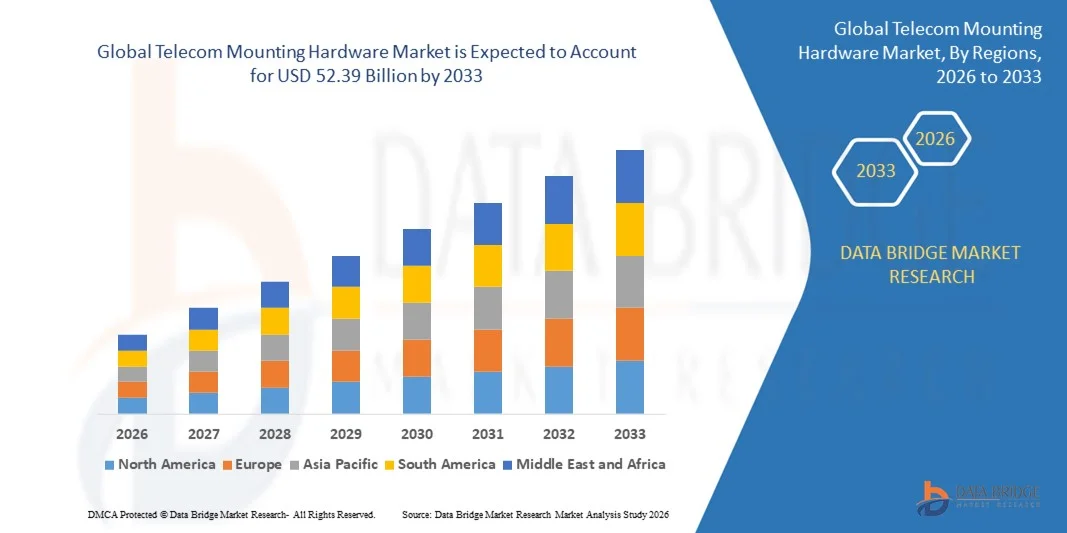
- The global telecom mounting hardware market size was valued at USD 21.46 billion in 2025 and is expected to reach USD 52.39 billion by 2033, at a CAGR of 11.80% during the forecast period
- The market growth is largely fueled by the rapid expansion of telecom networks, 5G deployment, and the increasing need for reliable, secure, and organized mounting solutions to support critical network infrastructure in both enterprise and service provider environments
- Furthermore, rising investments in data centers, fiber-optic networks, and smart city projects are driving demand for modular, scalable, and efficient mounting hardware. These converging factors are accelerating the adoption of telecom mounting solutions, thereby significantly boosting the industry’s growth
Telecom Mounting Hardware Market Analysis
- Telecom mounting hardware, including racks, cabinets, poles, towers, and wall/ceiling mounts, is increasingly vital for the structured installation, protection, and management of network equipment in both commercial and telecom service environments due to its role in ensuring operational efficiency, equipment safety, and organized cabling
- The escalating demand for telecom mounting hardware is primarily fueled by the growth of 5G networks, expanding fiber-optic infrastructure, and increasing requirements for modular and interoperable solutions that simplify installation, maintenance, and upgrades across large-scale telecom and enterprise networks
- North America dominated the telecom mounting hardware market with a share of 37.5% in 2025, due to rapid expansion of telecom infrastructure, data centers, and 5G deployments
- Asia-Pacific is expected to be the fastest growing region in the telecom mounting hardware market during the forecast period due to rapid 5G expansion, increasing data center investments, and government initiatives promoting smart infrastructure in countries such as China, Japan, and India
- Cabinets segment dominated the market with a market share of 41.8% in 2025, due to its critical role in housing telecom equipment and ensuring organized network management. Cabinets provide physical protection, efficient airflow, and security for sensitive networking devices, making them a preferred choice for telecom operators. The market sees strong demand for cabinets due to their compatibility with both indoor and outdoor deployments and their adaptability to various rack and mounting standards
Report Scope and Telecom Mounting Hardware Market Segmentation
|
Attributes |
Telecom Mounting Hardware Key Market Insights |
|
Segments Covered |
|
|
Countries Covered |
North America
Europe
Asia-Pacific
Middle East and Africa
South America
|
|
Key Market Players |
|
|
Market Opportunities |
|
|
Value Added Data Infosets |
In addition to the market insights such as market value, growth rate, market segments, geographical coverage, market players, and market scenario, the market report curated by the Data Bridge Market Research team includes in-depth expert analysis, import/export analysis, pricing analysis, production consumption analysis, and pestle analysis. |
Telecom Mounting Hardware Market Trends
Increasing Adoption of Modular and Scalable Mounting Solutions
- A key trend in the telecom mounting hardware market is the rising adoption of modular and scalable solutions that support flexible installation and rapid deployment across diverse telecom infrastructures. These solutions are enabling telecom operators and tower management companies to streamline equipment integration, reduce installation time, and accommodate future network expansions efficiently
- For instance, CommScope and RFS offer modular mounting systems for base stations and rooftop installations, allowing operators to easily adjust antenna configurations and integrate new hardware without extensive structural modifications. Such solutions enhance operational flexibility and support network densification initiatives
- The deployment of 5G networks is accelerating the need for mounting hardware capable of supporting compact and high-capacity antennas while ensuring structural stability. This trend is driving manufacturers to innovate lightweight and corrosion-resistant materials that meet stringent performance requirements
- Mounting hardware is increasingly being designed for multi-band and multi-operator installations, where a single support structure accommodates multiple service providers’ equipment. This capability is optimizing space utilization and lowering the overall cost of network rollouts
- Industries focusing on urban and rural telecom expansion are investing in advanced mounting solutions to meet the increasing demand for reliable coverage. These hardware systems are critical for supporting small cells, macro towers, and fiber-optic nodes under varied environmental conditions
- The market is witnessing stronger growth in smart and pre-engineered mounting systems that reduce on-site labor requirements and simplify maintenance activities. This rising preference is reinforcing the overall adoption of flexible, efficient, and future-proof telecom infrastructure
Telecom Mounting Hardware Market Dynamics
Driver
Rapid Expansion of 5G Networks and Fiber-Optic Infrastructure
- The rapid rollout of 5G networks and fiber-optic systems is a primary driver for the telecom mounting hardware market, as these networks require robust and scalable support structures for antennas, nodes, and equipment cabinets. Proper mounting solutions are critical for maintaining signal quality, structural integrity, and ease of maintenance across urban and rural deployments
- For instance, Huawei and Ericsson supply mounting hardware that supports high-density 5G base stations, enabling operators to scale network capacity efficiently and ensure uninterrupted service delivery. These solutions facilitate faster network expansion while reducing downtime during equipment upgrades
- The surge in global data consumption and the demand for ultra-low latency services are increasing the need for precise and secure mounting installations. This trend is prompting telecom companies to invest in hardware that supports optimal alignment and minimizes interference
- Expansion of fiber-optic infrastructure requires durable mounting solutions for repeaters, junction boxes, and distribution nodes. These systems are designed to withstand environmental stressors while ensuring consistent network performance
- The increasing adoption of IoT, smart city applications, and high-speed broadband is reinforcing the need for reliable mounting infrastructure. Robust hardware ensures uninterrupted network operation, supporting the broader digital transformation agenda for telecom providers
Restraint/Challenge
High Initial Investment and Complex Regulatory Compliance
- The telecom mounting hardware market faces challenges due to the high capital investment required for advanced, modular, and corrosion-resistant systems, which can constrain adoption, particularly in emerging regions. The cost includes design, materials, installation, and compliance with safety and structural standards
- For instance, companies such as RFS implement rigorous structural testing and regulatory certifications for their mounting solutions to meet international standards, which adds to upfront costs and extends deployment timelines. These compliance requirements can limit rapid expansion in cost-sensitive markets
- Navigating complex municipal, environmental, and safety regulations can delay hardware installation, requiring additional planning and administrative resources. This complexity is more pronounced for urban and high-rise deployments where multiple authorities may be involved
- The market is further challenged by the need for highly skilled labor to install and maintain sophisticated mounting systems. Workforce shortages and specialized training requirements increase operational costs and can slow deployment schedules
- Maintaining a balance between cost efficiency and compliance with structural, safety, and environmental standards remains critical. These constraints collectively impact the speed of network rollout and require telecom operators to strategically plan investments in mounting hardware while adhering to regulatory obligations
Telecom Mounting Hardware Market Scope
The market is segmented on the basis of product type, mounting application, and industry verticals.
- By Product Type
On the basis of product type, the Telecom Mounting Hardware market is segmented into cables, cabinets, routers, and others. The cabinets segment dominated the market with the largest market revenue share of 41.8% in 2025, driven by its critical role in housing telecom equipment and ensuring organized network management. Cabinets provide physical protection, efficient airflow, and security for sensitive networking devices, making them a preferred choice for telecom operators. The market sees strong demand for cabinets due to their compatibility with both indoor and outdoor deployments and their adaptability to various rack and mounting standards. Telecom operators often prioritize cabinet installations for high-density networking environments, ensuring operational efficiency and simplified maintenance.
The routers segment is anticipated to witness the fastest growth rate of 19.5% from 2026 to 2033, fueled by increasing deployment of advanced networking infrastructure in data centers, 5G networks, and enterprise environments. Routers integrated with mounting hardware provide streamlined installation, better cable management, and enhanced accessibility for monitoring and maintenance. The rising demand for scalable and modular network solutions also contributes to the rapid adoption of mounted routers. Businesses and service providers are increasingly leveraging router-mounted setups for optimized space utilization and network reliability in dynamic operational environments.
- By Mounting Application
On the basis of mounting application, the market is segmented into on-wall mounting, in-ceiling mounting, pole mounting, tower mounting, and other platform-specific mounting. The on-wall mounting segment dominated the market with the largest revenue share in 2025, driven by its widespread use in offices, telecom exchanges, and small-scale deployments. On-wall mounts offer straightforward installation, easy access for maintenance, and secure positioning of telecom equipment. Their compatibility with various cabinet sizes, routers, and patch panels enhances operational efficiency and reduces downtime. Service providers often choose on-wall mounting for residential and commercial setups due to lower infrastructure modification requirements and cost-effectiveness.
The tower mounting segment is expected to witness the fastest growth rate from 2026 to 2033, fueled by rapid expansion of cellular networks, especially 5G, and the increasing deployment of tower-based infrastructure in urban and rural regions. Tower-mounted hardware ensures optimal signal distribution, space efficiency, and enhanced equipment protection in challenging outdoor conditions. Telecom operators are prioritizing tower-mounted solutions to maximize network coverage while maintaining reliability and reducing operational complexity. Rising investments in tower modernization and upgrades further accelerate the adoption of this mounting application.
- By Industry Verticals
On the basis of industry verticals, the market is segmented into banking, financial services, insurance (BFSI), retail, media and entertainment, defense and aerospace, education, and others. The BFSI vertical dominated the market with the largest revenue share in 2025, driven by stringent security requirements, robust network infrastructure needs, and the growing adoption of digital banking and payment platforms. Telecom mounting hardware in BFSI ensures organized cabling, secure installation of routers and switches, and seamless connectivity for critical financial operations. The vertical also benefits from dedicated IT infrastructure investments, regulatory compliance mandates, and a focus on minimizing downtime for mission-critical networks.
The defense and aerospace vertical is anticipated to witness the fastest growth rate from 2026 to 2033, fueled by the increasing modernization of communication infrastructure, rising defense spending, and adoption of secure and resilient telecom networks. Mounting hardware in this vertical supports complex and high-performance equipment deployments, including tactical communications, radar systems, and command-and-control networks. The growing need for reliable, durable, and adaptable mounting solutions in harsh and remote environments contributes to rapid market expansion. Defense agencies and aerospace companies are prioritizing scalable mounting solutions to enhance operational efficiency and maintain network reliability in dynamic conditions.
Telecom Mounting Hardware Market Regional Analysis
- North America dominated the telecom mounting hardware market with the largest revenue share of 37.5% in 2025, driven by rapid expansion of telecom infrastructure, data centers, and 5G deployments
- Telecom operators and enterprises in the region prioritize organized mounting solutions that ensure secure installation, efficient cable management, and minimal network downtime
- High adoption of advanced networking technologies, increasing focus on infrastructure modernization, and supportive government policies are further strengthening demand for mounting hardware across the region
U.S. Telecom Mounting Hardware Market Insight
The U.S. market captured the largest revenue share in North America in 2025, fueled by large-scale 5G rollouts, cloud networking expansions, and growing investments in data centers. Enterprises and telecom operators are increasingly emphasizing robust, modular mounting solutions for racks, cabinets, and routers to optimize space and maintain network reliability. The demand for tower and pole-mounted hardware is also rising due to the need for widespread cellular coverage. In addition, government initiatives promoting smart city infrastructure and next-generation telecom networks are accelerating adoption across commercial, defense, and educational sectors.
Europe Telecom Mounting Hardware Market Insight
The Europe market is projected to expand at a substantial CAGR during the forecast period, driven by extensive digitalization of telecom infrastructure, increasing urbanization, and stringent regulatory standards for equipment safety and network reliability. Telecom operators are deploying modular and scalable mounting solutions to support high-density equipment in data centers and office networks. The adoption of integrated solutions that streamline installation, maintenance, and cable management is further boosting market growth. Countries such as Germany, France, and Italy are witnessing growth across both enterprise and telecom network applications.
U.K. Telecom Mounting Hardware Market Insight
The U.K. market is anticipated to grow at a noteworthy CAGR, fueled by increasing demand for advanced telecom infrastructure in enterprises, financial institutions, and government facilities. Rising investments in 5G and fiber networks are driving the need for high-quality mounting hardware to support routers, cabinets, and patch panels. The U.K.’s well-established IT and telecom ecosystem, coupled with growing awareness of network reliability and uptime, is boosting market adoption. In addition, the integration of mounting solutions with energy-efficient and modular designs is supporting sustainable deployment strategies.
Germany Telecom Mounting Hardware Market Insight
The Germany market is expected to expand at a considerable CAGR during the forecast period, driven by its strong focus on industrial digitization, smart city initiatives, and infrastructure modernization. Telecom operators and enterprises are increasingly prioritizing cabinet, pole, and tower-mounted solutions to ensure secure equipment installation and optimized network performance. Germany’s emphasis on high-quality, durable, and technologically advanced solutions is encouraging the adoption of modular and scalable mounting hardware. Integration with monitoring systems and advanced cable management solutions is enhancing operational efficiency across residential, commercial, and industrial networks.
Asia-Pacific Telecom Mounting Hardware Market Insight
The Asia-Pacific market is poised to grow at the fastest CAGR during 2026–2033, driven by rapid 5G expansion, increasing data center investments, and government initiatives promoting smart infrastructure in countries such as China, Japan, and India. The region’s growing telecom subscriber base, urbanization, and digitalization efforts are significantly fueling demand for mounting solutions. Rising industrialization and modernization of network infrastructure are also accelerating adoption. Moreover, the availability of cost-effective, locally manufactured mounting hardware is making deployment accessible to a wider range of enterprises and service providers.
Japan Telecom Mounting Hardware Market Insight
The Japan market is witnessing steady growth due to high technology adoption, extensive 5G rollouts, and increasing demand for reliable telecom infrastructure. Telecom operators and enterprises focus on mounting solutions that ensure compact installation, enhanced airflow, and optimized equipment accessibility. Integration with IoT-enabled monitoring systems and smart network management platforms is driving adoption. Japan’s emphasis on space-efficient and high-durability solutions supports both urban and industrial telecom infrastructure projects.
China Telecom Mounting Hardware Market Insight
The China market accounted for the largest revenue share in Asia-Pacific in 2025, fueled by rapid urbanization, large-scale telecom network expansion, and domestic manufacturing of mounting hardware. The country’s push toward smart city projects and next-generation networks is boosting demand for pole, tower, and cabinet-mounted solutions. Cost-effective local manufacturing, combined with high adoption of 5G and fiber optic networks, is facilitating faster deployment. Telecom operators prioritize mounting hardware that ensures efficient cable management, secure equipment housing, and modular scalability to accommodate future network growth.
Telecom Mounting Hardware Market Share
The telecom mounting hardware industry is primarily led by well-established companies, including:
- Sabre Industries (U.S.)
- Trylon (U.S.)
- Kenwood Telecom Corp (U.S.)
- MALICO INC. (U.S.)
- Talley Inc. (U.S.)
- Infinite Electronics International, Inc. (U.S.)
- Arkivator Telecom (Sweden)
- Kendall Howard (U.S.)
- Legrand North America, LLC. (U.S.)
- Rackmount.IT (U.S.)
- Tata Communications (India)
- Tongding Group Co., Ltd. (China)
- TPC Wire & Cable Corp (U.S.)
- CommScope (U.S.)
- Belden Inc. (U.S.)
- Finolex Cables Ltd. (India)
- Futong Group (China)
Latest Developments in Global Telecom Mounting Hardware Market
- In February 2026, Valmont Telecom and ConcealFab introduced a new side enclosure portfolio engineered for RF-transparent, pole-mounted outdoor cabinets. These solutions significantly accelerate the deployment of 5G small cells, fiber networks, and private LTE/5G systems, reducing the complexity and time required for installations. The enclosures are designed to meet stringent municipal design and aesthetic standards while ensuring robust protection and efficient airflow for equipment. This development is likely to improve network densification in urban and suburban areas, reduce field labor costs, and enhance the operational efficiency of telecom operators deploying high-density network infrastructure
- In December 2025, NEC, through the Telecom Infra Project, announced broader deployment support for its Phoenix open transponder hardware design, which enables interoperability between multiple vendor solutions. This initiative allows telecom operators to adopt modular, scalable mounting solutions that are compatible with a wider range of equipment, thereby reducing integration challenges and operational downtime. The development is expected to accelerate adoption of open networking standards, enhance flexibility in network design, and strengthen NEC’s position as an innovator in next-generation telecom infrastructure
- In September 2025, Commscope Holding Company, Inc. unveiled a new line of eco-friendly mounting solutions designed to meet the rising demand for sustainable telecom infrastructure. The products are manufactured using environmentally responsible processes and materials while maintaining high durability and performance standards. This initiative positions Commscope as a leader in sustainable telecom practices, attracting environmentally conscious clients and partners. It also encourages broader industry adoption of green infrastructure, potentially influencing future design standards and regulations for mounting hardware globally
- In August 2025, SBA Communications Corporation announced a strategic partnership with a leading technology firm to develop next-generation mounting solutions integrated with advanced AI capabilities. The AI-enabled systems are expected to optimize installation processes, monitor structural health, and improve predictive maintenance of mounted equipment. By streamlining operations, reducing installation times, and lowering operational costs, this development positions SBA as a frontrunner in intelligent mounting solutions, enhancing customer satisfaction and offering a competitive edge in a rapidly evolving market
- In July 2025, Huawei Technologies Co., Ltd. expanded its manufacturing capabilities in Europe, aiming to localize production and reduce lead times for its mounting hardware. This strategic move enhances supply chain reliability, allows faster response to European market demands, and reduces logistical challenges. Huawei’s strengthened local presence supports faster deployment of telecom infrastructure projects, improves service levels for operators, and helps the company maintain competitiveness against other global mounting hardware providers, particularly in the high-growth European 5G market
SKU-
Accédez en ligne au rapport sur le premier cloud mondial de veille économique

- Tableau de bord d'analyse de données interactif
- Tableau de bord d'analyse d'entreprise pour les opportunités à fort potentiel de croissance
- Accès d'analyste de recherche pour la personnalisation et les requêtes
- Analyse de la concurrence avec tableau de bord interactif
- Dernières actualités, mises à jour et analyse des tendances
- Exploitez la puissance de l'analyse comparative pour un suivi complet de la concurrence
Méthodologie de recherche
La collecte de données et l'analyse de l'année de base sont effectuées à l'aide de modules de collecte de données avec des échantillons de grande taille. L'étape consiste à obtenir des informations sur le marché ou des données connexes via diverses sources et stratégies. Elle comprend l'examen et la planification à l'avance de toutes les données acquises dans le passé. Elle englobe également l'examen des incohérences d'informations observées dans différentes sources d'informations. Les données de marché sont analysées et estimées à l'aide de modèles statistiques et cohérents de marché. De plus, l'analyse des parts de marché et l'analyse des tendances clés sont les principaux facteurs de succès du rapport de marché. Pour en savoir plus, veuillez demander un appel d'analyste ou déposer votre demande.
La méthodologie de recherche clé utilisée par l'équipe de recherche DBMR est la triangulation des données qui implique l'exploration de données, l'analyse de l'impact des variables de données sur le marché et la validation primaire (expert du secteur). Les modèles de données incluent la grille de positionnement des fournisseurs, l'analyse de la chronologie du marché, l'aperçu et le guide du marché, la grille de positionnement des entreprises, l'analyse des brevets, l'analyse des prix, l'analyse des parts de marché des entreprises, les normes de mesure, l'analyse globale par rapport à l'analyse régionale et des parts des fournisseurs. Pour en savoir plus sur la méthodologie de recherche, envoyez une demande pour parler à nos experts du secteur.
Personnalisation disponible
Data Bridge Market Research est un leader de la recherche formative avancée. Nous sommes fiers de fournir à nos clients existants et nouveaux des données et des analyses qui correspondent à leurs objectifs. Le rapport peut être personnalisé pour inclure une analyse des tendances des prix des marques cibles, une compréhension du marché pour d'autres pays (demandez la liste des pays), des données sur les résultats des essais cliniques, une revue de la littérature, une analyse du marché des produits remis à neuf et de la base de produits. L'analyse du marché des concurrents cibles peut être analysée à partir d'une analyse basée sur la technologie jusqu'à des stratégies de portefeuille de marché. Nous pouvons ajouter autant de concurrents que vous le souhaitez, dans le format et le style de données que vous recherchez. Notre équipe d'analystes peut également vous fournir des données sous forme de fichiers Excel bruts, de tableaux croisés dynamiques (Fact book) ou peut vous aider à créer des présentations à partir des ensembles de données disponibles dans le rapport.











