Global Tinnitus Drug Market Segmentation, By Type (Subjective Tinnitus, Neurological Tinnitus, Somatic Tinnitus, Objective Tinnitus), Therapy Type (Cognitive Behavioral Therapy, Tinnitus Retraining Therapy), Treatment Type (Medication and Surgery), Drug Class Type (Antidepressant Drugs, Antianxiety Drugs), Route of Administration (Oral and Injectable), End-Users (Hospitals, Homecare, Specialty Clinics, Others) - Industry Trends and Forecast to 2032
Tinnitus Drug Market Size
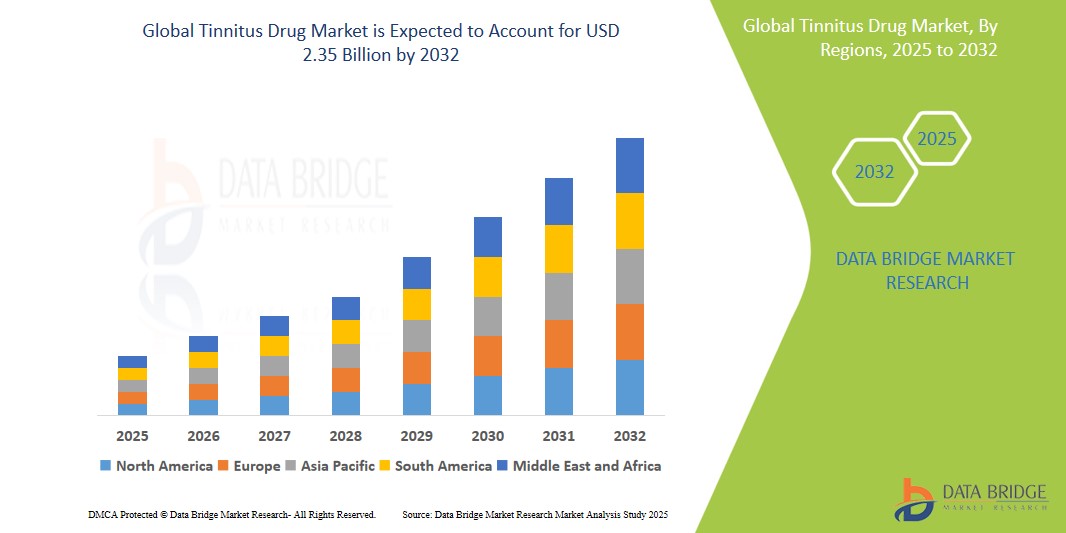
- The Global Tinnitus Drug Market size was valued at USD 1.90 billion in 2024 and is expected to reach USD 2.35 billion by 2032, at a CAGR of 7.50% during the forecast period
- This growth is driven by factors such as the aging population, increasing prevalence of eye diseases, and advancements in ophthalmic technology
Tinnitus Drug Market Analysis
- Tinnitus is described as the condition in which a person deliberately perceives a ringing sensation, buzzing, hissing, chirping or any other sounds ranging from any music to human voice. The condition is often worse when the surrounding is not too loud.
- The demand for tinnitus drugs is significantly driven by the increasing prevalence of tinnitus and rising awareness about treatment options worldwide
- North America is expected to dominate the global tinnitus drug market due to high healthcare expenditure, advanced healthcare infrastructure, and increased patient awareness
- Europe is expected to be the fastest-growing region in the tinnitus drug market during the forecast period due to rising cases of tinnitus and growing research activities.
- The pharmacological treatment segment is expected to dominate the market with a substantial market share, driven by the high prevalence of tinnitus and the need for effective medication options. Ongoing research and development efforts are further enhancing treatment efficacy.
Report Scope and Tinnitus Drug Market Segmentation
|
Attributes |
Tinnitus Drug Key Market Insights |
|
Segments Covered |
|
|
Countries Covered |
North America
Europe
Asia-Pacific
Middle East and Africa
South America
|
|
Key Market Players |
|
|
Market Opportunities |
|
|
Value Added Data Infosets |
In addition to the insights on market scenarios such as market value, growth rate, segmentation, geographical coverage, and major players, the market reports curated by the Data Bridge Market Research also include import export analysis, production capacity overview, production consumption analysis, price trend analysis, climate change scenario, supply chain analysis, value chain analysis, raw material/consumables overview, vendor selection criteria, PESTLE Analysis, Porter Analysis, and regulatory framework. |
Tinnitus Drug Market Trends
“Advancements in drug delivery systems and formulation technologies for improved tinnitus treatment efficacy”
- One prominent trend in the evolution of tinnitus treatments is the increasing integration of advanced diagnostic tools and digital monitoring systems
- These innovations enhance treatment precision by providing real-time, accurate assessment of tinnitus severity and patient response, facilitating personalized therapy approaches
- For instance, modern digital monitoring devices enable continuous tracking of tinnitus symptoms, allowing clinicians to tailor interventions more effectively and improve patient outcomes.
- These advancements are transforming tinnitus management, improving therapeutic efficacy, and driving the demand for next-generation drug delivery systems and personalized treatment solutions
Tinnitus Drug Market Dynamics
Driver
“Growing Need For Effective Tinnitus Treatments”
- The rising prevalence of auditory and neurological disorders such as tinnitus, hearing loss, and hyperacusis is significantly contributing to the increased demand for tinnitus drugs
- As the global population ages and exposure to noise pollution increases, the incidence of these conditions continues to grow, with older adults being more susceptible to chronic tinnitus that requires effective pharmacological management
- As more individuals seek treatment for these conditions, the demand for innovative tinnitus medications rises, aiming to improve symptom management, enhance quality of life, and reduce the burden of tinnitus-related distress
For instance,
- In December 2021, according to an article published by the National Center for Biotechnology Information, the global population is aging rapidly, with projections indicating that by 2066, nearly 25% of Australia's population will be aged 65 years and older. Older individuals tend to experience higher healthcare needs, including increased prevalence of tinnitus
- As a consequence of the rising incidence of age-related tinnitus and associated auditory disorders, there is a significant increase in the demand for tinnitus drugs, driven by the need for effective management of symptoms in the aging population
Opportunity
“Advancing Tinnitus Treatment with Innovative Pharmacological Solutions”
- AI-driven tinnitus management tools can enhance diagnostic precision, personalize treatment plans, and improve patient outcomes, enabling healthcare providers to make more informed decisions regarding tinnitus therapy
- AI algorithms can analyze patient data in real-time and offer instant feedback on treatment effectiveness, helping clinicians identify potential issues and adjust interventions accordingly
- Additionally, AI-powered solutions can assist in tracking patient progress, reviewing audiological data, and refining diagnosis accuracy, leading to more targeted and effective tinnitus treatments
For instance,
- In January 2025, according to an article published in the JMA Journal, AI algorithms, especially those based on deep learning, can analyze audiological data with high accuracy, identifying and grading the severity of tinnitus. These systems can efficiently process large volumes of patient information, reducing the burden on clinicians and improving screening and diagnosis coverage. The ability of AI to detect early signs of tinnitus and predict disease progression is vital for timely intervention, which can significantly improve patient outcomes and quality of life
- The integration of AI in tinnitus management can also lead to better treatment personalization, improved patient monitoring, and enhanced overall outcomes. By leveraging AI-powered data analysis, healthcare providers can identify patients at risk of developing severe tinnitus, allowing for proactive and targeted therapeutic strategies.
Restraint/Challenge
“High equipment costs hindering market penetration”
- The substantial costs associated with advanced tinnitus diagnosis and treatment equipment pose a significant barrier to widespread adoption, especially in emerging markets. These high expenses can limit access for many healthcare providers and patients, slowing down the overall growth of the tinnitus drug market.
- Additionally, the high costs may restrict the integration of innovative AI-powered diagnostic tools and personalized therapies, further impacting market expansion and the availability of cutting-edge tinnitus management options worldwide.
For instance,
- In November 2024, according to an article published by Ningbo Haishu HONYU Opto-Electro Co., Ltd, one of the main concerns surrounding the high cost of tinnitus treatments and diagnostic equipment is its potential impact on healthcare affordability and accessibility. The elevated costs of advanced tinnitus management devices and therapies limit the ability of healthcare facilities to invest in the latest technology, thereby affecting the quality of care provided to patients.
- Consequently, such financial barriers can lead to disparities in the quality of tinnitus care and access to innovative treatment options, ultimately hindering the overall growth of the tinnitus drug market
Tinnitus Drug Market Scope
The market is segmented on the basis application, product type, technology, magnification type, end user, and distribution channel.
|
Segmentation |
Sub-Segmentation |
|
By Type |
|
|
By Therapy Type |
|
|
By Treatment Type |
|
|
By Drug Class Type
|
|
|
By Route of Administration |
|
|
By End User |
|
In 2025, the Subjective Tinnitus is projected to dominate the market with a largest share in application segment
The Subjective Tinnitus segment is expected to dominate the Tinnitus Drug market with the largest share of 56.22% in 2025 due to its high prevalence and demand for targeted treatment options. As the most common form of tinnitus, ongoing advancements in pharmacological therapies and diagnostic approaches are enhancing patient outcomes and driving market growth. Increased awareness, rising geriatric populations, and the growing incidence of tinnitus-related conditions further contribute to the segment's market dominance.
The Cognitive Behavioral Therapy is expected to account for the largest share during the forecast period in technology market
In 2025, the Cognitive Behavioral Therapy segment is expected to dominate the market with the largest market share of 51.31% ue to its high prevalence and demand for effective management of tinnitus symptoms. As a widely recognized approach for tinnitus treatment, ongoing advancements in therapeutic techniques and increased awareness are enhancing outcomes and driving market growth. Rising awareness, increased healthcare focus on mental health, and the growing prevalence of tinnitus further contribute to its market dominance.
Tinnitus Drug Market Regional Analysis
“North America Holds the Largest Share in the Tinnitus Drug Market”
- North America dominates the Tinnitus Drug market, driven by advanced healthcare infrastructure, high adoption of cutting-edge medical technologies, and a strong presence of key market players.
- The U.S. holds a significant share due to increased demand for precise diagnostic and therapeutic options, rising prevalence of tinnitus, and continuous advancements in treatment methodologies
- The availability of well-established reimbursement policies and growing investments in research & development by leading pharmaceutical companies further strengthen the market.
- In addition, the increasing awareness about tinnitus management, along with the rising adoption of innovative therapies and medications, is fueling market expansion across the region.
“Asia-Pacific is Projected to Register the Highest CAGR in the Tinnitus Drug Market”
- The Asia-Pacific region is expected to witness the highest growth rate in the Tinnitus Drug market, driven by rapid expansion in healthcare infrastructure, increasing awareness about tinnitus management, and rising demand for effective treatment options
- Countries such as China, India, and Japan are emerging as key markets due to the growing prevalence of tinnitus, increasing geriatric populations, and the rising adoption of innovative pharmaceutical therapies
- Japan, with its advanced healthcare system and strong focus on research and development, remains a crucial market for tinnitus medications. The country continues to lead in the adoption of high-quality treatment options to improve patient outcomes
- China and India, with their large populations and rising awareness about tinnitus, are witnessing increased investments by government and private sectors in healthcare infrastructure and pharmaceutical research. The expanding presence of global pharmaceutical companies and improving access to advanced tinnitus treatments further contribute to market growth
Tinnitus Drug Market Share
The market competitive landscape provides details by competitor. Details included are company overview, company financials, revenue generated, market potential, investment in research and development, new market initiatives, global presence, production sites and facilities, production capacities, company strengths and weaknesses, product launch, product width and breadth, application dominance. The above data points provided are only related to the companies' focus related to market.
The Major Market Leaders Operating in the Market Are:
- Pfizer Inc. (U.S.),
- Teva Pharmaceutical Industries Ltd. (Israel),
- Mylan N.V. (U.S.),
- Sun Pharmaceutical Industries Ltd. (India),
- Novartis AG (Switzerland),
- Mallinckrodt (Ireland),
- Abbott (U.S.),
- Bayer AG (Germany),
- GlaxoSmithKline plc. (U.K.),
- Sound Pharmaceuticals (U.S.),
- Merz Pharma (Germany),
- Amneal Pharmaceuticals LLC (U.S.),
- Zydus Pharmaceuticals, Inc. (India),
- Lupin Pharmaceutical, Inc. (India),
- Torrent Pharmaceuticals Ltd (India),
- AA Pharma Inc (U.S.),
- Sanofi (France),
- Hikma Pharmaceuticals PLC (U.K.),
- Reliance Formulation Pvt Ltd (India),
- Sandoz International GmbH (Germany)
SKU-
Accédez en ligne au rapport sur le premier cloud mondial de veille économique
- Tableau de bord d'analyse de données interactif
- Tableau de bord d'analyse d'entreprise pour les opportunités à fort potentiel de croissance
- Accès d'analyste de recherche pour la personnalisation et les requêtes
- Analyse de la concurrence avec tableau de bord interactif
- Dernières actualités, mises à jour et analyse des tendances
- Exploitez la puissance de l'analyse comparative pour un suivi complet de la concurrence
Méthodologie de recherche
La collecte de données et l'analyse de l'année de base sont effectuées à l'aide de modules de collecte de données avec des échantillons de grande taille. L'étape consiste à obtenir des informations sur le marché ou des données connexes via diverses sources et stratégies. Elle comprend l'examen et la planification à l'avance de toutes les données acquises dans le passé. Elle englobe également l'examen des incohérences d'informations observées dans différentes sources d'informations. Les données de marché sont analysées et estimées à l'aide de modèles statistiques et cohérents de marché. De plus, l'analyse des parts de marché et l'analyse des tendances clés sont les principaux facteurs de succès du rapport de marché. Pour en savoir plus, veuillez demander un appel d'analyste ou déposer votre demande.
La méthodologie de recherche clé utilisée par l'équipe de recherche DBMR est la triangulation des données qui implique l'exploration de données, l'analyse de l'impact des variables de données sur le marché et la validation primaire (expert du secteur). Les modèles de données incluent la grille de positionnement des fournisseurs, l'analyse de la chronologie du marché, l'aperçu et le guide du marché, la grille de positionnement des entreprises, l'analyse des brevets, l'analyse des prix, l'analyse des parts de marché des entreprises, les normes de mesure, l'analyse globale par rapport à l'analyse régionale et des parts des fournisseurs. Pour en savoir plus sur la méthodologie de recherche, envoyez une demande pour parler à nos experts du secteur.
Personnalisation disponible
Data Bridge Market Research est un leader de la recherche formative avancée. Nous sommes fiers de fournir à nos clients existants et nouveaux des données et des analyses qui correspondent à leurs objectifs. Le rapport peut être personnalisé pour inclure une analyse des tendances des prix des marques cibles, une compréhension du marché pour d'autres pays (demandez la liste des pays), des données sur les résultats des essais cliniques, une revue de la littérature, une analyse du marché des produits remis à neuf et de la base de produits. L'analyse du marché des concurrents cibles peut être analysée à partir d'une analyse basée sur la technologie jusqu'à des stratégies de portefeuille de marché. Nous pouvons ajouter autant de concurrents que vous le souhaitez, dans le format et le style de données que vous recherchez. Notre équipe d'analystes peut également vous fournir des données sous forme de fichiers Excel bruts, de tableaux croisés dynamiques (Fact book) ou peut vous aider à créer des présentations à partir des ensembles de données disponibles dans le rapport.