Global Turner Syndrome Drug Market Segmentation, By Type (Classical Turner Syndrome and Mosaic Turner syndrome), Drugs Type (Norditropin, Oxandrolone, Humatrope, Somatropin, Oxandrin, Genotropin, Nutropin and Zomacton), Therapy Type (Growth Hormone Therapy, Estrogen and Progesterone Replacement Therapy), Routes of Administration (Oral, Intravenous, Sub-cutaneous, Intramuscular and Others), End Users (Hospitals, Homecare, Specialty Clinics, Surgical Centres and Others) - Industry Trends and Forecast to 2032
Turner Syndrome Drug Market Size
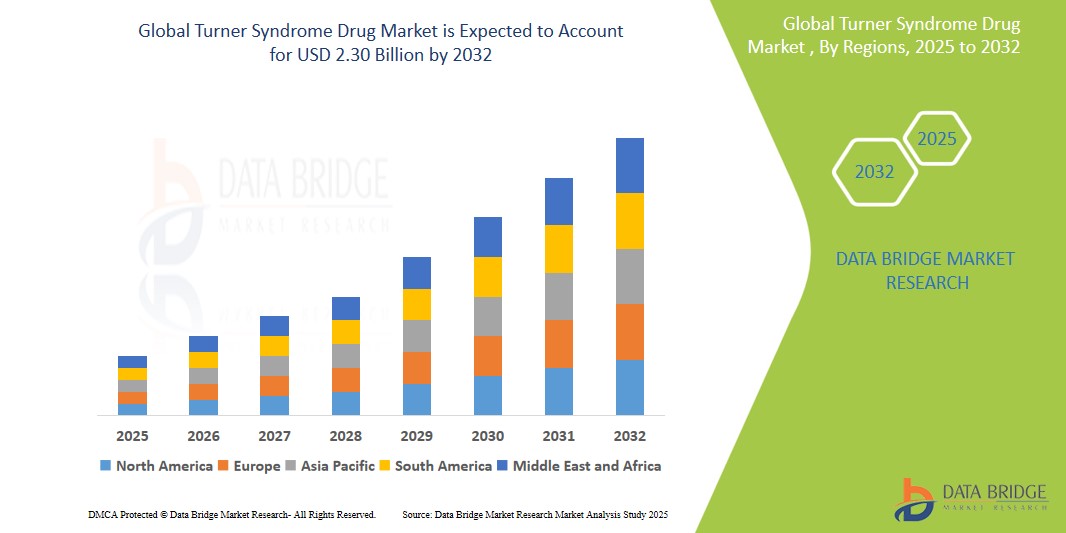
- The Global Turner Syndrome Drug Market size was valued atUSD 1.23 billion in 2024 and is expected to reachUSD 2.30 billion by 2032, at aCAGR of 8.4%during the forecast period
- This growth is primarily driven by increased diagnosis rates, advancements in hormone replacement therapies, and rising awareness about early intervention and treatment options for Turner Syndrome
Turner Syndrome Drug Market Analysis
- Turner Syndrome drugs play a crucial role in managing the clinical manifestations of this genetic condition, particularly in promoting growth development, puberty induction, and addressing cardiovascular and metabolic complications.
- The demand for Turner Syndrome therapies is driven by greater clinical recognition, availability of recombinant growth hormones, and government initiatives to improve rare disease management.
- North America is projected to lead the global Turner Syndrome drug market owing to robust healthcare systems, greater awareness, and early diagnosis and intervention programs.
- The Asia-Pacific region is expected to witness the fastest growth due to improving healthcare infrastructure, growing medical awareness, and increasing access to hormonal therapies.
- The growth hormone therapy segment is anticipated to dominate the market with a significant share, owing to its essential role in supporting normal growth and development in affected individuals. Innovations in drug delivery systems and biosimilars are also contributing to market expansion.
Report Scope and Turner Syndrome Drug Market Segmentation
|
Attributes |
Turner Syndrome Drug Key Market Insights |
|
Segments Covered |
|
|
Countries Covered |
North America
Europe
Asia-Pacific
Middle East and Africa
South America
|
|
Key Market Players |
|
|
Market Opportunities |
|
|
Value Added Data Infosets |
In addition to the insights on market scenarios such as market value, growth rate, segmentation, geographical coverage, and major players, the market reports curated by the Data Bridge Market Research also include import export analysis, production capacity overview, production consumption analysis, price trend analysis, climate change scenario, supply chain analysis, value chain analysis, raw material/consumables overview, vendor selection criteria, PESTLE Analysis, Porter Analysis, and regulatory framework. |
Turner Syndrome Drug Market Trends
“Emergence of Long-acting Growth Hormone Therapies”
- One significant trend shaping the Turner Syndrome drug market is the development and commercialization of long-acting growth hormone (GH) therapies.
- These advanced formulations offer less frequent dosing schedules compared to traditional daily injections, significantly improving patient compliance and quality of life for individuals with Turner Syndrome.
- For instance, recent innovations in GH therapy, such as weekly or bi-weekly injections, are reducing the treatment burden on pediatric and adolescent patients, while maintaining efficacy in promoting growth and development.
- These Long-acting therapies are expected to redefine the standard of care for Turner Syndrome management, enhancing treatment adherence and overall patient outcomes.
Turner Syndrome Drug Market Dynamics
Driver
“Increasing Early Diagnosis and Awareness Initiatives”
- The growing emphasis on early diagnosis and intervention programs for genetic disorders, including Turner Syndrome, is significantly driving the demand for targeted drug therapies.
- With the implementation of newborn screening programs, pediatric checkups, and genetic counseling initiatives, more cases of Turner Syndrome are being diagnosed early, facilitating timely initiation of growth hormone and estrogen therapies
For instance,
- In October 2023, according to an article published by the Global Genes Project, expanded newborn screening and rare disease advocacy efforts have led to earlier identification of rare genetic conditions, including Turner Syndrome, thereby improving access to treatment options and clinical care pathways.
- Earlier detection enables better growth outcomes, pubertal development, and overall health management, fueling the demand for effective Turner Syndrome drug therapies
Opportunity
“Advances in Gene Therapy and Personalized Medicine”
- The rise of gene therapy and personalized medicine is creating new opportunities for the treatment of Turner Syndrome, aiming to address underlying genetic defects and tailor therapies to individual patient profiles.
- Researchers are exploring gene-editing technologies like CRISPR/Cas9 to potentially correct chromosomal abnormalities associated with Turner Syndrome, although such treatments are still in early research phases.
- Additionally, personalized hormonal therapies based on individual growth patterns, hormone levels, and metabolic profiles are expected to deliver better treatment outcomes.
For instance,
- In February 2025, according to research published in the journal Nature Genetics, preliminary studies on personalized endocrine therapies demonstrated promising results in optimizing growth response and minimizing side effects in Turner Syndrome patients, paving the way for more targeted and individualized approaches.
- As precision medicine technologies mature, they have the potential to revolutionize Turner Syndrome care beyond current hormone-based therapies.
Restraint/Challenge
“High Treatment Costs and Limited Accessibility”
- The high cost of growth hormone therapies and hormone replacement treatments remains a significant barrier to the widespread adoption of Turner Syndrome therapies, especially in low- and middle-income countries.
- Treatment often requires years of continuous therapy, incurring substantial costs for families and healthcare systems, particularly when not fully covered by insurance or public health programs.
For instance,
- In November 2024, according to an article published by Rare Disease Health Journal, the annual cost of growth hormone treatment can range from USD 20,000 to USD 50,000 per patient, creating financial strain and limiting access, especially among underinsured populations.
- These financial challenges can lead to treatment interruptions, delayed initiation, or complete lack of access, ultimately impacting the growth potential and health outcomes for individuals with Turner Syndrome.
- Therefore, high therapy costs represent a critical restraint to market growth and highlight the need for more affordable treatment options and broader healthcare coverage.
Turner Syndrome Drug Market Scope
The market is segmented on the basis type, drug type, therapy type, route of administration, and end user.
|
Segmentation |
Sub-Segmentation |
|
By Type |
|
|
By Drugs Type |
|
|
By Therapy Type |
|
|
By Routes of Administration |
|
|
By End Users |
|
In 2025, the Growth Hormone Therapy Segment is Projected to Dominate the Market in the Therapy Type Segment
The growth hormone therapy segment is expected to dominate the Turner Syndrome drug market with the largest share of 61.45% in 2025, owing to its critical role in promoting normal height development in affected individuals. This therapy remains the first-line treatment for most diagnosed cases, often initiated in early childhood to maximize height potential. Advancements in long-acting growth hormone formulations, improved patient adherence, and clinical efficacy are key factors driving this segment's growth. Additionally, increasing awareness and early diagnosis of Turner Syndrome contribute to a growing patient base benefiting from GH therapy, reinforcing its market dominance
The Norditropin Segment is Expected to Account for the Largest Share in the Drug Type Segment
The Norditropin segment is projected to hold the largest market share of 47.68% in 2025 within the drug type category. As a widely prescribed recombinant growth hormone, Norditropin is preferred for its proven efficacy, convenient administration options, and broad availability across major markets.
Its dominance is further supported by strong physician trust, brand recognition, and a well-established safety profile. The increasing demand for personalized and effective hormonal therapies for Turner Syndrome continues to drive Norditropin’s leading position in the market.
Turner Syndrome Drug Market Regional Analysis
“North America Holds the Largest Share in the Turner Syndrome Drug Market”
- North America leads the global Turner Syndrome drug market, primarily due to its advanced healthcare infrastructure, high awareness levels, and early adoption of hormone replacement therapies.
- The United States dominates the regional market owing to comprehensive screening programs, strong presence of biopharmaceutical companies, and broad insurance coverage for rare disease treatments.
- The region benefits from robust research and development initiatives, particularly in growth hormone therapies and personalized medicine, further propelling market expansion.
- Additionally, the presence of specialized endocrinology clinics and multidisciplinary care models ensures timely diagnosis and optimal treatment outcomes for Turner Syndrome patients.
- Government support for rare disease management and the availability of FDA-approved treatment protocols continue to drive the region’s leadership in the market
“Asia-Pacific is Projected to Register the Highest CAGR in the Turner Syndrome Drug Market”
- The Asia-Pacific region is anticipated to witness the fastest growth in the Turner Syndrome drug market, driven by increasing awareness, improving diagnostic capabilities, and growing access to hormonal therapies.
- Countries like India, China, and Japan are emerging as key contributors due to rising pediatric healthcare investments, growing genetic testing availability, and expanding rare disease initiatives.
- Japan, with its advanced medical technology and specialized endocrine care systems, is at the forefront of adopting long-acting growth hormone therapies and personalized treatment approaches.
- In China and India, the large patient population and increasing collaboration between public health authorities and global pharmaceutical companies are fueling market demand.
- Ongoing efforts to improve healthcare accessibility, along with the expansion of insurance coverage and government-supported awareness programs, are expected to significantly boost the regional market over the forecast period.
Turner Syndrome Drug Market Share
The market competitive landscape provides details by competitor. Details included are company overview, company financials, revenue generated, market potential, investment in research and development, new market initiatives, global presence, production sites and facilities, production capacities, company strengths and weaknesses, product launch, product width and breadth, application dominance. The above data points provided are only related to the companies' focus related to market.
The Major Market Leaders Operating in the Market Are:
- Pfizer Inc. (U.S.)
- Novartis AG (Switzerland)
- Johnson & Johnson Services, Inc. (U.S.)
- F. Hoffmann-La Roche Ltd (Switzerland)
- Abbott (U.S.)
- Eli Lilly and Company (U.S.)
- Bausch Health Companies Inc. (Canada)
- AstraZeneca (United Kingdom)
- AbbVie Inc. (U.S.)
- Allergan (U.S.)
- Smiths Group plc (UK)
- Lupin Pharmaceuticals, Inc. (India)
- Medtronic (Ireland)
- Sanofi (France)
- GlaxoSmithKline plc. (UK)
- Sandoz International GmbH (Germany)
- Novo Nordisk A/S (Denmark)
- American Gene Technologies (U.S.)
- Codexis (U.S.)
- BioMarin (U.S.)
- Ultragenyx Pharmaceutical (U.S.)
Latest Developments in Global Turner Syndrome Drug Market
- In January 2023, Ascendis Pharma announced positive results from a Phase III trial of its long-acting growth hormone therapy, showing significant improvements in growth rates in Turner Syndrome patients, paving the way for regulatory submissions.
- In June 2022, Novo Nordisk launched a new formulation of growth hormone therapy with enhanced delivery mechanisms, aiming to improve patient compliance and reduce treatment burden.
SKU-
Accédez en ligne au rapport sur le premier cloud mondial de veille économique
- Tableau de bord d'analyse de données interactif
- Tableau de bord d'analyse d'entreprise pour les opportunités à fort potentiel de croissance
- Accès d'analyste de recherche pour la personnalisation et les requêtes
- Analyse de la concurrence avec tableau de bord interactif
- Dernières actualités, mises à jour et analyse des tendances
- Exploitez la puissance de l'analyse comparative pour un suivi complet de la concurrence
Méthodologie de recherche
La collecte de données et l'analyse de l'année de base sont effectuées à l'aide de modules de collecte de données avec des échantillons de grande taille. L'étape consiste à obtenir des informations sur le marché ou des données connexes via diverses sources et stratégies. Elle comprend l'examen et la planification à l'avance de toutes les données acquises dans le passé. Elle englobe également l'examen des incohérences d'informations observées dans différentes sources d'informations. Les données de marché sont analysées et estimées à l'aide de modèles statistiques et cohérents de marché. De plus, l'analyse des parts de marché et l'analyse des tendances clés sont les principaux facteurs de succès du rapport de marché. Pour en savoir plus, veuillez demander un appel d'analyste ou déposer votre demande.
La méthodologie de recherche clé utilisée par l'équipe de recherche DBMR est la triangulation des données qui implique l'exploration de données, l'analyse de l'impact des variables de données sur le marché et la validation primaire (expert du secteur). Les modèles de données incluent la grille de positionnement des fournisseurs, l'analyse de la chronologie du marché, l'aperçu et le guide du marché, la grille de positionnement des entreprises, l'analyse des brevets, l'analyse des prix, l'analyse des parts de marché des entreprises, les normes de mesure, l'analyse globale par rapport à l'analyse régionale et des parts des fournisseurs. Pour en savoir plus sur la méthodologie de recherche, envoyez une demande pour parler à nos experts du secteur.
Personnalisation disponible
Data Bridge Market Research est un leader de la recherche formative avancée. Nous sommes fiers de fournir à nos clients existants et nouveaux des données et des analyses qui correspondent à leurs objectifs. Le rapport peut être personnalisé pour inclure une analyse des tendances des prix des marques cibles, une compréhension du marché pour d'autres pays (demandez la liste des pays), des données sur les résultats des essais cliniques, une revue de la littérature, une analyse du marché des produits remis à neuf et de la base de produits. L'analyse du marché des concurrents cibles peut être analysée à partir d'une analyse basée sur la technologie jusqu'à des stratégies de portefeuille de marché. Nous pouvons ajouter autant de concurrents que vous le souhaitez, dans le format et le style de données que vous recherchez. Notre équipe d'analystes peut également vous fournir des données sous forme de fichiers Excel bruts, de tableaux croisés dynamiques (Fact book) ou peut vous aider à créer des présentations à partir des ensembles de données disponibles dans le rapport.