



Global Web Help Desk Automation Market Segmentation, By Solution (Alert Management and Ticket Sortation), End-User (IT, Telecommunication, Education, Government, and Retail), Organization Size (Large and SME’s) - Industry Trends and Forecast to 2033
Quelle est la taille et le taux de croissance du marché mondial de l'automatisation des comptoirs d'aide Web
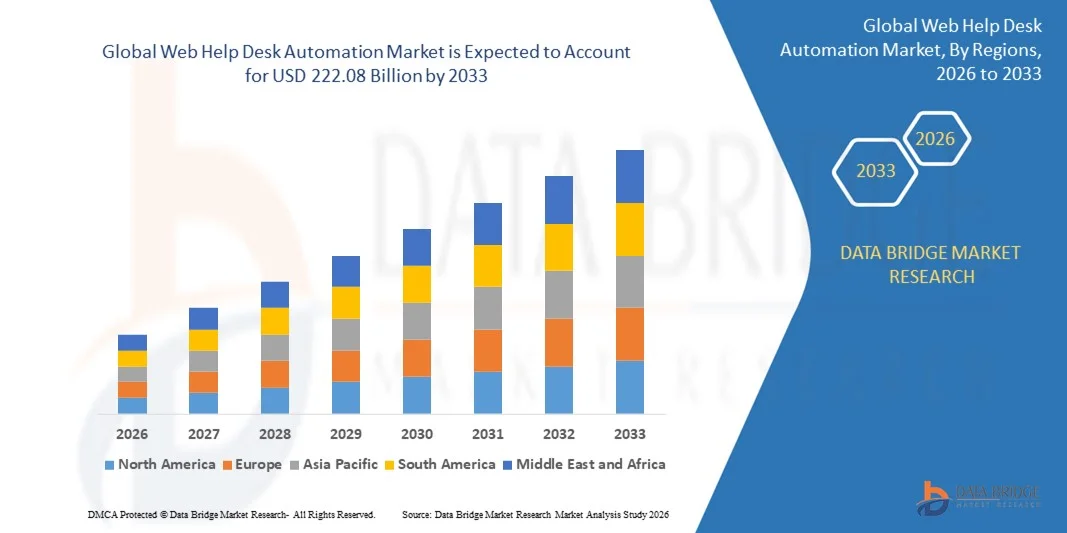
- La taille du marché mondial de l'automatisation des services d'assistance en ligne a été évaluée à22,41 milliards de dollars en 2025et devrait atteindre222,08 milliards de dollars en 2033, à unTCAC de 33,20 %pendant la période de prévision
- L'industrialisation rapide dans certaines parties du monde est un facteur crucial pour accélérer la croissance du marché, ainsi que la demande croissante d'optimisation des processus d'affaires dans le monde entier, l'utilisation croissante de l'intelligence artificielle (IA) et de l'apprentissage des machines (ML) dans diverses industries, la croissance significative croissante des technologies de l'information (TI) et des industries du commerce électronique et l'intégration croissante avec l'Internet des objets (IoT) et les technologies basées sur le cloud sont les principaux facteurs, entre autres, qui stimulent le marché de l'automatisation des services d'assistance en ligne.
Taille du marché et prévisions
- Valeur marchande mondiale (2025):22,41 milliards de dollars
- Valeur marchande prévue (2033) :222,08 milliards de dollars
- Prévisions CAGR (2025-2033):33.20%
Quels sont les principaux débouchés du marché de l'automatisation des comptoirs d'aide Web
- L'intensification des activités de recherche-développement (R-D) et l'augmentation des progrès technologiques et de la modernisation du logiciel créeront de nouvelles possibilités pour le marché de l'automatisation des services d'assistance en ligne au cours de la période de prévision mentionnée ci-dessus
- Toutefois, l ' augmentation des capacités limitées des petites organisations est l ' un des principaux facteurs qui freinent la croissance du marché, et va encore remettre en question le marché de l ' automatisation des services d ' assistance sur le Web au cours de la période de prévision mentionnée plus haut.
- L'Amérique du Nord a dominé le marché de l'automatisation des services d'assistance en ligne avec une part de revenus estimée à 36,12 % en 2025, sous l'effet de la transformation numérique généralisée, de l'adoption précoce de solutions de gestion des services de TI et de la forte pénétration des plateformes de soutien à la clientèle basées sur le cloud dans toutes les entreprises aux États-Unis et au Canada.
- L'Asie-Pacifique devrait enregistrer le TCAC le plus rapide de 7,36 % de 2026 à 2033, grâce à la numérisation rapide des entreprises, à l'expansion du secteur des services informatiques, à la croissance des écosystèmes de démarrage et à l'adoption croissante de plateformes de soutien à la clientèle en nuage en Chine, en Inde, au Japon, en Corée du Sud et en Asie du Sud-Est
- Le segment de tri des billets a dominé le marché avec une part estimée de 58,6 % en 2025, car il joue un rôle essentiel dans l'automatisation du classement des billets, de l'établissement des priorités, de l'acheminement et de l'affectation dans les environnements informatiques et de soutien à la clientèle
Rapport sur la portée et le Web Automatisation des comptoirs Segmentation du marché
|
Attributs |
Web Help Desk Automatisation Principales perspectives du marché |
|
Segments couverts |
|
|
Pays couverts |
Amérique du Nord
Europe
Asie-Pacifique
Moyen-Orient et Afrique
Amérique du Sud
|
|
Principaux acteurs du marché |
|
|
Possibilités de marché |
|
|
Infos sur la valeur ajoutée |
|
Quelle est la tendance clé sur le marché de l'automatisation des bureaux d'aide Web
De plus en plus de changement vers l'automatisation du bureau d'aide Web axé sur l'IA, le cloud et le flux de travail
- Le marché de l'automatisation des services d'assistance sur le Web est témoin d'une forte adoption de plateformes basées sur l'intelligence artificielle, le cloud-native et le navigateur conçues pour automatiser la gestion des billets, la résolution des incidents et les flux de travail des services informatiques
- Les fournisseurs introduisent des fonctions d'automatisation intelligentes telles que chatbots AI, agents virtuels, routage automatique et résolution de problèmes prédictifs pour améliorer l'efficacité du service et réduire les temps de réponse
- La demande croissante de systèmes de soutien rentables, évolutifs et déployables à distance stimule l'adoption dans les services informatiques, les équipes de soutien à la clientèle, les fournisseurs de services gérés et les entreprises.
- Par exemple, des entreprises comme ServiceNow, Zendesk, Freshworks, Ivanti et BMC Software ont amélioré leurs plateformes grâce à la classification des billets sous IA, à la détection des sentiments et à des tableaux de bord analytiques en temps réel
- Le besoin croissant d'une résolution plus rapide des problèmes, d'un support omnicanal et d'une intégration transparente avec les écosystèmes informatiques de l'entreprise accélère le passage à l'automatisation des services d'aide au cloud
- À mesure que les environnements informatiques deviendront plus complexes et distribués numériquement, les solutions Web Help Desk Automation resteront essentielles pour améliorer la qualité du service, l'efficacité opérationnelle et l'expérience des utilisateurs.
Quels sont les principaux moteurs du marché de l'automatisation des comptoirs d'aide Web
- Augmentation de la demande de solutions d'assistance efficaces, automatisées et conviviales pour gérer les demandes de services informatiques et les volumes de soutien à la clientèle
- Par exemple, en 2025, des fournisseurs de premier plan comme ServiceNow, Atlassian et Freshworks ont amélioré leurs plateformes avec l'IA générative, les portails en libre-service et l'orchestration avancée des flux de travail
- L'adoption croissante du cloud computing, des modèles de travail à distance, des applications SaaS et des initiatives de transformation numérique stimule la demande d'automatisation des services d'assistance en ligne aux États-Unis, en Europe et en Asie-Pacifique
- Progrès dans l'IA, l'apprentissage automatique,traitement des langues naturelles, et l'analyse ont considérablement amélioré la précision de la résolution des billets et la personnalisation du service
- Un besoin croissant de visibilité des services informatiques, de conformité aux SLA et de surveillance des performances en temps réel conduit à l'adoption parmi les entreprises et les PME
- Soutenu par des investissements continus dans la modernisation de la TI et l'optimisation de l'expérience client, le marché de l'automatisation Web Help Desk devrait connaître une forte croissance à long terme
Quel facteur met en cause la croissance du marché de l'automatisation des comptoirs d'aide Web
- Les coûts élevés de mise en œuvre et d'abonnement des plates-formes de dépannage perfectionnées grâce à l'IA peuvent limiter l'adoption parmi les petites entreprises et les organisations contraintes au budget
- Ainsi, entre 2024 et 2025, l'augmentation des coûts des infrastructures en nuage et l'augmentation des prix des fonctionnalités d'IA haut de gamme ont eu des répercussions sur l'adoption de certaines PME.
- La complexité de l'intégration des plates-formes d'automatisation des services d'assistance avec les systèmes informatiques existants et les logiciels d'entreprise augmente le temps de déploiement et les défis opérationnels
- Une connaissance limitée des capacités d'automatisation, des flux de travail liés à l'IA et des meilleures pratiques de gestion des services informatiques dans les marchés émergents ralentit l'adoption
- Une concurrence intense entre fournisseurs offrant des caractéristiques qui se chevauchent crée une pression sur les prix et réduit la différenciation
- Pour relever ces défis, les entreprises mettent l'accent sur la tarification modulaire, la simplification de l'embarquement, la personnalisation à faible code et la configuration assistée par l'IA pour élargir l'adoption mondiale de solutions d'automatisation de guichets d'assistance Web
Comment le marché de l'automatisation des comptoirs d'aide Web est-il segmenté
Le marché est segmenté sur la base desolution, utilisateur final et taille de l'organisation.
- Par solution
Sur la base de la solution, le marché de l'automatisation du service d'assistance web est segmenté en gestion des alertes et tri des billets. Le segment de tri des billets a dominé le marché avec une part estimée de 58,6 % en 2025, car il joue un rôle crucial dans l'automatisation du classement des billets, de l'établissement des priorités, de l'acheminement et de l'affectation dans les environnements informatiques et de soutien à la clientèle. Les organisations s'appuient de plus en plus sur le triage des billets à l'aide de l'IA pour réduire la charge de travail manuelle, améliorer le temps de première réponse et assurer la conformité à l'ALS. Les capacités avancées telles que l'analyse des sentiments, l'extraction de mots clés et la reconnaissance des intentions renforcent encore l'adoption dans les entreprises et les PME.
On s'attend à ce que le segment de la gestion des alertes augmente au rythme le plus rapide du TCAC de 2026 à 2033, en raison de la demande croissante de détection proactive des incidents, de surveillance en temps réel et de notifications automatisées dans les infrastructures informatiques complexes. L'adoption croissante de services en nuage, d'opérations à distance et de plates-formes ITSM intégrées accélère la demande de solutions d'alerte intelligentes qui réduisent les temps d'arrêt et améliorent la résilience opérationnelle.
- Par utilisateur final
Sur la base de l'utilisateur final, le marché de l'automatisation des services d'assistance sur le Web est segmenté en TI, télécommunications, éducation, gouvernement et commerce de détail. Le segment informatique a dominé le marché avec une part de 41,2% en 2025, soutenue par l'adoption généralisée de l'automatisation du service d'assistance pour gérer des volumes élevés de billets, des incidents d'infrastructure, des problèmes de logiciels et des demandes de services internes. Les services de TI tirent parti des outils d'automatisation pour rationaliser les flux de travail, permettre des portails en libre-service et améliorer la productivité des employés.
Le segment des télécommunications devrait enregistrer le TCAC le plus rapide de 2026 à 2033, en raison de la complexité croissante du réseau, des déploiements 5G et des attentes croissantes en matière de service à la clientèle. Les opérateurs de télécommunications ont besoin de systèmes automatisés de dépannage pour gérer efficacement les demandes de renseignements des clients à grande échelle, les interruptions de service et les escalades techniques. L'engagement croissant des clients numériques, les exigences de support omnicanal et l'optimisation des services axée sur l'IA continuent d'alimenter l'adoption dans tous les environnements de télécommunications.
- Selon la taille de l'organisation
Sur la base de la taille de l'organisation, le marché de l'automatisation des services d'assistance en ligne est segmenté en grandes entreprises et PME. Les grandes entreprises ont dominé le marché avec une part de 62,4 % en 2025, car elles exploitent des écosystèmes informatiques complexes et traitent des volumes élevés de demandes de services dans plusieurs départements et régions géographiques. Ces organisations investissent fortement dans l'automatisation avancée,analytique, et des workflows personnalisés pour améliorer la prestation des services, la conformité et l'efficacité opérationnelle.
Le segment des PME devrait croître au rythme le plus rapide du TCAC de 2026 à 2033, en raison de l'augmentation de la disponibilité de plateformes de dépannage basées sur le cloud et à prix d'abonnement avec de faibles coûts de mise en œuvre. Les PME adoptent rapidement l'automatisation des services d'assistance en ligne pour améliorer le soutien à la clientèle, réduire les frais généraux opérationnels et soutenir les environnements de travail à distance. La numérisation croissante et l'adoption de SaaS accélèrent encore la pénétration du marché parmi les petites organisations.
Quelle région détient la plus grande part du marché de l'automatisation des comptoirs d'aide Web
- L'Amérique du Nord a dominé le marché de l'automatisation des services d'assistance en ligne avec une part de revenus estimée à 36,12 % en 2025, sous l'effet de la transformation numérique généralisée, de l'adoption rapide de solutions de gestion des services de TI et de la forte pénétration des plates-formes de soutien à la clientèle en nuage dans les entreprises aux États-Unis et au Canada. Une forte dépendance à l'égard de la billetterie automatisée, de la gestion des incidents et des outils de soutien à la clientèle omnicanaux dans les secteurs des services informatiques, des télécommunications, de la BFSI et du gouvernement continue de stimuler la demande régionale
- Les principaux fournisseurs d'Amérique du Nord introduisent activement l'automatisation des billets alimentés par l'IA, l'analyse prédictive, les portails en libre-service et les plates-formes d'assistance infonuagiques, renforçant ainsi le leadership technologique de la région. Les investissements continus dans l'infrastructure de SaaS, la cybersécurité et l'automatisation d'entreprise soutiennent davantage l'expansion à long terme du marché.
- Une forte concentration d'entreprises technologiques, des écosystèmes informatiques matures et une forte concentration sur l'efficacité opérationnelle entre les organisations renforcent considérablement le leadership de l'Amérique du Nord sur le marché mondial de l'automatisation des services d'aide au Web
U.S. Web Help Desk Automatisation Aperçu du marché
Les États-Unis sont les principaux contributeurs en Amérique du Nord, appuyés par l'adoption massive de plates-formes de TISM en nuage dans les entreprises, les fournisseurs de services gérés et les organismes gouvernementaux. La demande croissante pour l'acheminement des billets par l'IA, la surveillance en temps réel de l'ALS et les solutions intégrées de soutien à la clientèle dans les secteurs de l'informatique, des télécommunications, des soins de santé et du commerce de détail alimente la croissance du marché. La présence des principaux fournisseurs de logiciels, les dépenses élevées de SaaS et l'adoption rapide de l'automatisation des entreprises accélèrent encore l'expansion du marché.
Canada Web Help Desk Automatisation Aperçu du marché
Le Canada contribue de façon constante à la croissance régionale, en raison de la numérisation croissante des services publics, des établissements d'enseignement et des moyennes entreprises. L'adoption croissante de plates-formes d'assistance en nuage, de solutions d'assistance informatique à distance et d'outils automatisés de service à la clientèle favorise la pénétration du marché. Les initiatives numériques dirigées par le gouvernement, la main-d'oeuvre qualifiée en TI et l'adoption croissante de SaaS renforcent la demande à long terme.
Marché de l'automatisation des comptoirs d'aide en Asie-Pacifique
L'Asie-Pacifique devrait enregistrer le TCAC le plus rapide de 7,36 % entre 2026 et 2033, grâce à la numérisation rapide des entreprises, à l'expansion du secteur des services informatiques, à la croissance des écosystèmes de démarrage et à l'adoption croissante de plateformes de soutien à la clientèle en nuage en Chine, en Inde, au Japon, en Corée du Sud et en Asie du Sud-Est. La hausse de la demande de solutions de dépannage évolutives et rentables dans les PME et les grandes entreprises accélère considérablement la croissance du marché.
China Web Help Desk Automatisation Aperçu du marché
La Chine est le principal contributeur en Asie-Pacifique en raison de l'expansion rapide des entreprises numériques, de la forte croissance du commerce électronique et de l'adoption croissante de plateformes de service à la clientèle axées sur l'IA. Un volume élevé d'interactions avec les clients dans les secteurs des services en ligne, des télécommunications et du commerce de détail stimule la demande pour des solutions automatisées de billetterie, de chatbots et d'assistance omnicanal.
Japon Web Help Desk Automatisation Aperçu du marché
Le Japon affiche une croissance soutenue par une infrastructure informatique avancée, une forte concentration de l'entreprise sur la qualité du service et l'adoption croissante d'outils d'automatisation dans les opérations de soutien à la clientèle. L'augmentation de la demande pour les bureaux d'assistance à l'IA, l'automatisation des flux de travail et les plateformes d'assistance multilingues soutient l'expansion du marché.
Inde Web Help Desk Automatisation Marché Insight
L'Inde est en train de devenir un marché à forte croissance alimenté par l'expansion rapide des services informatiques, l'adoption croissante de SaaS et la numérisation accrue parmi les PME. L'augmentation de la demande d'automatisation des services d'aide en nuage dans les secteurs des TI, des télécommunications, de l'éducation et de l'État favorise la pénétration du marché. Les initiatives numériques dirigées par le gouvernement et l'expansion des écosystèmes de démarrage accélèrent encore l'adoption.
Corée du Sud Web Help Desk Automatisation Aperçu du marché
La Corée du Sud apporte une contribution importante en raison de sa maturité numérique élevée, de sa solide infrastructure de télécommunications et de l'adoption croissante de systèmes de soutien à la clientèle alimentés par l'IA. La demande croissante de services de gestion en temps réel, de résolution automatisée des problèmes et de plates-formes intégrées de soutien informatique dans les entreprises soutient une croissance soutenue du marché.
Quelles sont les meilleures entreprises du marché de l'automatisation des comptoirs d'aide Web
l'industrie de l'automatisation des services d'assistance en ligne est principalement dirigée par des entreprises bien établies, notamment:
- ServiceNow (États-Unis)
- Zendesk (États-Unis)
- Atlassian (Australie)
- Freshworks Inc. (États-Unis)
- BMC Software, Inc. (États-Unis)
- Axios (États-Unis)
- CA Technologies (États-Unis)
- Cherwell Software, LLC. (États-Unis)
- HappyFox Inc. (États-Unis)
- Ivanti (États-Unis)
- Hewlett Packard Enterprise Development LP (États-Unis)
- Kayako (Royaume-Uni)
- ASG Technologies (États-Unis)
- Systèmes de résolution (États-Unis)
- Sunrise Software Limited (Royaume-Uni)
- Logiciel SunView (États-Unis)
- Logiciel de service à la clientèle par Vision Helpdesk (Inde)
- Kaseya Limited (États-Unis)
Quels sont les développements récents du marché mondial de l'automatisation des services d'assistance Web
- En août 2024, Freshworks a déposé une demande d'offre publique initiale (IPO) aux États-Unis, visant à lever USD 100 millions sur le Nasdaq Global Select Market sous le symbole de la touche FRSH, reflétant une forte confiance des investisseurs dans les plateformes d'automatisation du service d'assistance en nuage et du support à la clientèle
- En août 2024, Hiver est entré sur le marché des logiciels de dépannage, devenant la première solution de service à la clientèle à fonctionner nativement dans Google Workspace (G-Suite) tout en offrant des capacités complètes de dépannage directement via Gmail, marquant un changement majeur vers des solutions de support intégrées et centrées sur l'espace de travail
- En juin 2024, Salesforces capital-risque a investi dans Tanium avec l'intention d'introduire une solution commune de gestion des services aux employés, y compris un guichet unique unifié pour les employés, soulignant la convergence croissante des opérations informatiques et de la gestion de l'expérience des employés
- En octobre 2023, Atlassian Pty Ltd. a lancé un nouvel agent virtuel conçu pour permettre une assistance plus rapide et toujours à la fois aux employés et aux clients en automatisant les interactions au moyen d'outils de collaboration populaires, renforçant l'adoption d'un support conversationnel axé sur l'IA dans les environnements d'entreprise
- En février 2021, HappyFox Inc. a présenté HappyFox Assist AI, un produit avancé de support conversationnel alimenté par l'IA qui permet aux équipes IT et RH de résoudre automatiquement les requêtes répétitives au sein de Slack, accélérant l'adoption de l'automatisation dans les workflows de gestion des services internes
SKU-
Accédez en ligne au rapport sur le premier cloud mondial de veille économique

- Tableau de bord d'analyse de données interactif
- Tableau de bord d'analyse d'entreprise pour les opportunités à fort potentiel de croissance
- Accès d'analyste de recherche pour la personnalisation et les requêtes
- Analyse de la concurrence avec tableau de bord interactif
- Dernières actualités, mises à jour et analyse des tendances
- Exploitez la puissance de l'analyse comparative pour un suivi complet de la concurrence
Méthodologie de recherche
La collecte de données et l'analyse de l'année de base sont effectuées à l'aide de modules de collecte de données avec des échantillons de grande taille. L'étape consiste à obtenir des informations sur le marché ou des données connexes via diverses sources et stratégies. Elle comprend l'examen et la planification à l'avance de toutes les données acquises dans le passé. Elle englobe également l'examen des incohérences d'informations observées dans différentes sources d'informations. Les données de marché sont analysées et estimées à l'aide de modèles statistiques et cohérents de marché. De plus, l'analyse des parts de marché et l'analyse des tendances clés sont les principaux facteurs de succès du rapport de marché. Pour en savoir plus, veuillez demander un appel d'analyste ou déposer votre demande.
La méthodologie de recherche clé utilisée par l'équipe de recherche DBMR est la triangulation des données qui implique l'exploration de données, l'analyse de l'impact des variables de données sur le marché et la validation primaire (expert du secteur). Les modèles de données incluent la grille de positionnement des fournisseurs, l'analyse de la chronologie du marché, l'aperçu et le guide du marché, la grille de positionnement des entreprises, l'analyse des brevets, l'analyse des prix, l'analyse des parts de marché des entreprises, les normes de mesure, l'analyse globale par rapport à l'analyse régionale et des parts des fournisseurs. Pour en savoir plus sur la méthodologie de recherche, envoyez une demande pour parler à nos experts du secteur.
Personnalisation disponible
Data Bridge Market Research est un leader de la recherche formative avancée. Nous sommes fiers de fournir à nos clients existants et nouveaux des données et des analyses qui correspondent à leurs objectifs. Le rapport peut être personnalisé pour inclure une analyse des tendances des prix des marques cibles, une compréhension du marché pour d'autres pays (demandez la liste des pays), des données sur les résultats des essais cliniques, une revue de la littérature, une analyse du marché des produits remis à neuf et de la base de produits. L'analyse du marché des concurrents cibles peut être analysée à partir d'une analyse basée sur la technologie jusqu'à des stratégies de portefeuille de marché. Nous pouvons ajouter autant de concurrents que vous le souhaitez, dans le format et le style de données que vous recherchez. Notre équipe d'analystes peut également vous fournir des données sous forme de fichiers Excel bruts, de tableaux croisés dynamiques (Fact book) ou peut vous aider à créer des présentations à partir des ensembles de données disponibles dans le rapport.











