



Global Woodworking Power Tools Market Segmentation, By Type (Sawing and Cutting Tools, Drilling and Fastening Tools, Demolition Tools, Routing Tools, Portable Nibblers, Air-Powered Tools, Material Removal Tools, Electric Cords and Plugs, Accessories, and Others), Mode of Operation (Electric, Liquid Fuel Tool, Hydraulic, Pneumatic, and Powder-Actuated Tools), Material (Concrete, Wood/Metal, Brick/Block, Glass, and Others), End-User (Industrial/Professional, Residential), Sales Channel (Indirect Sales, and Direct Sales) - Industry Trends and Forecast to 2033
Qu'est-ce que le Woodworking Power Tools Taille du marché et taux de croissance
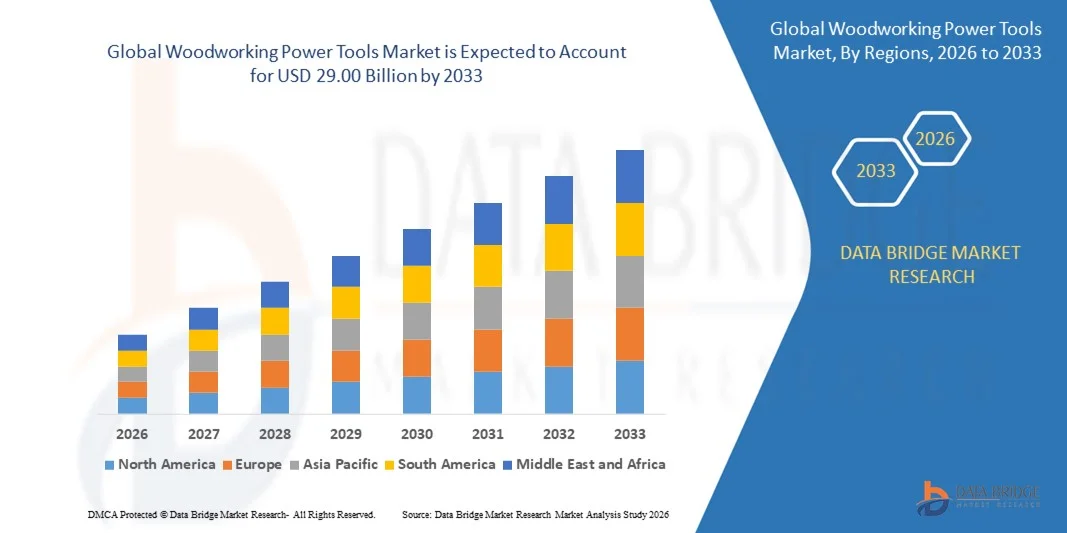
- Selon l'analyse de marché de Data Bridge, la taille du marché des outils de travail du bois a été évaluée à20,63 milliards de dollars en 2025et devrait atteindre29,00 milliards de dollars en 2033, à unTCAC de 4,35 %pendant la période de prévision
- La croissance du marché est en grande partie alimentée par la demande croissante d'outils de travail du bois efficaces, performants et polyvalents dans les secteurs industriel, commercial et résidentiel, entraînée par l'urbanisation rapide, l'expansion des activités de construction et la croissance de la fabrication de meubles.
- De plus, les progrès technologiques dans les outils électriques sans fil, à piles et ergonomiques améliorent la précision, la portabilité et la sécurité des utilisateurs, rendant les outils modernes de travail du bois plus accessibles et attrayants pour les professionnels et les amateurs. Ces facteurs accélèrent l'adoption et stimulent l'expansion du marché
Taille du marché et prévisions
- Valeur marchande mondiale (2025):20,63 milliards de dollars
- Valeur marchande prévue (2033) :29,00 milliards de dollars
- Prévisions CAGR (2026-2033):4.35%
Quelles sont les principales tendances du marché des outils de travail du bois
- Les outils de travail du bois, y compris les scies, les perceuses, les ponceuses et les outils de fixation, sont de plus en plus essentiels pour la coupe de précision, le façonnage et l'assemblage dans les ateliers industriels, les chantiers de construction et les applications résidentielles de bricolage en raison de leur efficacité, de leur précision et de leur flexibilité opérationnelle.
- La demande croissante pour ces outils est principalement alimentée par l'accent croissant mis sur la productivité, l'adoption croissante d'outils sans fil et intelligents, l'accroissement de la culture du bricolage et la nécessité de solutions ergonomiques et performantes qui réduisent l'effort manuel et améliorent la qualité de la production.
- L'Asie-Pacifique domine le marché des outils électriques pour le travail du bois avec une part de36,7 % en 2025, en raison de l'industrialisation rapide, de l'expansion des secteurs de la construction et de la fabrication de meubles et de l'adoption croissante d'outils électriques de pointe dans les applications commerciales et résidentielles
- On s'attend à ce que l'Amérique du Nord soit la région qui connaît la croissance la plus rapide sur le marché des outils électriques pour le travail du bois au cours de la période de prévision en raison de la demande croissante d'outils électriques pour la construction résidentielle, la rénovation et la fabrication industrielle.
- Le segment des outils de sciage et de coupe a dominé le marché avec une part de marché de 43 % en 2025, en raison de l'utilisation généralisée de scies et d'outils de coupe dans les ateliers industriels et les milieux résidentiels. Les professionnels et les amateurs privilégient souvent ces outils pour leur efficacité dans la coupe précise et la polyvalence entre différents matériaux. La popularité du segment est soutenue par l'innovation continue dans la technologie de lame, les conceptions ergonomiques et la compatibilité avec les configurations d'atelier automatisées et intelligentes
Portée du rapport et outils de travail du bois Segmentation du marché
|
Attributs |
Outils électriques pour le travail du bois Principales perspectives du marché |
|
Segments couverts |
|
|
Pays couverts |
Amérique du Nord
Europe
Asie-Pacifique
Moyen-Orient et Afrique
Amérique du Sud
|
|
Principaux acteurs du marché |
|
|
Possibilités de marché |
|
|
Infos sur la valeur ajoutée |
Outre les perspectives du marché telles que la valeur du marché, le taux de croissance, les segments de marché, la couverture géographique, les acteurs du marché et le scénario du marché, le rapport de marché préparé par l'équipe de recherche sur le marché de Data Bridge comprend une analyse approfondie des experts, une analyse des importations et des exportations, une analyse des prix, une analyse de la consommation de production et une analyse des ravageurs. |
Quelle est la tendance clé sur le marché des outils de travail du bois
Adoption croissante d'outils de travail du bois sans fil et intelligents
- Une tendance notable sur le marché des outils électriques pour le travail du bois est l'adoption croissante d'outils sans fil et intelligents, mue par la demande croissante de flexibilité, de mobilité et d'une précision accrue dans les opérations de travail du bois. Ces outils permettent à la fois aux artisans professionnels et aux amateurs de bricolage d'effectuer des tâches plus efficacement tout en intégrant des fonctionnalités numériques telles que la connectivité IoT et la surveillance basée sur l'application
- Par exemple, Bosch Power Tools et DeWalt offrent des perceuses, scies et ponceuses sans fil de pointe équipées de capteurs intelligents et de systèmes de gestion de batterie qui améliorent l'efficacité opérationnelle et réduisent les temps d'arrêt. De tels outils permettent aux utilisateurs de surveiller les performances, l'état de la batterie et le diagnostic des outils à distance, améliorant ainsi la productivité globale
- L'intégration des moteurs sans brosse et de l'électronique intelligente devient de plus en plus courante, ce qui permet aux outils d'offrir un couple plus élevé, un fonctionnement plus long et une meilleure efficacité énergétique. Cette tendance remodele les attentes des utilisateurs pour les outils électriques et place les outils intelligents sans fil comme essentiels dans les ateliers modernes
- Les outils de travail du bois voient une adoption accrue dans les secteurs de la construction, de la fabrication de meubles et de l'ébénisterie où la portabilité et la précision sont essentielles. Des outils avec des caractéristiques telles que le contrôle électronique de la vitesse, l'étalonnage automatique et les systèmes de gestion des poussières conduisent à des opérations plus sûres et plus précises
- Les fabricants développent de plus en plus des écosystèmes interconnectés où les outils communiquent avec des appareils complémentaires, fournissant des informations sur les flux de travail et des analyses d'utilisation. Cela facilite la maintenance prédictive et réduit les défaillances d'outils, ce qui accélère l'adoption dans les cadres professionnels
- Le marché connaît une forte croissance des outils électriques de qualité professionnelle où les innovations en ergonomie, en intégration numérique et en technologie de la batterie façonnent les préférences des utilisateurs. Ces développements renforcent la transition vers des solutions de travail du bois plus intelligentes, plus efficaces et très polyvalentes
Outils de travail du bois Dynamique du marché
Chauffeur
Demande croissante d'outils efficaces et à haut rendement
- Le besoin croissant d'outils de travail du bois de haute performance et d'efficacité dans le temps est à l'origine de l'expansion du marché car les utilisateurs recherchent des équipements capables d'accomplir les tâches plus rapidement tout en maintenant la précision. Des outils avec une meilleure durée de vie de la batterie, des commandes numériques et des conceptions ergonomiques répondent à ces attentes dans les ateliers et les applications industrielles
- Par exemple, Makita fournit des planeurs et des scies sans fil qui offrent des performances de coupe supérieures, un contrôle de vitesse variable et des batteries au lithium-ion de longue durée, ce qui permet aux professionnels d'améliorer la productivité sur place. Ces outils soutiennent à la fois des projets de menuiserie et des projets de grande envergure de qualité
- L'expansion des industries de la construction, du mobilier et de l'ébénisterie augmente la demande d'outils polyvalents qui peuvent gérer efficacement plusieurs applications. Cela conduit à des investissements dans des outils de qualité professionnelle qui réduisent les temps d'arrêt opérationnels et améliorent la production de travail
- L'essor des projets de culture de bricolage et d'amélioration des habitations stimule la croissance des outils électriques compacts et portables, offrant des performances élevées dans les applications résidentielles. Les utilisateurs préfèrent de plus en plus des outils qui équilibrent commodité, précision et fiabilité pour une variété de tâches
- L'innovation continue dans la technologie de la batterie, les moteurs sans brosse et l'électronique intelligente améliore la performance des outils, rendant les outils à grande vitesse, durables et économes en énergie plus accessibles. Ce moteur renforce l'importance des outils de pointe pour le travail du bois dans les environnements industriels et résidentiels modernes
Restriction/Défi
Coût élevé et entretien des outils avancés
- Le marché des outils électriques de travail du bois est confronté à des défis liés au coût élevé des outils évolués sans fil et intelligents, qui comprennent souvent de l'électronique sophistiquée, des batteries et des composants de précision. Ces caractéristiques augmentent les coûts d'achat et nécessitent une maintenance spécialisée pour assurer des performances à long terme
- Par exemple, Festool offre des scies à rail haut de gamme et des extracteurs de poussière qui nécessitent un entretien régulier, ce qui entraîne des dépenses opérationnelles plus élevées pour les professionnels. La nécessité de services de réparation certifiés et de remplacement de composants peut limiter l'accessibilité et l'adoption généralisée
- L'électronique complexe et les fonctionnalités intelligentes rendent les outils plus sensibles à la mauvaise utilisation, aux conditions environnementales et à la dégradation des batteries, ce qui affecte la fiabilité et augmente les exigences de maintenance
- La dépendance à l'égard de batteries au lithium-ion de haute qualité et de pièces spécialisées introduit des contraintes du côté de l'offre et des coûts de remplacement plus élevés, qui peuvent dissuader les acheteurs soucieux du budget
- La croissance du marché est modérée par l'équilibre entre l'investissement dans des outils de pointe pour l'efficacité et la gestion des coûts de maintenance continue. Ce défi souligne la nécessité d'innovations rentables qui maintiennent le rendement sans augmenter le total des dépenses de propriété
Comment le marché des outils de travail du bois est-il segmenté
Le marché est segmenté en fonction du type, du mode d'exploitation, du matériel, de l'utilisateur final et du canal de vente.
- Par type
Sur la base du type, le marché des outils électriques de travail du bois est segmenté en outils de sciage et de coupe, outils de forage et de fixation, outils de démolition, outils de routage, nichoirs portables, outils à air comprimé, outils d'enlèvement de matériaux, cordons et fiches électriques, accessoires, etc. Le segment des outils de sciage et de coupe a dominé le marché avec la plus grande part de revenus du marché de 43 % en 2025, en raison de l'utilisation généralisée de scies et d'outils de coupe dans les ateliers industriels et les milieux résidentiels. Les professionnels et les amateurs privilégient souvent ces outils pour leur efficacité dans la coupe précise et la polyvalence entre différents matériaux. La popularité du segment est également soutenue par l'innovation continue dans la technologie des lames, les conceptions ergonomiques et la compatibilité avec les configurations d'atelier automatisées et intelligentes. Les outils de sciage et de coupe sont considérés comme essentiels pour rationaliser les opérations de travail du bois, en améliorant la productivité et la précision.
Le secteur des outils de forage et de fixation devrait connaître le taux de croissance le plus rapide de 2026 à 2033, alimenté par l'augmentation de la demande dans les domaines de la construction, de la fabrication de meubles et du bricolage. Par exemple, des entreprises comme Bosch introduisent des pilotes de forage sans fil fonctionnant avec batterie avec un contrôle intelligent du couple qui offrent à la fois portabilité et efficacité. Ces outils offrent une commodité aux professionnels et aux utilisateurs à domicile en réduisant le temps de configuration, en améliorant la précision et en permettant le travail dans des espaces confinés. La croissance du segment est également soutenue par des innovations dans les matériaux légers, des conceptions ergonomiques et des caractéristiques de sécurité améliorées, ce qui rend ces outils attrayants pour une large base d'utilisateurs. L'adoption croissante d'outils modulaires et de systèmes de forage multifonctionnels accroît la popularité de ce segment.
- Par mode de fonctionnement
Sur la base du mode de fonctionnement, le marché est segmenté en outils électriques, liquides, hydrauliques, pneumatiques et actionnés par la poudre. Le segment des outils électriques a dominé le marché en 2025, grâce à une disponibilité facile, à une maintenance réduite et à l'aptitude des utilisateurs résidentiels et industriels. Les outils électriques offrent une puissance constante, une facilité d'utilisation et une compatibilité avec les systèmes de batterie rechargeables, ce qui améliore la portabilité et l'efficacité opérationnelle. Ils sont préférés pour des applications précises de travail du bois, réduisant le travail manuel et améliorant la productivité. Les fabricants innovent continuellement des outils électriques avec une technologie motrice de pointe, un contrôle numérique de la vitesse et des fonctions de sécurité intelligentes, renforçant ainsi leur domination sur le marché.
Le segment des outils pneumatiques devrait connaître le TCAC le plus rapide de 2026 à 2033, propulsé par l'adoption croissante dans les ateliers industriels et les unités de fabrication de meubles. Par exemple, Chicago Pneumatic offre des ponceuses et des cloueuses à air qui assurent un fonctionnement plus rapide et réduisent la fatigue des utilisateurs. Les outils pneumatiques sont valorisés pour leur durabilité, leur puissance de couple plus élevée et leur efficacité dans les tâches répétitives. Leur utilisation dans des environnements professionnels est déterminée par leur capacité à gérer des charges de travail intensives et à maintenir des performances sur de longues heures. La croissance du segment est également soutenue par l'expansion des infrastructures d'air comprimé dans les installations industrielles.
- Par matière
Sur la base des matériaux, le marché est segmenté en béton, bois/métal, brique/bloc, verre, et autres. Le segment bois/métal a dominé le marché en 2025 en raison de la forte demande d'outils polyvalents capables de traiter à la fois le travail du bois et le travail des métaux. Les professionnels et les amateurs de bricolage priorisent ces outils pour leur adaptabilité, leur précision et leur efficacité sur plusieurs matériaux. Les progrès technologiques, tels que l'amélioration des alliages de lames et des systèmes anti-vibrations, améliorent encore les performances et la sécurité. Le secteur bénéficie d'une utilisation industrielle généralisée dans les secteurs du mobilier, de l'ébénisterie et de la construction, ce qui favorise une demande soutenue et des revenus du marché.
Le segment concret devrait connaître la croissance la plus rapide de 2026 à 2033, en raison de l'augmentation des activités de construction dans le monde entier. Par exemple, Makita propose des fraises électriques en béton et des forets qui permettent des travaux plus rapides et précis sur les chantiers. Les outils conçus pour les applications en béton assurent la durabilité, la gestion des poussières et une puissance de coupe élevée, ce qui les rend essentiels pour une utilisation professionnelle. La croissance est encore accélérée par l'augmentation des projets d'infrastructure et des initiatives gouvernementales en matière de développement urbain. Le segment gagne également en traction dans la construction résidentielle pour les rénovations et les projets d'amélioration des logements.
- Par utilisateur final
Sur la base de l'utilisateur final, le marché est segmenté en utilisateurs industriels/professionnels et résidentiels. Le secteur industriel et professionnel a dominé le marché en 2025, sous l'impulsion d'une large utilisation dans la fabrication de meubles à grande échelle, la construction et les ateliers. Les professionnels ont besoin d'outils fiables et performants capables de gérer des tâches intensives et répétitives tout en assurant précision et sécurité. Ce segment bénéficie d'innovations dans les conceptions ergonomiques, les outils prêts à l'automatisation et les équipements multifonctionnels qui réduisent les coûts de main-d'oeuvre et améliorent l'efficacité de la production. Les utilisateurs industriels accordent également la priorité à la durabilité à long terme et à la facilité d'entretien lors de la sélection des outils électriques, tout en maintenant la domination du marché.
Le segment résidentiel devrait connaître la croissance la plus rapide de 2026 à 2033, alimentée par l'augmentation de la culture du bricolage et des projets de rénovation résidentielle. Par exemple, Black+ Decker propose des kits d'outils à domicile sans fil qui sont compacts, légers et convivial, attrayants pour les utilisateurs résidentiels. La croissance est soutenue par une disponibilité facile par les canaux de vente au détail et en ligne, l'accessibilité et des conceptions multifonctionnelles adaptées à des tâches ménagères variées. Les utilisateurs résidentiels adoptent de plus en plus des outils portatifs à piles pour améliorer la commodité et la sécurité pendant les projets à domicile. Le segment bénéficie également d'une sensibilisation accrue aux outils électriques intelligents et connectés qui simplifient les tâches communes de travail du bois.
- Par chaîne de vente
Sur la base du canal de vente, le marché est segmenté en ventes indirectes et en ventes directes. Le segment des ventes indirectes a dominé le marché en 2025, en raison de la forte présence de distributeurs d'outils électriques, de quincaillerie et de plateformes de commerce électronique. Les clients bénéficient d'une large disponibilité des produits, d'un prix concurrentiel et d'un soutien local offert par les détaillants autorisés. Les ventes indirectes permettent également aux marques de toucher efficacement divers utilisateurs résidentiels et industriels, renforçant ainsi la pénétration globale du marché.
Le segment des ventes directes devrait connaître la croissance la plus rapide de 2026 à 2033, sous l'impulsion des fabricants qui établissent des portails en ligne et des magasins appartenant à l'entreprise pour offrir des solutions personnalisées et des gammes de produits exclusives. Par exemple, DeWalt propose des canaux de vente en ligne directs pour des trousses personnalisées et des accessoires haut de gamme. Les ventes directes permettent aux fabricants de maintenir des marges plus élevées, d'offrir un soutien après-vente et de recueillir les informations des clients sur l'innovation des produits. La croissance de ce segment est encore renforcée par une préférence croissante pour les programmes d'achat en ligne et de loyalité de marque qui incitent à l'engagement direct auprès des clients.
Quelle région détient la plus grande part du marché des outils de travail du bois
- L'Asie-Pacifique a dominé le marché des outils électriques pour le travail du bois avec la plus grande part des revenus de 36,7 % en 2025, tirée par l'industrialisation rapide, l'expansion des secteurs de la construction et de la fabrication de meubles et l'adoption croissante d'outils électriques de pointe dans les applications commerciales et résidentielles.
- Les capacités de fabrication rentables de la région, la disponibilité de main-d'oeuvre qualifiée et la pénétration croissante du commerce électronique accélèrent l'expansion du marché
- L'urbanisation croissante, les politiques gouvernementales d'appui à la croissance industrielle et la demande croissante d'outils de travail du bois de haute qualité dans les PME et les ateliers à grande échelle contribuent à accroître la consommation dans la région
China Woodworking Power Tools Aperçu du marché
La Chine détenait la plus grande part du marché des outils de travail du bois en Asie et dans le Pacifique en 2025, en raison de son leadership dans les activités industrielles de fabrication et de construction. La forte base industrielle du pays, l'adoption généralisée d'outils électriques et pneumatiques et le soutien gouvernemental à la modernisation des ateliers sont des moteurs de croissance clés. La demande est encore renforcée par la fabrication de matériel de travail du bois axée sur l'exportation et par l'augmentation des applications de bricolage et d'habitation dans les centres urbains.
India Woodworking Power Tools Aperçu du marché
L ' Inde connaît la croissance la plus rapide dans la région de l ' Asie et du Pacifique, alimentée par l ' augmentation des activités de construction, la croissance du secteur de la fabrication de meubles et la sensibilisation aux outils électriques efficaces et perfectionnés. Des initiatives gouvernementales telles que « Make in India » et des investissements dans l'infrastructure industrielle sont à l'origine de l'adoption d'outils de qualité professionnelle et d'utilisation à domicile. L'expansion des circuits de commerce électronique et l'accessibilité des outils modernes de travail du bois accélèrent également la pénétration du marché.
Europe Outils électriques pour le travail du bois Aperçu du marché
Le marché européen des outils de travail du bois est en pleine expansion, soutenu par une forte demande d'outils de précision dans le mobilier et la construction, des normes de qualité strictes et l'adoption croissante d'outils durables et économes en énergie. La région met l'accent sur la sécurité des outils, l'ergonomie et l'automatisation des équipements pour les ateliers industriels. La demande croissante de projets résidentiels haut de gamme et d'unités de fabrication spécialisées renforce encore la croissance du marché.
Allemagne Outils électriques de travail du bois Aperçu du marché
Allemagne Le marché des outils de travail du bois est animé par son industrie manufacturière de pointe, son expertise en ingénierie de précision et son potentiel d'exportation élevé. Le pays bénéficie d'installations de R-D bien établies, de partenariats entre les fabricants et les instituts techniques et de l'adoption d'outils électriques intelligents et automatisés. La demande est particulièrement forte pour les outils industriels utilisés dans la production de meubles, la menuiserie et la construction.
U.K. Outils électriques de travail du bois Aperçu du marché
Le marché britannique est soutenu par une industrie du bois et de la construction mature, l'adoption croissante d'outils avancés et sans fil, et l'accent croissant sur les projets de bricolage et les rénovations domiciliaires. Les investissements dans des outils de haute qualité conformes à la sécurité et l'intégration numérique dans les ateliers professionnels améliorent le marché. La collaboration accrue entre les fabricants d'outils et les établissements de formation professionnelle est également à l'origine de la demande d'équipements de qualité industrielle.
North America Woodworking Power Tools Aperçu du marché
On prévoit que l'Amérique du Nord augmentera au TCAC le plus rapidement de 2026 à 2033, en raison de la demande croissante d'outils électriques dans la construction résidentielle, la rénovation et la fabrication industrielle. Les techniques de fabrication avancées, la préférence croissante pour des outils sans fil et intelligents et une solide infrastructure de R-D stimulent l'adoption. L'expansion des plateformes de commerce électronique et des réseaux de distribution spécialisés contribue à la croissance du marché dans la région.
U.S. Woodworking Power Tools Aperçu du marché
Les États-Unis représentaient la plus grande part du marché nord-américain en 2025, soutenue par ses secteurs de la construction, de la fabrication de meubles et du bricolage. Le pays met l'accent sur l'innovation, la conception d'outils intelligents et ergonomiques, et les normes de sécurité encourage l'adoption d'outils électriques avancés. La présence d'acteurs de premier plan, la généralisation des circuits de vente au détail et en ligne et une forte sensibilisation des consommateurs renforcent la position de premier plan des États-Unis dans la région.
Quelles sont les meilleures entreprises du marché des outils de travail du bois
L'industrie des outils de travail du bois est principalement dirigée par des entreprises bien établies, notamment :
- Atlas Copco AB (Suède)
- Stanley Black & Decker, Inc. (États-Unis)
- Snap-on Incorporated (États-Unis)
- Robert Bosch GmbH (Allemagne)
- Koki Holdings Co., Ltd. (Japon)
- Emerson Electric Co. (États-Unis)
- Festool GmbH (Allemagne)
- KYOCERA Corporation (Japon)
- Ingersoll Rand (Irlande)
- Makita Corporation (Japon)
- Hilti AG (Liechtenstein)
- Husqvarna AB (Suède)
- Panasonic Corporation of North America (États-Unis)
- Techtronic Industries Co. Ltd. (Hong Kong)
- Apex Tool Group, LLC (États-Unis)
- INTERSKOL (Russie)
- Ferm International (Pays-Bas)
- 3M (États-Unis)
- Delta Power Equipment Corporation (États-Unis)
- C. & E. Fein GmbH (Allemagne)
Quels sont les derniers développements dans le marché des outils électriques de travail du bois
- En octobre 2025, les grandes marques, dont Makita, ont élargi leurs portefeuilles d'outils sans fil en introduisant de nouvelles versions comme la pompe à vide sans fil Makita DVP181ZK 18V LXT et d'autres outils sans fil de nouvelle génération. Cette expansion reflète l'évolution générale de l'industrie vers des plates-formes sans fil et à haut rendement, qui améliorent considérablement la mobilité, réduisent la dépendance à l'égard des prises de courant et améliorent la productivité sur les sites d'emploi. Le lancement renforce le segment professionnel du travail du bois en offrant des solutions qui permettent des opérations plus rapides, précises et flexibles, répondant à la demande croissante d'outils sans fil avancés dans les ateliers et les environnements de construction
- En septembre 2025, Makita a augmenté sa gamme LXT 18V en libérant de nouveaux outils de fixation sans fil, dont une agrafeuse à couronne étroite et une cloueuse Brad. Ces introductions améliorent la précision et la facilité d'utilisation pour les professionnels, notamment dans la fabrication de meubles, l'ébénisterie et la menuiserie. En fournissant des outils performants, légers et ergonomiques, l'entreprise répond à la demande croissante d'efficacité et de sécurité dans le travail du bois. Cette évolution devrait accélérer l'adoption d'outils de fixation sans fil dans les projets industriels et résidentiels, renforçant ainsi la croissance du marché dans le segment
- En août 2025, Festool a lancé sa scie circulaire sans fil HKC 5K, équipée d'un moteur sans brosse avancé et de dispositifs de sécurité améliorés. Cette innovation représente une mise à niveau importante des outils de coupe portables, offrant une meilleure précision, rapidité et flexibilité opérationnelle aux menuisiers et aux professionnels du bois. La conception sans fil et les capacités de précision de l'outil répondent au besoin croissant de mobilité sur les chantiers, en particulier dans les ateliers où l'espace ou la puissance est limité. L'introduction met également l'accent sur l'intégration de la sécurité, de l'ergonomie et de l'efficacité dans les outils de travail du bois haut de gamme
- En août 2025, Kreg Tool a annoncé son entrée sur le marché des outils électriques sans fil avec le lancement de 23 UGS en octobre, dont le menuisier de poche Kreg Rebel Ionic Drive 20V. Cette démarche stratégique permet à l'entreprise de concurrencer le segment sans fil à forte croissance tout en répondant à la demande croissante de solutions de travail du bois compactes, efficaces et faciles à utiliser. La nouvelle ligne devrait attirer à la fois des utilisateurs professionnels et amateurs, stimulant l'innovation dans la menuiserie de poche et d'autres opérations de travail du bois, élargissant ainsi le marché global des outils sans fil
- En octobre 2024, Bosch Power Tools a introduit plus de 30 nouveaux produits, révélant des innovations de catégorie première et élargissant sa plateforme sans fil 18V. Ces lancements ont fourni aux professionnels et aux utilisateurs de bricolage une gamme plus large d'outils polyvalents et performants capables de manipuler diverses applications de travail du bois. L'expansion de la plate-forme sans fil a permis une intégration transparente entre plusieurs types d'outils, améliorant ainsi l'efficacité et la commodité des tâches de travail du bois. Le mouvement a renforcé le leadership du marché Bosch et a poussé la concurrence à se concentrer sur les outils électriques sans fil, intelligents et adaptables
SKU-
Accédez en ligne au rapport sur le premier cloud mondial de veille économique

- Tableau de bord d'analyse de données interactif
- Tableau de bord d'analyse d'entreprise pour les opportunités à fort potentiel de croissance
- Accès d'analyste de recherche pour la personnalisation et les requêtes
- Analyse de la concurrence avec tableau de bord interactif
- Dernières actualités, mises à jour et analyse des tendances
- Exploitez la puissance de l'analyse comparative pour un suivi complet de la concurrence
Méthodologie de recherche
La collecte de données et l'analyse de l'année de base sont effectuées à l'aide de modules de collecte de données avec des échantillons de grande taille. L'étape consiste à obtenir des informations sur le marché ou des données connexes via diverses sources et stratégies. Elle comprend l'examen et la planification à l'avance de toutes les données acquises dans le passé. Elle englobe également l'examen des incohérences d'informations observées dans différentes sources d'informations. Les données de marché sont analysées et estimées à l'aide de modèles statistiques et cohérents de marché. De plus, l'analyse des parts de marché et l'analyse des tendances clés sont les principaux facteurs de succès du rapport de marché. Pour en savoir plus, veuillez demander un appel d'analyste ou déposer votre demande.
La méthodologie de recherche clé utilisée par l'équipe de recherche DBMR est la triangulation des données qui implique l'exploration de données, l'analyse de l'impact des variables de données sur le marché et la validation primaire (expert du secteur). Les modèles de données incluent la grille de positionnement des fournisseurs, l'analyse de la chronologie du marché, l'aperçu et le guide du marché, la grille de positionnement des entreprises, l'analyse des brevets, l'analyse des prix, l'analyse des parts de marché des entreprises, les normes de mesure, l'analyse globale par rapport à l'analyse régionale et des parts des fournisseurs. Pour en savoir plus sur la méthodologie de recherche, envoyez une demande pour parler à nos experts du secteur.
Personnalisation disponible
Data Bridge Market Research est un leader de la recherche formative avancée. Nous sommes fiers de fournir à nos clients existants et nouveaux des données et des analyses qui correspondent à leurs objectifs. Le rapport peut être personnalisé pour inclure une analyse des tendances des prix des marques cibles, une compréhension du marché pour d'autres pays (demandez la liste des pays), des données sur les résultats des essais cliniques, une revue de la littérature, une analyse du marché des produits remis à neuf et de la base de produits. L'analyse du marché des concurrents cibles peut être analysée à partir d'une analyse basée sur la technologie jusqu'à des stratégies de portefeuille de marché. Nous pouvons ajouter autant de concurrents que vous le souhaitez, dans le format et le style de données que vous recherchez. Notre équipe d'analystes peut également vous fournir des données sous forme de fichiers Excel bruts, de tableaux croisés dynamiques (Fact book) ou peut vous aider à créer des présentations à partir des ensembles de données disponibles dans le rapport.











