


Middle East and Africa Quantum Computing Market, By System (Single Qubit Quantum System, Multiple Qubit System), Qubits (Trapped Ion Qubits, Semiconductor Qubits and Super Conducting), Offering (Systems, Services), Deployment Model (On-Premises, Cloud), Component (Hardware, Software and Services), Application (Cryptography, Simulation, Parallelism, Machine Learning, Algorithms, Others), Logic Gates (Toffoli Gate, Hadamard Gate, Pauli Logic Gates and Others), Verticals (Banking And Finance, Healthcare and Pharmaceuticals, Defense, Automotive, Chemical, Utilities, Others), - Industry Trends and Forecast to 2032
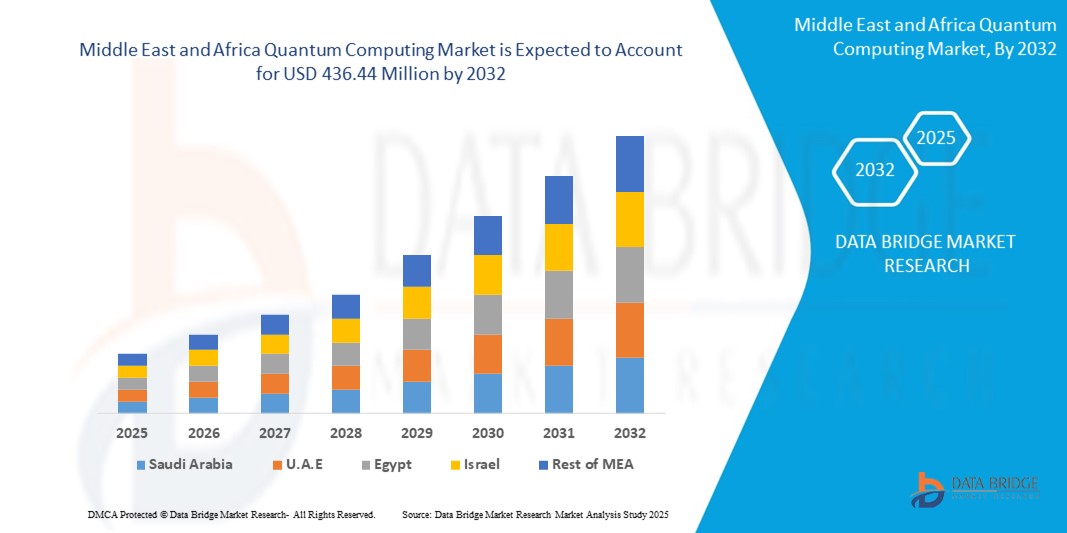
Middle East and Africa Quantum Computing Market Size
- The Middle East and Africa Quantum Computing market size was valued at USD 87.20 Million in 2024 and is expected to reach USD 436.44 Million by 2032, at a CAGR of 22.30% during the forecast period
- Growing awareness about the advantages of quantum computing technology such as its exponential speed for amplified optimization and vital calculations and rise in investments in quantum computing technology will emerge as the major factor driving market growth.
Middle East and Africa Quantum Computing Market Analysis
- Quantum computing is an area of advanced developing computer technology study that harnesses the phenomena of quantum mechanics that helps facilitate new discoveries in various sectors. Quantum computing technology processes information at atomic and sub atomic level through quantum computers and focuses on the development of technologies centered on the principles of quantum theory and quantum mechanics.
- Rising demand and application of this technology by the healthcare and pharmaceuticals industry will further aggravate the market growth rate. Surge in number of strategic partnerships and collaborations to carry out advancements, rising research and development proficiencies and early adoption of quantum computing in the banking and finance sector are other important market growth determinants.
- Saudi Arabia dominates the Middle East and Africa Quantum Computing market with the largest revenue share of 44.01% in 2025, Saudi Arabia’s quantum computing growth is driven by government-backed initiatives like Vision 2030, aiming to diversify the economy through advanced technologies. Strategic partnerships, such as with Pasqal, support innovation in energy optimization, logistics, and climate modeling, aligning national interests with cutting-edge quantum research and development.
- U.A.E is expected to be the fastest growing region in the Middle East and Africa Quantum Computing market during the forecast period due to strong governmental support, investment in R&D, and institutions like the Technology Innovation Institute. The nation's tech-forward vision and strategic global collaborations position it as a quantum innovation hub focused on defense, cybersecurity, and financial modeling applications across public and private sectors.
- The Single Qubit Quantum System segment is anticipated to hold the largest market share of 61.9% in the Middle East and Africa Quantum Computing Market during the forecast period. The Single Qubit Quantum System segment in the Middle East and Africa market is driven by increasing investments in foundational quantum research and education. Early-stage adoption by academic institutions and startups fuels innovation, laying the groundwork for scalable quantum technologies and future multi-qubit system development in the region.
Report Scope and Middle East and Africa Quantum Computing Market Segmentation
|
Attributes |
Middle East and Africa Quantum Computing Key Market Insights |
|
Segments Covered |
|
|
Countries Covered |
Middle East and Africa
|
|
Key Market Players |
|
|
Market Opportunities |
|
|
Value Added Data Infosets |
In addition to the insights on market scenarios such as market value, growth rate, segmentation, geographical coverage, and major players, the market reports curated by the Data Bridge Market Research also include import export analysis, production capacity overview, production consumption analysis, price trend analysis, climate change scenario, supply chain analysis, value chain analysis, raw material/consumables overview, vendor selection criteria, PESTLE Analysis, Porter Analysis, and regulatory framework. |
Middle East and Africa Quantum Computing Market Trends
“Accelerating Quantum Adoption through Strategic Research and Partnerships”
- The Middle East and Africa (MEA) region is witnessing growing investments in quantum computing research hubs, particularly in countries like the UAE and Saudi Arabia, aiming to establish themselves as leaders in quantum technology innovation.
- Collaboration between governments, academic institutions, and private companies is fueling advancements in quantum algorithms, hardware development, and software applications tailored to regional needs.
- Increasing awareness of quantum computing’s potential in solving complex problems related to cryptography, materials science, and optimization is driving interest across sectors such as finance, healthcare, and energy.
- The emergence of cloud-based quantum computing services is making quantum resources accessible to startups and SMEs in the region, accelerating experimentation and application development.
- Focus on developing quantum-safe cryptography solutions is rising due to increasing cybersecurity threats, pushing demand for quantum-resistant encryption technologies in government and defense sectors.
- Growing adoption of hybrid quantum-classical computing models is facilitating gradual integration into existing IT infrastructures, reducing barriers to adoption.
Middle East and Africa Quantum Computing Market Dynamics
Driver
“Government Initiatives and Investments Boosting Quantum Technology”
- Governments in the MEA region are launching national quantum strategies and funding programs to foster innovation ecosystems around quantum computing, encouraging startups and research collaborations.
- Public-private partnerships are playing a critical role in developing quantum infrastructure, including quantum communication networks and data centers equipped for quantum processing.
- The increasing digitization of critical industries such as oil and gas, finance, and healthcare drives the need for quantum-powered analytics and optimization, enhancing operational efficiency and competitive advantage.
- Growing interest from financial institutions to utilize quantum algorithms for portfolio optimization and risk analysis is a significant growth factor.
- The strategic importance of quantum technology for national security and defense is leading to increased investments in quantum sensors and quantum cryptography solutions.
Restraint/Challenge
“High Technical Complexity and Limited Skilled Workforce”
- The nascent stage of the quantum computing ecosystem in MEA faces challenges related to the shortage of skilled quantum scientists, engineers, and developers, impeding rapid market growth.
- Building and maintaining quantum hardware require highly specialized infrastructure, such as cryogenic cooling systems and noise isolation, which increases deployment costs and complexity.
- Lack of standardized quantum computing frameworks and limited interoperability among various quantum platforms hinder seamless integration into existing systems.
- Quantum error correction and stability remain significant technical barriers, limiting practical applications and scalability in the near term.
- Regulatory uncertainties regarding data privacy and export controls on quantum technologies create additional risks for investors and companies operating in the region.
- High upfront capital expenditure for quantum hardware and associated infrastructure is a considerable hurdle for many enterprises and governments looking to adopt quantum computing solutions.
Middle East and Africa Quantum Computing Market Scope
The market is segmented on the system, qubits, offering, deployment model, component, application, logic gates and verticals.
|
Segmentation |
Sub-Segmentation |
|
By System |
|
|
By Qubits |
|
|
By Offering |
|
|
By Deployment Model |
|
|
By Component |
|
|
By Application |
|
|
By Logic Gates |
|
|
By Verticals |
|
Middle East and Africa Quantum Computing Market Scope
The market is segmented on the basis system, qubits, offering, deployment model, component, application, logic gates and verticals.
- By System
On the basis of system, the Middle East and Africa Quantum Computing market is segmented into single qubit quantum system, multiple qubit system. The single qubit quantum system segment dominates the largest market revenue share of 52.1% in 2025, The single qubit segment is driven by growing academic and early-stage commercial interest. These systems serve as foundational platforms for research, enabling testing of algorithms and error correction techniques critical to developing scalable quantum computing in the MEA region.
The multiple qubit system segment is anticipated to witness the fastest growth rate of 20.1% from 2025 to 2032, Demand for multiple qubit systems is rising as regional institutions aim to solve more complex computational problems. Their ability to handle larger datasets and run advanced algorithms makes them essential for simulations, optimization, and machine learning applications in MEA industries.
- By Qubits
On the basis of qubits, the Middle East and Africa Quantum Computing market is segmented into trapped ion qubits, semiconductor qubits and super conducting. The trapped ion qubits held the largest market revenue share in 2025, Trapped ion technology is gaining traction in MEA due to its high fidelity and long coherence times. Government-backed research programs and international collaborations are encouraging adoption for secure communications, scientific simulations, and defense-related quantum advancements.
The semiconductor qubits segment is expected to witness the fastest CAGR from 2025 to 2032 Semiconductor qubits are driven by compatibility with existing fabrication technologies. MEA countries investing in chip manufacturing and nanotechnology view this architecture as scalable, cost-effective, and suitable for commercial applications, making it attractive for future regional quantum development.
- By Offering
On the basis of offering, the Middle East and Africa Quantum Computing market is segmented systems, services. The system held the largest market revenue share in 2025, Quantum systems are in demand across MEA as nations look to build self-reliant quantum infrastructure. Investments focus on building quantum computers and processors for national labs, universities, and enterprise pilots addressing regional challenges in logistics, energy, and defense.
The services segment is expected to witness the fastest CAGR from 2025 to 2032, Growth in services is fueled by demand for consulting, training, and system integration support. Organizations require expertise to implement quantum solutions, driving service providers to deliver workshops, simulations, and managed access to hardware via cloud platforms in MEA.
- By deployment model
On the basis of deployment model, the Middle East and Africa Quantum Computing market is segmented into on-premises, cloud. The on-premises held the largest market revenue share in 2025, On-premises deployment is driven by the need for data control, security, and compliance, especially in sectors like defense and finance. MEA governments prefer localized infrastructure to ensure sovereignty over sensitive quantum computing operations and research data.
The cloud segment is expected to witness the fastest CAGR from 2025 to 2032, Cloud-based quantum computing is accelerating adoption by offering flexible, low-barrier access. Startups, researchers, and SMEs in MEA leverage cloud platforms to experiment with quantum algorithms without heavy infrastructure investments, fostering innovation and practical use-case testing.
- By Application
On the basis of application, the Middle East and Africa Quantum Computing market is segmented cryptography, simulation, parallelism, machine learning, algorithms, others. The cryptography held the largest market revenue share in 2025, Rising cybersecurity threats are driving MEA interest in quantum-safe cryptography. Governments and financial institutions seek encryption methods resistant to quantum attacks, positioning quantum cryptography as a strategic priority for national security and data protection in the digital age.
The simulation segment is expected to witness the fastest CAGR from 2025 to 2032, Quantum simulation is vital for solving regional challenges in energy, pharmaceuticals, and materials. MEA institutions are adopting quantum systems to simulate molecular interactions and physical systems, enabling breakthroughs in sustainability, drug development, and industrial innovation.
- By logic gates
On the basis of logic gates, the Middle East and Africa Quantum Computing market is segmented into toffoli gate, hadamard gate, pauli logic gates and others, aerospace and defense, pharmaceuticals, plastics and polymers, metals and machining, food and beverages, cosmetics and others. The toffoli gate segment accounted for the largest market revenue share in 2024 and it is expected to witness the fastest CAGR from 2025 to 2032. Toffoli gates, crucial for quantum error correction and reversible logic, are gaining research attention in MEA. Their role in complex quantum circuits supports algorithm development, driving academic and experimental interest in creating more reliable quantum systems.
- By verticals
On the basis of verticals, the Middle East and Africa Quantum Computing market is segmented into banking and finance, healthcare & pharmaceuticals, defense, automotive, chemical, utilities, others. The banking and finance segment accounted for the largest market revenue share in 2024 and it is expected to witness the fastest CAGR from 2025 to 2032. MEA’s financial sector is exploring quantum computing for risk modeling, fraud detection, and portfolio optimization. As fintech grows, banks seek competitive advantage through faster data processing and secure transactions enabled by quantum technologies and encryption.
Saudi Arabia Quantum Computing Market Insight
The Saudi Arabia Quantum Computing market captured the largest revenue share of 44.01% within Saudi Arabia in 2025, Saudi Arabia is driving quantum computing adoption through Vision 2030, emphasizing technology diversification and innovation. Strategic partnerships, such as with Pasqal for the country’s first quantum computer, support national ambitions in energy, logistics, and AI. Government funding, research collaboration, and a growing tech ecosystem are positioning the Kingdom as a regional hub for quantum advancement.
U.A.E Quantum Computing Market Insight
The U.A.E Quantum Computing market is poised to grow at the fastest CAGR of over 24.1% in 2025, The U.A.E. is accelerating quantum computing development through strong governmental support and advanced research centers like the Technology Innovation Institute. Strategic investments, global partnerships, and initiatives like Qubits UAE highlight its commitment to leading in quantum science. The country focuses on real-world applications in finance, cybersecurity, and smart cities, aligning with its digital economy strategy.
Middle East and Africa Quantum Computing Market Share
The Middle East and Africa Quantum Computing industry is primarily led by well-established companies, including:
- Honeywell International, Inc.
- Accenture
- Fujitsu
- Rigetti & Co, Inc.
- 1QB Information Technologies, Inc.
- IonQ, Atom Computing, Inc.
- ID Quantique
- QuintessenceLabs
- Toshiba Research Europe Ltd.
- Microsoft
- The Xanadu
- Magiq Technologies, Inc.
- NEC Corporation
- Anyon System. Inc.
- CAMBRIDGE QUANTUM COMPUTING LTD
- QCWare
- Intel Corporation
Latest Developments in Middle East and Africa Quantum Computing Market
- In May 2024, Saudi Aramco partnered with Pasqal to deploy the Kingdom's first quantum computer—a 200-qubit system scheduled for installation in late 2025. This collaboration aims to advance quantum research and applications in energy and industrial sectors, aligning with Saudi Arabia’s Vision 2030 goals.
- On September 12, 2024, D-Wave hosted the inaugural Qubits UAE 2024 quantum computing event in Dubai. Co-organized with Staque and SquareOne, the event showcased real-world optimization use cases and progress in quantum-fueled AI technology, highlighting the UAE's commitment to quantum innovation.
- In April 2025, Vernewell Group Inc. hosted the Quantum Innovation Summit in Dubai, featuring the launch of VerneX Quantum Valley at NYU Abu Dhabi’s Center for Quantum and Topological Systems. The summit emphasized strategic alliances and advancements in quantum commercialization.
- On May 12, 2025, Humain, a Saudi AI company under the Public Investment Fund, was launched to drive the Kingdom's AI strategy. The company focuses on AI infrastructure, multimodal Arabic LLMs, and cloud AI services, aiming to position Saudi Arabia as a global leader in AI innovation.
SKU-
Accédez en ligne au rapport sur le premier cloud mondial de veille économique

- Tableau de bord d'analyse de données interactif
- Tableau de bord d'analyse d'entreprise pour les opportunités à fort potentiel de croissance
- Accès d'analyste de recherche pour la personnalisation et les requêtes
- Analyse de la concurrence avec tableau de bord interactif
- Dernières actualités, mises à jour et analyse des tendances
- Exploitez la puissance de l'analyse comparative pour un suivi complet de la concurrence
Méthodologie de recherche
La collecte de données et l'analyse de l'année de base sont effectuées à l'aide de modules de collecte de données avec des échantillons de grande taille. L'étape consiste à obtenir des informations sur le marché ou des données connexes via diverses sources et stratégies. Elle comprend l'examen et la planification à l'avance de toutes les données acquises dans le passé. Elle englobe également l'examen des incohérences d'informations observées dans différentes sources d'informations. Les données de marché sont analysées et estimées à l'aide de modèles statistiques et cohérents de marché. De plus, l'analyse des parts de marché et l'analyse des tendances clés sont les principaux facteurs de succès du rapport de marché. Pour en savoir plus, veuillez demander un appel d'analyste ou déposer votre demande.
La méthodologie de recherche clé utilisée par l'équipe de recherche DBMR est la triangulation des données qui implique l'exploration de données, l'analyse de l'impact des variables de données sur le marché et la validation primaire (expert du secteur). Les modèles de données incluent la grille de positionnement des fournisseurs, l'analyse de la chronologie du marché, l'aperçu et le guide du marché, la grille de positionnement des entreprises, l'analyse des brevets, l'analyse des prix, l'analyse des parts de marché des entreprises, les normes de mesure, l'analyse globale par rapport à l'analyse régionale et des parts des fournisseurs. Pour en savoir plus sur la méthodologie de recherche, envoyez une demande pour parler à nos experts du secteur.
Personnalisation disponible
Data Bridge Market Research est un leader de la recherche formative avancée. Nous sommes fiers de fournir à nos clients existants et nouveaux des données et des analyses qui correspondent à leurs objectifs. Le rapport peut être personnalisé pour inclure une analyse des tendances des prix des marques cibles, une compréhension du marché pour d'autres pays (demandez la liste des pays), des données sur les résultats des essais cliniques, une revue de la littérature, une analyse du marché des produits remis à neuf et de la base de produits. L'analyse du marché des concurrents cibles peut être analysée à partir d'une analyse basée sur la technologie jusqu'à des stratégies de portefeuille de marché. Nous pouvons ajouter autant de concurrents que vous le souhaitez, dans le format et le style de données que vous recherchez. Notre équipe d'analystes peut également vous fournir des données sous forme de fichiers Excel bruts, de tableaux croisés dynamiques (Fact book) ou peut vous aider à créer des présentations à partir des ensembles de données disponibles dans le rapport.











