



North America Biopreservation Market Segmentation By Product Type (Biopreservation Media and Biopreservation Equipment), Biospecimens (Human Tissue Samples, Organs, Stem Cells and Other Biospecimens), Application (Therapeutic Applications, Research Applications, Clinical Trials and Other Applications), End User (Bio Banks, Gene Banks, Hospitals and Other End Users) - Industry Trends and Forecast to 2032
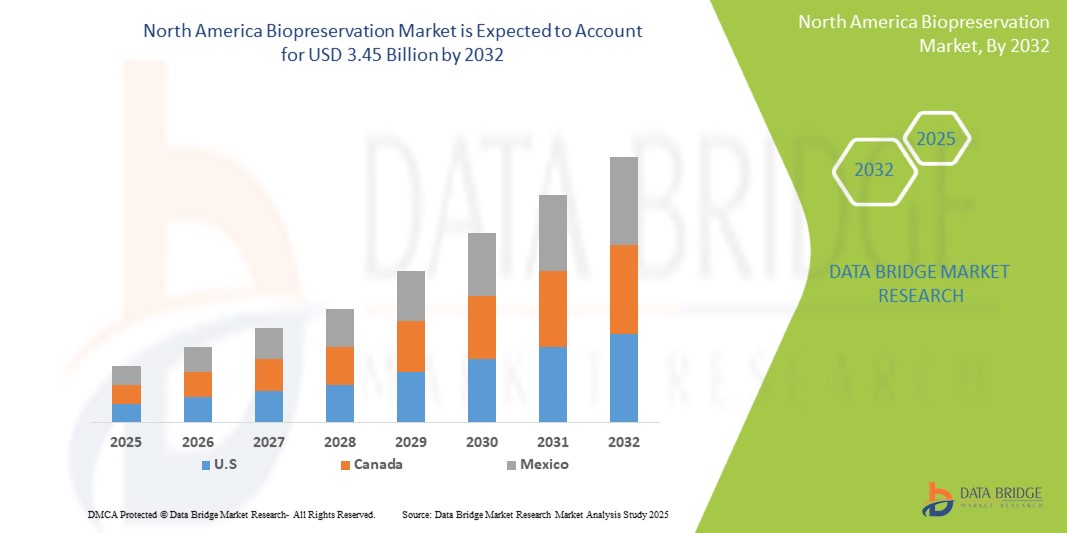
Biopreservation Market Size
- The North America Biopreservation Market was valued atUSD2.18 billionin 2024and is expected to reachUSD3.45 billionby 2032at aCAGR of 8.3% during the forecast period
- The increasing demand for regenerative medicine and personalized healthcare solutions, require the reliable preservation of biological samples such as cells, tissues, and organs. The growing use of stem cell therapies, gene editing, and cell-based treatments has significantly heightened the need for advanced biopreservation techniques.
North America Biopreservation Market Analysis
- Biopreservation plays a pivotal role in the management of vertebral compression fractures (VCFs), which are frequently linked to osteoporosis and aging. This technique supports critical outcomes such as pain relief, restoration of vertebral height, and improved patient mobility—collectively enhancing quality of life. Biopreservation solutions are widely utilized across hospitals, outpatient clinics, and rehabilitation centers, and are seeing growing use in home care settings for post-surgical recovery support.
- The demand for Biopreservation in North America is primarily driven by the increasing prevalence of osteoporosis-related fractures among the aging population. This trend is amplified by rising awareness of the clinical and economic benefits of minimally invasive interventions. Advances in medical technologies that improve surgical precision and reduce recovery times are accelerating the adoption of biopreservation across clinical settings. Additionally, the shift toward outpatient procedures and home-based recovery options is supporting broader market expansion.
- North America continues to hold a leading position in the North America Biopreservation market, backed by its robust healthcare infrastructure, high rate of technology adoption, and supportive reimbursement frameworks. The United States, in particular, dominates the regional market due to its high healthcare expenditure, large elderly population, and widespread integration of innovative surgical techniques that reduce inpatient stays and improve long-term patient outcomes.
Report Scope Biopreservation Market Segmentation
|
Attributes |
Biopreservation Key Market Insights |
|
Segments Covered |
|
|
Countries Covered |
North America
|
|
Key Market Players |
|
|
Market Opportunities |
|
|
Value Added Data Infosets |
In addition to the insights on market scenarios such as market value, growth rate, segmentation, geographical coverage, and major players, the market reports curated by the Data Bridge Market Research also include import export analysis, production capacity overview, production consumption analysis, price trend analysis, climate change scenario, supply chain analysis, value chain analysis, raw material/consumables overview, vendor selection criteria, PESTLE Analysis, Porter Analysis, and regulatory framework. |
Biopreservation Market Trends
“Minimally Invasive Innovations and Outpatient Procedure Growth”
- The market is witnessing a strong shift toward minimally invasive biopreservation procedures, driven by their ability to reduce surgical trauma, shorten recovery periods, and improve overall patient outcomes. Enhanced imaging systems and next-generation surgical tools are enabling greater procedural accuracy and efficiency, resulting in better spinal alignment and restoration in vertebral compression fracture (VCF) treatments.
- As procedures become faster and safer, there is a clear movement from inpatient settings to outpatient clinics and ambulatory surgical centers. This trend is fueled by cost-saving imperatives and improved procedural outcomes. With the support of advanced post-surgical care technologies and remote patient monitoring, healthcare providers are increasingly confident in managing recovery outside hospital walls—boosting accessibility and reducing system burden.
- For instance, the increasing focus on personalized medicine and regenerative therapies is driving a surge in demand for biopreservation solutions. As more emphasis is placed on preserving biological samples, such as cells, tissues, and organs, for research and therapeutic use, there is a growing need for advanced preservation technologies that ensure sample viability, improve recovery outcomes, and support the development of personalized treatment plans. This trend is particularly noticeable in stem cell therapies, tissue engineering, and biobanking sectors.
Biopreservation Market Dynamics
Driver
“Rising Prevalence of Osteoporotic Fractures and Increasing Geriatric Population”
- The North America Biopreservation Market is experiencing robust growth fueled by the increasing prevalence of osteoporosis-related vertebral compression fractures (VCFs), particularly among the aging population. As longevity rises, so does the demand for minimally invasive interventions that can address age-related spinal conditions effectively.
- The growing awareness of the benefits of minimally invasive procedures—such as quicker pain relief, restoration of spinal stability, and reduced hospital stays—is driving broader adoption of Biopreservation across both hospital and outpatient settings.
- With healthcare systems focusing on improving mobility and reducing long-term disability in older adults, Biopreservation is becoming a preferred approach due to its proven ability to restore vertebral height and function safely and effectively.
For instance,
- National Osteoporosis Foundation reports that approximately 1.5 million vertebral fractures occur annually in the U.S., with a large proportion linked to osteoporosis.
- In 2024, Medtronic launched a next-generation Biopreservation balloon catheter, offering improved navigation and enhanced bone access to facilitate safer, more effective fracture treatment.
Opportunity
“Technological Advancements and Expansion into Outpatient & Ambulatory Care Settings”
- A major opportunity in the Biopreservation market lies in the continuous innovation of procedural tools and materials, including advanced balloon technologies, integrated real-time imaging systems, and refined cement delivery techniques. These developments enhance surgical precision, safety, and procedural outcomes.
- The expansion of Biopreservation into outpatient clinics and ambulatory surgical centers (ASCs) presents a cost-effective alternative to hospital-based care. These settings provide improved accessibility, reduced overhead costs, and greater patient convenience.
For instance,
- For instance, in early 2024, Stryker introduced a streamlined Biopreservation system tailored for ambulatory surgery centers, reducing setup complexity and shortening procedure time.
- Collaborations between medical device companies and outpatient networks are also supporting workforce training and expanding access to Biopreservation beyond urban hospitals.
Restraint/Challenge
“High Procedure Cost and Reimbursement Barriers”
- One of the major challenges facing the North America Biopreservation Market is the high cost associated with the procedure. Expenses related to specialized equipment, real-time imaging, and post-operative care can limit patient access, especially among those lacking comprehensive insurance coverage.
- Inconsistent reimbursement policies across public and private insurers create uncertainty for healthcare providers and may deter smaller facilities from offering the procedure. Rural and underserved regions are particularly affected by these disparities.
- Furthermore, navigating the complex regulatory environment—which requires extensive clinical validation for new technologies—can delay product launches, increase development costs, and temporarily stifle innovation.
For instance,
- For instance, a 2023 CMS report noted variable reimbursement rates for vertebral augmentation procedures, contributing to inconsistent access across different U.S. states.
- Smaller clinics and healthcare providers often face financial hurdles in adopting Biopreservation systems due to low patient volumes and delayed reimbursement cycles.
Biopreservation Market Scope
The market is segmented on the basis, three notable segments based on By Product Type, application, End User .
|
Segmentation |
Sub-Segmentation |
|
By Product type |
|
|
By application |
|
|
By end user |
|
In 2025, the Biopreservation Media is projected to dominate the market with a largest share in product type segment
TheBiopreservation Mediais expected to lead the North America Biopreservation Market in 2025. with the largest share of 46.62% in 2025 driven by its critical role in maintaining cell viability during storage and transport. Increasing use in stem cell, gene therapy, and biobanking applications is driving demand. Technological advancements in formulation and stability are further supporting market growth.
TheTherapeutic Applicationsis expected to account for the largest share during the forecast period in application market
In 2025, Therapeutic Applications are projected to account for the largest share of the North America Biopreservation Market by application with the largest market share of 49.31% due to its growing use of preserved cells and tissues in regenerative medicine, stem cell therapy, and oncology treatments. Rising demand for personalized medicine further boosts the need for therapeutic biopreservation solutions.
Biopreservation Market Regional Analysis
“U.S. is the Dominant Country in the Biopreservation Market”
- The United States leads the North America Biopreservation Market, supported by a highly developed healthcare infrastructure, broad adoption of minimally invasive surgical technologies, and the strong presence of top-tier medical device manufacturers.
- The high incidence of osteoporosis-related vertebral compression fractures (VCFs), combined with a large and aging population, is fueling demand for effective, minimally invasive spinal procedures across hospitals and ambulatory surgical centers.
- Leading companies such as Medtronic, Stryker, and Globus Medical are deeply rooted in the U.S. market, offering advanced Biopreservation systems—including balloon-based kyphoplasty and precision cement delivery devices—that comply with regulatory standards and clinical performance requirements.
- Favorable reimbursement frameworks, increased physician training in minimally invasive techniques, and public health initiatives aimed at reducing long-term disability further cement the U.S.’s dominance in the regional Biopreservation landscape.
“Canada is Projected to Register the Highest Growth Rate”
- Canada is poised to experience the fastest growth in the North America Biopreservation Market, driven by rising government investment in bone health and expanded access to spinal care services targeting its aging population.
- The country’s publicly funded healthcare model and increasing awareness of minimally invasive alternatives for vertebral fracture management are accelerating the adoption of Biopreservation procedures across clinical settings.
- Growth in ambulatory surgical centers and rehabilitation clinics—especially in urban and semi-urban areas—is fueling demand for cost-effective, low-complication spinal treatments.
- National collaboration between health ministries, orthopedic associations, and academic institutions is fostering clinical education, technology adaptation, and domestic innovation in Biopreservation tools and techniques.
Biopreservation Market Share
The market competitive landscape provides details by competitor. Details included are company overview, company financials, revenue generated, market potential, investment in research and development, new market initiatives, North America presence, production sites and facilities, production capacities, company strengths and weaknesses, product launch, product width and breadth, application dominance. The above data points provided are only related to the companies' focus related to market.
The Major Market Leaders Operating in the Market Are:
- Medtronic (U.S.)
- Boston Scientific (U.S.)
- Philips Healthcare (Netherlands/U.S.)
- Stryker (U.S.)
- Globus Medical (U.S.)
- Zimmer Biomet (U.S.)
- Smith & Nephew (U.K.)
- Johnson & Johnson (U.S.)
- NuVasive (U.S.)
- CareFusion (U.S.)
Latest Developments in North America Biopreservation Market
- In March 2024, Merck Invests More than € 300 Million in New Life Science Production Site in Korea. This New Bioprocessing Production Center in Daejeon strengthened footprint of Merck in fast-growing Asia-Pacific region.
- In September 2023, Avantor Partnered with Tobin Scientific to Provide End-to-End Solution for Research Lab Relocations, Sample Transport, and GMP Storage Services to support end-to-end moves for U.S. biopharma customers looking to relocate their labs, research facilities, and samples. This partnership will deliver upon the growing customer need for complex logistics solutions with temperature-specific requirements.
SKU-
Accédez en ligne au rapport sur le premier cloud mondial de veille économique

- Tableau de bord d'analyse de données interactif
- Tableau de bord d'analyse d'entreprise pour les opportunités à fort potentiel de croissance
- Accès d'analyste de recherche pour la personnalisation et les requêtes
- Analyse de la concurrence avec tableau de bord interactif
- Dernières actualités, mises à jour et analyse des tendances
- Exploitez la puissance de l'analyse comparative pour un suivi complet de la concurrence
Méthodologie de recherche
La collecte de données et l'analyse de l'année de base sont effectuées à l'aide de modules de collecte de données avec des échantillons de grande taille. L'étape consiste à obtenir des informations sur le marché ou des données connexes via diverses sources et stratégies. Elle comprend l'examen et la planification à l'avance de toutes les données acquises dans le passé. Elle englobe également l'examen des incohérences d'informations observées dans différentes sources d'informations. Les données de marché sont analysées et estimées à l'aide de modèles statistiques et cohérents de marché. De plus, l'analyse des parts de marché et l'analyse des tendances clés sont les principaux facteurs de succès du rapport de marché. Pour en savoir plus, veuillez demander un appel d'analyste ou déposer votre demande.
La méthodologie de recherche clé utilisée par l'équipe de recherche DBMR est la triangulation des données qui implique l'exploration de données, l'analyse de l'impact des variables de données sur le marché et la validation primaire (expert du secteur). Les modèles de données incluent la grille de positionnement des fournisseurs, l'analyse de la chronologie du marché, l'aperçu et le guide du marché, la grille de positionnement des entreprises, l'analyse des brevets, l'analyse des prix, l'analyse des parts de marché des entreprises, les normes de mesure, l'analyse globale par rapport à l'analyse régionale et des parts des fournisseurs. Pour en savoir plus sur la méthodologie de recherche, envoyez une demande pour parler à nos experts du secteur.
Personnalisation disponible
Data Bridge Market Research est un leader de la recherche formative avancée. Nous sommes fiers de fournir à nos clients existants et nouveaux des données et des analyses qui correspondent à leurs objectifs. Le rapport peut être personnalisé pour inclure une analyse des tendances des prix des marques cibles, une compréhension du marché pour d'autres pays (demandez la liste des pays), des données sur les résultats des essais cliniques, une revue de la littérature, une analyse du marché des produits remis à neuf et de la base de produits. L'analyse du marché des concurrents cibles peut être analysée à partir d'une analyse basée sur la technologie jusqu'à des stratégies de portefeuille de marché. Nous pouvons ajouter autant de concurrents que vous le souhaitez, dans le format et le style de données que vous recherchez. Notre équipe d'analystes peut également vous fournir des données sous forme de fichiers Excel bruts, de tableaux croisés dynamiques (Fact book) ou peut vous aider à créer des présentations à partir des ensembles de données disponibles dans le rapport.











