



North America Cell and Gene Therapy Wawing Market Equipment Segmentation, By Modality (Benchtop and Portable), Sample (Cell Therapies and Gene Therapies), Type (Manual Thawing System et Automatic Thawing System), Application (Traitement en amont et traitement en aval), Utilisateur final (Blood Banks and Transfusion Centers, Hospitals and Diagnostic Laboratories, Research Laboratories and Academic Institutes, Biotechnology and Pharmaceutical Industry, Cord Blood and Stem Cell Banks, Gene Banks et autres), Distribution Channel (Direct Tender, Third Part Distributor et autres) - Tendances et prévisions de l'industrie jusqu'en 2033
Quelle est la taille et le taux de croissance du marché de l'équipement de dégel des cellules et des thérapies génétiques en Amérique du Nord
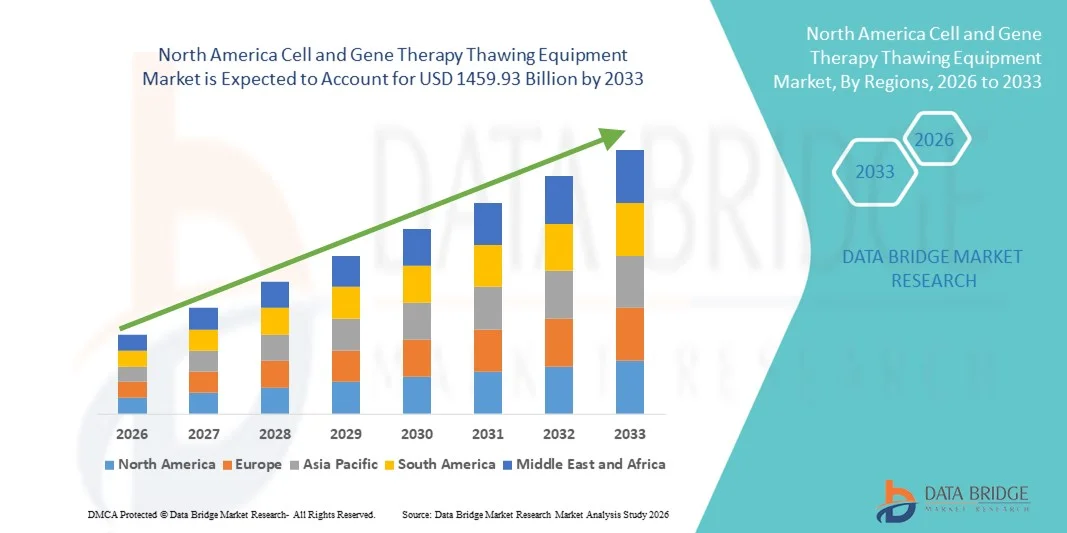
- Selon l'analyse de la recherche sur le marché de Data Bridge, la taille du marché des cellules et de la thérapie génique en Amérique du Nord a été évaluée à497,65 milliards de dollars en 2025et devrait atteindre1459,93 milliards de dollars en 2033, à unTCAC de 14,40%pendant la période de prévision
- La croissance du marché est largement alimentée par l'expansion rapide de la recherche et de la commercialisation sur les cellules et les thérapies géniques, ainsi que par les progrès technologiques continus dans les systèmes de dégel contrôlés, ce qui a permis d'améliorer la précision de la température, de réduire les dommages aux cellules et d'améliorer la normalisation des procédés dans les milieux de fabrication cliniques et commerciaux.
- En outre, la demande croissante de solutions de dégel sûres, fiables et conformes aux BPFbiopharmaceutiqueLes laboratoires de fabrication et les laboratoires cliniques placent l'équipement de dégel des cellules et des thérapies géniques comme une composante essentielle des flux de travail modernes de la médecine régénératrice, ce qui stimule considérablement la croissance globale du marché des équipements de dégel des cellules et des thérapies géniques
Taille du marché et prévisions
- Valeur marchande mondiale (2025):497,65 milliards de dollars
- Valeur marchande prévue (2033) :USD 1459,93 milliards
- Prévisions CAGR (2026-2033):14.40%
Quels sont les principaux débouchés de l'Amérique du Nord sur le marché de l'équipement de retraitement des cellules et des thérapies génétiques
- L'équipement de dégel des cellules et des thérapies géniques, conçu pour assurer le dégel contrôlé, uniforme et sans contamination des matériaux biologiques cryopréservés, devient un élément essentiel des flux de travail cliniques, de recherche et de thérapie cellulaire commerciale en raison de son rôle dans le maintien de la viabilité cellulaire et de l'intégrité du produit.
- La demande croissante de matériel de dégel cellulaire et de thérapie génique est principalement attribuable à l'expansion rapide des pipelines de traitement cellulaire et génique, à l'augmentation de l'activité des essais cliniques et à l'adoption croissante de solutions de biotraitement automatisées conformes aux BPF pour soutenir la fabrication évolutive et reproductible.
- Les États-Unis ont dominé le marché de l'équipement de dégel des cellules et des thérapies géniques avec la plus grande part des revenus d'environ 41,2 % en 2025, grâce à un financement fédéral et privé solide pour la recherche sur les cellules et les thérapies géniques, à un écosystème de fabrication biopharmaceutique bien établi, à une forte concentration d'essais cliniques, à l'adoption rapide de technologies de dégel automatisées et à la présence de principaux concepteurs de thérapies et fabricants d'équipement
- On s'attend à ce que le Canada soit le pays qui connaît la croissance la plus rapide du marché de l'équipement de dégel des cellules et des thérapies géniques au cours de la période de prévision, en raison de l'augmentation des investissements dans la médecine régénératrice, de l'expansion des programmes de recherche universitaires et subventionnés par l'État, de la croissance des centres de production de bioproduits, de l'augmentation de l'activité de l'OGMC et des initiatives réglementaires appuyant le développement de thérapies avancées.
- Le segment des thérapies cellulaires a représenté la plus grande part du revenu du marché (61,7 %) en 2025, en raison du nombre croissant de thérapies cellulaires approuvées.
Portée du rapport et segmentation du marché de l'équipement de dégel des cellules et des thérapies géniques
|
Attributs |
Thérapie cellulaire et génique Équipement de dégraissage Principales perspectives du marché |
|
Segments couverts |
|
|
Pays couverts |
Amérique du Nord
|
|
Principaux acteurs du marché |
|
|
Possibilités de marché |
|
|
Infos sur la valeur ajoutée |
En plus des renseignements sur les scénarios de marché comme la valeur marchande, le taux de croissance, la segmentation, la couverture géographique et les principaux intervenants, les rapports de marché établis par Data Bridge Market Research comprennent également une analyse approfondie des experts, l'épidémiologie des patients, l'analyse des pipelines, l'analyse des prix et le cadre réglementaire. |
Quelle est la tendance clé du marché nord-américain de la thérapie cellulaire et génique
Progrès dans les technologies de dégel contrôlées et automatisées
- Une tendance importante et accélérée sur le marché mondial de l'équipement de dégel de la thérapie génique est l'adoption croissante de systèmes de dégel automatisés et contrôlés avec précision conçus pour maintenir la viabilité des cellules et des vecteurs pendant la manipulation après la préservation de lacryo. Comme les thérapies géniques dépendent fortement de vecteurs viraux sensibles à la température et de cellules modifiées, le dégel constant et reproductible est devenu une exigence essentielle tant dans le contexte clinique que commercial.
- Les fabricants se concentrent de plus en plus sur les technologies de dégel sec sans eau et à système fermé, qui réduisent les risques de contamination et assurent un transfert de chaleur uniforme
- Par exemple, Sartorius a promu des solutions de dégel à sec pour les flux de travail de la thérapie cellulaire et génique pour remplacer les bains d'eau conventionnels, tandis que CytivaS TheraCube et les plates-formes de dégel contrôlées connexes sont de plus en plus utilisées par les CDMO pour soutenir les processus de manipulation de vecteurs viraux et de cellules conformes aux BPF, en réduisant les risques de contamination croisée et la variabilité dépendante des opérateurs
- L'intégration de la surveillance de la température en temps réel, des profils de dégel programmables et des capacités d'enregistrement des données améliore encore le contrôle des processus et la traçabilité. Ces caractéristiques permettent aux laboratoires et aux entreprises biopharmaceutiques de normaliser les protocoles de décongélation sur plusieurs sites, assurant ainsi une qualité uniforme des produits au cours des essais cliniques et de la production commerciale.
- De plus, l'évolution croissante vers des modèles de point de service et de fabrication décentralisée stimule la demande d'équipement de dégel compact, portable et facile à utiliser. Ces systèmes sont particulièrement utiles dans les pharmacies hospitalières et les centres cliniques où les thérapies géniques sont préparées immédiatement avant l'administration du patient.
- Cette tendance vers des solutions de dégel plus sûres, plus rapides et plus reproductibles consiste à remodeler les normes opérationnelles sur l'ensemble du flux de travail de la thérapie génique, en encourageant les fabricants d'équipement à continuer d'innover pour répondre aux besoins en évolution de la production biologique avancée.
Amérique du Nord Dynamique du marché de la thérapie cellulaire et génique
Chauffeur
Augmentation de la demande entraînée par la croissance rapide de la généothérapie Développement et commercialisation
- L'expansion rapide de la recherche en thérapie génique, des essais cliniques et des approbations réglementaires est l'un des principaux moteurs du marché du dégel des équipements de thérapie génique. À mesure qu'un nombre croissant de thérapies géniques passent du stade précoce au stade avancé des essais et du lancement commercial, la nécessité de solutions de dégel fiables et normalisées s'intensifie
- Par exemple, la commercialisation de thérapies géniques approuvées par la FDA, telles que Zolgensma et Luxturna, a accru la demande de systèmes de manipulation et de décongélation étroitement contrôlés dans les hôpitaux et les centres de traitement spécialisés, incitant les fabricants et les ORCM à adopter un équipement de décongélation validé pour protéger les thérapies de grande valeur avant l'administration du patient.
- Les thérapies géniques comportent souvent des matériaux sensibles à la température et de grande valeur tels que les vecteurs viraux et les cellules génétiquement modifiées, ce qui rend le dégel précis essentiel pour préserver l'efficacité thérapeutique et la sécurité des patients. Cela a conduit les entreprises biopharmaceutiques et les organisations de développement et de fabrication de contrats à investir dans des équipements de dégel spécialisés qui soutiennent des flux de travail cohérents et validés
- La prévalence croissante de troubles génétiques, d'indications oncologiques et de maladies rares accélère encore la demande de thérapies géniques, ce qui stimule indirectement l'adoption de systèmes de dégel avancés dans les instituts de recherche, les installations de fabrication et les centres cliniques.
- En outre, l'augmentation du financement des gouvernements et des investisseurs privés pour soutenir les médicaments de thérapie innovante (PSTA) renforce le développement de l'infrastructure, ce qui stimule l'achat d'équipements spécialisés de traitement de la thérapie génique, y compris des systèmes de dégel
Restriction/Défi
Coûts élevés de l'équipement et normalisation limitée entre les installations
- Le coût relativement élevé du matériel de dégel spécialisé en thérapie génique demeure un défi majeur, en particulier pour les petites entreprises de biotechnologie, les laboratoires de recherche universitaires et les acteurs émergents du marché. Par rapport aux méthodes classiques de dégel, les systèmes automatisés avancés nécessitent un investissement initial plus élevé, ce qui peut limiter l'adoption parmi les utilisateurs sensibles aux coûts
- Par exemple, les petites start-up en biotechnologie et les retombées scolaires en début de cycle continuent souvent d'utiliser des méthodes de dégel manuelles ou semi-automatisées en raison du coût élevé en capital des systèmes de dégel à sec conformes aux BPF, qui peuvent être difficiles à justifier avant que les thérapies n'avancent dans les essais cliniques en fin de cycle ou la commercialisation.
- De plus, l'absence de normalisation universelle des protocoles de dégel des différents produits de thérapie génique et des plates-formes de fabrication complique la sélection et la mise en œuvre des équipements. La variabilité des formats des conteneurs, des volumes et des exigences en matière de température nécessite souvent des solutions personnalisées, ce qui accroît la complexité opérationnelle.
- Les exigences en matière de formation et les difficultés d'intégration dans les flux de travail de fabrication existants peuvent également constituer des obstacles, en particulier pour les installations qui passent des méthodes de manipulation cryogénique traditionnelles aux systèmes entièrement automatisés
- Pour relever ces défis, les fabricants s'attachent à développer des plateformes de dégel évolutives, polyvalentes et rentables, ainsi qu'à améliorer la formation des utilisateurs et le soutien à la validation. Il sera essentiel de s'attaquer au problème de l'accessibilité et de l'interopérabilité pour permettre une adoption plus large et soutenir la croissance du marché à long terme.
Comment le marché nord-américain des cellules et de la thérapie génique est-il segmenté
Le marché est segmenté en fonction de la modalité, de l'échantillon, du type, de l'application, de l'utilisateur final et du canal de distribution.
- Par Modalité
Sur la base de la modalité, le marché de l'équipement de dégraissage cellulaire et génique est segmenté en systèmes de banc et portables. Le segment du banc d'essai a dominé le marché avec une part de chiffre d'affaires de 58,4% en 2025, en raison de son utilisation généralisée dans des environnements contrôlés en laboratoire et en clinique. Les systèmes de banc offrent une grande précision, uniformité de température et reproductibilité, qui sont essentielles au maintien de la viabilité cellulaire pendant le dégel. Ces systèmes sont largement adoptés dans les hôpitaux, les banques de sang et les installations pharmaceutiques. Leur compatibilité avec les flux de travail conformes aux BPF renforce encore la demande. Les unités de banc supportent le traitement en grand volume, ce qui les rend aptes aux essais cliniques à grande échelle. L'intégration aux systèmes automatisés de traitement des cellules améliore l'efficacité opérationnelle. Une forte acceptation réglementaire appuie également la domination. Une précision élevée réduit les risques de contamination. Les mises à niveau technologiques continues améliorent la fiabilité. La préférence du personnel qualifié favorise l'adoption. L'infrastructure établie dans les régions développées renforce le leadership. Dans l'ensemble, la fiabilité et l'évolutivité conduisent à la dominance.
Le segment portable devrait connaître le TCAC le plus rapide de 9,2 % entre 2026 et 2033, en raison de l'augmentation de la demande de traitements au point de soins et de thérapies décentralisées. Les systèmes portables offrent une flexibilité pour les applications au chevet et sur le terrain. L'adoption croissante de thérapies cellulaires personnalisées alimente la demande. Ces systèmes permettent le dégel rapide dans les situations d'urgence et à distance. L'utilisation croissante dans les essais cliniques augmente l'absorption. La conception compacte améliore la mobilité et la facilité d'utilisation. Les progrès technologiques améliorent la précision de la température. L'expansion des centres de traitement externe favorise la croissance. L'adoption accrue sur les marchés émergents stimule la demande. Le rapport coût-efficacité par rapport aux systèmes de banc supporte la pénétration. L'augmentation des investissements dans les infrastructures mobiles de soins accélère l'adoption. Dans l'ensemble, la portabilité et la commodité favorisent une forte croissance du TCAC.
- Par échantillon
Sur la base de l'échantillon, le marché est segmenté en thérapies cellulaires et thérapies génétiques. En 2025, le segment des thérapies cellulaires représentait la plus grande part des revenus du marché (61,7 %), en raison du nombre croissant de thérapies cellulaires approuvées. La forte demande de thérapies CAR-T et de cellules souches contribue de façon significative à la domination. Les thérapies cellulaires nécessitent un dégel précis pour préserver la viabilité et la fonctionnalité. L'augmentation des applications cliniques en oncologie et en médecine régénérative favorise la croissance. L'adoption croissante dans les hôpitaux et les centres de recherche stimule la demande. Un pipeline solide de produits de thérapie cellulaire renforce la part de marché. L'utilisation fréquente dans les banques de sang soutient également la domination. Les protocoles avancés de dégel améliorent les résultats cliniques. Les approbations réglementaires renforcent la confiance. L'expansion des installations de fabrication de thérapie cellulaire augmente la demande d'équipement. L'investissement dans l'automatisation soutient l'évolutivité. Ensemble, ces facteurs soutiennent le leadership.
Le segment des thérapies géniques devrait croître au taux le plus rapide de TCAC de 10,1 %, de 2026 à 2033, grâce à des progrès rapides en génie génétique. L'augmentation des approbations pour les traitements à base de gènes soutient la demande. Les thérapies génétiques nécessitent un dégel contrôlé pour maintenir la stabilité des vecteurs. L'expansion de l'activité des essais cliniques favorise l'adoption. La hausse des investissements dans le traitement des maladies rares accélère la croissance. Des solutions améliorées de dégel améliorent la sécurité et l'efficacité. Une sensibilisation accrue des cliniciens appuie l'adoption. L'expansion des banques de gènes accroît l'utilisation de l'équipement. Les partenariats entre entreprises de biotechnologie stimulent l'innovation. Le soutien réglementaire à la thérapie génique accélère la commercialisation. L'amélioration de la logistique de la chaîne du froid favorise la croissance. Ces tendances entraînent collectivement un TCAC élevé.
- Par type
Sur la base du type, le marché est segmenté en systèmes de dégel manuel et en systèmes de dégel automatique. e segment des systèmes de dégel automatique a dominé le marché avec une part de revenu de 54,9% en 2025, entraîné par une cohérence supérieure et réduit l'erreur humaine. Les systèmes automatisés assurent un contrôle précis de la température et des protocoles normalisés de dégel. Une forte adoption dans les installations conformes aux BPF favorise la domination. Ces systèmes réduisent considérablement les risques de contamination. La préférence croissante pour l'automatisation dans la fabrication de produits biopharmaceutiques stimule la demande. L'intégration au traitement en circuit fermé améliore la sécurité. La réduction de la dépendance au travail améliore l'efficacité. La capacité de débit élevé soutient la production à grande échelle. La forte demande des sociétés pharmaceutiques renforce le leadership. Les organismes de réglementation favorisent les processus automatisés. L'innovation continue améliore les performances du système. Dans l'ensemble, l'automatisation conduit à la domination.
On s'attend à ce que le segment des systèmes de dégel manuel augmente au TCAC le plus rapide de 8,6 %, de 2026 à 2033, en raison de l'accessibilité et de la simplicité. Les systèmes manuels sont largement utilisés dans les petits laboratoires et les instituts universitaires. Un faible investissement en capital favorise l'adoption. La croissance des activités de recherche dans les économies émergentes stimule la demande. La souplesse dans la manipulation de différents types d'échantillons favorise la croissance. L'augmentation des programmes de formation améliore la précision de l'utilisation. L'adoption au début de la recherche clinique favorise l'expansion. L'augmentation du nombre de petites start-up en biotechnologie alimente la demande. Facile d'entretien soutient la préférence. Les avantages de la transférabilité améliorent encore l'utilisation. La décentralisation croissante du traitement thérapeutique favorise la croissance. Ensemble, ces facteurs stimulent l'expansion du TCAC.
- Par demande
Sur la base de la demande, le marché est segmenté en traitement en amont et en aval. Le secteur de la transformation en aval détenait la plus grande part du marché en 2025, soit 57,3 %, en raison de son rôle essentiel dans la préparation de la thérapie finale. Le dégel précis pendant le traitement en aval garantit l'intégrité du produit. L'accroissement de la commercialisation des thérapies cellulaires et géniques stimule la demande. Une forte dépendance au dégel contrôlé soutient la domination. L'adoption dans les installations manufacturières renforce la part des revenus. Les exigences de contrôle de la qualité des chaînes améliorent l'utilisation de l'équipement. Les flux de travail avancés en aval nécessitent une gestion précise de la température. L'augmentation des volumes de production augmente la fréquence d'utilisation. L'accent mis par la réglementation sur la cohérence appuie l'adoption. L'intégration aux opérations de remplissage améliore la demande. Un investissement pharmaceutique fort soutient la croissance. Ces facteurs soutiennent le leadership.
On s'attend à ce que le segment du traitement en amont augmente au TCAC le plus rapide de 9,0 %, de 2026 à 2033, en raison de l'expansion des activités de recherche. L'expansion cellulaire au stade précoce nécessite un dégel fiable. L'augmentation des investissements en R-D stimule l'adoption. La croissance de la recherche universitaire soutient la demande. L'innovation technologique améliore l'efficacité en amont. Le nombre croissant d'essais cliniques stimule la croissance. L'intégration d'automatisation améliore l'évolutivité. Une attention accrue à l'optimisation des processus supporte l'expansion. La croissance de l'activité de démarrage de la biotechnologie stimule la demande. L'adoption dans la fabrication à l'échelle pilote augmente l'utilisation. Une reproductibilité améliorée favorise la préférence. Dans l'ensemble, l'expansion en amont stimule la croissance du TCAC.
- Par Utilisateur final
Sur la base de l'utilisateur final, le marché est segmenté en banques de sang et centres de transfusion, hôpitaux et laboratoires de diagnostic, laboratoires de recherche et instituts universitaires, biotechnologie et industrie pharmaceutique, banques de sang de cordon et de cellules souches, banques de gènes, etc. Le secteur de la biotechnologie et de l'industrie pharmaceutique a dominé le marché avec une part des revenus de 36,8 % en 2025, tirée par la fabrication de thérapies à grande échelle. La production en grand volume nécessite un équipement de dégel avancé. L'augmentation des approbations commerciales soutient la domination. L'investissement dans l'automatisation améliore l'efficacité. De solides pipelines de R-D stimulent la demande. L'expansion mondiale des installations manufacturières stimule l'adoption. La conformité réglementaire exige un dégel précis. Une forte disponibilité de capitaux favorise la modernisation du matériel. Les partenariats stratégiques renforcent la position du marché. L'accroissement des activités d'externalisation favorise l'utilisation. L'optimisation continue des processus soutient le leadership. Ces facteurs maintiennent la domination.
On s'attend à ce que le segment des banques de sang et de cellules souches du cordon augmente au taux de TCAC le plus rapide de 9,4 % entre 2026 et 2033, en raison de la sensibilisation accrue à la préservation des cellules souches. L'augmentation des taux de natalité dans les régions émergentes stimule la demande de stockage. L'utilisation croissante en médecine régénérative favorise l'adoption. L'amélioration des technologies de dégel améliore la viabilité des cellules. Les initiatives gouvernementales favorisent les banques de cellules souches. L'expansion des banques privées alimente la croissance. L'augmentation du tourisme médical soutient la demande. Les progrès technologiques améliorent l'efficacité opérationnelle. Augmenter l'utilisation des applications cliniques. L'expansion de l'infrastructure de stockage soutient le TCAC. La sensibilisation croissante des consommateurs stimule l'inscription. Ces tendances favorisent une forte croissance.
- Par canal de distribution
Sur la base du canal de distribution, le marché est segmenté en appel d'offres direct, distributeur tiers et autres. Le segment des appels d'offres directs a dominé le marché avec une part de chiffre d'affaires de 48,6% en 2025, sous l'impulsion des achats en gros effectués par les hôpitaux et les sociétés pharmaceutiques. L'approvisionnement direct assure l'efficience et l'assurance de la qualité. Les institutions financées par le gouvernement préfèrent les marchés publics fondés sur les appels d'offres. Les contrats d'approvisionnement à long terme garantissent la stabilité. La normalisation des équipements favorise l'efficacité opérationnelle. De solides relations fournisseurs-acheteurs renforcent la domination. Les grandes installations manufacturières dépendent des achats directs. Les processus d'appel d'offres appuient la conformité à la réglementation. L'inclusion des ententes de service accroît la valeur. La réduction des coûts intermédiaires favorise la préférence. L'achat en grand volume entraîne la domination. Ces facteurs soutiennent le leadership.
Le segment des distributeurs tiers devrait croître au rythme le plus rapide du TCAC de 8,9 %, passant de 2026 à 2033, en raison de l'expansion de la portée sur les marchés émergents. Les distributeurs facilitent l'accès aux petites et moyennes installations. La présence locale améliore la prestation des services. La croissance des infrastructures de santé privées stimule la demande. Des options d'achat flexibles soutiennent l'adoption. L'amélioration de la logistique améliore la disponibilité. Les fabricants bénéficient d'une réduction de la charge opérationnelle. La hausse des dépenses de santé soutient les réseaux de distributeurs. De plus en plus de startups en biotechnologie dépendent des distributeurs. Le support après-vente améliore la rétention des clients. L'expansion du marché dans les régions éloignées alimente la croissance. Ces facteurs favorisent une forte expansion du TCAC.
Quelle est la région qui détient la plus grande part du marché nord-américain des cellules et de la thérapie génique
- Le marché de l'équipement de dégel des cellules et des thérapies géniques de l'Amérique du Nord est sur le point de croître à un TCAC robuste au cours de la période de prévision, en raison de l'expansion rapide du secteur biopharmaceutique, d'importants investissements dans la médecine régénérative et de l'adoption croissante de thérapies cellulaires et géniques dans la région. La présence d'infrastructures de soins de santé avancées, d'un cadre réglementaire mature et d'une forte concentration de développeurs thérapeutiques accélère la demande de solutions de dégel précises et fiables
- Le nombre croissant d'essais cliniques, les actifs en phase terminale et la commercialisation de thérapies cellulaires et géniques approuvées stimulent considérablement la demande de matériel de dégel sans contamination et contrôlé, ce qui est essentiel au maintien de la viabilité, de la cohérence et de l'efficacité thérapeutique des cellules pendant la fabrication et la préparation au point de soins.
- En outre, le rôle de l'Amérique du Nord en tant que plaque tournante mondiale des services de fabrication et de développement de contrats biopharmaceutiques accélère l'adoption de systèmes de dégel normalisés et conformes aux BPF dans les laboratoires de recherche, les ORCM et les centres de traitement hospitaliers, en particulier à mesure que l'automatisation et le traitement des systèmes fermés prennent de l'importance dans les processus de traitement avancés.
U.S. Cell and Gene Therapy Défaillance du marché des équipements
Le marché américain de l'équipement de dégel des cellules et des thérapies géniques a dominé la région de l'Amérique du Nord avec la plus grande part de revenus d'environ 41,2 % en 2025, grâce à un financement fédéral et privé solide pour la recherche sur les cellules et les thérapies géniques et à un écosystème de fabrication biopharmaceutique bien établi. Le pays accueille une forte concentration d'essais cliniques portant sur l'oncologie, les maladies rares et les troubles génétiques, ce qui entraîne une demande constante de matériel de dégel précis tant dans le secteur manufacturier que dans les milieux cliniques. L'adoption précoce de technologies de dégel automatisées et de systèmes fermés renforce encore la croissance du marché, les développeurs de thérapie se concentrant sur l'évolutivité, la reproductibilité et la conformité réglementaire. De plus, la présence de grands développeurs de thérapie, de CDMO et de fabricants d'équipement renforce la position de leader des États-Unis dans l'infrastructure de thérapie cellulaire et génique avancée.
Le marché canadien de la thérapie cellulaire et génique
Le marché canadien de l'équipement de dégel des cellules et des thérapies géniques devrait être le pays qui connaît la croissance la plus rapide sur le marché de l'équipement de dégel des cellules et des thérapies géniques au cours de la période de prévision, en raison de l'augmentation des investissements dans la médecine régénérative et de l'expansion des programmes de recherche universitaires et gouvernementaux. La croissance des hubs de fabrication biologique et l'augmentation de l'activité de l'OCMO créent une forte demande d'équipement de dégel normalisé et évolutif pour appuyer la recherche clinique et la fabrication commerciale. Des initiatives réglementaires de soutien favorisant le développement de thérapies avancées, ainsi qu'une collaboration croissante entre les universités, les hôpitaux et les entreprises de biotechnologie, améliorent l'accès aux technologies modernes de traitement des cellules. Alors que le Canada continue de renforcer son écosystème thérapeutique de pointe, l'adoption de systèmes de dégel fiables et automatisés devrait augmenter régulièrement.
Quelles sont les meilleures entreprises d'Amérique du Nord sur le marché de la thérapie cellulaire et génique
L'industrie de la thérapie cellulaire et génique est principalement dirigée par des entreprises bien établies, notamment :
- Thermo Fisher Scientific (États-Unis)
- GE HealthCare (États-Unis)
- Cytiva (États-Unis)
- Solutions BioLife (États-Unis)
- Sartorius (Allemagne)
- Merck KGaA (Allemagne)
- PHC Holdings Corporation (Japon)
- Santé panasonique (Japon)
- Eppendorf (Allemagne)
- Helmer Scientific (États-Unis)
- B Systèmes médicaux (Luxembourg)
- Brooks Automation (États-Unis)
- Asymptote (Royaume-Uni)
- MedCision (Chine)
- Haier Biomedical (Chine)
Quels sont les derniers développements en Amérique du Nord sur le marché de l'équipement de dépannage des cellules et des thérapies génétiques
- En mars 2023, BioLife Solutions, Inc. a présenté une version améliorée de son système evo Smart Thawing doté d'une connectivité sans fil et d'une interface utilisateur améliorée, permettant une surveillance à distance et une traçabilité dans les thérapies cellulaires cryopréservées, une amélioration clé du contrôle de la qualité et de la conformité dans les flux de travail cliniques et de fabrication.
- En février 2023, Sartorius AG a annoncé une collaboration stratégique avec une société biopharmaceutique européenne de premier plan pour le développement d'une solution de dégel entièrement fermée et automatisée adaptée aux thérapies dérivées des cellules souches, visant à réduire le risque de contamination et à améliorer la consistance du dégel dans la fabrication de thérapies avancées.
- En janvier 2023, Thermo Fisher Scientific Inc. a lancé son système CryoMed Controlled-Rate Thawing, conçu pour assurer le dégel cohérent des échantillons biologiques critiques avec une reproductibilité élevée et soutenir la conformité réglementaire dans la recherche clinique et le dégel biopharmaceutique
- En avril 2025, Thermo Fisher Scientific a annoncé une collaboration stratégique avec Miltenyi Biotec afin d'intégrer le dégel automatisé aux flux de travail de traitement cellulaire pour les thérapies cellulaires cliniques, contribuant ainsi à réduire le temps de traitement global et à améliorer la viabilité cellulaire dans la production de thérapies avancées.
- En mai 2025, Stylus Medicine, une start-up en biotechnologie axée sur les technologies de fabrication de thérapies de pointe, a recueilli 85 millions de dollars US en financement, soutenant des initiatives qui incluent des innovations autour du dégel et des flux de production qui répondent aux défis de la fourniture de thérapies cellulaires et génétiques
SKU-
Accédez en ligne au rapport sur le premier cloud mondial de veille économique

- Tableau de bord d'analyse de données interactif
- Tableau de bord d'analyse d'entreprise pour les opportunités à fort potentiel de croissance
- Accès d'analyste de recherche pour la personnalisation et les requêtes
- Analyse de la concurrence avec tableau de bord interactif
- Dernières actualités, mises à jour et analyse des tendances
- Exploitez la puissance de l'analyse comparative pour un suivi complet de la concurrence
Méthodologie de recherche
La collecte de données et l'analyse de l'année de base sont effectuées à l'aide de modules de collecte de données avec des échantillons de grande taille. L'étape consiste à obtenir des informations sur le marché ou des données connexes via diverses sources et stratégies. Elle comprend l'examen et la planification à l'avance de toutes les données acquises dans le passé. Elle englobe également l'examen des incohérences d'informations observées dans différentes sources d'informations. Les données de marché sont analysées et estimées à l'aide de modèles statistiques et cohérents de marché. De plus, l'analyse des parts de marché et l'analyse des tendances clés sont les principaux facteurs de succès du rapport de marché. Pour en savoir plus, veuillez demander un appel d'analyste ou déposer votre demande.
La méthodologie de recherche clé utilisée par l'équipe de recherche DBMR est la triangulation des données qui implique l'exploration de données, l'analyse de l'impact des variables de données sur le marché et la validation primaire (expert du secteur). Les modèles de données incluent la grille de positionnement des fournisseurs, l'analyse de la chronologie du marché, l'aperçu et le guide du marché, la grille de positionnement des entreprises, l'analyse des brevets, l'analyse des prix, l'analyse des parts de marché des entreprises, les normes de mesure, l'analyse globale par rapport à l'analyse régionale et des parts des fournisseurs. Pour en savoir plus sur la méthodologie de recherche, envoyez une demande pour parler à nos experts du secteur.
Personnalisation disponible
Data Bridge Market Research est un leader de la recherche formative avancée. Nous sommes fiers de fournir à nos clients existants et nouveaux des données et des analyses qui correspondent à leurs objectifs. Le rapport peut être personnalisé pour inclure une analyse des tendances des prix des marques cibles, une compréhension du marché pour d'autres pays (demandez la liste des pays), des données sur les résultats des essais cliniques, une revue de la littérature, une analyse du marché des produits remis à neuf et de la base de produits. L'analyse du marché des concurrents cibles peut être analysée à partir d'une analyse basée sur la technologie jusqu'à des stratégies de portefeuille de marché. Nous pouvons ajouter autant de concurrents que vous le souhaitez, dans le format et le style de données que vous recherchez. Notre équipe d'analystes peut également vous fournir des données sous forme de fichiers Excel bruts, de tableaux croisés dynamiques (Fact book) ou peut vous aider à créer des présentations à partir des ensembles de données disponibles dans le rapport.











