


Saudi Arabia Building Thermal Insulation Market, By Product (FiberglassMineral Wool, Plastic Foam, Aerogels, Cellulose, and Others), Insulation (Slab or Block, Blanket, Loose Fill, Reflective, Spray Foam, and Others), Distribution Channel (Offline and Online), Application (Roof, Wall, and Floor), End-use (Residential, Commercial, Warehouses, Institutional, and Industrial) Industry Trends and Forecast to 2029.
Arabie Saoudite Construction de l'isolation thermique Analyse du marché et perspectives
Le marché saoudien de l'isolation thermique devrait connaître une forte croissance au cours de la période de prévision 2022 à 2029. Data Bridge Market Research analyse que le marché est en croissance avec un TCAC de 7,0% dans la période de prévision de 2022 à 2029 et devrait atteindre USD 437 612,95 mille d'ici 2029. Le principal facteur de croissance du marché est la popularité croissante de la mousse plastique en tant que matériau léger dans le bâtiment et la construction, l'expansion des bâtiments verts et l'importance croissante de l'isolation des toits.
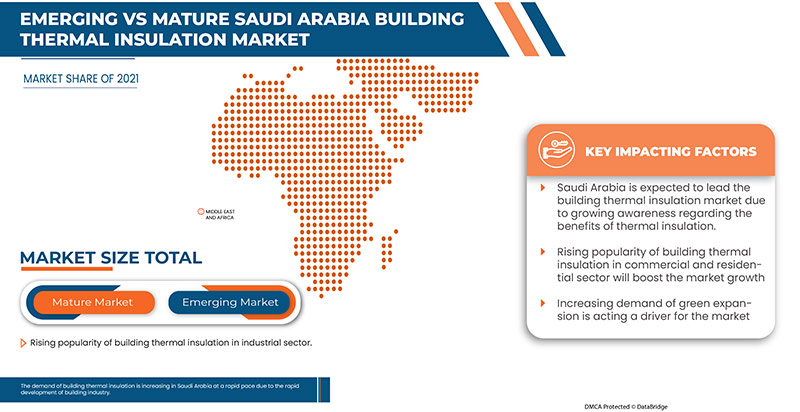
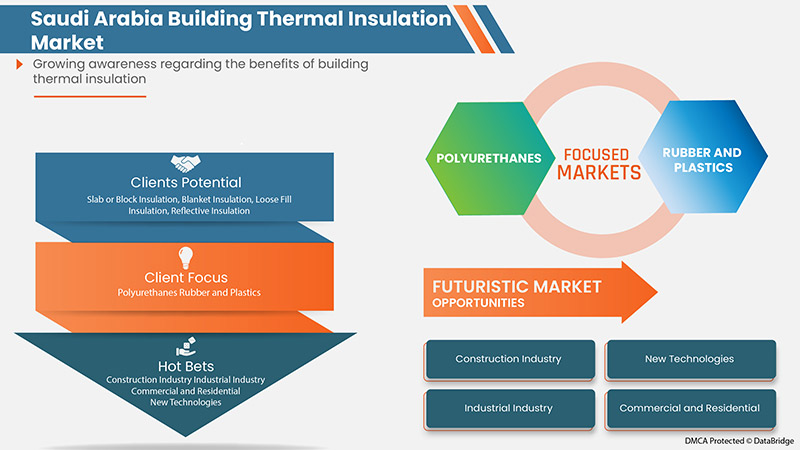
Les produits d'isolation thermique du bâtiment gagnent en popularité et sont largement utilisés dans l'industrie du bâtiment et de la construction, en particulier dans les secteurs résidentiel, commercial et industriel. Compte tenu de l'augmentation des investissements dans le développement de l'infrastructure et des initiatives gouvernementales favorables à la durabilité dans le pays, on s'attend à ce qu'ils permettent de stimuler la croissance du marché. De plus, plusieurs acteurs du marché investissent dans des activités de R-D pour lancer de nouveaux produits répondant aux besoins du secteur de l'infrastructure.
Le rapport du marché saoudien de l'isolation thermique fournit des détails sur la part de marché, les nouveaux développements et l'impact des acteurs du marché national et local, analyse les possibilités en termes de nouvelles poches de revenus, de changements dans la réglementation du marché, d'approbations de produits, de décisions stratégiques, de lancements de produits, d'expansions géographiques et d'innovations technologiques sur le marché. Pour comprendre l'analyse et le scénario du marché, contactez-nous pour un résumé d'analyste, notre équipe vous aidera à créer une solution d'impact sur les revenus pour atteindre votre objectif.
|
Rapport métrique |
Détails |
|
Période de prévision |
2022 à 2029 |
|
Année de référence |
2021 |
|
Année historique |
2020 (sur mesure jusqu ' en 2019-2014) |
|
Unités quantitatives |
Recettes en milliers de dollars des États-Unis |
|
Segments couverts |
Par produit (fibres de verre, laine minérale, mousse plastique, aérogels, cellulose, etc.), Isolation (plaque ou bloc, couverture, remplissage en vrac, réfléchissant, mousse de pulvérisation, etc.), Canal de distribution (hors ligne et en ligne), Application (toit, mur et plancher), Utilisation finale (résidentiel, commercial, entrepôts, institutionnel et industriel). |
|
Pays couverts |
Arabie saoudite |
|
Acteurs du marché couverts |
Saudi Rock Wool Factory, Arabian Fiberglass Insulation Company Ltd., BASF SE, SAINT-GOBAIN, Dow, DuPont, Wanhua Chemical Group Co., Ltd, MASCO, Clariant, PPG Industries, Inc., Fahad International Group, Saudi Vetonit Co. Ltd, Nippon Sheet Glass Co., Ltd, Sika AG, Fletcher Building et GAF |
Définition du marché
L'isolation thermique du bâtiment est une technologie qui contribue à réduire la consommation d'énergie dans les bâtiments en empêchant la perte de chaleur/gain par l'enveloppe du bâtiment. L'isolation thermique est composée de différents matériaux tels que la fibre de verre, la laine minérale, la mousse plastique, les aérogels, la cellulose, etc. La laine minérale est ensuite segmentée en laine de pierre et en laine de verre. Ces matériaux ont de grandes propriétés d'isolation thermique en raison de laquelle ils ont une large gamme d'applications dans les bâtiments de chauffage en Arabie Saoudite. L'isolation thermique réalisée avec de la laine minérale aide à maintenir la température requise en empêchant la perte de chaleur. D'autre part, l'isolation thermique en fibre de verre est l'un des matériaux d'isolation les plus populaires en raison de son rapport coût-efficacité et de son écologie. Il est composé de verre recyclé qui en fait une option écologique. L'isolation thermique produite à l'aide de divers matériaux a des applications étendues dans les complexes industriels, commerciaux et résidentiels.
La dynamique du marché de l'isolation thermique en Arabie saoudite
MÉDICAMENTS
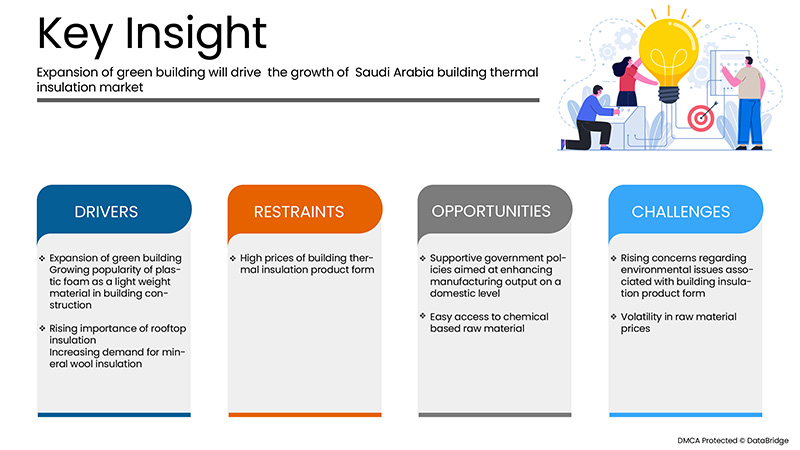
- Élargissement de la construction écologique
Les bâtiments verts sont moins toxiques pour l'environnement que les structures standard. Leur développement limite l'examen à proximité, permet d'économiser des biens normaux en utilisant des matériaux de construction facultatifs, et réutilise le gaspillage de développement au lieu d'envoyer de nombreux camions dans des décharges. Dans une grande partie d'un bâtiment vert, les espaces intérieurs ont un éclairage normal et des vues extérieures. Dans le même temps, des cadres d'air central profondément productifs (chauffage, ventilation et refroidissement) et des matériaux à faible teneur en composés organiques volatils (COV) (composés naturels imprévisibles) comme les meubles, la peinture et le revêtement de sol rendent l'air intérieur inégalé.
Un bâtiment durable ou vert est une structure qui, en raison de son développement et de sa construction, peut améliorer ou maintenir le niveau de l'environnement dans lequel il se trouve. Pour atteindre un niveau élevé de compétence, il est fondamental de réduire l'utilisation de l'énergie, de l'eau et de différents biens pour limiter la pollution. Les bâtiments verts sont également appelés structures d'exécution élite ou de maintenance. Il s'agit notamment de concevoir et d'utiliser des matériaux inoffensifs pour l'écosystème et de produire tous les biens grâce au modèle existant d'un bâtiment, y compris l'exploitation, la déconstruction, la construction, la rénovation de l'entretien, la conception et l'emplacement.
Les EAU ont le rythme le plus élevé d'utilisation de l'impératif dans la zone du Conseil de coopération du Golfe (CCG) et l'un des usages essentiels les plus surprenants par unité au monde.
Présenter les idées de structures vertes, de sécurité naturelle, d'augmentation de la température à l'échelle de la terre et de gestion dans les écoles et les plans d'enseignement collégial peut mettre en lumière des problèmes. De plus, les rassemblements et les expositions sur les structures vertes contribueront à élever la conscience publique et la conscience parmi les professionnels de terrain. Ces estimations de sensibilisation aideront à faire en sorte qu'un grand public admire les structures vertes et ouvre la voie à la coopération et au partage de l'information. La protection contre le changement est difficile à rater et nécessite une médiation gouvernementale, qui se souvient avoir commencé à diriger le peloton pour développer de nouvelles structures vertes et présenter de nouvelles lignes directrices (par exemple, des punitions et des impulsions).
- La popularité croissante de la mousse plastique comme matériau léger dans la construction de bâtiments
Le plastique devient mousse lorsqu'il est répondu par le spécialiste du soufflage. La mousse plastique est non fibreuse; aucun instrument de protection individuel n'est nécessaire pendant le montage. Diverses mousses de plastique comprennent le phénolique, le polyisocyanurate (PIR), le polystyrène, l'élastomère et le polyuréthane (PUR). L'énorme marché de la mousse plastique est attribuable à son application dans différentes gammes de températures. De même, le meilleur modèle de vie du matériau le rend raisonnable pour des applications telles que les murs, les planchers et les toits. Sa haute opposition chaleureuse, sa capacité d'adaptation, sa force et son espérance de vie suscitent son intérêt. Comme il est léger, la plupart des entreprises de construction en Arabie saoudite utilisent de la mousse plastique pendant la construction.
Les mousses plastiques sont traitées par des techniques de planification de surface similaires utilisées pour le polymère de base. Ceci est particulièrement valable pour les mousses thermoplastiques « primaires », par exemple le polycarbonate et l'oxyde de polyphénylène altéré. Parfois, ces mousses thermoplastiques peuvent être dissolvables et solidifiées. Les mousses thermorégulatrices les plus souvent éprouvées sont le polyuréthane, accessible en mousse souple, rigide et semi-rigide. La mousse rigide est réaliste en un grand nombre de densités. Avec leur surface étendue de matériaux authentiques découverts, les nuances plus denses seront plus simples à planifier par la procédure standard de ponçage souple et après élimination des résidus subséquents par vide ou brossage.
Les systèmes d'isolation en mousse de polyéthylène permettent de concevoir un complexe d'entreprises qui, dans une certaine mesure, garantissent l'efficacité énergétique de la construction, du logement et des objets spéciaux. L'exécution de l'idée de revêtement de protection cohérent permet de reconnaître les parties d'efficacité énergétique qui l'accompagnent. D'une certaine importance, c'est la fin des malheurs d'intensité directe à travers la protection ou, d'autre part, la conservation froide dans l'objet protégé. En outre, l'assurance de conceptions à partir d'effets climatiques extérieurs ou de conditions intérieures fortes contribue à la durabilité de ces conceptions.
Troisièmement, il est concevable de construire un microclimat intérieur idéal, dépendant de la raison utilitaire de l'article. Les parties économiques où sont utilisés les cadres de protection constante en mousse de polyéthylène concernent les développements privés et modernes, la construction de bureaux agricoles, la protection de bureaux sportifs et une région imaginative comme la préservation de la neige. Les cadres de protection à l'aide de mousse de polyéthylène avec un joint cohérent ont montré de grands résultats dans la protection des wagons, des entrepôts d'articles agricoles et des installations d'élevage. Dans les cadres examinés, il est possible de reconnaître les propriétés à la fois normales d'un large éventail d'éléments et spécifiques, qui devraient être réalisées pour traiter des questions fonctionnelles explicites.
- Importance croissante de l'isolation des toits
La demande est évaluée pour augmenter le niveau de protection des toits en raison de l'expansion rapide de l'industrie du développement. Des entreprises privées et non privées dans des pays comme la Chine, l'Arabie saoudite, l'Inde et les États-Unis sont à l'origine du marché ou du marché de la protection des toits. La restauration et la rénovation conduisent le marché dans ce fragment. Les matériaux utilisés pour la protection des toits comprennent la polaire en pierre, la mousse PUR et PIR, la mousse EPS et XPS, la laine en pierre, la mousse EPS, la mousse PUR et PIR et la mousse XPS. Les lignes directrices pour le développement de bâtiments économes en énergie sont censées affecter le marché dans la section des bâtiments privés. Les propriétés de l'isolation thermique du bâtiment sur des matériaux tels que la sécurité incendie et l'efficacité chaude élevée sont également évaluées pour accroître leur intérêt.
Les toits verts bénéficient de nombreux avantages biologiques. Ils offrent protection et refroidissement et diminuent l'intensité métropolitaine dans les communautés urbaines. Ils cachent un impact critique sur le refroidissement et diminuent la température. En outre, l'intensité ne se maintient pas dans un toit vert équivalent aux toits habituels. Là encore, ils sont viables dans la protection saine des structures, qui est un point important dans les régions métropolitaines, et de plus, ils améliorent une propension à la vie naturelle. Les toits verts nettoient également l'air et économisent l'énergie. Ils jouent un rôle essentiel dans l'eau pluviale et leur effet sur la diminution du dioxyde de carbone. En outre, ils sont utiles dans la création alimentaire et les angles de goût. La création et l'entretien des toits verts nécessitent quelques bureaux particuliers. Le toit vert peut être basé sur les assortiments du toit; cependant, dans les grandes parties des cas, ils sont développés sur les toits de niveau.
Malgré divers toits, ils ont différents styles de construction et de matériaux utilisés. Il y a une procédure pour construire des toits verts sur n'importe quel toit. Cependant, la question la plus connue est la limite du poids du chariot. Le moment le plus approprié pour construire un toit vert est l'heure de la construction d'une autre structure ou au moment où le sommet d'une structure actuelle doit être réparé ou remplacé; dans les deux cas, un expert principal devrait être employé pour la discussion afin de décider de la méthodologie appropriée pour construire un toit vert approprié.
Les toits verts sont de superbes revêtements de matériau qui empêchent la transition thermique à travers le toit. Ils comprennent des matériaux de protection qui sont des feuilles placées sur la surface du toit. Ces couvertures sont placées sous ou au-dessus de l'eau et des matériaux de toiture. S'il est fixé ci-dessus, il doit être fait de matériau adapté pour découvrir un état humide. Encore une fois, nous voulons une couche défensive de temps en temps puisque certaines couches de protection ne peuvent pas éviter des températures élevées. Les polyisocyanates, le polystyrène extrudeur, le polystyrène étendu et les feuilles de fresque sont les matériaux d'encaissement les plus connus sur le toit.
- Augmentation de la demande d'isolation en laine minérale
La laine minérale est un matériau naturel issu de la fusion de minéraux naturels dans les fours, et le produit est fabriqué. Il a une très faible conductivité thermique. L'isolation en laine minérale a représenté un développement important au cours de la période de jauge, attribuable aux qualités prédominantes du produit, notamment la compatibilité écologique, la sécurité incendie, la stabilité dimensionnelle et une barrière thermique efficace. L'expansion de la laine minérale dans les applications d'obstruction chaude stimulera son développement sur la période estimée. Il est léger en poids, fort, et facile à manipuler et couper pour convenir à des formes complexes. Il a une température de service maximale jusqu'à 800°C.
L'isolation de la laine minérale est produite à l'aide d'une combinaison de scories et de pierres, raison pour laquelle elle est également appelée protection Rockwool, protection de la laine de pierre, ou protection de la laine de laitier. La pierre ou le laitier est chauffé dans un chauffage jusqu'à ce qu'il devienne liquide. Puis, à ce moment-là, dans un cycle comme l'assemblage de sucreries de coton, la pierre liquide ou le laitier est tourné jusqu'à ce qu'il se refroidisse dans le développement de longs brins flasques. Les brins sont ensuite empilés les uns sur les autres. L'isolation de la laine minérale est utilisée dans les structures et les conceptions en raison de facteurs multiples. D'une certaine importance, cela ne conduit pas à bien chauffer. Ceci est significatif tout en essayant de garder une structure plus chaude ou plus froide que le climat externe. Comme les flammes sont un sujet de préoccupation pour les structures, la façon dont la laine minérale a besoin de combustion en fait un choix magnifique comme un encaissement. De même, la toison minérale est un magnifique amortisseur acoustique si la clameur est un souci tout en construisant une construction.
La protection primaire de la laine est principalement produite à l'aide de filaments de pierre comme le basalte liquide ou la diabase. Cette laine minérale est obtenue à partir de pierre volcanique, ramollie à environ 1600°C. Cette pierre dissoute est transformée en "fleece" et liée par divers goudrons et huiles. La seconde est produite à l'aide de scories tournantes. Le laitier est un sous-produit de la création d'acier. Les producteurs peuvent le faire à partir de pierre régulière ou un mélange de laitier liquide, de pierre normale, et de verre. Régulièrement, la protection des minéraux ou des pierres contient jusqu'à 90 % de contenu réutilisé.
OPPORTUNITÉ
- Politiques gouvernementales de soutien visant à améliorer la production manufacturière au niveau national
Mandeli (2008) déclare que le gouvernement saoudien a commencé à privatiser une partie des emplois de sa région, par exemple les installations récréatives, le nettoyage urbain, l'externalisation de l'approvisionnement en véhicules, la lutte antiparasitaire et différentes administrations. Il ne fait aucun doute que le gouvernement saoudien peut commencer à établir des contrats d'association avec la zone confidentielle. Toutefois, il s'agit de l'absence d'une base d'information vitale permettant d'examiner les avantages d'associations public-privé qui ont influencé l'impuissance des spécialistes de liaison et des spécialistes voisins à favoriser une structure légitime, des aspects d'exécution ou des évaluations des risques incontestables relativement à ces portes ouvertes acquises dans le cadre d'un programme privatisé. En outre, la force restreinte et légale des spécialistes voisins s'est intensifiée par un manque de personnel restreint l'extension après laquelle l'effort métropolitain peut créer (Mandeli, 2008). Le gouvernement saoudien peut immédiatement influencer l'exécution des structures supportables par le biais de la norme de construction saoudienne.
Le gouvernement assume une part énorme dans l'amélioration ou la dégradation de l'isolation thermique. Ils sont équipés pour fixer diverses lignes directrices qui favorisent la préservation de l'énergie et la compétence, ce qui oblige la population générale à appliquer des structures vertes. Simultanément, le résultat inverse peut être reconnu lorsqu'il n'est pas sérieusement tenu compte des lignes directrices en matière d'énergie. Par la suite, l'inaccessibilité ou la présence restreinte d'une structure de stratégie d'administration pour la préservation et la productivité de l'énergie s'attaque à un obstacle à l'amélioration de la structure verte. La mise en oeuvre de lignes directrices est essentielle au progrès des systèmes gouvernementaux.
RÉSULTATS/DISPOSITIONS
- Problèmes environnementaux liés à la forme de produit d'isolation des bâtiments
Le marché devrait être entravé par de graves inquiétudes en matière de protection thermique. Une longue ouverture à la laine de verre pendant l'interaction de l'établissement, par exemple, aggrave les yeux et le cadre respiratoire. Quelques examens ont montré que les processus d'extension et d'expulsion utilisés pour créer du polystyrène peuvent entraîner l'arrivée du styrène, qui provoque le cancer. Ces questions liées au bien-être devraient améliorer l'extension du marché et, par la suite, limiter les taux d'accueil.
L'isolation en fibre de verre est impuissante contre l'humidité. Contrairement aux options, par exemple, la planche à mousse ou l'isolation en mousse sous douche, la protection en fibre de verre humide perd toutes les valeurs R et n'a pratiquement aucune caractéristique de protection jusqu'à ce qu'elle sèche. Le Dampness pourrait polluer la protection dans les salles de stockage, une zone essentielle pour les battes en fibre de verre, en raison des rejets constants sur le toit ou de l'accumulation de base comme l'air chaud soyeux des espaces de vie sous se rassemble dans le loft et se consolide lorsque les températures diminuent autour du soir, en absorbant la protection. Au moment où l'humidité est présente dans l'isolation en fibre de verre, le développement des moules suit souvent. C'est plus courant dans la fibre de verre que dans les choix comme la cellulose de remplissage libre puisque la cellulose ne permet pas la progression libre de l'air qui transporte les spores de forme et transmet l'humidité. Les spores de forme aéroportée qui deviennent confortables, les brins de protection en fibre de verre s'épanouissent lorsqu'ils sont présentés à l'humidité de la fumée d'eau dans l'air ou l'accumulation. La forme peut être un bon ressort de la qualité de l'air intérieur indésirable et produire des effets secondaires hypersensibles chez les personnes sans défense.
L'une des meilleures techniques de protection des structures est la protection chaude de la mousse PUR. Un préjudice évident à cette technique de protection peut être son coût, par opposition à des stratégies différentes, qui pourraient sembler trop coûteuses. Il arrive juste que son coût soit équivalent à des stratégies de protection facultative. Tous les coûts seront récupérés au cours des deux années suivantes, et la solidité de l'isolation en mousse PUR est étonnamment longue. Lorsque vous regardez chacun des avantages de la protection contre la mousse de polyuréthane, l'obstacle jusqu'à ce que le coût devienne immatériel.
- Volatilité des prix des matières premières
Le marché des composés d'isolation thermique du bâtiment connaît des facteurs, notamment l'imprévisibilité des coûts de l'énergie et des substances naturelles et l'économie fluctuante. Par conséquent, ces variables permettent d'accélérer le rythme d'extension du marché pour les composés de construction. En outre, on suppose que le développement du marché serait entravé par la vulnérabilité qui englobe la modification des principes législatifs et des lignes directrices, ce qui élargit le temps distribué pour l'exécution des projets.
Développement récent
- En septembre 2022, le centre saoudien d'efficacité énergétique a demandé aux citoyens du pays d'assurer l'isolation thermique dans les bâtiments et d'économiser l'énergie. L'utilisation de l'isolation thermique peut réduire la consommation d'énergie électrique de près de 30% à 40%. Cette initiative du gouvernement devrait avoir une incidence positive sur la croissance globale du marché dans l'ensemble du pays.
Arabie Saoudite Construction du marché de l'isolation thermique
Le marché saoudien de l'isolation thermique est segmenté en fonction du produit, de l'isolation, du canal de distribution, de l'application et de l'utilisation finale. La croissance de ces segments vous aidera à analyser les principaux segments de croissance dans les industries et à fournir aux utilisateurs une vue d'ensemble et des perspectives de marché précieuses pour prendre des décisions stratégiques afin d'identifier les principales applications du marché.
Produit
- FIBERGLASS
- FEUILLE PLASTIQUE
- WOOL MINÉRAL
- AÉROGÈLES
- CELLULOSE
- AUTRES
Basé sur le produit, le marché est segmenté en fibre de verre, laine minérale, mousse plastique, aérogels, cellulose, etc.
Isolation
- SLAB OU BLOC
- BLANCHE
- TROUVEZ LE DÉPLACEMENT
- REFLECTIVE
- SPRAY FOAM
- AUTRES
Basé sur l'isolation, le marché est segmenté en dalle ou bloc, couverture, remplissage lâche, réfléchissant, mousse de pulvérisation, et d'autres.
Chaîne de distribution
- LIGNE
- EN LIGNE
Basé sur le canal de distribution, le marché est segmenté en ligne et hors ligne.
Demande
- ROI
- GAUCHE
- FLEURS
Selon l'application, le marché est segmenté en toit, mur et plancher.
Utilisation finale
- RÉSIDENTIEL
- COMMERCIAL
- EAU
- INSTITUTIONNEL
- INDUSTRIEL
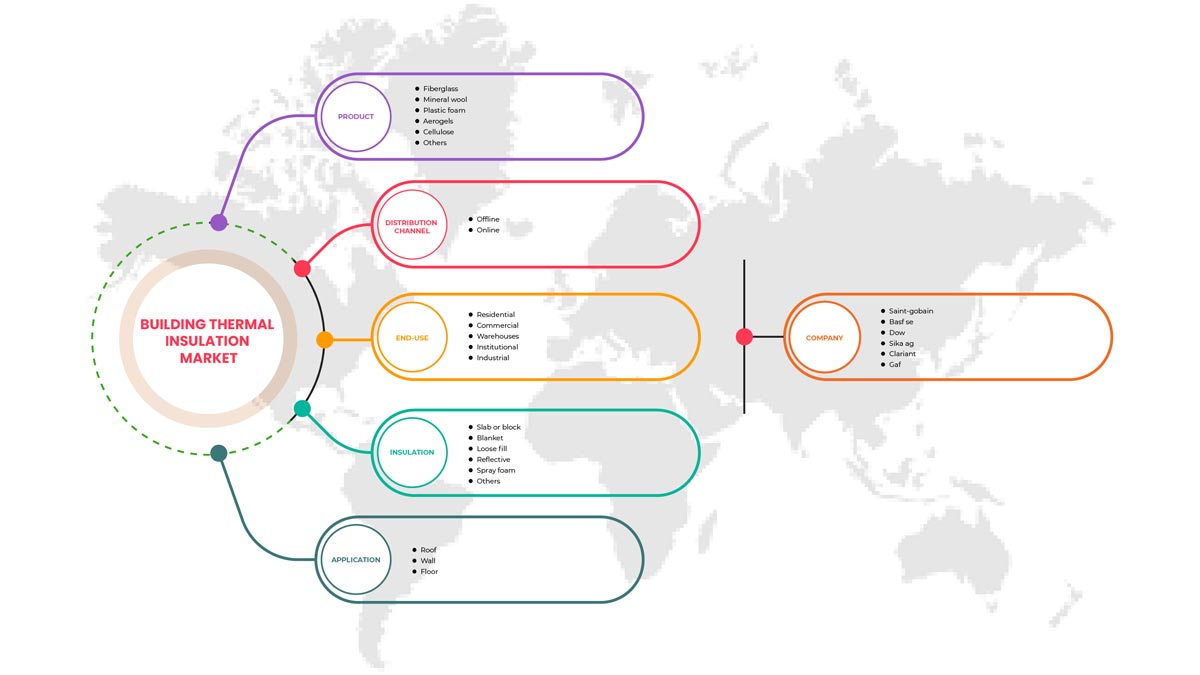
Selon l'utilisation finale, le marché est segmenté en secteurs commercial, résidentiel, des entrepôts, industriel et institutionnel.
Arabie saoudite Construction du marché de l'isolation thermique
Le marché saoudien de l'isolation thermique est segmenté en cinq segments importants, selon le produit, le type d'isolation, le canal de distribution, l'application et l'utilisation finale.
Le rapport présente également les facteurs qui influent sur le marché et les changements dans la réglementation du marché qui influent sur les tendances actuelles et futures du marché. L'analyse de la chaîne de valeur en aval et en amont, l'analyse des cinq forces du porteur de tendances techniques et les études de cas sont quelques-uns des indicateurs utilisés pour prévoir le scénario du marché pour l'Arabie saoudite. En outre, la présence et la disponibilité des marques saoudiennes et les difficultés qu ' elles rencontrent en raison de la concurrence importante ou rare des marques locales et nationales, ainsi que l ' impact des tarifs intérieurs et des itinéraires commerciaux sont pris en compte tout en fournissant des prévisions d ' analyse des données nationales.
Analyse de la part du marché de l'isolation thermique du bâtiment dans le paysage concurrentiel et l'Arabie saoudite
Le marché saoudien de l'isolation thermique fournit des détails par les concurrents. Les détails inclus sont l'aperçu de l'entreprise, les finances de l'entreprise, les revenus générés, le potentiel du marché, l'investissement dans la R-D, les nouvelles initiatives du marché, les sites et installations de production, les points forts et les faiblesses de l'entreprise, le lancement de produits, les pipelines d'essais de produits, les approbations de produits, les brevets, la largeur et l'étendue des produits, la prédominance des applications et la courbe de survie de la technologie. Les données ci-dessus fournies ne sont liées qu'à l'attention des entreprises liées au marché saoudien de l'isolation thermique.
Parmi les principaux participants sur le marché, mentionnons Saudi Rock Wool Factory, Arabian Fiberglass Insulation Company Ltd., BASF SE, SAINT-GOBAIN, Dow, DuPont, Wanhua Chemical Group Co., Ltd, MASCO, Clariant, PPG Industries, Inc., Fahad International Group, Saudi Vetonit Co. Ltd, Nippon Sheet Glass Co., Ltd, Sika AG, Fletcher Building et GAF.
Méthodologie de recherche
La collecte des données et l'analyse de l'année de référence se font à l'aide de modules de collecte de données de grande taille. Les données du marché sont analysées et estimées à l'aide de modèles statistiques et cohérents du marché. De plus, l'analyse de la part de marché et l'analyse des tendances clés sont les principaux facteurs de succès du rapport sur le marché. La principale méthodologie de recherche utilisée par l'équipe de recherche DBMR est la triangulation des données qui implique l'extraction de données, l'analyse de l'impact des variables de données sur le marché et la validation primaire (expert de l'industrie). Outre cela, les modèles de données comprennent les grilles de positionnement des fournisseurs, l'analyse de la ligne de temps du marché, l'aperçu et le guide du marché, les grilles de positionnement de l'entreprise, l'analyse des parts de marché de l'entreprise, les normes de mesure, l'analyse globale des V et l'analyse des parts de marché des fournisseurs. Veuillez demander un appel d'analyste en cas d'enquête complémentaire.
SKU-
Accédez en ligne au rapport sur le premier cloud mondial de veille économique

- Tableau de bord d'analyse de données interactif
- Tableau de bord d'analyse d'entreprise pour les opportunités à fort potentiel de croissance
- Accès d'analyste de recherche pour la personnalisation et les requêtes
- Analyse de la concurrence avec tableau de bord interactif
- Dernières actualités, mises à jour et analyse des tendances
- Exploitez la puissance de l'analyse comparative pour un suivi complet de la concurrence
Table des matières
1 INTRODUCTION
1.1 OBJECTIFS DE L'ÉTUDE
1.2 DÉFINITION DU MARCHÉ
1.3 APERÇU DU MARCHÉ DE L'ISOLATION THERMIQUE DES BÂTIMENTS EN ARABIE SAOUDITE
1.4 LIMITATION
1,5 MARCHÉS COUVERTS
2 SEGMENTATION DU MARCHÉ
2.1 MARCHÉS COUVERTS
2.2 PORTÉE GÉOGRAPHIQUE
2,3 ANS CONSIDÉRÉS POUR L'ÉTUDE
2.4 MONNAIE ET TARIFS
2.5 MODÈLE DE VALIDATION DES DONNÉES DU TRÉPIED DBMR
2.6 COURBE DE GAMME DE PRODUITS
2.7 MODÉLISATION MULTIVARIÉE
2.8 ENTRETIENS PRIMAIRES AVEC DES LEADERS D'OPINION CLÉS
2.9 GRILLE DE POSITIONNEMENT DU MARCHÉ DBMR
2.1 GRILLE DE COUVERTURE DES APPLICATIONS DU MARCHÉ
2.11 MATRICE DES DÉFIS DU MARCHÉ DBMR
2.12 ANALYSE DES PARTS DES FOURNISSEURS DBMR
2.13 SOURCES SECONDAIRES
2.14 HYPOTHÈSES
3 RÉSUMÉ EXÉCUTIF
4 INFORMATIONS PREMIUM
4.1 ANALYSE DU PILON
4.1.1 FACTEURS POLITIQUES
4.1.2 FACTEURS ÉCONOMIQUES
4.1.3 FACTEURS SOCIAUX
4.1.4 FACTEURS TECHNOLOGIQUES
4.1.5 FACTEURS JURIDIQUES
4.1.6 FACTEURS ENVIRONNEMENTAUX
4.2 SCÉNARIO DE DURABILITÉ
4.3 NORMES / CERTIFICATIONS
4.3.1 L'ORGANISATION SAOUDIENNE DE NORMALISATION, DE MÉTROLOGIE ET DE QUALITÉ (SASO)
4.3.2 CERTIFICATIONS ISO (ORGANISATION INTERNATIONALE DE NORMALISATION)
4.3.3 CERTIFICAT DE CONFORMITÉ DE PRODUIT SAOUDIEN (PCOC)
4.3.4 APPROBATION FM
4.3.5 CERTIFICATION VERTE
5 RÉGLEMENTATION
6. MARCHÉ DE L'ISOLATION THERMIQUE DES BÂTIMENTS EN ARABE SAOUDITE, ÉTAT DES LIEUX DU PAYS
7 APERÇU DU MARCHÉ
7.1 PILOTES
7.1.1 EXPANSION DE LA CONSTRUCTION ÉCOLOGIQUE
7.1.2 POPULARITÉ CROISSANTE DE LA MOUSSE PLASTIQUE COMME MATÉRIAU LÉGER DANS LA CONSTRUCTION DE BÂTIMENTS
7.1.3 IMPORTANCE CROISSANTE DE L'ISOLATION DES TOITS
7.1.4 DEMANDE CROISSANTE D'ISOLATION EN LAINE MINÉRALE
7.2 RETENUE
7.2.1 PRIX ÉLEVÉS DES PRODUITS D'ISOLATION THERMIQUE DU BÂTIMENT
7.3 OPPORTUNITÉS
7.3.1 POLITIQUES GOUVERNEMENTALES DE SOUTIEN VISANT À AMÉLIORER LA PRODUCTION MANUFACTURIÈRE AU NIVEAU NATIONAL
7.3.2 ACCÈS FACILE AUX MATIÈRES PREMIÈRES CHIMIQUES
7.4 DÉFIS
7.4.1 PRÉOCCUPATIONS CROISSANTES CONCERNANT LES PROBLÈMES ENVIRONNEMENTAUX ASSOCIÉS À LA FORME DES PRODUITS D'ISOLATION DES BÂTIMENTS
7.4.2 VOLATILITÉ DES PRIX DES MATIÈRES PREMIÈRES
8. MARCHÉ DE L'ISOLATION THERMIQUE DES BÂTIMENTS EN ARABIE SAOUDITE, PAR PRODUIT
8.1 APERÇU
8.2 FIBRE DE VERRE
8.2.1 MOUSSE PLASTIQUE
8.2.1.1 POLYSTYRÈNE
8.2.1.1.1 POLYSTYRÈNE EXPANSÉ (EPS)
8.2.1.1.2 POLYSTYRÈNE RÉTICULÉ (XPS)
8.2.1.2 PUR
8.2.1.3 POLYISOCYANURATE (PIR)
8.2.1.4 MOUSSE ÉLASTOMÈRE
8.2.1.5 AUTRES
8.2.2 LAINE MINÉRALE
8.2.2.1 LAINE DE ROCHE
8.2.2.2 LAINE DE VERRE
8.3 AÉROGEL
8.4 CELLULOSE
8,5 AUTRES
9 MARCHÉ DE L'ISOLATION THERMIQUE DES BÂTIMENTS EN ARABIE SAOUDITE, PAR ISOLATION
9.1 APERÇU
9.2 DALLE OU BLOC
9.2.1 COUVERTURE
9.2.1.1 LAMINÉ
9.2.1.2 BATT
9.3 REMPLISSAGE EN VRAC
9.4 RÉFLÉCHISSANT
9,5 MOUSSE EN SPRAY
9.6 AUTRES
10 Marché de l'isolation thermique des bâtiments en Arabie saoudite, par canal de distribution
10.1 APERÇU
10.2 HORS LIGNE
10.3 EN LIGNE
11 MARCHÉ DE L'ISOLATION THERMIQUE DES BÂTIMENTS EN ARABIE SAOUDITE, PAR APPLICATION
11.1 APERÇU
11.1.1 TOIT
11.1.1.1 PLAT
11.1.1.2 LANCE
11.1.2 MUR
11.1.2.1 INTERNE
11.1.2.2 EXTERNE
11.1.2.3 CAVITÉ
11.1.3 ÉTAGE
11.1.3.1 SOL EN BÉTON
11.1.3.2 PLANCHER SURÉLEVÉ EN BOIS
12 ARABIE SAOUDITE MARCHÉ DE L'ISOLATION THERMIQUE DES BÂTIMENTS, PAR UTILISATION FINALE
12.1 APERÇU
12.2 COMMERCIAL
12.2.1 COMMERCIAL, PAR PRODUIT
12.2.1.1 FIBRE DE VERRE
12.2.1.2 MOUSSE PLASTIQUE
12.2.1.3 LAINE MINÉRALE
12.2.1.4 AÉROGEL
12.2.1.5 CELLULOSE
12.2.1.6 AUTRES
12.2.2 COMMERCIAL, PAR SEGMENT
12.2.2.1 BUREAUX
12.2.2.2 STADES
12.2.2.3 HÔPITAUX
12.2.2.4 CENTRES COMMERCIAUX
12.2.2.5 MULTIPLEXES
12.2.2.6 BÂTIMENTS DE LOISIRS
12.2.2.7 AUTRES
12.3 RÉSIDENTIEL
12.3.1 RÉSIDENTIEL, PAR PRODUIT
12.3.1.1 FIBRE DE VERRE
12.3.1.2 MOUSSE PLASTIQUE
12.3.1.3 LAINE MINÉRALE
12.3.1.4 AÉROGEL
12.3.1.5 CELLULOSE
12.3.1.6 AUTRES
12.4 INDUSTRIEL
12.4.1 INDUSTRIEL, PAR PRODUIT
12.4.1.1 FIBRE DE VERRE
12.4.1.2 MOUSSE PLASTIQUE
12.4.1.3 LAINE MINÉRALE
12.4.1.4 AÉROGEL
12.4.1.5 CELLULOSE
12.4.1.6 AUTRES
12.5 ENTREPÔTS
12.5.1 ENTREPÔTS, PAR PRODUIT
12.5.1.1 FIBRE DE VERRE
12.5.1.2 MOUSSE PLASTIQUE
12.5.1.3 LAINE MINÉRALE
12.5.1.4 AÉROGEL
12.5.1.5 CELLULOSE
12.5.1.6 AUTRES
12.6 INSTITUTIONNEL
12.6.1 INSTITUTIONNEL, PAR PRODUIT
12.6.1.1 FIBRE DE VERRE
12.6.1.2 MOUSSE PLASTIQUE
12.6.1.3 LAINE MINÉRALE
12.6.1.4 AÉROGEL
12.6.1.5 CELLULOSE
12.6.1.6 AUTRES
12.6.2 INSTITUTIONNEL, PAR SEGMENT
12.6.2.1 ÉCOLES
12.6.2.2 UNIVERSITÉS
12.6.2.3 AUTRES
13 ARABIE SAOUDITE MARCHÉ DE L'ISOLATION THERMIQUE DES BÂTIMENTS, PAYSAGE DES ENTREPRISES
13.1 ANALYSE DES ACTIONS DE L'ENTREPRISE : ARABIE SAOUDITE
13.1.1 EXPANSION ET ACCORD
14 ANALYSE SWOT
15 PROFILS D'ENTREPRISE
15.1 SAINT-GOBAIN
15.1.1 INSTANTANÉ DE L'ENTREPRISE
15.1.2 ANALYSE DES REVENUS
15.1.3 PORTEFEUILLE DE PRODUITS
15.1.4 MISES À JOUR RÉCENTES
15.2 BASF SE
15.2.1 INSTANTANÉ DE L'ENTREPRISE
15.2.2 ANALYSE DES REVENUS
15.2.3 PORTEFEUILLE DE PRODUITS
15.2.4 MISES À JOUR RÉCENTES
15,3 DOW
15.3.1 INSTANTANÉ DE L'ENTREPRISE
15.3.2 ANALYSE DES REVENUS
15.3.3 PORTEFEUILLE DE PRODUITS
15.3.4 MISES À JOUR RÉCENTES
15.4 SIKA AG
15.4.1 INSTANTANÉ DE L'ENTREPRISE
15.4.2 ANALYSE DES REVENUS
15.4.3 PORTEFEUILLE DE PRODUITS
15.4.4 MISES À JOUR RÉCENTES
15,5 CLARIANT AG
15.5.1 INSTANTANÉ DE L'ENTREPRISE
15.5.2 ANALYSE DES REVENUS
15.5.3 PORTEFEUILLE DE PRODUITS
15.5.4 MISE À JOUR RÉCENTE
15,6 GAF
15.6.1 INSTANTANÉ DE L'ENTREPRISE
15.6.2 PORTEFEUILLE DE PRODUITS
15.6.3 MISES À JOUR RÉCENTES
15.7 DUPONT
15.7.1 INSTANTANÉ DE L'ENTREPRISE
15.7.2 ANALYSE DES REVENUS
15.7.3 PORTEFEUILLE DE PRODUITS
15.7.4 MISES À JOUR RÉCENTES
15,8 PPG INDUSTRIES, INC.
15.8.1 INSTANTANÉ DE L'ENTREPRISE
15.8.2 ANALYSE DES REVENUS
15.8.3 PORTEFEUILLE DE PRODUITS
15.8.4 MISES À JOUR RÉCENTES
15.9 USINE SAOUDIENNE DE LAINE DE ROCHE
15.9.1 INSTANTANÉ DE L'ENTREPRISE
15.9.2 PORTEFEUILLE DE PRODUITS
15.9.3 MISES À JOUR RÉCENTES
15.1 GROUPE FAHAD INTERNATIONAL
15.10.1 INSTANTANÉ DE L'ENTREPRISE
15.10.2 PORTEFEUILLE DE PRODUITS
15.10.3 MISES À JOUR RÉCENTES
15.11 SOCIÉTÉ ARABIENNE D'ISOLATION EN FIBRE DE VERRE LTD.
15.11.1 INSTANTANÉ DE L'ENTREPRISE
15.11.2 PORTEFEUILLE DE PRODUITS
15.11.3 MISES À JOUR RÉCENTES
15.12 SAUDI VETONIT CO. LTD.
15.12.1 INSTANTANÉ DE L'ENTREPRISE
15.12.2 PORTEFEUILLE DE PRODUITS
15.12.3 MISE À JOUR RÉCENTE
15.13 NIPPON SHEET GLASS CO., LTD.
15.13.1 INSTANTANÉ DE L'ENTREPRISE
15.13.2 ANALYSE DES REVENUS
15.13.3 PORTEFEUILLE DE PRODUITS
15.13.4 MISE À JOUR RÉCENTE
15.14 WANHUA CHEMICAL GROUP CO.LTD.
15.14.1 INSTANTANÉ DE L'ENTREPRISE
15.14.2 ANALYSE DES REVENUS
15.14.3 PORTEFEUILLE DE PRODUITS
15.14.4 MISE À JOUR RÉCENTE
15.15 MASCO CORP.
15.15.1 INSTANTANÉ DE L'ENTREPRISE
15.15.2 ANALYSE DES REVENUS
15.15.3 PORTEFEUILLE DE PRODUITS
15.15.4 MISE À JOUR RÉCENTE
15.16 BÂTIMENT FLECTCHER LTÉE.
15.16.1 INSTANTANÉ DE L'ENTREPRISE
15.16.2 ANALYSE DES REVENUS
15.16.3 PORTEFEUILLE DE PRODUITS
15.16.4 MISES À JOUR RÉCENTES
16 QUESTIONNAIRE
17 RAPPORTS CONNEXES
Liste des tableaux
TABLEAU 1 MARCHÉ DE L'ISOLATION THERMIQUE DES BÂTIMENTS EN ARABIE SAOUDITE, PAR PRODUIT, 2020-2029 (EN MILLIERS USD)
TABLEAU 2 MARCHÉ DE L'ISOLATION THERMIQUE DES BÂTIMENTS EN ARABIE SAOUDITE, PAR PRODUIT, 2020-2029 (TONNES)
TABLEAU 3 ARABIE SAOUDITE MOUSSE PLASTIQUE SUR LE MARCHÉ DE L'ISOLATION THERMIQUE DU BÂTIMENT, PAR SEGMENT, 2020-2029 (EN MILLIERS USD)
TABLEAU 4 ARABIE SAOUDITE POLYSTYRÈNE DANS LA MOUSSE PLASTIQUE SUR LE MARCHÉ DE L'ISOLATION THERMIQUE DU BÂTIMENT, PAR SEGMENT, 2020-2029 (MILLIERS USD)
TABLEAU 5 ARABIE SAOUDITE LAINE MINÉRALE SUR LE MARCHÉ DE L'ISOLATION THERMIQUE DU BÂTIMENT, PAR SEGMENT, 2020-2029 (EN MILLIERS USD)
TABLEAU 6 MARCHÉ DE L'ISOLATION THERMIQUE DES BÂTIMENTS EN ARABIE SAOUDITE, PAR ISOLATION, 2020-2029 (EN MILLIERS USD)
TABLEAU 7 MARCHÉ DE L'ISOLATION THERMIQUE DES BÂTIMENTS EN ARABIE SAOUDITE, PAR ISOLATION, 2020-2029 (TONNES)
TABLEAU 8 ARABIE SAOUDITE : COUVERTURE DU MARCHÉ DE L'ISOLATION THERMIQUE DES BÂTIMENTS, PAR SEGMENT, 2020-2029 (EN MILLIERS USD)
TABLEAU 9 MARCHÉ DE L'ISOLATION THERMIQUE DES BÂTIMENTS EN ARABIE SAOUDITE, PAR CANAL DE DISTRIBUTION, 2020-2029 (EN MILLIERS USD)
TABLEAU 10 MARCHÉ DE L'ISOLATION THERMIQUE DES BÂTIMENTS EN ARABIE SAOUDITE, PAR ISOLATION, 2020-2029 (TONNES)
TABLEAU 11 MARCHÉ DE L'ISOLATION THERMIQUE DES BÂTIMENTS EN ARABIE SAOUDITE, PAR APPLICATION, 2020-2029 (EN MILLIERS USD)
TABLEAU 12 MARCHÉ DE L'ISOLATION THERMIQUE DES BÂTIMENTS EN ARABIE SAOUDITE, PAR APPLICATION, 2020-2029 (TONNES)
TABLEAU 13 ARABIE SAOUDITE MARCHÉ DE L'ISOLATION THERMIQUE DES TOITS DANS LES BÂTIMENTS, PAR SEGMENT, 2020-2029 (EN MILLIERS USD)
TABLEAU 14 ARABIE SAOUDITE MARCHÉ DE L'ISOLATION THERMIQUE DES MURS DANS LES BÂTIMENTS, PAR SEGMENT, 2020-2029 (EN MILLIERS USD)
TABLEAU 15 ARABIE SAOUDITE ÉTAGE SUR LE MARCHÉ DE L'ISOLATION THERMIQUE DES BÂTIMENTS, PAR SEGMENT, 2020-2029 (MILLIERS USD)
TABLEAU 16 MARCHÉ DE L'ISOLATION THERMIQUE DES BÂTIMENTS EN ARABIE SAOUDITE, PAR UTILISATION FINALE, 2020-2029 (EN MILLIERS USD)
TABLEAU 17 MARCHÉ DE L'ISOLATION THERMIQUE DES BÂTIMENTS EN ARABIE SAOUDITE, PAR UTILISATION FINALE, 2020-2029 (TONNES)
TABLEAU 18 ARABIE SAOUDITE MARCHÉ DE L'ISOLATION THERMIQUE COMMERCIALE DANS LE BÂTIMENT, PAR PRODUIT, 2020-2029 (EN MILLIERS USD)
TABLEAU 19 ARABIE SAOUDITE MARCHÉ DE L'ISOLATION THERMIQUE COMMERCIALE DANS LES BÂTIMENTS, PAR SEGMENT, 2020-2029 (EN MILLIERS USD)
TABLEAU 20 ARABIE SAOUDITE MARCHÉ DE L'ISOLATION THERMIQUE RÉSIDENTIELLE DANS LES BÂTIMENTS, PAR PRODUIT, 2020-2029 (EN MILLIERS USD)
TABLEAU 21 MARCHÉ DE L'ISOLATION THERMIQUE INDUSTRIELLE DU BÂTIMENT EN ARABIE SAOUDITE, PAR PRODUIT, 2020-2029 (EN MILLIERS USD)
TABLEAU 22 ENTREPÔTS EN ARABIE SAOUDITE SUR LE MARCHÉ DE L'ISOLATION THERMIQUE DES BÂTIMENTS, PAR PRODUIT, 2020-2029 (EN MILLIERS USD)
TABLEAU 23 ARABIE SAOUDITE MARCHÉ INSTITUTIONNEL DE L'ISOLATION THERMIQUE DU BÂTIMENT, PAR PRODUIT, 2020-2029 (EN MILLIERS USD)
TABLEAU 24 ARABIE SAOUDITE MARCHÉ INSTITUTIONNEL DE L'ISOLATION THERMIQUE DU BÂTIMENT, PAR SEGMENT, 2020-2029 (EN MILLIERS USD)
Liste des figures
FIGURE 1 MARCHÉ DE L'ISOLATION THERMIQUE DES BÂTIMENTS EN ARABIE SAOUDITE : SEGMENTATION
FIGURE 2 MARCHÉ DE L'ISOLATION THERMIQUE DES BÂTIMENTS EN ARABIE SAOUDITE : TRIANGULATION DES DONNÉES
FIGURE 3 MARCHÉ DE L'ISOLATION THERMIQUE DES BÂTIMENTS EN ARABIE SAOUDITE : ANALYSE DROC
FIGURE 4 MARCHÉ DE L'ISOLATION THERMIQUE DES BÂTIMENTS EN ARABIE SAOUDITE : ANALYSE DU MARCHÉ EN ARABIE SAOUDITE
FIGURE 5 MARCHÉ DE L'ISOLATION THERMIQUE DES BÂTIMENTS EN ARABIE SAOUDITE : ANALYSE DE LA RECHERCHE DES ENTREPRISES
FIGURE 6 MARCHÉ DE L'ISOLATION THERMIQUE DES BÂTIMENTS EN ARABIE SAOUDITE : LA COURBE DE VIE DU PRODUIT
FIGURE 7 MARCHÉ DE L'ISOLATION THERMIQUE DES BÂTIMENTS EN ARABIE SAOUDITE : MODÉLISATION MULTIVARIABLE
FIGURE 8 MARCHÉ DE L'ISOLATION THERMIQUE DES BÂTIMENTS EN ARABIE SAOUDITE : DÉMOGRAPHIE DES ENTRETIENS
FIGURE 9 MARCHÉ DE L'ISOLATION THERMIQUE DES BÂTIMENTS EN ARABIE SAOUDITE : GRILLE DE POSITIONNEMENT DU MARCHÉ DBMR
FIGURE 10 MARCHÉ DE L'ISOLATION THERMIQUE DES BÂTIMENTS EN ARABIE SAOUDITE : GRILLE DE COUVERTURE DES APPLICATIONS DU MARCHÉ
FIGURE 11 MARCHÉ DE L'ISOLATION THERMIQUE DES BÂTIMENTS EN ARABIE SAOUDITE : LA MATRICE DES DÉFIS DU MARCHÉ
FIGURE 12 MARCHÉ DE L'ISOLATION THERMIQUE DES BÂTIMENTS EN ARABIE SAOUDITE : ANALYSE DE LA PART DES FOURNISSEURS
FIGURE 13 MARCHÉ DE L'ISOLATION THERMIQUE DES BÂTIMENTS EN ARABIE SAOUDITE : SEGMENTATION
FIGURE 14 L'AUGMENTATION DES DÉPENSES DANS LES GRANDES INFRASTRUCTURES COMMERCIALES ET SPORTIVES DEVRAIT STIMULER LE MARCHÉ DE L'ISOLATION THERMIQUE DES BÂTIMENTS EN ARABIE SAOUDITE AU COURS DE LA PÉRIODE DE PRÉVISION
FIGURE 15 LE SEGMENT DE LA FIBRE DE VERRE DEVRAIT REPRÉSENTER LA PLUS GRANDE PART DU MARCHÉ DE L'ISOLATION THERMIQUE DES BÂTIMENTS EN ARABIE SAOUDITE EN 2022 ET 2029
FIGURE 16 MOTEURS, CONTRAINTES, OPPORTUNITÉS ET DÉFIS DU MARCHÉ DE L'ISOLATION THERMIQUE DES BÂTIMENTS EN ARABIE SAOUDITE
FIGURE 17 MARCHÉ DE L'ISOLATION THERMIQUE DES BÂTIMENTS EN ARABIE SAOUDITE : PAR PRODUIT, 2021
FIGURE 18 MARCHÉ DE L'ISOLATION THERMIQUE DES BÂTIMENTS EN ARABIE SAOUDITE : PAR ISOLATION, 2021
FIGURE 19 MARCHÉ DE L'ISOLATION THERMIQUE DES BÂTIMENTS EN ARABIE SAOUDITE : PAR CANAL DE DISTRIBUTION, 2021
FIGURE 20 MARCHÉ DE L'ISOLATION THERMIQUE DES BÂTIMENTS EN ARABIE SAOUDITE : PAR APPLICATION, 2021
FIGURE 21 MARCHÉ DE L'ISOLATION THERMIQUE DES BÂTIMENTS EN ARABIE SAOUDITE : PAR UTILISATION FINALE, 2021
FIGURE 22 MARCHÉ DE L'ISOLATION THERMIQUE DES BÂTIMENTS EN ARABIE SAOUDITE : PART DES ENTREPRISES 2021 (%)

Méthodologie de recherche
La collecte de données et l'analyse de l'année de base sont effectuées à l'aide de modules de collecte de données avec des échantillons de grande taille. L'étape consiste à obtenir des informations sur le marché ou des données connexes via diverses sources et stratégies. Elle comprend l'examen et la planification à l'avance de toutes les données acquises dans le passé. Elle englobe également l'examen des incohérences d'informations observées dans différentes sources d'informations. Les données de marché sont analysées et estimées à l'aide de modèles statistiques et cohérents de marché. De plus, l'analyse des parts de marché et l'analyse des tendances clés sont les principaux facteurs de succès du rapport de marché. Pour en savoir plus, veuillez demander un appel d'analyste ou déposer votre demande.
La méthodologie de recherche clé utilisée par l'équipe de recherche DBMR est la triangulation des données qui implique l'exploration de données, l'analyse de l'impact des variables de données sur le marché et la validation primaire (expert du secteur). Les modèles de données incluent la grille de positionnement des fournisseurs, l'analyse de la chronologie du marché, l'aperçu et le guide du marché, la grille de positionnement des entreprises, l'analyse des brevets, l'analyse des prix, l'analyse des parts de marché des entreprises, les normes de mesure, l'analyse globale par rapport à l'analyse régionale et des parts des fournisseurs. Pour en savoir plus sur la méthodologie de recherche, envoyez une demande pour parler à nos experts du secteur.
Personnalisation disponible
Data Bridge Market Research est un leader de la recherche formative avancée. Nous sommes fiers de fournir à nos clients existants et nouveaux des données et des analyses qui correspondent à leurs objectifs. Le rapport peut être personnalisé pour inclure une analyse des tendances des prix des marques cibles, une compréhension du marché pour d'autres pays (demandez la liste des pays), des données sur les résultats des essais cliniques, une revue de la littérature, une analyse du marché des produits remis à neuf et de la base de produits. L'analyse du marché des concurrents cibles peut être analysée à partir d'une analyse basée sur la technologie jusqu'à des stratégies de portefeuille de marché. Nous pouvons ajouter autant de concurrents que vous le souhaitez, dans le format et le style de données que vous recherchez. Notre équipe d'analystes peut également vous fournir des données sous forme de fichiers Excel bruts, de tableaux croisés dynamiques (Fact book) ou peut vous aider à créer des présentations à partir des ensembles de données disponibles dans le rapport.











