Asia-Pacific Dry Eye Syndrome Treatment Market, By Drug Class (Anti-inflammatory Drugs, Artificial Tears, Secretagogues, Autologous Serum Eye Drops, Others), Route of Administration (Topical, Oral, Others), End-Users (Hospitals, Ophthalmic Clinics, Others), Distribution Channel (Hospital Pharmacy, Retail Pharmacy, Online Pharmacy) – Industry Trends and Forecast to 2032
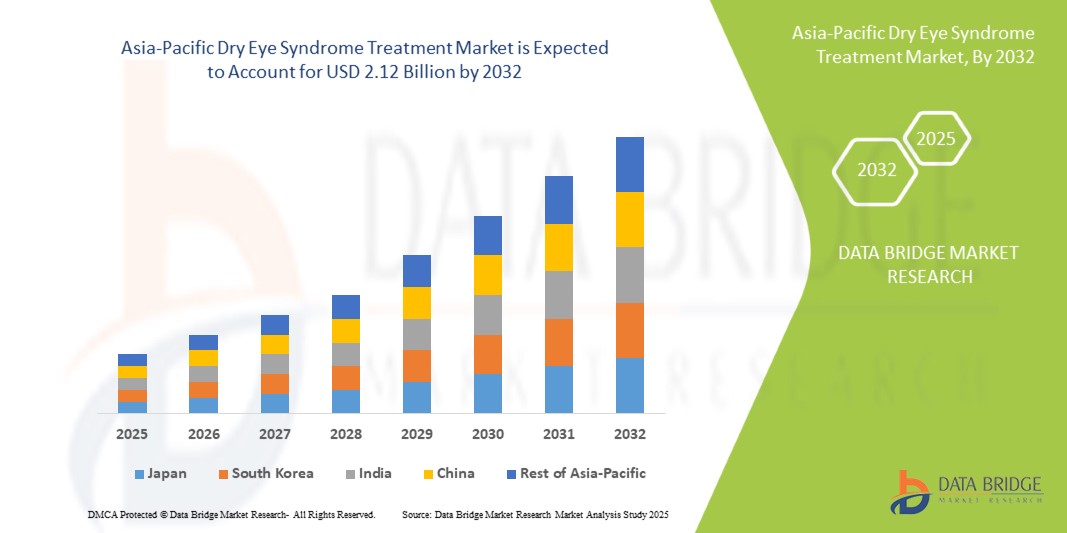
Dry Eye Syndrome Treatment Market Size
- The Asia-Pacific Dry Eye Syndrome Treatment Market was valued at USD 1.04 billion in 2024 and is expected to reach USD 2.12 billion by 2032.
- During the forecast period of 2025 to 2032, the market is projected to grow at a CAGR of 9.1%, primarily driven by the increasing prevalence of dry eye associated with screen exposure, environmental pollution, and aging demographics.
- This growth is fueled by factors such as a surge in digital device usage, growing awareness about ocular surface disorders, and advancements in tear film diagnostics and therapies.
Dry Eye Syndrome Treatment Market Analysis
- The Asia-Pacific Dry Eye Syndrome Treatment Market is anticipated to experience robust growth during the forecast period, with a CAGR of 9.1% from 2025 to 2032.
- Dry Eye Syndrome (DES), also known as keratoconjunctivitis sicca, is a multifactorial disease affecting the tear film and ocular surface, commonly caused by meibomian gland dysfunction, environmental factors, and systemic medications.
- The market is being driven by a rising demand for preservative-free artificial tears, development of novel anti-inflammatory eye drops, and incorporation of regenerative medicine such as autologous serum-based treatments.
- Factors such as increasing healthcare infrastructure, improved accessibility to specialized eye care, and a rise in awareness campaigns across emerging countries like India, China, and Southeast Asia are expected to support market expansion
Report Scope andDry Eye Syndrome Treatment Market Segmentation
|
Attributes |
Dry Eye Syndrome Treatment KeyMarket Insights |
|
Segments Covered |
|
|
Countries Covered |
Asia-Pacific
|
|
Key Market Players |
|
|
Market Opportunities |
Growing healthcare facilities Rise in the prevalence of delirium |
|
Value Added Data Infosets |
In addition to the insights on market scenarios such as market value, growth rate, segmentation, geographical coverage, and major players, the market reports curated by the Data Bridge Market Research also include import export analysis, production capacity overview, production consumption analysis, price trend analysis, climate change scenario, supply chain analysis, value chain analysis, raw material/consumables overview, vendor selection criteria, PESTLE Analysis, Porter Analysis, and regulatory framework. |
- Asia-Pacific Dry Eye Syndrome Treatment Market Trends
“Shift Toward Biologic and Targeted Immunomodulatory Therapies”
A key trend in the Asia-Pacific Dry Eye Syndrome Treatment market is the growing adoption of biologic agents and targeted therapies, particularly for cases associated with autoimmune conditions and chronic inflammatory diseases that are unresponsive to conventional corticosteroids. The region is increasingly focusing on TNF-alpha inhibitors, IL-6 antagonists, and T-cell modulators to manage inflammation at the molecular level with higher precision.
- For instance, adalimumab, a TNF-alpha inhibitor, has seen expanded use in several Asia-Pacific countries for non-infectious intermediate and posterior uveitis, offering prolonged remission and fewer relapses.
- The integration of optical coherence tomography (OCT), AI-based diagnostic tools, and personalized medicine platforms is optimizing disease monitoring and therapeutic decisions.
Additionally, advancements in long-acting ocular drug delivery systems, including depot formulations and intraocular implants, are significantly enhancing patient adherence and minimizing systemic adverse effects.
Asia-Pacific Dry Eye Syndrome Treatment Market Dynamics
Driver
“Growing Prevalence of Autoimmune and Inflammatory Eye Diseases”
The incidence of inflammatory eye disorders is on the rise in Asia-Pacific due to increasing autoimmune diseases and environmental triggers that affect ocular health.
For instance:
- According to the Asia-Pacific Academy of Ophthalmology (2023), inflammatory uveitis contributes significantly to visual impairment in the region, with autoimmune diseases such as Behçet’s disease and VKH syndrome being prevalent causes.
- The chronic nature and risk of vision loss associated with these conditions are driving demand for long-term, steroid-sparing therapies that provide both efficacy and safety.
“Regulatory Advancements and Fast-Track Designations for Biologics”
Progressive regulatory initiatives and increased funding for biologic drug development are accelerating the introduction of novel treatments for uveitic and dry eye conditions in Asia-Pacific.
For example:
- In countries like Japan, South Korea, and Australia, regulatory agencies have granted priority review and orphan drug status to biologics addressing non-infectious uveitis, enabling quicker market entry and improved treatment availability.
Opportunity
“Pipeline Expansion and Partnerships for Innovative Drug Development”
The Asia-Pacific Dry Eye Syndrome Treatment market is experiencing strong growth due to increased R&D, cross-border collaborations, and investments in novel therapeutic mechanisms.
For example:
- Regional pharmaceutical companies are investigating kinase inhibitors, S1P receptor modulators, and microbiome-derived therapies as next-generation treatments.
- Collaborations between universities, biotech firms, and government agencies are fostering innovation, particularly in emerging markets like India and China, where unmet needs remain high.
- The push for personalized medicine and development of first-in-class treatments is creating vast opportunities across diversified patient segments.
Restraint/Challenge
“Cost Constraints and Variability in Treatment Outcomes”
Despite technological advancements, the high cost of biologics and targeted therapies remains a significant barrier in several Asia-Pacific markets, particularly in developing countries.Access to sophisticated diagnostic tools and advanced medications is still limited across rural and underserved areas, affecting equitable treatment delivery.Patient response variability, driven by genetic diversity, environmental exposures, and microbiome composition, adds complexity to achieving uniform therapeutic success.
For example:
- tofacitinib has demonstrated clinical efficacy in autoimmune-related eye conditions, its high cost, risk of serious side effects, and the need for frequent monitoring hinder its broader use in routine care across the Asia-Pacific region
Dry Eye Syndrome Treatment market Scope
The market is segmented on the basis of type, drug class, application, dosage, route of administration, end-users, and distribution channel.
|
Segmentation |
Sub-Segmentation |
|
Drug Class |
|
|
Route of Administration |
|
|
End-Users |
|
|
Distribution Channel |
|
Asia Pacific Dry Eye Syndrome Treatment Market Regional Analysis
“North America is the Dominant Region in the Dry Eye Syndrome Treatment market”
- North America dominates the Asia Pacific Dry Eye Syndrome Treatment market owing to its advanced pharmaceutical ecosystem, robust healthcare infrastructure, and high awareness of ocular health and uveitis management.
- The United States holds the largest market share in this region, driven by a high incidence of uveitis, availability of specialized ophthalmologists, and rising cases of autoimmune conditions linked with uveitis.
- The region benefits from substantial R&D funding, presence of major drug manufacturers, and a strong regulatory environment led by the JAPAN. Food and Drug Administration (FDA), which ensures drug safety and efficacy.
- Increasing demand for biologics, corticosteroids, and immunosuppressive therapies along with rising adoption of advanced diagnostic tools contributes to continued market expansion.
- Collaborations between academic research institutions and pharmaceutical giants, alongside clinical advancements and innovation in drug delivery systems, are fostering growth in this region.
“Asia-Pacific is Projected to Register the Highest Growth Rate”
- The Asia-Pacific region is expected to exhibit the fastest growth in the Dry Eye Syndrome Treatment market, owing to increasing healthcare investments, a growing patient population, and improving access to specialty care.
- Key countries such as India, China, Japan, and South Korea are leading this growth, supported by rising awareness of uveitis, increasing prevalence of infectious and non-infectious forms of the disease, and improved ophthalmology services.
- Supportive government policies to enhance domestic pharmaceutical production and reduce reliance on imports are accelerating regional development.
- Japan, with its aging population and high healthcare standards, has shown strong adoption of advanced uveitis treatments and contributes significantly to regional market progress.
- A surge in clinical trials, expansion of biosimilar manufacturing, and collaborations between Asia Pacific pharmaceutical leaders and local players are expected to drive long-term growth across Asia-Pacific.
Dry Eye Syndrome Treatment Market Share
The competitive landscape provides comprehensive insights into key market players, detailing their profiles, financial data, R&D efforts, product portfolios, operational footprint, manufacturing capacity, strategic initiatives, strengths, weaknesses, and contributions to the uveitis treatment segment.
The Major Market Leaders Operating in the Market Include:
- AbbVie Inc.
- Novartis AG
- Bausch + Lomb
- Johnson & Johnson Services, Inc.
- Allergan (a subsidiary of AbbVie)
- Santen Pharmaceutical Co., Ltd.
- Eyegate Pharmaceuticals, Inc.
- EyePoint Pharmaceuticals, Inc.
- Alimera Sciences
- Clearside Biomedical, Inc.
- Teva Pharmaceutical Industries Ltd.
- Sun Pharmaceutical Industries Ltd.
- Pfizer Inc.
- Roche Holding AG
- Regeneron Pharmaceuticals, Inc.
- Amgen Inc.
- Acelyrin, Inc.
- MeiraGTx Holdings plc
- Ocugen, Inc.
- Aldeyra Therapeutics, Inc.
Latest Developments in Asia Pacific Dry Eye Syndrome Treatment Market
- In March 2022, a report from the International Agency for the Prevention of Blindness outlined significant challenges in the Dry Eye Syndrome Treatmentsector, including gaps in early diagnosis, high treatment costs, and the complexity of managing chronic and recurrent forms of the disease.
- The report also emphasized the growing importance of green chemistry, continuous manufacturing technologies, and regional self-reliance in reducing supply disruptions. Increased industry focus on API traceability and quality assurance is driving a shift toward more sustainable and transparent production practices in gastrointestinal therapeutics
SKU-
世界初のマーケットインテリジェンスクラウドに関するレポートにオンラインでアクセスする
- インタラクティブなデータ分析ダッシュボード
- 成長の可能性が高い機会のための企業分析ダッシュボード
- カスタマイズとクエリのためのリサーチアナリストアクセス
- インタラクティブなダッシュボードによる競合分析
- 最新ニュース、更新情報、トレンド分析
- 包括的な競合追跡のためのベンチマーク分析のパワーを活用
調査方法
データ収集と基準年分析は、大規模なサンプル サイズのデータ収集モジュールを使用して行われます。この段階では、さまざまなソースと戦略を通じて市場情報または関連データを取得します。過去に取得したすべてのデータを事前に調査および計画することも含まれます。また、さまざまな情報ソース間で見られる情報の不一致の調査も含まれます。市場データは、市場統計モデルと一貫性モデルを使用して分析および推定されます。また、市場シェア分析と主要トレンド分析は、市場レポートの主要な成功要因です。詳細については、アナリストへの電話をリクエストするか、お問い合わせをドロップダウンしてください。
DBMR 調査チームが使用する主要な調査方法は、データ マイニング、データ変数が市場に与える影響の分析、および一次 (業界の専門家) 検証を含むデータ三角測量です。データ モデルには、ベンダー ポジショニング グリッド、市場タイムライン分析、市場概要とガイド、企業ポジショニング グリッド、特許分析、価格分析、企業市場シェア分析、測定基準、グローバルと地域、ベンダー シェア分析が含まれます。調査方法について詳しくは、お問い合わせフォームから当社の業界専門家にご相談ください。
カスタマイズ可能
Data Bridge Market Research は、高度な形成的調査のリーダーです。当社は、既存および新規のお客様に、お客様の目標に合致し、それに適したデータと分析を提供することに誇りを持っています。レポートは、対象ブランドの価格動向分析、追加国の市場理解 (国のリストをお問い合わせください)、臨床試験結果データ、文献レビュー、リファービッシュ市場および製品ベース分析を含めるようにカスタマイズできます。対象競合他社の市場分析は、技術ベースの分析から市場ポートフォリオ戦略まで分析できます。必要な競合他社のデータを、必要な形式とデータ スタイルでいくつでも追加できます。当社のアナリスト チームは、粗い生の Excel ファイル ピボット テーブル (ファクト ブック) でデータを提供したり、レポートで利用可能なデータ セットからプレゼンテーションを作成するお手伝いをしたりすることもできます。