Asia
Market Size in USD Billion
CAGR :
%
USD
2.50 Billion
USD
7.67 Billion
2025
2033
| 2026 –2033 | |
| USD 2.50 Billion | |
| USD 7.67 Billion | |
|
|
|
|
Asia-Pacific Nerve Regeneration and Repair Market Segmentation, By Product (Neurostimulation and Neuromodulation Devices, and Biomaterials), Indication (Failed Back Surgery Syndrome, Parkinson’s disease, Urinary Incontinence, Epilepsy, Gastroparesis, Nerve Repair, and Grafting), Application, (Neurostimulation and Neuromodulation Surgeries, Direct Nerve Repair/Neurorrhaphy, Nerve Grafting, Stem Cell Therapy, and Others), End-User (Hospitals, Neurology Clinics, Home Healthcare, and Community Healthcare)- Industry Trends and Forecast to 2033
Asia-Pacific Nerve Regeneration and Repair Market Size
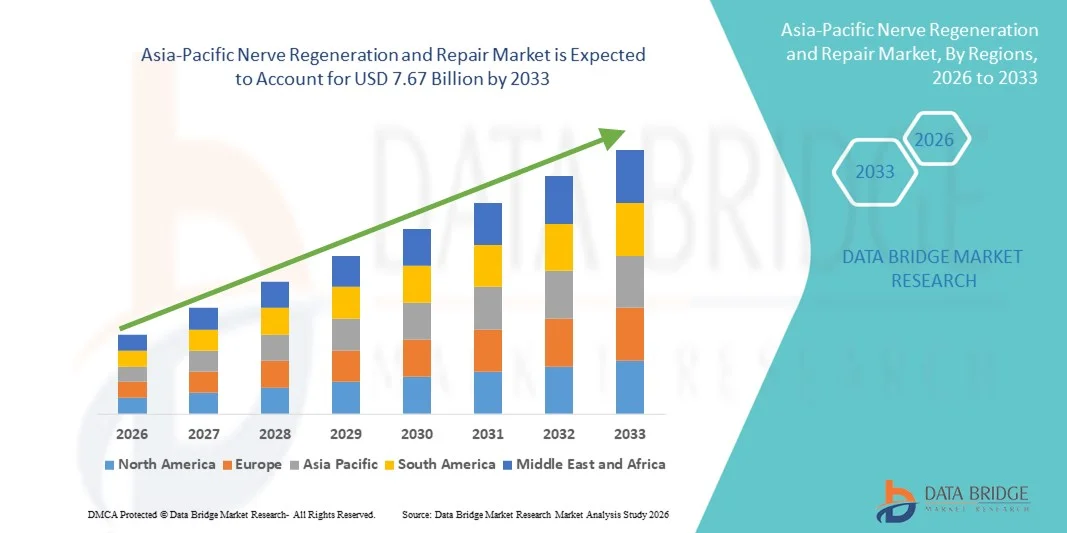
- The Asia-Pacific nerve regeneration and repair market size was valued at USD 2.50 billion in 2025 and is expected to reach USD 7.67 billion by 2033, at a CAGR of 15.05% during the forecast period
- The market growth is largely fueled by the increasing prevalence of nerve injuries, neurological disorders, and spinal cord injuries across the region, combined with ongoing advancements in regenerative medicine and biomaterials
- Furthermore, rising investments in research and development, growing awareness of innovative therapies, and government initiatives to improve healthcare infrastructure are driving demand for effective nerve repair solutions. These converging factors are accelerating the adoption of nerve regeneration therapies, thereby significantly boosting the industry's growth
Asia-Pacific Nerve Regeneration and Repair Market Analysis
- Nerve regeneration and repair solutions, including neurostimulation and neuromodulation devices and biomaterials, are increasingly vital components of modern neurological treatment and surgical procedures in both hospitals and neurology clinics due to their potential to restore nerve function, reduce recovery time, and improve patient outcomes
- The escalating demand for nerve regeneration therapies is primarily fueled by the rising incidence of nerve injuries, increasing prevalence of neurological disorders, and growing awareness of advanced treatment options among patients and healthcare providers
- Japan dominated the Asia-Pacific nerve regeneration and repair market with the largest revenue share of 28.5% in 2025, characterized by advanced healthcare infrastructure, high R&D investment, and early adoption of innovative therapies, with hospitals and specialized neurology clinics experiencing substantial uptake of neurostimulation devices and biomaterials
- China is expected to be the fastest-growing country in the Asia-Pacific nerve regeneration and repair market during the forecast period due to increasing healthcare investments, expanding clinical research capabilities, and rising prevalence of nerve injuries in urban and aging populations
- Neurostimulation and neuromodulation devices segment dominated the Asia-Pacific nerve regeneration and repair market with a market share of 42.3% in 2025, driven by their proven efficacy in treating failed back surgery syndrome, Parkinson’s disease, and other neurological indications, along with their integration into minimally invasive surgical procedures
Report Scope and Asia-Pacific Nerve Regeneration and Repair Market Segmentation
|
Attributes |
Asia-Pacific Nerve Regeneration and Repair Key Market Insights |
|
Segments Covered |
|
|
Countries Covered |
Asia-Pacific
|
|
Key Market Players |
|
|
Market Opportunities |
|
|
Value Added Data Infosets |
In addition to the insights on market scenarios such as market value, growth rate, segmentation, geographical coverage, and major players, the market reports curated by the Data Bridge Market Research also include in-depth expert analysis, patient epidemiology, pipeline analysis, pricing analysis, and regulatory framework |
Asia-Pacific Nerve Regeneration and Repair Market Trends
Advancements in Neurostimulation and Biomaterials
- A significant and accelerating trend in the Asia-Pacific nerve regeneration and repair market is the integration of advanced neurostimulation devices with next-generation biomaterials, enhancing precision and efficacy in nerve repair procedures
- For instance, the AxoGen Avance Nerve Graft combines processed allograft biomaterials with targeted neurostimulation guidance, promoting faster axonal regeneration and improved functional recovery
- Integration of bioengineered scaffolds with neurostimulation therapies enables more controlled nerve regeneration, improves surgical outcomes, and reduces complications compared to conventional treatments
- These innovations allow clinicians to tailor therapies to patient-specific nerve injuries, optimizing recovery and minimizing secondary tissue damage
- The trend toward combining neurostimulation with biomaterials is reshaping treatment protocols and raising patient expectations for effective, minimally invasive nerve repair therapies
- The demand for advanced, integrated nerve regeneration solutions is growing rapidly across hospitals and neurology clinics, as healthcare providers increasingly prioritize improved functional outcomes and reduced rehabilitation times
- Expansion of tele-neurology and home-based neurostimulation therapies is creating opportunities for remote monitoring and post-surgical rehabilitation in underserved regions
Asia-Pacific Nerve Regeneration and Repair Market Dynamics
Driver
Rising Prevalence of Nerve Injuries and Neurological Disorders
- The increasing incidence of peripheral nerve injuries, spinal cord injuries, and neurological disorders is a significant driver for the heightened demand for nerve regeneration and repair therapies
- For instance, in March 2025, Medtronic announced advancements in its neurostimulation device portfolio for peripheral nerve repair, aiming to enhance functional recovery in patients with chronic nerve injuries
- As patient awareness of innovative therapies grows, demand for neurostimulation and biomaterial-based treatments that improve recovery outcomes is expanding
- Furthermore, growing investments in clinical research and regenerative medicine, coupled with healthcare infrastructure improvements, are increasing the availability of advanced nerve repair options
- Rising adoption of nerve repair solutions in hospitals, neurology clinics, and specialized rehabilitation centers is propelling the market, as these therapies reduce long-term disability and enhance quality of life
- Government initiatives promoting regenerative medicine and reimbursement support for advanced therapies are further stimulating market growth
- Increasing collaboration between public and private sectors to fund regenerative medicine startups is driving faster innovation and commercialization of nerve repair technologies
- Growing prevalence of aging populations in Japan, China, and India is boosting demand for therapies targeting age-related nerve degeneration and neuropathies
Restraint/Challenge
High Cost and Regulatory Hurdles
- The relatively high cost of advanced neurostimulation devices and biomaterials remains a major challenge to broader adoption, particularly in emerging Asia-Pacific countries
- For instance, expensive allograft materials and implantable neurostimulation systems can limit access for price-sensitive patients and smaller healthcare facilities
- Regulatory compliance for nerve regeneration therapies, including device approvals and clinical trial requirements, poses additional hurdles, slowing market entry for new innovations
- Limited awareness of novel therapies among clinicians and patients in certain regions also restricts uptake, despite clinical efficacy demonstrated in trials
- Ensuring safety, efficacy, and reimbursement coverage, while educating stakeholders on treatment benefits, is essential to overcoming adoption barriers
- Addressing cost constraints, streamlining regulatory pathways, and expanding clinician training programs will be crucial for sustained growth in the Asia-Pacific nerve regeneration and repair market
- Inconsistent reimbursement policies across countries, particularly in Southeast Asia, can delay adoption of advanced nerve repair solutions and reduce profitability for providers
- Risks associated with long-term clinical outcomes and variability in patient response to regenerative therapies may slow acceptance among conservative healthcare providers
Asia-Pacific Nerve Regeneration and Repair Market Scope
The market is segmented on the basis of product, indication, application, and end-user.
- By Product
On the basis of product, the Asia-Pacific nerve regeneration and repair market is segmented into neurostimulation and neuromodulation devices and biomaterials. The Neurostimulation and Neuromodulation Devices segment dominated the market with the largest revenue share of 42.3% in 2025, driven by their proven efficacy in managing conditions such as failed back surgery syndrome, Parkinson’s disease, and peripheral nerve injuries. Hospitals and neurology clinics often prefer neurostimulation devices due to their minimally invasive nature and ability to provide targeted electrical stimulation that promotes nerve repair and functional recovery. The segment also benefits from continuous technological advancements, including implantable and wearable devices, that improve patient monitoring and treatment precision. Increasing clinician awareness and adoption, coupled with growing patient preference for less invasive options, further reinforces its market dominance.
The Biomaterials segment is anticipated to witness the fastest growth rate of 23.5% from 2026 to 2033, fueled by the rising adoption of bioengineered nerve scaffolds and allografts for nerve repair and grafting procedures. Biomaterials enable customized nerve regeneration solutions that support axonal growth and tissue integration, making them highly attractive for personalized therapies. Advances in 3D-printed scaffolds, stem cell-seeded matrices, and combination therapies with neurostimulation are also driving growth. The increasing investment in regenerative medicine research in countries such as China, India, and Japan is expected to accelerate biomaterials adoption.
- By Indication
On the basis of indication, the market is segmented into failed back surgery syndrome, parkinson’s disease, urinary incontinence, epilepsy, gastroparesis, nerve repair, and grafting. The Nerve Repair segment dominated the market with a revenue share of 37.8% in 2025, owing to the high prevalence of peripheral nerve injuries and the growing need for functional restoration. Hospitals and neurology centers often prioritize nerve repair therapies due to their proven ability to restore motor and sensory function. The segment’s dominance is further supported by continuous innovation in neurostimulation and biomaterials, which improve outcomes in neurorrhaphy and microsurgical procedures. In addition, increasing awareness among surgeons and patients regarding the long-term benefits of early nerve repair drives adoption.
The Parkinson’s Disease segment is expected to witness the fastest CAGR of 25.2% from 2026 to 2033, driven by the rising prevalence of Parkinson’s in aging populations across Japan, China, and India. Neurostimulation devices, such as deep brain stimulators, are increasingly preferred for symptom management and functional improvement. Growing government funding for neurological disorder management, combined with improved access to specialized neurology clinics, is fueling the uptake of Parkinson’s disease-targeted therapies.
- By Application
On the basis of application, the market is segmented into Neurostimulation and neuromodulation surgeries, direct nerve repair/neurorrhaphy, nerve grafting, stem cell therapy, and others. The Direct Nerve Repair/Neurorrhaphy segment dominated the market with a share of 35.4% in 2025, due to its established clinical effectiveness in restoring nerve continuity after injury. This application is widely adopted in hospitals and specialized neurology centers for treating traumatic nerve injuries and post-surgical complications. The segment benefits from improvements in microsurgical techniques, intraoperative monitoring, and enhanced biomaterials that support axonal regrowth. Growing clinician expertise and training programs in Asia-Pacific countries contribute to the segment’s market leadership.
The Stem Cell Therapy segment is expected to witness the fastest growth at a CAGR of 26.1% from 2026 to 2033, driven by breakthroughs in regenerative medicine and the potential for stem cells to promote nerve regeneration and functional recovery. Rising investments in clinical trials, increased patient awareness, and government support for regenerative therapies in countries such as China and India are accelerating adoption. Stem cell therapy is also gaining traction as an adjunct to surgical repair, neurostimulation, and biomaterial implantation, enhancing overall treatment outcomes.
- By End-User
On the basis of end-user, the market is segmented into hospitals, neurology clinics, home healthcare, and community healthcare. The Hospitals segment dominated the market with a revenue share of 48.2% in 2025, owing to the availability of advanced surgical infrastructure, skilled surgeons, and specialized neurology departments capable of performing complex nerve repair and neurostimulation procedures. Hospitals also lead in the adoption of integrated biomaterials and neurostimulation devices due to their access to high-end technologies and patient monitoring systems. Increasing patient referrals and higher procedural volumes further consolidate hospitals’ dominance in the market.
The Home Healthcare segment is expected to witness the fastest growth at a CAGR of 28.4% from 2026 to 2033, driven by rising demand for remote neurostimulation therapies, rehabilitation monitoring, and portable nerve repair devices. Expansion of telemedicine and home-based care solutions in China, India, and Australia is enabling patients to receive therapy in the comfort of their homes. Growing patient preference for convenient, non-hospitalized care models and the increasing availability of user-friendly devices support the rapid adoption of this end-user segment.
Asia-Pacific Nerve Regeneration and Repair Market Regional Analysis
- Japan dominated the Asia-Pacific nerve regeneration and repair market with the largest revenue share of 28.5% in 2025, characterized by advanced healthcare infrastructure, high R&D investment, and early adoption of innovative therapies, with hospitals and specialized neurology clinics experiencing substantial uptake of neurostimulation devices and biomaterials
- Patients and clinicians in the region highly value minimally invasive nerve repair procedures, targeted neurostimulation therapies, and biomaterial-based solutions that improve functional recovery and reduce rehabilitation time
- This widespread adoption is further supported by a well-established hospital network, high healthcare spending, and growing awareness of advanced nerve repair treatments, establishing Japan as a leading market for both hospitals and neurology clinics
The Japan Nerve Regeneration Market Insight
The Japan nerve regeneration and repair market is gaining momentum due to the country’s highly advanced healthcare infrastructure, early adoption of innovative therapies, and strong focus on research and development in regenerative medicine. Hospitals and specialized neurology clinics are at the forefront of implementing neurostimulation devices and biomaterial-based therapies, targeting peripheral nerve injuries, Parkinson’s disease, and spinal cord injuries. The aging population in Japan is also driving demand for easy-to-use, minimally invasive, and effective nerve repair solutions. Integration of nerve regeneration therapies with other digital health technologies, such as telemedicine and remote monitoring, is further enhancing patient outcomes. Growing awareness among patients and caregivers about the benefits of advanced nerve repair treatments is contributing to faster adoption and sustained market growth.
China Nerve Regeneration Market Insight
China is expected to be the fastest-growing country in the Asia-Pacific nerve regeneration market, fueled by government healthcare investments, growing clinical research initiatives, and a rising incidence of neurological disorders and traumatic nerve injuries. Hospitals and neurology clinics are increasingly adopting neurostimulation devices and biomaterials to meet the growing demand for functional recovery therapies. Expansion of rehabilitation centers, along with the rise of home-based neurostimulation and remote patient monitoring programs, is further improving accessibility to advanced therapies. The government’s support for regenerative medicine and investment in public-private partnerships for medical innovation is encouraging the development and commercialization of new nerve repair technologies.
India Nerve Regeneration Market Insight
India accounted for the largest revenue share in the Asia-Pacific nerve regeneration and repair market in 2025, owing to rapid urbanization, an expanding middle-class population, and increasing awareness of advanced treatment options. Hospitals, neurology clinics, and home healthcare providers are driving demand for neurostimulation devices and biomaterial-based grafts, which offer affordable and effective solutions for nerve repair and grafting procedures. India’s growing focus on “smart healthcare” initiatives, coupled with the domestic manufacturing of nerve repair devices, is reducing treatment costs and improving accessibility. In addition, increasing patient preference for minimally invasive and personalized therapies is further supporting market growth.
Australia Nerve Regeneration Market Insight
Australia’s nerve regeneration and repair market is growing steadily due to the country’s high healthcare standards, advanced surgical infrastructure, and strong adoption of neurostimulation devices and biomaterials. Hospitals and specialized neurology clinics lead the adoption of these therapies, supported by government-backed research initiatives and collaborations with international regenerative medicine companies. Patients increasingly prefer minimally invasive procedures, home-based rehabilitation, and therapies that reduce hospital stays, driving market growth. The availability of skilled clinicians and training programs in regenerative therapies also enhances adoption and ensures higher treatment success rates.
Asia-Pacific Nerve Regeneration and Repair Market Share
The Asia-Pacific Nerve Regeneration and Repair industry is primarily led by well-established companies, including:
- Axogen Corporation (U.S.)
- Boston Scientific Corporation (U.S.)
- Medtronic (Ireland)
- Abbott (U.S.)
- Stryker (U.S.)
- Integra LifeSciences Holdings Corporation (U.S.)
- Baxter (U.S.)
- Neuronetics Inc. (U.S.)
- LivaNova PLC (U.K.)
- Polyganics B.V. (Netherlands)
- Checkpoint Surgical, Inc. (U.S.)
- BioCircuit Technologies, Inc. (U.S.)
- Epineuron Technologies Inc. (U.S.)
- MicroTransponder Inc. (U.S.)
- NervGen Pharma Corp. (Canada)
- Neuraptive Therapeutics, Inc. (U.S.)
- Newrotex Ltd. (U.K.)
- Orthocell Ltd. (Australia)
- ReNerve Pty Ltd (Australia)
- Toyobo Co., Ltd. (Japan)
What are the Recent Developments in Asia-Pacific Nerve Regeneration and Repair Market?
- In January 2026, Australian medtech company ReNerve secured market approval in Malaysia for its NervAlign® Nerve Cuff, expanding its Asia‑Pacific footprint with clearances now in Malaysia, Hong Kong, and Thailand a key milestone validating clinical data and supporting peripheral nerve repair and regeneration following trauma or surgery in regional healthcare systems
- In January 2026, Australian medtech firm ReNerve secured regulatory market registration approval in Malaysia for its NervAlign® Nerve Cuff, marking the third Asia‑Pacific clearance for the device (after Hong Kong and Thailand) and strengthening commercial access for an implantable device that supports peripheral nerve repair and regeneration across regional healthcare systems
- In May 2025, NurExone announced that preclinical studies on its ExoPTEN platform demonstrated robust motor, sensory, and structural nerve regeneration in complete spinal cord injury (SCI) rat models, highlighting promising therapeutic potential for future clinical translation in neuroregeneration and advancing research in regenerative medicine within the region
- In July 2022, Checkpoint Surgical launched the Checkpoint Edge™ Nerve Cutting Kit, extending its intraoperative nerve care portfolio with a device designed to help surgeons prepare nerve tissue more consistently and preserve nerve integrity during repair, improving conditions for subsequent regeneration
- In March 2022, Integra LifeSciences launched the NeuraGen® 3D Nerve Guide Matrix, a resorbable implant engineered to create an optimized environment for more complete functional recovery after peripheral nerve discontinuities, representing a significant advancement in nerve repair technology used surgically to guide axonal growth and improve treatment outcomes
SKU-
世界初のマーケットインテリジェンスクラウドに関するレポートにオンラインでアクセスする

- インタラクティブなデータ分析ダッシュボード
- 成長の可能性が高い機会のための企業分析ダッシュボード
- カスタマイズとクエリのためのリサーチアナリストアクセス
- インタラクティブなダッシュボードによる競合分析
- 最新ニュース、更新情報、トレンド分析
- 包括的な競合追跡のためのベンチマーク分析のパワーを活用
調査方法
データ収集と基準年分析は、大規模なサンプル サイズのデータ収集モジュールを使用して行われます。この段階では、さまざまなソースと戦略を通じて市場情報または関連データを取得します。過去に取得したすべてのデータを事前に調査および計画することも含まれます。また、さまざまな情報ソース間で見られる情報の不一致の調査も含まれます。市場データは、市場統計モデルと一貫性モデルを使用して分析および推定されます。また、市場シェア分析と主要トレンド分析は、市場レポートの主要な成功要因です。詳細については、アナリストへの電話をリクエストするか、お問い合わせをドロップダウンしてください。
DBMR 調査チームが使用する主要な調査方法は、データ マイニング、データ変数が市場に与える影響の分析、および一次 (業界の専門家) 検証を含むデータ三角測量です。データ モデルには、ベンダー ポジショニング グリッド、市場タイムライン分析、市場概要とガイド、企業ポジショニング グリッド、特許分析、価格分析、企業市場シェア分析、測定基準、グローバルと地域、ベンダー シェア分析が含まれます。調査方法について詳しくは、お問い合わせフォームから当社の業界専門家にご相談ください。
カスタマイズ可能
Data Bridge Market Research は、高度な形成的調査のリーダーです。当社は、既存および新規のお客様に、お客様の目標に合致し、それに適したデータと分析を提供することに誇りを持っています。レポートは、対象ブランドの価格動向分析、追加国の市場理解 (国のリストをお問い合わせください)、臨床試験結果データ、文献レビュー、リファービッシュ市場および製品ベース分析を含めるようにカスタマイズできます。対象競合他社の市場分析は、技術ベースの分析から市場ポートフォリオ戦略まで分析できます。必要な競合他社のデータを、必要な形式とデータ スタイルでいくつでも追加できます。当社のアナリスト チームは、粗い生の Excel ファイル ピボット テーブル (ファクト ブック) でデータを提供したり、レポートで利用可能なデータ セットからプレゼンテーションを作成するお手伝いをしたりすることもできます。