


Europe Breast Lesion Localization Methods Market Segmentation, By Type (Wire Localization, Radioisotope Localization, Radioactive Seed Localization, Radio Occult Lesion Localization, Magnetic Tracers, and Others), Biopsy Techniques (Fine Needle Aspiration Biopsy, Core Needle Biopsy, Surgical Biopsy, Incisional Biopsy, Excisional Biopsy, Vacuum-Assisted Breast Biopsy, and Others), End-user (Diagnostic Centres, Hospitals, Oncology Clinics, and Ambulatory Surgical Centres), Usage (Tumor Identification, and Sentinel Lymph Node Lumpectomy)- Industry Trends and Forecast to 2033
Europe Breast Lesion Localization Methods Market Size
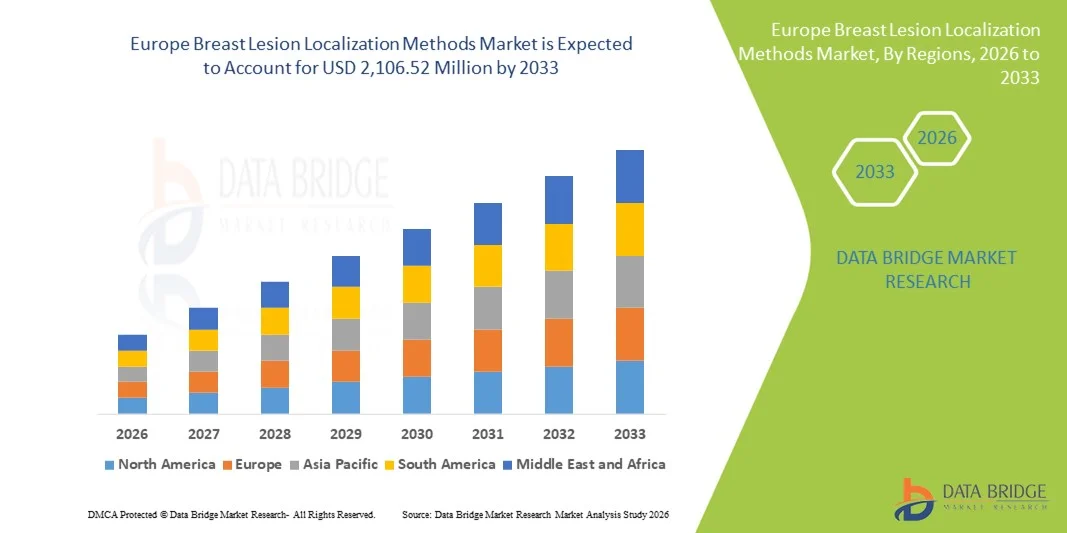
- The Europe breast lesion localization methods market size was valued at USD 775.76 million in 2025 and is expected to reach USD 2,106.52 million by 2033, at a CAGR of 13.30% during the forecast period
- The market growth is largely driven by the rising prevalence of breast cancer and increasing demand for early and precise tumor detection, leading to greater adoption of advanced localization technologies in hospitals and diagnostic centers across the region
- Furthermore, the growing preference for minimally invasive breast-conserving surgeries and improvements in imaging-guided localization techniques are establishing modern localization approaches as essential tools in breast cancer treatment pathways. These converging factors are accelerating the adoption of breast lesion localization methods, thereby significantly supporting the market’s growth.
Europe Breast Lesion Localization Methods Market Analysis
- Breast lesion localization methods, which include techniques used to accurately identify and mark non-palpable breast tumors before surgical removal, are increasingly important components of modern breast cancer management across hospitals and oncology centers due to their ability to enable precise tumor excision and improve surgical accuracy in breast-conserving procedures
- The escalating demand for breast lesion localization methods is primarily driven by the increasing prevalence of breast cancer, expansion of national breast cancer screening programs, and the growing adoption of minimally invasive surgical approaches that require accurate preoperative localization
- Germany dominated the Europe breast lesion localization methods market with the largest revenue share of 26.8% in 2025, characterized by advanced healthcare infrastructure, strong breast cancer screening participation, and high adoption of image-guided localization technologies in hospitals and specialized cancer treatment centers
- Poland is expected to be the fastest growing country in the market during the forecast period, driven by improving healthcare infrastructure, rising awareness regarding early breast cancer detection, and increasing investments in diagnostic imaging and oncology treatment facilities
- Wire localization segment dominated the breast lesion localization methods market with a market share of 41.5% in 2025, driven by its long-standing clinical adoption, cost-effectiveness, and widespread availability across hospitals for guiding surgeons during breast-conserving breast cancer surgeries
Report Scope and Europe Breast Lesion Localization Methods Market Segmentation
|
Attributes |
Europe Breast Lesion Localization Methods Key Market Insights |
|
Segments Covered |
|
|
Countries Covered |
Europe
|
|
Key Market Players |
|
|
Market Opportunities |
|
|
Value Added Data Infosets |
In addition to the insights on market scenarios such as market value, growth rate, segmentation, geographical coverage, and major players, the market reports curated by the Data Bridge Market Research also include in-depth expert analysis, patient epidemiology, pipeline analysis, pricing analysis, and regulatory framework |
Europe Breast Lesion Localization Methods Market Trends
Growing Adoption of Wire-Free and Image-Guided Localization Technologies
- A significant and accelerating trend in the Europe breast lesion localization methods market is the increasing adoption of wire-free localization technologies, including magnetic seed, radar-based, and radiofrequency identification (RFID) systems, which improve workflow efficiency and patient comfort compared with traditional wire-guided methods. This transition is enhancing surgical precision and flexibility in breast-conserving procedures
- For instance, advanced systems such as SAVI SCOUT radar localization and Magseed magnetic marker technology allow surgeons to precisely locate non-palpable breast lesions without the limitations associated with wire placement on the day of surgery. These solutions are increasingly adopted in hospitals and breast cancer centers across Europe to streamline surgical scheduling and improve patient experience
- Integration with advanced imaging modalities such as digital mammography, ultrasound, and MRI guidance is further strengthening localization accuracy and enabling clinicians to identify and target very small or early-stage lesions detected through screening programs. This imaging compatibility improves procedural efficiency and clinical outcomes
- Furthermore, modern localization technologies enable flexible scheduling between radiology and surgery departments, allowing markers to be placed days before surgery rather than on the same day, thereby reducing patient stress and hospital workflow constraints. Such advantages are encouraging healthcare providers to transition toward more advanced localization approaches
- The trend toward more precise, patient-friendly, and technologically advanced localization solutions is reshaping breast cancer surgical practices across Europe. Consequently, companies are investing in innovative wire-free systems designed to improve accuracy, reduce complications, and support minimally invasive breast cancer treatment strategies
- The demand for breast lesion localization methods that offer greater accuracy, workflow efficiency, and patient comfort is growing steadily across European healthcare systems as breast cancer screening programs expand and hospitals adopt more advanced surgical technologies
Europe Breast Lesion Localization Methods Market Dynamics
Driver
Rising Breast Cancer Screening Programs and Demand for Breast-Conserving Surgeries
- The increasing prevalence of breast cancer across Europe, combined with expanding national breast cancer screening initiatives, is a major driver fueling demand for breast lesion localization methods in hospitals and diagnostic centers
- For instance, several European countries continue to strengthen organized screening programs that enable the early detection of non-palpable breast lesions, which subsequently require accurate localization techniques before surgical removal. These initiatives are increasing the clinical need for reliable localization solutions
- As more breast cancers are detected at earlier stages through mammography screening, surgeons increasingly rely on localization methods to precisely identify tumors that cannot be felt during physical examination. This trend significantly increases the demand for localization technologies in breast-conserving surgeries
- Furthermore, the growing preference for breast-conserving surgery over mastectomy is driving the need for precise preoperative tumor marking, ensuring surgeons can remove cancerous tissue while preserving as much healthy breast tissue as possible
- Increasing government and healthcare initiatives promoting early breast cancer detection across Europe are significantly boosting the number of diagnostic procedures, thereby increasing the demand for lesion localization technologies prior to surgery
- The expanding network of specialized breast clinics and oncology centers across European countries is further supporting the adoption of advanced localization solutions to improve surgical accuracy and patient outcomes
- The ability of localization technologies to improve surgical accuracy, reduce re-excision rates, and enhance patient outcomes is encouraging healthcare providers to adopt these solutions across oncology centers. The continued expansion of screening programs and surgical advancements is therefore expected to strongly support market growth
Restraint/Challenge
High Procedure Costs and Need for Specialized Clinical Expertise
- The relatively high cost of advanced wire-free localization systems, including magnetic and radar-based technologies, presents a challenge to widespread adoption, particularly in smaller hospitals or healthcare facilities with limited budgets
- For instance, while innovative localization systems offer improved workflow and patient comfort, they often require dedicated detection devices, specialized markers, and additional training, which can increase overall procedural costs compared with traditional wire localization methods
- Healthcare providers must also ensure that radiologists and surgeons receive specialized training to accurately place localization markers and operate detection systems during surgery. This requirement can slow adoption in facilities with limited technical expertise
- In addition, hospitals must comply with strict European medical device regulatory standards, which can extend product approval timelines and increase development costs for manufacturers entering the market
- Limited availability of advanced localization technologies in smaller hospitals and rural healthcare facilities may restrict market penetration in certain parts of Europe where healthcare resources remain unevenly distributed
- Concerns related to procedural workflow integration and equipment compatibility with existing imaging systems can also slow adoption, as healthcare providers must ensure seamless coordination between radiology and surgical departments
- While the clinical benefits of advanced localization technologies are significant, budget constraints, training requirements, and regulatory considerations may limit adoption in some healthcare settings. Addressing these barriers through cost-effective solutions and broader clinical training will be important for sustained market expansion
Europe Breast Lesion Localization Methods Market Scope
The market is segmented on the basis of type, biopsy techniques, end-user, and usage.
- By Type
On the basis of type, the Europe breast lesion localization methods market is segmented into wire localization, radioisotope localization, radioactive seed localization, radio occult lesion localization, magnetic tracers, and others. The wire localization segment dominated the market with the largest market revenue share of 41.5% in 2025, driven by its long-standing clinical acceptance and widespread use in hospitals for guiding surgeons to non-palpable breast lesions. This technique remains the most commonly used approach due to its cost-effectiveness and availability across many healthcare facilities. In addition, wire localization procedures are supported by established clinical guidelines and trained medical professionals across Europe. Hospitals often rely on this method because it integrates easily with existing imaging modalities such as mammography and ultrasound. The reliability and familiarity of wire localization in surgical planning continue to support its dominance despite the emergence of newer technologies. Furthermore, its relatively lower procedural cost compared with advanced wireless techniques makes it a preferred option in several healthcare systems.
The magnetic tracers segment is anticipated to witness the fastest growth rate during the forecast period, fueled by increasing adoption of wire-free localization technologies that improve patient comfort and surgical workflow. Magnetic tracers allow surgeons to locate lesions without the need for wires placed on the day of surgery, enabling greater scheduling flexibility between radiology and surgical departments. These systems also reduce patient discomfort and anxiety associated with traditional wire-guided procedures. Increasing technological advancements and clinical acceptance of magnetic marker localization are further contributing to market expansion. In addition, the ability of magnetic tracers to support minimally invasive breast-conserving surgeries is driving their adoption in modern oncology practices. As European hospitals continue to adopt innovative surgical technologies, the demand for magnetic tracer systems is expected to grow significantly.
- By Biopsy Techniques
On the basis of biopsy techniques, the market is segmented into fine needle aspiration biopsy, core needle biopsy, surgical biopsy, incisional biopsy, excisional biopsy, vacuum-assisted breast biopsy, and others. The core needle biopsy segment dominated the market with the largest revenue share in 2025, primarily due to its high diagnostic accuracy and ability to obtain sufficient tissue samples for pathological analysis. This technique is widely used in breast cancer diagnostics because it provides more reliable results compared with fine needle aspiration. Core needle biopsy procedures are commonly performed under imaging guidance such as ultrasound or stereotactic mammography, improving lesion targeting. In addition, this technique is less invasive than surgical biopsy while still providing comprehensive diagnostic information. Many healthcare providers across Europe prefer this method as it balances diagnostic accuracy with patient safety and comfort. The increasing number of breast cancer screening procedures is further contributing to the demand for core needle biopsies.
The vacuum-assisted breast biopsy segment is expected to register the fastest growth during the forecast period, driven by its ability to remove larger tissue samples and improve diagnostic precision. Vacuum-assisted biopsy systems allow clinicians to collect multiple tissue samples during a single insertion, reducing the need for repeated procedures. This technology also enables the removal of certain benign lesions without the need for surgical intervention. Growing adoption of image-guided minimally invasive diagnostic procedures across European hospitals is supporting the expansion of this segment. Furthermore, advancements in biopsy devices and increasing awareness about early breast cancer diagnosis are encouraging healthcare providers to adopt vacuum-assisted techniques. These benefits are expected to accelerate the growth of this segment in the coming years.
- By End-user
On the basis of end-user, the market is segmented into diagnostic centres, hospitals, oncology clinics, and ambulatory surgical centres. The hospitals segment dominated the market with the largest market share in 2025, owing to the availability of advanced imaging infrastructure, specialized surgical teams, and comprehensive breast cancer treatment facilities. Hospitals are typically the primary centers for breast cancer diagnosis, lesion localization, and surgical treatment. The presence of multidisciplinary oncology teams allows hospitals to provide integrated care from diagnosis through treatment. In addition, hospitals often conduct a large volume of breast cancer screening and diagnostic procedures, increasing the demand for localization methods. The availability of advanced imaging technologies such as digital mammography, MRI, and ultrasound further supports hospital dominance in this market. Continuous investments in hospital-based oncology services across Europe are expected to maintain this segment’s leadership.
The ambulatory surgical centres segment is projected to witness the fastest growth during the forecast period, driven by the increasing preference for outpatient surgical procedures and cost-effective treatment options. Ambulatory surgical centres offer shorter hospital stays, reduced healthcare costs, and faster patient recovery compared with traditional hospital settings. Many minimally invasive breast procedures can now be performed safely in these facilities due to advancements in localization and imaging technologies. In addition, healthcare systems across Europe are encouraging the use of outpatient surgical centers to improve healthcare efficiency and reduce hospital workloads. The growing demand for convenient and accessible breast cancer treatment services is therefore supporting the rapid expansion of this segment.
- By Usage
On the basis of usage, the market is segmented into tumor identification and sentinel lymph node lumpectomy. The tumor identification segment dominated the market with the largest revenue share in 2025, as accurate identification of non-palpable breast tumors is essential before performing breast-conserving surgery. Breast lesion localization techniques are primarily used to guide surgeons to the precise location of tumors detected through imaging but not palpable during physical examination. The growing number of early-stage breast cancer diagnoses through screening programs has significantly increased the demand for tumor localization procedures. Accurate tumor identification helps surgeons remove cancerous tissue while preserving healthy breast tissue, improving patient outcomes. In addition, advancements in imaging-guided localization technologies are further supporting the efficiency and accuracy of tumor identification procedures. These factors continue to drive the dominance of this segment in the market.
The sentinel lymph node lumpectomy segment is expected to witness the fastest growth during the forecast period, driven by increasing adoption of targeted surgical approaches for breast cancer treatment. Sentinel lymph node procedures help determine whether cancer has spread to lymph nodes, allowing surgeons to make more informed treatment decisions. Localization technologies are increasingly used to guide these procedures and improve surgical precision. In addition, advancements in tracer technologies and imaging techniques are enhancing the effectiveness of sentinel lymph node identification during surgery. The growing focus on personalized and minimally invasive cancer treatment strategies across Europe is also contributing to the growth of this segment. As breast cancer management continues to evolve, the demand for localization-assisted sentinel lymph node procedures is expected to rise significantly.
Europe Breast Lesion Localization Methods Market Regional Analysis
- Germany dominated the Europe breast lesion localization methods market with the largest revenue share of 26.8% in 2025, characterized by advanced healthcare infrastructure, strong breast cancer screening participation, and high adoption of image-guided localization technologies in hospitals and specialized cancer treatment centers
- Healthcare providers in the region place strong emphasis on early cancer detection and minimally invasive breast-conserving surgeries, which require precise lesion localization techniques to accurately identify non-palpable tumors prior to surgical removal
- This widespread adoption is further supported by well-established healthcare infrastructure, government-supported screening initiatives, and the presence of specialized oncology centers, encouraging the use of advanced imaging-guided localization methods and improving treatment outcomes for breast cancer patients
The France Breast Lesion Localization Methods Market Insight
The France breast lesion localization methods market captured the largest revenue share of around 21% in 2025 within Europe, fueled by the country’s well-established national breast cancer screening programs and strong adoption of advanced diagnostic technologies. Healthcare providers increasingly prioritize early detection and precise tumor localization to support breast-conserving surgeries. The growing number of breast imaging procedures, supported by government-funded screening initiatives, further drives the demand for localization techniques. Moreover, the presence of specialized oncology centers and strong clinical expertise in breast cancer management significantly contributes to the market’s expansion across France.
U.K. Breast Lesion Localization Methods Market Insight
The U.K. breast lesion localization methods market is anticipated to grow at a noteworthy CAGR during the forecast period, driven by the strong presence of national breast cancer screening programs and increasing adoption of image-guided surgical procedures. Rising awareness regarding early breast cancer diagnosis is encouraging healthcare providers to utilize advanced lesion localization technologies. The expansion of specialized breast clinics and oncology centers across the country further supports the adoption of these methods. In addition, increasing healthcare investments and advancements in diagnostic imaging technologies are expected to stimulate market growth in the U.K.
Germany Breast Lesion Localization Methods Market Insight
The Germany breast lesion localization methods market is expected to expand at a considerable CAGR during the forecast period, fueled by increasing demand for precise diagnostic and surgical solutions in breast cancer management. Germany’s well-developed healthcare infrastructure and strong emphasis on medical innovation encourage the adoption of advanced localization technologies. The growing number of breast cancer screening procedures and diagnostic imaging tests is also supporting market growth. Furthermore, the integration of modern imaging techniques with surgical localization procedures is improving treatment accuracy and patient outcomes across the country.
Italy Breast Lesion Localization Methods Market Insight
The Italy breast lesion localization methods market is poised to grow steadily during the forecast period, driven by increasing awareness regarding breast cancer detection and the expansion of organized screening initiatives. The country’s healthcare system continues to emphasize early diagnosis and minimally invasive treatment strategies, supporting the adoption of lesion localization techniques. Hospitals and specialized breast units are increasingly adopting advanced imaging-guided localization methods to enhance surgical precision. In addition, ongoing improvements in healthcare infrastructure and oncology care services are expected to contribute to the market’s growth in Italy.
Poland Breast Lesion Localization Methods Market Insight
The Poland breast lesion localization methods market is expected to grow at a notable CAGR during the forecast period, driven by increasing awareness of breast cancer screening and expanding access to modern diagnostic technologies. The country is witnessing gradual improvements in healthcare infrastructure, which are enabling hospitals and diagnostic centers to adopt advanced imaging-guided localization techniques. Rising government initiatives promoting early breast cancer detection and the expansion of national screening programs are further supporting market growth. In addition, the increasing number of specialized oncology units and breast care clinics across Poland is encouraging the adoption of precise lesion localization methods to improve surgical outcomes and support minimally invasive breast-conserving procedures.
Europe Breast Lesion Localization Methods Market Share
The Europe Breast Lesion Localization Methods industry is primarily led by well-established companies, including:
- Hologic, Inc. (U.S.)
- Merit Medical Systems, Inc. (U.S.)
- BD (U.S.)
- Cook (U.S.)
- Argon Medical Devices, Inc. (U.S.)
- SOMATEX Medical Technologies GmbH (Germany)
- IsoAid, LLC (U.S.)
- Ranfac Corp. (U.S.)
- Stryker Corporation (U.S.)
- BPB Medica S.r.l. (Italy)
- STERLAB S.r.l. (Italy)
- Biomedical Srl (Italy)
- MDL Srl (Italy)
- Vigeo Srl (Italy)
- Medax S.r.l. (Italy)
- Sirius Medical Systems B.V. (Netherlands)
- IZI Medical Products, LLC (U.S.)
- Intramedical Imaging, LLC (U.S.)
- Laurane Medical LLC (U.S.)
- Tsunami Medical Srl (Italy)
What are the Recent Developments in Europe Breast Lesion Localization Methods Market?
- In October 2025, Endomag received EU Medical Device Regulation (MDR) certification for its Magseed® magnetic marker, a technology used to localize breast tumors before surgery. The certification confirmed that the device meets stringent European regulatory and safety standards, enabling broader clinical adoption across European hospitals. Magseed allows physicians to place a tiny magnetic seed in the tumor site days or weeks before surgery, improving surgical accuracy and workflow flexibility
- In September 2024, Sirius Medical launched the Pintuition Slim Probe with GPSDetect navigational guidance at the European Society of Surgical Oncology Congress in Belgium. The device enhances precision during breast tumor localization by enabling surgeons to navigate surgical markers with greater accuracy through smaller incisions. This innovation supports improved surgical efficiency and cosmetic outcomes in breast-conserving surgery. The launch highlights growing adoption of advanced navigation technologies for tumor localization procedures across European oncology centers
- In December 2023, a large-scale European clinical study evaluated magnetic seed localization systems for breast lesions, demonstrating a successful localization rate of nearly 100% in patients undergoing breast-conserving surgery. The research confirmed that magnetic seed technology is safe, reliable, and easy for clinicians to implement in clinical practice. The findings support the broader adoption of magnetic marker systems in European hospitals as alternatives to traditional wire-guided localization techniques.
- In August 2023, researchers from the National Cancer Institute of Milan published findings showing that ultrasound-guided magnetic seed localization is a safe and reliable method for identifying non-palpable breast lesions prior to surgery. The study demonstrated high accuracy in lesion detection and confirmed that magnetic seed localization can effectively replace traditional wire-guided techniques in many breast units
- In February 2023, the European Breast Cancer Research Association of Surgical Trialists (EUBREAST) and the iBRA-NET research network initiated the MELODY multinational study to evaluate various breast lesion localization technologies used in breast-conserving surgery. The study aims to analyze clinical outcomes, safety, and effectiveness of different localization techniques, including magnetic seeds, RFID tags, and radar reflectors. This initiative is expected to help standardize localization procedures and guide clinical adoption across European healthcare systems
SKU-
世界初のマーケットインテリジェンスクラウドに関するレポートにオンラインでアクセスする

- インタラクティブなデータ分析ダッシュボード
- 成長の可能性が高い機会のための企業分析ダッシュボード
- カスタマイズとクエリのためのリサーチアナリストアクセス
- インタラクティブなダッシュボードによる競合分析
- 最新ニュース、更新情報、トレンド分析
- 包括的な競合追跡のためのベンチマーク分析のパワーを活用
調査方法
データ収集と基準年分析は、大規模なサンプル サイズのデータ収集モジュールを使用して行われます。この段階では、さまざまなソースと戦略を通じて市場情報または関連データを取得します。過去に取得したすべてのデータを事前に調査および計画することも含まれます。また、さまざまな情報ソース間で見られる情報の不一致の調査も含まれます。市場データは、市場統計モデルと一貫性モデルを使用して分析および推定されます。また、市場シェア分析と主要トレンド分析は、市場レポートの主要な成功要因です。詳細については、アナリストへの電話をリクエストするか、お問い合わせをドロップダウンしてください。
DBMR 調査チームが使用する主要な調査方法は、データ マイニング、データ変数が市場に与える影響の分析、および一次 (業界の専門家) 検証を含むデータ三角測量です。データ モデルには、ベンダー ポジショニング グリッド、市場タイムライン分析、市場概要とガイド、企業ポジショニング グリッド、特許分析、価格分析、企業市場シェア分析、測定基準、グローバルと地域、ベンダー シェア分析が含まれます。調査方法について詳しくは、お問い合わせフォームから当社の業界専門家にご相談ください。
カスタマイズ可能
Data Bridge Market Research は、高度な形成的調査のリーダーです。当社は、既存および新規のお客様に、お客様の目標に合致し、それに適したデータと分析を提供することに誇りを持っています。レポートは、対象ブランドの価格動向分析、追加国の市場理解 (国のリストをお問い合わせください)、臨床試験結果データ、文献レビュー、リファービッシュ市場および製品ベース分析を含めるようにカスタマイズできます。対象競合他社の市場分析は、技術ベースの分析から市場ポートフォリオ戦略まで分析できます。必要な競合他社のデータを、必要な形式とデータ スタイルでいくつでも追加できます。当社のアナリスト チームは、粗い生の Excel ファイル ピボット テーブル (ファクト ブック) でデータを提供したり、レポートで利用可能なデータ セットからプレゼンテーションを作成するお手伝いをしたりすることもできます。
よくある質問
Europe Breast Lesion Localization Methods Marketレポートで扱われる主なセグメントは何ですか?
Europe Breast Lesion Localization Methods Marketの現在の市場規模はどのくらいですか?
Europe Breast Lesion Localization Methods Marketの予想成長率はどのくらいですか?
Europe Breast Lesion Localization Methods Market市場の主要企業はどこですか?












