Global Artificial Intelligence In Ultrasound Imaging Market Size, Share, and Trends Analysis Report
Market Size in USD Billion
CAGR :
%
USD
964.98 Million
USD
1,867.05 Million
2024
2032
| 2025 –2032 | |
| USD 964.98 Million | |
| USD 1,867.05 Million | |
|
|
|
|
Global Artificial Intelligence in Ultrasound Imaging Market Segmentation, By Solution (Devices, Software Tools or Platforms, and Services), Technology (Machine Learning, Natural Language Processing, Context- Aware Computing, and Computer Vision), Ultrasound Technology (Diagnostic Imaging, Therapeutic, 2D, 3D/4D Ultrasound Imaging, High Intensity Focused Ultrasound, Extracorporeal Shockwave Lithotripsy, and Doppler Ultrasound), Application (Radiology, Obstetrics and Gynaecology, Cardiovascular, and Gastroenterology), End- User (Hospitals and Providers, Patients, Pharmaceutical and Biotechnology Companies, and Healthcare Payers) - Industry Trends and Forecast to 2032
Artificial Intelligence In Ultrasound Imaging Market Size
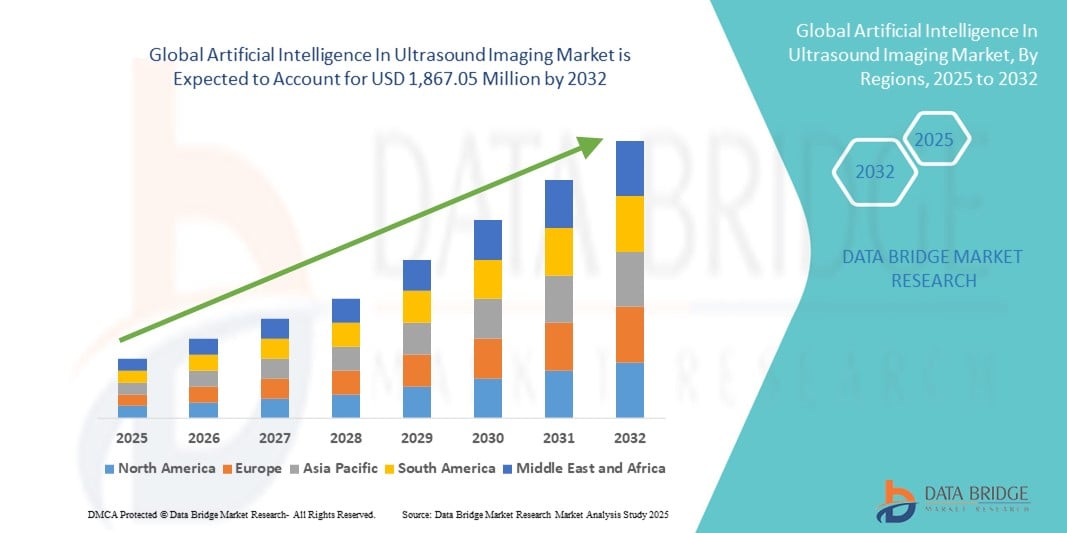
- The global artificial intelligence in ultrasound imaging market size was valued at USD 964.98 million in 2024 and is expected to reach USD 1,867.05 million by 2032, at a CAGR of 8.60% during the forecast period
- The growth of the artificial intelligence in ultrasound imaging market is primarily driven by the rapid adoption of AI-powered solutions in healthcare, which are enhancing diagnostic accuracy, workflow efficiency, and patient care
- Increasing demand for non-invasive, real-time imaging, combined with technological advancements in AI algorithms, deep learning, and machine vision, is enabling clinicians to detect abnormalities earlier and make more informed decisions. These factors are significantly boosting the market expansion across hospitals, diagnostic centers, and specialty clinics
Artificial Intelligence In Ultrasound Imaging Market Analysis
- Artificial Intelligence (AI) in ultrasound imaging, enabling automated image analysis, anomaly detection, and diagnostic decision support, is increasingly becoming a critical component of modern medical imaging workflows across hospitals, diagnostic centers, and specialty clinics due to its ability to enhance accuracy, efficiency, and workflow standardization
- The rising adoption of AI-powered ultrasound systems is primarily driven by increasing demand for faster and more reliable diagnostic solutions, the growing prevalence of chronic and complex diseases, and healthcare providers’ focus on reducing diagnostic errors while improving patient outcomes
- North America dominated the artificial intelligence in ultrasound imaging market with the largest revenue share of 38.6% in 2024, supported by advanced healthcare infrastructure, high adoption rates of cutting-edge medical technologies, favorable reimbursement policies, and a strong presence of leading medical device and AI solution providers. The U.S. market, in particular, is witnessing substantial growth due to the increasing prevalence of cardiovascular, obstetric, and oncologic conditions. The rising demand for precise, real-time diagnostics and AI-assisted ultrasound platforms is enhancing clinical outcomes and improving workflow efficiency across hospitals, diagnostic centers, and specialized imaging clinics
- Asia-Pacific is expected to be the fastest-growing region in the artificial intelligence in ultrasound imaging market during the forecast period, driven by rapid urbanization, rising healthcare expenditures, expanding hospital and diagnostic networks, and government initiatives aimed at improving diagnostic and imaging infrastructure. Countries such as China, Japan, and India are increasingly adopting AI-based ultrasound technologies for early disease detection, prenatal care, and routine imaging
- The Machine Learning segment dominated the artificial intelligence in ultrasound imaging market with a market revenue share of 52% in 2024, as it serves as the core technology behind AI-driven ultrasound imaging
Report Scope and Artificial Intelligence In Ultrasound Imaging Market Segmentation
|
Attributes |
Artificial Intelligence In Ultrasound Imaging Key Market Insights |
|
Segments Covered |
|
|
Countries Covered |
North America
Europe
Asia-Pacific
Middle East and Africa
South America
|
|
Key Market Players |
|
|
Market Opportunities |
|
|
Value Added Data Infosets |
In addition to the insights on market scenarios such as market value, growth rate, segmentation, geographical coverage, and major players, the market reports curated by the Data Bridge Market Research also include in-depth expert analysis, pricing analysis, brand share analysis, consumer survey, demography analysis, supply chain analysis, value chain analysis, raw material/consumables overview, vendor selection criteria, PESTLE Analysis, Porter Analysis, and regulatory framework. |
Artificial Intelligence In Ultrasound Imaging Market Trends
Enhanced Diagnostic Efficiency Through AI Integration
- A significant and accelerating trend in the global artificial intelligence in ultrasound imaging market is the deepening integration of AI with imaging workflows and popular healthcare management platforms. This fusion of technologies is significantly enhancing diagnostic accuracy, workflow efficiency, and clinical decision-making
- For instance, AI-enabled ultrasound systems can automatically detect anatomical structures, quantify measurements, and highlight potential anomalies, reducing manual interpretation errors and saving valuable clinician time. Platforms like Butterfly iQ+ and GE’s AI-powered ultrasound solutions exemplify this trend by offering real-time AI-assisted guidance during scanning procedures
- AI integration in ultrasound imaging enables features such as automated pattern recognition, predictive diagnostics, and advanced image reconstruction, which help clinicians identify early signs of disease with higher precision. Some systems even learn from accumulated data to improve detection accuracy over time and provide intelligent alerts when unusual patterns or anomalies are identified
- The seamless integration of AI with existing hospital information systems and electronic medical records facilitates centralized management of imaging data. Through a single interface, clinicians can access AI-analyzed results, track patient history, and coordinate multidisciplinary care more effectively, creating a more streamlined and automated diagnostic process
- This trend toward more intelligent, intuitive, and interconnected imaging solutions is fundamentally reshaping clinical expectations for ultrasound diagnostics. Consequently, companies such as Philips Healthcare and Siemens Healthineers are developing AI-powered ultrasound platforms with features such as automated measurement, anomaly detection, and seamless integration with hospital systems
- The demand for AI-integrated ultrasound imaging solutions is growing rapidly across both hospital and outpatient settings, as healthcare providers increasingly prioritize diagnostic accuracy, workflow efficiency, and comprehensive patient care
Artificial Intelligence In Ultrasound Imaging Market Dynamics
Driver
Growing Need Due to Rising Demand for Advanced Diagnostic Solutions
- The increasing prevalence of complex medical conditions, coupled with the need for faster, more accurate diagnostics, is a key driver for the growing adoption of AI-powered ultrasound imaging solutions. Hospitals and diagnostic centers are seeking tools that enhance imaging quality, streamline workflows, and support early detection of critical diseases
- For instance, in April 2024, EchoNous, Inc. announced the launch of its advanced AI-assisted ultrasound platform, designed to provide automated image interpretation and real-time diagnostic support, which is expected to drive growth in the global Artificial Intelligence in Ultrasound Imaging market
- The rising need for precision in radiology, cardiology, and obstetrics applications is prompting healthcare providers to adopt intelligent imaging platforms capable of analyzing large datasets and generating consistent, reproducible results
- Furthermore, the increasing focus on patient-centric care and the push toward minimally invasive diagnostics are driving demand for portable and user-friendly AI-enabled ultrasound devices
- The ability to reduce clinician workload, shorten diagnostic times, and improve overall patient outcomes is motivating healthcare facilities across both developed and emerging markets to integrate AI-based ultrasound solutions into routine clinical practice
Restraint/Challenge
High Costs and Integration Complexity
- The high upfront cost associated with AI-enabled ultrasound devices, combined with ongoing expenses for maintenance and specialized staff training, continues to pose a significant barrier to widespread adoption. This challenge is particularly pronounced in developing regions and smaller healthcare facilities where budget limitations restrict investment in advanced medical technologies
- The integration of AI-powered ultrasound systems into existing healthcare IT infrastructure, such as Picture Archiving and Communication Systems (PACS) and Electronic Medical Records (EMR), can be complex and resource-intensive. Hospitals and clinics may hesitate to adopt these technologies due to the time, technical expertise, and financial resources required for seamless implementation
- To overcome these adoption barriers, manufacturers are increasingly focusing on offering cost-effective device options, scalable deployment models, and comprehensive training programs tailored to healthcare professionals. Emphasizing intuitive, user-friendly interfaces and ensuring compatibility with existing systems are key strategies that can provide a competitive edge in the market
- Although the prices of AI-enabled ultrasound devices are gradually declining and technological efficiencies are improving, the perceived complexity of implementation and the initial investment still present challenges for smaller clinics and resource-constrained facilities
- Addressing these obstacles through robust customer support, extensive clinical validation studies, and demonstrating long-term cost savings and workflow improvements will be critical for sustained growth in the Artificial Intelligence in Ultrasound Imaging market. These measures not only build confidence among healthcare providers but also enhance the overall value proposition of AI-driven ultrasound solutions
Artificial Intelligence In Ultrasound Imaging Market Scope
The market is segmented on the basis of solution, technology, ultrasound type, application, and end-user.
- By Solution
On the basis of solution, the artificial intelligence in ultrasound imaging market is segmented into devices, software tools or platforms, and services. The devices segment dominated the market with a revenue share of 46% in 2024, supported by the widespread deployment of AI-enabled ultrasound systems across hospitals, diagnostic centers, and specialized imaging clinics. These advanced devices provide capabilities such as automated measurements, real-time anomaly detection, enhanced visualization, and integrated reporting tools, enabling clinicians to improve diagnostic accuracy, reduce interpretation time, and deliver more consistent results.
The Software Tools or Platforms segment is expected to witness the fastest CAGR of 11.2% from 2025 to 2032, fueled by rising investments in AI algorithm development, cloud-based analytics, and comprehensive software solutions. These platforms streamline workflow management, enable remote diagnostics, support predictive analytics, and allow clinicians to personalize patient care based on data-driven insights, driving growing adoption across clinical and research settings.
- By Technology
On the basis of technology, the artificial intelligence in ultrasound imaging market is segmented into machine learning, natural language processing, context-aware computing, and computer vision. The machine learning segment held the largest market revenue share of 52% in 2024, as it serves as the core technology behind AI-driven ultrasound imaging. Machine learning enables predictive diagnostics, automated anomaly recognition, pattern analysis, and continuous improvement of imaging models from extensive datasets, enhancing overall diagnostic confidence.
The Context-Aware Computing segment is projected to witness the fastest CAGR of 10.5% from 2025 to 2032, driven by its ability to dynamically optimize ultrasound imaging protocols based on patient-specific characteristics, clinical context, and historical data. This technology enhances operational efficiency, reduces variability in scans, improves diagnostic precision, and supports clinicians in making informed, real-time decisions, making it increasingly valuable in both routine and complex imaging procedures across hospitals and diagnostic centers
- By Ultrasound Technology
On the basis of ultrasound technology, the artificial intelligence in ultrasound imaging market is segmented into Diagnostic Imaging, Therapeutic, 2D, 3D/4D Ultrasound Imaging, High Intensity Focused Ultrasound (HIFU), Extracorporeal Shockwave Lithotripsy, and Doppler Ultrasound. The Diagnostic Imaging segment dominated with a revenue share of 48% in 2024, owing to its extensive range of clinical applications, from routine health assessments and prenatal checkups to the detection of complex conditions such as tumors and organ anomalies. Its wide adoption is supported by AI-assisted enhancements that improve image clarity, facilitate automated measurements, and streamline workflow efficiency for radiologists and sonographers.
The 3D/4D Ultrasound Imaging segment is expected to witness the fastest CAGR of 12.1% from 2025 to 2032, as it provides volumetric, real-time imaging that is essential for detailed prenatal monitoring, complex cardiovascular assessments, and precise surgical planning. These advanced systems enhance clinical workflows by offering high-resolution, multi-dimensional views of internal anatomy, improving diagnostic accuracy, supporting more informed treatment decisions, and engaging patients through intuitive visualizations that facilitate better understanding and communication of their medical conditions.
- By Application
On the basis of application, the artificial intelligence in ultrasound imaging market is segmented into Radiology, Obstetrics and Gynaecology, Cardiovascular, and Gastroenterology. The Radiology segment dominated the market with an revenue share of 41% in 2024, driven by the growing integration of AI-assisted imaging for tumor detection, early disease diagnosis, and optimization of radiology department workflows. AI applications reduce interpretation errors, enable faster reporting, and improve throughput in high-volume clinical settings.
The Cardiovascular segment is projected to witness the fastest CAGR of 11.5% from 2025 to 2032, driven by the increasing prevalence of cardiovascular disorders and the growing demand for accurate, non-invasive hemodynamic assessments. The adoption of AI-enabled imaging solutions in this segment allows real-time monitoring of heart structure and function, enhancing diagnostic precision, supporting timely clinical interventions, and enabling more effective treatment planning, thereby improving overall patient outcomes and clinical decision-making.
- By End-User
On the basis of end-user, the artificial intelligence in ultrasound imaging market is segmented into Hospitals and Providers, Patients, Pharmaceutical and Biotechnology Companies, and Healthcare Payers. Hospitals and Providers accounted for the largest market revenue share of 55% in 2024, reflecting widespread adoption of AI-assisted ultrasound systems for routine diagnostics, interventional procedures, and patient monitoring. These institutions benefit from enhanced workflow efficiency, improved diagnostic confidence, and the ability to manage larger patient volumes effectively.
The Pharmaceutical and Biotechnology Companies segment is expected to witness the fastest CAGR of 10.8% from 2025 to 2032, fueled by the growing integration of AI-assisted imaging into drug discovery, clinical trials, and translational research activities. By leveraging AI, these companies can achieve highly precise evaluations of treatment efficacy, improve patient stratification, model outcomes predictively, and accelerate the development of targeted therapies. This not only streamlines research workflows but also enhances the accuracy and reliability of clinical insights, ultimately supporting faster and more effective therapeutic innovations.
Artificial Intelligence In Ultrasound Imaging Market Regional Analysis
- North America dominated the artificial intelligence in ultrasound imaging market with the largest revenue share of 38.6% in 2024
- This growth is primarily supported by the region’s advanced healthcare infrastructure, high adoption rates of cutting-edge medical technologies, favorable reimbursement policies, and a strong presence of leading medical device and AI solution providers
- Increasing demand for precise, real-time diagnostics and AI-assisted ultrasound platforms is enhancing clinical outcomes, streamlining workflow efficiency, and improving diagnostic accuracy across hospitals, specialized imaging clinics, and diagnostic centers
U.S. Artificial Intelligence in Ultrasound Imaging Market Insight
The U.S. artificial intelligence in ultrasound imaging market is expected to experience robust growth during the forecast period, supported by advanced healthcare infrastructure, high adoption rates of cutting-edge medical technologies, favorable reimbursement policies, and a strong presence of leading medical device and AI solution providers. Increasing prevalence of cardiovascular, obstetric, and oncologic conditions is driving demand for AI-assisted ultrasound platforms that offer precise, real-time diagnostics. Hospitals, specialized imaging clinics, and diagnostic centers are investing in these solutions to improve clinical outcomes, optimize workflow efficiency, and enhance diagnostic accuracy. Furthermore, ongoing research and development initiatives, coupled with government and private-sector support for innovative imaging technologies, are further fueling market expansion across the country.
Europe Artificial Intelligence in Ultrasound Imaging Market Insight
The Europe artificial intelligence in ultrasound imaging market is projected to witness steady growth during the forecast period, driven by well-established healthcare systems, government initiatives supporting digital health, and growing adoption of AI-powered imaging solutions. Countries such as Germany, France, and the U.K. are investing in advanced diagnostic equipment to enhance early disease detection, prenatal care, and oncologic imaging. The emphasis on clinical accuracy, improved patient outcomes, and integration of AI into conventional ultrasound systems is fostering growth across hospitals, imaging centers, and specialized clinics.
U.K. Artificial Intelligence in Ultrasound Imaging Market Insight
The U.K. artificial intelligence in ultrasound imaging market is anticipated to grow at a notable CAGR during the forecast period, fueled by increasing healthcare investments, rising prevalence of chronic diseases, and expanding hospital networks. Adoption of AI-enhanced ultrasound systems is particularly driven by demand for faster diagnostics, improved prenatal care, and precision-guided cardiovascular imaging. Strong government support for medical technology upgrades and research initiatives is expected to further stimulate growth.
Germany Artificial Intelligence in Ultrasound Imaging Market Insight
The Germany artificial intelligence in ultrasound imaging market is projected to expand steadily due to the country’s advanced healthcare infrastructure, increasing awareness of AI-assisted diagnostics, and emphasis on clinical efficiency and accuracy. Hospitals and diagnostic centers are adopting AI-driven ultrasound systems for cardiovascular, oncologic, and obstetric applications, while ongoing digital health initiatives and investments in innovative imaging technologies continue to support market development.
Asia-Pacific Artificial Intelligence in Ultrasound Imaging Market Insight
The Asia-Pacific artificial intelligence in ultrasound imaging market region is expected to be the fastest-growing market during the forecast period, driven by rapid urbanization, rising healthcare expenditures, expanding hospital and diagnostic networks, and government initiatives aimed at enhancing diagnostic and imaging infrastructure. Countries such as China, Japan, and India are increasingly deploying AI-powered ultrasound technologies for early disease detection, routine imaging, and prenatal care. The rising healthcare awareness, coupled with growing investments in AI-based medical solutions, is further accelerating adoption across public and private healthcare facilities.
Japan Artificial Intelligence in Ultrasound Imaging Market Insight
The Japan artificial intelligence in ultrasound imaging market is witnessing significant growth due to high technological adoption, a rapidly aging population, and increasing demand for precision diagnostics. AI-enhanced ultrasound systems are increasingly integrated into hospitals and diagnostic centers for obstetric, cardiovascular, and oncologic imaging. Furthermore, government-led initiatives and private investments in advanced medical imaging are expected to sustain market momentum.
China Artificial Intelligence in Ultrasound Imaging Market Insight
The China artificial intelligence in ultrasound imaging market accounted for the largest revenue share in the Asia-Pacific region in 2024, driven by rapid urbanization, an expanding middle class, and increasing healthcare spending. Hospitals and diagnostic facilities are adopting AI-assisted ultrasound platforms to improve diagnostic accuracy and workflow efficiency, particularly in prenatal care, cardiovascular imaging, and oncology. National policies promoting digital health and AI adoption, alongside the presence of strong domestic manufacturers, are key factors driving market growth in China
Artificial Intelligence In Ultrasound Imaging Market Share
The artificial intelligence in ultrasound imaging industry is primarily led by well-established companies, including:
- NVIDIA Corporation (U.S.)
- Intel Corporation (U.S.)
- IBM (U.S.)
- EchoNous, Inc. (U.S.)
- Microsoft (U.S.)
- General Vision Inc. (U.S.)
- GENERAL ELECTRIC COMPANY (U.S.)
- Johnson & Johnson and its affiliates (U.S.)
- Siemens Healthineers AG (Germany)
- Medtronic (U.S.)
- CloudMedx Inc. (U.S.)
- Agfa-Gevaert Group (Belgium)
- Butterfly Network, Inc. (U.S.)
- Imagia Cybernetics Inc. (Canada)
- Enlitic, Inc. (U.S.)
- Micron Technology, Inc. (U.S.)
- SAMSUNG (South Korea)
Latest Developments in Global Artificial Intelligence In Ultrasound Imaging Market
- In September 2021, UltraSight, an Israeli-based digital health company specializing in AI-powered cardiac imaging, announced a collaboration with GE Healthcare to conduct a cardiac study aboard the Axiom ‘Rakia’ space mission. This partnership aimed to monitor astronauts' heart health using wireless cardiac point-of-care ultrasound systems, marking a significant advancement in space medicine and AI integration in ultrasound technology
- In May 2022, UltraSight revealed findings from a blinded pilot study at the 69th Annual Conference of the Israel Heart Society. The study demonstrated that AI-guided ultrasound imaging could produce usable images in 100% of cardiac patients, even when performed by medical professionals without sonography experience. This breakthrough highlighted the potential of AI to democratize access to cardiac imaging
- In June 2023, UltraSight announced a partnership with EchoNous, a point-of-care ultrasound innovator, to enable more healthcare professionals to perform cardiac ultrasound. This collaboration aimed to increase patient access to cardiac imaging by integrating UltraSight's AI guidance software with EchoNous' portable ultrasound devices
- In February 2024, UltraSight entered into a joint venture with SELVAS Healthcare, a Korean-based digital healthcare company, to introduce its AI-powered ultrasound technology to the Korean market. This partnership aimed to expand the reach of AI-guided cardiac imaging in Asia, particularly in regions with limited access to specialized sonographers
- In May 2024, Samsung Medison, a South Korean medical device company, acquired the French AI software firm Sonio SAS for approximately USD92 million. Sonio specializes in AI applications for fetal ultrasound imaging. This acquisition aimed to enhance Samsung Medison's capabilities in AI-driven prenatal diagnostics
- In March 2025, GE HealthCare and NVIDIA announced a collaboration to develop AI-enabled X-ray and ultrasound systems leveraging NVIDIA's Isaac for Healthcare platform. This partnership aimed to accelerate the integration of AI into diagnostic imaging, enhancing the speed and accuracy of ultrasound diagnostics
- In April 2025, Royal Philips launched the Elevate Platform upgrade on its EPIQ Elite ultrasound imaging platform at UltraFest 2025 in India. This AI-enabled upgrade aimed to streamline workflows and enhance diagnostic efficiency, enabling clinicians to deliver timely and confident decisions for a wider range of patients
- In June 2025, Exo announced that its Exo Iris ultrasound system received FDA 510(k) clearance for the first-ever AI-powered detection of pleural effusion, consolidation, and atelectasis. This AI-enabled feature aimed to improve diagnostic accuracy and efficiency in lung imaging
- In July 2025, MAUI Imaging, a medical startup, secured USD14 million in Series D funding to advance its pioneering ultrasound technology. The company developed systems capable of visualizing through typical barriers like bone, gas, fat, surgical tools, and implants—areas beyond the capabilities of traditional ultrasound. This innovation aimed to enhance diagnostic imaging in challenging clinical scenarios
SKU-
世界初のマーケットインテリジェンスクラウドに関するレポートにオンラインでアクセスする

- インタラクティブなデータ分析ダッシュボード
- 成長の可能性が高い機会のための企業分析ダッシュボード
- カスタマイズとクエリのためのリサーチアナリストアクセス
- インタラクティブなダッシュボードによる競合分析
- 最新ニュース、更新情報、トレンド分析
- 包括的な競合追跡のためのベンチマーク分析のパワーを活用
調査方法
データ収集と基準年分析は、大規模なサンプル サイズのデータ収集モジュールを使用して行われます。この段階では、さまざまなソースと戦略を通じて市場情報または関連データを取得します。過去に取得したすべてのデータを事前に調査および計画することも含まれます。また、さまざまな情報ソース間で見られる情報の不一致の調査も含まれます。市場データは、市場統計モデルと一貫性モデルを使用して分析および推定されます。また、市場シェア分析と主要トレンド分析は、市場レポートの主要な成功要因です。詳細については、アナリストへの電話をリクエストするか、お問い合わせをドロップダウンしてください。
DBMR 調査チームが使用する主要な調査方法は、データ マイニング、データ変数が市場に与える影響の分析、および一次 (業界の専門家) 検証を含むデータ三角測量です。データ モデルには、ベンダー ポジショニング グリッド、市場タイムライン分析、市場概要とガイド、企業ポジショニング グリッド、特許分析、価格分析、企業市場シェア分析、測定基準、グローバルと地域、ベンダー シェア分析が含まれます。調査方法について詳しくは、お問い合わせフォームから当社の業界専門家にご相談ください。
カスタマイズ可能
Data Bridge Market Research は、高度な形成的調査のリーダーです。当社は、既存および新規のお客様に、お客様の目標に合致し、それに適したデータと分析を提供することに誇りを持っています。レポートは、対象ブランドの価格動向分析、追加国の市場理解 (国のリストをお問い合わせください)、臨床試験結果データ、文献レビュー、リファービッシュ市場および製品ベース分析を含めるようにカスタマイズできます。対象競合他社の市場分析は、技術ベースの分析から市場ポートフォリオ戦略まで分析できます。必要な競合他社のデータを、必要な形式とデータ スタイルでいくつでも追加できます。当社のアナリスト チームは、粗い生の Excel ファイル ピボット テーブル (ファクト ブック) でデータを提供したり、レポートで利用可能なデータ セットからプレゼンテーションを作成するお手伝いをしたりすることもできます。