Global Brain Monitoring Devices Market Size, Share, and Trends Analysis Report
Market Size in USD Billion
CAGR :
%
USD
7.17 Billion
USD
12.98 Billion
2024
2032
| 2025 –2032 | |
| USD 7.17 Billion | |
| USD 12.98 Billion | |
|
|
|
|
Global Brain Monitoring Devices Market Segmentation, By Product (Electroencephalography (EEG) Devices, Magnetoencephalography (MEG) Devices, Transcranial Doppler (TCD) Devices, Intracranial Pressure (ICP) Monitors, Cerebral Oximeters, Magnetic Resonance Imaging (MRI) Devices, Computerized Tomography (CT) Devices, Positron Emission Tomography (PET) Devices, Sleep Monitoring Devices, Electromyography (EMG) Devices and Accessories), Procedure (Invasive and Non-invasive), Application (Epilepsy, Dementia, Parkinson's Disease, Huntington's Disease, Headache Disorders, Stroke, Traumatic Brain Injuries, Sleep Disorders and Other Diseases) - Industry Trends and Forecast to 2032
Brain Monitoring Devices Market Size
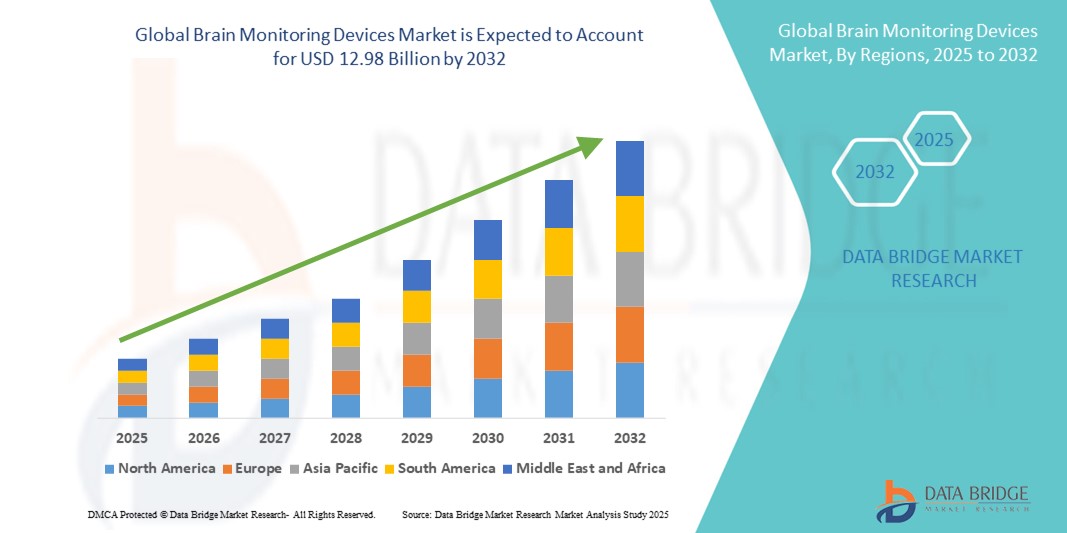
- The global brain monitoring devices market size was valued at USD 7.17 billion in 2024 and is expected to reach USD 12.98 billion by 2032, at a CAGR of 7.7% during the forecast period
- The market growth is primarily driven by the increasing prevalence of neurological disorders, rising geriatric population, and growing adoption of advanced neurodiagnostic and monitoring technologies in hospitals, clinics, and research centers
- In addition, technological advancements in wearable and non-invasive monitoring devices, coupled with rising demand for continuous patient monitoring and early detection of brain disorders, are positioning brain monitoring devices as critical tools in modern healthcare. These converging trends are accelerating market adoption and significantly propelling the industry's growth
Brain Monitoring Devices Market Analysis
- Brain monitoring devices, including EEG, intracranial pressure monitors, and wearable neurodiagnostic systems, are increasingly essential for early detection, continuous monitoring, and management of neurological conditions in hospitals, clinics, and research settings due to their accuracy, real-time data capabilities, and integration with digital healthcare platforms
- The rising demand for brain monitoring devices is primarily driven by the growing prevalence of neurological disorders, increasing geriatric population, and expanding adoption of advanced neurotechnology solutions for non-invasive and continuous monitoring
- North America dominated the brain monitoring devices market with the largest revenue share of 39.3% in 2024, fueled by high healthcare expenditure, advanced healthcare infrastructure, and the presence of leading medical device manufacturers. The U.S. witnessed substantial growth in device installations in hospitals and neurocritical care units, supported by innovations in wearable EEG, AI-assisted analysis, and cloud-based monitoring platforms
- Asia-Pacific is expected to be the fastest-growing region in the brain monitoring devices market during the forecast period due to increasing healthcare investments, rising awareness of neurological disorders, and expanding hospital networks
- Electroencephalography (EEG) devices segment dominated the brain monitoring devices market with a market share of 42% in 2024, driven by their non-invasive nature, ease of use, and critical role in diagnosing and monitoring epilepsy, sleep disorders, and other neurological conditions
Report Scope and Brain Monitoring Devices Market Segmentation
|
Attributes |
Brain Monitoring Devices Key Market Insights |
|
Segments Covered |
|
|
Countries Covered |
North America
Europe
Asia-Pacific
Middle East and Africa
South America
|
|
Key Market Players |
|
|
Market Opportunities |
|
|
Value Added Data Infosets |
In addition to the insights on market scenarios such as market value, growth rate, segmentation, geographical coverage, and major players, the market reports curated by the Data Bridge Market Research also include in-depth expert analysis, pricing analysis, brand share analysis, consumer survey, demography analysis, supply chain analysis, value chain analysis, raw material/consumables overview, vendor selection criteria, PESTLE Analysis, Porter Analysis, and regulatory framework. |
Brain Monitoring Devices Market Trends
Advancements in Wearable and AI-Enabled Neurodiagnostics
- A significant and accelerating trend in the global brain monitoring devices market is the development of wearable, non-invasive devices integrated with artificial intelligence (AI) for real-time neurodiagnostic analysis. These innovations are enhancing patient monitoring accuracy, early detection of neurological events, and overall clinical decision-making
- For instance, devices such as the Muse S headband and NeuroSky MindWave allow continuous brainwave monitoring in both clinical and home settings, providing actionable insights through AI-driven data analytics. Similarly, BrainScope One integrates AI algorithms to assist emergency and clinical personnel in assessing brain injuries rapidly
- AI integration enables predictive analytics, pattern recognition, and anomaly detection in brain activity, helping clinicians anticipate seizures, stroke onset, or cognitive decline. For instance, some EEG-based devices utilize machine learning to improve signal interpretation over time and alert caregivers of unusual brain activity patterns
- The integration of these devices with mobile apps, cloud platforms, and hospital information systems facilitates centralized monitoring, data sharing, and remote patient management, allowing healthcare providers to make informed decisions quickly and efficiently
- This trend toward more intelligent, interconnected, and user-friendly brain monitoring solutions is redefining clinical expectations, prompting companies such as Emotiv and Neuroelectrics to develop AI-enabled, wearable devices capable of continuous monitoring, data analytics, and remote alerts
- The demand for wearable and AI-powered brain monitoring devices is rapidly increasing across hospitals, neurocritical care units, and home-based care setups, as clinicians and patients prioritize timely diagnosis, continuous monitoring, and actionable neurological insights
Brain Monitoring Devices Market Dynamics
Driver
Increasing Prevalence of Neurological Disorders and Rising Demand for Continuous Monitoring
- The growing incidence of neurological disorders such as epilepsy, stroke, Alzheimer’s, and traumatic brain injury is a major driver for the escalating demand for brain monitoring devices. The need for continuous, precise monitoring is essential to improve patient outcomes and support early intervention
- For instance, in March 2024, Natus Medical, Inc. announced the launch of a next-generation EEG monitoring system designed for real-time neurocritical care, enhancing early detection and management of neurological events. Such innovations by key companies are expected to propel market growth during the forecast period
- Patients and healthcare providers increasingly rely on brain monitoring devices to track neurological health, detect abnormalities, and facilitate timely interventions, offering significant advantages over traditional observational methods
- The growing adoption of digital healthcare solutions, telemedicine, and remote patient monitoring is making brain monitoring devices a critical component of modern neurodiagnostic workflows, supporting seamless integration with hospital IT systems and cloud-based data platforms
- User-friendly, portable, and wearable monitoring solutions are expanding access beyond hospitals, enabling home-based neuro-monitoring and continuous assessment for at-risk populations, further driving market adoption
Restraint/Challenge
High Device Costs and Regulatory Compliance Challenges
- The relatively high cost of advanced brain monitoring devices, particularly AI-enabled or implantable systems, can restrict adoption in price-sensitive regions and smaller healthcare facilities. This creates a barrier for widespread penetration, especially in developing countries
- For instance, sophisticated devices with multi-channel EEG or intracranial monitoring capabilities remain expensive, limiting access for routine monitoring or outpatient applications
- Regulatory requirements and stringent approvals for medical devices, including compliance with FDA, CE, and other regional standards, can delay product launches and increase development costs. Companies such as Nihon Kohden and Natus must navigate these regulatory complexities to ensure market entry and sustained adoption
- In addition, concerns about data privacy and security in AI-enabled and cloud-integrated devices are becoming increasingly important, requiring robust encryption, secure authentication, and compliance with healthcare data regulations such as HIPAA and GDPR
- Addressing these challenges through cost-effective device design, streamlined regulatory strategies, and enhanced cybersecurity measures will be critical for the sustained growth of the global brain monitoring devices market
Brain Monitoring Devices Market Scope
The market is segmented on the basis of product, procedure, and application.
- By Product
On the basis of product, the brain monitoring devices market is segmented into electroencephalography (EEG) devices, magnetoencephalography (MEG) devices, transcranial doppler (TCD) devices, intracranial pressure (ICP) monitors, cerebral oximeters, magnetic resonance imaging (MRI) devices, computerized tomography (CT) devices, positron emission tomography (PET) devices, sleep monitoring devices, electromyography (EMG) devices, and accessories. The electroencephalography (EEG) devices segment dominated the market with the largest revenue share of 42% in 2024, driven by their widespread use in diagnosing and monitoring epilepsy, sleep disorders, and other neurological conditions. EEG devices are non-invasive, easy to use, and provide real-time brain activity data, making them a preferred choice in hospitals, research centers, and home-based monitoring setups. The segment also benefits from increasing adoption in neurocritical care units, expanding telemedicine applications, and the integration of AI for enhanced signal interpretation and predictive analysis. The availability of portable and wearable EEG solutions further strengthens the segment’s dominance, providing accessibility for continuous monitoring in clinical and home settings.
The magnetoencephalography (MEG) devices segment is expected to witness the fastest growth from 2025 to 2032, fueled by increasing demand for high-resolution, non-invasive brain mapping in research and surgical planning. MEG provides precise spatial and temporal brain activity measurements, which are critical in pre-surgical evaluations for epilepsy and tumor resection. Technological advancements in sensor accuracy, reduced device footprint, and AI-based signal analysis are enhancing MEG’s clinical adoption. Growing investments in neuroscience research and expanding government funding for brain disease studies further support the accelerated growth of this segment.
- By Procedure
On the basis of procedure, the brain monitoring devices market is segmented into invasive and non-invasive. The non-invasive segment dominated the market in 2024 due to its lower risk, ease of use, and suitability for routine monitoring and diagnostics. Devices such as EEG, TCD, and wearable cerebral oximeters enable continuous patient monitoring without surgical intervention, making them ideal for hospitals, clinics, and home healthcare. Non-invasive procedures are increasingly preferred for neurological disorder diagnosis, sleep monitoring, and cognitive research. Integration with AI and cloud-based platforms allows for remote monitoring, data analytics, and predictive insights, further driving adoption. Non-invasive procedures also benefit from faster regulatory approvals and broader acceptance among patients and healthcare providers.
The invasive segment is expected to witness the fastest growth during the forecast period, driven by the rising demand for precise intracranial monitoring in critical care, severe traumatic brain injury, and neurosurgery. ICP monitors and intracranial electrodes provide real-time measurements of brain pressure and neural activity, enabling timely interventions and improved patient outcomes. Technological advancements reducing procedural risks and enhancing device accuracy are supporting growth. Increasing ICU infrastructure, rising neurosurgical procedures, and government support for critical care facilities contribute to higher adoption rates of invasive brain monitoring devices globally.
- By Application
On the basis of application, the brain monitoring devices market is segmented into epilepsy, dementia, Parkinson’s disease, Huntington’s disease, headache disorders, stroke, traumatic brain injuries, sleep disorders, and other diseases. The epilepsy segment dominated the market with the largest revenue share in 2024 due to the high prevalence of epilepsy worldwide and the critical need for continuous monitoring to manage seizures. EEG devices and wearable monitoring systems are commonly used for diagnosis, seizure prediction, and therapy management. The integration of AI algorithms for automated detection and alerting further strengthens the clinical utility and market dominance of this application segment. Rising awareness about neurological disorders and growing patient preference for home-based monitoring also contribute to sustained demand.
The stroke segment is expected to witness the fastest growth from 2025 to 2032, driven by the increasing incidence of stroke, the need for rapid diagnosis, and the adoption of continuous cerebral monitoring. Devices such as TCD, ICP monitors, and cerebral oximeters play a critical role in detecting cerebral blood flow abnormalities, monitoring brain perfusion, and preventing secondary brain damage. Technological improvements, including portable monitoring solutions and integration with AI for predictive risk assessment, are enhancing early detection and intervention. Expanding stroke care programs and government initiatives in emerging economies are also supporting the rapid growth of this application segment.
Brain Monitoring Devices Market Regional Analysis
- North America dominated the brain monitoring devices market with the largest revenue share of 39.3% in 2024, fueled by high healthcare expenditure, advanced healthcare infrastructure, and the presence of leading medical device manufacturers
- Healthcare providers and research institutions in the region prioritize early detection, continuous monitoring, and advanced neurodiagnostic solutions, increasing the adoption of EEG, ICP monitors, and other brain monitoring devices
- The widespread adoption is further supported by high healthcare expenditure, technologically advanced hospitals, and strong presence of key market players such as Natus Medical, Nihon Kohden, and Medtronic
U.S. Brain Monitoring Devices Market Insight
The U.S. brain monitoring devices market captured the largest revenue share of 82% in 2024 within North America, fueled by the rising prevalence of neurological disorders and increasing adoption of advanced neurodiagnostic technologies. Hospitals and research institutions are prioritizing continuous monitoring solutions such as EEG, ICP monitors, and wearable neurodevices to enhance patient outcomes. The growing focus on early detection, telemedicine integration, and AI-assisted brain monitoring platforms is further propelling market growth. Moreover, government support for neurocritical care and ongoing investments by key players such as Natus Medical, Nihon Kohden, and Medtronic are significantly contributing to the expansion of the market.
Europe Brain Monitoring Devices Market Insight
The Europe brain monitoring devices market is projected to expand at a substantial CAGR throughout the forecast period, primarily driven by rising neurological disorder prevalence and stringent healthcare regulations. The increase in urbanization and technological adoption is fostering the demand for continuous brain monitoring solutions. European healthcare providers are increasingly integrating AI-enabled EEG and TCD devices into hospitals and research facilities. The region is witnessing significant growth in both inpatient and outpatient neuro-monitoring applications, with hospitals and neurocritical care units incorporating advanced monitoring technologies to improve patient outcomes.
U.K. Brain Monitoring Devices Market Insight
The U.K. brain monitoring devices market is anticipated to grow at a noteworthy CAGR during the forecast period, driven by increasing awareness of neurological health and a demand for accurate, non-invasive monitoring. Hospitals and clinics are adopting EEG and cerebral oximetry devices for early diagnosis and continuous monitoring of patients with epilepsy, stroke, and dementia. The country’s robust healthcare infrastructure and growing investments in neurotechnology, alongside an increasing emphasis on telehealth solutions, are expected to continue stimulating market growth. Furthermore, research institutions in the U.K. are investing in wearable and AI-integrated brain monitoring technologies, enhancing adoption across clinical and academic settings.
Germany Brain Monitoring Devices Market Insight
The Germany brain monitoring devices market is expected to expand at a considerable CAGR during the forecast period, fueled by growing investments in healthcare infrastructure, increasing awareness of neurological disorders, and the rising demand for technologically advanced solutions. Hospitals are integrating EEG, MEG, and ICP monitoring devices with digital platforms to provide real-time patient data and improve clinical decision-making. Germany’s emphasis on innovation and precision in healthcare, combined with its adoption of AI-assisted neurodiagnostic tools, promotes the market for brain monitoring devices in both residential care and hospital settings.
Asia-Pacific Brain Monitoring Devices Market Insight
The Asia-Pacific brain monitoring devices market is poised to grow at the fastest CAGR of 23% during the forecast period of 2025 to 2032, driven by increasing healthcare expenditure, rising neurological disorder prevalence, and growing adoption of advanced diagnostic devices in countries such as China, Japan, and India. Expanding hospital networks, government initiatives promoting digital healthcare, and rising awareness of neurocritical care are accelerating market growth. In addition, APAC is emerging as a hub for manufacturing and R&D of brain monitoring devices, improving accessibility and affordability for a wider patient base.
Japan Brain Monitoring Devices Market Insight
The Japan brain monitoring devices market is gaining momentum due to the country’s high healthcare standards, increasing prevalence of neurological disorders, and demand for precise, real-time monitoring solutions. Hospitals and research facilities are adopting wearable EEG, TCD, and AI-integrated monitoring devices to improve patient outcomes. The country’s aging population is further driving the demand for continuous monitoring and non-invasive neurodiagnostic solutions in both clinical and home-based care settings. Moreover, integration with hospital IT systems and other medical devices is enhancing operational efficiency and adoption rates.
India Brain Monitoring Devices Market Insight
The India brain monitoring devices market accounted for the largest revenue share in Asia-Pacific in 2024, attributed to rapid urbanization, increasing neurological disorder prevalence, and expanding healthcare infrastructure. The adoption of EEG, ICP monitors, and portable neurodiagnostic devices is rising across hospitals, clinics, and home healthcare services. Government initiatives for digital health, coupled with the availability of cost-effective devices and increasing awareness of early neurological interventions, are key factors propelling the market in India. The presence of domestic manufacturers and growing medical research facilities further supports market expansion.
Brain Monitoring Devices Market Share
The brain monitoring devices industry is primarily led by well-established companies, including:
- NIHON KOHDEN CORPORATION (Japan)
- Koninklijke Philips N.V. (Netherlands)
- GENERAL ELECTRIC COMPANY (U.S.)
- Siemens Healthineers AG (Germany)
- Natus Medical Incorporated (U.S.)
- Compumedics Limited (Australia)
- Magstim EGI (U.S.)
- CAS Medical Systems Inc (U.S.)
- Advanced Brain Monitoring (U.S.)
- B. Braun SE (Germany)
- BD (U.S.)
- DePuySynthes Companies (U.S.)
- Cadwell Industries, Inc. (U.S.)
- Masimo Corporation (U.S.)
- Elekta AB (Sweden)
- Integra LifeSciences Corporation (U.S.)
- Rimed Inc. (Israel)
- Yokogawa Electric Corporation (Japan)
- EMOTIV Inc. (U.S.)
What are the Recent Developments in Global Brain Monitoring Devices Market?
- In August 2025, Researchers at Stanford University have developed a brain implant capable of decoding inner speech thoughts silently imagined by individuals who are unable to speak due to conditions such as ALS or brainstem stroke. The implant uses electrode arrays implanted in the motor cortex to interpret phonemes directly from silent thought, achieving up to a 74% success rate in real-time decoding. This advancement offers a potential communication method for individuals with severe paralysis
- In July 2025, Linus Health, an AI-driven brain health company, has collaborated with League, a leading healthcare consumer experience platform, to integrate digital cognitive assessments into health plan portals. This partnership aims to provide millions of Americans with access to early detection of cognitive impairments, educational content on brain health, and evidence-based interventions such as lifestyle changes. The integration leverages Linus Health's AI technology to empower personalized, proactive brain health management
- In May 2025, A new wearable device has been developed to monitor the brain's waste-removal system during sleep, potentially aiding in the prevention of Alzheimer's and other neurological diseases. The device tracks the clearance of metabolic waste products from the brain, providing insights into the brain's health and function during rest. This development could lead to non-invasive methods for monitoring neurological health
- In February 2025, Medtronic has received U.S. FDA approval for the world's first adaptive deep brain stimulation (DBS) system for individuals with Parkinson's disease. The system features a closed-loop design that self-adjusts DBS therapy in real-time based on individual brain activity, marking a significant advancement in personalized neurostimulation. This innovation represents the largest commercial launch of brain-computer interface technology to date
- In April 2024, Soterix Medical introduced the MxN-GO EEG system, a lightweight, wire-free device designed for rapid setup and ease of use. Featuring 33 stimulation channels and 32 recording channels, the system offers high precision for various applications, including clinical research and patient monitoring. This launch aims to enhance the flexibility and accessibility of EEG technology in diverse settings
SKU-
世界初のマーケットインテリジェンスクラウドに関するレポートにオンラインでアクセスする

- インタラクティブなデータ分析ダッシュボード
- 成長の可能性が高い機会のための企業分析ダッシュボード
- カスタマイズとクエリのためのリサーチアナリストアクセス
- インタラクティブなダッシュボードによる競合分析
- 最新ニュース、更新情報、トレンド分析
- 包括的な競合追跡のためのベンチマーク分析のパワーを活用
調査方法
データ収集と基準年分析は、大規模なサンプル サイズのデータ収集モジュールを使用して行われます。この段階では、さまざまなソースと戦略を通じて市場情報または関連データを取得します。過去に取得したすべてのデータを事前に調査および計画することも含まれます。また、さまざまな情報ソース間で見られる情報の不一致の調査も含まれます。市場データは、市場統計モデルと一貫性モデルを使用して分析および推定されます。また、市場シェア分析と主要トレンド分析は、市場レポートの主要な成功要因です。詳細については、アナリストへの電話をリクエストするか、お問い合わせをドロップダウンしてください。
DBMR 調査チームが使用する主要な調査方法は、データ マイニング、データ変数が市場に与える影響の分析、および一次 (業界の専門家) 検証を含むデータ三角測量です。データ モデルには、ベンダー ポジショニング グリッド、市場タイムライン分析、市場概要とガイド、企業ポジショニング グリッド、特許分析、価格分析、企業市場シェア分析、測定基準、グローバルと地域、ベンダー シェア分析が含まれます。調査方法について詳しくは、お問い合わせフォームから当社の業界専門家にご相談ください。
カスタマイズ可能
Data Bridge Market Research は、高度な形成的調査のリーダーです。当社は、既存および新規のお客様に、お客様の目標に合致し、それに適したデータと分析を提供することに誇りを持っています。レポートは、対象ブランドの価格動向分析、追加国の市場理解 (国のリストをお問い合わせください)、臨床試験結果データ、文献レビュー、リファービッシュ市場および製品ベース分析を含めるようにカスタマイズできます。対象競合他社の市場分析は、技術ベースの分析から市場ポートフォリオ戦略まで分析できます。必要な競合他社のデータを、必要な形式とデータ スタイルでいくつでも追加できます。当社のアナリスト チームは、粗い生の Excel ファイル ピボット テーブル (ファクト ブック) でデータを提供したり、レポートで利用可能なデータ セットからプレゼンテーションを作成するお手伝いをしたりすることもできます。