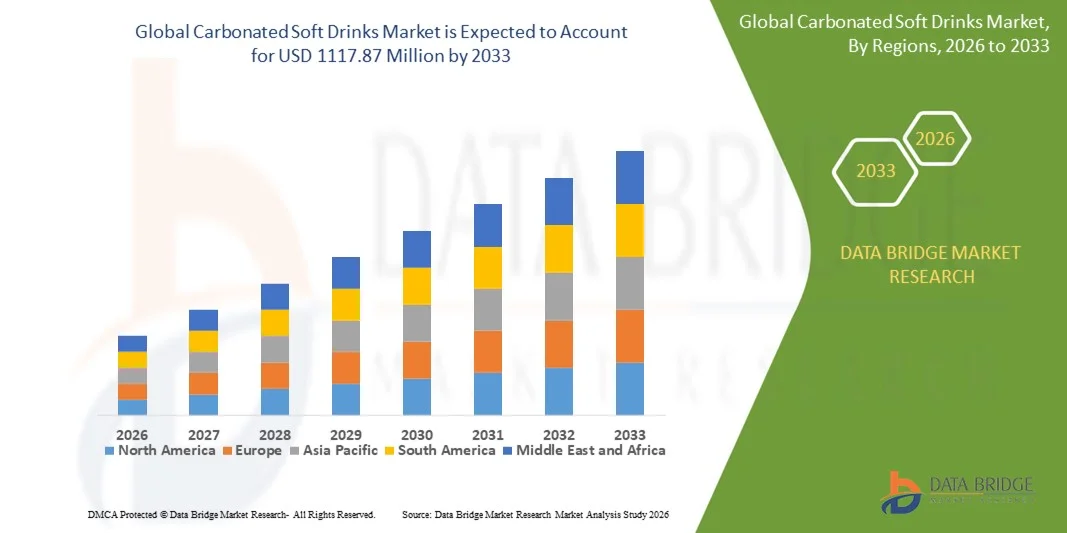
Global Carbonated Soft Drinks Market Size, Share and Trends Analysis Report – Industry Overview and Forecast to 2033

Request for TOC TOC のリクエスト Speak to Analyst アナリストに相談する Free Sample Report 無料サンプルレポート Inquire Before Buying 事前に問い合わせる Buy Now今すぐ購入

Global Carbonated Soft Drinks Market Size, Share and Trends Analysis Report – Industry Overview and Forecast to 2033

Global Carbonated Soft Drinks Market Segmentation, By Flavor (Cola, Lime, Lemon, Orange, and Others), Packaging Type (Bottles and Cans), Distribution Channel (Supermarkets & Hypermarkets, Convenience Stores, Online, and Others) - Industry Trends and Forecast to 2033

  • Food & Beverage
  • Jan 2026
  • Global
  • 350 ページ
  • テーブル数: 220
  • 図の数: 60
  • Author : Pawan Gusain

Global Carbonated Soft Drinks Market Size, Share and Trends Analysis Report

Market Size in USD Billion

CAGR :  % Diagram

Chart Image USD 697.15 Million USD 1,117.87 Million 2025 2033
Diagram 予測期間
2026 –2033
Diagram 市場規模(基準年)
USD 697.15 Million
Diagram Market Size (Forecast Year)
USD 1,117.87 Million
Diagram CAGR
%
Diagram Major Markets Players
  • Coca-Cola
  • PepsiCo
  • Dr Pepper Snapple Group
  • Nestlé S.A
  • and Monster Beverage Corporation

Global Carbonated Soft Drinks Market Segmentation, By Flavor (Cola, Lime, Lemon, Orange, and Others), Packaging Type (Bottles and Cans), Distribution Channel (Supermarkets & Hypermarkets, Convenience Stores, Online, and Others) - Industry Trends and Forecast to 2033

Global Carbonated Soft Drinks Marketz

Carbonated Soft Drinks Market Size

  • The global carbonated soft drinks market size was valued at USD 697.15 million in 2025 and is expected to reach USD 1117.87 million by 2033, at a CAGR of 6.08% during the forecast period
  • The market growth is largely fueled by rising global consumption of ready-to-drink beverages, driven by changing lifestyles, urbanization, and increasing preference for convenient refreshment options across all age groups
  • Furthermore, strong brand influence, continuous flavor innovation, and extensive availability across modern retail and foodservice channels are reinforcing consumer demand. These combined factors are accelerating consumption frequency and volume, thereby significantly supporting the growth of the carbonated soft drinks market

Carbonated Soft Drinks Market Analysis

  • Carbonated soft drinks are non-alcoholic beverages infused with carbon dioxide, available in a wide range of flavors and formulations, and consumed across residential, commercial, and on-the-go settings
  • The increasing demand for carbonated soft drinks is primarily driven by strong brand loyalty, aggressive marketing strategies, expanding distribution networks, and evolving consumer preferences for flavored and functional beverage variants
  • North America dominated the carbonated soft drinks market with a share of 45.5% in 2025, due to high per capita consumption, strong brand loyalty, and the widespread presence of established beverage manufacturers
  • Asia-Pacific is expected to be the fastest growing region in the carbonated soft drinks market during the forecast period due to rapid urbanization, rising disposable incomes, and expanding young population demographics
  • Cola segment dominated the market with a market share of 45.5% in 2025, due to its strong global brand presence, long-standing consumer preference, and wide acceptance across age groups. Cola beverages benefit from extensive marketing investments and consistent taste profiles that reinforce repeat consumption. Their strong positioning in both on-trade and off-trade channels further supports high sales volumes. Broad availability across price points and pack sizes continues to sustain demand. The dominance of cola is also supported by its pairing with meals and social occasions

Report Scope and Carbonated Soft Drinks Market Segmentation     

Attributes

Carbonated Soft Drinks Key Market Insights

Segments Covered

  • By Flavor: Cola, Lime, Lemon, Orange, and Others
  • By Packaging Type: Bottles and Cans
  • By Distribution Channel: Supermarkets & Hypermarkets, Convenience Stores, Online, and Others

Countries Covered

North America

  • U.S.
  • Canada
  • Mexico

Europe

  • Germany
  • France
  • U.K.
  • Netherlands
  • Switzerland
  • Belgium
  • Russia
  • Italy
  • Spain
  • Turkey
  • Rest of Europe

Asia-Pacific

  • China
  • Japan
  • India
  • South Korea
  • Singapore
  • Malaysia
  • Australia
  • Thailand
  • Indonesia
  • Philippines
  • Rest of Asia-Pacific

Middle East and Africa

  • Saudi Arabia
  • U.A.E.
  • South Africa
  • Egypt
  • Israel
  • Rest of Middle East and Africa

South America

  • Brazil
  • Argentina
  • Rest of South America

Key Market Players

  • Coca-Cola (U.S.)
  • PepsiCo (U.S.)
  • Dr Pepper Snapple Group (U.S.)
  • Nestlé S.A. (Switzerland)
  • Monster Beverage Corporation (U.S.)
  • Red Bull GmbH (Austria)
  • Britvic plc (U.K.)
  • Keurig Dr Pepper Inc. (U.S.)
  • Fanta (U.S.)
  • Asahi Group Holdings, Ltd. (Japan)
  • Danone S.A. (France)
  • Suntory Holdings Limited (Japan)
  • The Kraft Heinz Company (U.S.)
  • Tingyi Holding Corp. (China)

Market Opportunities

  • Expansion in Emerging Markets with Young and Urban Populations
  • Product Innovation Through Functional and Premium Carbonated Beverages

Value Added Data Infosets

In addition to the insights on market scenarios such as market value, growth rate, segmentation, geographical coverage, and major players, the market reports curated by the Data Bridge Market Research also include in-depth expert analysis, pricing analysis, brand share analysis, consumer survey, demography analysis, supply chain analysis, value chain analysis, raw material/consumables overview, vendor selection criteria, PESTLE Analysis, Porter Analysis, and regulatory framework.

Carbonated Soft Drinks Market Trends

Rising Demand for Low-Sugar and Zero-Calorie Carbonated Beverages

  • A major trend in the carbonated soft drinks market is the growing consumer shift toward low-sugar and zero-calorie beverage options, driven by increasing health awareness and changing dietary preferences. Consumers are actively reducing sugar intake while still seeking the taste and refreshment associated with carbonated drinks, which is reshaping product portfolios across the industry
    • For instance, Coca-Cola has expanded its Coca-Cola Zero Sugar and Diet Coke offerings across multiple regions to address rising demand for reduced-calorie alternatives. These products have gained strong traction among health-conscious consumers while maintaining brand familiarity and taste consistency
  • The trend is further supported by reformulation efforts that focus on alternative sweeteners and improved flavor profiles to meet evolving consumer expectations. Beverage manufacturers are investing in research to balance taste, mouthfeel, and calorie reduction without compromising product appeal
  • Retail shelves are increasingly dominated by low- and no-sugar variants, reflecting higher shelf allocation and promotional focus by retailers. This shift is encouraging faster adoption among consumers who previously limited carbonated soft drink consumption due to health concerns
  • Younger demographics are particularly driving this trend as they show greater preference for transparency in nutritional content and functional benefits. Their purchasing behavior is influencing brand strategies and accelerating the launch of better-for-you carbonated beverages
  • The sustained momentum of low-sugar and zero-calorie offerings is redefining competitive positioning within the market. This trend is reinforcing long-term demand by aligning carbonated soft drinks with healthier lifestyle choices while preserving mass-market appeal

Carbonated Soft Drinks Market Dynamics

Driver

Strong Brand Loyalty and Extensive Global Distribution Networks

  • Strong brand loyalty and well-established global distribution networks remain a key driver of the carbonated soft drinks market, enabling consistent product availability and sustained consumption across regions. Leading brands benefit from decades of consumer trust and recognition, which supports repeat purchases and stable demand
    • For instance, PepsiCo leverages its extensive global bottling and distribution network to ensure wide availability of its carbonated beverage portfolio across supermarkets, convenience stores, and foodservice outlets. This reach allows the company to maintain strong market penetration even in highly competitive environments
  • Large-scale marketing investments and sponsorships further strengthen brand attachment and consumer recall. These efforts reinforce emotional connections with consumers and sustain long-term brand preference
  • The ability to efficiently distribute products across urban and rural markets supports volume-driven growth. Established logistics capabilities reduce supply disruptions and ensure consistent shelf presence
  • As consumption remains closely tied to brand familiarity and accessibility, this driver plays a central role in supporting the resilience and scale of the carbonated soft drinks market

Restraint/Challenge

Increasing Health Concerns and Regulatory Pressure on Sugar Content

  • The carbonated soft drinks market faces growing challenges from rising health concerns and increasing regulatory scrutiny related to sugar consumption. Governments and health organizations are actively highlighting the links between excessive sugar intake and lifestyle-related diseases, influencing consumer behavior and policy decisions
    • For instance, the World Health Organization has consistently recommended reducing free sugar intake, prompting several countries to introduce sugar taxes on carbonated beverages. Such regulations have directly impacted pricing strategies and consumption patterns in multiple markets
  • Manufacturers are required to invest heavily in reformulation and compliance efforts to meet regulatory standards. These changes often involve higher costs related to ingredient sourcing, testing, and labeling updates
  • Shifting consumer perceptions toward sugary beverages are reducing demand for traditional full-sugar carbonated drinks. This creates pressure on legacy products that historically contributed significant revenue volumes
  • These regulatory and health-related constraints are reshaping competitive dynamics and compelling market players to adapt rapidly. The challenge continues to influence strategic planning and long-term growth trajectories within the carbonated soft drinks market

Carbonated Soft Drinks Market Scope

The market is segmented on the basis of flavor, packaging type, and distribution channel.

  • By Flavor

On the basis of flavor, the carbonated soft drinks market is segmented into cola, lime, lemon, orange, and others. The cola segment dominated the largest market revenue share of 45.5% in 2025, driven by its strong global brand presence, long-standing consumer preference, and wide acceptance across age groups. Cola beverages benefit from extensive marketing investments and consistent taste profiles that reinforce repeat consumption. Their strong positioning in both on-trade and off-trade channels further supports high sales volumes. Broad availability across price points and pack sizes continues to sustain demand. The dominance of cola is also supported by its pairing with meals and social occasions.

The lemon segment is anticipated to witness the fastest growth rate from 2026 to 2033, supported by rising consumer interest in refreshing and citrus-based flavors. Lemon-flavored carbonated drinks are increasingly perceived as lighter and more thirst-quenching, which appeals to health-conscious and younger consumers. Product innovations focusing on low-sugar and natural flavor formulations are strengthening adoption. Seasonal demand during warmer climates also contributes to higher consumption. Expanding availability in emerging markets is further accelerating growth.

  • By Packaging Type

On the basis of packaging type, the carbonated soft drinks market is segmented into bottles and cans. The bottles segment accounted for the largest market revenue share in 2025, driven by convenience, re-sealability, and suitability for family or multi-serve consumption. Plastic and glass bottles offer flexibility in size variants, supporting both single-use and bulk purchases. Bottles are widely preferred in retail environments due to ease of storage and transportation. Strong penetration in supermarkets and convenience stores further reinforces dominance. Brand visibility through labeling and packaging design also supports higher sales.

The cans segment is expected to register the fastest growth rate during the forecast period, supported by increasing demand for single-serve and on-the-go consumption. Cans offer faster chilling, improved portability, and reduced risk of contamination, making them popular in urban settings. Growing environmental focus on recyclability is improving the perception of aluminum cans. Rising consumption through vending machines and foodservice outlets is also driving growth. Premiumization trends are further supporting can-based offerings.

  • By Distribution Channel

On the basis of distribution channel, the carbonated soft drinks market is segmented into supermarkets & hypermarkets, convenience stores, online, and others. Supermarkets and hypermarkets dominated the largest market revenue share in 2025, driven by extensive product assortments and high consumer footfall. These channels enable bulk purchasing and promotional pricing, encouraging higher volume sales. Strong shelf visibility and in-store marketing support brand-driven purchases. Established supply chains ensure consistent product availability. Consumer preference for one-stop shopping further strengthens dominance.

The online segment is projected to witness the fastest growth rate from 2026 to 2033, supported by increasing digital penetration and evolving purchasing behavior. Online platforms provide convenience, home delivery, and access to a wider range of brands and pack sizes. Subscription-based models are encouraging repeat purchases of beverages. Growth in quick-commerce and app-based grocery services is accelerating adoption. Attractive discounts and personalized recommendations further enhance channel expansion.

Carbonated Soft Drinks Market Regional Analysis

  • North America dominated the carbonated soft drinks market with the largest revenue share of 45.5% in 2025, driven by high per capita consumption, strong brand loyalty, and the widespread presence of established beverage manufacturers
  • Consumers in the region show a strong preference for carbonated beverages across multiple occasions, supported by aggressive marketing, frequent product innovations, and extensive availability across retail and foodservice channels
  • This dominance is further supported by well-developed distribution infrastructure, high disposable incomes, and the growing demand for convenient, ready-to-drink beverages, reinforcing the region’s leadership in the global market

U.S. Carbonated Soft Drinks Market Insight

The U.S. carbonated soft drinks market captured the largest revenue share in 2025 within North America, supported by the strong presence of global beverage brands and a mature retail ecosystem. High consumption of cola-based drinks, combined with continuous flavor innovation and packaging diversification, continues to drive demand. The expansion of convenience stores and foodservice outlets further strengthens market growth. In addition, strong promotional activities and brand-driven consumer loyalty play a key role in sustaining sales volumes.

Europe Carbonated Soft Drinks Market Insight

The Europe carbonated soft drinks market is projected to grow at a steady CAGR during the forecast period, driven by changing consumer preferences and increasing demand for flavored and low-sugar carbonated beverages. Rising urbanization and evolving lifestyles are supporting consistent consumption across both Western and Eastern Europe. Manufacturers are increasingly focusing on reformulation and premium offerings to align with regulatory standards and consumer expectations. The region shows balanced growth across retail and on-trade channels.

U.K. Carbonated Soft Drinks Market Insight

The U.K. carbonated soft drinks market is expected to register notable growth during the forecast period, driven by strong demand for flavored and sugar-free carbonated beverages. Health awareness and regulatory measures on sugar content are influencing product innovation and portfolio diversification. Consumers continue to favor carbonated drinks for social and at-home consumption. The country’s strong retail penetration and promotional pricing strategies further support market expansion.

Germany Carbonated Soft Drinks Market Insight

The Germany carbonated soft drinks market is anticipated to expand at a moderate CAGR, supported by high consumption of carbonated beverages and a strong preference for flavored and fruit-based variants. Germany’s well-established beverage manufacturing base and efficient distribution networks support consistent supply. Increasing demand for sustainable packaging and recyclable cans and bottles is influencing market dynamics. The focus on quality and ingredient transparency aligns with evolving consumer expectations.

Asia-Pacific Carbonated Soft Drinks Market Insight

The Asia-Pacific carbonated soft drinks market is expected to grow at the fastest CAGR during the forecast period, driven by rapid urbanization, rising disposable incomes, and expanding young population demographics. Increasing westernization of diets and growing exposure to global beverage brands are accelerating consumption. The expansion of modern retail formats and convenience stores further supports market growth. Manufacturers are actively introducing region-specific flavors to capture local demand.

Japan Carbonated Soft Drinks Market Insight

The Japan carbonated soft drinks market is witnessing steady growth due to strong consumer demand for innovative flavors and premium carbonated beverages. The market benefits from advanced packaging technologies and a high level of product differentiation. Carbonated drinks are widely consumed across vending machines, convenience stores, and foodservice outlets. The preference for smaller pack sizes and functional beverage variants continues to shape market trends.

China Carbonated Soft Drinks Market Insight

The China carbonated soft drinks market accounted for the largest revenue share in Asia-Pacific in 2025, driven by rapid urbanization, a growing middle-class population, and strong brand penetration. Increasing consumption among younger consumers and rising demand for flavored carbonated beverages are key growth drivers. The expansion of e-commerce and modern retail channels is significantly improving product accessibility. Strong domestic manufacturers and competitive pricing strategies are further accelerating market expansion.

Carbonated Soft Drinks Market Share

The carbonated soft drinks industry is primarily led by well-established companies, including:

  • Coca-Cola (U.S.)
  • PepsiCo (U.S.)
  • Dr Pepper Snapple Group (U.S.)
  • Nestlé S.A. (Switzerland)
  • Monster Beverage Corporation (U.S.)
  • Red Bull GmbH (Austria)
  • Britvic plc (U.K.)
  • Keurig Dr Pepper Inc. (U.S.)
  • Fanta (U.S.)
  • Asahi Group Holdings, Ltd. (Japan)
  • Danone S.A. (France)
  • Suntory Holdings Limited (Japan)
  • The Kraft Heinz Company (U.S.)
  • Tingyi Holding Corp. (China)

Latest Developments in Global Carbonated Soft Drinks Market

  • In November 2025, Coca-Cola (U.S.) entered into a strategic partnership with a leading technology firm to strengthen its digital marketing capabilities, with a direct impact on consumer engagement and brand positioning. The collaboration enables the use of advanced analytics and data-driven personalization, allowing Coca-Cola to tailor marketing campaigns more precisely to consumer preferences. This approach is expected to enhance brand loyalty, improve campaign efficiency, and support sustained market share growth in a highly competitive carbonated soft drinks landscape. Deeper consumer insights may also guide future flavor and product innovations
  • In September 2025, PepsiCo (U.S.) introduced a new portfolio of organic carbonated sodas, reinforcing its strategic focus on health and wellness-driven consumption trends. This development expands PepsiCo’s presence in the premium and organic beverage segment, which is gaining traction among health-conscious consumers. By diversifying its carbonated soft drinks offerings, the company is positioned to attract new customer segments while strengthening its competitive edge. The move also supports long-term portfolio resilience amid shifting consumer preferences
  • In August 2025, Keurig Dr Pepper (U.S.) announced investments in sustainable packaging solutions for its carbonated soft drinks portfolio, aiming to reduce plastic usage and improve recyclability. This initiative is expected to enhance brand perception among environmentally conscious consumers and align the company with evolving regulatory and sustainability expectations. Improved packaging efficiency may also contribute to cost optimization over time. The focus on sustainability supports long-term market competitiveness and consumer trust
  • In July 2025, Dr Pepper Snapple Group (U.S.) expanded its distribution footprint across Southeast Asia to capitalize on rising demand for carbonated beverages in emerging economies. This expansion strengthens the company’s access to high-growth markets characterized by increasing urbanization and young consumer populations. Enhanced distribution capabilities are likely to improve product availability and brand visibility across the region. As a result, the company is positioned to capture incremental market share and reinforce its global growth strategy
  • In June 2025, The Coca-Cola Company (U.S.) launched region-specific flavored carbonated beverages across select Asia-Pacific markets to address local taste preferences. This localized product strategy is expected to drive higher consumer acceptance and trial rates in diverse regional markets. Tailoring flavors to cultural preferences enhances competitive differentiation and strengthens regional market penetration. The initiative supports volume growth and reinforces Coca-Cola’s adaptability in dynamic global markets


SKU-

世界初のマーケットインテリジェンスクラウドに関するレポートにオンラインでアクセスする

  • インタラクティブなデータ分析ダッシュボード
  • 成長の可能性が高い機会のための企業分析ダッシュボード
  • カスタマイズとクエリのためのリサーチアナリストアクセス
  • インタラクティブなダッシュボードによる競合分析
  • 最新ニュース、更新情報、トレンド分析
  • 包括的な競合追跡のためのベンチマーク分析のパワーを活用
デモのリクエスト

調査方法

データ収集と基準年分析は、大規模なサンプル サイズのデータ​​収集モジュールを使用して行われます。この段階では、さまざまなソースと戦略を通じて市場情報または関連データを取得します。過去に取得したすべてのデータを事前に調査および計画することも含まれます。また、さまざまな情報ソース間で見られる情報の不一致の調査も含まれます。市場データは、市場統計モデルと一貫性モデルを使用して分析および推定されます。また、市場シェア分析と主要トレンド分析は、市場レポートの主要な成功要因です。詳細については、アナリストへの電話をリクエストするか、お問い合わせをドロップダウンしてください。

DBMR 調査チームが使用する主要な調査方法は、データ マイニング、データ変数が市場に与える影響の分析、および一次 (業界の専門家) 検証を含むデータ三角測量です。データ モデルには、ベンダー ポジショニング グリッド、市場タイムライン分析、市場概要とガイド、企業ポジショニング グリッド、特許分析、価格分析、企業市場シェア分析、測定基準、グローバルと地域、ベンダー シェア分析が含まれます。調査方法について詳しくは、お問い合わせフォームから当社の業界専門家にご相談ください。

カスタマイズ可能

Data Bridge Market Research は、高度な形成的調査のリーダーです。当社は、既存および新規のお客様に、お客様の目標に合致し、それに適したデータと分析を提供することに誇りを持っています。レポートは、対象ブランドの価格動向分析、追加国の市場理解 (国のリストをお問い合わせください)、臨床試験結果データ、文献レビュー、リファービッシュ市場および製品ベース分析を含めるようにカスタマイズできます。対象競合他社の市場分析は、技術ベースの分析から市場ポートフォリオ戦略まで分析できます。必要な競合他社のデータを、必要な形式とデータ スタイルでいくつでも追加できます。当社のアナリスト チームは、粗い生の Excel ファイル ピボット テーブル (ファクト ブック) でデータを提供したり、レポートで利用可能なデータ セットからプレゼンテーションを作成するお手伝いをしたりすることもできます。


Frequently Asked Questions

市場は Segmentation, By Flavor (Cola, Lime, Lemon, Orange, and Others), Packaging Type (Bottles and Cans), Distribution Channel (Supermarkets & Hypermarkets, Convenience Stores, Online, and Others) - Industry Trends and Forecast to 2033 に基づいて分類されます。
Global Carbonated Soft Drinks Marketの規模は2025年にUSD 697.15 USD Millionと推定されました。
Global Carbonated Soft Drinks Marketは2026年から2033年の予測期間にCAGR 6.08%で成長すると見込まれています。
市場で活動している主要プレーヤーはCoca-Cola, PepsiCo, Dr Pepper Snapple Group, Nestlé S.A, and Monster Beverage Corporation です。
この市場レポートはNorth Americaのデータを含みます。
Testimonial