Global Computer
Market Size in USD Billion
CAGR :
%
USD
1.18 Billion
USD
2.12 Billion
2024
2032
| 2025 –2032 | |
| USD 1.18 Billion | |
| USD 2.12 Billion | |
|
|
|
|
Global Computer-Aided Oral and Maxillofacial Surgery Market Segmentation, By Product Type (CAD/CAM Systems, and CAD/CAM Materials), Type (In-Lab and In-Office), Component (Dental Printers, Milling Machine, Scanners, Software, and Others), Application (Crowns, Dentures, Bridges, Veneers, Inlays/Onlays, Cranial Flap Fixation, CMF Distraction, Temporomandibular Joint Replacement, MF Plate and Screw Fixation, and Others), End-User (Neurosurgery & ENT, Orthognathic and Dental Surgery, Plastic Surgery, Dental Surgery, Oral Surgery, and Others) - Industry Trends and Forecast to 2032
Computer-Aided Oral and Maxillofacial Surgery Market Size
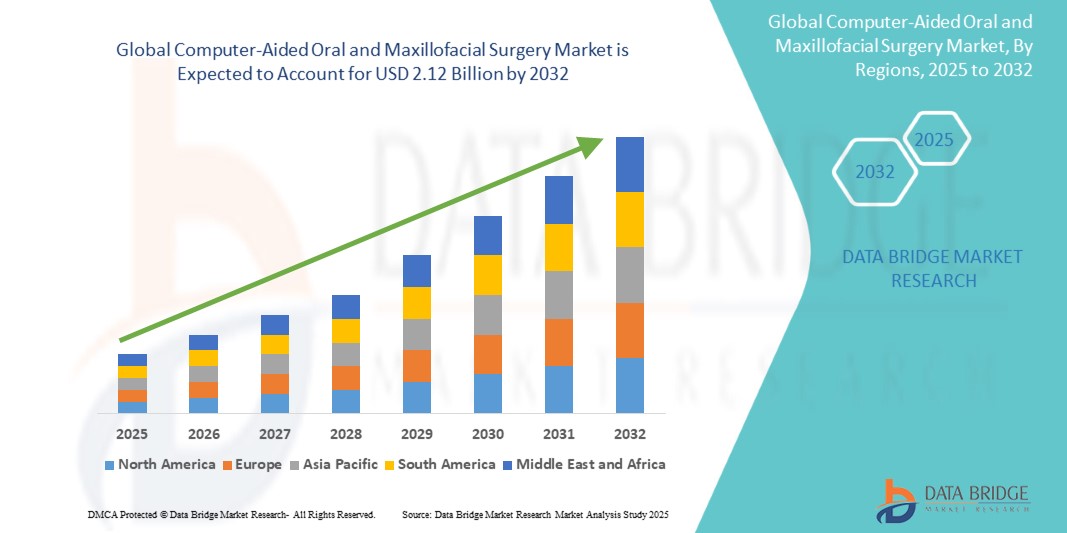
- The global computer-aided oral and maxillofacial surgery market size was valued at USD 1.18 billion in 2024 and is expected to reach USD 2.12 billion by 2032, at a CAGR of 7.60% during the forecast period
- The market growth is largely fueled by the increasing adoption of advanced digital technologies and imaging solutions in dental and maxillofacial care, leading to enhanced precision, efficiency, and treatment outcomes in both clinical and surgical settings
- Furthermore, rising demand for minimally invasive procedures, improved surgical planning, and personalized patient care is driving the adoption of computer-aided oral and maxillofacial surgery solutions, thereby significantly boosting the industry's growth
Computer-Aided Oral and Maxillofacial Surgery Market Analysis
- Combined Pituitary Hormone Deficiencies, characterized by deficiencies in multiple pituitary hormones, are increasingly recognized as critical components of endocrine disorders in both pediatric and adult populations. This is due to advancements in diagnostic techniques, heightened awareness, and the development of targeted therapies
- The escalating demand for CPHD treatments is primarily fueled by the rising prevalence of pituitary disorders, advancements in genetic research, and the increasing availability of hormone replacement therapies
- North America dominated the computer-aided oral and maxillofacial surgery market with the largest revenue share of 40.06% in 2024, characterized by early adoption of advanced diagnostic technologies, high healthcare expenditure, and a strong presence of key industry players. The U.S. experienced substantial growth in CPHD diagnoses and treatments, particularly in specialized endocrinology centers and research institutions
- Asia-Pacific is expected to be the fastest-growing region in the computer-aided oral and maxillofacial surgery market during the forecast period due to increasing urbanization, rising disposable incomes, and improvements in healthcare infrastructure
- The In-Lab segment held the largest market revenue share of 62.1% in computer-aided oral and maxillofacial surgery market in 2024, supported by well-established dental laboratories that offer professional-grade CAD/CAM fabrication services. In-Lab workflows are preferred for their high precision, stringent quality control, and ability to manage a wide variety of materials and complex restoration types
Report Scope and Computer-Aided Oral and Maxillofacial Surgery Market Segmentation
|
Attributes |
Computer-Aided Oral and Maxillofacial Surgery Key Market Insights |
|
Segments Covered |
|
|
Countries Covered |
North America
Europe
Asia-Pacific
Middle East and Africa
South America
|
|
Key Market Players |
|
|
Market Opportunities |
|
|
Value Added Data Infosets |
In addition to the insights on market scenarios such as market value, growth rate, segmentation, geographical coverage, and major players, the market reports curated by the Data Bridge Market Research also include in-depth expert analysis, pricing analysis, brand share analysis, consumer survey, demography analysis, supply chain analysis, value chain analysis, raw material/consumables overview, vendor selection criteria, PESTLE Analysis, Porter Analysis, and regulatory framework. |
Computer-Aided Oral and Maxillofacial Surgery Market Trends
Enhanced Precision and Efficiency in Surgery
- A significant and accelerating trend in the global computer-aided oral and maxillofacial surgery market is the increasing adoption of advanced digital surgical planning and navigation systems. These technologies are significantly improving the precision, predictability, and efficiency of surgical procedures
- For instance, virtual surgical planning software allows surgeons to create detailed 3D models of a patient’s craniofacial structure, enabling preoperative simulation of osteotomies, implant placement, and bone grafting procedures. Similarly, computer-assisted navigation systems provide real-time guidance during complex maxillofacial surgeries, enhancing accuracy and reducing operative risks
- Integration of 3D imaging and simulation technologies in CAOMS enables features such as precise implant alignment, improved occlusal outcomes, and more predictable soft-tissue reconstruction. For example, some systems allow surgeons to virtually plan mandibular reconstructions and simulate outcomes, reducing intraoperative adjustments and improving patient satisfaction
- The seamless integration of CAOMS with digital imaging modalities (such as CBCT and MRI) and patient-specific surgical guides facilitates a more coordinated and efficient workflow across preoperative planning, intraoperative navigation, and postoperative evaluation. This creates a unified approach that improves surgical outcomes and reduces complications
- This trend towards more precise, efficient, and patient-specific surgical solutions is fundamentally reshaping expectations for oral and maxillofacial procedures. Consequently, companies such as Materialise, 3D Systems, and Stryker are developing advanced CAOMS platforms with features such as personalized surgical guides, real-time navigation, and integrated 3D planning
- The demand for computer-aided solutions in oral and maxillofacial surgery is growing rapidly across both hospital and specialized clinic settings, as surgeons increasingly prioritize precision, efficiency, and improved patient outcomes
Computer-Aided Oral and Maxillofacial Surgery Market Dynamics
Driver
Growing Need Due to Increasing Surgical Complexity and Demand for Precision
- The increasing prevalence of complex craniofacial conditions, trauma cases, and reconstructive procedures, coupled with rising demand for precise and minimally invasive interventions, is a significant driver for the adoption of Computer-Aided Oral and Maxillofacial Surgery technologies
- For instance, in 2024, Materialise announced advancements in patient-specific surgical planning and 3D-printed surgical guides for mandibular reconstruction, highlighting how innovations by key companies are expected to propel growth in the CAOMS market during the forecast period
- As surgeons aim to improve clinical outcomes and reduce intraoperative errors, CAOMS systems offer advanced features such as preoperative 3D simulation, virtual surgical planning, and intraoperative navigation, providing a substantial improvement over traditional manual approaches
- Furthermore, the growing integration of digital imaging technologies (CBCT, MRI, and CT scans) and 3D printing in surgical workflows is making CAOMS an indispensable component of modern maxillofacial surgery, enabling precise treatment planning and patient-specific solutions
- The ability to perform accurate pre-surgical simulations, plan osteotomies or implant placements, and create patient-specific surgical guides is driving adoption in hospitals, specialized clinics, and academic medical centers. The trend towards digitally assisted surgical workflows and training is further accelerating market growth
Restraint/Challenge
High Costs, Technical Complexity, and Training Barriers
- One of the primary challenges restricting the widespread adoption of Computer-Aided Oral and Maxillofacial Surgery (CAOMS) is the high upfront cost of advanced systems. Procuring digital surgical planning software, 3D printing equipment, and computer-assisted navigation tools requires substantial financial investment, which can be prohibitive for smaller hospitals, dental clinics, and facilities in developing regions. This cost factor can limit access to cutting-edge surgical solutions despite their proven clinical benefits in improving surgical precision and reducing complications
- In addition to financial constraints, technical complexity and learning curves present significant hurdles. Effective use of CAOMS technologies demands specialized knowledge in interpreting 3D imaging data, performing virtual surgical planning, and operating navigation systems during live procedures. Surgeons and clinical staff often require extensive training, workshops, and hands-on experience to achieve optimal results, which can be time-consuming and resource-intensive
- Another challenge is the integration of digital workflows into existing surgical practices. Transitioning from traditional manual techniques to fully digital, computer-assisted procedures requires adjustments in preoperative planning, intraoperative coordination, and postoperative evaluation. Resistance to change among medical professionals or institutions accustomed to conventional methods can slow adoption rates
- Furthermore, maintenance and software updates for CAOMS systems are ongoing considerations. Ensuring that hardware and software remain current, compatible, and accurate can add additional operational costs and administrative burdens, especially for facilities lacking dedicated technical support
- Overcoming these restraints will require cost-effective solutions, scalable training programs, and streamlined workflow integration, as well as demonstration of clear clinical benefits and long-term cost savings to encourage wider adoption of CAOMS across diverse healthcare setting
Computer-Aided Oral and Maxillofacial Surgery Market Scope
The market is segmented on the basis of product type, type, component, application, and end-user.
• By Product Type
On the basis of product type, the global computer-aided oral and maxillofacial surgery market is segmented into CAD/CAM Systems and CAD/CAM Materials. The CAD/CAM Systems segment dominated the largest market revenue share of 55.4% in 2024, driven by the increasing adoption of advanced digital workflows in oral and maxillofacial procedures. These systems enable clinicians to design and manufacture highly customized dental restorations and craniofacial implants with exceptional precision, reducing errors and enhancing patient outcomes. The integration of CAD/CAM Systems with 3D imaging and planning software ensures that complex surgical procedures are executed efficiently, making these systems indispensable in modern dental and surgical practices.
The CAD/CAM Materials segment is projected to witness the fastest CAGR of 18.2% from 2025 to 2032, fueled by continuous innovations in biocompatible and high-strength materials. These materials improve the durability, aesthetics, and functional performance of restorations and implants, driving their growing adoption among dental professionals seeking high-quality outcomes.
• By Type
On the basis of type, the global computer-aided oral and maxillofacial surgery market is segmented into in-lab and in-office. The in-lab segment held the largest market revenue share of 62.1% in 2024, supported by well-established dental laboratories that offer professional-grade CAD/CAM fabrication services. In-Lab workflows are preferred for their high precision, stringent quality control, and ability to manage a wide variety of materials and complex restoration types. These laboratories cater to intricate dental and craniofacial applications where accuracy and long-term performance are critical.
The In-Office segment is expected to witness the fastest CAGR of 16.5% from 2025 to 2032, driven by the increasing popularity of chairside CAD/CAM systems. These systems allow dentists and surgeons to produce restorations, prosthetics, and surgical guides on-site, significantly reducing treatment time and improving patient convenience. The flexibility of In-Office systems supports personalized care and facilitates rapid adaptation to specific clinical needs, making them increasingly attractive for modern dental practices.
• By Component
On the basis of component, the global computer-aided oral and maxillofacial surgery market is segmented into dental printers, milling machines, scanners, software, and others. The Software segment held the largest market revenue share of 48.7% in 2024, as CAD/CAM software forms the backbone of digital workflows, enabling clinicians to plan, design, and simulate restorations and surgical procedures with remarkable accuracy. These software platforms offer advanced features such as 3D modeling, virtual articulators, and integration with imaging modalities, enhancing clinical decision-making and reducing procedural errors.
The milling machine segment is anticipated to witness the fastest CAGR of 17.8% from 2025 to 2032 in the global market. This growth is attributed to rising demand for high-precision fabrication of crowns, bridges, implants, and customized surgical components. Milling machines enable accurate reproduction of complex geometries, ensuring durable and biocompatible prosthetics that improve patient outcomes. Their versatility across both clinical and laboratory settings, coupled with integration of CAD/CAM technologies, is driving adoption. In addition, growing focus on digital dentistry and personalized treatment solutions further accelerates market expansion.
• By Application
On the basis of application, the global computer-aided oral and maxillofacial surgery market is segmented into Crowns, Dentures, Bridges, Veneers, Inlays/Onlays, Cranial Flap Fixation, CMF Distraction, Temporomandibular Joint Replacement, MF Plate and Screw Fixation, and Others. The Crowns segment accounted for the largest market revenue share of 41.3% in 2024, driven by the growing demand for durable, esthetic, and precisely fitting dental restorations. CAD/CAM technology ensures high-quality crowns with reduced chairside adjustments, improved longevity, and better patient satisfaction.
The CMF distraction segment is projected to record the fastest CAGR of 19.1% from 2025 to 2032 in the global computer-aided oral and maxillofacial surgery market. Growth is driven by advancements in patient-specific distraction devices, integration of 3D surgical planning, and adoption of computer-aided navigation systems that enable high precision in correcting cranio-maxillofacial deformities. Rising prevalence of congenital anomalies, trauma cases, and demand for minimally invasive reconstructive procedures further fuel adoption. In addition, technological collaborations among device manufacturers and software providers are enhancing treatment outcomes and accelerating market expansion.
• By End-User
On the basis of end-user, the global computer-aided oral and maxillofacial surgery market is segmented into Neurosurgery & ENT, Orthognathic and Dental Surgery, Plastic Surgery, Dental Surgery, Oral Surgery, and Others. The Dental Surgery segment held the largest market revenue share of 46.2% in 2024, driven by the high volume of restorative, prosthetic, and surgical procedures performed in dental clinics and hospitals. CAD/CAM systems allow dental surgeons to enhance precision, reduce chairside time, and provide customized solutions that meet individual patient needs.
The Oral Surgery segment is expected to witness the fastest CAGR of 18.7% from 2025 to 2032, fueled by the rising number of complex oral and maxillofacial surgeries and the increasing reliance on digital surgical planning and guided solutions. End-users in Plastic Surgery and Neurosurgery & ENT are also progressively adopting CAD/CAM technology to improve surgical accuracy, reduce operative time, and achieve better functional and esthetic outcomes. The versatility of CAD/CAM solutions across multiple surgical specialties highlights their essential role in modern, patient-centered healthcare.
Computer-Aided Oral and Maxillofacial Surgery Market Regional Analysis
- North America dominated the computer-aided oral and maxillofacial surgery market with the largest revenue share of 40.06% in 2024, driven by the early adoption of advanced surgical planning technologies, high healthcare expenditure, and a strong presence of key industry players
- The region benefits from highly developed healthcare infrastructure, widespread availability of imaging modalities such as CBCT and 3D CT, and a technologically proficient medical workforce
- These factors collectively support the integration of digital surgical planning, navigation systems, and patient-specific surgical guides in hospitals and specialized clinics
U.S. Computer-Aided Oral and Maxillofacial Surgery Market Insight
The U.S. computer-aided oral and maxillofacial surgery market captured the largest revenue share within North America in 2024, fueled by the rapid growth in oral and maxillofacial surgical procedures, particularly in specialized hospitals, dental centers, and research institutions. Surgeons are increasingly adopting digital surgical planning software, 3D printing for patient-specific guides, and computer-assisted navigation to improve precision, reduce operative risks, and achieve better postoperative outcomes. Strong investments in healthcare, combined with advanced clinical research facilities and a focus on minimally invasive, patient-specific procedures, further reinforce the U.S. as a leading market for CAOMS technologies.
Europe Computer-Aided Oral and Maxillofacial Surgery Market Insight
The Europe computer-aided oral and maxillofacial surgery market is projected to expand at a substantial CAGR during the forecast period, primarily driven by growing demand for precise and minimally invasive surgeries, as well as increasing cases of craniofacial trauma, congenital anomalies, and oral cancers. The region’s robust healthcare infrastructure, combined with stringent clinical quality regulations, encourages the adoption of digital surgical planning and navigation systems across hospitals and specialized clinics.
U.K. Computer-Aided Oral and Maxillofacial Surgery Market Insight
The U.K. computer-aided oral and maxillofacial surgery market is expected to grow at a noteworthy CAGR during the forecast period, supported by increasing prevalence of facial trauma, oral cancers, and deformities requiring corrective interventions. Adoption is further driven by advanced healthcare facilities, strong clinical research initiatives, and an emphasis on patient-specific, evidence-based surgical solutions that enhance precision and reduce postoperative complications.
Germany Computer-Aided Oral and Maxillofacial Surgery Market Insight
The Germany computer-aided oral and maxillofacial surgery market is projected to witness considerable growth in CAOMS adoption due to rising awareness of digital surgical technologies and a strong preference for innovative, precise treatment solutions. Well-developed medical infrastructure, a skilled surgical workforce, and focus on clinical research facilitate integration of computer-assisted navigation, 3D imaging, and patient-specific surgical planning in hospitals and specialty centers.
Asia-Pacific Computer-Aided Oral and Maxillofacial Surgery Market Insight
The Asia-Pacific computer-aided oral and maxillofacial surgery market is expected to be the fastest-growing region in the CAOMS market during the forecast period, driven by rapid urbanization, rising disposable incomes, and improvements in healthcare infrastructure. Countries such as China, Japan, and India are witnessing increasing adoption of digital surgical planning, 3D imaging, and navigation technologies for reconstructive, trauma, and orthodontic surgeries, supported by government initiatives, modern hospitals, and trained medical professionals.
Japan Computer-Aided Oral and Maxillofacial Surgery Market Insight
The Japan computer-aided oral and maxillofacial surgery market is gaining momentum due to advanced healthcare infrastructure, a high level of technological awareness, and rising demand for precision and minimally invasive surgeries. Increasing cases of oral cancers, trauma, and age-related craniofacial conditions are further boosting the adoption of patient-specific surgical planning and navigation solutions in hospitals and specialized clinics.
China Computer-Aided Oral and Maxillofacial Surgery Market Insight
The China computer-aided oral and maxillofacial surgery market accounted for the largest market revenue share in Asia-Pacific in 2024, driven by rapid urbanization, growing disposable incomes, and increased adoption of modern healthcare technologies. Expanding specialty hospitals, government support for healthcare digitalization, and growing clinical expertise are accelerating the use of CAOMS for reconstructive, trauma, and elective surgical procedures.
Computer-Aided Oral and Maxillofacial Surgery Market Share
The computer-aided oral and maxillofacial surgery industry is primarily led by well-established companies, including:
- Overjet AI (U.S.)
- Danaher Corporation (U.S.)
- Dentsply Sirona (U.S.)
- 3M (U.S.)
- Planmeca OY (Finland)
- A-dec Inc. (U.S.)
- AMD Lasers (U.S.)
- Biolase, Inc. (U.S.)
- Ivoclar Vivadent Marketing (India) Pvt. Ltd. (India)
- Midmark Corporation (U.S.)
- B&D Dental Technologies (U.S.)
- DATRON AG (Germany)
- Institut Straumann AG (Switzerland)
- 3Shape A/S (Denmark)
- Nobel Biocare Services AG (Switzerland)
Latest Developments in Global Computer-Aided Oral and Maxillofacial Surgery Market
- In February 2022, the American Board of Oral and Maxillofacial Surgery (ABOMS) introduced a new timeline for the Oral and Maxillofacial Surgery In-service Training Examination (OMSITE). This 250-question computer-based exam is designed to assess the knowledge base and competencies of residents in accredited oral and maxillofacial surgery training programs in the U.S. and Canada. The updated timeline aims to provide score reports earlier, assisting programs in evaluating their training performance more effectively
- In August 2025, a study published in Nature assessed the accuracy of robotic computer-aided implant surgery (rCAIS) in partially edentulous patients using a standard operation procedure. The study found that deviations of dental implants were minimal after superimposition of the preoperative and postoperative cone-beam computed tomography (CBCT) images, indicating the effectiveness of rCAIS in achieving precise implant placement
SKU-
世界初のマーケットインテリジェンスクラウドに関するレポートにオンラインでアクセスする

- インタラクティブなデータ分析ダッシュボード
- 成長の可能性が高い機会のための企業分析ダッシュボード
- カスタマイズとクエリのためのリサーチアナリストアクセス
- インタラクティブなダッシュボードによる競合分析
- 最新ニュース、更新情報、トレンド分析
- 包括的な競合追跡のためのベンチマーク分析のパワーを活用
調査方法
データ収集と基準年分析は、大規模なサンプル サイズのデータ収集モジュールを使用して行われます。この段階では、さまざまなソースと戦略を通じて市場情報または関連データを取得します。過去に取得したすべてのデータを事前に調査および計画することも含まれます。また、さまざまな情報ソース間で見られる情報の不一致の調査も含まれます。市場データは、市場統計モデルと一貫性モデルを使用して分析および推定されます。また、市場シェア分析と主要トレンド分析は、市場レポートの主要な成功要因です。詳細については、アナリストへの電話をリクエストするか、お問い合わせをドロップダウンしてください。
DBMR 調査チームが使用する主要な調査方法は、データ マイニング、データ変数が市場に与える影響の分析、および一次 (業界の専門家) 検証を含むデータ三角測量です。データ モデルには、ベンダー ポジショニング グリッド、市場タイムライン分析、市場概要とガイド、企業ポジショニング グリッド、特許分析、価格分析、企業市場シェア分析、測定基準、グローバルと地域、ベンダー シェア分析が含まれます。調査方法について詳しくは、お問い合わせフォームから当社の業界専門家にご相談ください。
カスタマイズ可能
Data Bridge Market Research は、高度な形成的調査のリーダーです。当社は、既存および新規のお客様に、お客様の目標に合致し、それに適したデータと分析を提供することに誇りを持っています。レポートは、対象ブランドの価格動向分析、追加国の市場理解 (国のリストをお問い合わせください)、臨床試験結果データ、文献レビュー、リファービッシュ市場および製品ベース分析を含めるようにカスタマイズできます。対象競合他社の市場分析は、技術ベースの分析から市場ポートフォリオ戦略まで分析できます。必要な競合他社のデータを、必要な形式とデータ スタイルでいくつでも追加できます。当社のアナリスト チームは、粗い生の Excel ファイル ピボット テーブル (ファクト ブック) でデータを提供したり、レポートで利用可能なデータ セットからプレゼンテーションを作成するお手伝いをしたりすることもできます。