Global Cortical Necrosis Market Segmentation, By Type (Focal Pathologic, Minor Pathologic, Patchy Pathologic, Gross Pathologic, Confluent Pathologic, and Others), Population (Adult, Neonatal, and Others), Treatment (Surgery, Medication, Supportive Care, and Others), Route of Administration (Oral, Parenteral, and Others), End-Users (Hospitals, Homecare, Specialty Clinics, and Others), Distribution Channel (Hospital Pharmacy, Online Pharmacy, and Retail Pharmacy) - Industry Trends and Forecast to 2033
Cortical Necrosis Market Size
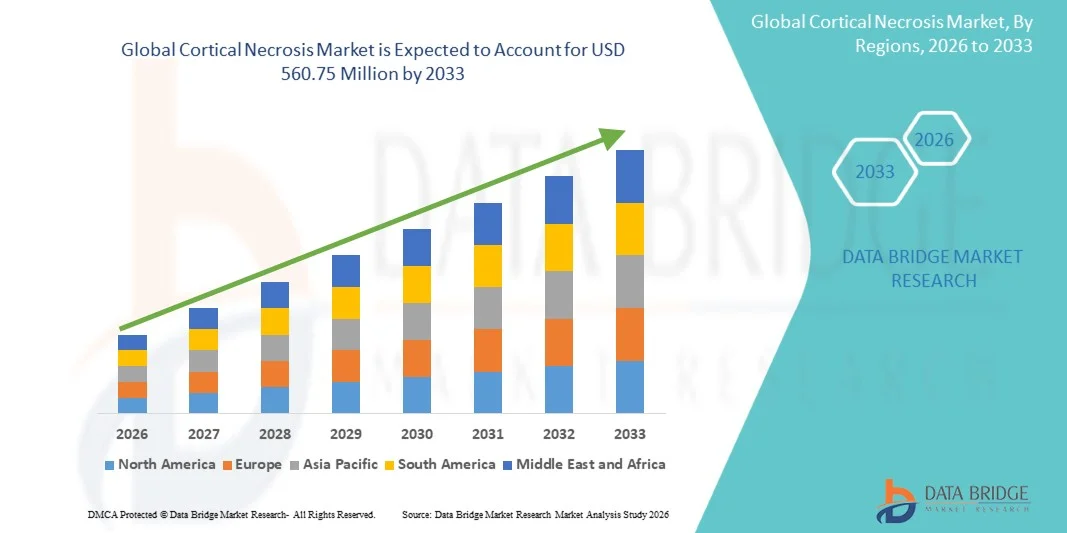
- The global cortical necrosis market size was valued at USD 350.50 Million in 2025 and is expected to reach USD 560.75 Million by 2033, at a CAGR of 6.05% during the forecast period
- The market growth is largely fueled by the increasing prevalence of acute kidney injuries and ischemic conditions that can lead to cortical necrosis, along with rising awareness among healthcare professionals regarding early diagnosis and intervention strategies. Technological advancements in diagnostic imaging, biomarkers, and treatment modalities are further supporting market expansion
- Furthermore, rising demand for effective, safe, and timely therapeutic and supportive solutions for cortical necrosis patients is positioning these interventions as essential in nephrology and critical care settings. These converging factors are accelerating the uptake of cortical necrosis solutions, thereby significantly boosting growth in the global cortical necrosis market
Cortical Necrosis Market Analysis
- Cortical necrosis management solutions, including diagnostic imaging, supportive therapies, and acute care interventions, are becoming increasingly critical in modern nephrology and critical care due to the ongoing incidence of acute kidney injuries and ischemic events that can lead to cortical tissue damage. Advances in early diagnostic technologies and improved treatment protocols are supporting broader adoption across clinical settings
- The escalating demand for cortical necrosis solutions is primarily fueled by increasing awareness of timely diagnosis and intervention, rising prevalence of conditions associated with cortical necrosis (such as obstetric complications, sepsis, and vascular disorders), and growing emphasis on improving patient outcomes. These converging factors are accelerating market uptake and significantly boosting overall industry growth
- North America dominated the cortical necrosis market, accounting for approximately 38% of global revenue in 2025, supported by well‑developed healthcare infrastructure, extensive clinical research activities, and high utilization of advanced diagnostic and therapeutic care for kidney‑related conditions
- Asia‑Pacific is expected to be the fastest‑growing region in the cortical necrosis market during the forecast period, with projected robust growth rates driven by rising healthcare expenditure, expanding access to tertiary care facilities, and increasing disease burden related to acute renal ischemia and complications
- The parenteral segment dominated the largest market revenue share of 46% in 2025, driven by intravenous interventions, high efficacy, and preferred usage in hospital settings for acute management
Report Scope and Cortical Necrosis Market Segmentation
|
Attributes |
Cortical Necrosis Key Market Insights |
|
Segments Covered |
|
|
Countries Covered |
North America
Europe
Asia-Pacific
Middle East and Africa
South America
|
|
Key Market Players |
• Pfizer (U.S.) |
|
Market Opportunities |
|
|
Value Added Data Infosets |
In addition to the insights on market scenarios such as market value, growth rate, segmentation, geographical coverage, and major players, the market reports curated by the Data Bridge Market Research also include in-depth expert analysis, patient epidemiology, pipeline analysis, pricing analysis, and regulatory framework. |
Cortical Necrosis Market Trends
“Rising Focus on Early Diagnosis and Advanced Therapeutics”
- A major trend in the global Cortical Necrosis market is the increasing emphasis on early diagnosis and the development of advanced therapeutic interventions. Medical professionals are adopting more precise imaging techniques, biomarkers, and laboratory diagnostics to identify cortical necrosis at earlier stages, improving patient outcomes
- For instance, the use of MRI and contrast-enhanced imaging in clinical settings has facilitated timely detection of renal cortical injury, allowing for targeted interventions and better management of at-risk patients
- Pharmaceutical companies are also focusing on developing novel treatments, including nephroprotective drugs and targeted therapies, to mitigate the impact of cortical necrosis. This trend is fostering research collaborations and increasing investment in clinical trials globally
- Healthcare providers are integrating multidisciplinary approaches, combining nephrology, critical care, and diagnostic innovations, to enhance patient management strategies
- The trend toward precision medicine and personalized treatment plans is reshaping how cortical necrosis is managed, driving both clinical and research-based growth in the market
Cortical Necrosis Market Dynamics
Driver
“Increasing Prevalence of Renal Disorders and Rising Healthcare Expenditure”
- The growing incidence of renal disorders, acute kidney injury (AKI), and related comorbidities is a key driver of the Cortical Necrosis market
- Populations with high rates of hypertension, diabetes, and sepsis are particularly at risk, creating increased demand for effective diagnostics and therapeutics
- For instance, studies indicate that patients in intensive care units are more prone to cortical necrosis due to ischemic or toxic injuries, emphasizing the need for advanced intervention strategies
- Rising healthcare expenditure, improved hospital infrastructure, and enhanced access to specialized nephrology care are supporting broader adoption of diagnostic tools and treatments for cortical necrosis
- Government initiatives and public health programs promoting early detection of kidney-related conditions are further fueling market growth, particularly in regions like North America and Europe
- Technological advancements in diagnostic assays, lab-on-chip solutions, and nephroprotective therapies are increasing the availability of treatment options, enabling clinicians to respond more effectively to cortical necrosis cases
Restraint/Challenge
“High Treatment Costs and Limited Awareness in Emerging Regions”
- Despite the growing need, the high cost of advanced diagnostics and therapies for cortical necrosis can limit adoption, especially in low- and middle-income countries. Access to cutting-edge imaging equipment and nephroprotective drugs may remain restricted for large patient populations
- Distribution and accessibility challenges, such as the availability of specialized renal care centers and trained medical personnel, further hinder timely diagnosis and treatment
- For instance, in rural India, many hospitals lack MRI or contrast-enhanced imaging facilities, delaying detection and management of cortical necrosis
- Lack of awareness among patients and some healthcare providers regarding the early signs and risk factors of cortical necrosis can delay intervention, negatively affecting outcomes
- Regulatory variations and differences in treatment protocols across countries also pose challenges for uniform market expansion
- Overcoming these barriers requires investment in affordable diagnostics, clinician education, public health awareness campaigns, and strengthening of healthcare infrastructure, particularly in developing regions
Cortical Necrosis Market Scope
The market is segmented on the basis of type, population, treatment, route of administration, end-users, and distribution channel.
• By Type
On the basis of type, the Cortical Necrosis market is segmented into focal pathologic, minor pathologic, patchy pathologic, gross pathologic, confluent pathologic, and others. The focal pathologic segment dominated the largest market revenue share of 42.8% in 2025, driven by its high prevalence in clinical diagnoses, well-established detection methods, and extensive reporting in hospital settings. Focal pathologic cases are frequently identified through imaging and biopsy, allowing precise treatment planning. Hospitals and specialty clinics prioritize these cases due to their relatively better prognosis. Early diagnosis and intervention reinforce segment dominance. Clinical guidelines and standardized protocols support adoption. Integration with advanced laboratory diagnostics improves efficiency. Insurance and reimbursement policies favor early treatment of focal pathologic cases. Awareness programs for renal conditions also strengthen uptake. High adoption in adult populations contributes to revenue leadership. Research centers and hospitals conduct continuous studies, maintaining market dominance. Training programs for nephrologists enhance early detection and management. The segment benefits from technological innovations in imaging and lab assays, supporting its continued leadership.
The gross pathologic segment is expected to witness the fastest CAGR of 20.4% from 2026 to 2033, fueled by increasing detection of severe cortical necrosis cases, rising awareness among clinicians, and advancements in surgical and supportive care interventions. Hospitals and specialty centers adopt gross pathologic management protocols due to higher complexity. Emerging markets show rapid uptake as imaging and diagnostic infrastructure improves. Technological integration with monitoring systems enhances patient management. Increased incidence in neonatal and adult populations supports adoption. Insurance coverage for advanced treatment encourages faster growth. Clinical research highlighting outcomes of gross pathologic cases accelerates adoption. Telemedicine and remote care further facilitate treatment. Pharmaceutical companies and hospitals focus on tailored interventions. Educational initiatives for nephrologists and pediatricians drive awareness. Integration with supportive therapies strengthens outcomes. Funding and governmental initiatives in renal care reinforce segment growth.
• By Population
On the basis of population, the Cortical Necrosis market is segmented into adult, neonatal, and others. The adult segment dominated the largest market revenue share of 45% in 2025, driven by higher incidence rates in adult patients due to comorbidities, vascular complications, and post-surgical risks. Hospitals, homecare providers, and specialty clinics prioritize adult cases for early detection and intervention. Advanced imaging and laboratory diagnostics support adult patient management. Chronic kidney disease prevalence contributes to sustained demand. Clinical guidelines recommend early intervention, reinforcing adoption. Integration with personalized medicine and monitoring tools enhances care. Insurance and reimbursement programs favor adult treatments. Academic research centers conduct studies, strengthening evidence-based care. Awareness campaigns promote early diagnosis. Healthcare infrastructure in developed markets supports segment leadership. Government initiatives for renal health further boost adoption. Pharmaceutical and medical device companies focus on adult patient solutions.
The neonatal segment is expected to witness the fastest CAGR of 18.9% from 2026 to 2033, fueled by increasing focus on neonatal intensive care, early diagnosis through imaging, and improvements in supportive interventions. NICUs and specialty clinics adopt advanced monitoring systems for early detection. Awareness programs for neonatal kidney conditions accelerate adoption. Government and private funding for neonatal care strengthens growth. Telemedicine and remote monitoring improve accessibility. Clinical research highlighting long-term outcomes reinforces adoption. Hospitals integrate neonatal-specific surgical and medication protocols. Pharmaceutical and device innovations support neonatal treatment. Emerging markets show rapid uptake as neonatal care improves. Parental awareness campaigns promote early intervention. Insurance coverage for neonatal interventions encourages market expansion. Educational initiatives for pediatric nephrologists further support growth.
• By Treatment
On the basis of treatment, the Cortical Necrosis market is segmented into surgery, medication, supportive care, and others. The supportive care segment dominated the largest market revenue share of 40.2% in 2025, driven by the widespread adoption of dialysis, fluid management, and renal monitoring protocols. Hospitals and homecare centers heavily rely on supportive care for patient stabilization. Continuous R&D in monitoring devices enhances treatment effectiveness. Integration with telemedicine facilitates homecare adoption. Government and insurance support further reinforce the segment. Clinical guidelines prioritize supportive care for early intervention. Adoption is strong in adult and neonatal populations. Multi-disciplinary teams enhance care coordination. Academic studies validate efficacy. Emerging markets increasingly adopt supportive care. High patient compliance contributes to segment dominance. Availability of specialized equipment strengthens adoption.
The surgery segment is expected to witness the fastest CAGR of 17.8% from 2026 to 2033, fueled by advancements in renal reconstructive and transplant procedures, increasing detection of severe cases, and rising investment in hospital surgical infrastructure. Specialty clinics and hospitals adopt cutting-edge surgical interventions. Training programs for nephrologists and surgeons enhance expertise. Insurance coverage and governmental initiatives support adoption. Integration with pre- and post-operative monitoring ensures better outcomes. Clinical research demonstrates efficacy of early surgical intervention. Patient awareness campaigns drive demand. Emerging markets show increased uptake as surgical facilities expand. Multi-omics and imaging integration improves precision. Hospital collaborations accelerate adoption. Technology advancements in surgical tools further strengthen growth.
• By Route of Administration
On the basis of route of administration, the Cortical Necrosis market is segmented into oral, parenteral, and others. The parenteral segment dominated the largest market revenue share of 46% in 2025, driven by intravenous interventions, high efficacy, and preferred usage in hospital settings for acute management. Hospitals and specialty clinics rely on parenteral administration for precise dosing. Clinical protocols reinforce segment adoption. Integration with supportive care and monitoring tools enhances outcomes. Insurance coverage supports adoption. High compliance and effectiveness in critical cases strengthen dominance. Technological improvements in IV administration improve safety. Multi-disciplinary care enhances treatment outcomes. Evidence-based protocols drive adoption. Research in acute management supports continued leadership. Emerging markets adopt parenteral interventions rapidly. Telemedicine integration supports monitoring. Regulatory guidelines encourage best practices.
The oral segment is expected to witness the fastest CAGR of 16.5% from 2026 to 2033, fueled by convenience, outpatient adoption, and growing use of oral medication for supportive and prophylactic care. Homecare and outpatient clinics increasingly adopt oral interventions. Patient adherence is high due to ease of use. Insurance coverage supports outpatient management. Technological advancements in formulations enhance bioavailability. Education programs for patients and caregivers increase adoption. Clinical research validates efficacy. Emerging markets show rapid uptake. Integration with telemedicine facilitates remote monitoring. Multi-disciplinary care teams recommend oral interventions. Pharmaceutical innovations drive growth. Patient awareness campaigns strengthen adoption.
• By End-Users
On the basis of end-users, the Cortical Necrosis market is segmented into hospitals, homecare, specialty clinics, and others. The hospitals segment dominated the largest market revenue share of 48% in 2025, driven by high patient inflow, infrastructure for acute and chronic management, and availability of specialized care units. Hospitals adopt advanced imaging, laboratory, and surgical interventions. Integration with multi-disciplinary teams enhances outcomes. Insurance coverage facilitates treatment. Academic research and clinical studies reinforce adoption. Government initiatives support hospital-based management. Emerging markets invest in hospital infrastructure. High patient trust strengthens adoption. Advanced monitoring systems improve care quality. Continuous training for clinicians reinforces dominance. Pharmaceutical and device suppliers prioritize hospitals.
The homecare segment is expected to witness the fastest CAGR of 19.2% from 2026 to 2033, fueled by increasing preference for home-based supportive care, telemedicine integration, and patient convenience. Homecare adoption is driven by chronic management and rehabilitation. Remote monitoring tools facilitate care delivery. Insurance and reimbursement encourage homecare services. Emerging markets show rapid uptake. Patient awareness and education drive adherence. Technology-enabled devices improve safety and efficacy. Collaboration with hospitals ensures continuity of care. Telehealth platforms support real-time monitoring. Multi-disciplinary care teams adopt homecare solutions. Funding from government and private sectors strengthens adoption. Convenience and patient comfort reinforce growth.
• By Distribution Channel
On the basis of distribution channel, the Cortical Necrosis market is segmented into hospital pharmacy, online pharmacy, and retail pharmacy. The hospital pharmacy segment dominated the largest market revenue share of 44.5% in 2025, driven by availability of critical medications, integration with hospital treatment protocols, and high patient dependency on hospital-administered care. Hospitals stock essential drugs for immediate use. Insurance coverage supports hospital pharmacy adoption. Integration with electronic health records enhances management. Multi-disciplinary care teams rely on hospital pharmacies. Emerging markets strengthen hospital pharmacy infrastructure. Research centers collaborate with hospital pharmacies. Patient trust reinforces dominance. Continuous supply chain improvements support availability. Regulatory compliance ensures quality. Clinical guidelines prioritize hospital pharmacy usage. Government initiatives improve access to critical medications.
The online pharmacy segment is expected to witness the fastest CAGR of 12.3% from 2026 to 2033, driven by e-commerce penetration, doorstep delivery, digital marketing, and convenience. Retail and hospital pharmacies show steady growth. Consumer awareness, smartphone adoption, and online consultations accelerate adoption. Emerging markets show strong uptake. Convenience and accessibility sustain faster growth. Marketing campaigns strengthen visibility. Integration with telemedicine and homecare services improves adherence. Discounted pricing and loyalty programs enhance adoption.
Cortical Necrosis Market Regional Analysis
- North America dominated the cortical necrosis market, accounting for approximately 38–42% of global revenue in 2025, supported by well-developed healthcare infrastructure, extensive clinical research activities, and high utilization of advanced diagnostic and therapeutic care for kidney-related conditions
- The region benefits from strong healthcare expenditure, early adoption of advanced imaging technologies such as MRI and CT scans, and widespread availability of specialized nephrology care, enabling timely diagnosis and management of cortical necrosis
- Increasing prevalence of acute kidney injury (AKI), sepsis, and related comorbidities, along with strong awareness among healthcare professionals, continues to drive demand for effective diagnostic and treatment solutions across the region
U.S. Cortical Necrosis Market Insight
The U.S. cortical necrosis market captured the largest share within North America in 2025, driven by advanced diagnostic capabilities, strong healthcare infrastructure, and high investments in nephrology research. The presence of leading hospitals, research institutions, and pharmaceutical companies supports early diagnosis and access to advanced treatment options. Additionally, high awareness regarding kidney-related complications, along with increasing incidence of conditions such as sepsis and hypertension, is contributing to sustained market growth in the country.
Europe Cortical Necrosis Market Insight
The Europe cortical necrosis market is expected to expand at a considerable CAGR during the forecast period, supported by well-established healthcare systems, increasing incidence of renal disorders, and strong focus on early disease detection. Countries such as Germany, the U.K., and France are key contributors due to their advanced diagnostic infrastructure and access to specialized medical care. Growing investment in research and clinical studies related to kidney diseases is further strengthening the regional market.
U.K. Cortical Necrosis Market Insight
The U.K. cortical necrosis market is projected to grow steadily, driven by increasing awareness of kidney health, strong public healthcare systems, and expansion of nephrology services. Government-supported health programs and early diagnosis initiatives are encouraging timely treatment, thereby supporting market growth.
Germany Cortical Necrosis Market Insight
Germany is expected to witness notable growth in the cortical necrosis market due to its advanced healthcare infrastructure, strong research ecosystem, and high adoption of innovative diagnostic technologies. The country’s focus on precision medicine and early intervention strategies is supporting improved patient outcomes and increasing demand for advanced renal care solutions.
Asia-Pacific Cortical Necrosis Market Insight
The Asia-Pacific cortical necrosis market is anticipated to grow at the fastest rate during the forecast period, driven by rising healthcare expenditure, expanding access to tertiary care facilities, and increasing burden of acute renal ischemia and related complications. Rapid urbanization, improving healthcare infrastructure, and growing awareness of kidney diseases in countries such as China, India, and Japan are supporting early diagnosis and treatment adoption.
Japan Cortical Necrosis Market Insight
Japan’s cortical necrosis market is gaining traction due to its advanced medical infrastructure, aging population, and strong focus on preventive healthcare. The increasing demand for early diagnostic procedures and specialized renal care is contributing to steady market growth.
China Cortical Necrosis Market Insight
China accounted for the largest market share in Asia-Pacific in 2025, driven by rising healthcare investments, rapid expansion of hospital infrastructure, and increasing prevalence of kidney-related disorders. Government initiatives aimed at improving access to healthcare services, along with growing awareness about early diagnosis, are supporting the adoption of diagnostic and treatment solutions for cortical necrosis.
Cortical Necrosis Market Share
The Cortical Necrosis industry is primarily led by well-established companies, including:
• Pfizer (U.S.)
• Novartis (Switzerland)
• Sanofi (France)
• Johnson & Johnson (U.S.)
• Bayer (Germany)
• GlaxoSmithKline (U.K.)
• Abbott Laboratories (U.S.)
• Fresenius Medical Care (Germany)
• Baxter International (U.S.)
• B. Braun Melsungen (Germany)
• Medtronic (Ireland)
• Nipro Corporation (Japan)
• Terumo Corporation (Japan)
• Asahi Kasei Medical (Japan)
• Roche (Switzerland)
• Cipla (India)
• Sun Pharma (India)
• Dr. Reddy’s Laboratories (India)
• Lupin Pharmaceuticals (India)
• AstraZeneca (U.K.)
Latest Developments in Global Cortical Necrosis Market
- In March 2024, a major case report highlighted a new clinical observation of cortical laminar necrosis triggered by hepatic encephalopathy and post‑traumatic subarachnoid hemorrhage, expanding clinical insight into non‑renal causes and informing broader neurological diagnostic considerations
- In June 2025, Zhanwei Zhang et al. published a single‑center retrospective study on pediatric cortical laminar necrosis, analyzing causes, clinical features, and outcomes from over a decade of cases and providing valuable epidemiological data to improve pediatric diagnostic and management strategies
- In August 2025, a case report in Neurological Sciences described cortical laminar necrosis following convulsive status epilepticus after COVID‑19 infection, demonstrating how systemic illnesses can precipitate cortical necrosis and emphasizing the importance of advanced neuroimaging follow‑ups in complicated post‑infectious neurological cases
SKU-
世界初のマーケットインテリジェンスクラウドに関するレポートにオンラインでアクセスする
- インタラクティブなデータ分析ダッシュボード
- 成長の可能性が高い機会のための企業分析ダッシュボード
- カスタマイズとクエリのためのリサーチアナリストアクセス
- インタラクティブなダッシュボードによる競合分析
- 最新ニュース、更新情報、トレンド分析
- 包括的な競合追跡のためのベンチマーク分析のパワーを活用
調査方法
データ収集と基準年分析は、大規模なサンプル サイズのデータ収集モジュールを使用して行われます。この段階では、さまざまなソースと戦略を通じて市場情報または関連データを取得します。過去に取得したすべてのデータを事前に調査および計画することも含まれます。また、さまざまな情報ソース間で見られる情報の不一致の調査も含まれます。市場データは、市場統計モデルと一貫性モデルを使用して分析および推定されます。また、市場シェア分析と主要トレンド分析は、市場レポートの主要な成功要因です。詳細については、アナリストへの電話をリクエストするか、お問い合わせをドロップダウンしてください。
DBMR 調査チームが使用する主要な調査方法は、データ マイニング、データ変数が市場に与える影響の分析、および一次 (業界の専門家) 検証を含むデータ三角測量です。データ モデルには、ベンダー ポジショニング グリッド、市場タイムライン分析、市場概要とガイド、企業ポジショニング グリッド、特許分析、価格分析、企業市場シェア分析、測定基準、グローバルと地域、ベンダー シェア分析が含まれます。調査方法について詳しくは、お問い合わせフォームから当社の業界専門家にご相談ください。
カスタマイズ可能
Data Bridge Market Research は、高度な形成的調査のリーダーです。当社は、既存および新規のお客様に、お客様の目標に合致し、それに適したデータと分析を提供することに誇りを持っています。レポートは、対象ブランドの価格動向分析、追加国の市場理解 (国のリストをお問い合わせください)、臨床試験結果データ、文献レビュー、リファービッシュ市場および製品ベース分析を含めるようにカスタマイズできます。対象競合他社の市場分析は、技術ベースの分析から市場ポートフォリオ戦略まで分析できます。必要な競合他社のデータを、必要な形式とデータ スタイルでいくつでも追加できます。当社のアナリスト チームは、粗い生の Excel ファイル ピボット テーブル (ファクト ブック) でデータを提供したり、レポートで利用可能なデータ セットからプレゼンテーションを作成するお手伝いをしたりすることもできます。