


Global Crane and Hoist Market Segmentation, By Type (Mobile Cranes and Fixed Cranes), Operations (Hydraulic, Electric, and Hybrid), Industry (Construction, Aerospace and Defense, Shipping and Material Handling, Mining, Automotive and Railway, Marine, Energy and Power, and Others) - Industry Trends and Forecast to 2033
Crane and Hoist Market Size
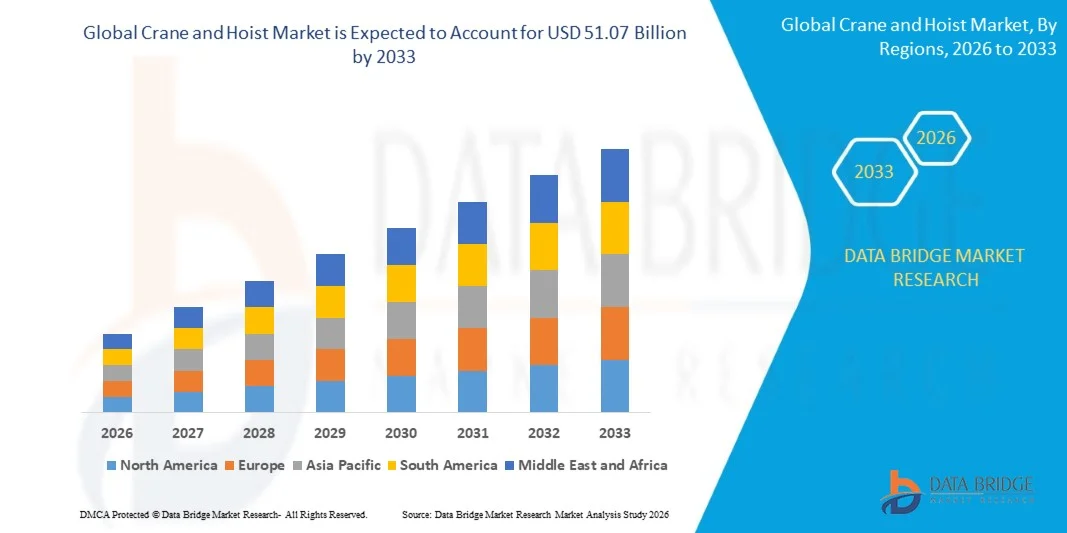
- The global crane and hoist market size was valued at USD 34.96 billion in 2025 and is expected to reach USD 51.07 billion by 2033, at a CAGR of 4.85% during the forecast period
- The market growth is largely fueled by increasing infrastructure development, industrialization, and urbanization worldwide, leading to higher demand for material handling and lifting solutions across construction, manufacturing, and logistics sectors
- Furthermore, rising adoption of technologically advanced cranes and hoists with enhanced safety features, automation, and energy-efficient operations is driving the replacement of conventional lifting equipment. These converging factors are accelerating the uptake of modern crane and hoist solutions, thereby significantly boosting the industry’s growth
Crane and Hoist Market Analysis
- Cranes and hoists, providing mechanical lifting and material handling capabilities, are increasingly critical for construction, industrial, shipping, and energy applications due to their ability to improve efficiency, safety, and operational flexibility
- The escalating demand for cranes and hoists is primarily fueled by ongoing infrastructure projects, expansion of industrial facilities, growing port and logistics operations, and a focus on modernizing equipment with automated and high-capacity lifting technologies
- Asia-Pacific dominated the crane and hoist market with a share of 44.1% in 2025, due to rapid infrastructure development, urbanization, and growing industrial and construction activities across the region
- North America is expected to be the fastest growing region in the crane and hoist market during the forecast period due to robust demand for material handling solutions, industrial automation, and modernization of construction and port facilities
- Mobile cranes segment dominated the market with a market share of 52.9% in 2025, due to their flexibility, mobility, and ability to handle diverse lifting operations across multiple construction sites. Mobile cranes are favored by contractors for rapid deployment and reduced setup time, making them ideal for infrastructure and urban development projects. The demand for mobile cranes is further supported by technological advancements such as telescopic booms, enhanced load sensors, and integration with telematics systems, which improve operational efficiency and safety
Report Scope and Crane and Hoist Market Segmentation
|
Attributes |
Crane and Hoist Key Market Insights |
|
Segments Covered |
|
|
Countries Covered |
North America
Europe
Asia-Pacific
Middle East and Africa
South America
|
|
Key Market Players |
|
|
Market Opportunities |
|
|
Value Added Data Infosets |
In addition to the insights on market scenarios such as market value, growth rate, segmentation, geographical coverage, and major players, the market reports curated by the Data Bridge Market Research also include in-depth expert analysis, geographically represented company-wise production and capacity, network layouts of distributors and partners, detailed and updated price trend analysis and deficit analysis of supply chain and demand. |
Crane and Hoist Market Trends
“Rising Adoption of Automated and Smart Crane Solutions”
- A key trend in the crane and hoist market is the increasing adoption of automated and smart crane solutions across construction, manufacturing, and logistics sectors, driven by the need for operational efficiency, enhanced safety, and precise load handling. These smart solutions integrate sensors, IoT connectivity, and AI-based control systems to optimize crane operations and reduce human intervention
- For instance, Konecranes provides automated overhead cranes and smart lifting solutions equipped with real-time monitoring and predictive maintenance capabilities that improve safety and operational uptime in industrial environments. Such implementations are enabling companies to achieve higher productivity and minimize downtime while ensuring compliance with safety standards
- The adoption of automated gantry and tower cranes is growing in large-scale construction projects where precise material placement and remote operation are critical. This trend positions smart cranes as essential components for modern infrastructure development and urban construction initiatives
- Industries such as steel manufacturing and shipbuilding are increasingly deploying hoists with integrated automation and digital controls to manage heavy loads efficiently. These technologies facilitate real-time performance tracking, predictive maintenance, and reduced manual labor dependency, strengthening overall workflow reliability
- The logistics and warehousing sectors are embracing automated crane systems to improve material handling speed, reduce errors, and enhance safety in dense storage environments. This is accelerating demand for intelligent hoist solutions capable of adapting to dynamic operational requirements
- Global initiatives to modernize infrastructure and industrial facilities are driving investment in digital crane technologies that combine AI, IoT, and remote monitoring capabilities. The rising integration of these advanced systems reinforces the market shift toward smarter, safer, and more connected lifting solutions
Crane and Hoist Market Dynamics
Driver
“Expanding Infrastructure and Industrial Development Globally”
- The global expansion of infrastructure and industrial development is a major driver for the crane and hoist market, as new construction projects, manufacturing facilities, and ports require advanced lifting solutions to handle increasing material volumes efficiently. This growth fuels demand for cranes and hoists capable of higher load capacities and automation
- For instance, Liebherr has supplied heavy-duty tower cranes for large infrastructure projects, including urban metro constructions in the U.S. and Europe, enabling faster material handling and improved project timelines. Such deployments demonstrate how infrastructure development directly stimulates crane and hoist adoption
- The industrial sector, particularly automotive and steel production, is expanding its facilities, necessitating efficient material handling equipment to support large-scale operations. This expansion is encouraging investment in high-capacity cranes and smart hoists to enhance operational efficiency and reduce manual labor
- Urbanization and large-scale commercial construction projects are increasing the need for tower and mobile cranes capable of precise load placement. These requirements position crane solutions as critical enablers of rapid, safe, and cost-effective infrastructure execution
- Governments worldwide are investing in modernization of ports, airports, and industrial parks, creating sustained demand for advanced lifting equipment. This ongoing development ensures steady market growth and positions cranes and hoists as central components in global industrialization initiatives
Restraint/Challenge
“High Capital Investment and Maintenance Costs”
- High capital investment and maintenance costs remain significant challenges for the crane and hoist market, as advanced lifting systems involve substantial upfront expenditure and continuous maintenance requirements to ensure safety and operational reliability. These financial burdens can limit adoption, particularly among small and medium-sized enterprises
- For instance, Demag Cranes requires considerable investment for automated crane systems with IoT-enabled monitoring, making it a high-cost solution for smaller industrial players. Such cost factors can delay procurement decisions and reduce short-term market penetration
- Routine maintenance, inspection, and replacement of critical components such as hoist motors, cables, and sensors add to operational expenses. These recurring costs increase total cost of ownership and necessitate budget allocations beyond initial purchase
- Upgrading existing crane fleets to incorporate smart automation or predictive maintenance capabilities demands additional capital, which can deter companies from modernizing older equipment. Balancing investment with expected operational benefits remains a key challenge
- Economic fluctuations and raw material price volatility can further exacerbate costs associated with crane manufacturing and service. These constraints collectively impact market expansion by influencing purchasing decisions and project planning in industrial and construction sectors
Crane and Hoist Market Scope
The market is segmented on the basis of type, operations, and industry.
• By Type
On the basis of type, the crane and hoist market is segmented into mobile cranes and fixed cranes. The mobile cranes segment dominated the market with the largest market revenue share of 52.9% in 2025, driven by their flexibility, mobility, and ability to handle diverse lifting operations across multiple construction sites. Mobile cranes are favored by contractors for rapid deployment and reduced setup time, making them ideal for infrastructure and urban development projects. The demand for mobile cranes is further supported by technological advancements such as telescopic booms, enhanced load sensors, and integration with telematics systems, which improve operational efficiency and safety. Their versatility across industries including construction, shipping, and mining strengthens their market dominance.
The fixed cranes segment is expected to witness the fastest growth rate from 2026 to 2033, fueled by large-scale industrial and port applications that require heavy-duty lifting with high stability. Fixed cranes provide consistent operational capacity and longer lifespan, making them suitable for high-volume material handling and assembly operations. For instance, Liebherr’s fixed tower cranes are widely adopted in urban construction projects for their load capacity and precision. The rising infrastructure investments in emerging economies also contribute to the growth of fixed crane installations.
• By Operations
On the basis of operations, the crane and hoist market is segmented into hydraulic, electric, and hybrid cranes. The hydraulic segment dominated the market with the largest market revenue share in 2025, driven by superior lifting power, precise control, and adaptability in challenging terrains. Hydraulic cranes are commonly preferred in construction and mining sectors due to their robust performance and reliability under heavy load conditions. Their advanced hydraulic systems enable smooth and controlled lifting, enhancing both safety and operational efficiency. The wide range of applications across industries and continued technological improvements further consolidate their market dominance.
The hybrid segment is anticipated to witness the fastest growth rate from 2026 to 2033, driven by increasing demand for energy-efficient and environmentally friendly crane solutions. Hybrid cranes combine electric and hydraulic operations to optimize fuel consumption while maintaining lifting performance. For instance, Terex hybrid mobile cranes are gaining popularity in construction and material handling projects for their reduced emissions and lower operating costs. Growing regulatory focus on sustainability and carbon footprint reduction is expected to accelerate hybrid crane adoption globally.
• By Industry
On the basis of industry, the crane and hoist market is segmented into construction, aerospace and defense, shipping and material handling, mining, automotive and railway, marine, energy and power, and others. The construction industry dominated the market with the largest market revenue share in 2025, fueled by rising infrastructure development, urbanization, and government-led construction projects worldwide. Construction projects require versatile lifting solutions for materials, prefabricated structures, and heavy machinery, which drives high demand for cranes across commercial, residential, and industrial sites. Advanced construction crane models with smart load monitoring and automated control enhance operational efficiency and site safety, further supporting market growth.
The shipping and material handling segment is expected to witness the fastest growth rate from 2026 to 2033, driven by the expansion of global trade, port modernization, and increased automation in warehouses and logistics centers. For instance, Konecranes’ automated container cranes are widely deployed in modern ports to enhance loading/unloading efficiency and reduce manual labor. The growing e-commerce sector and rise in bulk cargo handling contribute to the accelerated adoption of advanced cranes and hoists in material handling operations.
Crane and Hoist Market Regional Analysis
- Asia-Pacific dominated the crane and hoist market with the largest revenue share of 44.1% in 2025, driven by rapid infrastructure development, urbanization, and growing industrial and construction activities across the region
- The region’s cost-effective manufacturing capabilities, expanding port and logistics infrastructure, and strong presence of crane manufacturers are accelerating market expansion
- Availability of skilled labor, favorable government policies, and rising investments in industrial machinery and construction projects are contributing to increased crane and hoist adoption across both commercial and industrial sectors
China Crane and Hoist Market Insight
China held the largest share in the Asia-Pacific crane and hoist market in 2025, owing to its status as a global leader in construction and industrial manufacturing. The country’s strong industrial base, government-backed infrastructure initiatives, and extensive manufacturing capabilities for heavy machinery are major growth drivers. Demand is further supported by ongoing urban development, expansion of ports and logistics hubs, and adoption of technologically advanced cranes in material handling and construction sectors.
India Crane and Hoist Market Insight
India is witnessing the fastest growth in the Asia-Pacific region, fueled by rapid urbanization, government infrastructure programs, and increasing industrial output. Initiatives such as the National Infrastructure Pipeline and Make in India are strengthening the demand for cranes and hoists across construction, shipping, and mining applications. In addition, rising investments in energy, ports, and manufacturing facilities are contributing to robust market expansion.
Europe Crane and Hoist Market Insight
The Europe crane and hoist market is expanding steadily, supported by modernization of industrial facilities, adoption of automated material handling solutions, and stringent safety regulations. The region emphasizes high-quality machinery, environmental compliance, and integration of advanced control systems in cranes for construction and logistics operations. Increasing replacement of aging infrastructure and expansion of industrial automation are further enhancing market growth.
Germany Crane and Hoist Market Insight
Germany’s crane and hoist market is driven by its leadership in industrial automation, strong engineering expertise, and export-oriented manufacturing model. The country has well-established R&D networks and collaborations between machinery manufacturers and academic institutions, fostering continuous innovation in crane and hoist technology. Demand is particularly strong in automotive, railway, and construction industries requiring precision and high-capacity lifting solutions.
U.K. Crane and Hoist Market Insight
The U.K. market is supported by a mature industrial base, investments in modern logistics and port infrastructure, and increasing focus on advanced material handling systems. With growing emphasis on workplace safety, automation, and efficient lifting solutions, the country continues to see steady adoption of cranes and hoists in construction, shipping, and manufacturing sectors. Academic-industry collaborations for smart and automated crane systems further drive innovation and market growth.
North America Crane and Hoist Market Insight
North America is projected to grow at the fastest CAGR from 2026 to 2033, driven by robust demand for material handling solutions, industrial automation, and modernization of construction and port facilities. A strong focus on technological advancements, safety standards, and operational efficiency is boosting crane adoption across sectors. In addition, reshoring of manufacturing and rising infrastructure investments are supporting market expansion.
U.S. Crane and Hoist Market Insight
The U.S. accounted for the largest share in the North America market in 2025, underpinned by expansive construction and industrial manufacturing activities, strong R&D infrastructure, and investments in automated material handling systems. The country’s focus on efficiency, safety, and sustainability is encouraging adoption of high-capacity cranes and technologically advanced hoists. Presence of key industry players and well-established distribution networks further solidify the U.S.’s leading position in the region.
Crane and Hoist Market Share
The crane and hoist industry is primarily led by well-established companies, including:
- Konecranes (Finland)
- Terex Corporation (U.S.)
- PALFINGER AG (Austria)
- XCMG Group (China)
- Tadano Ltd. (Japan)
- Liebherr Group (Germany)
- ZPMC (China)
- Cargotec (Finland)
- The Manitowoc Company, Inc. (U.S.)
- Zoomlion Heavy Industry Science & Technology Co., Ltd. (China)
- Ingersoll Rand (Ireland)
- Columbus McKinnon Corporation (U.S.)
- Kito Europe GmbH (Germany)
Latest Developments in Global Crane and Hoist Market
- In November 2025, Hiab’s strategic acquisition of ING Cranes in Brazil will significantly strengthen its foothold in the Latin American crane market by expanding its portfolio and local manufacturing capabilities, enhancing service delivery and competitive positioning in a key emerging region for construction and industrial lifting solutions. This move is expected to accelerate Hiab’s market share growth in Brazil’s heavy equipment sector and improve after‑sales support across the region, reflecting broader consolidation trends in the global crane and hoist industry
- In December 2024, Aydıntaş, a long‑established Turkish crane and heavy haulage provider, placed an order with Liebherr for two high‑capacity LTM 1450‑8.1 mobile cranes capable of lifting up to 450 tonnes, a strategic expansion of its fleet that enhances its capacity to serve the energy sector and large infrastructure projects. This order underscores strong end‑user demand for advanced, versatile lifting machinery and reinforces Liebherr’s position as a go‑to supplier for heavy‑duty mobile cranes in energy and industrial applications
- In May 2024, Sumitomo Heavy Industries Construction Cranes Co., Ltd. in Japan introduced upgraded versions of its SCX1000A‑3 and SCX1800A‑3 lattice crawler cranes with Stage V compliant engines, improved safety systems, and enhanced performance features. These upgrades drive market expectations toward more environmentally compliant and efficient machines, supporting industrywide shifts toward reduced emissions and improved operator safety standards
- In June 2023, Konecranes’ acquisition of the industrial crane service division of Munck Cranes AS expanded its European service footprint and access to an established base of industrial crane installations in Norway and beyond, strengthening its maintenance and service ecosystem. This expansion enhances customer support capabilities and service revenue streams in the industrial segment, contributing to long‑term competitive advantages in regional markets
- In March 2023, Tadano Ltd. launched two truck crane models, the GT‑1200XL‑2 and GT‑800XL‑2, tailored for the U.S. and Canadian taxi crane markets due to their lightweight axles and compact transport dimensions, broadening the company’s product range and meeting specific regional market needs. This introduction reflects ongoing product innovation aimed at expanding applications and improving mobility for urban and service‑oriented crane operations
SKU-
世界初のマーケットインテリジェンスクラウドに関するレポートにオンラインでアクセスする

- インタラクティブなデータ分析ダッシュボード
- 成長の可能性が高い機会のための企業分析ダッシュボード
- カスタマイズとクエリのためのリサーチアナリストアクセス
- インタラクティブなダッシュボードによる競合分析
- 最新ニュース、更新情報、トレンド分析
- 包括的な競合追跡のためのベンチマーク分析のパワーを活用
調査方法
データ収集と基準年分析は、大規模なサンプル サイズのデータ収集モジュールを使用して行われます。この段階では、さまざまなソースと戦略を通じて市場情報または関連データを取得します。過去に取得したすべてのデータを事前に調査および計画することも含まれます。また、さまざまな情報ソース間で見られる情報の不一致の調査も含まれます。市場データは、市場統計モデルと一貫性モデルを使用して分析および推定されます。また、市場シェア分析と主要トレンド分析は、市場レポートの主要な成功要因です。詳細については、アナリストへの電話をリクエストするか、お問い合わせをドロップダウンしてください。
DBMR 調査チームが使用する主要な調査方法は、データ マイニング、データ変数が市場に与える影響の分析、および一次 (業界の専門家) 検証を含むデータ三角測量です。データ モデルには、ベンダー ポジショニング グリッド、市場タイムライン分析、市場概要とガイド、企業ポジショニング グリッド、特許分析、価格分析、企業市場シェア分析、測定基準、グローバルと地域、ベンダー シェア分析が含まれます。調査方法について詳しくは、お問い合わせフォームから当社の業界専門家にご相談ください。
カスタマイズ可能
Data Bridge Market Research は、高度な形成的調査のリーダーです。当社は、既存および新規のお客様に、お客様の目標に合致し、それに適したデータと分析を提供することに誇りを持っています。レポートは、対象ブランドの価格動向分析、追加国の市場理解 (国のリストをお問い合わせください)、臨床試験結果データ、文献レビュー、リファービッシュ市場および製品ベース分析を含めるようにカスタマイズできます。対象競合他社の市場分析は、技術ベースの分析から市場ポートフォリオ戦略まで分析できます。必要な競合他社のデータを、必要な形式とデータ スタイルでいくつでも追加できます。当社のアナリスト チームは、粗い生の Excel ファイル ピボット テーブル (ファクト ブック) でデータを提供したり、レポートで利用可能なデータ セットからプレゼンテーションを作成するお手伝いをしたりすることもできます。











