Global Drought
Market Size in USD Billion
CAGR :
%
USD
7.63 Billion
USD
12.34 Billion
2024
2032
| 2025 –2032 | |
| USD 7.63 Billion | |
| USD 12.34 Billion | |
|
|
|
|
Global Drought-Tolerant Seeds Market Segmentation, By Seed Type (Fruit Seed, Vegetable Seed, Grain Seed, Oil Seed and Others), Sales Channel (Direct Sales, E- Retailers (Online) and Retail Outlets (Offline)), Crop Type (Corn/ Maize, Soybean, Cotton, Canola, Grains and Others)- Industry Trends and Forecast to 2032
Drought-Tolerant Seeds Market Size
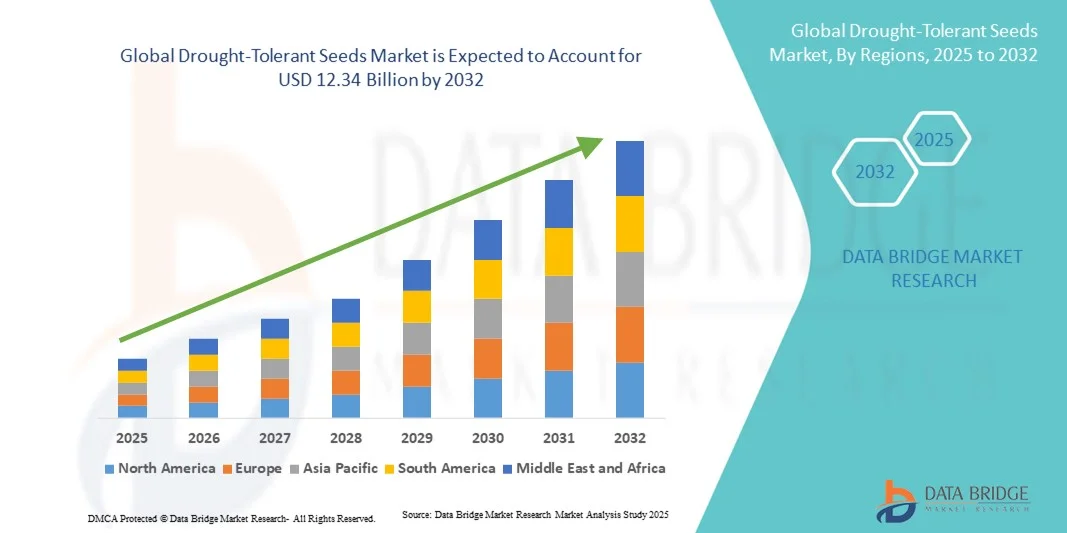
- The global drought-tolerant seeds market size was valued at USD 7.63 billion in 2024 and is expected to reach USD 12.34 billion by 2032, at a CAGR of 6.20% during the forecast period
- The market growth is largely fuelled by the rising need for resilient crop varieties that can withstand climate variability and ensure stable agricultural productivity
- Increasing investments in agricultural biotechnology and seed innovation are further accelerating market expansion
Drought-Tolerant Seeds Market Analysis
- The market is witnessing significant momentum as global agriculture adapts to the challenges of water scarcity and shifting climate conditions
- Leading seed companies are investing in advanced genetic engineering, hybridization techniques, and biotechnology to develop high-yield, drought-resilient crop varieties
- North America dominated the drought-tolerant seeds market with the largest revenue share of 39.8% in 2024, driven by advanced agricultural practices, strong adoption of genetically modified crops, and increasing demand for sustainable farming solutions
- Asia-Pacific region is expected to witness the highest growth rate in the global drought-tolerant seeds market, driven by rapid population growth, rising food demand, government support for modern agriculture, and the increasing adoption of drought-tolerant maize, rice, and soybean varieties
- The grain seed segment held the largest market revenue share in 2024, driven by the high global demand for staple crops such as maize, wheat, and rice that are most affected by drought conditions. Drought-tolerant grain seeds ensure stable yields and food security, making them a priority choice among farmers worldwide
Report Scope and Drought-Tolerant Seeds Market Segmentation
|
Attributes |
Drought-Tolerant Seeds Key Market Insights |
|
Segments Covered |
|
|
Countries Covered |
North America
Europe
Asia-Pacific
Middle East and Africa
South America
|
|
Key Market Players |
|
|
Market Opportunities |
|
|
Value Added Data Infosets |
In addition to the insights on market scenarios such as market value, growth rate, segmentation, geographical coverage, and major players, the market reports curated by the Data Bridge Market Research also include import export analysis, production capacity overview, production consumption analysis, price trend analysis, climate change scenario, supply chain analysis, value chain analysis, raw material/consumables overview, vendor selection criteria, PESTLE Analysis, Porter Analysis, and regulatory framework. |
Drought-Tolerant Seeds Market Trends
Adoption Of Biotechnology And Genetic Engineering In Seed Development
- The increasing use of biotechnology and advanced genetic engineering is reshaping the drought-tolerant seeds market by enabling the creation of high-yield, resilient crop varieties. These innovations ensure better performance under water-scarce conditions, minimizing yield loss and supporting food security in vulnerable regions, especially in developing economies where agriculture is highly climate dependent
- The rising demand for genetically modified (GM) crops that can withstand extreme weather conditions is driving significant investments from leading seed companies. Enhanced seed traits such as deeper root systems, efficient water utilization, and improved nutrient absorption are becoming key differentiators, ensuring higher farmer adoption across global agricultural value chains
- Farmers are increasingly adopting hybrid and biotech seeds due to their ability to provide consistent yields in drought-prone areas, reducing dependence on irrigation. This adoption is vital for addressing erratic rainfall patterns, improving resilience, and maintaining farm profitability amid climate variability
- For instance, in 2023, major agribusiness players introduced drought-resistant maize and soybean varieties in African and Latin American markets. These seeds boosted farm productivity, reduced crop failure risks, and supported regional governments’ food security objectives under severe drought conditions
- While biotechnology continues to open new opportunities, regulatory hurdles, public acceptance, and affordability remain crucial factors influencing widespread adoption of these advanced seeds. Addressing these barriers will require strong policy support, industry collaboration, and improved farmer outreach programs
Drought-Tolerant Seeds Market Dynamics
Driver
Rising Global Water Scarcity And Growing Focus On Food Security
- Increasing water scarcity caused by climate change, overuse of water resources, and unpredictable rainfall is driving the demand for drought-tolerant seeds. These resilient varieties are becoming an essential tool for farmers seeking to maintain crop productivity in increasingly water-limited environments
- Food security concerns are prompting governments and farmers to adopt resilient seed varieties that can safeguard yields under stress conditions. With global populations rising and arable land shrinking, drought-tolerant seeds are playing a central role in sustainable and climate-smart farming practices
- International organizations are also promoting drought-resilient agriculture through funding programs, subsidies, and technology transfer initiatives. Such efforts help reduce farmer risks, improve adoption, and create long-term pathways for resilient agricultural growth
- For instance, in 2022, several African nations, in collaboration with the FAO, launched initiatives promoting drought-resistant maize and sorghum varieties. These programs helped stabilize yields, improve farmer incomes, and safeguard food availability in regions highly vulnerable to climate shocks
- While demand for drought-tolerant seeds is increasing rapidly, awareness campaigns, extension services, and affordability remain critical. Effective farmer training and knowledge-sharing platforms are essential for ensuring large-scale adoption and maximizing benefits
Restraint/Challenge
High Development Costs And Regulatory Barriers For Genetically Modified Seeds
- Developing drought-tolerant seeds requires extensive R&D, field trials, and advanced genetic research, which significantly increases costs for manufacturers. Smaller seed companies often lack the capital and infrastructure to compete with global giants, leading to slower product commercialization
- Strict regulatory frameworks for genetically modified and biotech seeds in regions such as Europe hinder market expansion. Complicated approval processes, coupled with strong consumer skepticism, delay the introduction of new varieties and limit global growth opportunities
- Farmers in developing regions also face affordability challenges, as premium drought-tolerant seed varieties are priced higher than conventional seeds. Limited access to credit and financing makes it difficult for resource-constrained communities to invest in these innovations
- For instance, in 2023, multiple seed producers in Asia reported delays in the commercialization of genetically engineered rice. These were due to stringent biosafety and environmental clearance requirements, which increased costs and restricted market availability
- Although advancements in seed breeding continue, achieving cost efficiency, regulatory compliance, and broader farmer acceptance remains essential. Partnerships between governments, seed companies, and NGOs will be necessary to overcome these barriers and unlock full market potential
Drought-Tolerant Seeds Market Scope
The market is segmented on the basis of seed type, sales channel, and crop type.
- By Seed Type
On the basis of seed type, the drought-tolerant seeds market is segmented into fruit seed, vegetable seed, grain seed, oil seed, and others. The grain seed segment held the largest market revenue share in 2024, driven by the high global demand for staple crops such as maize, wheat, and rice that are most affected by drought conditions. Drought-tolerant grain seeds ensure stable yields and food security, making them a priority choice among farmers worldwide.
The oil seed segment is expected to witness the fastest growth rate from 2025 to 2032, as demand for soybean and canola continues to rise in both food and biofuel industries. The adoption of drought-tolerant oil seeds is accelerating due to their ability to withstand climate variability while maintaining profitability across diverse agricultural regions.
- By Sales Channel
On the basis of sales channel, the market is segmented into direct sales, e-retailers (online), and retail outlets (offline). Direct sales captured the largest revenue share in 2024 as major seed companies rely on direct distribution networks and partnerships with large-scale farmers to ensure reliable access to advanced seed varieties. This channel provides stronger farmer engagement and technical support.
The e-retailers (online) segment is expected to witness the fastest growth rate from 2025 to 2032, supported by the increasing penetration of digital platforms in rural areas and the convenience of doorstep delivery. Online sales are becoming popular among smallholder farmers seeking affordable access to certified drought-tolerant seeds.
- By Crop Type
On the basis of crop type, the market is segmented into corn/maize, soybean, cotton, canola, grains, and others. The corn/maize segment dominated the market in 2024, as maize is one of the most widely cultivated crops and highly vulnerable to drought. Farmers are increasingly turning to drought-tolerant maize hybrids to secure consistent yields in water-stressed regions.
The soybean segment is expected to witness the fastest growth rate from 2025 to 2032, driven by rising global demand for protein-rich crops and expanding applications in food, feed, and industrial sectors. Drought-tolerant soybean varieties are being rapidly adopted in North and South America, supporting higher resilience and productivity.
Drought-Tolerant Seeds Market Regional Analysis
- North America dominated the drought-tolerant seeds market with the largest revenue share of 39.8% in 2024, driven by advanced agricultural practices, strong adoption of genetically modified crops, and increasing demand for sustainable farming solutions
- Farmers in the region prioritize resilient, high-yield seed varieties that can withstand water scarcity and changing climate patterns, ensuring long-term productivity
- Supportive government initiatives, heavy R&D investments by leading seed companies, and strong adoption among both large-scale and smallholder farmers have positioned North America as a key hub for market growth
U.S. Drought-Tolerant Seeds Market Insight
The U.S. drought-tolerant seeds market captured the largest revenue share in 2024 within North America, supported by the nation’s strong focus on agricultural innovation and biotechnology adoption. Farmers increasingly prefer drought-resistant maize, soybean, and cotton varieties to reduce risks from unpredictable rainfall. Furthermore, advanced infrastructure, significant private-sector investments, and robust government support for sustainable agriculture are fueling demand. The growing trend of precision farming and biotech adoption further accelerates the market’s expansion.
Europe Drought-Tolerant Seeds Market Insight
The Europe drought-tolerant seeds market is expected to witness the fastest growth rate from 2025 to 2032, driven by increasing climate variability and the EU’s strong sustainability goals. Farmers are shifting toward resilient seed varieties to reduce dependency on irrigation and chemical inputs, aligning with strict environmental regulations. Demand is rising across multiple crop categories, particularly maize and grains, supported by research collaborations and EU-funded agricultural innovation programs.
U.K. Drought-Tolerant Seeds Market Insight
The U.K. drought-tolerant seeds market is expected to witness the fastest growth rate from 2025 to 2032, supported by the nation’s emphasis on food security and sustainable farming practices. Rising concerns about climate-induced crop failures are encouraging adoption among farmers. The U.K.’s focus on precision agriculture, combined with advancements in biotech and hybrid seed development, continues to drive the demand for high-performing drought-resilient seed varieties.
Germany Drought-Tolerant Seeds Market Insight
The Germany drought-tolerant seeds market is expected to witness the fastest growth rate from 2025 to 2032, supported by a rising awareness of climate change impacts and the push for innovative, sustainable agricultural practices. Germany’s strong research ecosystem and investments in advanced breeding technologies are accelerating seed development and adoption. With increasing water scarcity in certain regions, German farmers are prioritizing resilient crop varieties to ensure consistent yield performance.
Asia-Pacific Drought-Tolerant Seeds Market Insight
The Asia-Pacific drought-tolerant seeds market is expected to witness the fastest growth rate from 2025 to 2032, driven by rapid population growth, rising food demand, and government support for agricultural modernization. Farmers in countries such as China, India, and Japan are increasingly adopting drought-tolerant maize, rice, and soybean varieties to counter unpredictable rainfall and limited irrigation resources. Strong domestic seed production capabilities and improving affordability of biotech seeds are further boosting adoption.
Japan Drought-Tolerant Seeds Market Insight
The Japan drought-tolerant seeds market is expected to witness the fastest growth rate from 2025 to 2032 due to the nation’s strong focus on food security, advanced technology adoption, and limited arable land. Farmers are adopting resilient seed varieties to reduce risks from erratic rainfall and water scarcity. The integration of biotech innovations with traditional breeding practices is fueling market growth. In addition, Japan’s strong emphasis on self-sufficiency in food production is driving higher adoption of hybrid and drought-resilient seed varieties.
China Drought-Tolerant Seeds Market Insight
The China drought-tolerant seeds market accounted for the largest revenue share in Asia-Pacific in 2024, driven by the country’s large agricultural base, expanding middle class, and government-led initiatives for food security. Strong investments in seed biotechnology and the rapid adoption of genetically engineered crops are propelling growth. Moreover, the rising demand for maize, soybean, and rice in both domestic consumption and export markets is accelerating adoption of drought-resistant seeds, supported by China’s extensive manufacturing and distribution networks.
Drought-Tolerant Seeds Market Share
The Drought-Tolerant Seeds industry is primarily led by well-established companies, including:
- BASF SE (Germany)
- DuPont (U.S.)
- Dow (U.S.)
- Syngenta Crop Protection AG (Switzerland)
- Bayer AG (Germany)
- Nuseed (Australia)
- CALYXT (U.S.)
- Stine Seed Company (U.S.)
- Mahyco (India)
- J.R. Simplot Company (U.S.)
- JK Agri Genetics Limited (India)
- Corteva Agriscience (U.S.)
- Cyanamid Agro Ltd. (India)
- ICAR-Central Institute of Brackishwater Aquaculture (India)
- Rhône-Poulenc (France)
Latest Developments in Global Drought-Tolerant Seeds Market
- In March 2023, Bayer Crop Science launched DroughtGuard Pro, a CRISPR-edited corn hybrid designed to deliver up to 35% higher yields under severe drought conditions. Targeted at water-stressed regions globally, the hybrid is expected to drive market growth by increasing adoption of advanced, drought-resilient seed varieties, while strengthening Bayer’s market share in drought-prone agricultural areas
- In July 2021, India contributed nearly USD 1 million to the World Food Programme (WFP) in Zimbabwe, supporting climate-resilient agriculture initiatives. The funding aimed to enable over 5,200 smallholder farmers in Chiredzi and Mangwe districts to cultivate drought-tolerant crops, improving crop yields and enhancing food security in water-stressed regions. This initiative helped strengthen local farming resilience and promoted the adoption of climate-smart agricultural practices
SKU-
世界初のマーケットインテリジェンスクラウドに関するレポートにオンラインでアクセスする

- インタラクティブなデータ分析ダッシュボード
- 成長の可能性が高い機会のための企業分析ダッシュボード
- カスタマイズとクエリのためのリサーチアナリストアクセス
- インタラクティブなダッシュボードによる競合分析
- 最新ニュース、更新情報、トレンド分析
- 包括的な競合追跡のためのベンチマーク分析のパワーを活用
調査方法
データ収集と基準年分析は、大規模なサンプル サイズのデータ収集モジュールを使用して行われます。この段階では、さまざまなソースと戦略を通じて市場情報または関連データを取得します。過去に取得したすべてのデータを事前に調査および計画することも含まれます。また、さまざまな情報ソース間で見られる情報の不一致の調査も含まれます。市場データは、市場統計モデルと一貫性モデルを使用して分析および推定されます。また、市場シェア分析と主要トレンド分析は、市場レポートの主要な成功要因です。詳細については、アナリストへの電話をリクエストするか、お問い合わせをドロップダウンしてください。
DBMR 調査チームが使用する主要な調査方法は、データ マイニング、データ変数が市場に与える影響の分析、および一次 (業界の専門家) 検証を含むデータ三角測量です。データ モデルには、ベンダー ポジショニング グリッド、市場タイムライン分析、市場概要とガイド、企業ポジショニング グリッド、特許分析、価格分析、企業市場シェア分析、測定基準、グローバルと地域、ベンダー シェア分析が含まれます。調査方法について詳しくは、お問い合わせフォームから当社の業界専門家にご相談ください。
カスタマイズ可能
Data Bridge Market Research は、高度な形成的調査のリーダーです。当社は、既存および新規のお客様に、お客様の目標に合致し、それに適したデータと分析を提供することに誇りを持っています。レポートは、対象ブランドの価格動向分析、追加国の市場理解 (国のリストをお問い合わせください)、臨床試験結果データ、文献レビュー、リファービッシュ市場および製品ベース分析を含めるようにカスタマイズできます。対象競合他社の市場分析は、技術ベースの分析から市場ポートフォリオ戦略まで分析できます。必要な競合他社のデータを、必要な形式とデータ スタイルでいくつでも追加できます。当社のアナリスト チームは、粗い生の Excel ファイル ピボット テーブル (ファクト ブック) でデータを提供したり、レポートで利用可能なデータ セットからプレゼンテーションを作成するお手伝いをしたりすることもできます。