


Global Hair Care Packaging Market Segmentation, By Product Type (Hair Oil, Shampoos, Hair Creams, Hair Sprays, and Hair Dyes), Form (Liquid, Solid, and Semi-Solid), Packaging Type (Sprayers, Droppers, Sachets, Bottles, Tubes, and Cartons), Material (Plastic, Glass, Metal, and Paper & Paperboard) - Industry Trends and Forecast to 2033
Hair Care Packaging Market Size
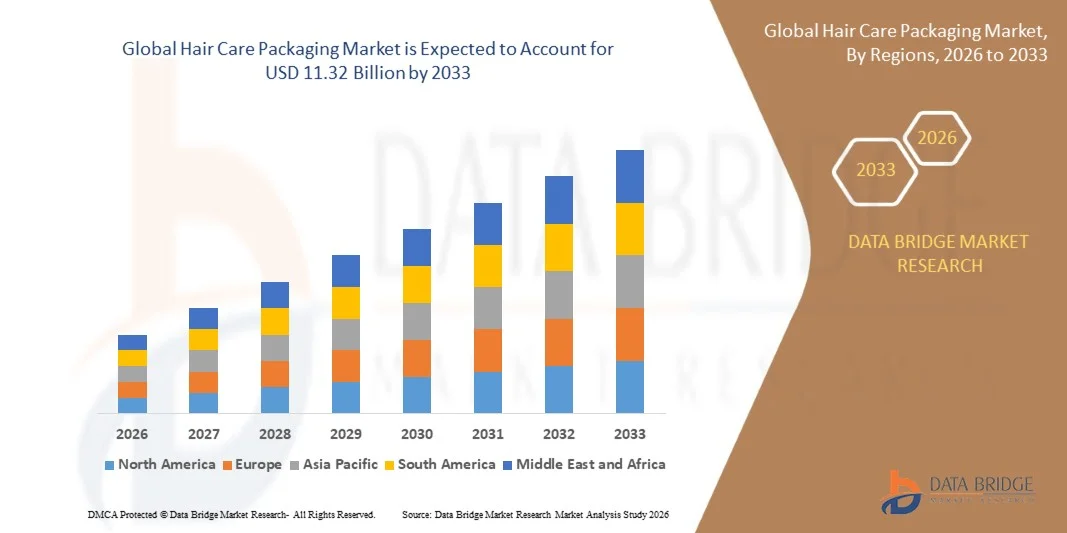
- The global hair care packaging market size was valued at USD 8.60 billion in 2025 and is expected to reach USD 11.32 billion by 2033, at a CAGR of 3.50% during the forecast period
- The market growth is largely driven by the rising consumption of hair care products across mass and premium segments, supported by increasing focus on personal grooming, hygiene awareness, and lifestyle upgrades among consumers
- Furthermore, growing demand for sustainable, convenient, and visually appealing packaging solutions is encouraging brands to innovate in materials, formats, and dispensing systems. These combined factors are accelerating the adoption of advanced hair care packaging solutions, thereby supporting steady market expansion
Hair Care Packaging Market Analysis
- Hair care packaging, which includes bottles, tubes, sachets, jars, and dispensing systems for products such as shampoos, oils, creams, and styling solutions, plays a critical role in product protection, usability, and brand differentiation across both retail and professional channels
- The increasing demand for hair care packaging is primarily driven by high product consumption frequency, rapid expansion of e-commerce and organized retail, and rising emphasis on sustainable and cost-efficient packaging formats that enhance consumer experience and brand value
- Asia-Pacific dominated the hair care packaging market with a share of 41.6% in 2025, due to high consumption of hair care products, expanding personal care manufacturing, and strong demand from emerging economies
- North America is expected to be the fastest growing region in the hair care packaging market during the forecast period due to rising demand for premium hair care products, sustainable packaging, and innovative dispensing solutions
- Liquid segment dominated the market with a market share of 72.9% in 2025, due to the dominance of liquid-based products such as shampoos, hair oils, and conditioners. Liquid formulations require secure, spill-proof, and user-friendly packaging, leading to high adoption of bottles, pumps, and sprayers. The widespread daily usage of liquid hair care products across all consumer demographics continues to sustain this segment’s leadership
Report Scope and Hair Care Packaging Market Segmentation
|
Attributes |
Hair Care Packaging Key Market Insights |
|
Segments Covered |
|
|
Countries Covered |
North America
Europe
Asia-Pacific
Middle East and Africa
South America
|
|
Key Market Players |
|
|
Market Opportunities |
|
|
Value Added Data Infosets |
In addition to the insights on market scenarios such as market value, growth rate, segmentation, geographical coverage, and major players, the market reports curated by the Data Bridge Market Research also include import export analysis, production capacity overview, production consumption analysis, price trend analysis, climate change scenario, supply chain analysis, value chain analysis, raw material/consumables overview, vendor selection criteria, PESTLE Analysis, Porter Analysis, and regulatory framework. |
Hair Care Packaging Market Trends
“Rising Adoption of Sustainable and Eco-Friendly Hair Care Packaging”
- A key trend in the hair care packaging market is the growing shift toward sustainable and eco-friendly packaging formats as brands respond to rising environmental awareness and regulatory scrutiny on packaging waste. Manufacturers are increasingly adopting recyclable, refillable, and biodegradable packaging materials to reduce environmental impact while maintaining product safety and shelf appeal
- For instance, Unilever has introduced recyclable and recycled plastic packaging across several of its hair care brands, including refill pouches and bottles made with post-consumer recycled content. These initiatives support circular economy goals and demonstrate how large personal care companies are embedding sustainability into packaging strategies
- The use of lightweight packaging designs is expanding as brands aim to lower material consumption and reduce transportation-related emissions. This trend is reshaping bottle and cap designs without compromising durability or consumer convenience
- There is increasing interest in bio-based plastics and paper-based packaging solutions that offer reduced dependence on fossil fuel–derived materials. These alternatives are gaining traction as technological advancements improve their performance and compatibility with liquid hair care formulations
- Premium and professional hair care brands are adopting minimalist and reusable packaging concepts to align with eco-conscious consumer preferences. This is strengthening brand differentiation while supporting long-term sustainability commitments
- Overall, the emphasis on sustainable packaging is reinforcing innovation across materials, formats, and supply chains. This trend is positioning eco-friendly hair care packaging as a central factor influencing purchasing decisions and long-term market growth
Hair Care Packaging Market Dynamics
Driver
“Increasing Global Consumption of Hair Care and Personal Grooming Products”
- The rising global consumption of hair care and personal grooming products is a major driver for the hair care packaging market, supported by growing urbanization, changing lifestyles, and heightened focus on personal appearance. This expansion directly increases demand for bottles, tubes, jars, and dispensing systems designed specifically for shampoos, conditioners, and styling products
- For instance, L’Oréal continues to expand its global hair care portfolio across mass and premium segments, driving consistent demand for high-volume and customized packaging solutions. The company’s broad product launches contribute to sustained packaging requirements across multiple regions
- Emerging markets are witnessing increased spending on personal grooming products as disposable incomes rise and awareness of hair health improves. This growth is generating strong demand for cost-effective yet visually appealing packaging formats
- E-commerce expansion is further amplifying the need for durable and leak-resistant hair care packaging that can withstand logistics and handling challenges. Brands are prioritizing packaging that ensures product integrity during transportation
- The continuous rise in hair care consumption across demographics is strengthening this driver by creating sustained demand for functional, attractive, and scalable packaging solutions. This ongoing growth is reinforcing the hair care packaging market’s expansion trajectory
Restraint/Challenge
“Volatility in Raw Material Prices and Regulatory Pressure on Plastic Usage”
- The hair care packaging market faces challenges from fluctuating raw material prices, particularly for plastics and resins, which impact manufacturing costs and pricing stability. These cost variations create uncertainty for packaging producers and brand owners when planning long-term supply strategies
- For instance, Amcor has highlighted the impact of resin price volatility and regulatory changes on plastic packaging production, prompting increased focus on material optimization and alternative packaging solutions. Such pressures affect margins and require continuous adaptation in sourcing strategies
- Regulatory pressure to reduce single-use plastic packaging is intensifying across multiple regions, forcing manufacturers to redesign products and invest in compliant materials. These changes increase development costs and extend product transition timelines
- The shift toward sustainable materials often involves higher initial costs and technical challenges related to compatibility with hair care formulations. This creates a balancing challenge between environmental goals and cost efficiency
- Collectively, raw material price volatility and regulatory pressure are restraining market growth by increasing operational complexity and financial risk. These challenges are pushing companies to innovate while carefully managing cost structures and compliance requirements
Hair Care Packaging Market Scope
The market is segmented on the basis of product type, form, packaging type, and material.
• By Product Type
On the basis of product type, the hair care packaging market is segmented into hair oil, shampoos, hair creams, hair sprays, and hair dyes. The shampoos segment dominated the market with the largest revenue share in 2025, supported by their high consumption frequency and wide usage across mass, premium, and salon-grade hair care products. Shampoo packaging demands durability, leak resistance, and ease of dispensing, which has driven consistent demand for bottles and pumps. The expansion of multifunctional and medicated shampoos has further reinforced the dominance of this segment across both developed and emerging markets.
The hair dyes segment is anticipated to witness the fastest growth rate from 2026 to 2033, driven by rising consumer focus on personal grooming and increasing adoption of at-home hair coloring solutions. Packaging for hair dyes emphasizes precision dispensing, product protection, and visual appeal to differentiate brands. Growth in aging populations and fashion-driven hair coloring trends continues to accelerate demand for innovative and premium packaging formats in this segment.
• By Form
On the basis of form, the hair care packaging market is segmented into liquid, solid, and semi-solid. The liquid segment accounted for the largest market revenue share of 72.9% in 2025 due to the dominance of liquid-based products such as shampoos, hair oils, and conditioners. Liquid formulations require secure, spill-proof, and user-friendly packaging, leading to high adoption of bottles, pumps, and sprayers. The widespread daily usage of liquid hair care products across all consumer demographics continues to sustain this segment’s leadership.
The semi-solid segment is expected to grow at the fastest CAGR from 2026 to 2033, supported by rising demand for hair creams, gels, masks, and styling products. Semi-solid packaging prioritizes controlled dispensing and product preservation, increasing the use of tubes and jars. Premiumization of styling and treatment products is further encouraging manufacturers to adopt advanced packaging solutions for this segment.
• By Packaging Type
On the basis of packaging type, the hair care packaging market is segmented into sprayers, droppers, sachets, bottles, tubes, and cartons. The bottles segment dominated the market in 2025, driven by their extensive use across shampoos, hair oils, and conditioners. Bottles offer high durability, ease of labeling, and compatibility with various closures, making them suitable for both mass-market and premium hair care brands. Their adaptability to different sizes and materials has reinforced their widespread adoption.
The sachets segment is projected to witness the fastest growth rate from 2026 to 2033, fueled by increasing demand in price-sensitive and emerging markets. Sachets enable affordable single-use consumption and wider product penetration among first-time users. Growth in rural distribution networks and promotional sampling strategies continues to accelerate the adoption of sachet packaging formats.
• By Material
On the basis of material, the hair care packaging market is segmented into plastic, glass, metal, and paper & paperboard. The plastic segment held the largest market revenue share in 2025 due to its lightweight nature, cost-effectiveness, and design flexibility. Plastic materials support a wide range of packaging formats and are compatible with both liquid and semi-solid hair care products. High durability and ease of transportation have further strengthened plastic’s dominance across global supply chains.
The paper & paperboard segment is expected to register the fastest growth from 2026 to 2033, driven by increasing sustainability initiatives and regulatory pressure to reduce plastic usage. Brands are increasingly adopting recyclable and biodegradable materials to enhance their environmental positioning. Growing consumer preference for eco-friendly packaging is accelerating innovation and adoption within this material segment.
Hair Care Packaging Market Regional Analysis
- Asia-Pacific dominated the hair care packaging market with the largest revenue share of 41.6% in 2025, driven by high consumption of hair care products, expanding personal care manufacturing, and strong demand from emerging economies
- Rapid urbanization, rising disposable income, and increasing penetration of mass and premium hair care brands are accelerating packaging demand across the region
- The presence of cost-efficient manufacturing, growing e-commerce distribution, and supportive government policies for packaging and FMCG sectors are contributing to sustained market expansion
China Hair Care Packaging Market Insight
China held the largest share in the Asia-Pacific hair care packaging market in 2025, supported by its large consumer base, strong FMCG manufacturing ecosystem, and extensive plastic and paper packaging production capacity. The country’s dominance is reinforced by high demand for shampoos, hair oils, and styling products, along with rapid innovation in sustainable and lightweight packaging. Strong domestic brands and export-oriented production further strengthen China’s position.
India Hair Care Packaging Market Insight
India is witnessing the fastest growth in the Asia-Pacific region, fueled by rising hair care consumption, expanding middle-class population, and increasing rural market penetration through sachets and small-format packaging. Growth in domestic FMCG manufacturing, along with government initiatives promoting local production, is driving packaging demand. Increasing focus on affordability and sustainability is also shaping packaging innovation in the country.
Europe Hair Care Packaging Market Insight
The Europe hair care packaging market is growing steadily, driven by strong demand for premium and sustainable packaging solutions and high consumption of professional hair care products. Stringent environmental regulations are encouraging the adoption of recyclable, reusable, and paper-based packaging formats. The region’s emphasis on design, branding, and sustainability is supporting consistent market growth.
Germany Hair Care Packaging Market Insight
Germany’s market is driven by its advanced packaging technology capabilities, strong cosmetics manufacturing base, and focus on eco-friendly materials. The country leads in innovation for recyclable plastics and paper-based packaging used in premium hair care products. Strong R&D investment and collaboration between packaging manufacturers and personal care brands support continuous development.
U.K. Hair Care Packaging Market Insight
The U.K. market is supported by high demand for premium, organic, and sustainable hair care products. Increasing adoption of refillable and minimalist packaging designs, along with strong retail and e-commerce channels, is driving packaging innovation. Regulatory focus on reducing plastic waste further accelerates the shift toward alternative materials.
North America Hair Care Packaging Market Insight
North America is projected to grow at a significant CAGR from 2026 to 2033, driven by rising demand for premium hair care products, sustainable packaging, and innovative dispensing solutions. Strong brand competition and high consumer awareness around environmental impact are encouraging investment in advanced packaging technologies. Growth in direct-to-consumer channels is also boosting packaging customization.
U.S. Hair Care Packaging Market Insight
The U.S. accounted for the largest share in the North America market in 2025, supported by a well-established personal care industry, high per-capita spending on hair care products, and strong presence of global brands. The country’s focus on sustainability, smart packaging, and design differentiation is driving demand for advanced packaging formats. A mature supply chain and continuous product innovation reinforce the U.S.’s leadership position in the region.
Hair Care Packaging Market Share
The hair care packaging industry is primarily led by well-established companies, including:
- HCP Packaging (U.K.)
- Gerresheimer Holdings (Germany)
- Silgan Holdings (U.S.)
- ABC Packaging (U.S.)
- AptarGroup (U.S.)
- AREXIM Packaging (France)
- DS Smith (U.K.)
- Fusion Packaging Solutions (U.S.)
- Graham Packaging Company (U.S.)
- Albéa Group (France)
- Amcor plc (Switzerland)
- RPC Group (U.K.)
- Quadpack Industries (Spain)
- Cosmopak (Hong Kong)
Latest Developments in Global Hair Care Packaging Market
- In January 2026, Sunsilk launched a science-backed, mood-boosting hair mist as part of its strategy to connect with Gen Z consumers through sensory and emotional engagement. This launch is driving demand for lightweight spray and mist packaging that supports portability, frequent usage, and strong visual branding. The development highlights how experiential product formats are influencing packaging innovation in the hair care market
- In August 2025, Imperial DAX Co., Inc. introduced redesigned packaging for its DAX Classic jar products alongside a refreshed digital platform, marking its first major visual update in nearly eight years. The packaging refresh improves shelf visibility while preserving brand heritage, helping the company remain relevant in a competitive hair care landscape. This development supports continued demand for rigid jar packaging in traditional grooming categories
- In July 2025, P&G launched Gemz, a first-of-its-kind hair care brand that replaces traditional bottles with single-dose, water-activated dissolvable “gems.” This innovation significantly reduces packaging material usage and eliminates plastic bottles, reinforcing sustainability-driven packaging trends. The launch is accelerating interest in waterless formulations and alternative packaging formats across the hair care packaging market
- In June 2025, L’Oréal expanded the use of refill pouches for its Elvive hair care range in multiple global markets to reduce virgin plastic consumption. The shift toward refill-based packaging is increasing adoption of flexible packaging formats and encouraging repeat purchases through lower-cost refills. This move is strengthening the role of refill systems in driving sustainable growth within the hair care packaging industry
- In May 2025, Unilever increased the rollout of refillable and low-plastic packaging for its Love Beauty and Planet hair care brand across select regions. By promoting reusable containers and concentrated refills, the company is reducing packaging waste while enhancing brand sustainability positioning. This development is reinforcing long-term demand for reusable and eco-conscious hair care packaging solutions
SKU-
世界初のマーケットインテリジェンスクラウドに関するレポートにオンラインでアクセスする

- インタラクティブなデータ分析ダッシュボード
- 成長の可能性が高い機会のための企業分析ダッシュボード
- カスタマイズとクエリのためのリサーチアナリストアクセス
- インタラクティブなダッシュボードによる競合分析
- 最新ニュース、更新情報、トレンド分析
- 包括的な競合追跡のためのベンチマーク分析のパワーを活用
調査方法
データ収集と基準年分析は、大規模なサンプル サイズのデータ収集モジュールを使用して行われます。この段階では、さまざまなソースと戦略を通じて市場情報または関連データを取得します。過去に取得したすべてのデータを事前に調査および計画することも含まれます。また、さまざまな情報ソース間で見られる情報の不一致の調査も含まれます。市場データは、市場統計モデルと一貫性モデルを使用して分析および推定されます。また、市場シェア分析と主要トレンド分析は、市場レポートの主要な成功要因です。詳細については、アナリストへの電話をリクエストするか、お問い合わせをドロップダウンしてください。
DBMR 調査チームが使用する主要な調査方法は、データ マイニング、データ変数が市場に与える影響の分析、および一次 (業界の専門家) 検証を含むデータ三角測量です。データ モデルには、ベンダー ポジショニング グリッド、市場タイムライン分析、市場概要とガイド、企業ポジショニング グリッド、特許分析、価格分析、企業市場シェア分析、測定基準、グローバルと地域、ベンダー シェア分析が含まれます。調査方法について詳しくは、お問い合わせフォームから当社の業界専門家にご相談ください。
カスタマイズ可能
Data Bridge Market Research は、高度な形成的調査のリーダーです。当社は、既存および新規のお客様に、お客様の目標に合致し、それに適したデータと分析を提供することに誇りを持っています。レポートは、対象ブランドの価格動向分析、追加国の市場理解 (国のリストをお問い合わせください)、臨床試験結果データ、文献レビュー、リファービッシュ市場および製品ベース分析を含めるようにカスタマイズできます。対象競合他社の市場分析は、技術ベースの分析から市場ポートフォリオ戦略まで分析できます。必要な競合他社のデータを、必要な形式とデータ スタイルでいくつでも追加できます。当社のアナリスト チームは、粗い生の Excel ファイル ピボット テーブル (ファクト ブック) でデータを提供したり、レポートで利用可能なデータ セットからプレゼンテーションを作成するお手伝いをしたりすることもできます。











