


世界の工業用真空蒸発システム市場のセグメンテーション、システムタイプ別(機械式蒸気再圧縮蒸発器、ヒートポンプ蒸発器、コージェネレーション温冷蒸発器、ロータリー蒸発器、熱蒸発器、多重効果、単効果)、機器タイプ別(水破砕蒸発装置、水噴霧蒸発装置)、相タイプ別(一相、二相、三相)、容量別(100リットル/日以下、150~500リットル/日、500~1000リットル/日、1000~2000リットル/日、2000~4000リットル/日、4000~8000リットル/日、8000~20000リットル/日、20000~50000リットル/日)、用途別(廃水処理およびリサイクル、溶剤リサイクルおよび精製、蒸留、合成、濃縮、乾燥再結晶)、最終用途産業(医薬品、化学、冶金、印刷および繊維、石油および石油化学、食品および飲料、半導体、発電、医療および研究ラボ)-2033年までの産業動向と予測
工業用真空蒸着システム市場規模
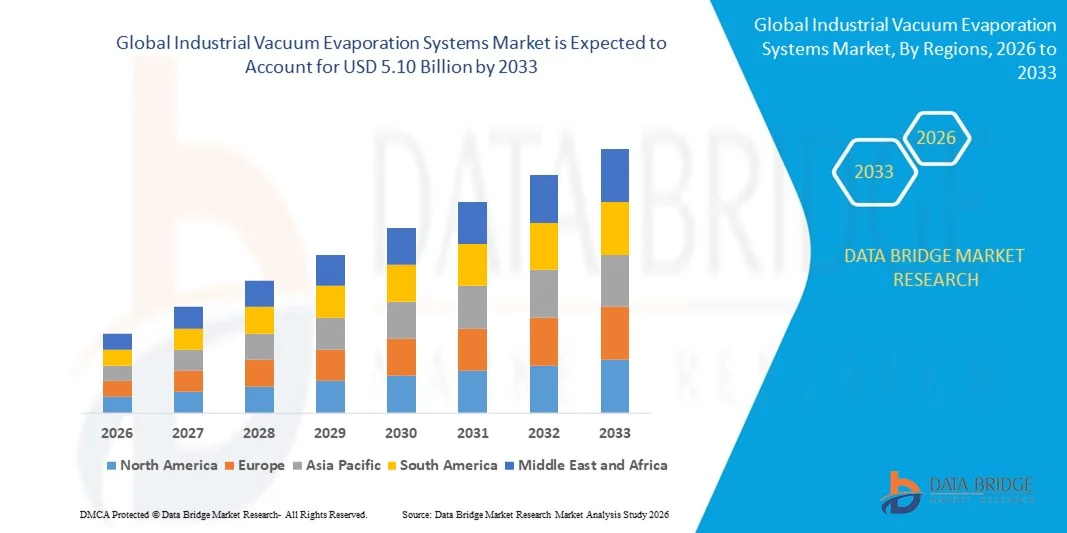
- 世界の工業用真空蒸発システム市場規模は、2025年には32億7000万米ドルと評価され、予測期間中の年平均成長率(CAGR)5.70%で、2033年には51億米ドル に達すると予測されている。
- 市場の成長は、化学、製薬、食品加工業界におけるエネルギー効率の高い蒸発システムに対する需要の高まりによって大きく促進されている。
- 工業化の進展、厳格な環境規制、そして廃棄物削減の必要性が、さらなる普及を促進している。
工業用真空蒸着システム市場分析
- 工業用真空蒸着システムは、低温で動作できるため、エネルギー消費量を削減し、デリケートな材料を保護することができることから、ますます好まれるようになっている。
- 医薬品、特殊化学品、食品・飲料業界からの需要の高まりを受けて、メーカー各社は高容量かつカスタマイズ可能なシステムの開発に取り組んでいる。
- 北米は、急速な工業化、厳格な環境規制、自動車、エレクトロニクス、コーティングなどの分野における需要の高まりを背景に、2025年には世界の産業用真空蒸着システム市場で最大の収益シェアを獲得し、市場を牽引した。
- アジア太平洋地域は、急速な都市化、拡大するエレクトロニクスおよび自動車産業、技術革新、そして産業近代化を促進する政府の支援策に牽引され、世界の産業用真空蒸発システム市場において最も高い成長率を示すと予想されている。
- 多段式蒸発器セグメントは、エネルギー効率の高さと大規模蒸発プロセスに対応できる能力により、2025年に最大の市場収益シェアを獲得し、化学・医薬品製造分野で広く採用されています。多段式蒸発器は、蒸気消費量の削減と高い運転効率により、産業ユーザーの運用コストを削減できるため、好まれています。また、これらのシステムは、製品品質の向上と濃度の一貫性を実現し、繊細な化学・医薬品溶液にとって非常に重要です。製造業者は、多段式蒸発器の長い耐用年数と環境負荷の低さから、多段式蒸発器への投資を増やしています。
レポートの範囲と産業用真空蒸発システム市場のセグメンテーション
|
属性 |
工業用真空蒸着システムの主要市場インサイト |
|
対象分野 |
|
|
対象国 |
北米
ヨーロッパ
アジア太平洋
中東およびアフリカ
南アメリカ
|
|
主要市場プレーヤー |
|
|
市場機会 |
|
|
Value Added Data Infosets |
In addition to the insights on market scenarios such as market value, growth rate, segmentation, geographical coverage, and major players, the market reports curated by the Data Bridge Market Research also include in-depth expert analysis, geographically represented company-wise production and capacity, network layouts of distributors and partners, detailed and updated price trend analysis and deficit analysis of supply chain and demand. |
Industrial Vacuum Evaporation Systems Market Trends
Rising Adoption of Energy-Efficient and Sustainable Evaporation Technologies
- The increasing focus on reducing energy consumption and environmental impact is significantly shaping the industrial vacuum evaporation systems market, as manufacturers seek equipment that improves process efficiency while minimizing operational costs. Advanced vacuum evaporation systems are gaining traction due to their ability to enhance product quality, throughput, and consistency, making them essential across pharmaceuticals, chemicals, and food & beverage industries
- Growing demand for high-purity and specialty products has accelerated the adoption of vacuum evaporation systems for chemical processing, wastewater treatment, and food concentration applications. Companies are investing in modern systems that offer precise control, scalability, and reduced material loss, fostering innovation in design and process optimization
- Sustainability and regulatory compliance trends are influencing purchasing decisions, with manufacturers emphasizing equipment that adheres to environmental norms and energy-efficiency standards. These factors are helping companies differentiate operations, reduce carbon footprint, and improve operational reliability, driving wider adoption of modern vacuum evaporation systems
- For instance, in 2024, GEA Group in Germany and SPX FLOW in the U.S. upgraded their industrial evaporation lines with high-efficiency vacuum systems for food and chemical applications. These installations were designed to enhance energy savings, improve product consistency, and reduce operational costs, reinforcing the companies’ commitment to sustainability and process innovation
- While demand for industrial vacuum evaporation systems is growing, long-term market expansion depends on ongoing R&D, cost-effective deployment, and compatibility with diverse industrial processes. Manufacturers are focusing on improving scalability, modularity, and process integration to meet the evolving needs of multiple sectors
Industrial Vacuum Evaporation Systems Market Dynamics
Driver
Growing Demand for Energy-Efficient and High-Precision Evaporation Systems
- Rising adoption of vacuum evaporation systems in pharmaceuticals, chemicals, and food & beverage industries is a major driver for the market. Companies are increasingly replacing conventional evaporation techniques with vacuum systems to achieve higher efficiency, reduce energy consumption, and improve product quality. This trend also encourages investment in innovative system designs to optimize throughput and minimize environmental impact
- Expanding applications in wastewater treatment, concentration of liquids, and specialty chemical processing are influencing market growth. Vacuum evaporation systems help maintain product integrity, enhance yield, and reduce operational risks, enabling manufacturers to meet strict regulatory and quality standards
- Equipment manufacturers are actively promoting high-efficiency vacuum evaporation solutions through process optimization, automation, and energy-saving technologies. This is supported by the growing emphasis on sustainability, cost reduction, and regulatory compliance, and it also fosters collaboration between equipment suppliers and end-users to improve performance and reliability
- For instance, in 2023, Alfa Laval in Sweden and SPX FLOW in the U.S. reported increased adoption of vacuum evaporation systems for chemical concentration and wastewater management. These upgrades followed higher industrial demand for energy-efficient and environmentally responsible equipment, driving operational savings, process optimization, and customer satisfaction
- Although rising industrial and environmental efficiency trends support growth, wider adoption depends on cost optimization, installation complexity, and skilled workforce availability. Investments in advanced design, modular systems, and training programs will be critical for meeting global demand and maintaining competitive advantage
Restraint/Challenge
High Capital Costs And Maintenance Requirements
- The high initial investment and operational costs of industrial vacuum evaporation systems remain a key challenge, limiting adoption among small and medium-sized enterprises. The requirement for specialized installation, skilled operators, and ongoing maintenance adds to overall expenditure, affecting ROI for cost-sensitive industries
- Equipment downtime and complex maintenance requirements can impact process continuity and productivity. Manufacturers may face challenges in ensuring consistent operational performance without skilled technicians or regular service contracts
- Supply chain constraints for critical components and spare parts also affect market growth, as delays can hinder installation timelines and operational efficiency. In addition, fluctuations in energy prices may increase the cost of running high-capacity systems, influencing purchasing decisions
- For instance, in 2024, food processing facilities in India and Thailand reported delays in vacuum evaporation system deployment due to high equipment costs, maintenance complexity, and limited local technical support. These factors restricted adoption in certain small- and medium-scale production setups
- Overcoming these challenges will require cost-effective system designs, robust service networks, and training programs for operators. Collaboration with local suppliers, technology partners, and educational initiatives can unlock the long-term growth potential of the global industrial vacuum evaporation systems market, while innovations in modular and energy-efficient solutions will support broader adoption
Industrial Vacuum Evaporation Systems Market Scope
The market is segmented on the basis of system type, equipment type, phase type, capacity, application, and end-use industry.
- By System Type
On the basis of system type, the global industrial vacuum evaporation systems market is segmented into Mechanical Vapor Recompression Evaporator, Heat Pump Evaporator, Co-Generation Hot and Cold Evaporator, Rotary Evaporator, Thermal Evaporator, Multiple Effect, and Single Effect. The Multiple Effect segment held the largest market revenue share in 2025, driven by its energy efficiency and ability to handle large-scale evaporation processes, making it widely adopted in chemical and pharmaceutical manufacturing. Multiple Effect systems are preferred for their reduced steam consumption and high operational efficiency, which lowers operational costs for industrial users. These systems also provide enhanced product quality and consistent concentration, which is critical for sensitive chemical and pharmaceutical solutions. Manufacturers increasingly invest in Multiple Effect systems due to their long service life and lower environmental impact.
The Heat Pump Evaporator segment is expected to witness the fastest growth rate from 2026 to 2033, attributed to its low energy consumption and environmentally friendly operation. Heat Pump Evaporators are increasingly chosen for small- to medium-scale operations where energy efficiency and sustainability are critical, often serving as a preferred solution for solvent recovery and wastewater treatment applications. Their ability to recover heat and operate at lower temperatures reduces degradation of heat-sensitive products. In addition, regulatory incentives for energy-efficient systems are driving their adoption across industries.
- By Equipment Type
On the basis of equipment type, the market is segmented into Water Fracturing Evaporation Equipment and Water Atomization Evaporation Equipment. Water Atomization Evaporation Equipment held the largest revenue share in 2025 due to its high efficiency in converting liquid feed into vapor for drying and crystallization processes, widely utilized in pharmaceutical and chemical industries. This equipment provides precise control over particle size and product uniformity, which is critical in high-value chemical applications. Its robustness and ability to handle continuous high-volume operations make it preferred for industrial settings.
The Water Fracturing Evaporation Equipment segment is projected to grow rapidly from 2026 to 2033, driven by its precise temperature control and effective handling of viscous or heat-sensitive fluids, making it suitable for specialized industrial applications. These systems offer flexibility in process scaling and are often integrated with other processing units to optimize production efficiency. Industries with strict purity requirements are increasingly adopting fracturing evaporation equipment to maintain product integrity.
- By Phase Type
On the basis of phase type, the market is segmented into One Phase, Two-Phase, and Three Phase. The Two-Phase segment dominated the market in 2025, owing to its balanced efficiency and operational simplicity for continuous evaporation processes. Two-Phase systems provide stable thermal performance and are versatile across multiple industrial applications, including chemical synthesis and wastewater treatment. They also reduce operational downtime due to easier maintenance compared to multi-phase systems.
The Three-Phase segment is expected to grow at the fastest rate during the forecast period due to its enhanced heat transfer capabilities and suitability for high-capacity evaporation operations in chemical and metallurgical industries. Three-Phase systems allow better energy utilization, which reduces operational costs and improves process consistency. They are also preferred in industries requiring high throughput without compromising product quality.
- By Capacity
On the basis of capacity, the market is segmented into Up to 100 Liters/Day, 150-500 Liters/Day, 500-1000 Liters/Day, 1000-2000 Liters/Day, 2000-4000 Liters/Day, 4000-8000 Liters/Day, 8000-20000 Liters/Day, and 20000-50000 Liters/Day. The 2000-4000 Liters/Day segment held the largest market share in 2025, driven by its optimal balance between throughput and cost-efficiency for industrial-scale operations. This capacity range meets the needs of most mid-sized chemical and pharmaceutical manufacturers seeking efficient production without requiring high upfront capital investment.
The 8000-20000 Liters/Day segment is expected to register the fastest growth from 2026 to 2033, fueled by rising demand from large-scale chemical and pharmaceutical manufacturing facilities requiring high-volume evaporation solutions. These high-capacity systems are preferred in bulk production scenarios where time efficiency, energy optimization, and process automation are critical. Companies are increasingly investing in this segment to expand production capabilities and meet growing global demand.
- By Application
On the basis of application, the market is segmented into Wastewater Treatment and Recycling, Solvent Recycling and Purification, Distillation, Synthesis, Concentration, and Drying Recrystallization. Wastewater Treatment and Recycling held the largest share in 2025 due to stringent environmental regulations and the growing need for sustainable industrial operations. These systems allow industries to minimize effluent discharge and comply with environmental norms while recovering valuable resources. They also support water conservation initiatives, which are becoming increasingly critical in regions facing water scarcity.
The Solvent Recycling and Purification segment is expected to witness the fastest growth from 2026 to 2033, driven by increasing adoption in pharmaceutical and chemical industries to reduce operational costs and minimize environmental impact. Efficient solvent recovery reduces raw material usage and improves overall process sustainability. Companies focusing on green manufacturing and ESG (Environmental, Social, Governance) compliance are investing heavily in solvent recycling technologies.
- By End-Use Industry
On the basis of end-use industry, the market is segmented into Pharmaceutical, Chemicals, Metallurgy, Printing and Textiles, Oil and Petrochemicals, Food and Beverages, Semiconductors, Power Generation, and Medical and Research Laboratories. The Pharmaceutical industry dominated the market in 2025, owing to high demand for precise and contamination-free evaporation processes for drug manufacturing. The use of vacuum evaporation systems ensures consistent product concentration, enhances purity, and supports strict quality control requirements. Pharmaceutical companies rely on these systems for both R&D and large-scale production of high-value products.
The Chemicals industry segment is expected to witness the fastest growth from 2026 to 2033, fueled by the expanding chemical manufacturing activities globally and the increasing need for efficient solvent recovery and concentration solutions. Chemical manufacturers benefit from reduced operational costs, higher process efficiency, and improved energy utilization. The adoption of vacuum evaporation systems also helps meet regulatory compliance and sustainability goals across chemical production processes.
Industrial Vacuum Evaporation Systems Market Regional Analysis
- North America dominated the global industrial vacuum evaporation systems market with the largest revenue share in 2025, propelled by rapid industrialization, stringent environmental regulations, and escalating demand across sectors such as automotive, electronics, and coatings
- Manufacturers in the region are increasingly investing in advanced vacuum evaporation solutions to improve product quality, enhance process efficiency, and meet sustainability goals
- The widespread adoption is further supported by high industrial spending, technological advancements, and the presence of major market players, establishing industrial vacuum evaporation systems as essential for precision manufacturing and surface treatment processes
U.S. Industrial Vacuum Evaporation Systems Market Insight
The U.S. industrial vacuum evaporation systems market captured the largest revenue share in 2025 within North America, driven by the strong presence of end-use industries and continuous innovation in manufacturing technologies. Industries are prioritizing high‑precision coating and deposition processes, fueling demand for vacuum evaporation systems. The rising need for lightweight and corrosion‑resistant components in aerospace and automotive sectors, coupled with robust R&D activities, is bolstering market growth. In addition, supportive government initiatives and investments in advanced manufacturing further accelerate adoption.
Europe Industrial Vacuum Evaporation Systems Market Insight
The Europe industrial vacuum evaporation systems market is expected to witness robust growth from 2026 to 2033, due to stringent regulatory norms aimed at reducing emissions and improving product standards. The region’s strong industrial base, particularly in Germany, France, and Italy, is driving demand for precision coating and surface engineering solutions. Increasing focus on sustainable manufacturing practices and the integration of Industry 4.0 technologies are further supporting market expansion across automotive, electronics, and aerospace sectors.
U.K. Industrial Vacuum Evaporation Systems Market Insight
The U.K. industrial vacuum evaporation systems market is anticipated to exhibit significant growth from 2026 to 2033, influenced by the country’s emphasis on high‑tech manufacturing and advanced material applications. The growing demand for specialized coatings in medical devices, electronics, and automotive components is encouraging adoption. Moreover, investments in digital manufacturing and automation, along with a strong focus on quality and compliance, are expected to sustain market momentum.
Germany Industrial Vacuum Evaporation Systems Market Insight
The Germany industrial vacuum evaporation systems market is projected to witness notable growth from 2026 to 2033, driven by the nation’s leadership in industrial innovation and precision engineering. The automotive and machinery sectors’ demand for high‑performance surface treatments and coatings is a key growth factor. Germany’s commitment to energy efficiency and advanced production techniques further propels the adoption of vacuum evaporation technologies in diverse industrial applications.
Asia-Pacific Industrial Vacuum Evaporation Systems Market Insight
The Asia-Pacific industrial vacuum evaporation systems market is expected to experience the fastest growth rate from 2026 to 2033, supported by rapid industrial expansion, rising manufacturing investments, and technological advancements in China, Japan, India, and South Korea. Increasing infrastructure development and the growing electronics and automotive industries are major contributors to market demand. Furthermore, government initiatives promoting manufacturing modernization and export‑oriented production are driving the adoption of industrial vacuum evaporation systems across the region.
Japan Industrial Vacuum Evaporation Systems Market Insight
The Japan industrial vacuum evaporation systems market is anticipated to grow significantly from 2026 to 2033, due to the country’s focus on advanced manufacturing, precision components, and automation. The electronics and semiconductor industries’ demand for high‑quality thin films and coatings is fueling market expansion. In addition, Japan’s technological prowess and emphasis on innovation are fostering the integration of vacuum evaporation systems with IoT and smart production processes.
China Industrial Vacuum Evaporation Systems Market Insight
The China industrial vacuum evaporation systems market accounted for the largest market revenue share in Asia-Pacific in 2025, driven by the country’s rapid industrial growth, expanding manufacturing base, and strong adoption of modern production technologies. China’s significant presence in electronics, automotive, and renewable energy sectors, coupled with substantial investments in industrial automation, is propelling market growth. The availability of cost‑effective solutions and local system manufacturers is further enhancing market accessibility and competitiveness.
Industrial Vacuum Evaporation Systems Market Share
The Industrial Vacuum Evaporation Systems industry is primarily led by well-established companies, including:
- Veolia Water Solutions & Technologies (France)
- Bucher (Switzerland)
- GEA Group Aktiengesellschaft (Germany)
- Eco‑Techno SRL (Italy)
- Condorchem Envitech (Spain)
- SUEZ (France)
- JEOL USA, Inc. (U.S.)
- 3R Technology (U.K.)
- Saltworks Technologies Inc. (Canada)
- Lenntech B.V. (Netherlands)
- Vilokan Recycling Tech (Germany)
- DE DIETRICH SAS (France)
- SAMSCO (India)
- ENCON Evaporators (U.S.)
- ALFA LAVAL (Sweden)
- Praj Industries (India)
- SANSHIN MFG.CO., LTD. (Japan)
- Unitop Aquacare Limited (U.K.)
- H2O GmbH (Germany)
- SPX Flow, Inc. (U.S.)
SKU-
世界初のマーケットインテリジェンスクラウドに関するレポートにオンラインでアクセスする

- インタラクティブなデータ分析ダッシュボード
- 成長の可能性が高い機会のための企業分析ダッシュボード
- カスタマイズとクエリのためのリサーチアナリストアクセス
- インタラクティブなダッシュボードによる競合分析
- 最新ニュース、更新情報、トレンド分析
- 包括的な競合追跡のためのベンチマーク分析のパワーを活用
調査方法
データ収集と基準年分析は、大規模なサンプル サイズのデータ収集モジュールを使用して行われます。この段階では、さまざまなソースと戦略を通じて市場情報または関連データを取得します。過去に取得したすべてのデータを事前に調査および計画することも含まれます。また、さまざまな情報ソース間で見られる情報の不一致の調査も含まれます。市場データは、市場統計モデルと一貫性モデルを使用して分析および推定されます。また、市場シェア分析と主要トレンド分析は、市場レポートの主要な成功要因です。詳細については、アナリストへの電話をリクエストするか、お問い合わせをドロップダウンしてください。
DBMR 調査チームが使用する主要な調査方法は、データ マイニング、データ変数が市場に与える影響の分析、および一次 (業界の専門家) 検証を含むデータ三角測量です。データ モデルには、ベンダー ポジショニング グリッド、市場タイムライン分析、市場概要とガイド、企業ポジショニング グリッド、特許分析、価格分析、企業市場シェア分析、測定基準、グローバルと地域、ベンダー シェア分析が含まれます。調査方法について詳しくは、お問い合わせフォームから当社の業界専門家にご相談ください。
カスタマイズ可能
Data Bridge Market Research は、高度な形成的調査のリーダーです。当社は、既存および新規のお客様に、お客様の目標に合致し、それに適したデータと分析を提供することに誇りを持っています。レポートは、対象ブランドの価格動向分析、追加国の市場理解 (国のリストをお問い合わせください)、臨床試験結果データ、文献レビュー、リファービッシュ市場および製品ベース分析を含めるようにカスタマイズできます。対象競合他社の市場分析は、技術ベースの分析から市場ポートフォリオ戦略まで分析できます。必要な競合他社のデータを、必要な形式とデータ スタイルでいくつでも追加できます。当社のアナリスト チームは、粗い生の Excel ファイル ピボット テーブル (ファクト ブック) でデータを提供したり、レポートで利用可能なデータ セットからプレゼンテーションを作成するお手伝いをしたりすることもできます。











