Global Mining Tailings Management Market Size, Share, and Trends Analysis Report
Market Size in USD Billion
CAGR :
%
USD
16.89 Billion
USD
24.20 Billion
2024
2032
| 2025 –2032 | |
| USD 16.89 Billion | |
| USD 24.20 Billion | |
|
|
|
|
Global Mining Tailings Management Market Segmentation, By Type (Dry Stacking, Underground Storage, and Others), Technology (Paste Tailings, Thickened Tailings, Filtered Tailings, and Cyanide Tailings Management), Mineral Type (Gold, Copper, Iron, and Coal), Service Type (Consulting, Design Engineering, Project Management, and Monitoring Reporting), Application (Metal Mineral and Non-Metallic Mineral)- Industry Trends and Forecast to 2032
Mining Tailings Management Market Size
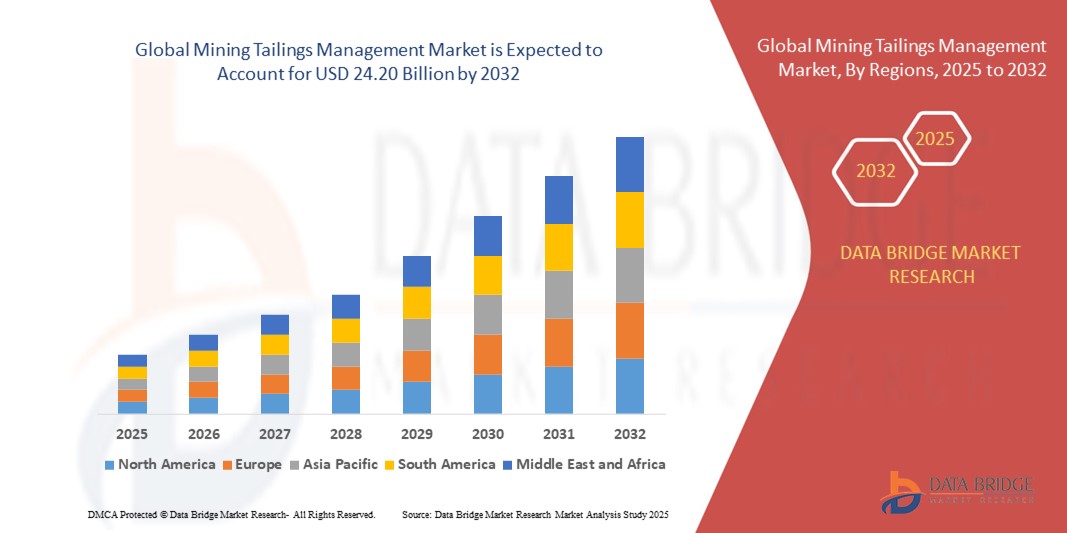
- The global mining tailings management market size was valued at USD 16.89 billion in 2024 and is expected to reach USD 24.20 billion by 2032, at a CAGR of 4.60% during the forecast period
- The market growth is largely fueled by increasing mining activities worldwide, rising demand for sustainable and environmentally compliant waste management solutions, and stringent regulations regarding tailings disposal
- Adoption of advanced tailings storage technologies, growing focus on reducing environmental hazards, and the need for safe management of mining waste are further driving market expansion
Mining Tailings Management Market Analysis
- The market is witnessing rising investment in innovative tailings management techniques, including dry stacking, thickened tailings, and filtered tailings methods, aimed at minimizing environmental impact
- Increasing awareness among mining companies about operational safety, risk reduction, and sustainable practices is supporting market growth
- North America dominated the mining tailings management market with the largest revenue share of 38.5% in 2024, driven by increasing mining activities, stringent environmental regulations, and rising adoption of advanced tailings storage solutions
- Asia-Pacific region is expected to witness the highest growth rate in the global mining tailings management market, driven by rapid urbanization, increasing mining operations, and government initiatives promoting environmentally sustainable practices.
- The Dry Stacking segment held the largest market revenue share in 2024, driven by its reduced environmental impact, improved safety, and lower water usage. Dry stacking solutions are increasingly preferred for sustainable mining operations and regulatory compliance
Report Scope and Mining Tailings Management Market Segmentation
|
Attributes |
Mining Tailings Management Key Market Insights |
|
Segments Covered |
|
|
Countries Covered |
North America
Europe
Asia-Pacific
Middle East and Africa
South America
|
|
Key Market Players |
|
|
Market Opportunities |
|
|
Value Added Data Infosets |
In addition to the insights on market scenarios such as market value, growth rate, segmentation, geographical coverage, and major players, the market reports curated by the Data Bridge Market Research also include import export analysis, production capacity overview, production consumption analysis, price trend analysis, climate change scenario, supply chain analysis, value chain analysis, raw material/consumables overview, vendor selection criteria, PESTLE Analysis, Porter Analysis, and regulatory framework. |
Mining Tailings Management Market Trends
Adoption of Advanced Tailings Storage and Recycling Technologies
- The increasing adoption of advanced tailings storage solutions, such as dry stacking, filtered tailings, and thickened tailings, is transforming the mining tailings management landscape by improving safety and reducing environmental impact. These technologies enable more efficient waste handling and minimize the risk of tailings dam failures, enhancing operational reliability
- Growing demand for sustainable and environmentally responsible mining practices is driving investment in tailings recycling and reuse methods. These approaches help recover valuable minerals from waste, reduce disposal volumes, and lower operational costs, creating both economic and ecological benefits
- The integration of digital monitoring systems and remote sensing technologies allows for real-time tailings dam monitoring, predictive maintenance, and early detection of structural issues. This leads to improved risk management and regulatory compliance for mining operators
- For instance, in 2023, several copper and gold mines in Chile implemented filtered tailings systems, which reduced water usage, minimized environmental footprint, and improved overall safety, setting benchmarks for responsible tailings management
- While advanced technologies are driving efficiency and sustainability, their widespread adoption depends on cost-effectiveness, regulatory support, and workforce training. Companies must focus on scalable, locally adaptable solutions to fully capitalize on this market trend
Mining Tailings Management Market Dynamics
Driver
Increasing Mining Activities and Stringent Environmental Regulations
- The rise in global mining activities and growing mineral demand is pushing operators to adopt effective tailings management solutions. Proper management reduces environmental hazards, enhances operational safety, and ensures adherence to local and international regulations. Mining companies are increasingly integrating risk assessment protocols to manage tailings efficiently
- Governments and environmental agencies are enforcing stricter regulations on tailings disposal, requiring mining companies to implement sustainable waste management practices. These regulatory frameworks are boosting demand for modern tailings solutions, while incentivizing adoption of eco-friendly technologies and reducing potential liabilities from tailings failures
- Public and private sector initiatives, including investment in safer tailings technologies, digital monitoring, and real-time analytics, are supporting operational efficiency and environmental stewardship. Such initiatives also encourage knowledge sharing, workforce training, and adoption of best practices across mining operations globally
- For instance, in 2022, several mining operators in Australia adopted thickened tailings storage systems to meet updated environmental guidelines, resulting in safer disposal, reduced water usage, and improved community acceptance. This demonstrates how compliance-driven adoption can also enhance sustainability and corporate reputation
- While mining expansion and regulations drive market growth, effective implementation relies on sufficient infrastructure, a skilled workforce, and continued investment in technology. Companies must address operational complexity, integrate automation, and ensure proper maintenance to maximize the benefits of advanced tailings management systems
Restraint/Challenge
High Capital Investment and Technical Complexity of Tailings Management Solutions
- Advanced tailings storage and recycling systems involve significant upfront investment, making them less accessible for small-scale or financially constrained mining operators. High costs can delay adoption, limit technology deployment, and restrict market penetration, especially in emerging economies with budget constraints
- In many regions, a lack of trained personnel and technical expertise limits the effective implementation and maintenance of complex tailings management systems. Operational challenges can increase environmental and safety risks, while inadequate training may lead to underutilization of technological capabilities
- Supply chain constraints and limited availability of specialized equipment in remote mining locations further restrict market penetration. Mines often rely on conventional tailings disposal methods, which are less efficient and environmentally riskier, creating challenges in meeting regulatory standards and sustainability goals
- For instance, in 2023, several small-scale mines in South America reported delays in implementing filtered tailings systems due to high costs and limited technical support, highlighting adoption challenges and potential operational setbacks. This underscores the need for accessible solutions and technical guidance
- While technological advancements continue to improve efficiency, safety, and sustainability, addressing cost, workforce training, and infrastructure limitations is crucial. Companies must invest in scalable solutions, mobile deployment units, and localized training programs to unlock broader market growth and minimize environmental risks
Mining Tailings Management Market Scope
The market is segmented on the basis of type, technology, mineral type, service type, and application.
- By Type
On the basis of type, the market is segmented into Dry Stacking, Underground Storage, and Others. The Dry Stacking segment held the largest market revenue share in 2024, driven by its reduced environmental impact, improved safety, and lower water usage. Dry stacking solutions are increasingly preferred for sustainable mining operations and regulatory compliance.
The Underground Storage segment is expected to witness the fastest growth rate from 2025 to 2032, driven by its ability to minimize surface footprint, ensure long-term containment, and reduce the risk of tailings dam failures. Underground storage solutions are gaining traction in mines with limited land availability.
- By Technology
On the basis of technology, the market is segmented into Paste Tailings, Thickened Tailings, Filtered Tailings, and Cyanide Tailings Management. The Thickened Tailings segment held the largest market revenue share in 2024, owing to its efficient water recovery, reduced storage volume, and enhanced stability.
The Filtered Tailings segment is expected to witness the fastest growth rate from 2025 to 2032, driven by its lower environmental risk, improved safety profile, and ability to support arid-region mining operations with minimal water usage.
- By Mineral Type
On the basis of mineral type, the market is segmented into Gold, Copper, Iron, and Coal. The Gold segment held the largest revenue share in 2024, due to the high value of extracted materials and stringent safety and environmental regulations associated with gold mining operations.
The Copper segment is expected to witness the fastest growth rate from 2025 to 2032, driven by expanding copper mining activities, growing demand for copper in electrification, and the need for effective tailings management in large-scale operations.
- By Service Type
On the basis of service type, the market is segmented into Consulting, Design Engineering, Project Management, and Monitoring & Reporting. The Monitoring & Reporting segment held the largest market revenue share in 2024, supported by regulatory requirements, increased environmental scrutiny, and adoption of digital monitoring solutions for tailings storage facilities.
The Design Engineering segment is expected to witness the fastest growth rate from 2025 to 2032, driven by growing demand for customized tailings solutions, innovative storage methods, and optimization of operational efficiency for complex mining projects.
- By Application
On the basis of application, the market is segmented into Metal Mineral and Non-Metallic Mineral. The Metal Mineral segment held the largest revenue share in 2024, fueled by increasing global demand for metals and stricter environmental and safety regulations in metal mining operations.
The Non-Metallic Mineral segment is expected to witness the fastest growth rate from 2025 to 2032, driven by expanding industrial mineral mining, growing adoption of advanced tailings technologies, and increased regulatory oversight in non-metallic mining regions.
Mining Tailings Management Market Regional Analysis
• North America dominated the mining tailings management market with the largest revenue share of 38.5% in 2024, driven by increasing mining activities, stringent environmental regulations, and rising adoption of advanced tailings storage solutions.
• Operators in the region highly value safer disposal techniques, regulatory compliance, and technologies such as dry stacking and thickened tailings, which reduce environmental risks and improve operational efficiency.
• This widespread adoption is further supported by well-developed infrastructure, skilled workforce, and strong government initiatives promoting sustainable mining practices across both metal and non-metallic mining sectors.
U.S. Mining Tailings Management Market Insight
The U.S. mining tailings management market captured the largest revenue share in 2024 within North America, fueled by increased mineral extraction, regulatory oversight, and adoption of modern tailings management technologies. Mining operators are increasingly prioritizing risk mitigation, environmental compliance, and sustainable waste management solutions. Government incentives, digital monitoring systems, and investment in safer storage methods further contribute to market growth.
Europe Mining Tailings Management Market Insight
The Europe mining tailings management market is expected to witness the fastest growth rate from 2025 to 2032, primarily driven by stringent environmental regulations and growing demand for sustainable mining operations. Increasing urbanization and mining activities, coupled with adoption of paste, thickened, and filtered tailings systems, are fostering market growth. The region is witnessing significant adoption across gold, copper, and other mineral projects, with operators focusing on reducing water usage and improving dam safety.
U.K. Mining Tailings Management Market Insight
The U.K. mining tailings management market is expected to witness the fastest growth rate from 2025 to 2032, driven by regulatory emphasis on environmental protection and a desire for safer, technologically advanced tailings storage solutions. Mining operators are implementing dry stacking and digital monitoring systems to meet compliance requirements, while improving operational efficiency and reducing environmental impact.
Germany Mining Tailings Management Market Insight
The Germany mining tailings management market is expected to witness the fastest growth rate from 2025 to 2032, fueled by increasing awareness of sustainable mining practices and the need for advanced tailings technologies. Germany’s focus on innovation, eco-friendly solutions, and strong industrial infrastructure promotes adoption of thickened and filtered tailings systems. Integration with project monitoring and reporting services is also becoming increasingly common to ensure regulatory compliance and operational safety.
Asia-Pacific Mining Tailings Management Market Insight
The Asia-Pacific mining tailings management market is expected to witness the fastest growth rate from 2025 to 2032, driven by rapid urbanization, rising mining activities, and increasing adoption of advanced storage technologies in countries such as China, India, and Australia. Government initiatives promoting sustainable mining, along with a growing focus on water conservation and environmental safety, are accelerating market adoption.
Japan Mining Tailings Management Market Insight
The Japan mining tailings management market is expected to witness the fastest growth rate from 2025 to 2032 due to increasing mineral production, regulatory compliance requirements, and demand for eco-conscious tailings solutions. Operators are focusing on filtered tailings and thickened tailings systems to reduce environmental risks and improve operational efficiency. The integration of digital monitoring and reporting platforms is further supporting adoption in both metal and non-metallic mining projects.
China Mining Tailings Management Market Insight
The China mining tailings management market accounted for the largest market revenue share in Asia-Pacific in 2024, attributed to the country’s growing mining output, strict regulatory framework, and adoption of advanced tailings storage technologies. The push for sustainable mining practices, combined with investment in thickened and dry stacking systems, is driving market growth. China’s strong domestic manufacturing of tailings management equipment further enhances accessibility and adoption across mining operations.
Mining Tailings Management Market Share
The Mining Tailings Management industry is primarily led by well-established companies, including:
- BHP Group (Australia)
- Rio Tinto (U.K.)
- Vale S.A. (Brazil)
- Glencore (Switzerland)
- Anglo American plc (U.K.)
- China Shenhua Energy Company Limited (China)
- Saudi Aramco (Saudi Arabia)
- ExxonMobil (U.S.)
- Chevron Corporation (U.S.)
- Shell (Netherlands)
- TotalEnergies (France)
- BP (U.K.)
- ConocoPhillips (U.S.)
- PetroChina (China)
- Gazprom (Russia)
- Rosneft (Russia)
- Freeport-McMoRan (U.S.)
- Northern Star Resources (Australia)
- Sibanye Stillwater (South Africa)
- Newmont Corporation (U.S.)
- Teck Resources (Canada)
- Antofagasta PLC (U.K.)
SKU-
世界初のマーケットインテリジェンスクラウドに関するレポートにオンラインでアクセスする

- インタラクティブなデータ分析ダッシュボード
- 成長の可能性が高い機会のための企業分析ダッシュボード
- カスタマイズとクエリのためのリサーチアナリストアクセス
- インタラクティブなダッシュボードによる競合分析
- 最新ニュース、更新情報、トレンド分析
- 包括的な競合追跡のためのベンチマーク分析のパワーを活用
調査方法
データ収集と基準年分析は、大規模なサンプル サイズのデータ収集モジュールを使用して行われます。この段階では、さまざまなソースと戦略を通じて市場情報または関連データを取得します。過去に取得したすべてのデータを事前に調査および計画することも含まれます。また、さまざまな情報ソース間で見られる情報の不一致の調査も含まれます。市場データは、市場統計モデルと一貫性モデルを使用して分析および推定されます。また、市場シェア分析と主要トレンド分析は、市場レポートの主要な成功要因です。詳細については、アナリストへの電話をリクエストするか、お問い合わせをドロップダウンしてください。
DBMR 調査チームが使用する主要な調査方法は、データ マイニング、データ変数が市場に与える影響の分析、および一次 (業界の専門家) 検証を含むデータ三角測量です。データ モデルには、ベンダー ポジショニング グリッド、市場タイムライン分析、市場概要とガイド、企業ポジショニング グリッド、特許分析、価格分析、企業市場シェア分析、測定基準、グローバルと地域、ベンダー シェア分析が含まれます。調査方法について詳しくは、お問い合わせフォームから当社の業界専門家にご相談ください。
カスタマイズ可能
Data Bridge Market Research は、高度な形成的調査のリーダーです。当社は、既存および新規のお客様に、お客様の目標に合致し、それに適したデータと分析を提供することに誇りを持っています。レポートは、対象ブランドの価格動向分析、追加国の市場理解 (国のリストをお問い合わせください)、臨床試験結果データ、文献レビュー、リファービッシュ市場および製品ベース分析を含めるようにカスタマイズできます。対象競合他社の市場分析は、技術ベースの分析から市場ポートフォリオ戦略まで分析できます。必要な競合他社のデータを、必要な形式とデータ スタイルでいくつでも追加できます。当社のアナリスト チームは、粗い生の Excel ファイル ピボット テーブル (ファクト ブック) でデータを提供したり、レポートで利用可能なデータ セットからプレゼンテーションを作成するお手伝いをしたりすることもできます。