Global Piezoelectric Materials Market Size, Share and Trends Analysis Report
Market Size in USD Billion
CAGR :
%
USD
1.47 Billion
USD
2.16 Billion
2025
2033
| 2026 –2033 | |
| USD 1.47 Billion | |
| USD 2.16 Billion | |
|
|
|
|
Global Piezoelectric Materials Market Segmentation, By Product (Ceramics, Polymers, Composites, and Others), Application (Actuators, Sensors, Motors, Acoustic Devices, Generators, SONAR, Transducers, and Others), End Use (Automotive, Healthcare, Information & Telecom, Consumer Goods, Aerospace & Defense, and Others) - Industry Trends and Forecast to 2033
What is the Global Piezoelectric Materials Market Size and Growth Rate?
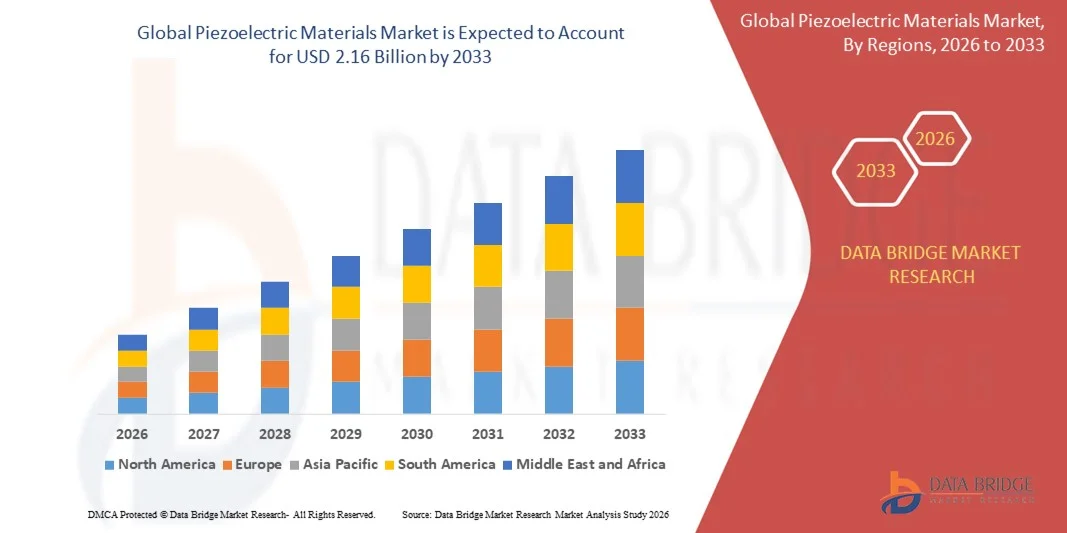
- The global piezoelectric materials market size was valued at USD 1.47 billion in 2025 and is expected to reach USD 2.16 billion by 2033, at a CAGR of6.88% during the forecast period
- Rising demand for energy-efficient and high-performance electronic components, increasing adoption of piezoelectric materials in automotive sensors, actuators, medical imaging devices, industrial automation, and consumer electronics, expanding use in IoT-enabled devices, and continuous advancements in smart materials and miniaturized electronic systems are among the key factors driving market growth
What are the Major Takeaways of Piezoelectric Materials Market?
- Growing demand for electric vehicles, advanced healthcare devices, precision sensors, and smart consumer electronics, along with increasing research and development activities in material science, is creating significant growth opportunities for the piezoelectric materials market
- However, high material costs, complex manufacturing processes, environmental concerns related to lead-based ceramics, and limited availability of skilled expertise for advanced material integration are key challenges that may restrain market growth over the forecast period
- Asia-Pacific dominated the piezoelectric materials market with the largest revenue share of 35.53% in 2025, driven by strong electronics manufacturing bases, rapid industrialization, and high demand from automotive, consumer electronics, telecom, and industrial automation sectors across China, Japan, South Korea, and India
- North America is expected to register the fastest CAGR of 9.36% from 2026 to 2033, supported by strong R&D activity, rapid adoption of advanced medical technologies, aerospace & defense innovation, and growing use of piezoelectric materials in EVs, renewable energy systems, and industrial automation
- The Ceramics segment dominated the market with a share of around 48% in 2025, owing to its superior piezoelectric coefficients, high mechanical strength, thermal stability, and wide applicability across sensors, actuators, transducers, and medical ultrasound devices
Report Scope and Piezoelectric Materials Market Segmentation
|
Attributes |
Piezoelectric Materials Key Market Insights |
|
Segments Covered |
|
|
Countries Covered |
North America
Europe
Asia-Pacific
Middle East and Africa
South America
|
|
Key Market Players |
|
|
Market Opportunities |
|
|
Value Added Data Infosets |
In addition to the insights on market scenarios such as market value, growth rate, segmentation, geographical coverage, and major players, the market reports curated by the Data Bridge Market Research also include in-depth expert analysis, pricing analysis, brand share analysis, consumer survey, demography analysis, supply chain analysis, value chain analysis, raw material/consumables overview, vendor selection criteria, PESTLE Analysis, Porter Analysis, and regulatory framework. |
What is the Key Trend in the Piezoelectric Materials Market?
Increasing Shift Toward Miniaturized, High-Performance, and Application-Specific Piezoelectric Materials
- The piezoelectric materials market is witnessing rising adoption of compact, lightweight, and high-sensitivity materials designed for advanced sensors, actuators, medical devices, and precision electronics
- Manufacturers are increasingly focusing on lead-free ceramics, single crystals, and polymer-based piezoelectric materials to meet sustainability regulations and performance requirements
- Growing demand for miniaturized electronic components, MEMS devices, and wearable technologies is driving innovation in thin-film and flexible piezoelectric materials
- For instance, companies such as TDK, CeramTec, PI Ceramics, Solvay, and Arkema are expanding portfolios with high-efficiency, application-optimized piezoelectric ceramics and polymers
- Increasing use of piezoelectric materials in energy harvesting, ultrasound imaging, precision motion control, and acoustic sensing is accelerating market adoption
- As electronic systems become smaller, smarter, and more energy-efficient, piezoelectric materials remain critical for precision control, sensing accuracy, and multifunctional device integration
What are the Key Drivers of Piezoelectric Materials Market?
- Rising demand for high-performance sensors, actuators, and transducers across automotive, healthcare, industrial automation, and consumer electronics sectors
- For instance, during 2024–2025, several manufacturers enhanced piezoelectric material formulations to support EV systems, advanced driver-assistance systems (ADAS), and medical imaging equipment
- Growing adoption of IoT devices, robotics, smart manufacturing systems, and precision instrumentation is boosting demand for reliable piezoelectric components globally
- Advancements in material science, crystal growth techniques, and polymer composites have improved sensitivity, durability, and temperature stability
- Increasing deployment of ultrasound-based diagnostics, minimally invasive medical devices, and aerospace sensing systems is driving volume demand
- Supported by strong investments in electronics R&D, healthcare technology, and advanced manufacturing, the Piezoelectric Materials market is expected to experience sustained long-term growth
Which Factor is Challenging the Growth of the Piezoelectric Materials Market?
- High costs associated with advanced piezoelectric ceramics, single-crystal materials, and precision manufacturing processes limit adoption in cost-sensitive applications
- For instance, during 2024–2025, fluctuations in raw material prices and energy costs impacted production expenses for several global piezoelectric material suppliers
- Design complexity and material integration challenges in high-frequency, high-temperature, and miniaturized applications require specialized expertise
- Environmental concerns and regulatory restrictions on lead-based piezoelectric materials increase compliance costs and R&D burden
- Competition from alternative sensing technologies, such as optical and electromagnetic sensors, creates pricing pressure in certain applications
- To overcome these challenges, companies are investing in lead-free materials, scalable manufacturing, and application-specific customization, supporting broader market adoption of piezoelectric materials
How is the Piezoelectric Materials Market Segmented?
The market is segmented on the basis of product type, application, and end use.
- By Product
On the basis of product, the piezoelectric materials market is segmented into Ceramics, Polymers, Composites, and Others. The Ceramics segment dominated the market with a share of around 48% in 2025, owing to its superior piezoelectric coefficients, high mechanical strength, thermal stability, and wide applicability across sensors, actuators, transducers, and medical ultrasound devices. Piezoelectric ceramics such as PZT are extensively used in automotive systems, industrial automation, aerospace components, and consumer electronics due to their reliability and cost-effectiveness in high-volume production.
The Polymers segment is expected to register the fastest CAGR from 2026 to 2033, driven by growing demand for lightweight, flexible, and wearable electronics. Increasing adoption of polymer-based piezoelectric materials in medical devices, energy harvesting systems, flexible sensors, and IoT applications is accelerating growth. Advancements in material engineering and rising preference for lead-free alternatives further support long-term expansion.
- By Application
On the basis of application, the market is segmented into Actuators, Sensors, Motors, Acoustic Devices, Generators, SONAR, Transducers, and Others. The Sensors segment held the largest market share of approximately 38–40% in 2025, supported by extensive usage in automotive safety systems, industrial monitoring, healthcare diagnostics, and consumer electronics. Piezoelectric sensors offer high sensitivity, fast response, and durability, making them ideal for pressure, vibration, acceleration, and acoustic sensing applications.
The Actuators segment is projected to grow at the fastest CAGR during 2026–2033, driven by increasing demand for precision motion control in robotics, semiconductor manufacturing, aerospace systems, and medical equipment. Rising adoption of micro-positioning systems, adaptive optics, and nano-positioning technologies is significantly boosting the use of piezoelectric actuators across advanced engineering applications.
- By End Use
On the basis of end use, the piezoelectric materials market is segmented into Automotive, Healthcare, Information & Telecom, Consumer Goods, Aerospace & Defense, and Others. The Automotive segment dominated the market with a share of about 34–36% in 2025, driven by rising integration of piezoelectric materials in fuel injection systems, engine management, ADAS, vibration sensing, and EV powertrain components. Increasing vehicle electrification and stringent safety standards continue to strengthen adoption.
The Healthcare segment is expected to witness the fastest growth from 2026 to 2033, supported by expanding use of piezoelectric materials in ultrasound imaging, medical sensors, drug delivery systems, and minimally invasive devices. Growing healthcare investments, aging populations, and technological advancements are further accelerating market growth in this segment.
Which Region Holds the Largest Share of the Piezoelectric Materials Market?
- Asia-Pacific dominated the piezoelectric materials market with the largest revenue share of 35.53% in 2025, driven by strong electronics manufacturing bases, rapid industrialization, and high demand from automotive, consumer electronics, telecom, and industrial automation sectors across China, Japan, South Korea, and India. The region benefits from large-scale production of sensors, actuators, transducers, and acoustic components that extensively use piezoelectric ceramics and polymers
- Rising investments in semiconductor fabrication, EV manufacturing, robotics, and smart devices, along with expanding 5G infrastructure and IoT deployment, continue to fuel demand for piezoelectric materials across both mass-market and high-performance applications
- Cost-effective manufacturing, skilled labor availability, and strong government support for electronics and advanced materials further strengthen Asia-Pacific’s leadership in the global market
China Piezoelectric Materials Market Insight
China is the largest contributor within Asia-Pacific, supported by its dominant electronics manufacturing ecosystem, large automotive production base, and aggressive investments in smart manufacturing and renewable energy technologies. Growing use of piezoelectric materials in sensors, ultrasonic devices, energy harvesting systems, and industrial automation drives sustained market growth.
Japan Piezoelectric Materials Market Insight
Japan demonstrates steady growth due to its strong focus on high-precision electronics, automotive innovation, robotics, and medical devices. Continuous R&D in advanced ceramics and lead-free piezoelectric materials supports long-term adoption across premium applications.
India Piezoelectric Materials Market Insight
India is emerging as a high-growth market, driven by expanding electronics manufacturing, rising EV adoption, healthcare device production, and government-backed “Make in India” initiatives. Increasing demand for sensors, actuators, and medical ultrasound equipment accelerates market penetration.
North America Piezoelectric Materials Market
North America is expected to register the fastest CAGR of 9.36% from 2026 to 2033, supported by strong R&D activity, rapid adoption of advanced medical technologies, aerospace & defense innovation, and growing use of piezoelectric materials in EVs, renewable energy systems, and industrial automation.
U.S. Piezoelectric Materials Market Insight
The U.S. leads regional growth due to strong semiconductor research, medical device innovation, and aerospace applications. Rising demand for precision sensors, actuators, and ultrasound technologies significantly boosts market expansion.
Canada Piezoelectric Materials Market Insight
Canada contributes steadily, driven by growing adoption of piezoelectric materials in healthcare diagnostics, industrial sensing, clean energy applications, and academic research, supported by government-funded innovation programs and skilled engineering talent.
Which are the Top Companies in Piezoelectric Materials Market?
The piezoelectric materials industry is primarily led by well-established companies, including:
- PI Ceramics GmbH (Germany)
- APC International, Ltd. (U.S.)
- L3Harris Technologies, Inc. (U.S.)
- CeramTec (Germany)
- Arkema (France)
- Solvay (Belgium)
- Sparkler Ceramics (India)
- Piezomechanik GmbH (Germany)
- TDK Corporation (Japan)
- Hong Kong Piezo Co. Ltd. (China)
- Mide Technology (U.S.)
- Meggitt PLC (U.K.)
- HOERBIGER Motion Control GmbH (Germany)
- Piezo Kinetics Inc. (U.S.)
- TRS Technologies, Inc. (U.S.)
What are the Recent Developments in Global Piezoelectric Materials Market?
- In February 2025, CeramTec developed a new bismuth sodium titanate–barium titanate (BNT-BT) based lead-free piezoceramic with strong potential for medical applications, reinforcing the company’s focus on sustainable and high-performance materials for next-generation healthcare technologies
- In December 2024, PI Ceramic introduced a fully automated production line for multilayer technology and invested around USD 1.08 million to accelerate small-series production and prototype development, enabling faster sample turnaround and greater manufacturing flexibility to meet rising customer demand
- In October 2022, PI Ceramic invested approximately USD 16.24 million to construct a new facility in Lederhose, Germany, increasing its production capacity for high-quality piezo components by nearly 50%, a move that strengthens long-term supply capabilities amid growing global demand
- In April 2020, CTS Corporation expanded its product portfolio by launching four new crystal families designed for automotive-grade crystal resonator applications, enhancing its position in the automotive electronics market through improved performance and reliability solutions
SKU-
世界初のマーケットインテリジェンスクラウドに関するレポートにオンラインでアクセスする

- インタラクティブなデータ分析ダッシュボード
- 成長の可能性が高い機会のための企業分析ダッシュボード
- カスタマイズとクエリのためのリサーチアナリストアクセス
- インタラクティブなダッシュボードによる競合分析
- 最新ニュース、更新情報、トレンド分析
- 包括的な競合追跡のためのベンチマーク分析のパワーを活用
調査方法
データ収集と基準年分析は、大規模なサンプル サイズのデータ収集モジュールを使用して行われます。この段階では、さまざまなソースと戦略を通じて市場情報または関連データを取得します。過去に取得したすべてのデータを事前に調査および計画することも含まれます。また、さまざまな情報ソース間で見られる情報の不一致の調査も含まれます。市場データは、市場統計モデルと一貫性モデルを使用して分析および推定されます。また、市場シェア分析と主要トレンド分析は、市場レポートの主要な成功要因です。詳細については、アナリストへの電話をリクエストするか、お問い合わせをドロップダウンしてください。
DBMR 調査チームが使用する主要な調査方法は、データ マイニング、データ変数が市場に与える影響の分析、および一次 (業界の専門家) 検証を含むデータ三角測量です。データ モデルには、ベンダー ポジショニング グリッド、市場タイムライン分析、市場概要とガイド、企業ポジショニング グリッド、特許分析、価格分析、企業市場シェア分析、測定基準、グローバルと地域、ベンダー シェア分析が含まれます。調査方法について詳しくは、お問い合わせフォームから当社の業界専門家にご相談ください。
カスタマイズ可能
Data Bridge Market Research は、高度な形成的調査のリーダーです。当社は、既存および新規のお客様に、お客様の目標に合致し、それに適したデータと分析を提供することに誇りを持っています。レポートは、対象ブランドの価格動向分析、追加国の市場理解 (国のリストをお問い合わせください)、臨床試験結果データ、文献レビュー、リファービッシュ市場および製品ベース分析を含めるようにカスタマイズできます。対象競合他社の市場分析は、技術ベースの分析から市場ポートフォリオ戦略まで分析できます。必要な競合他社のデータを、必要な形式とデータ スタイルでいくつでも追加できます。当社のアナリスト チームは、粗い生の Excel ファイル ピボット テーブル (ファクト ブック) でデータを提供したり、レポートで利用可能なデータ セットからプレゼンテーションを作成するお手伝いをしたりすることもできます。