Global Plant Sterol Esters Market Size, Share, and Trends Analysis Report – Industry Overview and Forecast to 2033

Request for TOC TOC のリクエスト Speak to Analyst アナリストに相談する Free Sample Report 無料サンプルレポート Inquire Before Buying 事前に問い合わせる Buy Now今すぐ購入

Global Plant Sterol Esters Market Size, Share, and Trends Analysis Report – Industry Overview and Forecast to 2033

Global Plant Sterol Esters Market Segmentation, By Form (Oil and Powder), By Application (Food and Beverages, Dietary Supplement, Pharmaceutical, Cosmetics and Others)- Industry Trends and Forecast to 2033

  • Chemical and Materials
  • Dec 2021
  • Global
  • 350 ページ
  • テーブル数: 220
  • 図の数: 60

Global Plant Sterol Esters Market Size, Share, and Trends Analysis Report

Market Size in USD Billion

CAGR :  % Diagram

Chart Image USD 13.33 Billion USD 22.82 Billion 2025 2033
Diagram 予測期間
2026 –2033
Diagram 市場規模(基準年)
USD 13.33 Billion
Diagram Market Size (Forecast Year)
USD 22.82 Billion
Diagram CAGR
%
Diagram Major Markets Players
  • Raisio Oyj (Finland)
  • ADM (U.S.)
  • Cargill Incorporated (U.S.)
  • BASF SE (Germany)
  • Bunge Limited (U.S.)

Global Plant Sterol Esters Market Segmentation, By Form (Oil and Powder), By Application (Food and Beverages, Dietary Supplement, Pharmaceutical, Cosmetics and Others)- Industry Trends and Forecast to 2033

Plant Sterol Esters Market Size

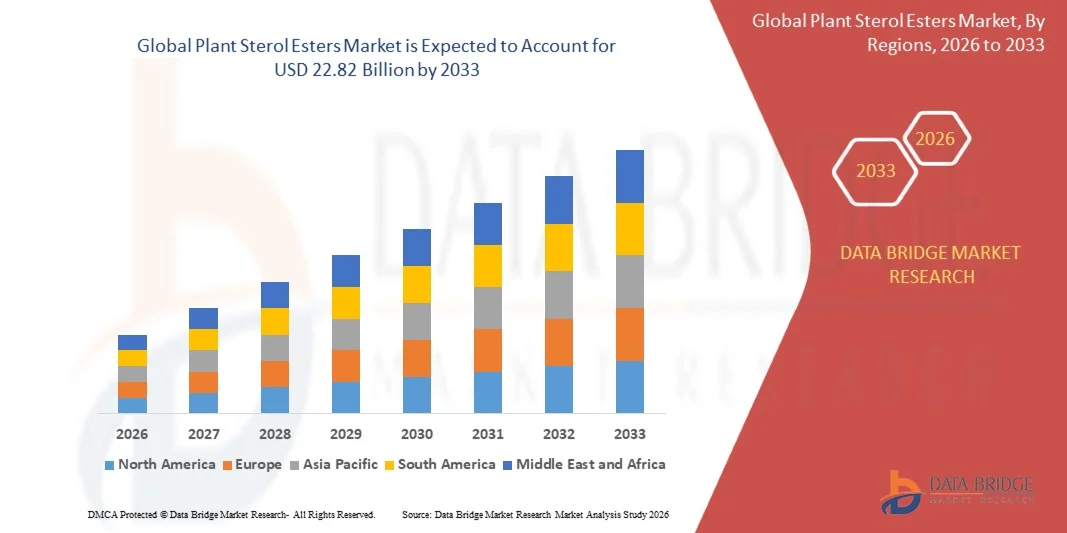
  • The global plant sterol esters market size was valued at USD 13.33 billion in 2025 and is expected to reach USD 22.82 billion by 2033, at a CAGR of 6.95% during the forecast period
  • The market growth is largely fuelled by the rising prevalence of cardiovascular diseases, increasing consumer awareness about cholesterol-lowering functional foods, and growing adoption of heart-healthy diets
  • Increasing demand for fortified foods and beverages, such as margarine, dairy products, and spreads, is driving the expansion of the plant sterol esters market

Plant Sterol Esters Market Analysis

  • Growing consumer preference for natural and plant-based ingredients is positively impacting the plant sterol esters market, encouraging manufacturers to innovate and expand product portfolios
  • Strategic collaborations between ingredient suppliers, food manufacturers, and healthcare companies are enhancing market penetration and distribution channels globally
  • North America dominated the plant sterol esters market with the largest revenue share of 38.50% in 2025, driven by growing consumer awareness of cholesterol management, increasing adoption of functional foods, and rising demand for heart-healthy products
  • Asia-Pacific region is expected to witness the highest growth rate in the global plant sterol esters market, driven by increasing adoption of functional foods, expanding middle-class population, government initiatives promoting preventive healthcare, and growing availability of affordable plant sterol ester products across retail and online channels
  • The oil segment held the largest market revenue share in 2025, driven by its ease of incorporation into functional foods, beverages, and dairy products. Oil-based plant sterol esters offer better solubility, stability, and bioavailability, making them a preferred choice for manufacturers aiming to enhance cholesterol-lowering benefits in food formulations. In addition, the growing demand for ready-to-consume functional foods and fortified cooking oils further supports the dominance of this segment. The segment also benefits from technological advancements in oil extraction and esterification processes, which improve product quality and shelf life

Plant Sterol Esters Market

Report Scope and Plant Sterol Esters Market Segmentation  

Attributes

Plant Sterol Esters Key Market Insights

Segments Covered

  • By Form: Oil and Powder
  • By Application: Food and Beverages, Dietary Supplement, Pharmaceutical, Cosmetics and Others

Countries Covered

North America

  • U.S.
  • Canada
  • Mexico

Europe

  • Germany
  • France
  • U.K.
  • Netherlands
  • Switzerland
  • Belgium
  • Russia
  • Italy
  • Spain
  • Turkey
  • Rest of Europe

Asia-Pacific

  • China
  • Japan
  • India
  • South Korea
  • Singapore
  • Malaysia
  • Australia
  • Thailand
  • Indonesia
  • Philippines
  • Rest of Asia-Pacific

Middle East and Africa

  • Saudi Arabia
  • U.A.E.
  • South Africa
  • Egypt
  • Israel
  • Rest of Middle East and Africa

South America

  • Brazil
  • Argentina
  • Rest of South America

Key Market Players

Raisio Oyj (Finland)
ADM (U.S.)
Cargill, Incorporated (U.S.)
BASF SE (Germany)
Bunge Limited (U.S.)
• FENCHEM (China)
• Arboris (France)
• Enzymotech Ltd. (Israel)
• Xi'an Healthful Biotechnology Co., Ltd. (China)
• Vitae Caps S.A. (Switzerland)
• Top Pharm Chemical Group (China)
• ConnOils LLC (U.S.)
• Blackmores (Australia)
• New Roots Herbal Inc. (Canada)
• Advanced Organic Materials SA (Switzerland)
• Ashland (U.S.)
• Pharmachem Laboratories, Inc. (U.S.)
• Oxford Vitality Ltd. (U.K.)
• Nutrartis (France)
• Lamberts Healthcare (U.K.)

Market Opportunities

• Rising Demand For Functional Foods And Beverages
• Expansion Of Plant-Based Nutraceuticals And Dietary Supplements

Value Added Data Infosets

In addition to the insights on market scenarios such as market value, growth rate, segmentation, geographical coverage, and major players, the market reports curated by the Data Bridge Market Research also include import export analysis, production capacity overview, production consumption analysis, price trend analysis, climate change scenario, supply chain analysis, value chain analysis, raw material/consumables overview, vendor selection criteria, PESTLE Analysis, Porter Analysis, and regulatory framework.

Plant Sterol Esters Market Trends

“Rising Demand for Cholesterol-Lowering Functional Foods”

• The growing focus on heart-healthy diets is significantly shaping the plant sterol esters market, as consumers increasingly prefer ingredients that can naturally reduce LDL cholesterol levels. Plant sterol esters are gaining traction due to their proven efficacy in cardiovascular health, supporting adoption across spreads, dairy products, beverages, and dietary supplements, encouraging manufacturers to innovate with functional formulations that meet evolving health-conscious consumer needs

• Increasing awareness around cardiovascular diseases, wellness, and preventive nutrition has accelerated the demand for plant sterol esters in margarines, dairy-based products, and plant-based alternatives. Health-conscious populations are actively seeking products fortified with plant sterols, prompting brands to prioritize nutritional benefits and functional labeling, while collaborations between ingredient suppliers and food manufacturers enhance efficacy and market penetration

• Health and sustainability trends are influencing purchasing decisions, with manufacturers emphasizing transparent sourcing, eco-friendly production, and scientifically backed health claims. These factors help brands differentiate products in competitive functional food markets and build consumer trust, driving the adoption of fortified spreads, beverages, and nutraceuticals

• For instance, in 2024, Danone in France and Arla Foods in Sweden expanded their portfolios by incorporating plant sterol esters in spreads and dairy alternatives. These launches were introduced in response to rising consumer preference for heart-healthy, cholesterol-lowering products, with distribution across retail, specialty, and online channels. The products were also marketed as functional and wellness-oriented, enhancing brand loyalty and repeat purchases

• While demand for plant sterol esters is growing, sustained market expansion depends on continuous R&D, cost-effective production, and maintaining functional performance comparable to conventional cholesterol-lowering agents. Manufacturers are also focusing on improving scalability, supply chain reliability, and developing innovative solutions that balance cost, quality, and nutritional benefits for broader adoption

Plant Sterol Esters Market Dynamics

Driver

“Rising Preference for Functional Foods and Heart-Healthy Ingredients”

• Growing consumer awareness of cholesterol management and cardiovascular health is a major driver for the plant sterol esters market. Manufacturers are increasingly fortifying spreads, dairy products, and beverages with plant sterols to meet health-conscious consumer demand and comply with functional food regulations

• Expanding applications in margarine, dairy, plant-based alternatives, and dietary supplements are influencing market growth. Plant sterol esters help improve nutritional profiles while maintaining product quality, enabling manufacturers to cater to consumers seeking preventive health solutions

• Food and beverage manufacturers are actively promoting plant sterol ester-based formulations through product innovation, marketing campaigns, and industry certifications. These efforts are supported by increasing consumer preference for heart-healthy and functional products and encourage partnerships between ingredient suppliers and brands to enhance product efficacy and market reach

• For instance, in 2023, Unilever in the U.K. and Fonterra in New Zealand reported increased incorporation of plant sterol esters in spreads and dairy products. This expansion followed higher consumer demand for cholesterol-lowering functional foods, driving repeat purchases and product differentiation. Both companies also highlighted clinical evidence and traceability in marketing campaigns to strengthen consumer trust and brand loyalty

• Although rising functional food trends support growth, wider adoption depends on cost optimization, ingredient availability, and scalable production processes. Investment in supply chain efficiency, sustainable sourcing, and advanced fortification technology will be critical for meeting global demand and maintaining competitive advantage

Restraint/Challenge

“High Cost And Limited Consumer Awareness Compared To Conventional Products”

• The relatively higher cost of plant sterol esters compared to standard food ingredients remains a key challenge, limiting adoption among price-sensitive manufacturers. Complex extraction and purification processes contribute to elevated pricing, while inconsistent availability of high-purity sterols affects market penetration

• Consumer and manufacturer awareness remains uneven, particularly in developing regions where functional food demand is still emerging. Limited understanding of health benefits restricts adoption across certain product categories and slows innovation uptake in emerging economies where educational initiatives on plant sterol esters are minimal

• Supply chain and distribution challenges also impact market growth, as plant sterol esters require proper storage, handling, and adherence to regulatory quality standards. Logistical complexities and shorter shelf life of fortified products increase operational costs

• For instance, in 2024, distributors in Southeast Asia supplying spreads and dairy products fortified with plant sterol esters reported slower uptake due to higher prices and limited awareness of functional advantages. Storage requirements and regulatory compliance were additional barriers, leading some retailers to limit shelf space for premium functional products

• Overcoming these challenges will require cost-efficient production, expanded distribution networks, and focused educational initiatives for manufacturers and consumers. Collaboration with retailers, foodservice operators, and certification bodies can help unlock the long-term growth potential of the global plant sterol esters market. Developing cost-competitive formulations and strengthening marketing strategies around health and wellness benefits will be essential for widespread adoption

Plant Sterol Esters Market Scope

The market is segmented on the basis of form and application

• By Form

On the basis of form, the global plant sterol esters market is segmented into oil and powder. The oil segment held the largest market revenue share in 2025, driven by its ease of incorporation into functional foods, beverages, and dairy products. Oil-based plant sterol esters offer better solubility, stability, and bioavailability, making them a preferred choice for manufacturers aiming to enhance cholesterol-lowering benefits in food formulations. In addition, the growing demand for ready-to-consume functional foods and fortified cooking oils further supports the dominance of this segment. The segment also benefits from technological advancements in oil extraction and esterification processes, which improve product quality and shelf life.

The powder segment is expected to witness the fastest growth rate from 2026 to 2033, driven by its versatility in dietary supplements and convenience for precise dosage in pharmaceutical applications. Powdered plant sterol esters are increasingly adopted for encapsulated supplements and fortified products due to their longer shelf life and ease of handling. In addition, the rising popularity of personalized nutrition and powdered formulations in health drinks and functional snacks is fueling market growth. The segment also benefits from improved processing techniques that enhance solubility and maintain the bioactive properties of sterols.

• By Application

On the basis of application, the plant sterol esters market is segmented into food and beverages, dietary supplements, pharmaceutical, cosmetics, and others. The food and beverages segment held the largest revenue share in 2025, fueled by the growing consumer preference for functional foods with heart health benefits. Products such as fortified margarine, spreads, dairy drinks, and bakery items are widely contributing to market expansion. In addition, manufacturers are increasingly promoting low-cholesterol diets, which is driving the incorporation of plant sterol esters in everyday foods. The segment is further supported by health-conscious consumers seeking natural, preventive solutions for cardiovascular wellness.

The dietary supplements segment is projected to grow at the highest CAGR from 2026 to 2033, driven by increasing awareness of cholesterol management and preventive healthcare. Supplements containing plant sterol esters are gaining popularity for their convenience, standardized dosage, and scientifically backed efficacy, especially among health-conscious adults. Rising adoption of nutraceutical products and functional capsules further contributes to segment growth. In addition, the growing focus on aging populations and lifestyle-related health issues is driving demand for plant sterol ester supplements globally. The segment also benefits from digital marketing and online distribution channels expanding its reach to health-conscious consumers.

Plant Sterol Esters Market Regional Analysis

• North America dominated the plant sterol esters market with the largest revenue share of 38.50% in 2025, driven by growing consumer awareness of cholesterol management, increasing adoption of functional foods, and rising demand for heart-healthy products

• Consumers in the region highly value the scientifically backed health benefits, convenience, and incorporation of plant sterol esters in everyday foods and beverages

• This widespread adoption is further supported by high disposable incomes, a health-conscious population, and the growing preference for preventive healthcare solutions, establishing plant sterol esters as a favored ingredient in both food and supplement industries

U.S. Plant Sterol Esters Market Insight

The U.S. plant sterol esters market captured the largest revenue share in 2025 within North America, fueled by the rapid uptake of functional foods and dietary supplements targeting cholesterol reduction. Consumers are increasingly prioritizing products that support cardiovascular health through natural and preventive ingredients. The growing preference for fortified dairy, spreads, and beverages, combined with strong awareness campaigns about heart health, further propels the plant sterol esters industry. Moreover, the presence of well-established nutraceutical companies and e-commerce channels significantly contributes to market expansion.

Europe Plant Sterol Esters Market Insight

The Europe plant sterol esters market is expected to witness the fastest growth rate from 2026 to 2033, primarily driven by increasing health consciousness, aging population, and stringent dietary guidelines promoting functional foods. The rising adoption of fortified foods, dietary supplements, and plant-based products is fostering market growth. Consumers are also drawn to the natural, plant-derived nature of sterol esters and their proven health benefits. The region is experiencing significant expansion across food, beverage, and supplement applications, with manufacturers innovating in formulations to meet diverse consumer needs.

U.K. Plant Sterol Esters Market Insight

The U.K. plant sterol esters market is expected to witness the fastest growth rate from 2026 to 2033, driven by increasing demand for cholesterol-lowering and heart-health products. The rising trend of health-conscious consumption, along with government initiatives promoting preventive healthcare, is encouraging both manufacturers and consumers to adopt plant sterol esters. The U.K.’s strong retail and e-commerce infrastructure supports product accessibility, while growing awareness about functional foods and natural ingredients continues to stimulate market growth.

Germany Plant Sterol Esters Market Insight

The Germany plant sterol esters market is expected to witness the fastest growth rate from 2026 to 2033, fueled by increasing awareness of cardiovascular health and preventive nutrition. Germany’s focus on natural, plant-based, and eco-conscious products promotes the adoption of plant sterol esters in functional foods and dietary supplements. The integration of plant sterol esters into everyday products, including spreads, dairy, and bakery items, is becoming increasingly prevalent, with strong consumer preference for scientifically validated health benefits and sustainable formulations.

Asia-Pacific Plant Sterol Esters Market Insight

The Asia-Pacific plant sterol esters market is expected to witness the fastest growth rate from 2026 to 2033, driven by rising health awareness, urbanization, and increasing disposable incomes in countries such as China, Japan, and India. The region's growing inclination towards functional foods and preventive healthcare solutions is boosting demand for plant sterol esters. In addition, expanding retail channels, government support for nutrition-focused initiatives, and increasing availability of fortified foods and supplements are facilitating market penetration across the region.

Japan Plant Sterol Esters Market Insight

The Japan plant sterol esters market is expected to witness the fastest growth rate from 2026 to 2033 due to the country’s health-conscious population, aging demographics, and increasing demand for preventive nutrition. Consumers are actively seeking functional foods, fortified beverages, and dietary supplements that provide cardiovascular benefits. The integration of plant sterol esters into conventional and ready-to-eat products, combined with a strong culture of nutraceutical adoption, is fueling market growth across residential and retail segments.

China Plant Sterol Esters Market Insight

The China plant sterol esters market accounted for the largest market revenue share in Asia-Pacific in 2025, attributed to the country’s expanding middle class, increasing prevalence of lifestyle diseases, and growing awareness of functional foods. China stands as one of the largest markets for cholesterol-lowering products, with plant sterol esters being incorporated into dairy, spreads, and dietary supplements. Government initiatives promoting healthy diets, coupled with the availability of affordable products and strong domestic manufacturing, are key factors driving the market in China.

Plant Sterol Esters Market Share

The Plant Sterol Esters industry is primarily led by well-established companies, including:

• Raisio Oyj (Finland)
• ADM (U.S.)
• Cargill, Incorporated (U.S.)
• BASF SE (Germany)
• Bunge Limited (U.S.)
• FENCHEM (China)
• Arboris (France)
• Enzymotech Ltd. (Israel)
• Xi'an Healthful Biotechnology Co., Ltd. (China)
• Vitae Caps S.A. (Switzerland)
• Top Pharm Chemical Group (China)
• ConnOils LLC (U.S.)
• Blackmores (Australia)
• New Roots Herbal Inc. (Canada)
• Advanced Organic Materials SA (Switzerland)
• Ashland (U.S.)
• Pharmachem Laboratories, Inc. (U.S.)
• Oxford Vitality Ltd. (U.K.)
• Nutrartis (France)
• Lamberts Healthcare (U.K.)


SKU-

世界初のマーケットインテリジェンスクラウドに関するレポートにオンラインでアクセスする

  • インタラクティブなデータ分析ダッシュボード
  • 成長の可能性が高い機会のための企業分析ダッシュボード
  • カスタマイズとクエリのためのリサーチアナリストアクセス
  • インタラクティブなダッシュボードによる競合分析
  • 最新ニュース、更新情報、トレンド分析
  • 包括的な競合追跡のためのベンチマーク分析のパワーを活用
デモのリクエスト

調査方法

データ収集と基準年分析は、大規模なサンプル サイズのデータ​​収集モジュールを使用して行われます。この段階では、さまざまなソースと戦略を通じて市場情報または関連データを取得します。過去に取得したすべてのデータを事前に調査および計画することも含まれます。また、さまざまな情報ソース間で見られる情報の不一致の調査も含まれます。市場データは、市場統計モデルと一貫性モデルを使用して分析および推定されます。また、市場シェア分析と主要トレンド分析は、市場レポートの主要な成功要因です。詳細については、アナリストへの電話をリクエストするか、お問い合わせをドロップダウンしてください。

DBMR 調査チームが使用する主要な調査方法は、データ マイニング、データ変数が市場に与える影響の分析、および一次 (業界の専門家) 検証を含むデータ三角測量です。データ モデルには、ベンダー ポジショニング グリッド、市場タイムライン分析、市場概要とガイド、企業ポジショニング グリッド、特許分析、価格分析、企業市場シェア分析、測定基準、グローバルと地域、ベンダー シェア分析が含まれます。調査方法について詳しくは、お問い合わせフォームから当社の業界専門家にご相談ください。

カスタマイズ可能

Data Bridge Market Research は、高度な形成的調査のリーダーです。当社は、既存および新規のお客様に、お客様の目標に合致し、それに適したデータと分析を提供することに誇りを持っています。レポートは、対象ブランドの価格動向分析、追加国の市場理解 (国のリストをお問い合わせください)、臨床試験結果データ、文献レビュー、リファービッシュ市場および製品ベース分析を含めるようにカスタマイズできます。対象競合他社の市場分析は、技術ベースの分析から市場ポートフォリオ戦略まで分析できます。必要な競合他社のデータを、必要な形式とデータ スタイルでいくつでも追加できます。当社のアナリスト チームは、粗い生の Excel ファイル ピボット テーブル (ファクト ブック) でデータを提供したり、レポートで利用可能なデータ セットからプレゼンテーションを作成するお手伝いをしたりすることもできます。


業界関連レポート

お客様の声