Global Turner Syndrome Drug Market Segmentation, By Type (Classical Turner Syndrome and Mosaic Turner syndrome), Drugs Type (Norditropin, Oxandrolone, Humatrope, Somatropin, Oxandrin, Genotropin, Nutropin and Zomacton), Therapy Type (Growth Hormone Therapy, Estrogen and Progesterone Replacement Therapy), Routes of Administration (Oral, Intravenous, Sub-cutaneous, Intramuscular and Others), End Users (Hospitals, Homecare, Specialty Clinics, Surgical Centres and Others) - Industry Trends and Forecast to 2032
Turner Syndrome Drug Market Size
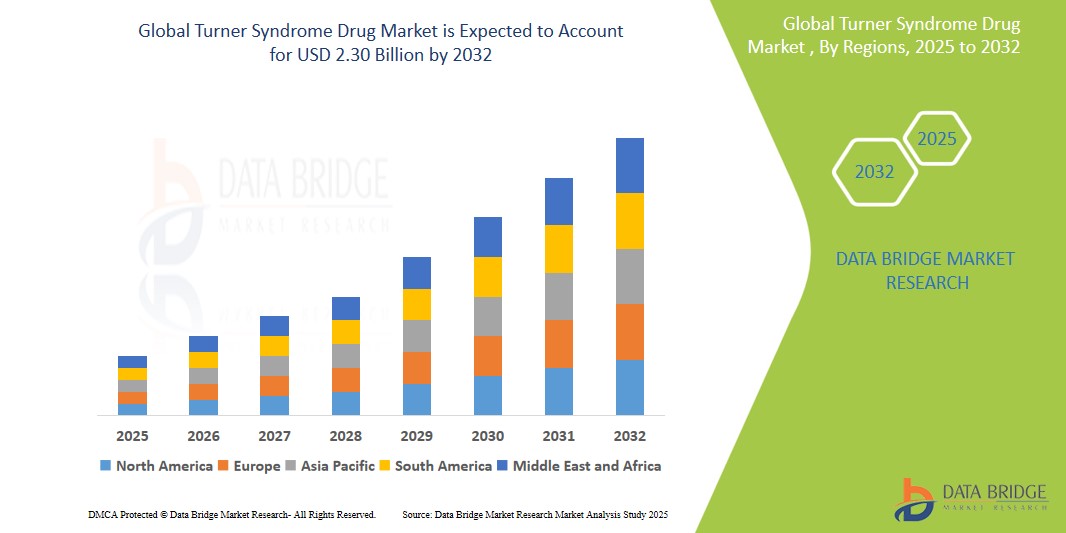
- The Global Turner Syndrome Drug Market size was valued atUSD 1.23 billion in 2024 and is expected to reachUSD 2.30 billion by 2032, at aCAGR of 8.4%during the forecast period
- This growth is primarily driven by increased diagnosis rates, advancements in hormone replacement therapies, and rising awareness about early intervention and treatment options for Turner Syndrome
Turner Syndrome Drug Market Analysis
- Turner Syndrome drugs play a crucial role in managing the clinical manifestations of this genetic condition, particularly in promoting growth development, puberty induction, and addressing cardiovascular and metabolic complications.
- The demand for Turner Syndrome therapies is driven by greater clinical recognition, availability of recombinant growth hormones, and government initiatives to improve rare disease management.
- North America is projected to lead the global Turner Syndrome drug market owing to robust healthcare systems, greater awareness, and early diagnosis and intervention programs.
- The Asia-Pacific region is expected to witness the fastest growth due to improving healthcare infrastructure, growing medical awareness, and increasing access to hormonal therapies.
- The growth hormone therapy segment is anticipated to dominate the market with a significant share, owing to its essential role in supporting normal growth and development in affected individuals. Innovations in drug delivery systems and biosimilars are also contributing to market expansion.
Report Scope and Turner Syndrome Drug Market Segmentation
|
Attributes |
Turner Syndrome Drug Key Market Insights |
|
Segments Covered |
|
|
Countries Covered |
North America
Europe
Asia-Pacific
Middle East and Africa
South America
|
|
Key Market Players |
|
|
Market Opportunities |
|
|
Value Added Data Infosets |
In addition to the insights on market scenarios such as market value, growth rate, segmentation, geographical coverage, and major players, the market reports curated by the Data Bridge Market Research also include import export analysis, production capacity overview, production consumption analysis, price trend analysis, climate change scenario, supply chain analysis, value chain analysis, raw material/consumables overview, vendor selection criteria, PESTLE Analysis, Porter Analysis, and regulatory framework. |
Turner Syndrome Drug Market Trends
“Emergence of Long-acting Growth Hormone Therapies”
- One significant trend shaping the Turner Syndrome drug market is the development and commercialization of long-acting growth hormone (GH) therapies.
- These advanced formulations offer less frequent dosing schedules compared to traditional daily injections, significantly improving patient compliance and quality of life for individuals with Turner Syndrome.
- For instance, recent innovations in GH therapy, such as weekly or bi-weekly injections, are reducing the treatment burden on pediatric and adolescent patients, while maintaining efficacy in promoting growth and development.
- These Long-acting therapies are expected to redefine the standard of care for Turner Syndrome management, enhancing treatment adherence and overall patient outcomes.
Turner Syndrome Drug Market Dynamics
Driver
“Increasing Early Diagnosis and Awareness Initiatives”
- The growing emphasis on early diagnosis and intervention programs for genetic disorders, including Turner Syndrome, is significantly driving the demand for targeted drug therapies.
- With the implementation of newborn screening programs, pediatric checkups, and genetic counseling initiatives, more cases of Turner Syndrome are being diagnosed early, facilitating timely initiation of growth hormone and estrogen therapies
For instance,
- In October 2023, according to an article published by the Global Genes Project, expanded newborn screening and rare disease advocacy efforts have led to earlier identification of rare genetic conditions, including Turner Syndrome, thereby improving access to treatment options and clinical care pathways.
- Earlier detection enables better growth outcomes, pubertal development, and overall health management, fueling the demand for effective Turner Syndrome drug therapies
Opportunity
“Advances in Gene Therapy and Personalized Medicine”
- The rise of gene therapy and personalized medicine is creating new opportunities for the treatment of Turner Syndrome, aiming to address underlying genetic defects and tailor therapies to individual patient profiles.
- Researchers are exploring gene-editing technologies like CRISPR/Cas9 to potentially correct chromosomal abnormalities associated with Turner Syndrome, although such treatments are still in early research phases.
- Additionally, personalized hormonal therapies based on individual growth patterns, hormone levels, and metabolic profiles are expected to deliver better treatment outcomes.
For instance,
- In February 2025, according to research published in the journal Nature Genetics, preliminary studies on personalized endocrine therapies demonstrated promising results in optimizing growth response and minimizing side effects in Turner Syndrome patients, paving the way for more targeted and individualized approaches.
- As precision medicine technologies mature, they have the potential to revolutionize Turner Syndrome care beyond current hormone-based therapies.
Restraint/Challenge
“High Treatment Costs and Limited Accessibility”
- The high cost of growth hormone therapies and hormone replacement treatments remains a significant barrier to the widespread adoption of Turner Syndrome therapies, especially in low- and middle-income countries.
- Treatment often requires years of continuous therapy, incurring substantial costs for families and healthcare systems, particularly when not fully covered by insurance or public health programs.
For instance,
- In November 2024, according to an article published by Rare Disease Health Journal, the annual cost of growth hormone treatment can range from USD 20,000 to USD 50,000 per patient, creating financial strain and limiting access, especially among underinsured populations.
- These financial challenges can lead to treatment interruptions, delayed initiation, or complete lack of access, ultimately impacting the growth potential and health outcomes for individuals with Turner Syndrome.
- Therefore, high therapy costs represent a critical restraint to market growth and highlight the need for more affordable treatment options and broader healthcare coverage.
Turner Syndrome Drug Market Scope
The market is segmented on the basis type, drug type, therapy type, route of administration, and end user.
|
Segmentation |
Sub-Segmentation |
|
By Type |
|
|
By Drugs Type |
|
|
By Therapy Type |
|
|
By Routes of Administration |
|
|
By End Users |
|
In 2025, the Growth Hormone Therapy Segment is Projected to Dominate the Market in the Therapy Type Segment
The growth hormone therapy segment is expected to dominate the Turner Syndrome drug market with the largest share of 61.45% in 2025, owing to its critical role in promoting normal height development in affected individuals. This therapy remains the first-line treatment for most diagnosed cases, often initiated in early childhood to maximize height potential. Advancements in long-acting growth hormone formulations, improved patient adherence, and clinical efficacy are key factors driving this segment's growth. Additionally, increasing awareness and early diagnosis of Turner Syndrome contribute to a growing patient base benefiting from GH therapy, reinforcing its market dominance
The Norditropin Segment is Expected to Account for the Largest Share in the Drug Type Segment
The Norditropin segment is projected to hold the largest market share of 47.68% in 2025 within the drug type category. As a widely prescribed recombinant growth hormone, Norditropin is preferred for its proven efficacy, convenient administration options, and broad availability across major markets.
Its dominance is further supported by strong physician trust, brand recognition, and a well-established safety profile. The increasing demand for personalized and effective hormonal therapies for Turner Syndrome continues to drive Norditropin’s leading position in the market.
Turner Syndrome Drug Market Regional Analysis
“North America Holds the Largest Share in the Turner Syndrome Drug Market”
- North America leads the global Turner Syndrome drug market, primarily due to its advanced healthcare infrastructure, high awareness levels, and early adoption of hormone replacement therapies.
- The United States dominates the regional market owing to comprehensive screening programs, strong presence of biopharmaceutical companies, and broad insurance coverage for rare disease treatments.
- The region benefits from robust research and development initiatives, particularly in growth hormone therapies and personalized medicine, further propelling market expansion.
- Additionally, the presence of specialized endocrinology clinics and multidisciplinary care models ensures timely diagnosis and optimal treatment outcomes for Turner Syndrome patients.
- Government support for rare disease management and the availability of FDA-approved treatment protocols continue to drive the region’s leadership in the market
“Asia-Pacific is Projected to Register the Highest CAGR in the Turner Syndrome Drug Market”
- The Asia-Pacific region is anticipated to witness the fastest growth in the Turner Syndrome drug market, driven by increasing awareness, improving diagnostic capabilities, and growing access to hormonal therapies.
- Countries like India, China, and Japan are emerging as key contributors due to rising pediatric healthcare investments, growing genetic testing availability, and expanding rare disease initiatives.
- Japan, with its advanced medical technology and specialized endocrine care systems, is at the forefront of adopting long-acting growth hormone therapies and personalized treatment approaches.
- In China and India, the large patient population and increasing collaboration between public health authorities and global pharmaceutical companies are fueling market demand.
- Ongoing efforts to improve healthcare accessibility, along with the expansion of insurance coverage and government-supported awareness programs, are expected to significantly boost the regional market over the forecast period.
Turner Syndrome Drug Market Share
The market competitive landscape provides details by competitor. Details included are company overview, company financials, revenue generated, market potential, investment in research and development, new market initiatives, global presence, production sites and facilities, production capacities, company strengths and weaknesses, product launch, product width and breadth, application dominance. The above data points provided are only related to the companies' focus related to market.
The Major Market Leaders Operating in the Market Are:
- Pfizer Inc. (U.S.)
- Novartis AG (Switzerland)
- Johnson & Johnson Services, Inc. (U.S.)
- F. Hoffmann-La Roche Ltd (Switzerland)
- Abbott (U.S.)
- Eli Lilly and Company (U.S.)
- Bausch Health Companies Inc. (Canada)
- AstraZeneca (United Kingdom)
- AbbVie Inc. (U.S.)
- Allergan (U.S.)
- Smiths Group plc (UK)
- Lupin Pharmaceuticals, Inc. (India)
- Medtronic (Ireland)
- Sanofi (France)
- GlaxoSmithKline plc. (UK)
- Sandoz International GmbH (Germany)
- Novo Nordisk A/S (Denmark)
- American Gene Technologies (U.S.)
- Codexis (U.S.)
- BioMarin (U.S.)
- Ultragenyx Pharmaceutical (U.S.)
Latest Developments in Global Turner Syndrome Drug Market
- In January 2023, Ascendis Pharma announced positive results from a Phase III trial of its long-acting growth hormone therapy, showing significant improvements in growth rates in Turner Syndrome patients, paving the way for regulatory submissions.
- In June 2022, Novo Nordisk launched a new formulation of growth hormone therapy with enhanced delivery mechanisms, aiming to improve patient compliance and reduce treatment burden.
SKU-
世界初のマーケットインテリジェンスクラウドに関するレポートにオンラインでアクセスする
- インタラクティブなデータ分析ダッシュボード
- 成長の可能性が高い機会のための企業分析ダッシュボード
- カスタマイズとクエリのためのリサーチアナリストアクセス
- インタラクティブなダッシュボードによる競合分析
- 最新ニュース、更新情報、トレンド分析
- 包括的な競合追跡のためのベンチマーク分析のパワーを活用
調査方法
データ収集と基準年分析は、大規模なサンプル サイズのデータ収集モジュールを使用して行われます。この段階では、さまざまなソースと戦略を通じて市場情報または関連データを取得します。過去に取得したすべてのデータを事前に調査および計画することも含まれます。また、さまざまな情報ソース間で見られる情報の不一致の調査も含まれます。市場データは、市場統計モデルと一貫性モデルを使用して分析および推定されます。また、市場シェア分析と主要トレンド分析は、市場レポートの主要な成功要因です。詳細については、アナリストへの電話をリクエストするか、お問い合わせをドロップダウンしてください。
DBMR 調査チームが使用する主要な調査方法は、データ マイニング、データ変数が市場に与える影響の分析、および一次 (業界の専門家) 検証を含むデータ三角測量です。データ モデルには、ベンダー ポジショニング グリッド、市場タイムライン分析、市場概要とガイド、企業ポジショニング グリッド、特許分析、価格分析、企業市場シェア分析、測定基準、グローバルと地域、ベンダー シェア分析が含まれます。調査方法について詳しくは、お問い合わせフォームから当社の業界専門家にご相談ください。
カスタマイズ可能
Data Bridge Market Research は、高度な形成的調査のリーダーです。当社は、既存および新規のお客様に、お客様の目標に合致し、それに適したデータと分析を提供することに誇りを持っています。レポートは、対象ブランドの価格動向分析、追加国の市場理解 (国のリストをお問い合わせください)、臨床試験結果データ、文献レビュー、リファービッシュ市場および製品ベース分析を含めるようにカスタマイズできます。対象競合他社の市場分析は、技術ベースの分析から市場ポートフォリオ戦略まで分析できます。必要な競合他社のデータを、必要な形式とデータ スタイルでいくつでも追加できます。当社のアナリスト チームは、粗い生の Excel ファイル ピボット テーブル (ファクト ブック) でデータを提供したり、レポートで利用可能なデータ セットからプレゼンテーションを作成するお手伝いをしたりすることもできます。