



North America Breast Lesion Localization Methods Market Segmentation, By Type (Wire Localization, Radioisotope Localization, Electromagnetic Localization, Magnetic Localization, and Others), Usage (Tumor Identification and Sentinel Lymph Node Identification), Technique (Fine-Needle Aspiration Biopsy, Core Needle Biopsy, Image Guided Biopsy, and Surgical Biopsy), End User (Hospitals, Oncology Clinics, Diagnostic Centers, and Ambulatory Surgical Centers) - Industry Trends and Forecast to 2033
North America Breast Lesion Localization Methods Market Size
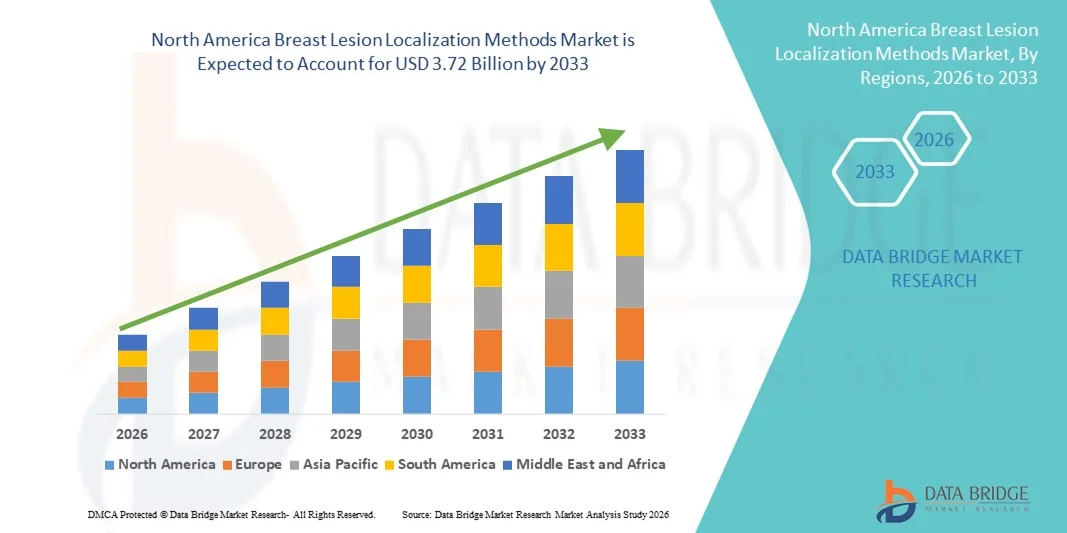
- The North America Breast Lesion Localization Methods market size was valued at USD 1.37 billion in 2025 and is expected to reach USD 3.72 billion by 2033, at a CAGR of 13.30% during the forecast period
- The market growth is largely fueled by the increasing prevalence of breast cancer worldwide, rising awareness about early detection, and the growing demand for minimally invasive diagnostic and surgical procedures, leading to enhanced precision in lesion localization and improved patient outcomes
- Furthermore, advancements in imaging technologies, such as ultrasound, mammography, MRI, and radioactive seed localization, along with the integration of digital guidance systems, are establishing Breast Lesion Localization Methods solutions as essential tools in modern breast cancer management. These converging factors are accelerating the uptake of breast lesion localization techniques, thereby significantly boosting the industry’s growth
North America Breast Lesion Localization Methods Market Analysis
- Breast Lesion Localization Methods, offering precise identification and guidance for suspicious breast lesions prior to biopsy or surgery, are increasingly vital components of modern breast cancer diagnosis and treatment workflows in both hospitals and specialized breast centers due to their enhanced accuracy, minimally invasive nature, and integration with imaging and surgical guidance systems
- The escalating demand for Breast Lesion Localization Methods is primarily fueled by the increasing prevalence of breast cancer, growing awareness regarding early detection, and a rising preference for minimally invasive procedures that improve surgical outcomes and patient comfort
- U.S. dominated the breast lesion localization methods market with the largest revenue share of approximately 42.5% in 2025, supported by advanced healthcare infrastructure, high awareness of breast cancer screening, strong adoption of minimally invasive localization technologies, and the presence of key industry players. The U.S. accounts for a major share due to extensive breast cancer diagnostic programs, high adoption of imaging-guided localization methods, and technological innovations in surgical guidance systems
- Canada is expected to be the fastest-growing region in the breast lesion localization methods market during the forecast period due to improving healthcare infrastructure, rising awareness regarding breast cancer early detection, increasing adoption of advanced localization techniques, and expanding access to specialized diagnostic and surgical centers
- The tumor identification segment held the largest market revenue share of around 52.3% in 2025, driven by the high incidence of breast cancer worldwide and the necessity for precise preoperative localization of non-palpable lesions
Report Scope and Breast Lesion Localization Methods Market Segmentation
|
Attributes |
Breast Lesion Localization Methods Key Market Insights |
|
Segments Covered |
|
|
Countries Covered |
North America
|
|
Key Market Players |
|
|
Market Opportunities |
|
|
Value Added Data Infosets |
In addition to the insights on market scenarios such as market value, growth rate, segmentation, geographical coverage, and major players, the market reports curated by the Data Bridge Market Research also include in-depth expert analysis, patient epidemiology, pipeline analysis, pricing analysis, and regulatory framework. |
North America Breast Lesion Localization Methods Market Trends
Adoption of Minimally Invasive and Image-Guided Techniques
- A major trend in the global breast lesion localization methods market is the shift toward minimally invasive procedures that reduce patient discomfort and recovery time, while maintaining high diagnostic and surgical accuracy
- For instance, the adoption of radioactive seed localization (RSL) in the U.S. has grown significantly in 2025, as it allows precise localization of non-palpable breast lesions prior to surgery, improving surgical outcomes and patient satisfaction
- The increasing integration of image-guided localization techniques such as ultrasound, mammography, and MRI is enhancing the accuracy of tumor identification, leading to more conservative surgeries and reduced removal of healthy tissue
- Emerging technologies, including magnetic and radar-based localization systems, are gaining traction as alternatives to traditional wire-guided localization, offering improved workflow efficiency in operating rooms and better patient comfort
- Growing awareness among surgeons and patients regarding the benefits of advanced localization methods is driving widespread adoption, particularly in developed regions with advanced healthcare infrastructure
North America Breast Lesion Localization Methods Market Dynamics
Driver
Rising Incidence of Breast Cancer and Focus on Early Detection
- The increasing global prevalence of breast cancer is a key driver for the demand for advanced breast lesion localization methods. Early detection and precise localization are critical for improving survival rates and treatment outcomes
- For instance, in 2025, the National Cancer Institute reported that over 300,000 new breast cancer cases were diagnosed in the U.S., fueling adoption of localization methods such as wire-guided, radioactive seed, and magnetic marker systems in hospitals and outpatient centers
- Technological advancements in imaging modalities such as high-resolution ultrasound and digital mammography have made lesion localization more accurate and less invasive, encouraging hospitals to adopt these methods routinely
- The rise of breast cancer screening programs in countries like Germany, Canada, and Japan is creating a higher demand for precise localization techniques, ensuring that detected lesions can be accurately targeted for biopsy or surgical removal
- Clinicians increasingly prefer methods that reduce operating time and patient anxiety, such as non-wire localization techniques, further driving the market
- The expansion of outpatient surgical centers and ambulatory clinics, combined with the adoption of standardized protocols for lesion localization, supports market growth across both developed and emerging regions
Restraint/Challenge
High Costs, Infrastructure Requirements, and Limited Skilled Personnel
- The high cost of advanced localization systems, particularly magnetic, radar, and radioactive seed methods, is a significant barrier for smaller hospitals and clinics, especially in developing regions
- For instance, many regional hospitals in India continue to rely on traditional wire-guided localization due to the high price and maintenance requirements of radioactive seed or magnetic marker systems
- Lack of trained specialists and technicians in advanced localization techniques can slow adoption, as precise placement and interpretation of localization devices require skilled radiologists and surgeons
- Infrastructure limitations such as inadequate imaging equipment, regulatory hurdles for radioactive materials, and limited surgical support can hinder deployment in smaller hospitals and diagnostic centers
- Reimbursement and insurance coverage issues in some regions restrict patient access to high-end localization procedures, limiting market penetration
- Clinical adoption resistance among practitioners accustomed to conventional wire-guided methods may delay the transition to newer techniques, despite the clear benefits in patient comfort and surgical outcomes
- Operational challenges, such as longer setup times for certain localization methods, coordination between radiology and surgery departments, and the need for precise scheduling, can also restrict widespread implementation
North America Breast Lesion Localization Methods Market Scope
The Breast Lesion Localization Methods market is segmented on the basis of type, usage, technique, and end user.
- By Type
On the basis of type, the Breast Lesion Localization Methods market is segmented into wire localization, radioisotope localization, electromagnetic localization, magnetic localization, and others. The wire localization segment dominated the largest market revenue share of approximately 38.5% in 2025, driven by its long-standing adoption and reliability in clinical practice. Wire localization is widely used for accurately identifying non-palpable breast lesions before surgical excision. Surgeons and radiologists prefer this method due to its precision in marking tumor margins, which helps minimize healthy tissue removal. The growing prevalence of breast cancer and the rising number of early-stage detections are significantly driving demand for wire localization. Additionally, improvements in preoperative imaging techniques, such as ultrasound and mammography guidance, enhance the accuracy and safety of wire localization procedures. Hospitals and diagnostic centers continue to rely on wire localization due to its cost-effectiveness and clinical familiarity. The segment benefits from recurring procedural usage, ensuring a steady revenue stream for manufacturers. Technological advancements, including thinner and more flexible wires, further improve patient comfort and procedural efficiency. Regulatory approvals and guideline recommendations for wire localization in standard breast cancer management protocols also support its market dominance. The segment is widely applied in both routine tumor identification and sentinel lymph node mapping.
The magnetic localization segment is expected to witness the fastest CAGR of 9.1% from 2026 to 2033, driven by the increasing adoption of radiation-free, minimally invasive procedures. Magnetic localization uses non-radioactive magnetic seeds to identify tumor sites, providing a safer and patient-friendly alternative to wire and radioisotope methods. Hospitals and oncology clinics are increasingly integrating magnetic localization to improve workflow efficiency and reduce procedure time. The method is particularly popular in outpatient and ambulatory surgical centers due to its simplicity and portability. Rising patient preference for less invasive localization techniques also fuels growth. Technological improvements in magnetic seed design and compatibility with imaging guidance systems are further enhancing accuracy. Awareness campaigns promoting safer breast cancer surgeries are encouraging adoption. The magnetic localization method is increasingly used for both tumor and sentinel lymph node identification. As healthcare providers focus on patient safety and procedural efficiency, this segment is expected to grow rapidly over the forecast period.
- By Usage
On the basis of usage, the Breast Lesion Localization Methods market is segmented into tumor identification and sentinel lymph node identification. The tumor identification segment held the largest market revenue share of around 52.3% in 2025, driven by the high incidence of breast cancer worldwide and the necessity for precise preoperative localization of non-palpable lesions. Accurate tumor identification ensures complete excision while preserving healthy tissue, which is critical for patient outcomes and cosmetic results. Hospitals, oncology clinics, and diagnostic centers frequently perform tumor localization procedures prior to lumpectomy and partial mastectomy. Technological advancements in imaging guidance, including stereotactic and ultrasound-assisted methods, have improved localization accuracy and procedural efficiency. The segment benefits from repeated use in screening programs and routine surgical workflows. Growing awareness of early breast cancer detection and proactive treatment strategies continues to boost demand for tumor identification procedures. Adoption of minimally invasive localization methods such as electromagnetic and magnetic techniques further supports market growth. Regulatory and clinical guidelines emphasizing precise tumor localization reinforce the segment’s dominance in the market.
The sentinel lymph node identification segment is expected to witness the fastest CAGR of 8.7% from 2026 to 2033, driven by the growing adoption of lymphatic mapping in breast cancer management. Sentinel lymph node procedures help determine metastasis spread and guide surgical decisions, reducing the need for extensive axillary lymph node dissection. Techniques such as radioisotope, magnetic, and dye-based localization are increasingly used to enhance accuracy and patient outcomes. Rising breast cancer awareness and the emphasis on minimally invasive surgeries encourage adoption. The segment also benefits from technological integration with imaging-guided localization systems. Increasing numbers of oncology clinics and ambulatory surgical centers adopting advanced sentinel lymph node mapping procedures further support growth. As precision medicine and individualized treatment strategies expand, this segment is expected to grow rapidly during the forecast period.
- By Technique
On the basis of technique, the Breast Lesion Localization Methods market is segmented into fine-needle aspiration biopsy, core needle biopsy, image-guided biopsy, and surgical biopsy. The core needle biopsy segment dominated the market with a revenue share of approximately 44.7% in 2025, owing to its balance of diagnostic accuracy and minimally invasive nature. Core needle biopsy is widely used for sampling breast tissue to confirm malignancy while reducing patient trauma compared to surgical biopsy. Hospitals and diagnostic centers prefer this method due to its reproducibility and compatibility with imaging guidance systems. The segment benefits from the increasing number of breast cancer screenings and early-stage lesion detection programs. Technological improvements, including automated biopsy guns and real-time imaging assistance, enhance procedural safety and accuracy. Core needle biopsy is applicable for both tumor identification and sentinel lymph node assessment. Increasing awareness regarding early and precise breast cancer diagnosis drives adoption. Regulatory recommendations favor minimally invasive tissue sampling, which supports segment growth. Additionally, the availability of high-quality biopsy devices and procedural training in oncology centers ensures continued demand.
The image-guided biopsy segment is expected to witness the fastest CAGR of 9.4% from 2026 to 2033, driven by rising adoption of advanced imaging technologies such as ultrasound, mammography, and MRI for lesion localization. Image guidance improves the accuracy of needle placement, reduces sampling errors, and enhances patient outcomes. Hospitals, oncology clinics, and specialized diagnostic centers are increasingly integrating image-guided procedures in routine breast lesion assessments. Technological advancements and training programs supporting image-guided biopsies further accelerate adoption. Patient preference for precise, minimally invasive procedures also contributes to segment growth.
- By End User
On the basis of end user, the Breast Lesion Localization Methods market is segmented into hospitals, oncology clinics, diagnostic centers, and ambulatory surgical centers. The hospitals segment dominated the market with the largest revenue share of approximately 49.1% in 2025, due to the availability of advanced diagnostic and surgical infrastructure required for localization procedures. Hospitals frequently handle complex and high-volume breast cancer cases, necessitating precise preoperative localization. Hospitals also benefit from integrated imaging and surgical teams, which improve workflow efficiency and patient outcomes. Rising breast cancer incidence and screening programs further contribute to segment growth. Regulatory support and clinical guidelines for early detection reinforce the use of hospital-based localization procedures.
The oncology clinics segment is expected to witness the fastest CAGR of 8.9% from 2026 to 2033, driven by increasing specialization in breast cancer diagnosis and treatment. Clinics are adopting minimally invasive localization methods and advanced biopsy techniques to improve precision and patient comfort. The growing focus on outpatient and day-care procedures supports rapid adoption. Expansion of specialized oncology centers, patient preference for focused care, and rising awareness of early detection contribute to segment growth.
North America Breast Lesion Localization Methods Market Regional Analysis
- North America dominated the breast lesion localization methods market with the largest revenue share in 2025, driven by advanced healthcare infrastructure, high awareness of breast cancer screening, strong adoption of minimally invasive localization technologies, and the presence of leading medical device manufacturers
- Technological innovations in surgical guidance systems—including wireless and non-wire localization methods—are enhancing procedural accuracy and efficiency, making advanced localization techniques more accessible across hospitals and specialized clinics
- The growing emphasis on minimally invasive procedures, improved clinical outcomes, and patient comfort is accelerating the uptake of advanced localization methods in both private and public healthcare facilities
U.S. Breast Lesion Localization Methods Market Insight
The U.S. breast lesion localization methods market captured the largest revenue share of approximately 42.5% in 2025, supported by extensive breast cancer screening programs, adoption of imaging-guided localization techniques, and continuous innovations in surgical guidance technologies. High awareness of early detection and minimally invasive procedures is driving rapid adoption across hospitals, outpatient surgical centers, and diagnostic facilities.
Canada Breast Lesion Localization Methods Market Insight
Canada breast lesion localization methods market is expected to be the fastest-growing region in the breast lesion localization methods market during the forecast period due to improving healthcare infrastructure, rising awareness regarding early breast cancer detection, increasing adoption of advanced localization techniques, and expanding access to specialized diagnostic and surgical centers. Initiatives to strengthen breast cancer screening programs and training of healthcare professionals further support the market’s growth trajectory.
North America Breast Lesion Localization Methods Market Share
The Breast Lesion Localization Methods industry is primarily led by well-established companies, including:
- Hologic, Inc. (U.S.)
- BD (U.S.)
- Teleflex Incorporated (U.S.)
- Devicor Medical Products, Inc. (U.S.)
- Cianna Medical, Inc. (U.S.)
- Cook Medical (U.S.)
- Mammotome, Inc. (U.S.)
- Argon Medical Devices, Inc. (U.S.)
- Hologic Europe (Sweden)
- Devicor Medical Products Europe (Austria)
- Cianna Medical Europe (Germany)
- Teleflex Europe (Ireland)
- Cook Medical Europe (Denmark)
- Mammotome Europe (Austria)
- Hologic Asia Pacific (Japan)
- Cianna Medical Asia Pacific (China)
- Teleflex Asia Pacific (China)
- Cook Medical Asia Pacific (China)
- Mammotome Asia Pacific (China)
- Argon Medical Devices Europe (South Korea)
Latest Developments in North America Breast Lesion Localization Methods Market
- In April 2023, the medical device company MOLLI Surgical introduced MOLLI 2, a new breast cancer localization and removable wire‑free marker product designed to improve patient experience and streamline breast cancer surgery by enabling more accurate and comfortable identification of malignant tissue during surgery
- In July 2024, the Medical University of South Carolina (MUSC) Hollings Cancer Center implemented the MOLLI 2 System in clinical practice to enhance surgical localization of non‑palpable breast lesions, highlighting institutional adoption of advanced lesion localization technologies aimed at improving surgical precision and patient outcomes
- In February 2024, Merit Medical Systems received expanded U.S. FDA 510(k) clearance for its SCOUT MD Surgical Guidance System, broadening regulatory approval for its radar‑based localization offerings, enabling wider clinical use of non‑wire, radar‑guided localization technology in breast lesion procedures
- In April 2024, Hologic, Inc. completed the acquisition of Endomagnetics Ltd (Endomag), adding wireless magnetic localization and lymphatic tracing technologies to its women’s health portfolio to enhance its breast surgery and localization solutions
- In March 2025, GE HealthCare launched Invenia ABUS Premium, an advanced AI‑driven 3D ultrasound imaging system designed to support improved detection of lesions — particularly in dense breast tissue — thereby increasing demand for precise localization procedures prior to surgery
- In May 2025, GE HealthCare expanded its radiation‑oncology portfolio at ESTRO 2025 with innovations including MR Contour DL for automated organ segmentation — a tool expected to improve planning accuracy for breast‑conserving surgery and subsequent lesion localization activities
- In September 2025, the International Agency for Research on Cancer (IARC) and Dharmais Cancer Hospital in Jakarta launched the Ultra3‑CBE project, integrated into Indonesia’s national breast cancer screening program to assess the feasibility of using ultrasound for early identification and localization of benign breast lumps in primary care settings
SKU-
世界初のマーケットインテリジェンスクラウドに関するレポートにオンラインでアクセスする

- インタラクティブなデータ分析ダッシュボード
- 成長の可能性が高い機会のための企業分析ダッシュボード
- カスタマイズとクエリのためのリサーチアナリストアクセス
- インタラクティブなダッシュボードによる競合分析
- 最新ニュース、更新情報、トレンド分析
- 包括的な競合追跡のためのベンチマーク分析のパワーを活用
調査方法
データ収集と基準年分析は、大規模なサンプル サイズのデータ収集モジュールを使用して行われます。この段階では、さまざまなソースと戦略を通じて市場情報または関連データを取得します。過去に取得したすべてのデータを事前に調査および計画することも含まれます。また、さまざまな情報ソース間で見られる情報の不一致の調査も含まれます。市場データは、市場統計モデルと一貫性モデルを使用して分析および推定されます。また、市場シェア分析と主要トレンド分析は、市場レポートの主要な成功要因です。詳細については、アナリストへの電話をリクエストするか、お問い合わせをドロップダウンしてください。
DBMR 調査チームが使用する主要な調査方法は、データ マイニング、データ変数が市場に与える影響の分析、および一次 (業界の専門家) 検証を含むデータ三角測量です。データ モデルには、ベンダー ポジショニング グリッド、市場タイムライン分析、市場概要とガイド、企業ポジショニング グリッド、特許分析、価格分析、企業市場シェア分析、測定基準、グローバルと地域、ベンダー シェア分析が含まれます。調査方法について詳しくは、お問い合わせフォームから当社の業界専門家にご相談ください。
カスタマイズ可能
Data Bridge Market Research は、高度な形成的調査のリーダーです。当社は、既存および新規のお客様に、お客様の目標に合致し、それに適したデータと分析を提供することに誇りを持っています。レポートは、対象ブランドの価格動向分析、追加国の市場理解 (国のリストをお問い合わせください)、臨床試験結果データ、文献レビュー、リファービッシュ市場および製品ベース分析を含めるようにカスタマイズできます。対象競合他社の市場分析は、技術ベースの分析から市場ポートフォリオ戦略まで分析できます。必要な競合他社のデータを、必要な形式とデータ スタイルでいくつでも追加できます。当社のアナリスト チームは、粗い生の Excel ファイル ピボット テーブル (ファクト ブック) でデータを提供したり、レポートで利用可能なデータ セットからプレゼンテーションを作成するお手伝いをしたりすることもできます。











