Asia-Pacific Biometrics in Government Market Size, Share and Trends Analysis Report – Industry Overview and Forecast to 2033

TOC 요청 TOC 요청 분석가에게 문의 분석가에게 문의 무료 샘플 보고서 무료 샘플 보고서 구매하기 전에 문의 구매하기 전에 문의 지금 구매 지금 구매

Asia-Pacific Biometrics in Government Market Size, Share and Trends Analysis Report – Industry Overview and Forecast to 2033

Asia-Pacific Biometrics in Government Market Segmentation, By Mode (Fingerprint Recognition, Face Recognition, Iris Recognition, Palm print Recognition, Vein Recognition, Signature Recognition, Voice Recognition, and Others), Components (Hardware and Software), Type (Contactless, Contact-based and Hybrid/Multimodal), Authentication (Single Factor Authentication and Multiple Factor Authentication), Application (Civil, Military, Law Enforcement, E-Passport, E-Visas, Commercial and Others)- Industry Trends and Forecast to 2033

  • Semiconductors and Electronics
  • Aug 2021
  • Asia-Pacific
  • 350 Pages
  • 테이블 수: 220
  • 그림 수: 60

Asia Pacific Biometrics In Government Market

시장 규모 (USD 10억)

연평균 성장률 :  % Diagram

Chart Image USD 3.71 Billion USD 11.94 Billion 2025 2033
Diagram 예측 기간
2026 –2033
Diagram 시장 규모(기준 연도)
USD 3.71 Billion
Diagram 시장 규모(예측 연도)
USD 11.94 Billion
Diagram 연평균 성장률
%
Diagram 주요 시장 플레이어
  • NEC Corporation (Japan)
  • Fujitsu Limited (Japan)
  • Hitachi Ltd. (Japan)
  • Suprema Inc. (South Korea)
  • Hanwang Technology Co. Ltd. (China)

Asia-Pacific Biometrics in Government Market Segmentation, By Mode (Fingerprint Recognition, Face Recognition, Iris Recognition, Palm print Recognition, Vein Recognition, Signature Recognition, Voice Recognition, and Others), Components (Hardware and Software), Type (Contactless, Contact-based and Hybrid/Multimodal), Authentication (Single Factor Authentication and Multiple Factor Authentication), Application (Civil, Military, Law Enforcement, E-Passport, E-Visas, Commercial and Others)- Industry Trends and Forecast to 2033

Asia-Pacific Biometrics in Government Market Size

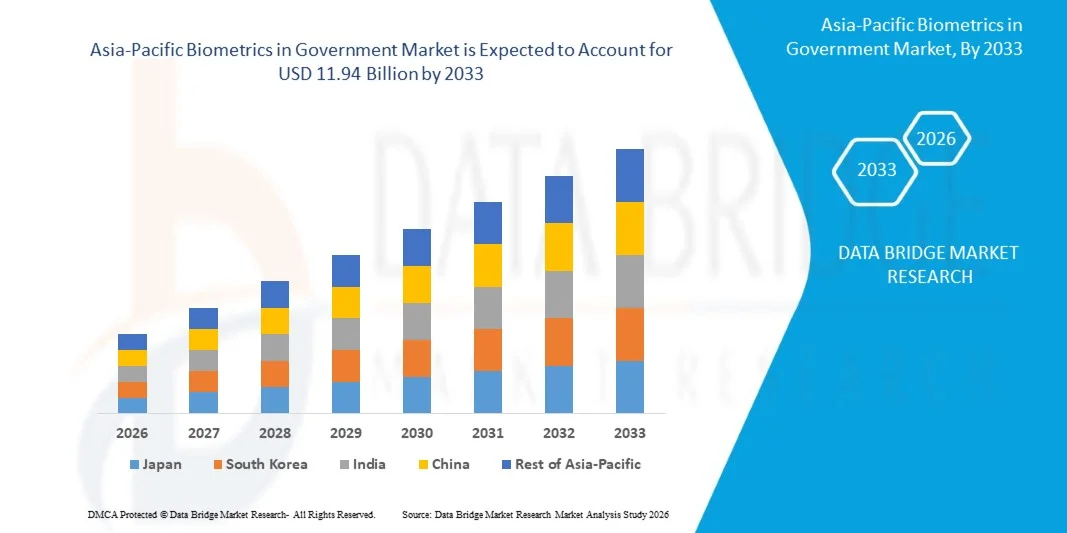
  • The Asia-Pacific biometrics in government market size was valued at USD 3.71 billion in 2025 and is expected to reach USD 11.94 billion by 2033, at a CAGR of 15.70% during the forecast period
  • The market growth is largely fuelled by the increasing need for secure identity verification systems across border control, national ID programs, and law enforcement agencies
  • Rising concerns over cybersecurity threats, identity fraud, and terrorism are accelerating adoption of advanced biometric authentication technologies such as fingerprint, facial recognition, iris, and multimodal systems

Asia-Pacific Biometrics in Government Market Analysis

  • The market is witnessing steady expansion driven by government investments in national identification systems, smart passports, voter registration platforms, and public safety databases aimed at enhancing transparency and reducing fraud
  • In addition, integration of artificial intelligence and cloud-based biometric platforms is improving accuracy, scalability, and real-time authentication capabilities, enabling governments to strengthen border security and citizen service delivery systems
  • China dominated the biometrics in government market in Asia-Pacific with the largest revenue share in 2025, driven by extensive deployment of facial recognition and surveillance systems across public security networks
  • ​Japan is expected to witness the highest compound annual growth rate (CAGR) in the Asia-Pacific biometrics in government market due to increasing adoption of contactless authentication technologies and modernization of immigration and public service systems. Growing investments in secure digital identity frameworks, coupled with advancements in high-precision facial and vein recognition solutions, are significantly accelerating biometric integration across government applications
  • The Fingerprint Recognition segment held the largest market revenue share in 2025 driven by its long-standing adoption in national ID programs, border control systems, and law enforcement databases. Fingerprint systems are widely preferred due to their proven accuracy, cost-effectiveness, and ease of integration with existing government infrastructure

Asia-Pacific Biometrics in Government Market

Report Scope and Asia-Pacific Biometrics in Government Market Segmentation

Attributes

Asia-Pacific Biometrics in Government Key Market Insights

Segments Covered

  • By Mode: Fingerprint Recognition, Face Recognition, Iris Recognition, Palm print Recognition, Vein Recognition, Signature Recognition, Voice Recognition, and Others
  • By Components: Hardware and Software
  • By Type: Contactless, Contact-based and Hybrid/Multimodal
  • By Authentication: Single Factor Authentication and Multiple Factor Authentication
  • By Application: Civil, Military, Law Enforcement, E-Passport, E-Visas, Commercial and Others

Countries Covered

Asia-Pacific

  • China
  • Japan
  • India
  • South Korea
  • Singapore
  • Malaysia
  • Australia
  • Thailand
  • Indonesia
  • Philippines
  • Rest of Asia-Pacific  

Key Market Players

NEC Corporation (Japan)
Fujitsu Limited (Japan)
Hitachi, Ltd. (Japan)
Suprema Inc. (South Korea)
Hanwang Technology Co., Ltd. (China)
• ZKTeco Co., Ltd. (China)
• Dahua Technology Co., Ltd. (China)
• Hikvision Digital Technology Co., Ltd. (China)
• Mantra Softech (India)
• BioEnable Technologies Pvt. Ltd. (India)
• Aratek Biometrics Technology Co., Ltd. (China)
• VIVOTEK Inc. (Taiwan)
• Idemia India Pvt. Ltd. (India)
• Thales DIS Singapore Pte Ltd (Singapore)
• IDEMIA Asia-Pacific (Singapore)

Market Opportunities

• Expansion Of National Digital Identity And E-Governance Programs
• Increasing Adoption Of Multimodal And AI-Enabled Biometric Authentication Systems

Value Added Data Infosets

In addition to the insights on market scenarios such as market value, growth rate, segmentation, geographical coverage, and major players, the market reports curated by the Data Bridge Market Research also include in-depth expert analysis, geographically represented company-wise production and capacity, network layouts of distributors and partners, detailed and updated price trend analysis and deficit analysis of supply chain and demand.

Asia-Pacific Biometrics in Government Market Trends

“Rising Adoption of Digital Identity and Border Security Solutions”

• The growing emphasis on secure and reliable identity verification systems is significantly shaping the biometrics in government market, as public sector agencies increasingly prioritize advanced authentication technologies to combat identity fraud and unauthorized access. Biometric systems such as fingerprint, facial recognition, iris scanning, and multimodal platforms are gaining traction due to their accuracy, efficiency, and ability to strengthen national security frameworks

• Increasing investment in digital identity programs, e-passports, voter registration systems, and border control modernization is accelerating the deployment of biometric technologies across government institutions. Authorities are focusing on enhancing citizen data management, reducing duplication in welfare distribution, and improving transparency in public administration through secure biometric databases

• Government initiatives supporting smart governance and digital transformation are influencing procurement strategies, with agencies emphasizing scalable cloud-based platforms, AI-enabled analytics, and real-time authentication capabilities. These advancements are helping public institutions streamline operations, enhance surveillance capabilities, and strengthen public trust through secure and transparent systems

• For instance, in 2024, multiple government agencies globally expanded biometric-enabled national ID and border management programs to enhance authentication accuracy and reduce identity fraud. These initiatives included upgrades to facial recognition algorithms and integration of multimodal biometric databases, improving operational efficiency and citizen verification processes

• While demand for biometric solutions in government is increasing, sustained market growth depends on continuous technological innovation, data protection compliance, and maintaining high accuracy standards while addressing privacy concerns and cybersecurity risks

Asia-Pacific Biometrics in Government Market Dynamics

Driver

“Growing Demand for Secure Identity Verification and Public Safety Enhancement”

• Rising concerns regarding identity theft, cybercrime, and national security threats are major drivers for the biometrics in government market. Public sector authorities are increasingly deploying biometric authentication systems to strengthen border control, law enforcement investigations, and national identity management programs

• Expanding adoption of biometric-enabled passports, e-visa systems, and secure access control solutions is influencing market growth. These technologies improve verification speed and reduce reliance on traditional identification methods, enhancing efficiency and minimizing fraud risks across government operations

• Governments are actively promoting biometric integration within digital governance platforms to improve service delivery, welfare distribution accuracy, and secure citizen authentication. Investments in AI-powered facial recognition and fingerprint identification technologies are further supporting system reliability and scalability

• For instance, in 2023, several national administrations upgraded biometric voter registration and immigration control systems to improve transparency and prevent identity duplication. These enhancements contributed to stronger public safety infrastructure and improved administrative accountability

• Although increasing security demands support market expansion, broader adoption depends on regulatory compliance, cybersecurity resilience, and effective data management frameworks to ensure privacy protection and system interoperability

Restraint/Challenge

“Privacy Concerns and High Implementation Costs”

• Data privacy concerns and regulatory compliance requirements remain significant challenges in the biometrics in government market. Collection and storage of sensitive biometric data require strict adherence to data protection laws, which can delay project implementation and increase administrative complexity

• High initial investment costs associated with biometric hardware installation, database integration, and infrastructure upgrades limit adoption, particularly in resource-constrained public institutions. Maintenance, cybersecurity safeguards, and periodic system updates further add to operational expenditure

• Technical challenges such as false positives, system interoperability issues, and integration with legacy government databases can affect efficiency and public confidence. Ensuring consistent accuracy across diverse demographic populations also requires continuous algorithm refinement

• For instance, in 2024, certain government modernization projects experienced implementation delays due to data protection reviews and procurement constraints related to biometric surveillance systems. These challenges highlighted the importance of balanced regulation, transparency, and public communication in large-scale biometric deployments

• Addressing these challenges will require cost optimization strategies, robust encryption standards, and comprehensive legal frameworks to protect citizen data. Strengthening public awareness and investing in secure, interoperable platforms will be essential for long-term adoption and sustainable growth in the biometrics in government market

Asia-Pacific Biometrics in Government Market Scope

The market is segmented on the basis of mode, components, type, authentication, and application.

• By Mode

On the basis of mode, the biometrics in government market is segmented into Fingerprint Recognition, Face Recognition, Iris Recognition, Palm Print Recognition, Vein Recognition, Signature Recognition, Voice Recognition, and Others. The Fingerprint Recognition segment held the largest market revenue share in 2025 driven by its long-standing adoption in national ID programs, border control systems, and law enforcement databases. Fingerprint systems are widely preferred due to their proven accuracy, cost-effectiveness, and ease of integration with existing government infrastructure.

The Face Recognition segment is expected to witness the fastest growth rate from 2026 to 2033, driven by advancements in artificial intelligence, real-time surveillance capabilities, and increasing deployment in public safety and smart governance initiatives. Facial recognition technologies enable contactless identification and rapid authentication, making them suitable for large-scale government applications.

• By Components

On the basis of components, the market is segmented into Hardware and Software. The Hardware segment held the largest market revenue share in 2025 due to extensive deployment of biometric scanners, cameras, sensors, and enrollment devices across government facilities. Large-scale procurement for border checkpoints, voter registration centers, and national identification projects continues to support hardware demand.

The Software segment is expected to witness the fastest growth rate from 2026 to 2033 driven by increasing integration of AI-powered algorithms, cloud-based biometric databases, and analytics platforms. Governments are prioritizing scalable and interoperable software solutions to enhance system accuracy, data security, and real-time verification capabilities.

• By Type

On the basis of type, the market is segmented into Contactless, Contact-based, and Hybrid/Multimodal. The Contact-based segment held the largest market revenue share in 2025 supported by widespread deployment of fingerprint and signature recognition systems in administrative and law enforcement operations. These systems are considered reliable and cost-efficient for structured identification processes.

The Hybrid/Multimodal segment is expected to witness the fastest growth rate from 2026 to 2033 due to increasing demand for higher authentication accuracy and fraud prevention. Combining multiple biometric modalities enhances verification reliability and reduces false acceptance or rejection rates in critical government applications.

• By Authentication

On the basis of authentication, the market is segmented into Single Factor Authentication and Multiple Factor Authentication. The Single Factor Authentication segment held the largest market revenue share in 2025 owing to its extensive use in basic identification programs and civil registration systems. Governments continue to deploy single biometric identifiers for routine verification tasks due to operational simplicity.

The Multiple Factor Authentication segment is expected to witness the fastest growth rate from 2026 to 2033 driven by heightened security requirements and increasing concerns regarding identity fraud and cyber threats. Integration of biometric verification with additional credentials enhances overall system security and compliance with data protection standards.

• By Application

On the basis of application, the market is segmented into Civil, Military, Law Enforcement, E-Passport, E-Visas, Commercial, and Others. The Civil segment held the largest market revenue share in 2025 driven by large-scale national ID enrollment programs, voter registration systems, and public welfare distribution platforms. Civil applications account for significant biometric database expansion globally.

The Law Enforcement segment is expected to witness the fastest growth rate from 2026 to 2033 supported by increasing deployment of biometric identification systems for criminal investigation, surveillance, and forensic analysis. Rising investment in secure and real-time authentication solutions is strengthening adoption across public safety agencies.

Asia-Pacific Biometrics in Government Market Regional Analysis

• China dominated the biometrics in government market in Asia-Pacific with the largest revenue share in 2025, driven by extensive deployment of facial recognition and surveillance systems across public security networks

• The government continues to expand national ID databases, smart city infrastructure, and AI-powered monitoring platforms to strengthen identification and verification mechanisms

• Large-scale investments in advanced biometric technologies and strong domestic manufacturing capabilities further consolidate the country’s dominant market position

Japan Biometrics in Government Market Insight

The Japan biometrics in government market is expected to witness the fastest growth rate from 2026 to 2033, supported by increasing adoption of contactless authentication technologies and modernization of immigration control systems. Government initiatives promoting secure digital identity verification and integration of biometric systems in public services are driving demand. In addition, advancements in high-precision facial and vein recognition technologies are significantly contributing to the market’s rapid expansion.

Asia-Pacific Biometrics in Government Market Share

The Asia-Pacific biometrics in government industry is primarily led by well-established companies, including:

• NEC Corporation (Japan)
• Fujitsu Limited (Japan)
• Hitachi, Ltd. (Japan)
• Suprema Inc. (South Korea)
• IDEMIA Asia-Pacific (Singapore)
• Thales DIS Singapore Pte Ltd (Singapore)
• Hanwang Technology Co., Ltd. (China)
• ZKTeco Co., Ltd. (China)
• Dahua Technology Co., Ltd. (China)
• Hikvision Digital Technology Co., Ltd. (China)
• Idemia India Pvt. Ltd. (India)
• Mantra Softech (India)
• BioEnable Technologies Pvt. Ltd. (India)
• VIVOTEK Inc. (Taiwan)
• Aratek Biometrics Technology Co., Ltd. (China)


SKU-

세계 최초의 시장 정보 클라우드 보고서에 온라인으로 접속하세요

  • 대화형 데이터 분석 대시보드
  • 높은 성장 잠재력 기회를 위한 회사 분석 대시보드
  • 사용자 정의 및 질의를 위한 리서치 분석가 액세스
  • 대화형 대시보드를 통한 경쟁자 분석
  • 최신 뉴스, 업데이트 및 추세 분석
  • 포괄적인 경쟁자 추적을 위한 벤치마크 분석의 힘 활용
데모 요청

연구 방법론

데이터 수집 및 기준 연도 분석은 대규모 샘플 크기의 데이터 수집 모듈을 사용하여 수행됩니다. 이 단계에는 다양한 소스와 전략을 통해 시장 정보 또는 관련 데이터를 얻는 것이 포함됩니다. 여기에는 과거에 수집한 모든 데이터를 미리 검토하고 계획하는 것이 포함됩니다. 또한 다양한 정보 소스에서 발견되는 정보 불일치를 검토하는 것도 포함됩니다. 시장 데이터는 시장 통계 및 일관된 모델을 사용하여 분석하고 추정합니다. 또한 시장 점유율 분석 및 주요 추세 분석은 시장 보고서의 주요 성공 요인입니다. 자세한 내용은 분석가에게 전화를 요청하거나 문의 사항을 드롭하세요.

DBMR 연구팀에서 사용하는 주요 연구 방법론은 데이터 마이닝, 시장에 대한 데이터 변수의 영향 분석 및 주요(산업 전문가) 검증을 포함하는 데이터 삼각 측량입니다. 데이터 모델에는 공급업체 포지셔닝 그리드, 시장 타임라인 분석, 시장 개요 및 가이드, 회사 포지셔닝 그리드, 특허 분석, 가격 분석, 회사 시장 점유율 분석, 측정 기준, 글로벌 대 지역 및 공급업체 점유율 분석이 포함됩니다. 연구 방법론에 대해 자세히 알아보려면 문의를 통해 업계 전문가에게 문의하세요.

사용자 정의 가능

Data Bridge Market Research는 고급 형성 연구 분야의 선두 주자입니다. 저희는 기존 및 신규 고객에게 목표에 맞는 데이터와 분석을 제공하는 데 자부심을 느낍니다. 보고서는 추가 국가에 대한 시장 이해(국가 목록 요청), 임상 시험 결과 데이터, 문헌 검토, 재생 시장 및 제품 기반 분석을 포함하도록 사용자 정의할 수 있습니다. 기술 기반 분석에서 시장 포트폴리오 전략에 이르기까지 타겟 경쟁업체의 시장 분석을 분석할 수 있습니다. 귀하가 원하는 형식과 데이터 스타일로 필요한 만큼 많은 경쟁자를 추가할 수 있습니다. 저희 분석가 팀은 또한 원시 엑셀 파일 피벗 테이블(팩트북)로 데이터를 제공하거나 보고서에서 사용 가능한 데이터 세트에서 프레젠테이션을 만드는 데 도움을 줄 수 있습니다.


자주 묻는 질문

정부 시장 성장률의 아시아 태평양 바이오미터는 2028년까지 15.7%가 될 것입니다.
정부 시장의 아시아 태평양 생물 지표는 2028년까지 5,762.94 천 달러를 초과 할 것입니다.
정부 시장의 아시아 태평양 바이오 메트릭의 주요 회사는 Paravision, Thales Group, NEC Corporation, HID Global Corporation, IDEMIA, Shenzhen Goodix Technology Co., Ltd., Aratek, Aware Inc., Beijing Kuangshi Technology Co., Ltd., BioEnable Technologies Pvt. Ltd., BioID, BIO-key International Cognitec Systems GmbH, FUJITSU, id3 Technologies, Innovatrics, Integrated Biometrics, Secuense 등입니다.
모드, 구성 요소, 유형, 인증 및 응용 프로그램은 정부 시장 연구의 Asia Pacific Biometrics가 근거한 요인입니다.
정부 시장의 Asia Pacific Biometrics의 최신 개발은 Innovatrics가 디지털 온보딩 플랫폼과 ABIS 및 NEC Corporation이 제공하는 Trusted Enrolment 플랫폼의 출시를 발표했습니다. Lufthansa Airlines 및 Swiss International Airlines는 Star Alliance의 회원으로 NEC의 얼굴 인식 기술을 사용하는 "Star Alliance Biometrics" identity 검증 플랫폼을 출시했습니다.
정부 시장 규모의 아시아 태평양 바이오미터는 2025년 1억 달러에 달했습니다.
정부 시장의 아시아 태평양 생물 미터는 2026에서 2033의 예측 기간 동안 15.70%의 CAGR에서 성장하는 것입니다.
NEC Corporation (Japan), Fujitsu Limited (Japan), Hitachi, Ltd. (Japan), Suprema Inc. (South Korea), Hanwang Technology Co., Ltd. (China)와 같은 기업은 정부 시장에서 아시아 태평양 생물 미터의 주요 선수입니다.
정부 시장의 아시아 태평양 바이오미터에 덮인 국가는 중국, 일본, 인도, 대한민국, 싱가포르, 말레이시아, 호주, 태국, 인도네시아, 필리핀, 아시아 태평양의 나머지입니다.
정부 시장에 있는 아시아 태평양 생물 미터는 형태, 성분, 유형, 입증 및 신청을 기준으로 5개의 주목할만한 세그먼트로 분류됩니다. 형태의 기초에, 시장은 지문 승인, 얼굴 승인, 아이리스 승인, 손바닥 인쇄 승인, 정맥 승인, 서명 승인, 음성 승인 및 다른 사람으로 구분됩니다. 구성 요소의 기초에, 시장은 하드웨어 및 소프트웨어로 구분됩니다. 유형의 기초에, 시장은 contactless, 접촉 근거한, 및 잡종/다중으로 구분됩니다. 인증의 기초에, 시장은 단일 인자 인증 및 여러 요인 인증으로 구분됩니다. 신청의 기초에, 시장은 시민, 군, 법 집행, e-passport, e-visas, 상업 및 다른 사람으로 구분됩니다.

산업 관련 보고서

고객 후기