



Asia-Pacific Canned Meat Market, By Meat Type (Poultry, Pork, Beef, Seafood, Goat (Mutton), Lamb (Mutton) and Others), Nature (Organic and Conventional), Application (Horeca Industry and Household/Retail), Distribution Channel (Store-Based Retailing and Non-Store-Based Retailing/Online Retailers) - Industry Trends and Forecast to 2029.
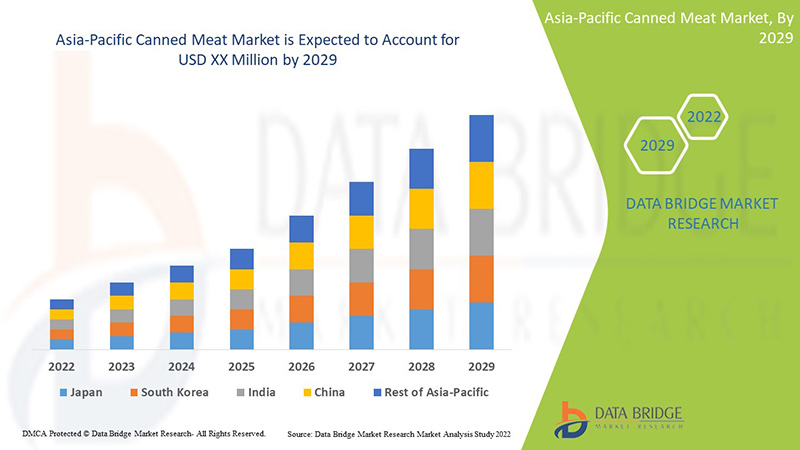
Asia-Pacific Canned Meat Market Analysis and Insights
Canned meat products are made by hermetically sealing (preventing air from escaping or entering) the product in a container (usually tin-coated steel cans) and thermally processing it to kill spoilage microorganisms. Canned meat is a high-quality, protein-rich food that remains stable at room temperature and is extremely convenient. Consumers can choose from a wide variety of meat-based products. Whole muscles, meat stews, luncheon meat, sausages, sauces with meat pieces, and paste products are instances of canned meat products.
The majority of canned meats are 'commercially' sterilized, which means they have been processed to kill most microorganisms and their spores. They are of good quality and have proper labelling. However, the high investment costs of canned meat and its products are expected to restrain the market growth of canned meat during the forecasted period.
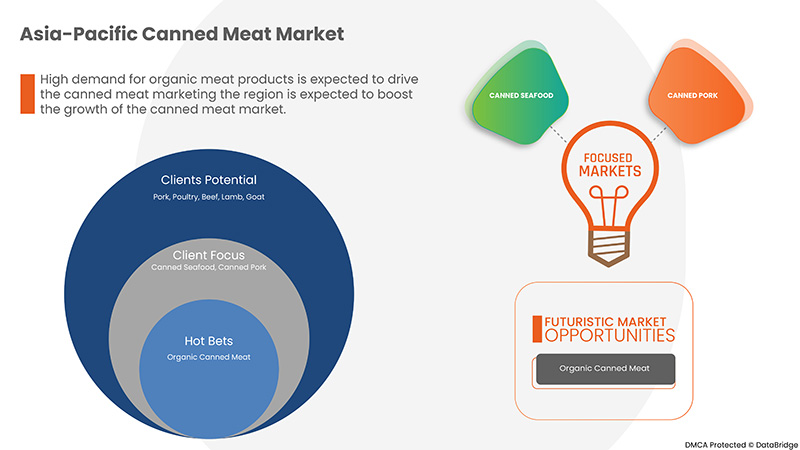
The increase in the demand for organic meat products and rising health awareness among people, coupled with urbanization, are expected to create immense opportunities for manufacturers of canned meat. On the other hand, the lack of uniform food safety standards may challenge the market's growth.
Data Bridge Market Research analyses that the Asia-Pacific canned meat market will grow at a CAGR of 3.3% during the forecast period of 2022 to 2029.
|
Report Metric |
Details |
|
Forecast Period |
2022 to 2029 |
|
Base Year |
2021 |
|
Historic Years |
2020 (Customizable to 2019 - 2015) |
|
Quantitative Units |
Revenue in USD Million, Pricing in USD |
|
Segments Covered |
By Meat Type (Poultry, Pork, Beef, Seafood, Goat, Lamb, and Others), Nature (Organic and Conventional), Application (Horeca Industry and Household/Retail), Distribution Channel (Store-Based Retailing and Non-Store-Based Retailing/Online Retailers) |
|
Regions Covered |
China, Japan, Vietnam, India, Indonesia, South Korea, Philippines, Australia, Malaysia, Thailand, New Zealand, Singapore and Rest of Asia-Pacific |
|
Market Players Covered |
JBS Foods, Danish Crown A.M.B.A., Oceans Secret, China Kuyu, Industrial Co. Ltd., Pronas, Bejing Yuanyoung Hongxing Food Co. Ltd., Conagra Brands, Inc., Zwanenberg Food Group |
Market Definition
Canned meat is a high-quality, protein-rich food that remains stable at room temperature and is extremely convenient. Consumers can choose from a wide variety of meat-based products. Meat is a low-acid food that must be sterilized unless other precautions are taken. Most countries have specific food and hygiene regulations governing meat slaughter and processing, and these and the relevant regulatory bodies must be followed before any meat products are produced.
Asia-Pacific Canned Meat Market Dynamics
Drivers
-
Growth in investments & collaborations in meat processing and canning business
The rising demand for different meat products leads to increasing investments and collaborations in the meat processing and canning market. Many investors have a number of approaches, such as joint venture, acquisition, new product launch, and acquisition, among others. For the meat canning market investments. Many meat companies choose to analyze from a sustainability perspective, considering the future scenario. Many companies use a range of water, climate, and land indicators to calculate their environmental and carbon footprints to inform their investment decisions. Moreover, companies are also tying up with various food research institutes for product development in the meat canning market. Companies are investing in the meat market due to the increased popularity of healthy protein source meat products. Moreover, there has been a key understanding of the health benefits of various meat products arising from poultry, and so on.
As a result, companies are continuously acquiring, obtaining funding, and investing in new products, which is expected to propel market growth.
-
Preference for animal-based proteins over plant-based proteins
Adapting plant-based proteins as an alternative to meat proteins has increased allergies among some consumers. It disproportionately affects children, which considers for meat products to grow in the forecast period.
The allergies to vegan food products increase the risk of nutritional deficiencies that can cause severe effects on the health of individuals. The immunoglobulin-E-mediated food allergy rate has peaked, especially in high-income countries. The high amount of macro- and micro-nutrients present in legumes, pulses, and whole grains, among others, are one of the prime reasons that cause allergies and side effects such as bloating, nausea, and improper digestion. Due to growing allergies from the consumption of plant-based meat, consumers may tend and divert their attention back to conventional meat products due to various allergies associated with plant-based meat consumption. This is driving the market growth.
Opportunities
Growing preference for organic meat
Organic farming not only helps small farmers to get a fair price for their produce but it also benefits the environment by encouraging the growth of a number of natural varieties of food. Organic food contains no chemical pesticides and fertilizers and are grown naturally with the help of manure or compost. Organic food does not contains growth hormones or antibiotic residues, which therefore do not threaten a child’s future.
Restraints/Challenges
- High investment costs in the poultry business
Poultry manufacturers face several adversities in terms of transportation, inadequate storage, and wastage of products which lead to loss of value of end products.
The equipment involved in the poultry business, such as high-pressure processing, refrigeration equipment, massaging equipment, and injectors, increases the efficiency of food production by reducing wastage.
However, poultry processing units require high capital investments in terms of massive requirements for infrastructure. This includes pack houses, cold storage facilities across the value chain, the latest technology equipment for processing processed meats that maintain their nutritional values, infrastructure at port gateways with phytosanitary facilitation, and multi-modal logistics.
Post COVID-19 Impact on Asia-Pacific Canned Meat Market
COVID-19 has affected the market to some extent. Due to the lockdown, the manufacturing and production of many small and large companies were halted, and the demand for canned meat also increased, influencing the market. Due to the change in many mandates and regulations, manufacturers can design and launch new products in the market, which will help the market's growth.
Recent Developments
- In December 2021, Tyson Foods Inc. planned to spend more than $1.3 billion to increase automation in meat plants over the next three years. This will help the company grow and increase its production capacity
Asia-Pacific Canned Meat Market Scope
The Asia-Pacific canned meat market is segmented into notable segments based on meat type, nature, application, and distribution channel. The growth amongst these segments will help you analyze major growth segments in the industries and provide the users with a valuable market overview and market insights to make strategic decisions to identify core market applications.
Meat Type
- Poultry
- Pork
- Beef
- Seafood
- Goat (Mutton)
- Lamb (Mutton)
- Others
Based on meat type, the canned meat market is further segmented into poultry, pork, beef, seafood, goat (mutton), lamb (mutton) and others.
Nature
- Conventional
- Organic
Based on meat type, the canned meat market is further segmented into organic and conventional.
Application
- Horeca Industry
- Household/Retail
Based on application, the canned meat market is further segmented into horeca industry and household/retail.
Distribution Channel
- Store-based retailing
- Non-Store-Based Retailing/Online Retailers
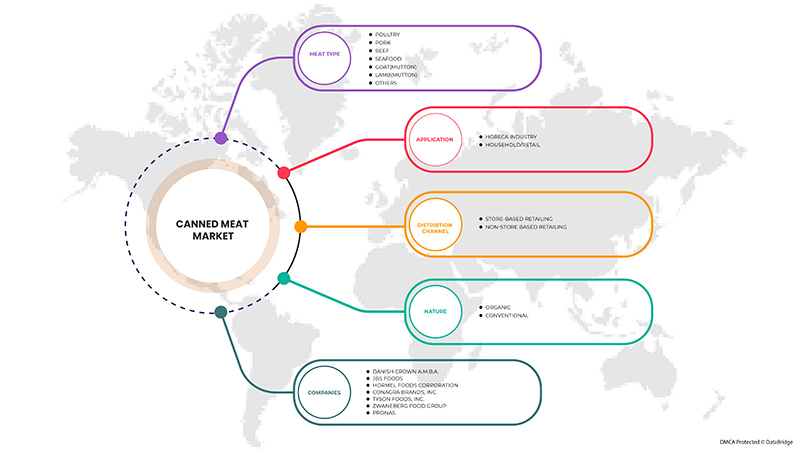
Based on distribution channel, the canned meat market is further segmented into store-based retailing and non-store-based retailing/online retailers.
Asia-Pacific Canned Meat Market Regional Analysis/Insights
The Asia-Pacific canned meat market is analyzed, and market size insights and trends are provided based on as referenced above.
The countries covered in the Asia-Pacific canned meat market report are China, Japan, Vietnam, India, Indonesia, South Korea, Philippines, Australia, Malaysia, Thailand, New Zealand, Singapore and Rest of Asia-Pacific.
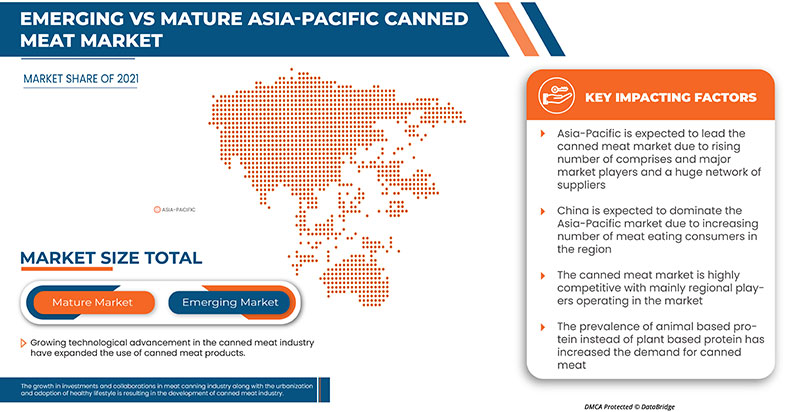
China is expected to dominate the Asia-Pacific canned meat market in terms of market share and revenue and is estimated to maintain its dominance during the forecast period due to the growing surge for canned meat in various industries and growing consumer demand from end users.
The region section of the report also provides individual market-impacting factors and changes in regulations in the market that impact the current and future trends of the market. Data points, such as new and replacement sales, country demographics, disease epidemiology, and import-export tariffs, are some of the major pointers used to forecast the market scenario for individual countries. In addition, the presence and availability of global brands and their challenges faced due to high competition from local and domestic brands and the impact of sales channels are considered while providing forecast analysis of the country data.
Competitive Landscape and Asia-Pacific Canned Meat Market Share Analysis
The Asia-Pacific canned meat market competitive landscape provides details about the competitors. Details included are company overview, company financials, revenue generated, market potential, investment in research and development, new market initiatives, Asia-Pacific presence, production sites and facilities, production capacities, company strengths and weaknesses, product launch, product width and breadth, and application dominance. The above data points are only related to the companies focus on the Asia-Pacific canned meat market.
Some of the major players operating in the Asia-Pacific canned meat market are JBS Foods, Danish Crown A.M.B.A., Oceans Secret, China Kuyu, Industrial Co. Ltd., Pronas, Bejing Yuanyoung Hongxing Food Co. Ltd. Conagra Brands, Inc., Zwanenberg Food Group among others.
Research Methodology
Data collection and base year analysis are done using data collection modules with large sample sizes. The market data is analyzed and estimated using market statistical and coherent models. In addition, market share analysis and key trend analysis are the major success factors in the market report. The key research methodology used by the DBMR research team is data triangulation which involves data mining, analysis of the impact of data variables on the market, and primary (industry expert) validation. Apart from this, data models include the Vendor Positioning Grid, Market Time Line Analysis, Market Overview and Guide, Company Positioning Grid, Company Market Share Analysis, Standards of Measurement, Asia-Pacific Vs Regional, and Vendor Share Analysis. Please request an analyst call in case of further inquiry.
SKU-
세계 최초의 시장 정보 클라우드 보고서에 온라인으로 접속하세요

- 대화형 데이터 분석 대시보드
- 높은 성장 잠재력 기회를 위한 회사 분석 대시보드
- 사용자 정의 및 질의를 위한 리서치 분석가 액세스
- 대화형 대시보드를 통한 경쟁자 분석
- 최신 뉴스, 업데이트 및 추세 분석
- 포괄적인 경쟁자 추적을 위한 벤치마크 분석의 힘 활용
목차
1 서론
1.1 연구 목적
1.2 시장 정의
1.3 제한 사항
1.4 대상 시장
2 시장 세분화
2.1 대상 시장
2.2 지리적 범위
연구에 2.3년이 고려됨
2.4 통화 및 가격
2.5 DBMR TRIPOD 데이터 검증 모델
2.6 육류 종류 수명선 곡선
2.7 주요 여론 선도자와의 1차 인터뷰
2.8 DBMR 시장 위치 그리드
2.9 2차 소스
2.1 가정
3 요약
4가지 프리미엄 인사이트
5 시장 개요
5.1 드라이버
5.1.1 육류 가공 및 통조림 사업에 대한 투자 및 협력 증가
5.1.2 식물성 단백질보다 동물성 단백질을 더 선호함
5.1.3 도시화 확대 및 건강한 라이프스타일 채택 증가
5.2 제약
5.2.1 가금류 사업의 높은 투자 비용
5.2.2 채식주의 인구 증가 및 육류 대체 식품에 대한 수요 증가
5.3 기회
5.3.1 패스트푸드 및 레스토랑 체인의 성장
5.3.2 육류 가공 산업의 자동화 증가
5.3.3 유기농 육류에 대한 선호도 증가
5.4 과제
5.4.1 엄격한 정부 규정
5.4.2 COVID-19 팬데믹으로 인한 공급망 교란
6 아시아 태평양 통조림 고기 시장, 육류 유형별
6.1 개요
6.2 가금류
6.3 돼지고기
6.4 쇠고기
6.5 해산물
6.6 염소(양고기)
6.7 양고기
6.8 기타
7 아시아 태평양 통조림 고기 시장, 자연별
7.1 개요
7.2 기존
7.3 유기농
8 아시아 태평양 통조림 고기 시장, 응용 분야별
8.1 개요
8.2 호레카 산업
8.3 가정/소매
9 아시아 태평양 통조림 고기 시장, 유통 채널별
9.1 개요
9.2 매장 기반 소매업
9.3 비매장 기반 소매/온라인 소매업체
10 아시아 태평양 통조림 고기 시장, 지역별
10.1 아시아 태평양
10.1.1 중국
10.1.2 일본
10.1.3 베트남
10.1.4 인도
10.1.5 인도네시아
10.1.6 대한민국
10.1.7 필리핀
10.1.8 호주
10.1.9 말레이시아
10.1.10 태국
10.1.11 뉴질랜드
10.1.12 싱가포르
10.1.13 아시아 태평양의 나머지 지역
11 회사 전경
11.1 회사 점유율 분석: 아시아 태평양
12 SWOT 분석
13 회사 프로필
13.1 덴마크 크라운 암바
13.1.1 회사 스냅샷
13.1.2 회사 점유율 분석
13.1.3 제품 포트폴리오
13.1.4 최근 개발 사항
13.2 JBS푸드
13.2.1 회사 스냅샷
13.2.2 REVENUS 분석
13.2.3 회사 점유율 분석
13.2.4 제품 포트폴리오
13.2.5 최근 개발 사항
13.3 호멜푸드 주식회사
13.3.1 회사 스냅샷
13.3.2 REVENUS 분석
13.3.3 회사 점유율 분석
13.3.4 제품 포트폴리오
13.3.5 최근 개발
13.4 코나그라 브랜드 주식회사
13.4.1 회사 스냅샷
13.4.2 수익 분석
13.4.3 회사 점유율 분석
13.4.4 제품 포트폴리오
13.4.5 최근 개발
13.5 타이슨푸드 주식회사
13.5.1 회사 스냅샷
13.5.2 REVENUS 분석
13.5.3 회사 점유율 분석
13.5.4 제품 포트폴리오
13.5.5 최근 개발 사항
13.6 베이징 위안영홍싱식품유한회사
13.6.1 회사 스냅샷
13.6.2 제품 포트폴리오
13.6.3 최근 개발 사항
13.7 중국쿤위공업유한공사
13.7.1 회사 스냅샷
13.7.2 제품 포트폴리오
13.7.3 최근 개발 사항
13.8 키스톤 미트
13.8.1 회사 스냅샷
13.8.2 제품 포트폴리오
13.8.3 최근 개발 사항
13.9 바다의 비밀
13.9.1 회사 스냅샷
13.9.2 제품 포트폴리오
13.9.3 최근 개발 사항
13.1 프로나
13.10.1 회사 스냅샷
13.10.2 제품 포트폴리오
13.10.3 최근 개발 사항
13.11 와일드 플래닛 푸드
13.11.1 회사 스냅샷
13.11.2 제품 포트폴리오
13.11.3 최근 개발 사항
13.12 즈바넨베르그 푸드 그룹
13.12.1 회사 스냅샷
13.12.2 제품 포트폴리오
13.12.3 최근 개발
14 설문지
15 관련 보고서
그림 목록
그림 1 아시아 태평양 통조림 고기 시장: 세분화
그림 2 아시아 태평양 통조림 고기 시장: 데이터 삼각 측량
그림 3 아시아 태평양 통조림 고기 시장: DROC 분석
그림 4 아시아 태평양 통조림 고기 시장: 아시아 태평양 대 지역 시장 분석
그림 5 아시아 태평양 통조림 고기 시장: 회사 연구 분석
그림 6 아시아 태평양 통조림 고기 시장: 인터뷰 인구 통계
그림 7 아시아 태평양 통조림 고기 시장: DBMR 시장 위치 그리드
그림 8 아시아 태평양 통조림 고기 시장: 세분화
그림 9 식물성 단백질 대신 동물성 단백질에 대한 수요 증가가 2022년~2029년 예측 기간 동안 아시아 태평양 통조림 육류 시장 성장을 견인하고 있습니다.
그림 10 가금류 부문은 2022년 및 2029년 아시아 태평양 통조림 육류 시장에서 가장 큰 점유율을 차지할 것으로 예상됩니다.
그림 11 아시아 태평양 통조림 육류 시장의 동인, 제약, 기회 및 과제
그림 12 아시아 태평양 통조림 고기 시장: 고기 종류별(2021년)
그림 13 아시아 태평양 통조림 고기 시장: 자연별(2021)
그림 14 아시아 태평양 통조림 고기 시장: 응용 분야별(2021년)
그림 15 아시아 태평양 통조림 고기 시장: 유통 채널별(2021년)
그림 16 아시아 태평양 통조림 고기 시장: 스냅샷 기준(2021)
그림 17 아시아 태평양 통조림 고기 시장: 국가별(2021년)
그림 18 아시아 태평양 통조림 고기 시장: 국가별(2022-2029)
그림 19 아시아 태평양 통조림 고기 시장: 국가별(2021-2029)
그림 20 아시아 태평양 통조림 고기 시장: 고기 종류별(2022-2029)
그림 21 아시아 태평양 통조림 고기 시장: 회사 점유율 2021(%)

연구 방법론
데이터 수집 및 기준 연도 분석은 대규모 샘플 크기의 데이터 수집 모듈을 사용하여 수행됩니다. 이 단계에는 다양한 소스와 전략을 통해 시장 정보 또는 관련 데이터를 얻는 것이 포함됩니다. 여기에는 과거에 수집한 모든 데이터를 미리 검토하고 계획하는 것이 포함됩니다. 또한 다양한 정보 소스에서 발견되는 정보 불일치를 검토하는 것도 포함됩니다. 시장 데이터는 시장 통계 및 일관된 모델을 사용하여 분석하고 추정합니다. 또한 시장 점유율 분석 및 주요 추세 분석은 시장 보고서의 주요 성공 요인입니다. 자세한 내용은 분석가에게 전화를 요청하거나 문의 사항을 드롭하세요.
DBMR 연구팀에서 사용하는 주요 연구 방법론은 데이터 마이닝, 시장에 대한 데이터 변수의 영향 분석 및 주요(산업 전문가) 검증을 포함하는 데이터 삼각 측량입니다. 데이터 모델에는 공급업체 포지셔닝 그리드, 시장 타임라인 분석, 시장 개요 및 가이드, 회사 포지셔닝 그리드, 특허 분석, 가격 분석, 회사 시장 점유율 분석, 측정 기준, 글로벌 대 지역 및 공급업체 점유율 분석이 포함됩니다. 연구 방법론에 대해 자세히 알아보려면 문의를 통해 업계 전문가에게 문의하세요.
사용자 정의 가능
Data Bridge Market Research는 고급 형성 연구 분야의 선두 주자입니다. 저희는 기존 및 신규 고객에게 목표에 맞는 데이터와 분석을 제공하는 데 자부심을 느낍니다. 보고서는 추가 국가에 대한 시장 이해(국가 목록 요청), 임상 시험 결과 데이터, 문헌 검토, 재생 시장 및 제품 기반 분석을 포함하도록 사용자 정의할 수 있습니다. 기술 기반 분석에서 시장 포트폴리오 전략에 이르기까지 타겟 경쟁업체의 시장 분석을 분석할 수 있습니다. 귀하가 원하는 형식과 데이터 스타일로 필요한 만큼 많은 경쟁자를 추가할 수 있습니다. 저희 분석가 팀은 또한 원시 엑셀 파일 피벗 테이블(팩트북)로 데이터를 제공하거나 보고서에서 사용 가능한 데이터 세트에서 프레젠테이션을 만드는 데 도움을 줄 수 있습니다.











