



Asia-Pacific Plant-Based Egg Market Segmentation, By Plant-Based Egg Type(Full Egg, White Egg, and Egg Yolk), Form(Powder, Liquid and Others), Base Ingredient (Algal Flour, Wheat Flour, Soy Flour, Chia Seeds, Garbanzo Beans, Starch, Mung Beans, Pea, and Others), Function (Partial Egg Replacement, Full Egg Replacement, Egg Wash Substitute, and Others), Application (Breakfast Application, Homemade Bakery Applications, and Others), Packaging Type (Bottles, Pouches, Tetra Packs, and Others), Distribution Channel (Store Based Retailer and Non-Store Based Retailer)- Industry Trends and Forecast to 2033
Asia-Pacific Plant-Based Egg Market Size
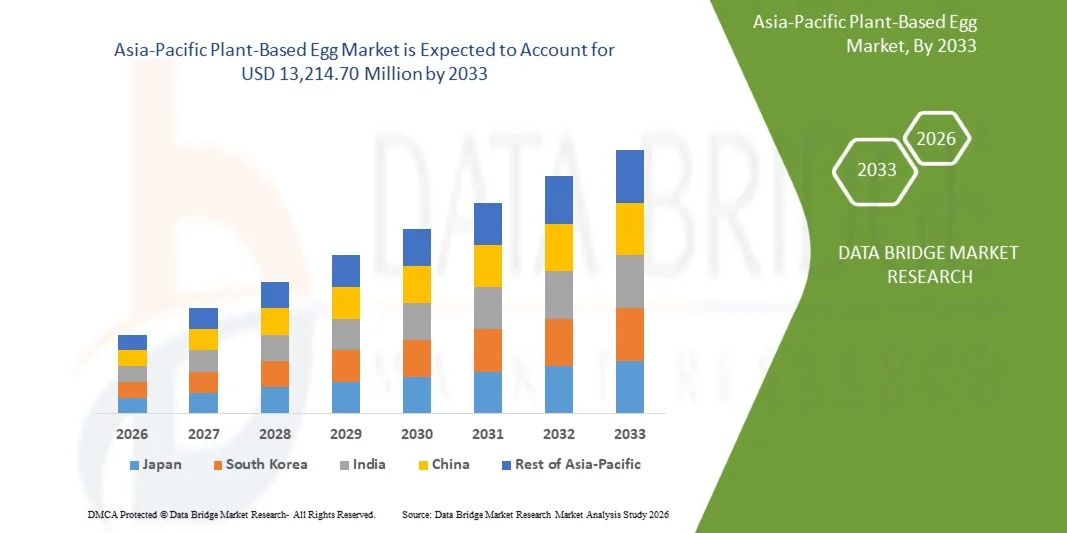
- The Asia-Pacific plant-based egg market size was valued at USD 163.93 million in 2025 and is expected to reach USD 13,214.70 million by 2033, at a CAGR of 73.10% during the forecast period
- The market growth is largely fuelled by the rising adoption of vegan and flexitarian diets across developed and developing economies
- Increasing consumer awareness regarding animal welfare, environmental sustainability, and cholesterol-free alternatives is further accelerating demand
Asia-Pacific Plant-Based Egg Market Analysis
- The market is witnessing strong momentum due to growing consumer preference for sustainable and allergen-friendly protein sources, supported by innovation in plant protein formulations such as mung bean, soy, and pea protein to enhance taste, texture, and nutritional value
- In addition, strategic collaborations, product launches, and investments in food technology are enabling manufacturers to improve scalability, reduce production costs, and expand their footprint in both household and commercial food applications
- China dominated the Asia-Pacific plant-based egg market with the largest revenue share in 2025, driven by its large consumer base, rapid urbanization, and strong demand for innovative plant-based food products
- Japan is expected to witness the highest compound annual growth rate (CAGR) in the Asia-Pacific plant-based egg market due to growing health consciousness, strong demand for functional and clean-label foods, and increasing interest in vegan and flexitarian lifestyles
- The Full Egg segment held the largest market revenue share in 2025 driven by its broad applicability across breakfast preparations, bakery, and ready-to-eat meals. Full egg alternatives are widely adopted due to their balanced functionality in binding, emulsification, and texture enhancement, closely mimicking conventional eggs. In addition, growing consumer demand for convenient and versatile vegan substitutes is further strengthening this segment’s position
Report Scope and Asia-Pacific Plant-Based Egg Market Segmentation
|
Attributes |
Asia-Pacific Plant-Based Egg Key Market Insights |
|
Segments Covered |
|
|
Countries Covered |
Asia-Pacific
|
|
Key Market Players |
|
|
Market Opportunities |
|
|
Value Added Data Infosets |
In addition to the insights on market scenarios such as market value, growth rate, segmentation, geographical coverage, and major players, the market reports curated by the Data Bridge Market Research also include in-depth expert analysis, pricing analysis, brand share analysis, consumer survey, demography analysis, supply chain analysis, value chain analysis, raw material/consumables overview, vendor selection criteria, PESTLE Analysis, Porter Analysis, and regulatory framework. |
Asia-Pacific Plant-Based Egg Market Trends
“Rising Demand for Sustainable And Cholesterol-Free Protein Alternatives”
- The increasing shift toward plant-based diets is significantly shaping the plant-based egg market, as consumers seek sustainable, cholesterol-free, and cruelty-free protein options. Plant-based eggs are gaining traction due to their ability to replicate the taste, texture, and functionality of conventional eggs while aligning with ethical and environmental preferences. This trend is accelerating adoption across retail, foodservice, and processed food applications, encouraging manufacturers to enhance product performance and nutritional value
- Growing awareness regarding animal welfare, environmental sustainability, and the carbon footprint associated with poultry farming is further accelerating demand. Consumers are actively seeking egg alternatives formulated from legumes, soy, mung beans, and other plant proteins, prompting brands to emphasize clean-label positioning and transparent ingredient sourcing. This shift is also supporting product innovation focused on allergen-free and non-GMO formulations
- Health-conscious consumers are driving demand for products low in cholesterol and saturated fats while rich in plant-based protein. Manufacturers are highlighting functional benefits such as high protein content, absence of antibiotics, and suitability for vegan diets. Marketing strategies increasingly focus on sustainability claims and nutritional advantages to strengthen brand differentiation and consumer loyalty
- For instance, in 2024, several leading plant-based food brands expanded their portfolios with improved liquid and powdered egg alternatives designed for baking, scrambling, and foodservice applications. These launches emphasized enhanced taste, improved binding properties, and fortified nutritional profiles to better compete with traditional eggs. Companies promoted these products through retail expansion and digital campaigns to capture a broader consumer base
- While demand for plant-based eggs is rising, sustained growth depends on continuous research and development, cost competitiveness, and achieving parity in taste, texture, and pricing with conventional eggs. Manufacturers are focusing on scaling production, strengthening supply chains, and optimizing formulations to ensure long-term market penetration
Asia-Pacific Plant-Based Egg Market Dynamics
Driver
“Growing Preference For Vegan And High-Protein Diets”
- Increasing consumer adoption of vegan, vegetarian, and flexitarian diets is a key driver for the plant-based egg market. Manufacturers are introducing innovative formulations that replicate the functional properties of conventional eggs, including binding, emulsifying, and leavening capabilities. This supports expanded usage in bakery, ready-to-eat meals, and household cooking applications
- Rising concerns regarding cholesterol intake and food safety are encouraging consumers to shift toward plant-derived egg substitutes. Plant-based eggs provide a healthier alternative while maintaining comparable culinary functionality, making them appealing to health-focused and lifestyle-driven consumers
- Food manufacturers and foodservice providers are incorporating plant-based eggs into menus and packaged products to meet evolving dietary preferences. Product innovation, strategic partnerships, and expanded distribution networks are further supporting market growth, with brands investing in improved taste profiles and fortified nutrition
- For instance, in 2023, major plant-based food companies reported increased integration of egg alternatives in bakery mixes, frozen meals, and breakfast offerings following heightened consumer demand for vegan and allergen-friendly options. These initiatives strengthened product portfolios and enhanced competitive positioning within the alternative protein sector
- Although vegan and high-protein trends are driving growth, broader adoption will depend on competitive pricing, consistent supply of raw materials, and consumer education regarding functional and nutritional equivalence. Investment in scalable production technologies and ingredient innovation will be critical to sustaining momentum
Restraint/Challenge
“Higher Pricing And Functional Limitations Compared To Conventional Eggs”
- The relatively higher price of plant-based eggs compared to conventional eggs remains a significant challenge, particularly in price-sensitive markets. Production costs associated with plant protein extraction, formulation, and processing contribute to elevated retail pricing, which can limit mass-market adoption
- Achieving complete functional parity with traditional eggs in terms of taste, texture, and cooking performance remains complex. Some formulations may not fully replicate the sensory experience of conventional eggs, potentially affecting repeat purchases and consumer acceptance
- Limited consumer awareness regarding usage versatility and preparation methods can also restrict market penetration. Misconceptions about taste and performance may slow adoption, especially among consumers unfamiliar with plant-based cooking
- For instance, in 2024, certain foodservice operators reported slower adoption of plant-based egg substitutes due to cost concerns and performance variability in large-scale baking and frying applications. Retailers also indicated that premium pricing impacted shelf rotation compared to conventional egg products
- Overcoming these challenges will require cost optimization, continuous product refinement, and targeted consumer education campaigns. Strengthening supply chains, improving formulation technology, and expanding distribution partnerships will be essential to unlock the full growth potential of the global plant-based egg market
Asia-Pacific Plant-Based Egg Market Scope
The market is segmented on the basis of plant-based egg type, form, base ingredient, function, application, packaging type, and distribution channel.
• By Plant-Based Egg Type
On the basis of plant-based egg type, the Asia-Pacific plant-based egg market is segmented into Full Egg, White Egg, and Egg Yolk. The Full Egg segment held the largest market revenue share in 2025 driven by its broad applicability across breakfast preparations, bakery, and ready-to-eat meals. Full egg alternatives are widely adopted due to their balanced functionality in binding, emulsification, and texture enhancement, closely mimicking conventional eggs. In addition, growing consumer demand for convenient and versatile vegan substitutes is further strengthening this segment’s position.
The White Egg segment is expected to witness the fastest growth rate from 2026 to 2033, driven by rising demand for high-protein and low-fat formulations in fitness-oriented and health-conscious consumer groups. Egg white alternatives are increasingly used in bakery and confectionery products where aeration and structure are critical. Continuous innovation in texture and whipping performance is also supporting segment expansion across commercial food applications.
• By Form
On the basis of form, the market is segmented into Powder, Liquid, and Others. The Liquid segment held the largest market revenue share in 2025 driven by its ready-to-use convenience and strong penetration in foodservice channels. Liquid plant-based eggs are preferred for scrambling, omelets, and direct cooking applications due to their ease of handling and closer resemblance to traditional eggs. Increasing retail availability and improved flavor profiles are further enhancing adoption.
The Powder segment is expected to witness the fastest growth rate from 2026 to 2033, driven by longer shelf life, cost efficiency in bulk storage, and suitability for packaged food manufacturers. Powdered variants are widely used in bakery premixes and processed food formulations where stability and ease of transport are essential. Growing industrial demand and expanding export opportunities are supporting segment growth.
• By Base Ingredient
On the basis of base ingredient, the market is segmented into Algal Flour, Wheat Flour, Soy Flour, Chia Seeds, Garbanzo Beans, Starch, Mung Beans, Pea, and Others. The Mung Beans segment held the largest market revenue share in 2025 driven by its strong functional properties such as emulsification, binding, and neutral taste profile. Mung bean-based formulations are widely recognized for closely replicating the texture and cooking behavior of conventional eggs. Rising consumer acceptance and product innovation are strengthening this segment.
The Pea segment is expected to witness the fastest growth rate from 2026 to 2033 due to increasing preference for allergen-friendly and protein-rich ingredients. Pea-based formulations are gaining popularity for their sustainability profile and compatibility with clean-label positioning. Manufacturers are investing in advanced processing techniques to improve taste and texture performance.
• By Function
On the basis of function, the market is segmented into Partial Egg Replacement, Full Egg Replacement, Egg Wash Substitute, and Others. The Full Egg Replacement segment held the largest market revenue share in 2025 driven by growing vegan adoption and demand for complete plant-based formulations in bakery and breakfast applications. These products are increasingly used to replicate binding, structure, and moisture retention functions.
The Egg Wash Substitute segment is expected to witness the fastest growth rate from 2026 to 2033 driven by expanding use in bakery and ready-to-bake products. Plant-based egg wash alternatives provide desirable browning and glazing effects without animal-derived ingredients. Increasing demand from artisanal and commercial bakeries is accelerating segment expansion.
• By Application
On the basis of application, the market is segmented into Breakfast Application, Homemade Bakery Applications, and Others. The Breakfast Application segment held the largest market revenue share in 2025 driven by rising consumption of plant-based scrambled eggs and ready-to-cook formats. Urban lifestyles and growing vegan awareness are supporting adoption in daily meal routines.
The Homemade Bakery Applications segment is expected to witness the fastest growth rate from 2026 to 2033 due to increasing home baking trends and demand for allergen-free ingredients. Consumers are actively seeking plant-based substitutes that deliver consistent texture and taste in cakes, muffins, and pastries. Product innovation in baking-specific formulations is supporting growth.
• By Packaging Type
On the basis of packaging type, the market is segmented into Bottles, Pouches, Tetra Packs, and Others. The Bottles segment held the largest market revenue share in 2025 driven by convenience, resealability, and suitability for liquid formulations. Bottled packaging enhances ease of pouring and storage, particularly in household settings.
The Pouches segment is expected to witness the fastest growth rate from 2026 to 2033 driven by cost efficiency and reduced material usage. Flexible packaging solutions are gaining traction due to sustainability benefits and ease of transportation. Manufacturers are increasingly adopting lightweight formats to optimize supply chain efficiency.
• By Distribution Channel
On the basis of distribution channel, the market is segmented into Store Based Retailer and Non-Store Based Retailer. The Store Based Retailer segment held the largest market revenue share in 2025 driven by strong presence of supermarkets, hypermarkets, and specialty stores offering plant-based alternatives. Physical retail outlets provide product visibility and consumer trust, supporting impulse purchases and brand discovery.
The Non-Store Based Retailer segment is expected to witness the fastest growth rate from 2026 to 2033 driven by the rapid expansion of e-commerce platforms and direct-to-consumer sales models. Online channels offer wider product variety, subscription options, and convenient doorstep delivery. Increasing digital adoption and promotional strategies are accelerating segment growth across the region.
Asia-Pacific Plant-Based Egg Market Regional Analysis
- China dominated the Asia-Pacific plant-based egg market with the largest revenue share in 2025, driven by its large consumer base, rapid urbanization, and strong demand for innovative plant-based food products
- Consumers in the country are increasingly adopting alternative protein solutions due to rising health awareness, lactose and egg allergies, and concerns regarding food safety
- The dominance is further supported by strong domestic manufacturing capabilities, expanding quick-service restaurant chains, and government support for plant-based innovation, strengthening China’s leadership position in the regional market
Japan Plant-Based Egg Market Insight
The Japan plant-based egg market is expected to witness the fastest growth rate in the Asia-Pacific region, driven by increasing demand for convenient, functional, and health-oriented food products. Consumers are prioritizing clean-label, high-protein, and low-cholesterol alternatives that align with evolving dietary preferences. The country’s strong culture of food innovation and advanced retail ecosystem is enabling rapid product adoption. In addition, rising interest in sustainable consumption and premium plant-based offerings is further propelling the growth of the plant-based egg market in Japan.
Asia-Pacific Plant-Based Egg Market Share
The Asia-Pacific plant-based egg industry is primarily led by well-established companies, including:
- Float Foods (Singapore)
- Evo Foods (India)
- Hegg Foods (Singapore)
- OsomeFood (Singapore)
- Nabati Foods (Indonesia)
- Dharmic Foods (India)
- Alternative Foods (Japan)
- Namaste Foods (India)
- J&K Ingredients (India)
- Fiberstar (Japan)
- Fismer Lecithin (Australia)
- All American Foods (Australia)
- Veggletto Company (Australia)
- Plantible Foods (India)
- Protem (Japan)
SKU-
세계 최초의 시장 정보 클라우드 보고서에 온라인으로 접속하세요

- 대화형 데이터 분석 대시보드
- 높은 성장 잠재력 기회를 위한 회사 분석 대시보드
- 사용자 정의 및 질의를 위한 리서치 분석가 액세스
- 대화형 대시보드를 통한 경쟁자 분석
- 최신 뉴스, 업데이트 및 추세 분석
- 포괄적인 경쟁자 추적을 위한 벤치마크 분석의 힘 활용
연구 방법론
데이터 수집 및 기준 연도 분석은 대규모 샘플 크기의 데이터 수집 모듈을 사용하여 수행됩니다. 이 단계에는 다양한 소스와 전략을 통해 시장 정보 또는 관련 데이터를 얻는 것이 포함됩니다. 여기에는 과거에 수집한 모든 데이터를 미리 검토하고 계획하는 것이 포함됩니다. 또한 다양한 정보 소스에서 발견되는 정보 불일치를 검토하는 것도 포함됩니다. 시장 데이터는 시장 통계 및 일관된 모델을 사용하여 분석하고 추정합니다. 또한 시장 점유율 분석 및 주요 추세 분석은 시장 보고서의 주요 성공 요인입니다. 자세한 내용은 분석가에게 전화를 요청하거나 문의 사항을 드롭하세요.
DBMR 연구팀에서 사용하는 주요 연구 방법론은 데이터 마이닝, 시장에 대한 데이터 변수의 영향 분석 및 주요(산업 전문가) 검증을 포함하는 데이터 삼각 측량입니다. 데이터 모델에는 공급업체 포지셔닝 그리드, 시장 타임라인 분석, 시장 개요 및 가이드, 회사 포지셔닝 그리드, 특허 분석, 가격 분석, 회사 시장 점유율 분석, 측정 기준, 글로벌 대 지역 및 공급업체 점유율 분석이 포함됩니다. 연구 방법론에 대해 자세히 알아보려면 문의를 통해 업계 전문가에게 문의하세요.
사용자 정의 가능
Data Bridge Market Research는 고급 형성 연구 분야의 선두 주자입니다. 저희는 기존 및 신규 고객에게 목표에 맞는 데이터와 분석을 제공하는 데 자부심을 느낍니다. 보고서는 추가 국가에 대한 시장 이해(국가 목록 요청), 임상 시험 결과 데이터, 문헌 검토, 재생 시장 및 제품 기반 분석을 포함하도록 사용자 정의할 수 있습니다. 기술 기반 분석에서 시장 포트폴리오 전략에 이르기까지 타겟 경쟁업체의 시장 분석을 분석할 수 있습니다. 귀하가 원하는 형식과 데이터 스타일로 필요한 만큼 많은 경쟁자를 추가할 수 있습니다. 저희 분석가 팀은 또한 원시 엑셀 파일 피벗 테이블(팩트북)로 데이터를 제공하거나 보고서에서 사용 가능한 데이터 세트에서 프레젠테이션을 만드는 데 도움을 줄 수 있습니다.











