



Asia-Pacific Tomatoes Market, By Type (Cherry Tomatoes, Grape Tomatoes, Roma Tomatoes, Beefsteak Tomatoes, Heirloom Tomatoes, Tomatoes On The Vine, Green Tomatoes, and Others), Product Type (Fresh, Frozen, and Dried), Category (Conventional and Organic), End User (Food Service Industry and Household/Retail Industry), Distribution Channel (Direct and Indirect) Industry Trends and Forecast to 2030.
Asia-Pacific Tomatoes Market Analysis and Insights
Asia-Pacific tomatoes market is gaining significant growth due to the increased usage of tomatoes in various cuisines and processing units. Tomatoes are used in producing different types of tomato products and have huge demand in the market. They are not only good in taste but also provide health benefits to humans.
The factors driving the market growth are growing demand for tomatoes in food processing industries as well as the development and production of new varieties of tomatoes in the market. The factor restraining the market growth is fluctuations in the prices of tomatoes, which depend on various factors such as rain, temperature, and season. The opportunity for market growth is growing tomatoes with the help of Artificial Intelligence (AI). Some of the factors that challenge market growth are rising post-harvesting losses due to lack of storage facilities.
Market players are more focused on new product development, partnership, and other strategies to increase their market share. Therefore, the rising standards and regulations laid by governmental bodies have to be followed by the manufacturer to sell their products into the market and to ensure the demand for consumers will boost the market growth. Whereas, the lack of technical expertise in small enterprises is likely to restrict market growth in the region.
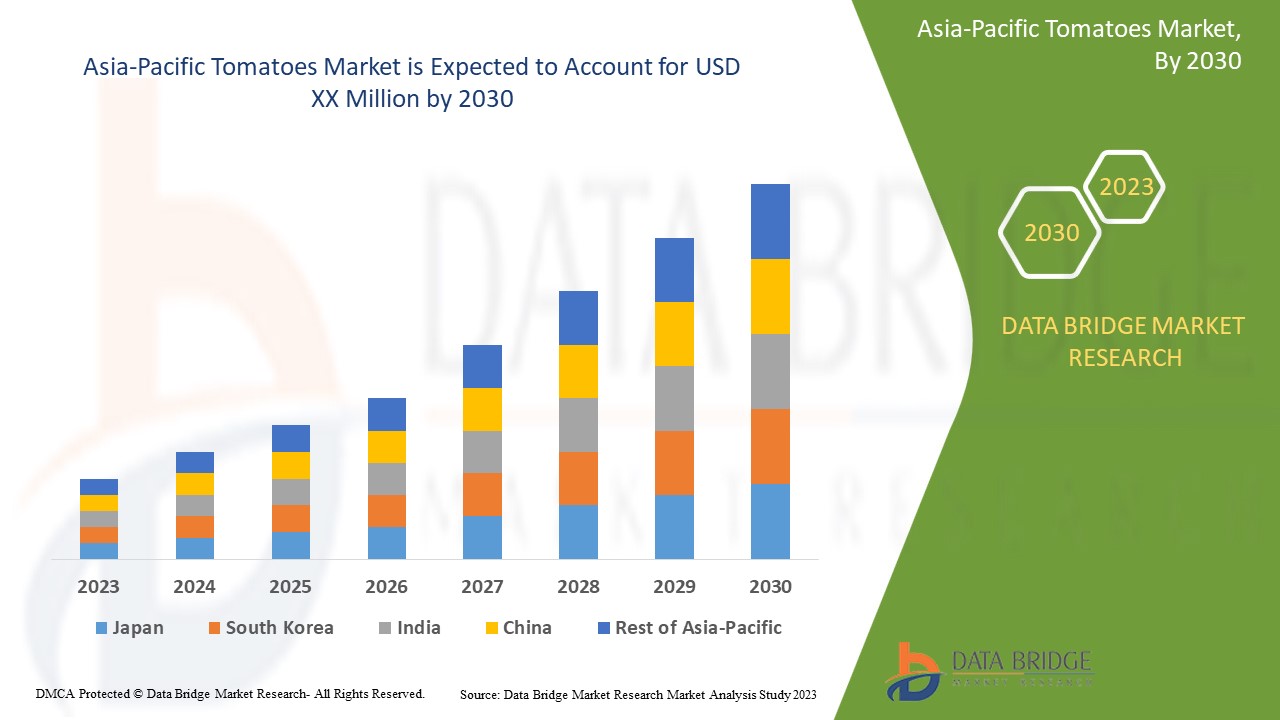
Data Bridge Market Research analyzes that the Asia-Pacific tomatoes market will grow at a CAGR of 3.3% during the forecast period of 2023 to 2030.
|
Report Metric |
Details |
|
Forecast Period |
2023 to 2030 |
|
Base Year |
2022 |
|
Historic Year |
2021 (Customizable to 2020 - 2016) |
|
Quantitative Units |
Revenue in USD Million, Pricing in USD |
|
Segments Covered |
By Type (Cherry Tomatoes, Grape Tomatoes, Roma Tomatoes, Beefsteak Tomatoes, Heirloom Tomatoes, Tomatoes On The Vine, Green Tomatoes, and Others), Product Type (Fresh, Frozen, and Dried), Category (Conventional and Organic), End User (Food Service Industry and Household/Retail Industry), Distribution Channel (Direct and Indirect). |
|
Countries Covered |
China, India, Japan, Indonesia, Australia, South Korea, Philippines, Malaysia, Thailand, Vietnam, New Zealand, Singapore, Taiwan, and Rest Of Asia-Pacific. |
|
Market Players Covered |
Sahyadri Farms Post Harvest Care Ltd. and MASTRONARDI PRODUCE LTD. |
Market Definition
Tomatoes are basically round-shaped vegetables that can be eaten cooked or uncooked. They are edible, pulpy berries of the herb Solanum lycoperscium. They are of many colors such as red, yellow, orange, and many more. They are of many varieties having different tastes and applications.
Tomatoes have a wide application in the food and beverages industry. They are used in the production of soups, sauces, purees, juices, and ketchup among others. They are also used as raw vegetables in burgers, sandwiches, salads, pizza, and many more.
Tomatoes are an essential source in food processing industries having wide applications and also contain essential components useful for the human body. They help in maintaining blood pressure and healthy skin and also have anti-inflammatory action.
Asia-Pacific Tomatoes Market Dynamics
This section deals with understanding the market drivers, advantages, opportunities, restraints, and challenges. All of this is discussed in detail below:
Drivers
- Government Initiatives to Boost Tomato Production and the Agricultural Sector
With the increasing population and higher demand for fruits and fresh vegetables, the government has put several efforts into increasing the production and processing of the crops. Through much R&D in science and technology, the government has come up with many initiatives to increase tomato production to fulfill the demand for tomatoes and other agricultural products. The government funds research institutions such as the California Tomato Research Institute, Agriculture Research Service (ARS), and ICAR-IIHR in India to develop new varieties such as Pusa Ruby, Pusa Gaurav, and Chhuhara. These high-yielding varieties give more yield and are also more disease and pest-resistant, which is very important for higher production and makes them less prone to natural disasters.
- Increased Development of New Tomato Varieties
Cultivating new plant varieties can help farmers grow more food and adapt to climate change. This also helps scientists learn more about how plants are affected by climate change and drought and can help refine and improve the plant breeding process in many ways. The rising healthcare expenditure increased life expectancy, and the desire of older people to improve their quality of life have all emphasized more scientific developments. Using bioactive substances at higher concentrations than usual is one of the tactics used in developing functional foods. Despite not being particularly abundant in vitamins and antioxidants, tomatoes have emerged as an intriguing antioxidant source due to their widespread consumption. Researchers are highly interested in the enzymatic properties of tomatoes because of their easy availability. For instance, tomatoes are the first dietary source of lycopene, the second source of vitamin C and carotene, and the third dietary source of vitamin E in Spain. The carotenoid content and its implications on health have received special attention from scientists.
Restraint
- Increasing Environmental Elements and Climate Conditions
Environment change affects food system sustainability by influencing farmer livelihoods, consumer choices, and food security through changes in agroecosystems' natural and human components. Annual precipitation and heavy rainfall events are becoming more common, especially in the spring. An excessive amount of spring rain slows crop establishment, interrupts planting, increases the prevalence of several fungal and bacterial crop diseases, and might cause labor problems due to delaying field operations. Variations in temperature and precipitation directly impact the quantity and quality of tomato crop production and indirectly impact the scheduling of important farm operations and the economic effects of pests, weeds, and diseases. Adverse weather conditions also hamper the supply chain and transportation of tomatoes.
Opportunity
- Wide Range of Applications in the Food and Beverages Sector
In the food and beverages industry, tomatoes are used in various forms and as a fresh component, including frozen, dried, pureed, sauces, and powder. The flexibility of these many tomato-based applications is growing daily, eventually opening up opportunities for the food processing industries to produce various tomato-based products. Due to customer habituation with the flavor and taste of tomatoes, tomatoes have greatly increased in popularity. Additionally, processed foods and snacks frequently utilize tomato paste, purees, sauces, powders, and other ingredients. Developing more specialized food production technologies aids in discovering new applications for tomatoes in the food industry. These factors will continue creating profitable business opportunities for established market players and new entrepreneurs.
Challenge
- Rising Post Harvesting Losses due to Lack of Storage Facility
Despite the driving factors and the opportunities available in the market for tomato demand globally, there is a certain challenge faced by the farmer and the supplier that affects the supply of tomatoes. The challenge is post-harvest losses because of the perishable nature of tomatoes and the lack of storage facilities after harvesting and during transportation. Post-harvest losses are primarily caused by rotting, mechanical damage, poor handling, inappropriate temperature, relative humidity management, and hygiene issues during handling. Post-harvest losses cause the product's quality to decline, eventually lowering its price and negatively influencing market expansion.
Post-COVID-19 Impact on Asia-Pacific Tomatoes Market
Post the pandemic, the demand for tomatoes increased as there was an allowance for fruits and vegetables during the lockdown time and demand for vegetables increased at that time. Tomatoes having properties of increasing immunity led to the high demand during COVID-19.
Recent Developments
- In January 2021, the Organic Produce Network, the organic tomato market was extremely active, according to Ricardo Crisantes, Chief Commercial Officer at Wholesum in Nogales, Arizona, and supply often lagged behind demand daily.
- In March 2020, "Organic Marketing Tomatoes for Maximum Sales" entitled article published by PHOENIX MEDIA NETWORK, INC. PUBLICATION stated that customers are reportedly interested in purchasing organic tomatoes despite their high price because of their health benefits.
Asia-Pacific Tomatoes Market Scope
Asia-Pacific tomatoes market is segmented into five notable segments based on type, product type, category, end user, and distribution channel. The growth amongst these segments will help you analyze major growth segments in the industries and provide the users with a valuable market overview and market insights to help them make strategic decisions for identifying core market applications.
Type
- Cherry Tomatoes
- Grape Tomatoes
- Roma Tomatoes
- Tomatoes On The Vine
- Beefsteak Tomatoes
- Heirloom Tomatoes
- Green Tomatoes
- Others
Based on type, the Asia-Pacific tomatoes market is segmented into cherry tomatoes, grape tomatoes, roma tomatoes, tomatoes on the vine, beefsteak tomatoes, heirloom tomatoes, green tomatoes, and others.
Product Type
- Fresh
- Frozen
- Dried
Based on product type, the Asia-Pacific tomatoes market is segmented into fresh, frozen, and dried.
Category
- Conventional
- Organic
Based on category, the Asia-Pacific tomatoes market is segmented into conventional and organic.
End User
- Food Service Industry
- Household/Retail Industry
Based on end user, the Asia-Pacific tomatoes market is segmented into food service industry and household/retail industry.
Distribution Channel
- Direct
- Indirect
Based on distribution channel, the Asia-Pacific tomatoes market is segmented into direct and indirect.
Asia-Pacific Tomatoes Market Regional Analysis/Insights
The Asia-Pacific tomatoes market is analyzed and market size insights and trends are provided by country, type, product type, category, end user, and distribution channel as referenced above.
The countries covered in this report are China, India, Japan, Indonesia, Australia, South Korea, Philippines, Malaysia, Thailand, Vietnam, New Zealand, Singapore, Taiwan, and rest of Asia-Pacific.
China is expected to dominate the Asia-Pacific tomatoes market in terms of market share and revenue. It is estimated to maintain its dominance during the forecast period due to growing demand for these tomatoes, which is the major reason for growth of tomatoes in Asia-Pacific region.
The region section of the report also provides individual market impacting factors and changes in regulations in the market that impact the current and future trends of the market. Data points, such as new and replacement sales, country demographics, disease epidemiology, and import-export tariffs, are some of the major pointers used to forecast the market scenario for individual countries. In addition, the presence and availability of Asia-Pacific brands and their challenges faced due to high competition from local and domestic brands and the impact of sales channels are considered while providing forecast analysis of the country data.
Competitive Landscape and Asia-Pacific Tomatoes Market Share Analysis
The competitive Asia-Pacific tomatoes market provides details about the competitors. Details include company overview, company financials, revenue generated, market potential, investment in R&D, new market initiatives, Asia-Pacific presence, production sites and facilities, production capacities, company strengths and weaknesses, product launch, product width and breadth, and application dominance. The above data points are only related to the companies' focus on the market.
Some of the major players operating in the Asia-Pacific tomatoes market are Sahyadri Farms Post Harvest Care Ltd. and MASTRONARDI PRODUCE LTD. among others.
SKU-
세계 최초의 시장 정보 클라우드 보고서에 온라인으로 접속하세요

- 대화형 데이터 분석 대시보드
- 높은 성장 잠재력 기회를 위한 회사 분석 대시보드
- 사용자 정의 및 질의를 위한 리서치 분석가 액세스
- 대화형 대시보드를 통한 경쟁자 분석
- 최신 뉴스, 업데이트 및 추세 분석
- 포괄적인 경쟁자 추적을 위한 벤치마크 분석의 힘 활용
목차
1 서론
1.1 연구 목적
1.2 시장 정의
1.3 아시아 태평양 토마토 시장 개요
1.4 제한 사항
1.5 대상 시장
2 시장 세분화
2.1 대상 시장
2.2 지리적 범위
연구에 2.3년이 고려됨
2.4 통화 및 가격
2.5 DBMR TRIPOD 데이터 검증 모델
2.6 다변량 모델링
2.7 작물 유형 수명선 곡선
2.8 주요 여론 선도자와의 1차 인터뷰
2.9 DBMR 시장 위치 그리드
2.1 공급업체 점유율 분석
2.11 2차 소스
2.12 가정
3 요약
4가지 프리미엄 인사이트
4.1 토마토 시장 최대 수출국
4.2 토마토 시장의 최고 수입국
4.3 신제품 출시 전략
4.3.1 질병 저항성 품종 출시
4.3.2 패키지 전략을 통한 출시 촉진
4.3.3 유기농 제품 Aunching
4.3.4 결론
5 규정 적용 범위
6 아시아 태평양 토마토 시장의 공급망
6.1 원자재 조달
6.2 처리
6.3 마케팅 및 유통
6.4 최종 사용자
7 시장 개요
7.1 드라이버
7.1.1 토마토 생산 및 농업 부문을 촉진하기 위한 정부 이니셔티브
7.1.2 식품 가공 산업에서 토마토의 급증
7.1.3 새로운 토마토 품종 개발 증가
7.1.4 토마토에 대한 국내 및 국제 수요 증가
7.2 제약
7.2.1 토마토 가격 변동
7.2.2 증가하는 환경 요소 및 기후 조건
7.2.3 토마토 거래 및 수출에 대한 엄격한 규칙 및 규정
7.3 기회
7.3.1 인공지능을 이용한 토마토 재배
7.3.2 식품 및 음료 부문에서의 광범위한 응용 분야
7.3.3 토마토 생산을 위한 기술적 진보의 증가
7.3.4 유기농 및 무화학 토마토에 대한 높은 수요
7.4 과제
7.4.1 수자원의 부족과 지하수의 염도
7.4.2 저장 시설 부족으로 인한 수확 후 손실 증가
7.4.3 작물 보호 제품 사용 증가
8 아시아 태평양 토마토 시장, 유형별
8.1 개요
8.2 체리토마토
8.3 포도 토마토
8.4 로마 토마토
8.5 포도나무에 심은 토마토
8.6 비프스테이크 토마토
8.7 가보 토마토
8.8 녹색 토마토
8.9 기타
9 아시아 태평양 토마토 시장, 제품 유형별
9.1 개요
9.2 신선함
9.3 동결
9.4 건조
10 아시아 태평양 토마토 시장, 카테고리별
10.1 개요
10.2 기존
10.3 유기농
11 아시아 태평양 토마토 시장, 최종 사용자별
11.1 개요
11.2 식품 서비스 산업
11.2.1 유형별 식품 서비스 산업
11.2.1.1 호텔
11.2.1.2 레스토랑
11.2.1.3 카페
11.2.1.4 기타
11.3 가정/소매 산업
12 아시아 태평양 토마토 시장, 유통 채널별
12.1 개요
12.2 직접
12.3 간접
13 아시아 태평양 토마토 시장, 지역별
13.1 아시아 태평양
13.1.1 중국
13.1.2 인도
13.1.3 일본
13.1.4 인도네시아
13.1.5 호주
13.1.6 대한민국
13.1.7 필리핀
13.1.8 말레이시아
13.1.9 태국
13.1.10 베트남
13.1.11 뉴질랜드
13.1.12 싱가포르
13.1.13 대만
13.1.14 아시아 태평양의 나머지 지역
14 아시아 태평양 토마토 시장, 회사 환경
14.1 회사 점유율 분석: 아시아 태평양
15 회사 프로필
15.1 앱하베스트
15.1.1 회사 스냅샷
15.1.2 수익 분석
15.1.3 회사 점유율 분석
15.1.4 제품 포트폴리오
15.1.5 최근 개발
15.2 마스트로나르디 프로듀스 유한회사
15.2.1 회사 스냅샷
15.2.2 회사 점유율 분석
15.2.3 제품 포트폴리오
15.2.4 최근 개발 사항
15.3 CASALASCO - SOCIETÀ AGRICOLA SPA
15.3.1 회사 스냅샷
15.3.2 회사 점유율 분석
15.3.3 제품 포트폴리오
15.3.4 최근 개발 사항
15.4 하우웰링스
15.4.1 회사 스냅샷
15.4.2 회사 점유율 분석
15.4.3 제품 포트폴리오
15.4.4 최근 개발 사항
15.5 무치 인터내셔널 주식회사
15.5.1 회사 스냅샷
15.5.2 회사 점유율 분석
15.5.3 제품 포트폴리오
15.5.4 최근 개발 사항
15.6 레드스타 세일즈 BV
15.6.1 회사 스냅샷
15.6.2 제품 포트폴리오
15.6.3 최근 개발
15.7 아일머 가족 농장
15.7.1 회사 스냅샷
15.7.2 제품 포트폴리오
15.7.3 최근 개발
15.8 토마토의 수확
15.8.1 회사 스냅샷
15.8.2 제품 포트폴리오
15.8.3 최근 개발
15.9 엑서터 생산
15.9.1 회사 스냅샷
15.9.2 제품 포트폴리오
15.9.3 최근 개발
15.1 HNATIUK 정원
15.10.1 회사 스냅샷
15.10.2 제품 포트폴리오
15.10.3 최근 개발
15.11 매직썬
15.11.1 회사 스냅샷
15.11.2 제품 포트폴리오
15.11.3 최근 개발 사항
15.12 네이쳐 프레쉬 팜스
15.12.1 회사 스냅샷
15.12.2 제품 포트폴리오
15.12.3 최근 개발 사항
15.13 온타리오 가공 야채 재배자
15.13.1 회사 스냅샷
15.13.2 제품 포트폴리오
15.13.3 최근 개발 사항
15.14 퍼시픽 림 제작
15.14.1 회사 스냅샷
15.14.2 제품 포트폴리오
15.14.3 최근 개발
15.15 R&L 홀트 주식회사
15.15.1 회사 스냅샷
15.15.2 제품 포트폴리오
15.15.3 최근 개발
15.16 로얄프라이드
15.16.1 회사 스냅샷
15.16.2 제품 포트폴리오
15.16.3 최근 개발
15.17 SAHYADRI FARMS 수확 후 관리 LTD.
15.17.1 회사 스냅샷
15.17.2 제품 포트폴리오
15.17.3 최근 개발 사항
15.18 스트리트프로듀스 유한회사
15.18.1 회사 스냅샷
15.18.2 제품 포트폴리오
15.18.3 최근 개발
15.19 토마토 재배자 공급 회사
15.19.1 회사 스냅샷
15.19.2 제품 포트폴리오
15.19.3 최근 개발
15.2 웨스트 코스트 토마토, LLC
15.20.1 회사 스냅샷
15.20.2 제품 포트폴리오
15.20.3 최근 개발
16 설문지
17 관련 보고서
표 목록
표 1 신선 및 냉장 토마토의 최고 수출국, HS 코드: 0702 2017-2021, 톤 단위 수량
표 2 신선 및 냉장 토마토의 주요 수입국, HS 코드: 0702 2017-2021, 톤 단위 수량
표 3 사이즈 코드가 적용되는 경우 다음 표의 코드 및 범위를 준수해야 합니다.
표 4 아시아 태평양 토마토 시장, 유형별 2021-2030 (백만 달러)
표 5 아시아 태평양 체리 토마토, 토마토 시장, 지역별, 2021-2030 (백만 달러)
표 6 아시아 태평양 포도 토마토, 지역별 토마토 시장, 2021-2030 (백만 달러)
표 7 아시아 태평양 지역 토마토 시장에서의 로마 토마토, 지역별, 2021-2030 (백만 달러)
표 8 아시아 태평양 토마토 시장, 지역별 토마토 재배 규모, 2021-2030년(백만 달러)
표 9 아시아 태평양 비프스테이크 토마토, 지역별 토마토 시장, 2021-2030 (백만 달러)
표 10 아시아 태평양 전통 토마토 시장, 지역별 토마토 시장, 2021-2030 (백만 달러)
표 11 아시아 태평양 토마토 시장 내 녹색 토마토, 지역별, 2021-2030 (백만 달러)
표 12 아시아 태평양 기타 토마토 시장, 지역별, 2021-2030 (백만 달러)
표 13 아시아 태평양 토마토 시장, 제품 유형별, 2021-2030년(백만 달러)
표 14 신선한 토마토를 공급하는 회사
표 15 아시아 태평양 신선 토마토 시장, 지역별, 2021-2030 (백만 달러)
표 16 아시아 태평양 지역별 냉동 토마토 시장, 2021-2030년 (백만 달러)
표 17 아시아 태평양 건조 토마토 시장, 지역별, 2021-2030 (백만 달러)
표 18 아시아 태평양 토마토 시장, 카테고리별, 2021-2030 (백만 달러)
표 19 아시아 태평양 지역 토마토 시장, 지역별, 2021-2030 (백만 달러)
표 20 아시아 태평양 지역별 토마토 유기농 시장, 2021-2030년 (백만 달러)
표 21 아시아 태평양 토마토 시장, 최종 사용자별, 2021-2030년(백만 달러)
표 22 아시아 태평양 식품 서비스 산업의 토마토 시장, 지역별, 2021-2030 (백만 달러)
표 23 아시아 태평양 식품 서비스 산업의 토마토 시장, 유형별, 2021-2030 (백만 달러)
표 24 아시아 태평양 가정/소매 산업 토마토 시장, 지역별, 2021-2030 (백만 달러)
표 25 아시아 태평양 토마토 시장, 유통 채널별, 2021-2030 (백만 달러)
표 26 아시아 태평양 토마토 직접 시장, 지역별, 2021-2030 (백만 달러)
표 27 아시아 태평양 토마토 간접시장, 지역별, 2021-2030 (백만 달러)
표 28 아시아 태평양 토마토 시장, 국가별, 2021-2030 (백만 달러)
표 29 아시아 태평양 토마토 시장, 유형별 2021-2030 (백만 달러)
표 30 아시아 태평양 토마토 시장, 제품 유형별, 2021-2030년(백만 달러)
표 31 아시아 태평양 토마토 시장, 카테고리별, 2021-2030 (백만 달러)
표 32 아시아 태평양 토마토 시장, 최종 사용자별, 2021-2030년(백만 달러)
표 33 아시아 태평양 식품 서비스 산업의 토마토 시장, 유형별, 2021-2030 (백만 달러)
표 34 아시아 태평양 토마토 시장, 유통 채널별, 2021-2030년(백만 달러)
표 35 중국 토마토 시장, 유형별 2021-2030 (백만 달러)
표 36 중국 토마토 시장, 제품 유형별, 2021-2030년(백만 달러)
표 37 중국 토마토 시장, 카테고리별, 2021-2030 (백만 달러)
표 38 최종 사용자별 중국 토마토 시장, 2021-2030년(백만 달러)
표 39 토마토 시장의 중국 식품 서비스 산업, 유형별, 2021-2030 (백만 달러)
표 40 중국 토마토 시장, 유통 채널별, 2021-2030 (백만 달러)
표 41 인도 토마토 시장, 유형별 2021-2030 (백만 달러)
표 42 인도 토마토 시장, 제품 유형별, 2021-2030년(백만 달러)
표 43 인도 토마토 시장, 카테고리별, 2021-2030 (백만 달러)
표 44 최종 사용자별 인도 토마토 시장, 2021-2030년(백만 달러)
표 45 토마토 시장의 인도 식품 서비스 산업, 유형별, 2021-2030 (백만 달러)
표 46 인도 토마토 시장, 유통 채널별, 2021-2030년(백만 달러)
표 47 일본 토마토 시장, 유형별 2021-2030 (백만 달러)
표 48 일본 토마토 시장, 제품 유형별, 2021-2030년(백만 달러)
표 49 일본 토마토 시장, 카테고리별, 2021-2030 (백만 달러)
표 50 최종 사용자별 일본 토마토 시장, 2021-2030년(백만 달러)
표 51 토마토 시장의 일본 식품 서비스 산업, 유형별, 2021-2030 (백만 달러)
표 52 유통 채널별 일본 토마토 시장, 2021-2030년(백만 달러)
표 53 인도네시아 토마토 시장, 유형별 2021-2030 (백만 달러)
표 54 인도네시아 토마토 시장, 제품 유형별, 2021-2030년(백만 달러)
표 55 인도네시아 토마토 시장, 카테고리별, 2021-2030 (백만 달러)
표 56 최종 사용자별 인도네시아 토마토 시장, 2021-2030년(백만 달러)
표 57 토마토 시장의 인도네시아 식품 서비스 산업, 유형별, 2021-2030 (백만 달러)
표 58 인도네시아 토마토 시장, 유통 채널별, 2021-2030년(백만 달러)
표 59 호주 토마토 시장, 유형별 2021-2030 (백만 달러)
표 60 호주 토마토 시장, 제품 유형별, 2021-2030년(백만 달러)
표 61 호주 토마토 시장, 카테고리별, 2021-2030 (백만 달러)
표 62 최종 사용자별 호주 토마토 시장, 2021-2030년(백만 달러)
표 63 토마토 시장의 호주 식품 서비스 산업, 유형별, 2021-2030 (백만 달러)
표 64 호주 토마토 시장, 유통 채널별, 2021-2030년(백만 달러)
표 65 한국 토마토 시장, 유형별 2021-2030 (백만 달러)
표 66 한국 토마토 시장, 제품 유형별, 2021-2030 (백만 달러)
표 67 한국 토마토 시장, 카테고리별, 2021-2030 (백만 달러)
표 68 최종 사용자별 한국 토마토 시장, 2021-2030년(백만 달러)
표 69 한국 식품 서비스 산업 토마토 시장, 유형별, 2021-2030 (백만 달러)
표 70 유통 채널별 한국 토마토 시장, 2021-2030 (백만 달러)
표 71 필리핀 토마토 시장, 유형별 2021-2030 (백만 달러)
표 72 필리핀 토마토 시장, 제품 유형별, 2021-2030년(백만 달러)
표 73 필리핀 토마토 시장, 카테고리별, 2021-2030 (백만 달러)
표 74 필리핀 토마토 시장, 최종 사용자별, 2021-2030년(백만 달러)
표 75 필리핀 식품 서비스 산업 토마토 시장, 유형별, 2021-2030 (백만 달러)
표 76 필리핀 토마토 시장, 유통 채널별, 2021-2030년(백만 달러)
표 77 말레이시아 토마토 시장, 유형별 2021-2030 (백만 달러)
표 78 말레이시아 토마토 시장, 제품 유형별, 2021-2030년(백만 달러)
표 79 말레이시아 토마토 시장, 카테고리별, 2021-2030 (백만 달러)
표 80 말레이시아 토마토 시장, 최종 사용자별, 2021-2030년(백만 달러)
표 81 2021-2030년 유형별 토마토 시장의 말레이시아 식품 서비스 산업(백만 달러)
표 82 말레이시아 토마토 시장, 유통 채널별, 2021-2030년(백만 달러)
표 83 태국 토마토 시장, 유형별 2021-2030 (백만 달러)
표 84 태국 토마토 시장, 제품 유형별, 2021-2030년(백만 달러)
표 85 태국 토마토 시장, 카테고리별, 2021-2030 (백만 달러)
표 86 태국 토마토 시장, 최종 사용자별, 2021-2030년(백만 달러)
표 87 토마토 시장의 태국 식품 서비스 산업, 유형별, 2021-2030 (백만 달러)
표 88 태국 토마토 시장, 유통 채널별, 2021-2030 (백만 달러)
표 89 베트남 토마토 시장, 유형별 2021-2030 (백만 달러)
표 90 베트남 토마토 시장, 제품 유형별, 2021-2030 (백만 달러)
표 91 베트남 토마토 시장, 카테고리별, 2021-2030 (백만 달러)
표 92 베트남 토마토 시장, 최종 사용자별, 2021-2030년(백만 달러)
표 93 2021-2030년 유형별 토마토 시장의 베트남 식품 서비스 산업(백만 달러)
표 94 베트남 토마토 시장, 유통 채널별, 2021-2030 (백만 달러)
표 95 뉴질랜드 토마토 시장, 유형별 2021-2030 (백만 달러)
표 96 뉴질랜드 토마토 시장, 제품 유형별, 2021-2030년(백만 달러)
표 97 뉴질랜드 토마토 시장, 카테고리별, 2021-2030 (백만 달러)
표 98 최종 사용자별 뉴질랜드 토마토 시장, 2021-2030년(백만 달러)
표 99 토마토 시장의 뉴질랜드 식품 서비스 산업, 유형별, 2021-2030 (백만 달러)
표 100 뉴질랜드 토마토 시장, 유통 채널별, 2021-2030 (백만 달러)
표 101 싱가포르 토마토 시장, 유형별 2021-2030 (백만 달러)
표 102 싱가포르 토마토 시장, 제품 유형별, 2021-2030년(백만 달러)
표 103 싱가포르 토마토 시장, 카테고리별, 2021-2030 (백만 달러)
표 104 싱가포르 토마토 시장, 최종 사용자별, 2021-2030년(백만 달러)
표 105 토마토 시장의 싱가포르 식품 서비스 산업, 유형별, 2021-2030 (백만 달러)
표 106 싱가포르 토마토 시장, 유통 채널별, 2021-2030년(백만 달러)
표 107 대만 토마토 시장, 유형별 2021-2030 (백만 달러)
표 108 대만 토마토 시장, 제품 유형별, 2021-2030년(백만 달러)
표 109 대만 토마토 시장, 카테고리별, 2021-2030 (백만 달러)
표 110 대만 토마토 시장, 최종 사용자별, 2021-2030년(백만 달러)
표 111 토마토 시장에서 대만 식품 서비스 산업, 유형별, 2021-2030 (백만 달러)
표 112 대만 토마토 시장, 유통 채널별, 2021-2030 (백만 달러)
표 113 아시아 태평양 토마토 시장의 나머지 지역, 유형별 2021-2030년(백만 달러)
그림 목록
그림 1 아시아 태평양 토마토 시장: 세분화
그림 2 아시아 태평양 토마토 시장: 데이터 삼각 측량
그림 3 아시아 태평양 토마토 시장: DROC 분석
그림 4 아시아 태평양 토마토 시장: 아시아 태평양 대 지역 분석
그림 5 아시아 태평양 토마토 시장: 회사 연구 분석
그림 6 아시아 태평양 토마토 시장: 인터뷰 인구 통계
그림 7 아시아 태평양 토마토 시장: DBMR 위치 그리드
그림 8 아시아 태평양 토마토 시장: 공급업체 점유율 분석
그림 9 아시아 태평양 토마토 시장: 세분화
그림 10 식품 가공 산업에서 토마토에 대한 수요 증가는 2023년에서 2030년까지 예측 기간 동안 아시아 태평양 토마토 시장을 주도할 것으로 예상됩니다.
그림 11 체리 토마토 세그먼트는 2023년에서 2030년까지의 예측 기간 동안 아시아 태평양 토마토 시장에서 가장 큰 점유율을 차지할 것으로 예상됩니다.
그림 12 아시아 태평양 토마토 시장의 공급망
그림 13 아시아 태평양 토마토 시장의 동인, 제약, 기회 및 과제
그림 14 장기 가격 추세와 비교한 1kg당 토마토 소매 가격의 평균 변화
그림 15 아시아 태평양 토마토 시장, 유형별, 2022
그림 16 아시아 태평양 토마토 시장, 제품 유형별, 2022년
그림 17 아시아 태평양 토마토 시장, 카테고리별, 2022
그림 18 아시아 태평양 토마토 시장, 최종 사용자별, 2022
그림 19 아시아 태평양 토마토 시장, 유통 채널별, 2022년
그림 20 아시아 태평양 토마토 시장: 스냅샷(2022년)
그림 21 아시아 태평양 토마토 시장: 국가별(2022년)
그림 22 아시아 태평양 토마토 시장: 국가별(2023년 및 2030년)
그림 23 아시아 태평양 토마토 시장: 국가별(2022년 및 2030년)
그림 24 아시아 태평양 토마토 시장: 유형별(2023-2030)
그림 25 아시아 태평양 토마토 시장: 회사 점유율 2022(%)

연구 방법론
데이터 수집 및 기준 연도 분석은 대규모 샘플 크기의 데이터 수집 모듈을 사용하여 수행됩니다. 이 단계에는 다양한 소스와 전략을 통해 시장 정보 또는 관련 데이터를 얻는 것이 포함됩니다. 여기에는 과거에 수집한 모든 데이터를 미리 검토하고 계획하는 것이 포함됩니다. 또한 다양한 정보 소스에서 발견되는 정보 불일치를 검토하는 것도 포함됩니다. 시장 데이터는 시장 통계 및 일관된 모델을 사용하여 분석하고 추정합니다. 또한 시장 점유율 분석 및 주요 추세 분석은 시장 보고서의 주요 성공 요인입니다. 자세한 내용은 분석가에게 전화를 요청하거나 문의 사항을 드롭하세요.
DBMR 연구팀에서 사용하는 주요 연구 방법론은 데이터 마이닝, 시장에 대한 데이터 변수의 영향 분석 및 주요(산업 전문가) 검증을 포함하는 데이터 삼각 측량입니다. 데이터 모델에는 공급업체 포지셔닝 그리드, 시장 타임라인 분석, 시장 개요 및 가이드, 회사 포지셔닝 그리드, 특허 분석, 가격 분석, 회사 시장 점유율 분석, 측정 기준, 글로벌 대 지역 및 공급업체 점유율 분석이 포함됩니다. 연구 방법론에 대해 자세히 알아보려면 문의를 통해 업계 전문가에게 문의하세요.
사용자 정의 가능
Data Bridge Market Research는 고급 형성 연구 분야의 선두 주자입니다. 저희는 기존 및 신규 고객에게 목표에 맞는 데이터와 분석을 제공하는 데 자부심을 느낍니다. 보고서는 추가 국가에 대한 시장 이해(국가 목록 요청), 임상 시험 결과 데이터, 문헌 검토, 재생 시장 및 제품 기반 분석을 포함하도록 사용자 정의할 수 있습니다. 기술 기반 분석에서 시장 포트폴리오 전략에 이르기까지 타겟 경쟁업체의 시장 분석을 분석할 수 있습니다. 귀하가 원하는 형식과 데이터 스타일로 필요한 만큼 많은 경쟁자를 추가할 수 있습니다. 저희 분석가 팀은 또한 원시 엑셀 파일 피벗 테이블(팩트북)로 데이터를 제공하거나 보고서에서 사용 가능한 데이터 세트에서 프레젠테이션을 만드는 데 도움을 줄 수 있습니다.











