



China, Taiwan, Hong Kong, Vietnam, Japan, and Korea Food Shelf Life Testing Market, By Type (Devices, Reagents & Kits, and Services), Parameter (Micro-organism, Nutrient Stability, Organoleptic Properties, Water Activity, Label Claims, Total Viable Count (TVC), Moisture Content, Acidity Levels, PH, Fat Rancidity, and Others), Method (Real-Time Shelf Life Testing, and Accelerated Shelf Life Testing), Testing Technology (Equipment- & Kit-Based, and Manual Test), Condition (Frozen (-15°C to -20°C), Refrigerated (2°C to 8°C), Ambient (25°C/60%RH), Intermediate (30°C/65%RH), Accelerated (40°C/75%RH), Tropical (30°C/75%RH), and Others), Food Tested (Food, and Beverages), Industry Trends and Forecast to 2029.
China, Taiwan, Hong Kong, Vietnam, Japan, and Korea Food Shelf Life Testing Market Analysis and Size
A product's shelf life is the period during when it remains effective and free of deterioration, and thus sellable, without becoming unfit for use, consumption, or sale. Shelf life testing is done in a laboratory to determine the expected shelf life of a food product and when it should be consumed. This test ensures that the product is microbiologically safe. Shelf life testing lowers the likelihood of product recalls. It also identifies the causes of decreased shelf life and contributes to the improvement of products, processes, and, ultimately, profitability. Therefore, the increased demand for packaged and convenience foods and an increasing prevalence of foodborne disease outbreaks will boost the growth of the market. Whereas the lack of organization and sophistication in the food systems of developing economies is likely to restrict the growth of the market in the region.
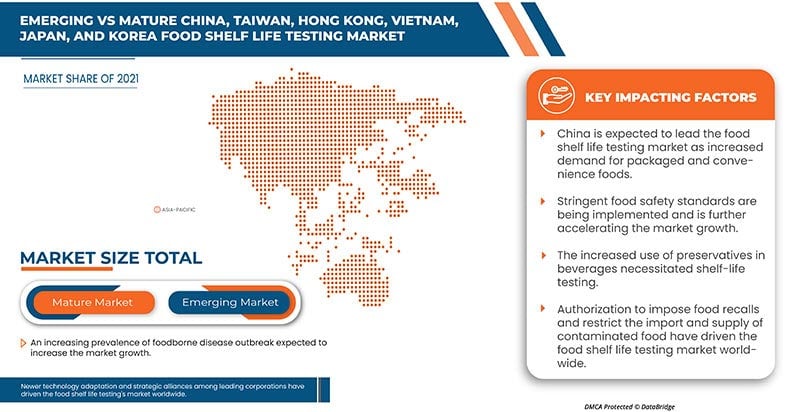
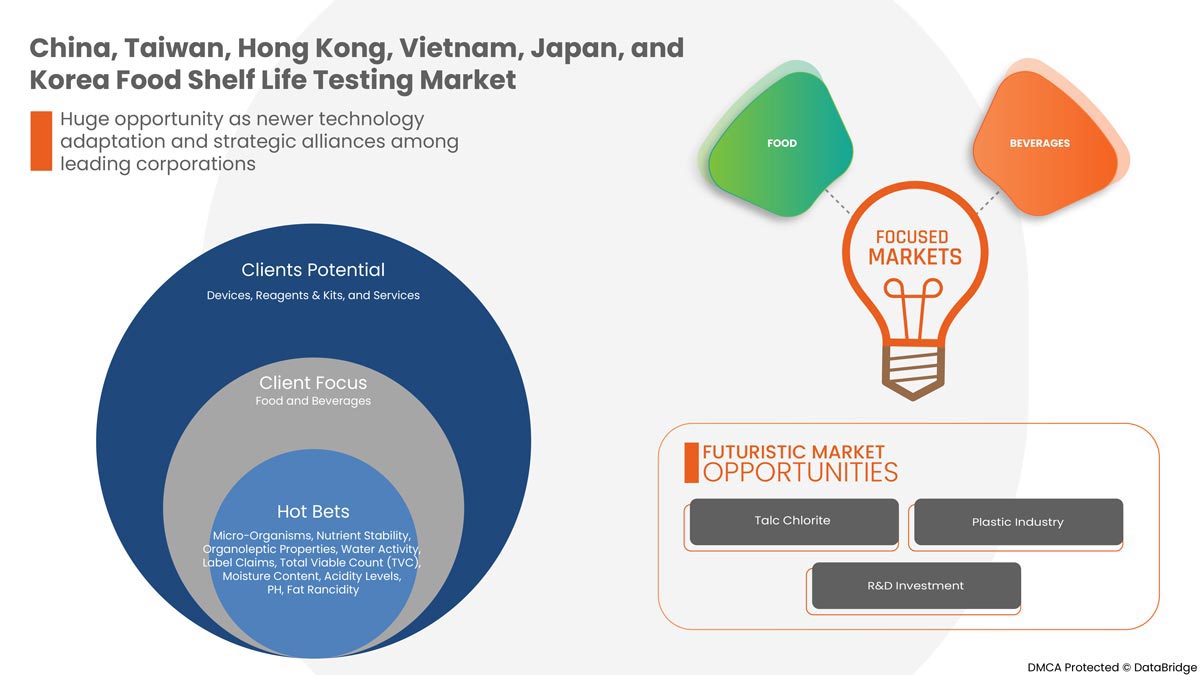
Data Bridge Market Research analyses that the China, Taiwan, Hong Kong, Vietnam, Japan, and Korea food shelf life testing market is expected to reach the value of USD 1,036.12 million by the year 2029, and will grow at a CAGR of 4.2% during the forecast period of 2022 to 2029.
|
Report Metric |
Details |
|
Forecast Period |
2022 to 2029 |
|
Base Year |
2021 |
|
Historic Years |
2020 (Customizable to 2019 - 2015) |
|
Quantitative Units |
Revenue in USD Million, Pricing in USD |
|
Segments Covered |
By Type (Devices, Reagents & Kits, and Services), Parameter (Micro-organism, Nutrient Stability, Organoleptic Properties, Water Activity, Label Claims, Total Viable Count (TVC), Moisture Content, Acidity Levels, PH, Fat Rancidity, and Others), Method (Real-Time Shelf Life Testing, and Accelerated Shelf Life Testing), Testing Technology (Equipment- & Kit-Based, and Manual Test), Condition (Frozen (-15°C to -20°C), Refrigerated (2°C to 8°C), Ambient (25°C/60%RH), Intermediate (30°C/65%RH), Accelerated (40°C/75%RH), Tropical (30°C/75%RH), and Others), Food Tested (Food, and Beverages) |
|
Regions Covered |
China, Taiwan, Hong Kong, Vietnam, Japan, and Korea. |
|
Market Players Covered |
Intertek Group plc, Mérieux NutriSciences Corporation, TÜV SÜD, SGS Société Générale de Surveillance SA, Xian LIB Environmental Simulation Industry, ANRESCO., and DKSH Holding Ltd. |
Market Definition
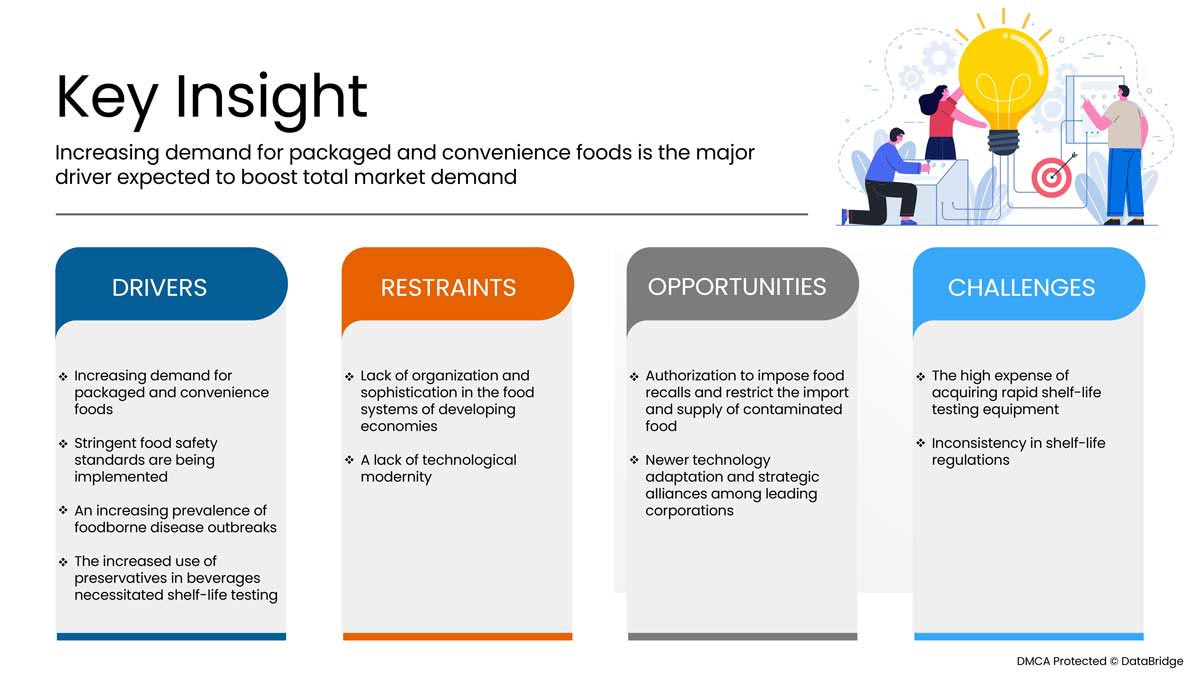
Increased demand for packaged and convenience foods is an important driver for the China, Taiwan, Hong Kong, Vietnam, Japan, and Korea food shelf life testing market. Stringent food safety standards are being implemented and are accelerating market growth. An increasing prevalence of foodborne disease outbreaks accelerates the growth of the market. The increased use of preservatives in beverages necessitated shelf-life testing to drive the growth of the market. The major restraints that may negatively impact the China, Taiwan, Hong Kong, Vietnam, Japan, and Korea food shelf life testing market are a lack of organization and sophistication in the food systems of developing economies and a lack of technological modernity. Authorization to impose food recalls and restrict the import and supply of contaminated food and newer technology adaptation and strategic alliances among leading corporations are expected to provide the China, Taiwan, Hong Kong, Vietnam, Japan, and Korea food shelf life testing market opportunity. However, the high expense of acquiring rapid shelf-life testing equipment and inconsistency in shelf-life regulations is projected to challenge the China, Taiwan, Hong Kong, Vietnam, Japan, and Korea food shelf life testing market.
China, Taiwan, Hong Kong, Vietnam, Japan, and Korea Food Shelf Life Testing Market Dynamics
This section deals with understanding the market drivers, opportunities, restraints, and challenges. All of this is discussed in detail as below:
Drivers
-
Increasing demand for packaged and convenience foods
Increased consumption and demand for processed, ready-to-eat packaged food and convenience food items are predicted to contribute to the growth of the food shelf-life testing market. Furthermore, when disposable earnings rise, working professionals and students are more inclined to spend more money on packaged and convenience foods. Thus, packaged food products must be of excellent quality, high in nutritional content, free of contamination, and must not cause foodborne disease to customers based on their shelf-life term. Shelf-life testing is very critical in this case. A shelf life assessment evaluates the quality and hygiene of a food product through a chemical, physical, and microbiological study. It provides food makers and producers with confidence in their product's shelf life. Keep their brand and their customers protected.
For instance,
- The food shelf life testing service provided by TÜV SD Vietnam includes detailed reviews of foodborne micro-organisms, the total number of living micro-organisms, challenge test, water activity test, acid content, food pH, oh sour, structure change, damage caused by micro-organisms, chemical browning, and enzyme browning. This helps firms reduce the threat of product recalls while also strengthening their brand's image.
-
Stringent food safety standards are being implemented
The increased complexity and number of supply chain partners have made it challenging for businesses to follow hygienic and sanitized manufacturing processes uniformly. As a result of these circumstances, the frequency of food contamination incidents has increased, pushing governments in Asia-Pacific nations such as China, Taiwan, Hong Kong, Vietnam, Japan, and Korea to enact and further strengthen severe food safety legislation. Diverse regulatory organizations such as the Vietnam Food Administration (VFA), China Food and Drug Administration (CFDA), Food Sanitation Act (FSA), Taiwan Food and Drug Administration (TFDA), and South Korea’s Ministry of Food and Drug Safety (MFDS), this has spurred the expansion of the food shelf life testing market.
For instance,
-
In June 2022, according to Food Safety magazine, The China National Strategy for Food Safety (CNSFS) was proposed in 2016. The newly released timeline and roadmap build on it by establishing a strict, efficient, and socially regulated food safety governance system by 2027, fundamental modernization of food safety governance and food chain oversight by 2035, and full modernization of food safety governance throughout China by 2050.
Opportunities
Authorization to impose food recalls and restrict the import and supply of contaminated food
A food recall is the removal of goods from sale, distribution, and consumption that may represent a safety concern to people. A food recall may be initiated in response to a report or complaint received from a variety of sources, including producers, distributors, retailers, government agencies, and consumers. It might also happen as a result of internal testing and/or auditing at a food company. Food companies perform recalls to ensure that potentially harmful or unhealthy items are not ingested. Food recalls can be authorized after consultation between state and territorial government officials and a sponsor, who is generally the product's provider, such as the manufacturer or importer.
- Newer technology adaptation and strategic alliances among leading corporations
The emphasis on minimizing lead time, sample usage, testing costs, and disadvantages associated with various technologies has led to technical advances and the creation of new technologies such as spectrometry, imaging, chemical analysis, and temperature monitoring. Increased use of these technologies, aided by government funding, provides a chance for medium- and small-scale laboratories to increase their service offerings and compete with significant market players in the sector.
Restraints/Challenges
- Lack of organization and sophistication in the food systems of developing economies
The food business in developing nations is still extremely fragmented, dominated by small and disorganized firms that may not have implemented basic food testing and shelf-life testing processes, increasing the risk of contamination. Food and beverage product testing, including packaged foods, dairy products, beverages, and meat products, among other samples, need appropriate enforcement mechanisms, coordination among market parties, and supporting infrastructure. However, many nations designated as emerging economies, such as China, Vietnam, Taiwan, and others, lack these criteria, posing a challenge to the shelf-life testing business.
- A lack of technological modernity
Businesses today recognize that technology is an enabler and utilize it to compete in the marketplace, but as businesses expand and adapt, so must their use of technology. Food shelf life testing systems and the software that they employ lag behind changing business realities. Furthermore, because technology is a rapidly aging commodity, organizations frequently feel the need for technology modernization. Technology modernization decisions require significant money and resource expenditures and have an impact on how employees operate in the firm. This means that any technology modernization decisions for corporations will be difficult. Organizations must use dependable technology to meet today's and tomorrow's business demands in order to remain relevant and competitive.
- The high expense of acquiring rapid shelf-life testing equipment
The purpose of shelf life testing is to offer an objective measure of the quality criteria that characterize the product and the point at which failure occurs. This failure occurs when the meal exhibits physical, chemical, microbiological, or sensory properties that the customer finds unsatisfactory. Food shelf-life testing may be a complex, intimidating, and costly process. High-end methods, such as chromatography and spectrometry, need expensive instruments and consumables for successful shelf-life assessment of food samples. If the technology is outdated and requires constant maintenance, this adds to the expense.
- Inconsistency in shelf-life regulations
The rising number of national standards for food shelf-life management has created uncertainty, and there is a need for these shelf-life standards to be harmonized. Leading food companies have increasingly realized the costs and inefficiencies associated with the establishment of numerous shelf-life standards.
Food fraud can take numerous forms. However, it is usually classified into two types. Either the meal itself is tainted, or the information accompanying it is incorrect. The last form is expiry date fraud. The aim for expiry date fraud is most typically to extend the period that food may be sold rather than discarded. The reason is economic, like with any food fraud. There is a financial incentive to retain and sell food over its expiration date in expiry date fraud. Expiry date fraud happens at all levels of the business and affects food in both large-scale, well-organized operations and smaller companies. Because of inconsistency and laziness in completing food shelf-life tests, frozen packaged food, notably seafood and meat, is typically affected, but other foods may also be affected. Thus, shelf-life testing regulations must be strictly followed, and the consistency of the regulations aids in the abolition of food fraud.
Recent Developments
- In July 2021, the Group acquired JLA Brasil Laboratório de Análises de Alimentos S.A. ('JLA'), a market-leading independent provider of Food, Agriculture, and Environmental testing solutions based in Brazil. The acquisition of JLA presents a compelling opportunity to enter the fast-growing and highly attractive food testing sector in Brazil, which is one of the largest markets globally in terms of agri-food and beverage production value. This acquisition helps the company to focus on more productivity and increase its market share.
- In July 2022, DKSH Business Unit Consumer Goods, a leading partner for FMCG companies seeking to grow their business in Asia and beyond, announced its expanded partnership in Malaysia with Oatly Asia, a Sweden-based food and beverage company that markets the world’s original and largest oat drink company Oatly. This will provide market expansion services.
China, Taiwan, Hong Kong, Vietnam, Japan, and Korea Food Shelf Life Testing Market Scope
China, Taiwan, Hong Kong, Vietnam, Japan, and Korea food shelf life testing market is segmented based on type, parameter, method, testing technology, condition, and food tested. The growth amongst these segments will help you analyze major growth segments in the industries and provide the users with a valuable market overview and market insights to make strategic decisions to identify core market applications.
Type
- Devices
- Reagents & Kits
- Services
On the basis of type, China, Taiwan, Hong Kong, Vietnam, Japan, and Korea food shelf life testing market is segmented into devices, reagents & kits, and services.
Parameter
- Micro-organisms
- Nutrient stability
- Organoleptic Properties
- Water Activity
- Label Claims
- Total Viable Count (TVC)
- Moisture Content
- Acidity Levels
- PH
- Fat Rancidity
- Others
On the basis of parameters, China, Taiwan, Hong Kong, Vietnam, Japan, and Korea food shelf life testing market is segmented into micro-organisms, nutrient stability, organoleptic properties, water activity, label claims, total viable count (TVC), moisture content, acidity levels, PH, fat rancidity, and others.
Method
- Real-time shelf life testing
- Accelerated shelf life testing
On the basis of the method, China, Taiwan, Hong Kong, Vietnam, Japan, and Korea food shelf life testing market is segmented into real-time shelf life testing and accelerated shelf life testing.
Testing Technology
- Equipment & kit-based
- Manual test
On the basis of testing technology, China, Taiwan, Hong Kong, Vietnam, Japan, and Korea food shelf life testing market is segmented into equipment & kit-based, and manual tests.
Condition
- Frozen (-15°C to -20°C)
- Refrigerated (2°C to 8°C)
- Ambient (25°C/60%RH)
- Intermediate (30°C/65%RH)
- Accelerated (40°C/75%RH)
- Tropical (30°C/75%RH)
- Others
On the basis of condition, China, Taiwan, Hong Kong, Vietnam, Japan, and Korea food shelf life testing market is segmented into Frozen (-15°C to -20°C), Refrigerated (2°C to 8°C), Ambient (25°C/60%RH), Intermediate (30°C/65%RH), Accelerated (40°C/75%RH), Tropical (30°C/75%RH), and Others.
Food Tested
- Food
- Beverages
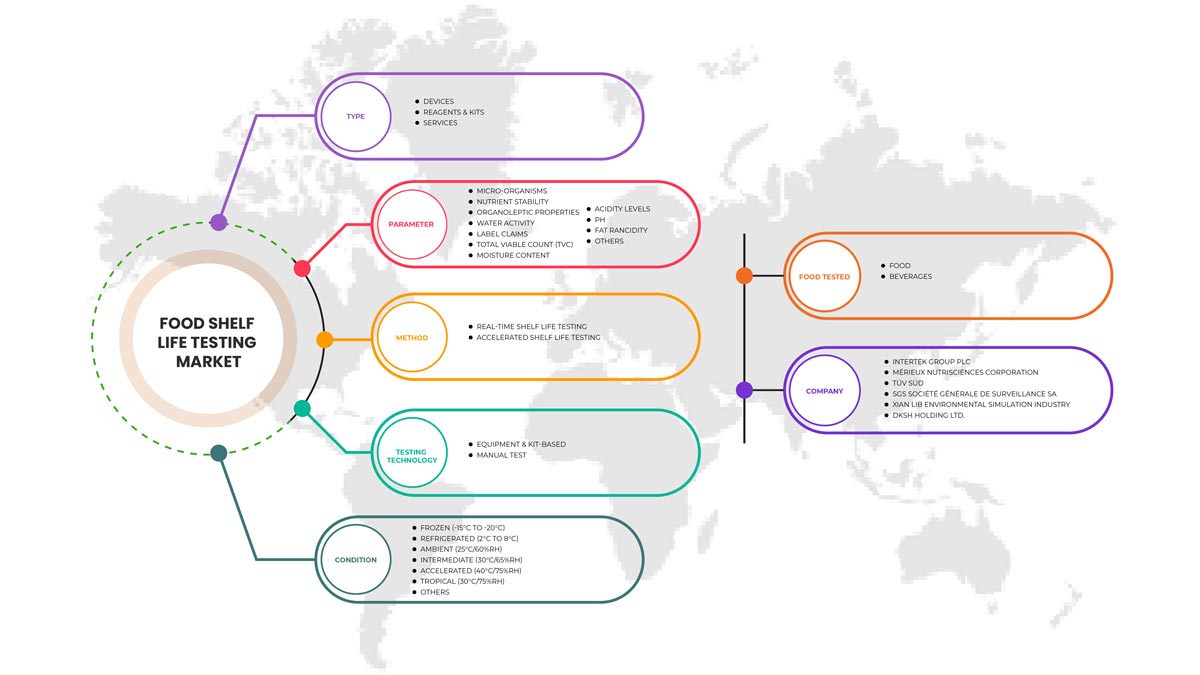
On the basis of food tested, China, Taiwan, Hong Kong, Vietnam, Japan, and Korea food shelf life testing market is segmented into food and beverages.
China, Taiwan, Hong Kong, Vietnam, Japan, and Korea Food Shelf Life Testing Market Regional Analysis/Insights
China, Taiwan, Hong Kong, Vietnam, Japan, and Korea food shelf life testing market are analyzed, and market size insights and trends are provided by country, type, parameter, method, testing technology, condition, and food tested, as referenced above.
The countries covered in the China, Taiwan, Hong Kong, Vietnam, Japan, and Korea food shelf life testing report are China, Taiwan, Hong Kong, Vietnam, Japan, and Korea.
China is expected to dominate the China, Taiwan, Hong Kong, Vietnam, Japan, and Korea food shelf life testing market in terms of market share and revenue. It is estimated to maintain its dominance during the forecast period due to strong market players and high demand for packaged and convenience food regions.
The region section of the report also provides individual market-impacting factors and changes in regulations in the market that impact the current and future trends of the market. Data points, such as new and replacement sales, country demographics, disease epidemiology, and import-export tariffs, are some of the major pointers used to forecast the market scenario for individual countries. In addition, the presence and availability of China, Taiwan, Hong Kong, Vietnam, Japan, and Korea brands and their challenges faced due to high competition from local and domestic brands and the impact of sales channels are considered while providing forecast analysis of the country data.
Competitive Landscape and China, Taiwan, Hong Kong, Vietnam, Japan, and Korea Food Shelf Life Testing Market Share Analysis
Competitive China, Taiwan, Hong Kong, Vietnam, Japan, and Korea food shelf life testing market provides details about the competitors. Details include company overview, company financials, revenue generated, market potential, investment in research and development, new market initiatives, Asia-Pacific presence, production sites and facilities, production capacities, company strengths and weaknesses, product launch, product width and breadth, and application dominance. The above data points are only related to the companies focus on the China, Taiwan, Hong Kong, Vietnam, Japan, and Korea food shelf life testing market.
Some of the major players operating in the China, Taiwan, Hong Kong, Vietnam, Japan, and Korea food shelf life testing market are Intertek Group plc, Mérieux NutriSciences Corporation, TÜV SÜD, SGS Société Générale de Surveillance SA, Xian LIB Environmental Simulation Industry, ANRESCO and DKSH Holding Ltd.
Research Methodology
Data collection and base year analysis are done using data collection modules with large sample sizes. The market data is analyzed and estimated using market statistical and coherent models. In addition, market share analysis and key trend analysis are the major success factors in the market report. The key research methodology used by the DBMR research team is data triangulation which involves data mining, analysis of the impact of data variables on the market, and primary (industry expert) validation. Apart from this, data models include vendor positioning grids, market timeline analysis, market overview and guide, company positioning grid, company market share analysis, standards of measurement, and vendor share analysis. Please request an analyst call in case of further inquiry.
SKU-
세계 최초의 시장 정보 클라우드 보고서에 온라인으로 접속하세요

- 대화형 데이터 분석 대시보드
- 높은 성장 잠재력 기회를 위한 회사 분석 대시보드
- 사용자 정의 및 질의를 위한 리서치 분석가 액세스
- 대화형 대시보드를 통한 경쟁자 분석
- 최신 뉴스, 업데이트 및 추세 분석
- 포괄적인 경쟁자 추적을 위한 벤치마크 분석의 힘 활용
목차
1 서론
1.1 연구 목적
1.2 시장 정의
1.3 중국, 대만, 홍콩, 베트남, 일본, 한국 식품 유통기한 시험 시장 개요
1.4 제한 사항
1.5 대상 시장
2 시장 세분화
2.1 대상 시장
2.2 지리적 범위
연구에 2.3년이 고려됨
2.4 통화 및 가격
2.5 DBMR TRIPOD 데이터 검증 모델
2.6 다변량 모델링
2.7 유형 라이프라인 곡선
2.8 주요 여론 선도자와의 1차 인터뷰
2.9 DBMR 시장 위치 그리드
2.1 시장 적용 범위 그리드
2.11 DBMR 시장 도전 매트릭스
2.12 공급업체 점유율 분석
2.13 2차 소스
2.14 가정
3 요약
4가지 프리미엄 인사이트
4.1 포터의 5가지 힘:
4.2 중국, 대만, 홍콩, 베트남, 일본, 한국 식품 유통기한 시험 시장의 주요 시장 참여자들이 채택한 성장 전략
4.3 공급망 분석
4.3.1 원자재 조달
4.3.2 제조
4.3.3 마케팅 및 유통
4.3.4 최종 사용자
4.4 가치 사슬 분석
4.5 최종 사용자의 구매 결정에 영향을 미치는 요인
4.6 경기 침체가 시장에 미치는 영향
4.7 수입 및 수출 분석
4.8 산업 동향 및 미래 전망
4.9 기술 혁신 개요
4.1 원자재 및 사선 공급자 적용 범위
4.11 규제 프레임워크 및 지침
5 시장 개요
5.1 드라이버
5.1.1 포장식품 및 편의식품에 대한 수요 증가
5.1.2 엄격한 식품 안전 기준이 구현되고 있습니다.
5.1.3 식품 매개 질병 발병의 증가 추세
5.1.4 음료에서 방부제 사용 증가로 인해 유통기한 테스트가 필요해졌습니다.
5.2 제약
5.2.1 개발도상국 식품 시스템의 조직 및 정교함 부족
5.2.2 기술적 현대성의 부족
5.3 기회
5.3.1 식품 리콜을 부과하고 오염된 식품의 수입 및 공급을 제한하는 권한
5.3.2 선도 기업 간의 최신 기술 적응 및 전략적 제휴
5.4 과제
5.4.1 신속한 유통기한 테스트 장비를 구입하는 데 드는 높은 비용
5.4.2 유통기한 규정의 불일치
6 중국, 대만, 홍콩, 베트남, 일본, 한국 식품 유통기한 테스트 시장(유형별)
6.1 개요
6.2 장치
6.3 시약 및 키트
6.4 서비스
7 중국, 대만, 홍콩, 베트남, 일본, 한국 식품 유통기한 테스트 시장(매개변수별)
7.1 개요
7.2 미생물
7.2.1 클로스트리디움 퍼프린젠스
7.2.2 효모
7.2.3 무산소성 판수
7.2.4 총 대장균군 및 대장균
7.2.5 중온성 및 열온성 포자 형성자
7.2.6 살모넬라균
7.2.7 유산균
7.2.8 알리시클로바실루스
7.2.9 황색포도상구균
7.2.10 리스테리아
7.2.11 엔테로박테리아과
7.2.12 캄필로박터
7.2.13 바실러스 세레우스
7.2.14 시겔라균
7.2.15 비브리오균
7.2.16 녹농균
7.2.17 기타
7.2.18 장비 및 키트 기반
7.2.19 수동 테스트
7.3 영양소 안정성
7.3.1 장비 및 키트 기반
7.3.2 수동 테스트
7.4 유기감각적 특성
7.4.1 장비 및 키트 기반
7.4.2 수동 테스트
7.5 수분 활동
7.5.1 장비 및 키트 기반
7.5.2 수동 테스트
7.6 라벨 주장
7.6.1 장비 및 키트 기반
7.6.2 수동 테스트
7.7 총 생존 가능 수(TVC)
7.7.1 장비 및 키트 기반
7.7.2 수동 테스트
7.8 수분 함량
7.8.1 장비 및 키트 기반
7.8.2 수동 테스트
7.9 산도 수준
7.9.1 장비 및 키트 기반
7.9.2 수동 테스트
7.1 pH
7.10.1 장비 및 키트 기반
7.10.2 수동 테스트
7.11 지방 산패
7.11.1 장비 및 키트 기반
7.11.2 수동 테스트
7.12 기타
7.12.1 장비 및 키트 기반
7.12.2 수동 테스트
8 중국, 대만, 홍콩, 베트남, 일본, 한국 식품 유통기한 테스트 시장(방법별)
8.1 개요
8.2 실시간 유통기한 테스트
8.3 가속 유통기한 테스트
9 중국, 대만, 홍콩, 베트남, 일본, 한국 식품 유통기한 테스트 시장, 테스트 기술별
9.1 개요
9.2 장비 및 키트 기반
9.2.1 문화 기반
9.2.2 크로마토그래피 및 분광법
9.2.3 효소연계면역흡착시험(ELISA)
9.2.4 중합효소 연쇄 반응(PCR)
9.3 수동 테스트
10 중국, 대만, 홍콩, 베트남, 일본, 한국 식품 유통기한 테스트 시장(조건별)
10.1 개요
10.2 냉동(-15°C ~ -20°C)
10.3 냉장 (2°C ~ 8°C)
10.4 주변 온도(25°C/60%RH)
10.5 중간(30°C/65%RH)
10.6 가속(40°C/75%RH)
10.7 열대(30°C/75%RH)
10.8 기타
11 중국, 대만, 홍콩, 베트남, 일본, 한국 식품 유통기한 테스트 시장(식품 테스트 기준)
11.1 개요
11.2 음식
11.2.1 유제품 및 유제품
11.2.1.1 아이스크림
11.2.1.2 요거트
11.2.1.3 치즈
11.2.1.4 밀크 디저트
11.2.1.5 푸딩
11.2.1.6 가공 치즈
11.2.1.7 커스터드
11.2.1.8 치즈 기반 디저트
11.2.1.8.1 치즈 케이크
11.2.1.8.2 치즈 푸딩
11.2.1.8.3 치즈 크림
11.2.1.8.4 기타
11.2.2 제빵 및 제과 제품
11.2.2.1 캔디바
11.2.2.2 사탕
11.2.2.3 잼과 젤리
11.2.2.4 빵
11.2.2.5 쿠키 및 크래커
11.2.2.6 비스킷
11.2.2.7 머핀 & 파이
11.2.2.8 기타
11.2.3 육류 및 육류 제품
11.2.3.1 쇠고기
11.2.3.2 돼지고기
11.2.3.3 해산물
11.2.3.4 램
11.2.3.5 기타
11.2.4 향신료
11.2.5 식용유
11.2.5.1 올리브 오일
11.2.5.2 코코넛 오일
11.2.5.3 땅콩 기름
11.2.5.4 대두유
11.2.5.5 해바라기 기름
11.2.5.6 기타
11.2.6 포장식품
11.2.7 가공 과일 및 야채
11.2.7.1 통조림 과일 및 야채
11.2.7.2 과일 및 야채 퓨레
11.2.7.3 건조 과일 및 야채
11.2.7.4 피클
11.2.7.5 기타
11.2.8 영유아용 조제분유
11.2.8.1 첫 번째 영유아용 조제분유
11.2.8.2 역류 방지(체류 중단) 공식
11.2.8.3 컴포트 포뮬라
11.2.8.4 저자극성 포뮬라
11.2.8.5 후속 공식
11.2.8.6 기타
11.2.9 너트
11.2.9.1 아몬드
11.2.9.2 캐슈넛
11.2.9.3 호두
11.2.9.4 브라질너트
11.2.9.5 마카다미아 너트
11.2.9.6 기타
11.2.10 기타
11.2.11 장비 및 키트 기반
11.2.12 수동 테스트
11.2.13 미생물
11.2.14 영양소 안정성
11.2.15 유기감각적 특성
11.2.16 수분 활동
11.2.17 라벨 클레임
11.2.18 총 생존 가능 수(TVC)
11.2.19 수분 함량
11.2.20 산도 수준
11.2.21 필라델피아
11.2.22 지방 산패
11.2.23 기타
11.3 음료
11.3.1 알코올 중독자
11.3.1.1 위스키
11.3.1.2 브랜디
11.3.1.3 맥주
11.3.1.4 와인
11.3.1.5 보드카
11.3.1.6 진
11.3.1.7 테킬라
11.3.1.8 기타
11.3.2 비알코올
11.3.2.1 영양 음료
11.3.2.2 주스
11.3.2.3 스포츠 음료
11.3.2.4 탄산 음료
11.3.2.5 미네랄 워터
11.3.2.6 스무디
11.3.2.7 차
11.3.2.8 커피
11.3.2.9 계획 기반 우유
11.3.2.10 기타
11.3.3 장비 및 키트 기반
11.3.4 수동 테스트
11.3.5 미생물
11.3.6 영양소 안정성
11.3.7 유기감각적 특성
11.3.8 수분 활동
11.3.9 라벨 클레임
11.3.10 총 생존 가능 수(TVC)
11.3.11 수분 함량
11.3.12 산도 수준
11.3.13 전화
11.3.14 지방 산패
11.3.15 기타
12 중국, 대만, 홍콩, 베트남, 일본, 한국 식품 유통기한 테스트 시장, 국가별
12.1 중국
12.2 대만
12.3 홍콩
12.4 일본
12.5 한국
12.6 베트남
13 중국, 대만, 홍콩, 베트남, 일본, 한국 식품 유통기한 테스트 시장, 회사 환경
13.1 회사 점유율 분석: 중국, 대만, 홍콩, 베트남, 일본 및 한국
13.2 인증
13.3 인수
14 SWOT 분석
15개 회사 프로필
15.1 인터텍 그룹 PLC
15.1.1 회사 스냅샷
15.1.2 수익 분석
15.1.3 제품 포트폴리오
15.1.4 최근 개발
15.2 TÜV SÜD
15.2.1 회사 스냅샷
15.2.2 수익 분석
15.2.3 제품 포트폴리오
15.2.4 최근 개발
15.3 SGS SOCIÉTÉ GÉNÉRALE DE SURVEILLANCE SA
15.3.1 회사 스냅샷
15.3.2 수익 분석
15.3.3 제품 포트폴리오
15.3.4 최근 개발
15.4 DKSH 홀딩 유한회사
15.4.1 회사 스냅샷
15.4.2 수익 분석
15.4.3 제품 포트폴리오
15.4.4 최근 개발
15.5 MÉRIEUX NUTRISCIENCES CORPORATION
15.5.1 회사 스냅샷
15.5.2 제품 포트폴리오
15.5.3 최근 개발 사항
15.6 안레스코.
15.6.1 회사 스냅샷
15.6.2 제품 포트폴리오
15.6.3 최근 개발
15.7 XIAN LIB 환경 시뮬레이션 산업
15.7.1 회사 스냅샷
15.7.2 제품 포트폴리오
15.7.3 최근 개발
16 설문지
17 관련 보고서
표 목록
표 1 규제 프레임워크
표 2 중국, 대만, 홍콩, 베트남, 일본, 한국 식품 유통기한 테스트 시장, 유형별, 2020-2029년(백만 달러)
표 3 중국, 대만, 홍콩, 베트남, 일본, 한국 식품 유통기한 테스트 시장, 매개변수별, 2020-2029년(백만 달러)
표 4 중국, 대만, 홍콩, 베트남, 일본, 한국의 식품 유통기한 검사 시장의 미생물 유형별, 2020-2029년(백만 달러)
표 5 중국, 대만, 홍콩, 베트남, 일본, 한국의 식품 유통기한 테스트 시장에서의 미생물, 테스트 기술별, 2020-2029년(백만 달러)
표 6 중국, 대만, 홍콩, 베트남, 일본 및 한국의 식품 유통기한 시험 시장의 영양소 안정성, 시험 기술별, 2020-2029년(백만 달러)
표 7 중국, 대만, 홍콩, 베트남, 일본 및 한국의 식품 유통기한 시험 시장의 유기물 분해 특성, 시험 기술별, 2020-2029년(백만 달러)
표 8 중국, 대만, 홍콩, 베트남, 일본 및 한국의 식품 유통기한 테스트 시장에서의 수분 활성도, 테스트 기술별, 2020-2029년(백만 달러)
표 9 중국, 대만, 홍콩, 베트남, 일본, 한국의 식품 유통기한 테스트 시장에서의 라벨 클레임, 테스트 기술별, 2020-2029년(백만 달러)
표 10 중국, 대만, 홍콩, 베트남, 일본, 한국의 식품 유통기한 테스트 시장의 총 생존균 수(TVC), 테스트 기술별, 2020-2029년(백만 달러)
표 11 중국, 대만, 홍콩, 베트남, 일본, 한국 식품 유통기한 테스트 시장의 수분 함량, 테스트 기술별, 2020-2029년(백만 달러)
표 12 중국, 대만, 홍콩, 베트남, 일본, 한국의 식품 유통기한 테스트 시장의 산도 수준, 테스트 기술별, 2020-2029년(백만 달러)
표 13 중국, 대만, 홍콩, 베트남, 일본 및 한국의 식품 유통기한 테스트 시장 점유율(테스트 기술 기준), 2020-2029년(백만 달러)
표 14 중국, 대만, 홍콩, 베트남, 일본, 한국의 식품 유통기한 테스트 시장에서의 지방 산패율, 테스트 기술별, 2020-2029년(백만 달러)
표 15 중국, 대만, 홍콩, 베트남, 일본, 한국 등 식품 유통기한 테스트 시장, 테스트 기술별, 2020-2029년(백만 달러)
표 16 중국, 대만, 홍콩, 베트남, 일본, 한국 식품 유통기한 테스트 시장, 방법별, 2020-2029년(백만 달러)
표 17 중국, 대만, 홍콩, 베트남, 일본, 한국 식품 유통기한 테스트 시장, 테스트 기술별, 2020-2029년(백만 달러)
표 18 중국, 대만, 홍콩, 베트남, 일본, 한국 식품 유통기한 테스트 시장 장비 및 키트 기반, 유형별, 2020-2029년(백만 달러)
표 19 중국, 대만, 홍콩, 베트남, 일본, 한국 식품 유통기한 테스트 시장, 조건별, 2020-2029년 (백만 달러)
표 20 중국, 대만, 홍콩, 베트남, 일본, 한국의 식품 유통기한 테스트 시장(테스트된 식품 기준), 2020-2029년(백만 달러)
표 21 중국, 대만, 홍콩, 베트남, 일본, 한국 식품의 식품 유통기한 테스트 시장, 유형별, 2020-2029년(백만 달러)
표 22 중국, 대만, 홍콩, 베트남, 일본, 한국 유제품 및 유제품의 식품 유통기한 테스트 시장, 유형별, 2020-2029년(백만 달러)
표 23 중국, 대만, 홍콩, 베트남, 일본, 한국 치즈 기반 디저트의 식품 유통기한 테스트 시장, 유형별, 2020-2029년(백만 달러)
표 24 중국, 대만, 홍콩, 베트남, 일본, 한국의 제빵 및 과자 제품 유형별 식품 유통기한 테스트 시장, 2020-2029년(백만 달러)
표 25 중국, 대만, 홍콩, 베트남, 일본, 한국 육류 및 육류 제품 식품 유통기한 테스트 시장, 유형별, 2020-2029년(백만 달러)
표 26 중국, 대만, 홍콩, 베트남, 일본, 한국 식용유의 식품 유통기한 시험 시장, 유형별, 2020-2029년(백만 달러)
표 27 중국, 대만, 홍콩, 베트남, 일본, 한국의 식품 유통기한 테스트 시장에서의 가공 과일 및 채소, 유형별, 2020-2029년(백만 달러)
표 28 중국, 대만, 홍콩, 베트남, 일본, 한국 영유아용 조제분유 시장, 유형별, 2020-2029년(백만 달러)
표 29 중국, 대만, 홍콩, 베트남, 일본, 한국의 견과류 식품 유통기한 테스트 시장, 유형별, 2020-2029년(백만 달러)
표 30 중국, 대만, 홍콩, 베트남, 일본, 한국 식품 유통기한 테스트 시장, 테스트 기술별, 2020-2029년(백만 달러)
표 31 중국, 대만, 홍콩, 베트남, 일본, 한국 식품의 식품 유통기한 테스트 시장, 매개변수별, 2020-2029년(백만 달러)
표 32 중국, 대만, 홍콩, 베트남, 일본, 한국 음료의 식품 유통기한 테스트 시장 유형별, 2020-2029년(백만 달러)
표 33 중국, 대만, 홍콩, 베트남, 일본, 한국 음료 알코올성 식품 유통기한 테스트 시장, 유형별, 2020-2029년(백만 달러)
표 34 중국, 대만, 홍콩, 베트남, 일본, 한국 비알코올 식품 유통기한 테스트 시장, 유형별, 2020-2029년(백만 달러)
표 35 중국, 대만, 홍콩, 베트남, 일본, 한국 음료의 식품 유통기한 테스트 시장, 테스트 기술별, 2020-2029년(백만 달러)
표 36 중국, 대만, 홍콩, 베트남, 일본, 한국 음료의 식품 유통기한 테스트 시장, 매개변수별, 2020-2029년(백만 달러)
표 37 중국, 대만, 홍콩, 베트남, 일본, 한국 식품 유통기한 테스트 시장, 국가별, 2020-2029년(백만 달러)
표 38 중국 식품 유통기한 테스트 시장, 유형별, 2020-2029년(백만 달러)
표 39 중국 식품 유통기한 테스트 시장, 매개변수별, 2020-2029년(백만 달러)
표 40 중국 식품 유통기한 테스트 시장의 미생물, 유형별, 2020-2029 (백만 달러)
표 41 중국 식품 유통기한 테스트 시장의 미생물, 테스트 기술별, 2020-2029년(백만 달러)
표 42 중국 식품 유통기한 테스트 시장의 영양소 안정성, 테스트 기술별, 2020-2029년(백만 달러)
표 43 중국 식품 유통기한 테스트 시장의 유기감각적 특성, 테스트 기술별, 2020-2029년(백만 달러)
표 44 중국 식품 유통기한 테스트 시장의 수분 활동도, 테스트 기술별, 2020-2029년(백만 달러)
표 45 중국 식품 유통기한 테스트 시장의 라벨 클레임, 테스트 기술별, 2020-2029년(백만 달러)
표 46 중국 식품 유통기한 테스트 시장의 총 생존 가능 수(TVC), 테스트 기술별, 2020-2029년(백만 달러)
표 47 중국 식품 유통기한 테스트 시장의 수분 함량, 테스트 기술별, 2020-2029년(백만 달러)
표 48 중국 식품 유통기한 테스트 시장의 산도 수준, 테스트 기술별, 2020-2029년(백만 달러)
표 49 중국 식품 유통기한 테스트 시장 pH, 테스트 기술별, 2020-2029 (백만 달러)
표 50 중국 식품 유통기한 테스트 시장의 지방 산패율, 테스트 기술별, 2020-2029년(백만 달러)
표 51 중국 기타 식품 유통기한 테스트 시장, 테스트 기술별, 2020-2029년(백만 달러)
표 52 중국 식품 유통기한 테스트 시장, 방법별, 2020-2029년(백만 달러)
표 53 중국 식품 유통기한 테스트 시장, 테스트 기술별, 2020-2029년(백만 달러)
표 54 중국 식품 유통기한 테스트 장비 및 키트 기반 시장, 유형별, 2020-2029년(백만 달러)
표 55 중국 식품 유통기한 테스트 시장, 조건별, 2020-2029 (백만 달러)
표 56 중국 식품 유통기한 테스트 시장, 테스트 식품별, 2020-2029년(백만 달러)
표 57 중국 식품의 식품 유통기한 테스트 시장, 유형별, 2020-2029년(백만 달러)
표 58 중국 유제품 및 유제품 식품 유통기한 테스트 시장, 유형별, 2020-2029년(백만 달러)
표 59 중국 식품 유통기한 테스트 시장에서의 치즈 기반 디저트, 유형별, 2020-2029년(백만 달러)
표 60 중국 제빵 및 제과 제품 식품 유통기한 테스트 시장, 유형별, 2020-2029년(백만 달러)
표 61 중국 육류 및 육류 제품 식품 유통기한 테스트 시장, 유형별, 2020-2029년(백만 달러)
표 62 중국 식용유의 식품 유통기한 테스트 시장, 유형별, 2020-2029 (백만 달러)
표 63 중국 가공 과일 및 채소의 식품 유통기한 테스트 시장, 유형별, 2020-2029년(백만 달러)
표 64 중국 영유아용 조제분유 시장, 유형별, 2020-2029년(백만 달러)
표 65 식품 저장 수명 테스트 시장에서의 중국 견과류, 유형별, 2020-2029년(백만 달러)
표 66 중국 식품 유통기한 테스트 시장, 테스트 기술별, 2020-2029년(백만 달러)
표 67 중국 식품의 식품 유통기한 테스트 시장, 매개변수별, 2020-2029년(백만 달러)
표 68 중국 음료의 식품 유통기한 테스트 시장, 유형별, 2020-2029 (백만 달러)
표 69 중국 알코올성 식품 유통기한 테스트 시장, 유형별, 2020-2029 (백만 달러)
표 70 중국 비알코올 식품 유통기한 테스트 시장, 유형별, 2020-2029 (백만 달러)
표 71 중국 식품 유통기한 테스트 시장의 음료, 테스트 기술별, 2020-2029년(백만 달러)
표 72 중국 식품 유통기한 테스트 시장에서의 음료, 매개변수별, 2020-2029년(백만 달러)
표 73 대만 식품 유통기한 테스트 시장, 유형별, 2020-2029년(백만 달러)
표 74 대만 식품 유통기한 테스트 시장, 매개변수별, 2020-2029년(백만 달러)
표 75 대만의 식품 유통기한 테스트 시장에서의 미생물, 유형별, 2020-2029년(백만 달러)
표 76 2020-2029년 테스트 기술별 식품 유통기한 테스트 시장의 대만 미생물(백만 달러)
표 77 대만 식품 유통기한 테스트 시장의 영양소 안정성, 테스트 기술별, 2020-2029년(백만 달러)
표 78 2020-2029년 테스트 기술별 대만 식품 유통기한 테스트 시장의 유기감각적 특성(백만 달러)
표 79 2020-2029년 테스트 기술별 식품 유통기한 테스트 시장에서의 대만 수분 활동도(백만 달러)
표 80 테스트 기술별 식품 유통기한 테스트 시장에서의 대만 라벨 클레임, 2020-2029년(백만 달러)
표 81 2020-2029년 테스트 기술별 식품 유통기한 테스트 시장에서의 대만 총 생존 가능 수(TVC) (백만 달러)
표 82 대만 식품 유통기한 테스트 시장의 수분 함량, 테스트 기술별, 2020-2029년(백만 달러)
표 83 2020-2029년 테스트 기술별 식품 유통기한 테스트 시장의 대만 산도 수준(백만 달러)
표 84 2020-2029년 테스트 기술별 식품 유통기한 테스트 시장에서의 대만 PH(백만 달러)
표 85 대만의 식품 유통기한 테스트 시장에서의 지방 산패율, 테스트 기술별, 2020-2029년(백만 달러)
표 86 대만 기타 식품 유통기한 테스트 시장, 테스트 기술별, 2020-2029 (백만 달러)
표 87 대만 식품 유통기한 테스트 시장, 방법별, 2020-2029년(백만 달러)
표 88 대만 식품 유통기한 테스트 시장, 테스트 기술별, 2020-2029년(백만 달러)
표 89 대만의 식품 유통기한 테스트 시장 장비 및 키트 기반, 유형별, 2020-2029년(백만 달러)
표 90 대만 식품 유통기한 테스트 시장, 조건별, 2020-2029 (백만 달러)
표 91 대만 식품 유통기한 테스트 시장, 테스트 식품별, 2020-2029년(백만 달러)
표 92 대만 식품의 식품 유통기한 테스트 시장, 유형별, 2020-2029년(백만 달러)
표 93 대만 유제품 및 유제품 식품 유통기한 테스트 시장, 유형별, 2020-2029년(백만 달러)
표 94 대만 치즈 기반 디저트의 식품 유통기한 테스트 시장, 유형별, 2020-2029년(백만 달러)
표 95 대만 제빵 및 과자 제품 식품 유통기한 테스트 시장, 유형별, 2020-2029년(백만 달러)
표 96 대만 육류 및 육류 제품 식품 유통기한 테스트 시장, 유형별, 2020-2029년(백만 달러)
표 97 대만 식용유의 식품 유통기한 테스트 시장, 유형별, 2020-2029년(백만 달러)
표 98 대만 가공 과일 및 채소의 식품 유통기한 테스트 시장, 유형별, 2020-2029년(백만 달러)
표 99 대만 영유아용 조제분유의 식품 유통기한 시험 시장, 유형별, 2020-2029년(백만 달러)
표 100 대만산 견과류의 식품 유통기한 테스트 시장, 유형별, 2020-2029년(백만 달러)
표 101 2020-2029년 테스트 기술별 식품 유통기한 테스트 시장에서의 대만 식품(백만 달러)
표 102 2020-2029년 매개변수별 식품 유통기한 테스트 시장에서의 대만 식품(백만 달러)
표 103 2020-2029년 유형별 식품 유통기한 테스트 시장에서의 대만 음료(백만 달러)
표 104 대만 알코올성 식품 유통기한 테스트 시장, 유형별, 2020-2029 (백만 달러)
표 105 대만의 비알코올 식품 유통기한 테스트 시장, 유형별, 2020-2029년(백만 달러)
표 106 2020-2029년 테스트 기술별 식품 유통기한 테스트 시장에서의 대만 음료(백만 달러)
표 107 2020-2029년 매개변수별 식품 유통기한 테스트 시장에서의 대만 음료(백만 달러)
표 108 홍콩 식품 유통기한 테스트 시장, 유형별, 2020-2029년(백만 달러)
표 109 홍콩 식품 유통기한 테스트 시장, 매개변수별, 2020-2029년(백만 달러)
표 110 홍콩 식품 유통기한 테스트 시장의 미생물, 유형별, 2020-2029 (백만 달러)
표 111 홍콩 식품 유통기한 테스트 시장의 미생물, 테스트 기술별, 2020-2029년(백만 달러)
표 112 홍콩 식품 유통기한 테스트 시장의 영양소 안정성, 테스트 기술별, 2020-2029년(백만 달러)
표 113 홍콩 식품 유통기한 테스트 시장의 유기물 특성, 테스트 기술별, 2020-2029년(백만 달러)
표 114 홍콩 식품 유통기한 테스트 시장의 수분 활성도, 테스트 기술별, 2020-2029년(백만 달러)
표 115 홍콩 식품 유통기한 테스트 시장의 라벨 클레임, 테스트 기술별, 2020-2029년(백만 달러)
표 116 홍콩 식품 유통기한 테스트 시장의 총 생존 가능 수(TVC), 테스트 기술별, 2020-2029년(백만 달러)
표 117 홍콩 식품 유통기한 테스트 시장의 수분 함량, 테스트 기술별, 2020-2029년(백만 달러)
표 118 홍콩 식품 유통기한 테스트 시장의 산도 수준, 테스트 기술별, 2020-2029년(백만 달러)
표 119 홍콩 PH의 식품 유통기한 테스트 시장, 테스트 기술별, 2020-2029년(백만 달러)
표 120 홍콩 식품 유통기한 테스트 시장의 지방 산패율, 테스트 기술별, 2020-2029년(백만 달러)
표 121 홍콩 기타 식품 유통기한 테스트 시장, 테스트 기술별, 2020-2029 (백만 달러)
표 122 홍콩 식품 유통기한 테스트 시장, 방법별, 2020-2029년(백만 달러)
표 123 홍콩 식품 유통기한 테스트 시장, 테스트 기술별, 2020-2029년(백만 달러)
표 124 홍콩 식품 유통기한 테스트 시장 장비 및 키트 기반, 유형별, 2020-2029년(백만 달러)
표 125 홍콩 식품 유통기한 테스트 시장, 조건별, 2020-2029 (백만 달러)
표 126 홍콩의 식품 유통기한 테스트 시장, 2020-2029년 식품 테스트 대상(백만 달러)
표 127 홍콩 식품 유통기한 테스트 시장(유형별), 2020-2029(백만 달러)
표 128 홍콩 유제품 및 유제품 식품 유통기한 테스트 시장, 유형별, 2020-2029년(백만 달러)
표 129 홍콩 치즈 기반 디저트의 식품 유통기한 테스트 시장, 유형별, 2020-2029년(백만 달러)
표 130 홍콩 제빵 및 과자 제품 식품 유통기한 테스트 시장, 유형별, 2020-2029년(백만 달러)
표 131 홍콩 육류 및 육류 제품 식품 유통기한 테스트 시장, 유형별, 2020-2029년(백만 달러)
표 132 홍콩 식용유의 식품 유통기한 테스트 시장, 유형별, 2020-2029 (백만 달러)
표 133 홍콩 가공 과일 및 채소의 식품 유통기한 테스트 시장, 유형별, 2020-2029년(백만 달러)
표 134 홍콩 영유아용 조제분유 시장, 유형별, 2020-2029년(백만 달러)
표 135 홍콩 견과류 식품 유통기한 테스트 시장, 유형별, 2020-2029 (백만 달러)
표 136 홍콩 식품 유통기한 테스트 시장, 테스트 기술별, 2020-2029년(백만 달러)
표 137 홍콩 식품 유통기한 테스트 시장, 매개변수별, 2020-2029(백만 달러)
표 138 홍콩 음료의 식품 유통기한 테스트 시장, 유형별, 2020-2029 (백만 달러)
표 139 홍콩 알코올성 식품 유통기한 테스트 시장, 유형별, 2020-2029 (백만 달러)
표 140 홍콩 비알코올 식품 유통기한 테스트 시장, 유형별, 2020-2029 (백만 달러)
표 141 홍콩 음료 식품 유통기한 테스트 시장, 테스트 기술별, 2020-2029년(백만 달러)
표 142 홍콩 음료 식품 유통기한 테스트 시장, 매개변수별, 2020-2029(백만 달러)
표 143 일본 식품 유통기한 테스트 시장, 유형별, 2020-2029 (백만 달러)
표 144 일본 식품 유통기한 테스트 시장, 매개변수별, 2020-2029년(백만 달러)
표 145 2020-2029년 유형별 식품 유통기한 테스트 시장의 일본 미생물(백만 달러)
표 146 2020-2029년 테스트 기술별 식품 유통기한 테스트 시장의 일본 미생물(백만 달러)
표 147 2020-2029년 시험 기술별 식품 유통기한 시험 시장의 일본 영양소 안정성(백만 달러)
표 148 2020-2029년 테스트 기술별 식품 유통기한 테스트 시장의 일본 유기감각적 특성(백만 달러)
표 149 2020-2029년 테스트 기술별 식품 유통기한 테스트 시장의 일본 수분 활동도(백만 달러)
표 150 테스트 기술별 식품 유통기한 테스트 시장의 일본 라벨 클레임, 2020-2029년(백만 달러)
표 151 일본 총 생존 가능 수(TVC) 식품 유통기한 테스트 시장, 테스트 기술별, 2020-2029년(백만 달러)
표 152 테스트 기술별 식품 유통기한 테스트 시장의 일본 수분 함량, 2020-2029년(백만 달러)
표 153 2020-2029년 테스트 기술별 식품 유통기한 테스트 시장의 일본 산도 수준(백만 달러)
표 154 테스트 기술별 식품 유통기한 테스트 시장의 일본 pH, 2020-2029년(백만 달러)
표 155 2020-2029년 테스트 기술별 식품 유통기한 테스트 시장의 일본 지방 산패(백만 달러)
표 156 일본 기타 식품 유통기한 테스트 시장, 테스트 기술별, 2020-2029 (백만 달러)
표 157 일본 식품 유통기한 테스트 시장, 방법별, 2020-2029년(백만 달러)
표 158 일본 식품 유통기한 테스트 시장, 테스트 기술별, 2020-2029년(백만 달러)
표 159 일본 식품 유통기한 테스트 시장의 장비 및 키트 기반, 유형별, 2020-2029년(백만 달러)
표 160 일본 식품 유통기한 테스트 시장, 조건별, 2020-2029 (백만 달러)
표 161 일본 식품 유통기한 테스트 시장, 테스트 식품별, 2020-2029 (백만 달러)
표 162 2020-2029년 유형별 일본 식품 유통기한 테스트 시장(백만 달러)
표 163 일본 유제품 및 유제품, 식품 유통기한 테스트 시장, 유형별, 2020-2029(백만 달러)
표 164 2020-2029년 유형별 식품 유통기한 테스트 시장에서의 일본 치즈 기반 디저트(백만 달러)
표 165 2020-2029년 유형별 식품 유통기한 테스트 시장의 일본 제빵 및 제과 제품(백만 달러)
표 166 2020-2029년 유형별 일본 육류 및 육류 제품 식품 유통기한 테스트 시장(백만 달러)
표 167 2020-2029년 유형별 일본 식용유 식품 유통기한 테스트 시장(백만 달러)
표 168 2020-2029년 유형별 식품 유통기한 테스트 시장에서의 일본 가공 과일 및 채소(백만 달러)
표 169 2020-2029년 유형별 식품 유통기한 시험 시장에서의 일본 영유아용 조제분유(백만 달러)
표 170 2020-2029년 유형별 식품 유통기한 테스트 시장에서의 일본견과류(백만 달러)
표 171 2020-2029년 테스트 기술별 식품 유통기한 테스트 시장에서의 일본 식품(백만 달러)
표 172 2020-2029년 매개변수별 식품 유통기한 테스트 시장에서의 일본 식품(백만 달러)
표 173 2020-2029년 유형별 식품 유통기한 테스트 시장에서의 일본 음료(백만 달러)
표 174 일본 알코올성 식품 유통기한 테스트 시장, 유형별, 2020-2029(백만 달러)
표 175 일본 비알코올 식품 유통기한 테스트 시장, 유형별, 2020-2029 (백만 달러)
표 176 테스트 기술별 식품 유통기한 테스트 시장의 일본 음료, 2020-2029년(백만 달러)
표 177 식품 유통기한 테스트 시장에서의 일본 음료, 매개변수별, 2020-2029년(백만 달러)
표 178 한국 식품 유통기한 시험 시장, 유형별, 2020-2029 (백만 달러)
표 179 한국 식품 유통기한 시험 시장, 매개변수별, 2020-2029 (백만 달러)
표 180 한국 미생물 식품 유통기한 검사 시장 규모, 유형별, 2020-2029 (백만 달러)
표 181 2020-2029년 시험 기술별 식품 유통기한 시험 시장의 한국 미생물(백만 달러)
표 182 2020-2029년 시험 기술별 식품 유통기한 시험 시장의 한국 영양소 안정성(백만 달러)
표 183 2020-2029년 시험 기술별 식품 유통기한 시험 시장의 한국 유기감각적 특성(백만 달러)
표 184 한국 식품 유통기한 시험 시장의 수분 활성도, 시험 기술별, 2020-2029 (백만 달러)
표 185 시험 기술별 식품 유통기한 시험 시장의 한국 라벨 클레임, 2020-2029 (백만 달러)
표 186 2020-2029년 시험 기술별 식품 유통기한 시험 시장의 한국 총 생존균 수(TVC) (백만 달러)
표 187 한국 식품 유통기한 시험 시장의 수분 함량, 시험 기술별, 2020-2029 (백만 달러)
표 188 2020-2029년 시험 기술별 식품 유통기한 시험 시장의 한국 산도 수준(백만 달러)
표 189 시험 기술별 식품 유통기한 시험 시장에서의 한국 pH, 2020-2029 (백만 달러)
표 190 한국 식품 유통기한 검사 시장의 지방 산패율, 검사 기술별, 2020-2029년 (백만 달러)
표 191 한국 기타 식품 유통기한 검사 시장, 검사 기술별, 2020-2029 (백만 달러)
표 192 한국 식품 유통기한 시험 시장, 방법별, 2020-2029 (백만 달러)
표 193 한국 식품 유통기한 시험 시장, 시험 기술별, 2020-2029 (백만 달러)
표 194 한국 식품 유통기한 테스트 장비 및 키트 기반 시장, 유형별, 2020-2029 (백만 달러)
표 195 한국 식품 유통기한 시험 시장, 조건별, 2020-2029 (백만 달러)
표 196 한국 식품 유통기한 시험 시장, 시험 식품별, 2020-2029 (백만 달러)
표 197 한국 식품의 식품 유통기한 검사 시장, 유형별, 2020-2029 (백만 달러)
표 198 한국 유제품 및 유제품 식품 유통기한 시험 시장, 유형별, 2020-2029 (백만 달러)
표 199 식품 유통기한 시험 시장에서 한국 치즈 기반 디저트, 유형별, 2020-2029년 (백만 달러)
표 200 한국 제빵 및 제과 제품 식품 유통기한 시험 시장, 유형별, 2020-2029 (백만 달러)
표 201 2020-2029년 유형별 한국 육류 및 육류 제품 식품 유통기한 테스트 시장(백만 달러)
표 202 한국 식용유의 식품 유통기한 시험 시장, 유형별, 2020-2029 (백만 달러)
표 203 한국 가공 과일 및 채소의 식품 유통기한 검사 시장, 유형별, 2020-2029 (백만 달러)
표 204 한국 영유아용 조제분유 시장, 유형별, 2020-2029 (백만 달러)
표 205 2020-2029년 유형별 식품 유통기한 시험 시장에서의 한국산 견과류(백만 달러)
표 206 한국 식품의 식품 유통기한 시험 시장, 시험 기술별, 2020-2029 (백만 달러)
표 207 2020-2029년 매개변수별 식품 유통기한 시험 시장에서의 한국 식품(백만 달러)
표 208 2020-2029년 유형별 식품 유통기한 시험 시장에서의 한국 음료(백만 달러)
표 209 한국 알코올 식품 유통기한 시험 시장, 유형별, 2020-2029 (백만 달러)
표 210 한국 비알코올 식품 유통기한 시험 시장, 유형별, 2020-2029 (백만 달러)
표 211 2020-2029년 시험 기술별 식품 유통기한 시험 시장에서의 한국 음료(백만 달러)
표 212 2020-2029년 매개변수별 식품 유통기한 시험 시장에서의 한국 음료(백만 달러)
표 213 베트남 식품 유통기한 테스트 시장, 유형별, 2020-2029 (백만 달러)
표 214 베트남 식품 유통기한 테스트 시장, 매개변수별, 2020-2029년(백만 달러)
표 215 베트남 식품 유통기한 테스트 시장의 미생물, 유형별, 2020-2029 (백만 달러)
표 216 2020-2029년 테스트 기술별 식품 유통기한 테스트 시장의 베트남 미생물(백만 달러)
표 217 베트남 식품 유통기한 테스트 시장의 영양소 안정성, 테스트 기술별, 2020-2029년(백만 달러)
표 218 베트남 식품 유통기한 테스트 시장의 유기감각적 특성, 테스트 기술별, 2020-2029년 (백만 달러)
표 219 2020-2029년 테스트 기술별 식품 유통기한 테스트 시장에서의 베트남 수분 활동도(백만 달러)
표 220 베트남 식품 유통기한 테스트 시장의 라벨 표시 요구 사항, 테스트 기술별, 2020-2029년(백만 달러)
표 221 베트남 식품 유통기한 테스트 시장의 총 생존 가능 수(TVC), 테스트 기술별, 2020-2029년(백만 달러)
표 222 베트남 식품 유통기한 테스트 시장의 수분 함량, 테스트 기술별, 2020-2029년(백만 달러)
표 223 2020-2029년 테스트 기술별 식품 유통기한 테스트 시장의 베트남 산도 수준(백만 달러)
표 224 베트남 식품 유통기한 테스트 시장의 pH, 테스트 기술별, 2020-2029 (백만 달러)
표 225 베트남 식품 유통기한 테스트 시장의 지방 산패율, 테스트 기술별, 2020-2029년(백만 달러)
표 226 베트남 기타 식품 유통기한 테스트 시장, 테스트 기술별, 2020-2029 (백만 달러)
표 227 베트남 식품 유통기한 테스트 시장, 방법별, 2020-2029 (백만 달러)
표 228 베트남 식품 유통기한 테스트 시장, 테스트 기술별, 2020-2029년(백만 달러)
표 229 베트남 식품 유통기한 테스트 시장 장비 및 키트 기반, 유형별, 2020-2029년(백만 달러)
표 230 베트남 식품 유통기한 테스트 시장, 조건별, 2020-2029 (백만 달러)
표 231 베트남 식품 유통기한 테스트 시장, 테스트 식품별, 2020-2029 (백만 달러)
표 232 베트남 식품의 식품 유통기한 테스트 시장, 유형별, 2020-2029 (백만 달러)
표 233 베트남 유제품 및 유제품 식품 유통기한 테스트 시장, 유형별, 2020-2029년(백만 달러)
표 234 베트남 치즈 기반 디저트의 식품 유통기한 테스트 시장, 유형별, 2020-2029년(백만 달러)
표 235 베트남 제빵 및 과자 제품 식품 유통기한 테스트 시장, 유형별, 2020-2029년(백만 달러)
표 236 베트남 육류 및 육류 제품 식품 유통기한 테스트 시장, 유형별, 2020-2029년(백만 달러)
표 237 베트남 식용유의 식품 유통기한 테스트 시장, 유형별, 2020-2029 (백만 달러)
표 238 베트남 가공 과일 및 채소의 식품 유통기한 테스트 시장, 유형별, 2020-2029년(백만 달러)
표 239 베트남 영유아용 조제분유의 식품 유통기한 시험 시장, 유형별, 2020-2029년(백만 달러)
표 240 베트남 견과류의 식품 유통기한 테스트 시장, 유형별, 2020-2029 (백만 달러)
표 241 베트남 식품의 식품 유통기한 테스트 시장, 테스트 기술별, 2020-2029년(백만 달러)
표 242 베트남 식품의 식품 유통기한 테스트 시장, 매개변수별, 2020-2029년(백만 달러)
표 243 베트남 음료의 식품 유통기한 테스트 시장, 유형별, 2020-2029 (백만 달러)
표 244 베트남 알코올성 식품 유통기한 테스트 시장, 유형별, 2020-2029 (백만 달러)
표 245 베트남 비알코올 식품 유통기한 테스트 시장, 유형별, 2020-2029 (백만 달러)
표 246 2020-2029년 테스트 기술별 식품 유통기한 테스트 시장의 베트남 음료(백만 달러)
표 247 베트남 음료의 식품 유통기한 테스트 시장, 매개변수별, 2020-2029년(백만 달러)
그림 목록
그림 1 중국, 대만, 홍콩, 베트남, 일본, 한국 식품 유통기한 테스트 시장: 세분화
그림 2 중국, 대만, 홍콩, 베트남, 일본, 한국 식품 유통기한 테스트 시장: 데이터 삼각 측량
그림 3 중국, 대만, 홍콩, 베트남, 일본, 한국 식품 유통기한 테스트 시장: DROC 분석
그림 4 중국, 대만, 홍콩, 베트남, 일본, 한국 식품 유통기한 테스트 시장: 글로벌 대 지역 시장 분석
그림 5 중국, 대만, 홍콩, 베트남, 일본, 한국 식품 유통기한 테스트 시장: 회사 연구 분석
그림 6 중국, 대만, 홍콩, 베트남, 일본, 한국 식품 유통기한 테스트 시장: 유통채널 수명선 곡선
그림 7 중국, 대만, 홍콩, 베트남, 일본, 한국 식품 유통기한 테스트 시장: 인터뷰 인구 통계
그림 8 중국, 대만, 홍콩, 베트남, 일본, 한국 식품 유통기한 시험 시장: DBMR 시장 위치 그리드
그림 9 중국, 대만, 홍콩, 베트남, 일본 및 한국 식품 유통기한 시험 시장: 시장 적용 범위 그리드
그림 10 중국, 대만, 홍콩, 베트남, 일본, 한국 식품 유통기한 시험 시장: 시장 과제 매트릭스
그림 11 중국, 대만, 홍콩, 베트남, 일본, 한국 식품 유통기한 테스트 시장: 공급업체 점유율 분석
그림 12 중국, 대만, 홍콩, 베트남, 일본, 한국 식품 유통기한 테스트 시장: 세분화
그림 13 선도 기업 간의 최신 기술 도입 및 전략적 제휴가 2022년~2029년 예측 기간 동안 중국, 대만, 홍콩, 베트남, 일본, 한국의 식품 유통기한 테스트 시장을 주도할 것으로 예상됨
그림 14 서비스 부문은 2022년 및 2029년에 중국, 대만, 홍콩, 베트남, 일본 및 한국 식품 유통기한 테스트 시장에서 가장 큰 점유율을 차지할 것으로 예상됩니다.
그림 15 시장 참여자들이 채택한 마케팅 전략
그림 16 공급망 분석 - 중국, 대만, 홍콩, 베트남, 일본 및 한국 식품 유통기한 테스트 시장
그림 17 중국, 대만, 홍콩, 베트남, 일본, 한국 식품 유통기한 시험 시장의 가치 사슬
그림 18 중국, 대만, 홍콩, 베트남, 일본, 한국 식품 유통기한 테스트 시장의 동인, 제약, 기회 및 과제
그림 19 중국, 대만, 홍콩, 베트남, 일본, 한국 식품 유통기한 테스트 시장: 유형별, 2021년
그림 20 중국, 대만, 홍콩, 베트남, 일본, 한국 식품 유통기한 테스트 시장: 매개변수별, 2021년
그림 21 중국, 대만, 홍콩, 베트남, 일본, 한국 식품 유통기한 테스트 시장: 방법별, 2021년
그림 22 중국, 대만, 홍콩, 베트남, 일본, 한국 식품 유통기한 테스트 시장: 테스트 기술별, 2021년
그림 23 중국, 대만, 홍콩, 베트남, 일본, 한국 식품 유통기한 테스트 시장: 조건별, 2021년
그림 24 중국, 대만, 홍콩, 베트남, 일본, 한국 식품 유통기한 테스트 시장: 2021년 테스트 식품별
그림 25 중국, 대만, 홍콩, 베트남, 일본, 한국 식품 유통기한 테스트 시장: 스냅샷(2021)
그림 26 중국, 대만, 홍콩, 베트남, 일본, 한국 식품 유통기한 테스트 시장: 국가별(2021년)
그림 27 중국, 대만, 홍콩, 베트남, 일본, 한국 식품 유통기한 테스트 시장: 국가별(2022년 및 2029년)
그림 28 중국, 대만, 홍콩, 베트남, 일본, 한국 식품 유통기한 테스트 시장: 국가별(2021년 및 2029년)
그림 29 중국, 대만, 홍콩, 베트남, 일본, 한국 식품 유통기한 테스트 시장: 유형별(2022-2029) 전체
그림 30 중국, 대만, 홍콩, 베트남, 일본, 한국 식품 유통기한 테스트 시장: 회사 점유율 2021(%)

연구 방법론
데이터 수집 및 기준 연도 분석은 대규모 샘플 크기의 데이터 수집 모듈을 사용하여 수행됩니다. 이 단계에는 다양한 소스와 전략을 통해 시장 정보 또는 관련 데이터를 얻는 것이 포함됩니다. 여기에는 과거에 수집한 모든 데이터를 미리 검토하고 계획하는 것이 포함됩니다. 또한 다양한 정보 소스에서 발견되는 정보 불일치를 검토하는 것도 포함됩니다. 시장 데이터는 시장 통계 및 일관된 모델을 사용하여 분석하고 추정합니다. 또한 시장 점유율 분석 및 주요 추세 분석은 시장 보고서의 주요 성공 요인입니다. 자세한 내용은 분석가에게 전화를 요청하거나 문의 사항을 드롭하세요.
DBMR 연구팀에서 사용하는 주요 연구 방법론은 데이터 마이닝, 시장에 대한 데이터 변수의 영향 분석 및 주요(산업 전문가) 검증을 포함하는 데이터 삼각 측량입니다. 데이터 모델에는 공급업체 포지셔닝 그리드, 시장 타임라인 분석, 시장 개요 및 가이드, 회사 포지셔닝 그리드, 특허 분석, 가격 분석, 회사 시장 점유율 분석, 측정 기준, 글로벌 대 지역 및 공급업체 점유율 분석이 포함됩니다. 연구 방법론에 대해 자세히 알아보려면 문의를 통해 업계 전문가에게 문의하세요.
사용자 정의 가능
Data Bridge Market Research는 고급 형성 연구 분야의 선두 주자입니다. 저희는 기존 및 신규 고객에게 목표에 맞는 데이터와 분석을 제공하는 데 자부심을 느낍니다. 보고서는 추가 국가에 대한 시장 이해(국가 목록 요청), 임상 시험 결과 데이터, 문헌 검토, 재생 시장 및 제품 기반 분석을 포함하도록 사용자 정의할 수 있습니다. 기술 기반 분석에서 시장 포트폴리오 전략에 이르기까지 타겟 경쟁업체의 시장 분석을 분석할 수 있습니다. 귀하가 원하는 형식과 데이터 스타일로 필요한 만큼 많은 경쟁자를 추가할 수 있습니다. 저희 분석가 팀은 또한 원시 엑셀 파일 피벗 테이블(팩트북)로 데이터를 제공하거나 보고서에서 사용 가능한 데이터 세트에서 프레젠테이션을 만드는 데 도움을 줄 수 있습니다.











